LITTLE Carrie was a heathen child, about ten years old, with bright black eyes, dark skin, curly brown hair, and slight, neat form.
A little while after she began to go to school, the teacher noticed one day that she looked less happy than usual.
“My dear,” she said, “why do you look so sad?”
“Because I am thinking.”
“What are you thinking about?”
“O teacher! I do not know whether Jesus loves me or not.”
“Carrie, did Jesus ever invite little children to come to him?”
The little girl repeated the verse, “Suffer little children to come unto me,” which she had learned at school.
“Well, who is that for?”
In an instant Carrie clapped her hands with joy, and said, “It is not for you, teacher, is it? for you are not a child. No; it is for me! for me!”
From that hour Carrie knew that Jesus loved her, and she loved him back again with all her heart.
Now, if the heathen children learn that Jesus loves them, and believe his kind words as soon as they hear them, ought not we who hear so much about the dear Saviour, to believe and love him too? Every one of us ought to say, “It is for me! for me!” and throw ourselves into the arms of the loving Saviour.—The Morning Light.
CINNAMON TREES.
The cinnamon tree, whose bark yields the spice so named, grows in India, but specially flourishes in the island of Ceylon. Bishop Heber in his Journal writes: “In the afternoon we drove through the far-famed cinnamon gardens, which cover upwards of seventeen thousand acres of land on the coast, the largest of which are near Colombo. The plant thrives best in a poor, sandy soil, in a damp atmosphere; it grows wild in the woods to the size of a large apple-tree; but when cultivated is never allowed to grow more than ten or twelve feet in height, each plant standing separate. The leaf is something like that of the laurel in shape, but of a lighter color; when it first shoots out it is red, and changes gradually to green. It is now out of blossom; but I am told that the flower is white, and appears, when in full bloom, to cover the garden.
“After hearing so much of the ‘spicy gales’ from the island, I was much disappointed at not being able to discover any scent, at least from the plants, in passing through the gardens; there is a very fragrant smelling flower growing under them, which at first led us into the belief that we smelt the cinnamon, but we were soon undeceived. On pulling off a leaf or a twig, one perceives the spicy odor very strongly; but I was surprised to hear that the flower has little or none.
“The manager of the cinnamon gardens good-naturedly sent some of the cinnamon-peelers to us, that we might see the way in which the spice is prepared. They brought with them branches of about three feet in length, of which they scraped off the bark with knives, and then, with a peculiar-shaped instrument, stripped off the inner rind in long slips; these are tied up in bundles, and placed to dry in the sun, and the wood is sold for fuel.”
HOW BOYS’ MARBLES ARE MADE.
Almost all the “marbles” with which boys everywhere amuse themselves, in season and out of season, on sidewalks and in shady spots, are made at Oberstein, Germany. There are large agate quarries and mills in that neighborhood, and the refuse is turned to good account in providing the small stone balls for experts to “knuckle” with. The stone is broken into small cubes, by blows of a light hammer. These small blocks of stone are thrown by the shovelful into the hopper of a small mill, formed of a bedstone, having its surface grooved with concentric furrows; above this is the “runner,” which is of some hard wood, having a level face on its lower surface. The upper block is made to revolve rapidly, water being delivered upon the grooves of the bedstone where the marbles are being rounded. It takes about fifteen minutes to finish a half bushel of good marbles ready for the boys’ knuckles. One mill will turn out 160,000 marbles per week. The very hardest “crackers,” as the boys call them, are made by a slower process, somewhat similar, however, to the other.
THE YOUTH'S INSTRUCTOR
Is published weekly and monthly by the S.-D. A. PUBLISHING ASSOCIATION, BATTLE CREEK, MICH.
Terms always in advance.
Monthly Edition.—An eight-page illustrated monthly. 50 cents a year.
Weekly Edition.—A four-page weekly, especially adapted to the use of Sabbath-schools, containing each week Lessons for Children and Lessons for Youth.
Single copy, 75 cts. a year.
5 copies to one address, 60 cts. each.
10 copies and upwards to one address, 50 cts. each.
Address, Youth's Instructor, Battle Creek, Mich.
Or, Pacific Press, Oakland, Cal.
SPRING-TIME
“THE Spring has come,” chirped the dear little birds
As they opened their drowsy eyes,
And shook out the fans in their pretty tails,
And turned up their heads to the skies.
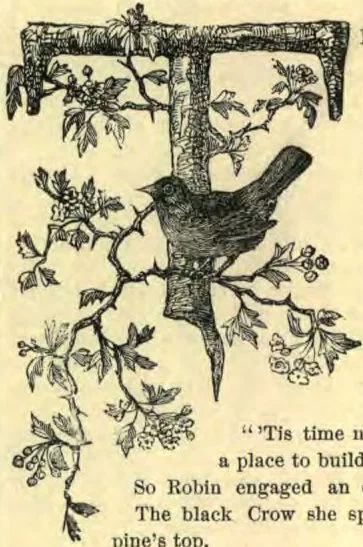
“’Tis time now to look for a place to build”—
So Robin engaged an elm-tree.
The black Crow she spoke for a tall pine’s top,
Where high in the world she might be.
The Sparrow took lease of an old ox-track
With grasses to thatch it all o’er.
“I like a low cottage,” she said to herself,—
“With a daisy to nod by the door.”
The Swallow she fancied the corner lot
Of the barn, ’neath the sloping eaves;
The Oriole sought for a graceful twig,
Where her cradle could rock with the breeze.
“The Spring has come,” said each little flower
As she stirred in her damp, brown bed;
First Snowdrop peeped in her neat white cap,
Then modestly hung down her head.
“Do I hear Sir Robin?” said Crocus white,
“Then I’m certainly late,” cried she;
And popped out her head from under the clothes,
And looked straight into the tree.
The May-Flower woke, and she drew from the moss
On which she had pillowed her head,
Her small waxen phials of odorous sweets
To perfume her soft, lowly bed.
“’Tis darksome down here,” moaned Violet blue;
But when she crept out to the sky,
She had to slip back just behind a green leaf,
’ T was so bright for her tender young eye.
“These rich, golden beams,” said Buttercup gay,
“I will take to my dairy brown,
And churn them and pat them in bright little balls,
The green of my young buds to crown.”
“Oh, there is a bee!” cried Miss Clover, so red,
“He’s buzzing because I’m not up;”
So she sprang into sight with her sweet honey jars,
And asked Mr. Bee in to sup.
A busy time is this fresh, bright Spring
For Birdie and Bee and for Flowers;
There’s work for each in its own little world,
And joy just the same as in ours.