The Youth’s Instructor, Vol. 35, No. 48.

SCATTER THE SUNBEAMS

The Youth’s Instructor

Nov 30, 1887

S. D. A. Publishing Association · Battle Creek, Mich. · Nov 30, 1887

SCATTER THE SUNBEAMS.

SCATTER the sunbeams, bright and gay, Over the way, over the way,— Over the way where billows roll, Over the way of the weary soul. Scatter them, pray, scatter them, pray, Over life's dreary, toilsome way.
Many are walking 'mid shadows drear; Many are walking in doubt and fear; Hopeless and heartsick, by night and by day. Weary ones, weary ones, pass on their way. Pity them, pity them, children of light; Scatter the sunbeams, beautiful, bright.
Sunbeams of love, for the weary and worn; Sunbeams of hope, for the sad ones who mourn; Sunbeams to banish the darkness of night; Bringing the dawn with its radiant light. Scatter them, pray, scatter them, pray, Over life's dreary, toilsome way.
Scatter the sunbeams, bright and gay, Over the way, over the way. Ye who know naught of sorrow and care, Ye who are happy, list to our prayer. Scatter the sunbeams, scatter them, pray, Over life's dreary, toilsome way.

THE INVENTOR OF THE SPINNING-FRAME.

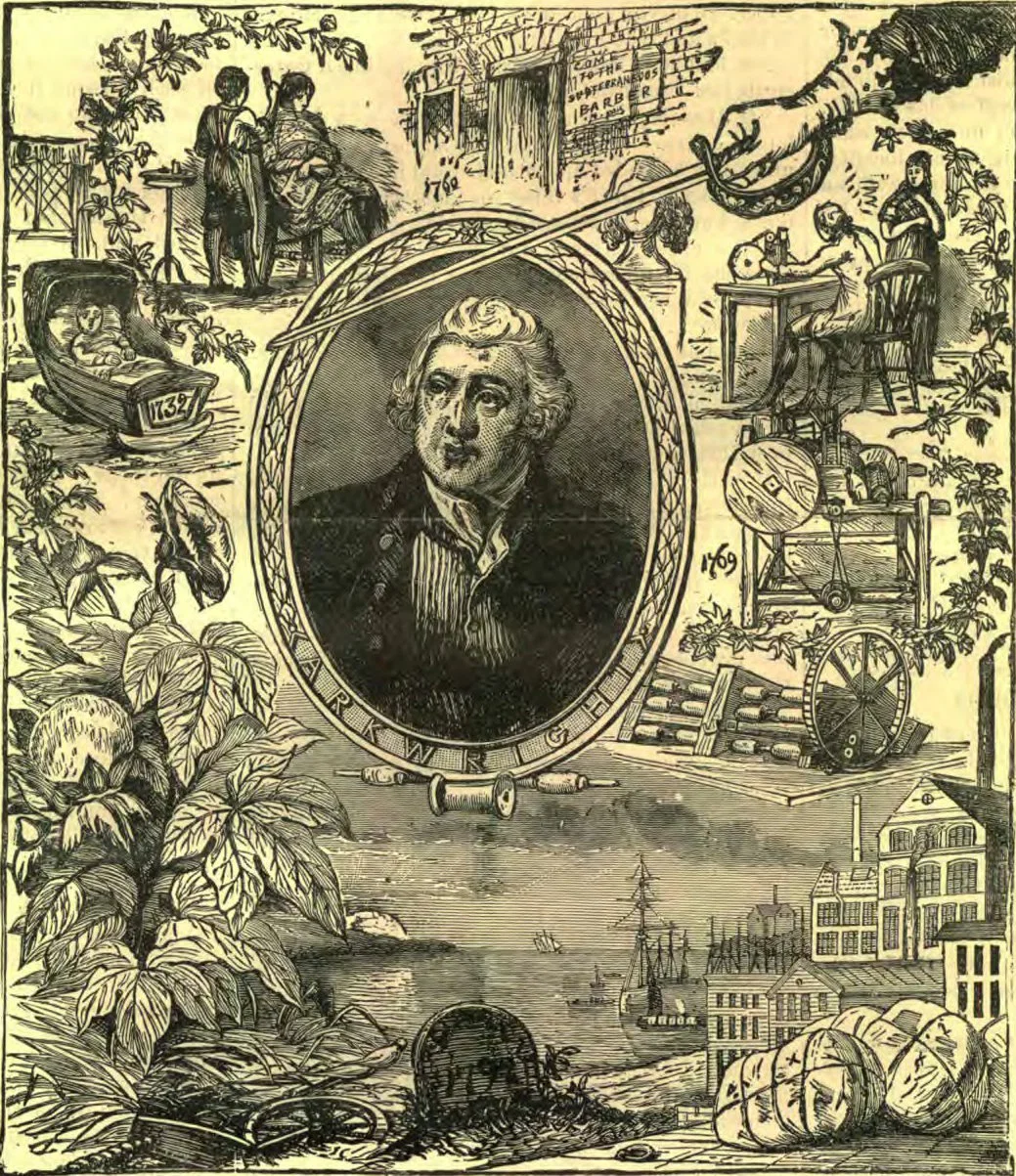
ONE of the most prosperous and busy towns in the great manufacturing region in northern England is Bolton. A hundred and thirty years ago it was a much smaller town than now, but it had then the reputation of being one of England's most thriving industrial centers. At that time Bolton was a queer, struggling place, with many old grimy houses, and many narrow lanes and alleys branching off from the streets. One of these alleys conducted the wayfarer to an ancient, cozy inn, the Old Millstone. If you had been walking in this alley about the year 1750, you would have seen a rude sign hanging over a cellar on one side, bearing these words: “Come to the under-ground Barber! He shaves for a penny!” Descending into the cellar, you would have seen the barber, a bright-eyed, active, keen-looking young man about twenty-one years of age, standing ready in his shirt-sleeves to shave the next customer. Nor would he have to wait long; for the cheap rates brought an almost continual succession of artisans from the neighboring machine-shops to his dark little cellar.
This lively barber, besides being very expert at his trade, was, like many another barber before him and since, a great talker. Everybody who came under the swift sweep of his razor had to pay his contribution of chatter. The barber asked his customers about their various trades, and he was always especially eager to learn what anybody would tell him about machinery. He loved to hear all about the new machines which now and then were introduced into the shops and factories—how they were made, how they worked, how much labor they saved, and what kind of goods they made.
The name of this barber was Richard Arkwright. His childhood and boyhood had not been very pleasant. His father was a very poor man, and had thirteen children. Of course, as there were then no free schools in England, he could not hope to give this large family a good education. The result was that Richard grew up without learning much of anything, and just as soon as he was strong enough to work, he was set about it. Yet Richard was a youth of a very persevering, determined spirit. He had a manly independence about him, and a cheerful courage, which enabled him to bear bravely whatever hardships came upon him, and to carry on sturdily his struggles with the world. While he was shaving for a penny, he was always dreaming of something better and more profitable. He knew that he had a good deal of mechanical ingenuity, and he resolved to put it to use as soon as he could. He spent the little leisure time he had in studying machinery, and in trying to invent something. By the time he was thirty, Richard made up his mind that he had had quite enough of the shaving business. He worked hard, yet he only made enough to keep body and soul together; he was laying up nothing for the future.
So throwing aside the razor, he took up the trade of a dealer in hair. He wandered about the country, buying the hair of rustic young girls, making it up into wigs, and selling them to the old people. Meanwhile he invented a new way of dying hair, which brought him in a brisk trade. He thrived so well in his new business that he laid up quite a little sum of money, and falling in love with a farmer's daughter, he married her.
One day he was in a manufacturing town, and heard some weavers talking about the threads used in weaving cloth. The cloth they made consisted of linen thread woven with cotton. But it was hard, they said, to get enough cotton thread to form what was called the “weft” of the cloth. A machine for spinning cotton thread had already been invented by a poor weaver named James Hargreaves, to whom his invention had been nothing but a misfortune, since he had been persecuted and driven from place to place, because the spinners thought that his “spinning-jenny” would deprive them of work. But the spinning-jenny did not produce enough thread for the demand, nor was its thread fine and close enough for the weft.
Richard Arkwright listened intently to all that the weavers were saying. He plied them with questions. He found one of Hargreaves's spinning-jennies, and examined closely its every part. From that time he had but one idea—to invent a machine which would spin thread faster and finer than the spinning-jenny. And now, like many inventors who absorb themselves in their one idea, Richard began to neglect his regular business. His young wife saw with anger that he was daily growing poorer and poorer, and that instead of saving money, he did not now earn enough to give them the common comforts of life. Instead of going up and down the country for his stock of maidens' tresses, he stayed at home, making models of machines, and brooding over them by the hour together. One day he would feel sure that the model he had just made would answer the purpose, and bring fame and fortune at last; the next, he would discover some fatal defect, would throw the model aside, and begin on a new one. They finally grew so poor that it was with difficulty they could procure enough to eat from day to day.
Richard's wife, who was a young woman of rather violent temper, was always upbraiding him for what she thought his idleness, and crying out to him that his attempts to invent a spinning-machine were all nonsense. At last her patience gave way entirely, and one day she seized the last model which he had carefully and laboriously made, and in a fit of rage threw it violently on to the floor. Richard could not stand this. He was infuriated to see his pretty model lying on the floor in twenty pieces, and told his wife to leave forever. She obeyed him, going away from their humble home never to return.
After several years of great poverty and suffering, during which he met and overcame many obstacles, Richard at last completed the machine which has made his name immortal in the annals of invention. The old days of want vanished forever after Arkwright had at last introduced his spinning-frame. This machine produced a cotton thread fit not only for the “weft,” but also for the “warp” of the cloth, so that the cloth could now be woven wholly of cotton.
In a few years the beautiful vale of the River Derwent, in the center of England, revealed to the eye several large mills busily at work with Arkwright's machines, and not far from them rose a stately country house, with parks and lawns, known as Willersley Castle. Both the mills and the castle belonged to Richard Arkwright, become rich and prosperous, and growing richer every day. He who had once been a humble barber in a dingy cellar, shaving workmen for a penny apiece, was now one of the chief men of his neighborhood, and one of the most famous in all England. He was made high sheriff of his county, which in England is a high honor; and once, when King George the Third paid a visit to his locality, Arkwright, as sheriff, presented the monarch with an address of welcome. For this slight deed, and not because he was the inventor of one of the most useful machines ever made, the king made Arkwright a knight, so that he rose from his knees with the title of Sir Richard Arkwright. Thus titled, rich, and renowned, the inventor lived to a good old age, happy in the respect of all men.—Harper's Young People.

THE HEROINE OF GEORGIA.

One of the most picturesque figures of Revolutionary days has never been admitted to the pages of history—Nancy Hart—known throughout the South as “the giantess” and the “Heroine of Georgia.”
She lived in the wilderness of Elbert County, and supported herself and her children by hunting and trapping. Nancy was over six feet in height, and with her mop of red hair and crossed eyes, she assuredly was not prepossessing. But one of her contemporaries writes: “Her voice was quiet and soft, and if she had the courage of a man, she had beneath it the warm heart of a woman.”
She espoused the Whig cause vehemently from the first outbreak of the Revolution. Six British soldiers, when pursuing deserters, came to her cabin and demanded food. She cooked them a good dinner, and while they were eating it, hid their guns, drove away their horses, and locking the doors, sent word to her neighbors: “I have trapped six base Tories; come and hold them for me.”
During the winter, in the disguise of a man, she frequently entered the British camp in Augusta, and carried to Colonel Clarke the information she gained there. On one occasion, when a freshet rendered the ford across the Savannah River impassable, she made a raft of logs, bound together by wild grape-vines, and crossed triumphantly under fire of the enemy to the camp of the Georgia troops.
Another day, meeting a puny little British soldier on the road, she took his gun from him, and marched him before her into the Georgian camp.
So great was the confidence of the colonists in her discretion and valor, that she was once left by Colonel Clarke in command of a fort filled with women and children.
A company of British skirmishers attacked it. But Nancy, herself in uniform, forced the scared women to put on their husbands’ clothes and to show themselves on the walls, while she kept up so vigorous a fire from the old cannon that the enemy fled and reported the fort to be fully manned and equipped.
After the war was over, Elbert County was invaded by two or three peaceable squatters. Nancy fled before them. She packed her goods on a pair of mules and emigrated into the wilderness of Kentucky, declaring that “so many neighbors left her no air to breathe.”
Among her descendants have been statesmen and soldiers. Much of their physical and mental vigor doubtless came from the old huntress, Nancy Hart.—Youth’s Companion.

BESSIE'S “CHRISTIAN ENDEAVOR.”

Bessie Marshall was never so unhappy. It was only a rainstorm when she wanted sunshine, but she allowed the disappointment to settle into her face in the shape of a formidable frown, which made both her brother and sister keep their distance.
“I want to hire you. Will you work for me to-day?”
It was Miss May’s voice coming down through the register, and Bessie sprang upstairs to her room with the lightness of a bird. Miss May was an invalid who had boarded for several summers at Dr. Marshall’s.
“Are you afraid of the rain, Bessie?”
“No, indeed! I’ve got a lovely gray water-proof, and some nice light rubbers.”
“Here is a bright little story for children in this paper. Will you take it over to poor, blind Maggie Griebel’s and read it to her?”
In a half-hour Bessie returned dripping like a water-sprite just risen from a pool.
“O Miss May! you ought to have seen Maggie laugh. Mrs. Griebel wiped the soapsuds from her arms with her faded apron, and stood in the door and laughed too. I don’t think she understood the story much, but she was pleased to see Maggie happy.”
“‘Dat chile not laugh dat way dis two year; not since she no longer couldn’t see mit her eyes. Me tink it do her pretty much goot,’ she said in her broken tongue.”
“Yes, but we’ll talk later. Now is the time to work. Here is a pile of magazines. Take the scissors and cut out all the pretty pictures, and carry them down to the mill-tenement, and find that poor little boy who broke his leg last week, and leave them for him.”
How the scissors clicked for a few minutes! Bessie’s tongue was not still either, but the roll was soon made up, and the little laborer was off on her errand. She began to be interested.
“Only one more rainy day expedition,” said Miss May, when she again returned, “and then you may stay indoors for awhile. Go out to the pansy bed and pick a whole basketful of blossoms, and we will make them up into bouquets for distribution.”
“Where are they to be carried?”
“That you must help me decide. It might be well to carry them to the most unhappy persons we can think of.”
An hour later several beautiful pansy bouquets were made up and labeled, and placed in the little girl’s basket.
“I’m afraid it will seem queer for me to offer flowers to people whom I don’t know,” said Bessie.
“Bessie,” said Miss May, with a sweet seriousness the child had never seen, “do you think Jesus ever refused to heal a sick person or restore to sight a blind man because he had not been introduced? We can’t afford, in a world of sin and suffering, to stand on ceremony. ‘It is enough for the disciple that he be as his Master.’ Go right on, and tell me if anybody seems offended.”
Mrs. Jenner had just finished dressing the wounded head of her intemperate son, and sat down with a heavy heart when Bessie knocked.
“Wouldn’t you like some of my pansies? I have so many, I don’t like to let them wither without anybody’s getting the sweet fragrance.”
“Blessed child! Indeed I would. I didn’t suppose anybody in heaven or earth ever thought of me in my misery now-a-days;” and Bessie saw the tears trickle down her cheeks as she turned away.
Bridget Maher’s brother had been killed by an accident, and she had made few friends since her arrival in the country. She worked next door to Dr. Marshall’s, and she did not fail to invoke a warm Irish blessing on the head of the giver, as she took the flowers, and returned to the hot kitchen and its weary tasks.
The courts had a month before sentenced to two years’ imprisonment a widow’s only son. Surely no more unhappy hearts were beating in all the village of Canterbury than these, and both boy and mother were included in Bessie’s list of beneficiaries.
The little girl felt her heart give a tremendous thump as she rang the bell under the great dark portal of the jail. She knew the warden, and was reassured when she saw his kindly face. She left her last bouquet for the widow’s erring son, and sped home, too happy from her own light-heartedness to notice that the sun had burst out through the clouds and promised a glorious afternoon.
“I’ll pay you your wages and let you off from your engagement this noon, if you like,” said Miss May; “your picnic need not be spoiled, after all.”
“Miss May,” said Bessie, seriously, “if it is the nicest picnic in the world, I sha’n’t enjoy it any more than this morning’s work. I’ve made so many people happy, or a little less miserable!” and a sunrise light of new enjoyment glowed from Bessie’s face.
It was Bessie’s first little lesson in Christian endeavor; but she has learned fast, and her spiritual life is unfolding day by day, and she finds no hour in her life so cloudy but she can find in it some means of “sending the day into the darkened heart.”—The Well-Spring.

FAME OR DUTY.

WHAT shall I do to be forever known? Thy duty ever. This did full many who yet slept unknown— Oh, never, never! Thinkest thou, perchance, that they remain unknown Whom thou know’st not? By angel-trumps in heaven their praise is blown— Divine their lot.
—Schiller.

HOW SHALL WE SPEND OUR TIME?

TIME—when shall we learn its true value? Only a few learn it in youth; some by a long and sad experience; and some, never. How true are the words of the Psalmist: “We spend our years as a tale that is told”! Life is to many like a dreamy sleep; and only when it is too late do they awake to find that its best opportunities have forever passed by.
Who can estimate the blessings of a well-spent, self-denying life,—the sorrows it has soothed, and the blessed sunshine of peace it has shed on humanity? Of such persons it may be said, that though dead, their works do not die; for their influence lives long after they themselves are gone. We cherish the memory of our loved ones who have helped to make life brighter for us.
But the lives of the selfish, the reckless, or the wicked, make no pleasant picture to look back upon. The spiteful acts, the unkind looks, the cutting words, leave wounds that may never heal. And there are others whose lives are nearly a blank. While they are careful to do no evil, they also do no good; they add nothing to the comfort or joy of others. Their lives are empty and wasted.
What lesson can we who are young learn from the lives of others? Our time will pass away as rapidly as did theirs. What use will we make of it in this our morning? Should we like to sit down at its eve to lament time ill-spent and wasted? Now is the time to settle this question. There are responsible places needing faithful service. Opportunities come to us never to return. Shall we improve them?
The only true happiness lies in doing others good. A selfish life is the most miserable one under the sun. Mr. Moody says, “I would rather die than live for self, or for the sake of living, if I could not be a blessing to others.” Let us remember life is short, that it comes to us but once, and that its greatest happiness lies in doing good. Let us not forget life’s highest aim, to so spend our time that we shall be fitted to enjoy a glorious eternity of days.
W. O. P.

HOW TO BE GRACEFUL.

A SCHOOL girl misses a great deal of valuable education who hurries away to school, morning and afternoon, without having used her muscles in helping her mother. She misses something else, which, in a few years, she will know how to value better than she does now—grace of movement and carriage.
What makes a girl graceful? It is using all her bodily powers. A student who is nothing but a student soon begins to stoop, and the habit, once begun, grows inveterate and incurable. Half our school-girls cannot walk with ease and grace.
A girl who would have a graceful carriage, a sound digestion, and a clear complexion, must work for them every day, and no work is better for the purpose than the ordinary work of a house, done with diligence and carefulness.

DON'T GOSSIP.

CHILDREN, avoid this evil. I am pained every day at seeing the work which mischief-makers do. Some one has compared this evil to pin-making. “There is sometimes some truth which I call the wire. As this passes from hand to hand, one gives it a polish, another a point, others make and put on the head, and at last the pin is done.” The Bible speaks much against mischief-making, and I would advise you to collect all the verses in this book, bearing on this subject, and commit them to memory, and then I do not think you will ever be guilty of this sin. Remember, my little friends, that you can never gather up the mischief you may do by gossip.—Pansy.

SAGACITY OF ANIMALS.

In the INSTRUCTOR for September 14 I noticed an article with the heading, “Can Birds Talk?” that called to mind a circumstance which occurred here in California, and which several of my friends have requested me to write out for the INSTRUCTOR.
During the summer of 1870, while residing in Healdsburg, we had among our Spanish hens a mother with nine chickens. This hen at length sickened, and died with the comb disease. Her chicks were only about four weeks old, and could scratch but little for themselves. The weak mother would go around with them, putting down her bill to indicate where they were to scratch. She soon became too weak even for this. Soon after, we noticed all of her chicks standing around her in a sort of half circle, with their eyes looking piteously toward her, “peeping” mournfully, she in turn giving faint “chirps.” At this all the other fowls came around her, and each seemed to have something to say. After about fifteen minutes had been spent in this manner, a healthy young Dominick hen, that was laying eggs every day, and had shown no signs of even desiring to set, stepped out from among the rest and took her position by the side of the sick hen. Upon this, the mother hen gave a few faint “chirps,” which all the chicks answered with a “chirp.” Then the mother looked towards the Dominick, and gave two or three “clucks,” to which the Dominick responded for the first time with “cluck! cluck!” and the chickens answered with “peep! peep!” in concert, and all rushed up to the Dominick. The mother hen gave two or three more farewell “chirps” and the new mother walked off with the brood, clucking and scratching as vigorously for them as though she had herself hatched the brood. The Dominick and brood never went near the mother hen again. She died the next day; and Dominick hovered and faithfully raised the chicks committed to her trust.
Whatever others may think of this, it seemed to the writer and those who witnessed the transaction, as genuine a case of giving away children before death as we witness among human kind. These creatures must have had communication with each other respecting the matter, at least judging from their actions, and the old saying, that “actions speak louder than words,” was literally true in this case.
J. N. LOUGHBOROUGH.

WHY PRAYER IS NOT HEARD.

THERE are some who are not at all interested in this inquiry. They offer no prayer. There is in their case nothing to be heard. They are content with the things which are to be had without asking. Such are in a bad way, and I suspect they sometimes themselves think so. That dependent creatures should habitually and devoutly acknowledge their dependence before God; and that needy creatures, whose necessities return every day, and indeed recur with every moment, should ask God to supply them, is too reasonable a thing for men to neglect it, and yet be at perfect peace with themselves.
But to pass from those who never make the experiment of prayer, we observe that some pray without any expectation or care to be heard. To obtain is not their object. Their end is accomplished in asking. They hear and judge that prayer is a duty owed to God. They therefore pray, that they may discharge this duty; and having prayed, and so done their duty, they are satisfied. Of course such persons obtain nothing. Why should they? If a child of yours should come and ask you for anything from a mere sense of duty, you would say, “Very well, you have done your duty, go;” but you would not give him the thing. He did not ask it with any wish to get it. He does not feel his want of it. He meant only to do his duty in asking. It makes very little difference with such what is the matter of their prayer—what petitions they offer. Anything that is of the nature of supplication will do. It is true, they generally pray for the right things, because the prayers they have heard and read petitioned for such, and they fall naturally into that style of prayer. Ask such persons if their prayers are heard, and you astonish them. That is what they never looked for. They never asked anything with the hope of receiving it—never prayed from a sense of want. I have sometimes thought, how many would never pray, if prayer was not a duty. They never pray except when urged to it by conscience. As a privilege they set no value on it. Now the truth is, when a man is really engaged in prayer, he altogether forgets that it is a duty. He feels that he wants something which God alone can give, and therefore goes and asks it; and feeling that he wants it very much, he is in earnest, asks and asks again, and waits and pleads for it, till he gets it. Does any one suppose that the publican smote on his breast, and cried, “God be merciful to me a sinner,” from a sense of duty, and not rather from a conviction of sin, and a deep feeling of his need of mercy? And yet how many ask for mercy from a mere sense of duty. They have their reward, but they do not obtain mercy.
Some prayers proceed from a conviction of want, while there is no sense of want. The persons judge that they need the things they ask for, but they do not feel their need of them. Now, prayers which come from no deeper source than the understanding, are not heard. They must come from the heart. True prayer always originates in the heart. It is the heart’s sincere desire. Or, as another has well described it, “It is a sense of want, seeking relief from God.”
But there may be a sense of want, and yet no real desire for that which is adapted to the supply of the want. In that case the prayer, not being sustained by a corresponding desire in the heart, is not heard. There is a conflict here. The lips pray one thing and the heart another. The request is perhaps to be delivered from all sin, but the desire is to be delivered from all but one or two favorite sins. Now it would be strange if God should grant a man’s request to the disregard of his desire—that he should attend to the lips rather than the heart, and answer the prayer according to its terms rather than its meaning.
But sometimes the desire for the thing requested is real, while the mischief is, it is not paramount—it is not supreme. This is a common case. The prayer expresses what is desired, but not what is desired on the whole. Many really wish to be religious, and they pray that they may be so, but they do not on the whole desire it. They have a strange wish to be something else which is incompatible with their being religious. Again, some sincerely desire the progress of the Gospel, but they desire still more to take their ease, or to keep their money. But desire may be sincere and supreme, and yet not intense. Effectual prayer is the expression of intense desire. The examples of successful prayer recorded in the Bible evince this. The woman of Canaan sincerely, supremely, and intensely desired what she asked. Such was the character of Jacob’s desire for a blessing, and of the publican’s for mercy. Where the desire of spiritual blessings is not very strong, it shows that these blessings are not suitably estimated.
To present a petition is one thing. To prosecute a suit is another. Most prayer answers to the former. But successful prayer corresponds to the latter. The children of this world are in this respect wise in their generation. When they have a petition to carry, they go with it to the seat of government, and having conveyed it by the proper channel to the power which is to decide upon it, they anxiously await the decision, in the meantime securing all the influence they can, and doing everything possible to insure a favorable result. So should the children of light do. But frequently they just lodge their petition in the court of heaven, and there they let it lie. They do not press their suit. They do not employ other means of furthering it, beyond the simple presenting of it. They do not await the decision on it. The whole of prayer does not consist in taking hold of God. The main matter is holding on. How many are induced, by the slightest appearance of repulse, to let go, as Jacob did not! I have been struck with the manner in which petitions are usually concluded: “And your petitioners will ever pray.” So “men ought always to pray, (to God,) and never faint.” Payson says: “The promise of God is not to the act, but to the habit of prayer.”
Sometimes prayer is not heard, because not offered in faith. “He that cometh to God must believe.” Yea, he must “Ask in faith, nothing wavering.” Sometimes it is for want of a concomitant submission to the will of God. He who said, “Let this cup pass from me,” added, “nevertheless, not as I will, but as thou wilt.” Prayer is sometimes ineffectual, because too general. When we ask many things, it commonly indicates that we are not in earnest for anything. The heart is incapable of being at the same time the subject of many intense desires. The memorials of the children of this world are specific. They are rarely encumbered with more than one petition. Does any one suppose that when prayer was made of the church for Peter, being in prison, they prayed for everybody and everything first, and only brought in Peter’s case at the close?
Need I say that allowed sin vitiates prayer? “If I regard iniquity in my heart, the Lord will not hear me.” Moreover, confession of sin out of a broken heart, and gratitude for good received, should accompany it. And there is a “praying in the Holy Ghost,” which we should aim to understand and realize.
Perhaps one brings his gift to the altar, and forgets that his brother has aught against him; or remembering it, does not go first and seek reconciliation with him, but proceeds to offer his gift, and that is the reason it is not accepted.
Many a Christian hinders his prayers by indulging in that species of unbelief, which surmises that what he asks is too great a thing for God to bestow on one so unworthy as he is. He forgets that the greatest, aye the greatest gift, has already been conferred in God’s own Son, and the foundation therein laid for the argument, “How shall he not with him also freely give us all things?” God having begun his bounty in such a style of magnificence, consistency requires him now to go on, and do the greatest possible thing for the recipients of his Son.—Nevins.

A LOCOMOTIVE GAS LIGHTER.

The covered street at Milan, now well known as the Victor Emmanuel gallery, is roofed with glass, and completed by a large dome, round the interior of which runs a chain of gas lamps. The lighting of these lamps at a considerable elevation used to present some difficulties, and was always a source of risk, until an arrangement was made for doing the work by electricity. A miniature railway has been constructed close to the gas burners, on which runs a little electric locomotive carrying a wick steeped in spirits of wine. When it is desired to light the burners, the wick is set on fire and the locomotive started on its career. It flies round the dome, rapidly kindling the lights, and exciting much interest among the crowds that assemble nightly to witness the performance.—Golden Days.

SOUNDING BY SOUND.

On some parts of the coast of Sumatra and the neighboring islands, writes Mr. W. Mathew Williams, the fishermen test the depth of the sea, and also the nature of the sea bottom, by the noises they hear on applying the ear to one end of an oar of which the other end is plunged in the water. At a depth of twenty feet and less, the sound is a crepitation, similar to that produced when salt is thrown on burning charcoal; at fifty feet it is like the ticking of a watch, the tick-tack being more or less rapid, according to whether the bottom is entirely of coral or alternately of coral and mud, or of sand. If the bottom is entirely of sand, the sound is clear; if of mud, it resembles the humming of a swarm of bees. On dark nights the fishermen select their fishery grounds according to these indications.

PRAYER

LESSON 17.—REVIEW ON LESSONS 4-6.

1. Show that a prayer for pardon must be accompanied by confession. Num. 5:6, 7; Prov. 28:13.
2. Mention some worthy examples. Ps. 32:5; Dan. 9:1-21.
3. Show that repentance, humility, faith, and obedience must accompany prevailing prayer. 2 Chron. 7:14; Heb. 11:6; 1 John 3:22.
4. Show that God will not be sought in a careless manner, nor with a divided mind. Deut. 4:29; Jer. 29:13.
5. Show that an unforgiving spirit shuts us out from the mercy of God. Mark 11:25, 26.
6. How should we show our confidence in the promises of God? Heb. 4:16.
7. What would be the desire of those who would become blameless before God? Job 13:23; Ps. 26:2.
8. How does David describe his own feelings when he was convicted for sin? Ps. 25:16, 17.
9. Was he willing to confess his sins? Ps. 51:3.
10. How did he plead with God? Ps. 25:11; 51:2.
11. How did he express his longings for complete purity? Verses 7, 10.
12. What should be the leading desire of one whose sins have been forgiven? Ps. 25:5; 86:11.
13. What should be his unwavering purpose? Ps. 119:34.
14. How does David pray for strength to carry out such a purpose? Ps. 119:10, 35, 36.
15. What importance did he attach to an understanding of the word of God? Verses 80, 133.
16. How did he show a distrust of his own strength and discernment? Ps. 17:5; 19:12, 13.
17. What other scriptures set forth man's dependence upon God? Jer. 10:23; Prov. 20:24.
18. What important prayer is contained in Jer. 10:24?

THE PINE MARTEN

THIS is a strange-looking animal, is it not? It is a little North American, and it belongs to the large Weasel family. The weasels, the sables, and the ferrets are relatives of this little pine marten, or marten-cat, as it is sometimes called.
The pine marten lives in the Northern part of Europe, as well as in the Northern part of this country. It gets its name of pine marten because it lives among the pine woods, and is not found in countries where pine trees do not grow.
It is very fond of climbing the tall pine trees, and running along on the branches. It moves so swiftly and noiselessly that it can catch birds before they have time to lift their wings in flight. And it is so fond of birds that it not only eats the little ones, but robs the nest of eggs, and even kills the parent birds. It likes best to plunder the magpie's nest, because this is all roofed over, and has only a small entrance, thus making it an easy matter for the marten-cat to surprise the birds. When they live near the farm-yard, they make sorry work among the poultry, killing the old hens, and carrying off the eggs and chickens. They also catch squirrels and other small animals.
But the pine marten, like the rest of his relatives, is a small animal for such a mischief-maker. His body, from the tip of his nose to the base of his tail, is about seventeen inches long, and his tail is perhaps ten inches longer. His legs are short, and he is so slim that he can wind his body in and out of the smallest crevices. He is so fierce and quick-motioned that he can conquer animals much larger than himself.
Though the marten takes delight in killing birds and animals just for the fun of it, he himself gets killed for his fur. The martens around Lake Superior and Hudson's Bay have fur that is soft and fine, and almost as good as sable. It is yellowish brown, and when dyed a dark color, is often sold for a much more costly fur. W. E. L.

GET UP AND TRY AGAIN.

WHAT does Johnnie do when he stubs his toe and falls—just lie there on the ground? No, indeed? He is up and off again in a moment, and very careful is he not to stub his toe on that stone again, or any other like it.
That is the way to do when we stumble in sin—in disobedience, anger, the use of bad words, or anything. Because little Christians do wrong, and feel guilty, and that God is displeased, they should not give up all, and stay just there in sin and away from God.
Why, that would be as though Johnnie, when he fell, should stay flat on the ground and crawl after that, instead of walking. We should go right back to God, tell him how sorry we are, ask him to forgive us, and then try not to stumble on that stone again.—Selected.
Continue reading: Letter Budget