The Youth’s Instructor, Vol. 29, No. 1.

RURAL LIFE IN PALESTINE

The Youth’s Instructor

Jan 5, 1881

S. D. A. Publishing Association · Battle Creek, Mich. · Jan 5, 1881

RURAL LIFE IN PALESTINE.
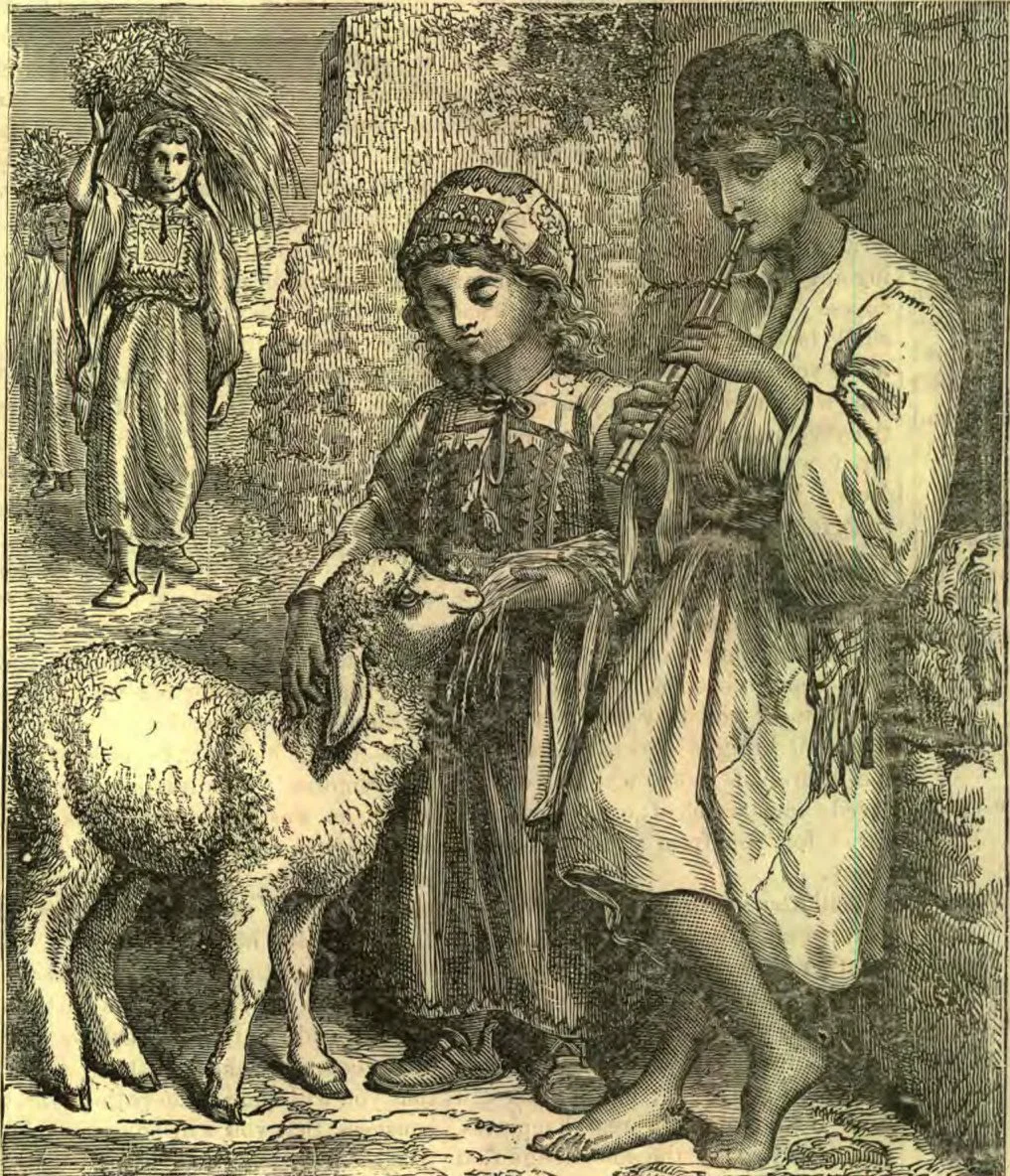
We need not to be told that our picture represents a scene in some Oriental country; and there is about the whole that air of quiet simplicity which makes us almost sure that it is in the Holy Land. It really rests one to look at the picture, with its expression of calm, happy contentment, and makes one almost long to go back to those early days when Heaven seemed not so far from earth.
The habits and customs, as well as the dress, of the people in Palestine are very simple; and what seems strange to us is that they have not materially changed during thousands of years. The modes of life in that country at the present time are but little different from those in the days of Abraham, Isaac, and Jacob; and in some instances even the work of those hands so long returned to dust, still remains. The houses are built square, with flat roofs. The better of them are built of stone, and have a court in the center; but many are made of only mud, while some among the poorer classes, especially shepherds, dwell in caves and grottoes, and sometimes in tents.
The scene represented in our picture may be in the country; but it is more probably on the outskirts of a village, as the children appear to be leaning against an old stone ruin, whose very massiveness seems to give an air of security. There is nothing to tell us which of the many villages of Palestine we have this glimpse of; but from the name the artist has given his picture, we conclude that it is Bethlehem. The word itself means house of bread, and the use of the term was fully justified by the fruitful fields and vineyards that surrounded the town in the days of old, before the land was left desolate.
No village in all the Holy Land is so rich in pleasant and sacred associations. How many “children of Bethlehem” rise up before us as we think it all over, from the time when Jacob, with aching heart, buried his dead “in the way to Ephrath which is Bethlehem” to that other joyful day when “peace on earth, good-will toward men” was proclaimed above the plains of Bethlehem.
The scene before us seems to be in harvest time, and the woman coming with the sheaf of grain on her head reminds one of the gentle Ruth who gleaned in these very fields of Bethlehem after the reapers of Boaz. Perhaps this woman is the mother of the children who are so patiently waiting. The boy, with his fine Hebrew face and shepherd’s pipe, seems a fit representative of that shepherd lad who finally came to be the poet king of Israel. The lamb may be one of a flock such as he kept for his father on the fields of Bethlehem,—the very fields where so long afterward the shepherds were keeping their flocks by night when the glad tidings was made known to them of the birth of the Son of David, the Saviour of the world.
Near the gate of the little town is the well of Bethlehem, for whose cool waters David so longed when he had become a man of war, and was faint and weary with the battle. Surely “the streams most sweet are those at which our young lips drank.” A little way out of the town is the tomb of Rachel; and we may easily imagine that the feet of our little shepherd lad and his sister have often visited the sacred spot where for nearly four thousand years has quietly rested Jacob’s best-loved wife, alike undisturbed by the joys or sorrows, triumphs or defeats, of her restless children.
Verily, “thou Bethlehem in the land of Judah art not the least among the princes of Judah.”
EVA BELL.
CHILDREN OF BETHLEHEM.

THE FIRST PSALM.

This brief psalm is replete with instruction. Here is matter for the thoughtful and devout mind to profitably meditate upon, and its glorious truths are not above the comprehension of the young. From the first verse we learn that the ungodly person has his counsel; the sinner his way; and the scorner his seat. God would have the young shun all these. Hence we read: “Blessed is the man that walketh not in the counsel of the ungodly, nor standeth in the way of sinners, nor sitteth in the seat of the scornful. But his delight is in the law of the Lord, and in his law doth he meditate day and night.”
The lesson here taught is that sin is progressive. The sinner does not find a level in his transgressions and there remain, but one sin indulged in leads to another. Bad counsel is very apt to lead to evil deeds; and he who indulges in deeds of wickedness, will sooner or later find himself enjoying the seat and practices of the scorner. “When lust hath conceived, it bringeth forth sin; and sin, when it is finished, bringeth forth death.”
The young especially should heed the counsel of Solomon given in the following words, if they would have the favor of God: “Take fast hold of instruction; let her not go; keep her; for she is thy life. Enter not into the path of the wicked, and go not in the way of evil men. Avoid it, pass not by it; turn from it, and pass away.” Prov. 4:13–15.
The law of the Lord, how much it is like its Giver! It is “perfect,” “holy,” “just,” and “good.” The law may be said to occupy the same position with respect to its Author that the light of the sun does to the sun itself. How profitable it is to meditate in the law by day and by night!
The man who thus meditates is compared to a tree planted by the rivers of water, tenderly cared for, and growing where its roots draw moisture and nourishment from the water and the mellow banks of the river. Its leaf is green, and it bears its fruit in season. How noble and beautiful such a tree!
Now notice the contrast between the good man and the ungodly man. We have seen the man who meditates and delights in the law of the Lord represented by the living tree covered and beautified with its foliage and golden fruit; but when we come to the ungodly, mark the change,—the ungodly “are like the chaff which the wind driveth away.” And thus will be the hopes and expectations of the ungodly in the day of Judgment. They will not stand; but the righteous will then be acknowledged. “Enter into the joy of thy Lord,” will be his final welcome. May I ask, young reader, do you love the law of God?
“’Tis short, and sweet, and good, and plain; Easy to learn and to retain. May grace divine our souls renew, And ’twill be sweet to practice too.”
A. S. HUTCHINS.

THE NEW YEAR.

ANOTHER year, my children dear, Has glided swiftly by; And all your acts and all your deeds Are registered on high.
The new, fresh year, like open book With leaves all pure and white, Is spread before your youthful eyes, And on it you must write.
What will you pen? Oh, pause and think! Shall idle words appear? Shall evil deeds be written down Upon those pages clear?
Shall blots of sin the record mar, While angels turn and weep, As you refuse the holy law Of God in Heaven to keep?
Ah no! be wise and serve the Lord In golden days of youth; Seek righteousness and purity, And early “buy the truth.”
And then the coming years will be A step toward home and Heaven, While peace and joy and blessedness To you will e’er be given.
ELIZA H. MORTON.

HAPPY NEW YEAR.

BY MRS. E. G. WHITE.
This beautiful morning of January 1, 1881, I greet the children and youth of the INSTRUCTOR with a Happy New Year. The old year, 1880, with its burden of records, has passed out, and the new year, with its prospects, hopes, and labors, has come.
My dear youthful readers, will you not pause, while standing upon the very threshold of 1881, and inquire of your own hearts, what has been the character of the life record that has passed up to Heaven for you? The past year’s record, be it good or evil, cannot be changed. If you feel that your past life has been almost a failure, how much reason have you for gratitude to God that your probation did not close with the old year!
Another year now opens its fair unwritten pages before you. The recording angel stands ready to write. Your course of action will determine what shall be traced by him. You may make your future life good or evil; and this will determine for you whether the year upon which you have just entered will be to you a Happy New Year. It is in your power to make it such for yourself and for those around you. If you connect with God, you may make bright sunshine in the family circle by thoughtfulness of others’ comfort, putting away all discontent, and being cheerful, courteous, and obedient, or you may pursue a course that will bring a dark shadow upon the hearts of those who have ever loved you, watched over you, and cared for you from your earliest infancy.
Will the youth who read the INSTRUCTOR ask themselves the question whether they are a blessing to their parents, or a source of anxiety and a curse? It would be a great satisfaction to them to know that you are trying to be dutiful and kind; but nothing can give them so much real happiness, this new year, as the knowledge that you have made Jesus a gift of yourselves, and that your daily prayer is, “My Father, be thou the guide of my youth.” Begin the new year, then, by giving yourselves to God, if you have not already done so; and every day you spend in his service will bring blessings to you and all connected with you.
Angels of God are waiting to show you the path of life; friends are seeking to draw you from the path of selfish pleasure and sin; you may be even now standing upon the dividing line; oh, pause and think! on the one side is life; on the other, death.
I once read of an “old man who stood upon the border of the closing year, and looked forth from his window upon the blue heavens bright with stars, and upon the cold earth white with snow, and he thought no heart could be so hopeless and joyless as his. He saw the open grave before him, and behind him the sins and sorrows of a wasted life. He had followed the path of his own choosing for happiness, and he found it not. He was wasted in body, and his soul was filled with remorse.
“The days of his youth came back to his memory like reproachful specters, and he saw himself again at the point where two paths met,—the one leading to the heavenly home of peace, and the other leading to darkness and despair. He saw, he felt, the fearful mistake he had made in choosing the dark path, and following the leading of Satan, when angels of God were waiting and anxious to show him the path of light. Life to him was a failure. Distracted with grief and disappointment, he cried in agony, ‘O my Father, give me back the days of my youth! Let me stand once more at the dividing ways, that I may choose the path of light.’ But there was no Father’s voice to answer, and the days of youth would not come back at his call. He thought of the companions of his youth who had chosen the better path, and he wished that he had gone with them. He wished that he had died in his infancy rather than to have lived a wasted life as he had done. With bitter remorse and blinding tears, he bowed his head and cried again, ‘Oh that the days of my youth would come back! oh for a touch from the guiding angel’s hand that once was put forth to lead me in the path of peace and holiness.’”
“And his youth did come back; for all that he had seen and said and felt was only the prophetic dream of one who was still young in years, yet had been rapidly growing old in sin. In an hour of sadness and weariness with the world, he had seen, by anticipation, the remorse and disappointment to which he was hastening in his wanderings from God; and he awoke with joy to find that there was yet time for him to choose the path of peace, of happiness, and of Heaven.”
I hope that the youth who read this will reflect in regard to the past, the present, and the future. Decide now, at the commencement of the new year, that you will choose the path of righteousness, that you will be earnest and true-hearted, and that life with you shall not prove a mistake. Go forward, guided by the heavenly angels; be courageous; be enterprising; let your light shine; and may the words of inspiration be applicable to you,—“I write unto you, young men, because ye are strong and have overcome the wicked one.” Listen to the words of the great apostle, echoing down the ages: “Quit you like men, be strong.” 1 Cor. 16:13. Men who are in the battle against falsity and wickedness, are found true and noble. They are men who will fight to the last rather than yield the contest. I close by wishing you a Happy New Year.

WINTER

WINTER comes to us as a blessing, inasmuch as it reminds us of the stern realities of life. Were we to have continual summer, we would become indolent, and neglect to provide for our wants. But not so. Winter comes to remind us that the earth needs rest; and that in summer we, by earnest labor, must lay by provisions sufficient to meet our demands during that rest.
Thus it is in life. All is not summer; but winter alternates with it, and teaches us that there must be an ingathering of knowledge and virtue, to meet the demand against ignorance and vice which we meet from day to day, that we may “be as corner stones, polished after the similitude of a palace;” that we may be fitted for the life that now is, and also for the life to come. Let us heed the lesson taught, and during the long winter evenings, search for the gems of knowledge that lie around us on every hand. A. A. JOHN.

The Power of Secret Prayer

SECRET prayer is a power to the soul that uses it. Cultivate it as a pearl of great price.

ACTIVE REST.

INACTION is not always rest, nor is rest always inaction. A brain-weary poet or composer can find rest in busying himself with a demonstration in Euclid. It is change, not idleness, that the mind needs in order to be refreshed,—some shift in the mental machinery that will knit up the web of life where another kind of motion has unraveled it. Says a clergyman:
I met a student toiling up a mountain. His face was flushed, and the perspiration was starting from his brow.
“What are you doing here?” I said.
“Resting,” was the reply, and he was not jesting with me.
He meant what he said. He was brain-weary. He was tired of books and of the narrow walls of his study. He wanted to be in the open air, to develop his muscles and rest his nerves. The very toil of climbing relieved the pressure on the brain. Physical exercise stilled the throbbings of thought and care, and gave him an exquisite feeling of relief.
Like this will be our rest in Heaven,—not inactivity, but fresh activity in a new sphere.

THE APOSTLE JOHN.

The apostle John was born at Bethsaida on the Sea of Galilee. His father's name was Zebedee, and his mother's, Salome. He and his brother James were fishermen; and it was at this occupation that Jesus found them, and made them “fishers of men.”
Peter, James, and John were the three apostles that ever seemed to be nearest our Saviour. Peter was bold, impetuous, rash, and a born leader among men. James was cautious, prudent, cool-headed, and eminently wise. John had all the boldness of Peter, the wisdom of James, and, withal, a sweetness of disposition and an amiability of temper that made him the heart companion of our Lord. He was “that disciple whom Jesus loved.” He had a clearer insight into Christ's character then any of the rest of the apostles. He not only saw the works that he did, and believed in him for the works' sake, but he dwelt on those utterances of Jesus wherein he declares himself the Son of God.
When Jesus was betrayed, and arrested by the soldiers of the high priest, while the rest of the apostles fled, and Peter denied him, John followed close by, was at the trial before the high priest, and, at the crucifixion, stood at the foot of the cross.
John lived to be nearly one hundred years old, and is said to be the only apostle who died a natural death. He was often persecuted, and at one time was banished, by the command of the Roman emperor, to the island of Patmos, where he had those wonderful visions recorded in Revelation.
John is sometimes called the “apostle of love,” because, in his writings, he has so much to say about the love of God, and how his children ought to love one another.—The Bible Scholar.

Praise.

At thy feet, our God and Father, Who has blessed us all our days, We with grateful hearts would gather, And begin the year with praise,— Praise for light so brightly shining On our steps from Heaven above; Praise for mercies daily twining Round us golden cords of love.

LESSONS FOR CHILDREN.

LESSON CVI.—RECAPITULATION.

During the famine caused by the lack of rain, Elijah was fed by ravens, and had his home by the brook Cherith, probably in some of the caves that abound in the rocky cliffs along its way. But at last the brook dried up, and Elijah went many miles across the country to a little city called Zar'-e-phath. There a poor woman divided her last morsel with him; but her faith was rewarded; for Elijah, by a wonderful miracle, caused her scanty supply of provisions to last till the famine was over. But this was not her only reward for kindness shown to the man of God; for when her son died, he was raised to life again in answer to the prayer of the prophet.
Ahab had searched everywhere in vain for Elijah, intending to kill him. Finally, the Lord told Elijah to go and show himself to Ahab. When Ahab met him, he accused him of troubling Israel; but Elijah denied the charge, and told Ahab that he was the one who had troubled Israel by forsaking the commandments of God, and worshiping idols. At Elijah's request, Ahab then gathered the prophets of Baal and of the groves, several hundred in number; and when the people had assembled on Mount Carmel, the prophets prepared one sacrifice, and Elijah another.
The prophets of Baal cried all day in vain for their god to send fire to consume their sacrifice; but just as the sun was going down, Elijah spoke a few words of prayer, and fire came from heaven, consumed his sacrifice, and burned so fiercely as to dry up the twelve barrels of water that had been poured upon the sacrifice, and had filled the ditch around.
The people were then convinced that Baal was a false god, and they helped Elijah to destroy the false prophets that had deceived them. Then Elijah prayed for rain, and it was sent in great abundance.
When Jezebel, the wicked wife of Ahab, knew the fate of the false prophets, she determined to take Elijah's life; but he fled and journeyed till he came to Mount Horeb. It was on this journey that he was fed by an angel, and then went without food forty days. At Horeb the Lord encouraged Elijah, and then gave him errands to perform that took him back into Palestine again. It was on this homeward journey that he called Elisha from his labor in the field to follow him.
About this time, the Lord encouraged Ahab to turn to himself by giving him two remarkable victories over the Syrians. But Jezebel still led her husband on to destruction. She caused Naboth to be falsely accused and slain, in order to get his vineyard for Ahab. A few years afterward, this wicked king was mortally wounded in battle, and being brought home in a chariot, dogs licked his blood in the very place where Naboth had been killed.
Then Ahaziah, the son of Ahab, reigned so wickedly that Elijah foretold his sudden death; and when the king, enraged at this, sent soldiers to take the prophet, Elijah called fire from heaven, and destroyed two companies of them. Finally, Elijah was caught up into heaven in the sight of Elisha and many other prophets.
From this time, Elisha became the leading prophet, and performed many wonderful miracles. He separated the waters of the Jordan; healed the great fountain at Jericho; supplied water for the perishing armies; multiplied the widow's oil; and raised to life the son of the Shunammite woman.

QUESTIONS.

  1. What was caused by the withholding of rain in the time of Elijah?
  2. How was the prophet kept alive during the first part of the famine?
  3. Why did he have to live in such a place?
  4. Where did he go when the waters of the brook dried up?
  5. What did the poor woman of Zare-phath do for him?
  6. How was her faith rewarded?
  7. In what other way was she paid for her kindness to the man of God?
  8. When the right time had come, what did the Lord tell Elijah to do?
  9. Of what did Ahab accuse the prophet?
  10. What did Elijah say?
  11. What was done at the request of Elijah?
  12. When the people had gathered at Mount Carmel, what preparations were made for showing which was the true God?
  13. What did Elijah say to the people about it? 1 Kings 18: 21.
  14. How was the matter decided?
  15. What did the people then help Elijah to do?
  16. What was then given in answer to his prayer?
  17. How did he escape the vengeance of Jezebel?
  18. What remarkable experience did he have on this journey?
  19. What at Mount Horeb? 1 Kings 19.
  20. How was he brought back again to Palestine?
  21. How was Ahab encouraged to turn to the Lord?
  22. What course did he pursue?
  23. Describe Jezebel's wicked treatment of Naboth.
  24. How was this crime punished a few years afterward?
  25. Who reigned after the death of Ahab?
  26. How did he become enraged at Elijah?
  27. How did he succeed in trying to take the prophet by force?
  28. What finally became of Elijah?
  29. Who then became the leading prophet?
  30. Mention some of the wonderful miracles which he performed.
  31. Relate the circumstances attending each of these miracles.

JACOB’S WELL.

Situated near the place where the great road leading from Jerusalem to Galilee is crossed by the valley of Shechem, are Mounts Ebal and Gerizim. The mountains are on opposite sides of the valley of Shechem, or Nablous, Ebal on the north and Gerizim on the south; but both are on the west side of the valley that comes down from Galilee.
Mount Gerizim falls steeply to the valley level, but before it quite reaches it, slopes off a little. On this slope, slightly above the level of the valley, is the well of Jacob. There can be little doubt that this is the veritable well which Jacob dug, and by which Christ rested when he talked with the woman of Samaria. Says Dr. Bonar: “You cannot in all Palestine draw a circle of limited diameter within whose circumference you can be absolutely certain that Jesus once stood, except around Jacob’s well.”
Over the well, a few years since, was still to be seen the remains of an alcove, such as is built beside most Eastern wells to give a seat and shelter to the tired wayfarer; but now there is said to be absolutely nothing to mark the spot on approaching; and the mouth of the well is found partially choked with stones and rubbish. It is nine feet in diameter, and for a distance of some twelve feet is carefully walled up. The rest of the way downward it is cut through the solid rock. It must originally have been very deep. In 1697 the depth was found to be some 105 feet; but twelve or fifteen years ago an Arab was let down into the well, and by measuring the rope, it was found to be seventy-five feet deep, and quite dry at the bottom. It is, however, constantly filling up, both by natural causes and by the stones thrown in by travelers and natives, until now it is not probably more than sixty feet deep. As it depends on rain-water, it is now usually dry except in the wet season, though quite likely when of a greater depth there may have been plenty of water.
At the mouth of the well, for some feet down, it is furrowed by deep rope-cuts, deeper of course at the top, the manner of drawing water in those days having been to let down a pitcher by a rope. This gives force to the saying of the woman, “Thou hast nothing to draw with, and the well is deep.”
Something more than a mile west from this well, down the valley of Nablous, is the city of Shechem, or Sychar, now called Nablous, to which the disciples went to buy food while their Master rested by the well-side. The valley, at the place where the town is, is so narrow that a strong man might shoot an arrow from one side to the other. The modern town contains some eight or ten thousand inhabitants, but not more than two or three hundred of these are Samaritans. The streets are narrow, the houses high and in general well-built, all of stone, with domes upon the roofs. Through the whole length of the main street a stream of clear water rushes along,—a rare occurrence in the East. Luxuriant gardens, richly watered, girdle it around outside its old and dilapidated walls, whose gates, hanging off their hinges, are an emblem of all things else in Palestine at this day.
All travelers unite in admiration of the scene about Nablous. Dean Stanley says: “A valley, green with grass, gray with olives; gardens sloping down on each side, fresh springs rushing down in all directions; at the end a white town embosomed in all this verdure,—this is the aspect of Nablous, the most beautiful, perhaps the only very beautiful spot in central Palestine.”
It was here in the valley of Shechem that the bones of Joseph were buried (Josh. 24:32); and a few minutes’ ride from the town brings the traveler to a Mohammedan wely, or dome, said to mark the site of the tomb of Joseph. Mr. Porter says, “There is nothing about it to interest one, or to give evidence of antiquity, yet it is most probably genuine.” It is also an interesting fact in this connection, that Justin Martyr was born here at Shechem. E. B.
In connection with the lesson on New-Testament History, in this issue, read the article entitled “The Samaritans,” found in the Sabbath-school department of the Review of January 4, 1881.
In the last double number, in report of Michigan Sabbath-school, by mistake of the printer, 18 cents was credited to the Jasper school which should have been credited to Jefferson. E. B.

LESSONS ON NEW-TESTAMENT HISTORY.

LESSON 11.—THE WOMAN OF SAMARIA.

When Jesus heard that John was put in prison, he left Judea and went into Galilee. Following the great road leading northward from Jerusalem, he would necessarily pass by the city of Sy'-char. Sychar was anciently called She'-chem, and is now known by the name of Nab'-lous. It is situated in the valley between Mounts Ebal and Ger'-i-zim, twenty-eight miles, in a straight line, from Jerusalem, and about thirty-four from Nazareth.
A mile or two east of the city, the valley of Shechem is crossed by another valley, running north and south. The road leading through this valley must have been the one that Jesus and his disciples followed. Near the place where the two valleys meet, and just at the foot of Mount Gerizim, is the well which Jacob dug in the parcel of ground which he bought of Hamor, the father of Shechem. When they came to this place, Jesus, being weary, sat down upon the curbing of the well, and waited for his disciples to go to the city and buy food; for it was about noon. While he was sitting here, a Samaritan woman came to the well to draw water. When he asked her to give him a drink, she expressed her surprise that a Jew should ask a favor of a Samaritan; for ever since the building of the temple by Zerubbabel, there had been such bitterness of feeling that the Jews would have no dealings with the Samaritans. But Christ came to save all men, without respect to birth or nation, and so proceeded to make himself known as the Saviour of the world. He said, “If thou knewest the gift of God, and who it is that saith to thee, Give me to drink; thou wouldst have asked of him, and he would have given thee living water.” The living water here referred to must be the Spirit of God dwelling in the heart and prompting to that faith and obedience which will secure eternal life. Isa. 44:3. But the woman did not seem to understand him; for she said, “Sir, thou hast nothing to draw with, and the well is deep; from whence then hast thou that living water? Art thou greater than our father Jacob, which gave us the well, and drank thereof himself, and his children and his cattle? Jesus answered and said unto her, Whosoever drinketh of this water shall thirst again; but whosoever drinketh of the water that I shall give him shall never thirst; but the water that I shall give him shall be in him a well of water springing up into everlasting life. The woman saith unto him, Sir, give me this water, that I thirst not, neither come hither to draw. Jesus saith unto her, Go, call thy husband, and come hither. The woman answered and said, I have no husband. Jesus said unto her, Thou hast well said, I have no husband; for thou hast had five husbands; and he whom thou now hast is not thy husband: in that saidst thou truly. The woman saith unto him, Sir, I perceive that thou art a prophet. Our fathers worshiped in this mountain; and ye say, that in Jerusalem is the place where men ought to worship. Jesus saith unto her, Woman, believe me, the hour cometh, when ye shall neither in this mountain nor yet at Jerusalem, worship the Father. Ye worship ye know not what; we know what we worship; for salvation is of the Jews. But the hour cometh, and now is, when the true worshipers shall worship the Father in Spirit and in truth; for the Father seeketh such to worship him. God is a Spirit; and they that worship him must worship him in spirit and in truth. The woman saith unto him, I know that Messias cometh, which is called Christ: when he is come, he will tell us all things. Jesus saith unto her, I that speak unto thee am he.”

QUESTIONS.

1. What did Jesus do when he heard that John was put in prison?
2. What road would he be likely to follow in making a journey from Judea to Galilee?
3. In following this road what noted city would he pass by?
4. What was this city anciently called?
5. Where is it situated?
6. How far is it from Jerusalem, measuring in a straight line?
7. How far is it from Nazareth?
8. What crosses the Valley of Shechem a mile or two east of the city?
9. What leads through this valley?
10. Where is Jacob's well situated?
11. Of whom did Jacob buy the parcel of ground where this well was dug?
12. For what is this well most remarkable?
13. How did Jesus come to be sitting by the well when the Samaritan woman came to draw water?
14. Why was she surprised at his asking her for a drink?
15. Why would not the Jews have any dealings with the Samaritans?
16. Relate the circumstances which first caused them to become enemies.
17. From whom were these Samaritans descended? See Bible Lessons for Youth, Lesson 96; also Article in YOUTH'S INSTRUCTOR, 1880, p. 203, and 2 Kings 17: 3-6, 24; Ezra 4.
18. Why did not Christ follow this custom of slighting the Samaritans?
19. Following out this noble purpose, what did he proceed to do?
20. How did he reply to her question? John 4:10.
21. What must be meant by the living water here referred to?
22. Did the woman seem to understand his meaning?
23. What did she say? Verse 11.
24. By what artful question did she show her disbelief in his ability to furnish water in a miraculous manner? Verse 12.
  • 25. Describe this well which Jacob dug so many years ago. Read the accompanying article.
26. How did Jesus convince the woman that the living water which he spoke of was not literal water? Repeat verses 13, 14.
27. What did she then say to him?
28. What did he tell her to do?
29. What did she say about her husband?
30. How did Jesus then show that he knew all about her past life? Verses 17, 18.
31. What did she then exclaim? Verse 19.
32. As soon as she perceived that he was a prophet, how did she refer to the chief point of religious contention between the Jews and the Samaritans? Verse 20.
33. How did Jesus show that he regarded the Jews as most nearly right in their worship? Verse 22.
34. How did he show her that God regards the sincerity of his worshipers as of greater consequence than the place where they worship? Verses 21, 23, 24.
35. How did the woman show that the Samaritans were looking for a Messiah to come and give them a complete knowledge of God's will? Verse 25.
36. What did Jesus then say to her?

LETTER BUDGET.

Agnes Mason, of Sunlight, Nebraska, writes: “I wrote once for the INSTRUCTOR, but it was not printed, and I thought I would write again. I have taken the INSTRUCTOR for two years. I keep the Sabbath with my parents, and attend Sabbath-school. I belong to the church, and am trying to be a Christian. I am twelve years old.”
J. M. Williams, of Blue Branch, Texas, writes: “I like your paper very much. Mrs. M. B. Miller sends it to me. I never saw her, but wish that I could. It has rained for almost two weeks past, and the creeks have overflowed, and the water has come up into our fields, but it has not done much harm. We have no Sunday-school here, but we have preaching every Sunday except the third Sunday in the month. Your little friend.”
Bessie C. Robinson writes from Humburd, Wisconsin, as follows: “I am a little girl seven years old to-day. I have never seen any letters in the INSTRUCTOR from Humburd, so I thought I would write one. I read all the stories in the INSTRUCTOR, and think that they are nice. I go to school and read in the Third Reader. I have a little brother one year old. I go to Sabbath-school every week. I love God’s holy Sabbath, and am trying to be good so I may be saved when Jesus comes. Much love to the INSTRUCTOR family.”

THE NEW YEAR'S PARTY.

Well, Harry boy, what will you have, This happy New Year's day? We'll lay aside our books and work,— No studies, but all play!
“I want a party, papa, dear, And I will tell you why,— I've had so much to make me glad, Through all the days gone by!
I know a little boy that's lame, And don't have any fun! And one that's blind and cannot see This glorious New Year's sun! Now can't they just come here to-day, Where all is warm and bright, And let me make them happy, too, And fill them with delight!”
“Why, yes, my dear, I'm sure they may, A party it shall be! Invite a few with limbs and eyes, If such you chance to see!
Let some of God's poor little ones Enjoy with you, my dear, The comforts of your pleasant home, This happy, glad New Year!”
Ah! joy indeed is there to-day, And hungry hearts are filled,— The little hearts that oh, so oft With cold and want are chilled! Such dainties sweet they never saw! Such games, such merry play! Ah! did there ever dawn before So glad a New Year's day?
Thus Harry's year is well begun, In kind and loving deeds; And he will sometime reap the fruit, Where now he sows the seeds. The opening year before us lies, Its snowy page so fair! Oh, may some kindly deed of love Be first engraven there!
—Mrs. R. N. Turner.
Continue reading: MABEL'S SECRET