The Youth’s Instructor, Vol. LI, No. 50

God's Little Lamb

The Youth’s Instructor

December 15, 1903

Review and Herald Publishing Assn. · Washington, D. C. · December 15, 1903

God's Little Lamb
MANY years ago a young man from a well-known mercantile house in a large city was dispatched upon important business to the residence of a wealthy gentleman living in the same city. A servant answered his ring, and seated him in the reception room until the gentleman of the house was at leisure.
As the young man waited, there was a pattering of little feet in the lobby, and presently a rosy face peeped in at the partly open door. The inquiring look on the face of the child was answered by a nod and a smile from the visitor, whereupon the little one came forward to make friends. A picture of beauty and innocence was little Marjorie, with her large blue eyes, and shining flaxen curls that clustered about the fair forehead and slender neck. She soon became friends with her papa's visitor, and he took her upon his knee, as she told him of her pets. Gaily she chatted to him about her big dog Punch, and her Angora kitten.
“I wonder if she is ever taught about God and heaven,” thought he, for she belonged to an aristocratic family, where wealth and fashion reigned, and the customs of high society life prevailed.
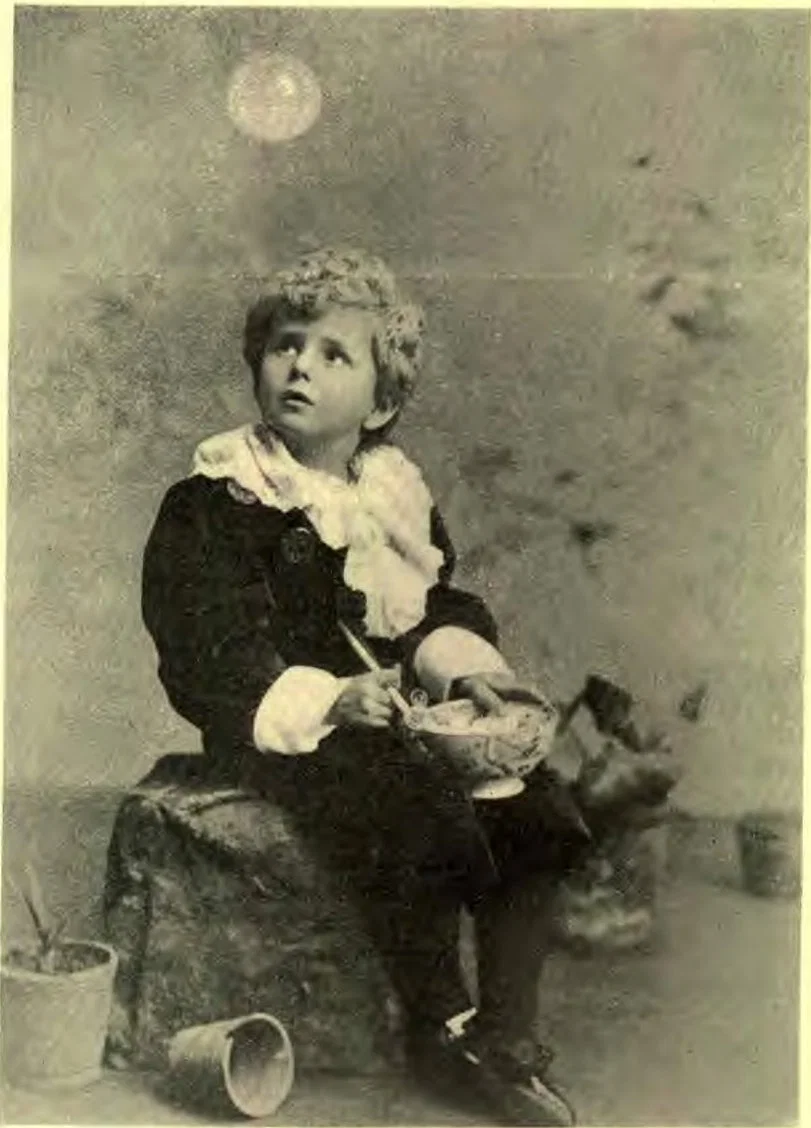
MOTHER'S LITTLE BUBBLE BLOWER
“Did you ever hear about Jesus?” he asked.
“Who's Desus?” and the blue eyes opened wide.
“What a pity,” he thought, “that such an innocent baby should grow up without any knowledge of the love of God.” He contrasted her refined surroundings with those of the little street urchins who came every week to the mission Sabbath-school. There he had toiled long and faithfully to bring a knowledge of the blessed Saviour's love to little hearts that knew nothing but vice and crime and misery and woe. Naturally of an affectionate nature, his heart went out to this sweet, innocent little flower, apparently uncontaminated from the wicked world without. Here was an opportunity for him. Possibly the hearts of the parents might be touched by some childish ministry.
So he told her of the dear Jesus who was once a little child, and when he became a man, he loved little children dearly, and took them in his arms and blessed them. He told her how Jesus died for us, so that we may be saved and live with him in heaven. She repeated after him the beautiful verses, “Jesus said, Suffer little children . . . to come unto me,” and, “He shall gather the lambs with his arm, and carry them in his bosom.”
As the moments sped on, and still the gentleman was occupied with other callers, the young man taught her to repeat a stanza of a curious old hymn, composed by an Indian woman, which runs as follows:—
“I am glad I ever saw the day — Sing glory, glory, glory — When first I learned to sing and pray Of glory, glory, glory. 'Tis glory's foretaste makes me sing Of glory, glory, glory; I praise my Saviour and my King, Like those who dwell in glory.”
To Marjorie's great delight she could repeat the verses alone, and was told to say them many times so she would remember them. They had been together nearly an hour when her papa came in to receive the caller, bidding her run and play.
The interview was ended, and the young man was asked to call again in a few days to complete the business.
When the clerk came again, he found the man of business occupied, and was obliged to wait his turn. “I wonder if I shall see little Marjorie this time,” he thought. He had not waited long, however, when in she came, approaching him shyly. To his delight she had remembered the verses he had taught her, and repeated them for him.
“Tell me more pretty verses ’bout Desus,” pleaded the child, whereupon he produced a book of hymns he had brought purposely, hoping to see her. This he gave to her, telling her to have her mama read her many pretty things about Jesus.
Some weeks after this it was necessary for the young man to go on business, probably for the last time, to Marjorie's home. Her father was out of town, the child's mother received him, bringing Marjorie with her. She instantly ran to him, and began repeating her verses, somewhat to the embarrassment of the young man, who did not know whether the mother would approve of what he had done, and of the child's fondness for him. Much to his relief, the mother received him kindly, speaking of the pleasure Marjorie took in what he had taught her, and how she was constantly begging her mama to tell her other verses. Then the mother asked him to explain what Marjorie meant.
“Ah! here is another opportunity,” thought he. Producing a small pocket Bible, he read a number of beautiful verses, and spoke to her of the love of God. As he passed out into the street, he sent up a silent petition that the good seed sown might some day bear fruit.
Nearly six months passed before he saw or heard from either the child or her mother again. Occasionally, as he had passed the house, a strong desire seized him to see the little one again, but disliking to be unconventional, he refrained from calling. How many times we hesitate when God's Spirit prompts us to action! Many times, too, hearts are waiting, longing, for the bread of life. One evening when passing down the street, he determined to overcome his timidity, and call at the house. The servant who admitted him said Mrs. — was at home; his card was taken up, and he waited several moments.
Presently Mrs. — appeared. Her eyes were heavy with weeping, and as she saw him, her tears burst forth afresh. “O sir!” she exclaimed, “my child! Will you see her?”
Without further words they proceeded up-stairs, and as he observed her intense emotion, fears seized him as to the seriousness of the situation, while he tried to choke back the lump that was rising in his own throat. Little Marjorie must be very ill.
As the door was opened, there lay Marjorie in her little white bed, tossing to and fro in delirium. Her face was flushed, and her beautiful curls lay in a tangled mat upon the little head. Now and then she repeated snatches from the verses he had taught her,—sometimes nearly a whole verse correctly; then her mind wandered, and her moanings were indistinct.
The sobs of the poor mother were all that broke the silence of the room. She was a young woman, and Marjorie was her only child. Evidently the mother had never learned to say, “It is the Lord! let him do what seemeth him good.” The young man begged her to look for comfort to the God of all consolation. Fervently did he pray that night for this dear lamb of the Saviour’s fold, committing her to the loving care of him who neither slumbers nor sleeps.
Being sent out of town on business for his employer, it was the evening of the second day since his last call before he could go and inquire after the sick child. Hastening his steps thither, he was met at the door by the servant, who in tears exclaimed, “O sir, my mistress thought you would have come sooner!”
He was quickly admitted to the sick room, only to find the grief-stricken mother sitting by the bedside, her face buried in her handkerchief. Her husband tried to support her, but his own frame shook with emotion.
The frail little form now lay quietly in bed. The fever was gone, the delirium was quite over, and she was very weak and tranquil.
The young man approached the bedside. As he bent over her quietly, she looked up into his face, and smiled faintly. “Do you know me, Marjorie?” he asked.
“Yes,” she answered, and put her hand in his, “you told me pretty verses ’bout Desus. ‘I am glad I ever saw the day — Sing glory, glory, glory —’”
She stopped, leaving the line unfinished,—indeed, the last words were scarcely heard. Then as she moved, he placed his hand under her head to ease her position. Her eyes opened again quite fully, and looking up into his face, she said, “Jesus said, Suffer little children, . . . to come unto me;” “He will gather the lambs with his arm, and carry them in his bosom.”
The eyelids closed. The little head sank heavier on his arm, and the child was gone. And then,—ah, then,—how sweet to the sorrowing ones were the words of Revelation: “His servants shall serve him; and they shall see his face; and his name shall be in their foreheads.”
Let us not think of death as of grief and pain and the cold grave, but let us think of the glad resurrection which comes after the brief sleep. “For the Lord himself shall descend from heaven with a shout, with the voice of the archangel and with the trump of God: and the dead in Christ shall rise first; then we which are alive and remain shall be caught up together with them in the clouds, to meet the Lord in the air: and so shall we ever be with the Lord. Wherefore comfort one another with these words.”
This is a true story. Think not that the young man came by accident into that home. God had a purpose in leading him there, that he might bring salvation to hearts that knew not the Saviour of men. Let us not be slow to speak words of hope and cheer,—the “wonderful words of life,”—wherever there is opportunity. Many a little lamb is out of the fold of the Good Shepherd. Many a wandering sheep would gladly come in, had it some one to lead the way. “Feed my lambs.” “Feed my sheep.” *

Put on the Whole Armor

Now gird thee for the battle; Put on the armor bright; The evil day is coming; Now arm thee for the fight.
Let truth be like a girdle, A wall of living light To strengthen and sustain thee In conflict for the right.
O, righteous be and holy, A breastplate none can pierce When wild around thee rages The tempest dark and fierce.
And let your feet be ready To run the way of life; Shod with the peace of heaven. Turn from the path of strife.
A shield He has to give thee; O, hold it ever high, To quench the darts of evil From foemen lurking nigh!
Put on thine head the helmet. Salvation full and free; And take the shining weapon, The sword God gives to thee.
Go forward, nothing fearing; As soldiers brave, endure; Though long the battle rages, The victory is sure.
CORNELIA SNOW.

In a Caisson Chamber

WHEN we speak of a bridge-builder, we think of a man whose work is done in mid-air, who labors over cables or rivets, with a narrow steel beam and a hundred feet of space between himself and the solid earth or the unquiet water. But some bridge-builders work nearly as far beneath the earth as others do above it. These are the men who lay the foundations of such great structures as those which span the East River at New York, or the Mississippi at St. Louis—the caisson-workers, they are called.
A caisson is simply a massive box of timbers, strongly bolted together, one of its six sides being left open. It is of the same dimensions as the pier which is to be built, and may reach a length and width of sixty or seventy feet. It is floated upon the water, its open side downward, and masonry is built upon its top, until, sinking beneath this weight, its edges rest upon the river bottom.
Then through pipes, previously let into the top of the caisson, air is forced down by means of powerful compressors. When the pressure is greater than that of the water outside, the water within the caisson is forced out, until at length the space is left clear. The air must always be kept four times as dense as it is at the surface, else the water would make its way in, and put a stop to the work, even if it did not drown some of the workmen.
It is the part of these men to remove the mud from beneath the caisson, excavating very cautiously under its edges, until the whole structure sinks by gradual stages to the bedrock of the river channel. The cavity of the caisson is then filled with cement, and the foundations of the great pier are secured.
Open spaces for two shafts are left in the masonry originally built on the top of the caisson. One of these is occupied by the elevator in which the workmen ride up and down; the other is used for the removal of the mud and the delivery of the cement. When the caisson itself has been filled, these shafts are stopped with cement.
In descending into the caisson, one is taken by the elevator to the air-lock, a small, circular, iron-walled chamber on the roof of the great box. The door communicating with the shaft is then securely closed, and a valve into the caisson chamber is opened. With a shrill scream the compressed air rushes into the chamber, the temperature rises, and the air becomes close and heavy.
There is but one actual danger, however, and that is to the ear-drums. But if the nose be held shut, the mouth opened, and the air forced, by swallowing, into the Eustachian tubes, the pressure on both sides of the membrane is equalized, and all possibility of injury avoided. Of course no one with really diseased lungs or heart should expose himself to the peculiar conditions of caisson-work.
When at last the air in the lock is of equal density with that in the caisson, the latter may be safely entered.
Here, at a depth of seventy feet or more beneath the surface of the water, our subterranean bridge-builders are at work. They are lightly clad, and even so their exertions bathe them in perspiration, for in air containing four times the usual quantity of oxygen, tissue-burning is very rapid.
Toil is so exhausting under these conditions that the men can work only one hour at a time. Two shifts of one hour each make a day’s work — equal to eight hours or more of labor at the surface of the earth. As the work goes on night and day, there are twelve “working-days” in every twenty-four hours. Bridge-building beneath the water is decidedly expensive!
It is not only by the rapidity with which fatigue comes that the worker realizes the strangeness of his surroundings. The voice loses its resonance in the dense, damp air, and becomes flat and hollow in tone. Words and inflections lose their distinctness; some sounds, especially those of the dental letters, d and t, are almost inaudible, or become strangely transmuted into f’s.
It is impossible, also, for even the most accomplished whistler to produce the slightest sound in this dense atmosphere. Pucker and blow as he will, the air escapes noiselessly from his lips.
Another curious thing is that the candles which are used to explore the dark corners of the caisson, to which the electric light does not always penetrate, can not be blown out. The flame may be extinguished for an instant by a vigorous puff, but the wick remains momentarily aglow, and so abundant is the oxygen in the caisson air that it rekindles the flame at once, and the candle burns as brightly as before.
When at length, after an hour’s work, the tired laborer is ready to ascend to the surface, the air-lock is again entered, the door into the caisson closed, and another valve opened into the elevator shaft, through which the compressed air escapes, hissing and screaming. Now another curious phenomenon is noticed.
As the pressure is released, the air expands, and in accordance with natural law, it becomes much colder. It is, however, heavily charged with moisture, and just as a pitcher of ice-water condenses the moisture of the air upon its sides, so the falling temperature condenses the moisture in the air-lock, and the chamber is at once filled with a chill, white fog, which is often so thick that water is felt trickling in tiny rivulets down one’s face and hands.
Too rapid a change in pressure at this point is more dangerous than on entering the caisson. Faintness and dizziness, and severe pains in the legs and chest, are often felt, and temporary paralysis, or even, in rare cases, death, is the result of carelessness. Ten minutes are occupied in slowly reducing the pressure to normal, and then at length the caisson-worker may step into the elevator and rise again to the surface.—Youth’s Companion.

The Real Athlete

Do you know, says a writer to the Nashville Advocate, the real athlete? The boy or young man who not only excels in the school sports, but is champion of the wood-pile and like opportunities for home exercise?
I know of at least one such young man. He can throw the hammer several feet farther than any other young men in his class, yet he practises at the sport far less than those with whom he competes. He can lift more than those who test with him their strength, yet he gives little thought to the accomplishment. He can walk a mile several minutes quicker than those who would outstrip him in a foot-race, yet seldom is he seen practising on the school course.
A year since I spent a week at his home in the country, and, while there, learned the secret of his athletic excellence. When I saw him at the woodpile six mornings in succession, I realized where a large share of his skill as a thrower of the hammer came from. Seeing him at work after school hours building a stone wall, I knew somewhat of the secret of his strength. When I saw him start for school, two miles away, with less than half an hour at his disposal, for he had insisted upon going to the spring for water, lest there should not be sufficient for the morning’s use, I knew something of his practise as a pedestrian.—Selected.

Building a Modern Kite

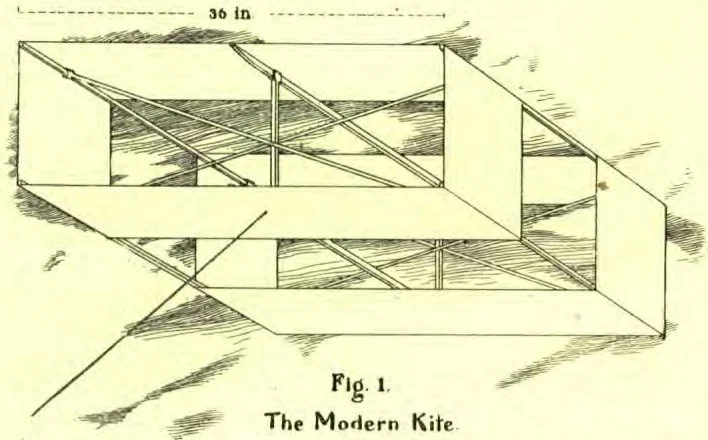
Fig. 1.
The Modern Kite.
Fig. 1. The Modern Kite.
The kite we will make this week is a simplified model of “the great cloth bird” at Blue Hill Observatory, near Boston, where it has been used for several years in elevating recording thermometers and other instruments that automatically register the condition of the upper air. This big, standard kite of Uncle Sam’s Weather Bureau contains nearly seventy square feet of supporting surface, and often pulls over a hundred pounds on the string. Of course no one man can fly it safely by hand; and so strong, well-anchored reels are used instead. The string itself is a fine steel wire about the diameter of an ordinary pin, and usually between two and three miles long. It will not break with any strain under two hundred pounds, and therefore is strong enough except when several kites are flown tandem, in order to explore the very highest altitudes.
Notwithstanding its marvelous lifting power, the modern scientific kite hovers for hours with the smoothness and grace of some gigantic bird. It is even possible to take photographs of the earth, by cameras suspended from this kite.

The Model

A boy who is handy with his knife, and can induce a patient, long-suffering sister to do some sewing for him, will have no trouble in making his scientific fun machine. It certainly calls for more time in construction than the old “cross-stick” kite, but it also certainly repays the labor bestowed on it far better. Whoever undertakes it has just two points to be careful of: First, the frame must be stiff; second, it must be well balanced.

Materials

Straight-grained spruce or pine is the thing for the framework sticks; three yards of calico or muslin, or an old sheet, will do for the covering; and some small tacks and coarse, waxed linen thread will fasten things together.

Sizes

You can make your kite any size you wish, of course, as soon as you understand the principle on which it flies. However, as in the construction of yachts, so in the construction of this model kite, certain proportions have been found to work best; and, to begin with at least, it will perhaps be safest to hold closely to these. The pieces of wood you will need are cut as follows:—
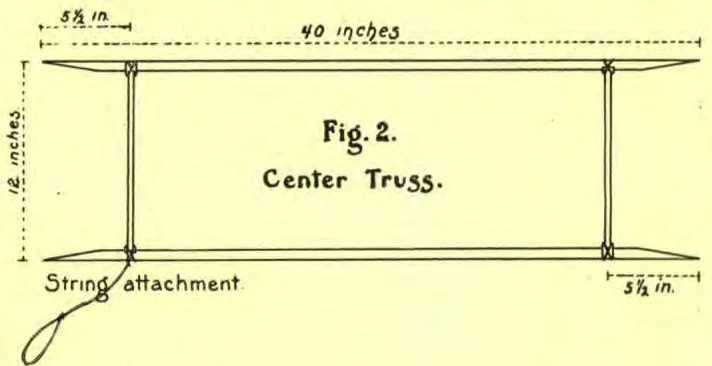
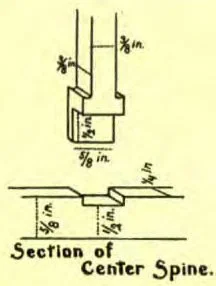
Figure 2.— 2 center spines for center truss, ¼ x ⅝ x 40.
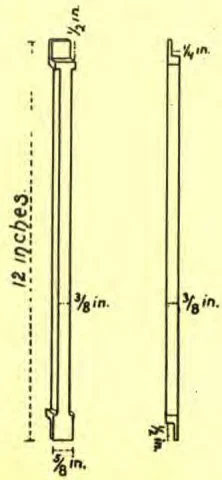
Figure 3.— 2 vertical supports for center truss, ⅜ x 1 x 12.
Figure 4.— 4 corner spines, ⅜ x ⅜ x 40.
Figure 5.— 4 diagonal braces, ¼ x ⅝ x 37¾.
The figures will show just how and where to notch the wood in order to make the framework perfectly rigid, and also where to trim away unnecessary weight.

Building

Having the twelve pieces necessary, build first the center truss, or backbone, of your “bird,” as shown in the figure, by binding the four pieces made for it firmly together with plenty of shoemakers’ waxed twine, or common string, waxed.
The next step is to prepare the covering. This is made of two long strips of cloth. Both edges must be hemmed, and still leave the width just twelve inches. The total length on the kite for each strip is ninety-six and one-half inches,—the one-half inch being allowed for the lap in sewing the goods together.
Now mark the two cloth bands at the places they are to be fastened to the framework. In order to do this, stretch each band on two sticks, make it tight and firm, and lay off on it a twelve-inch section, draw it around a little, so that the stretching sticks will not interfere, and with the pencil mark off a thirty-six-inch section, then a twelve, then another thirty-six. Do not hurry in this part of the work, as on it depends a great share of the kite’s success. Complete the marking by drawing two lines where the center truss will come, just in the middle of the thirty-six-inch sections.
Fig. 5. Diagonal Braces.
With some of the small tacks fasten the bands to the center truss in the proper places, using half a dozen tacks in each place. In the same manner fasten in the corner spines, taking care that the notches you have made in them come right for the diagonal braces.
In the measurements for the sticks the diagonals were placed at about 37¾. It is well to make them even a little longer than that, in case your cloth should stretch considerably, and trim them down till they fit snug, and stretch the cloth outward as tight as a drum, so to speak. Notice that one diagonal goes before and one behind the vertical of the center truss, and that they are bound together at every joint with the waxed string.
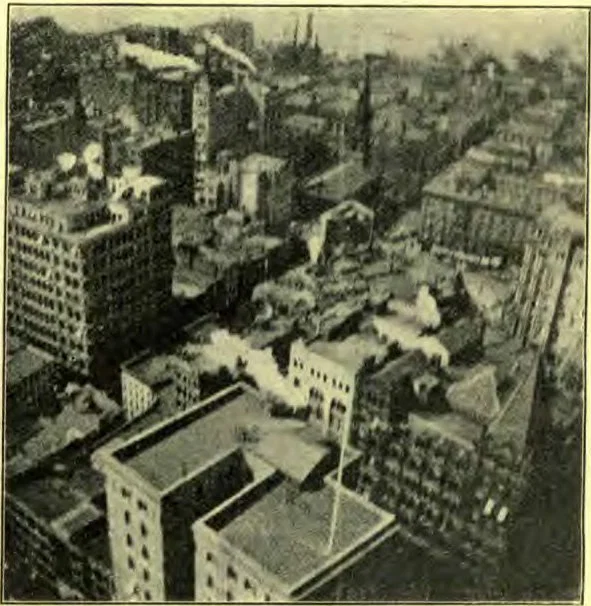
A KITE PHOTOGRAPH TAKEN IN NEW YORK CITY
AT FIVE HUNDRED FEET ALTITUDE
A KITE PHOTOGRAPH TAKEN IN NEW YORK CITY AT FIVE HUNDRED FEET ALTITUDE

Attaching the String

There are two methods, one for light and one for heavy winds. In the second method a piece of cord is tied to the center truss, as shown in Figure 2, passing it through small slits in the cloth. The other end of the cord is made into a loop, into which the kite string proper may be tied. The first method, for light winds, has the two-point fastening. This will be understood from Figure 6. It may be necessary to make several trials, in order to get the exact slant to the kite as it hangs from the string; this of course will be effected by fastening the real kite string to just the right part of the bridle.
The kite string should be a great deal stronger than that needed for the ordinary kite. However, it is probable that in ordinary winds the common twine will do very well. If it is found too weak, it can be strengthened by waxing with beeswax.

Sending It Up

The best time to fly the kite is during what we would call “a common wind.” Run out a hundred feet or so of string while somebody else holds the kite. Have your assistant toss it lightly upward in the direction in which it is to go. It will then take care of itself, and mount rapidly.
Fig. 3.
Verticals of
Center Truss.
Fig. 3. Verticals of Center Truss.
Section of Center Spine.
If the kite is not thrown up in line with the wind, it will behave badly, as any other kite would do. It may behave badly in either case, and this is a sure sign that it is poorly made. It is not balanced, and should be weighted on one side or the other with small pieces of lead or iron, tied to the corner spines. This will usually make matters right, and the kite will sail so high that, large as it is, it will be almost lost to view, provided, of course, your string is long enough, and the wind sufficiently stiff.
Boys who have flown ordinary kites tandem, several from a single string, will know how to do the same thing with their scientific kites, and will appreciate the absence of the troublesome tail. They will also find it possible to send up heavy flags, lanterns, fireworks, or cameras. Many strange pictures can be secured by swinging a light camera between the two cells of the kite, so that it is well balanced, providing some simple way of working the shutter, and taking bird’s-eye views of farms, towns, and valleys. The photograph shown herewith was taken in this way in New York City several years ago.
Edison Driver.

The Broom-Corn Brothers

“CAN’T get an education, did you say, my boy? Can’t go to college because you have no money?” Money is not the essential thing in getting an education. Energy counts more than money, and thousands of boys have proved it. In the State university in Kansas, nearly one half the students are self-supporting.
An incident in the lives of three brothers came to my attention the other day—three Kansas boys who had no money, and wanted an education. Their struggle began twelve years ago, when the eldest, Frank Mahin, went to the State normal school from a southwest Kansas farm, determined to win a diploma. He was equipped with a few books, some broom-corn, and a broom-making machine, but very little money.
When he went out to hunt a boarding-place, his prospective landlady asked: “What about payment—will your father meet the bills?”
“No, ma’am,” said the country boy. “I will, if you will take chickens, eggs, and butter.”
She looked at him in astonishment. “You do not live here—where will you get them?”
“Trade brooms for them.”
“Brooms? Where will you get brooms?”
“Make them—in the barn, if you will let me.”
It took considerable explaining before the landlady was made to understand his plan, but she did at last.
He set up his machine in the barn, and made brooms. These he traded to the farmers for produce, and this went to his landlady for board. Week after week went by, and he met all his expenses. He did this until he completed the normal school course. He wanted to go to a medical college, but the money was needed at home, so he returned to the farm and kept his brothers in the country schools.
Those were the hard times on the prairie, and, though the family raised a good crop of broom-corn the next year, it would not sell for enough to pay rent, and the landlord took it. The other boys left the public school, and all three worked hard for a year paying off a $1,200 mortgage. They studied nights, and kept up with their classes.
Then the boys went back to the normal school town, and made brooms while continuing their studies. The Santa Fe Railroad heard of them, and gave them a large order for special-made brooms to be used by the car-sweepers.
The last of the “broom-corn brothers” to make his way through school was the youngest, Melvin, who fitted up a factory in the carriage-shed at the place where he roomed, and, with another student, made brooms, working an hour or two each day. Soon after the Christmas holidays he was offered the principalship of a ward school in a growing town, and left his studies to accept it. Charles also had a good principalship, and the eldest brother is completing his work in a Southern medical college.
During the dozen years these three boys have been working their way through school, they have assisted their parents, and have added eighty acres to the eighteen-acre home farm. They also rent three hundred acres more, and have established a permanent broom factory, which is earning a good return each year. They are prosperous, and have the esteem of their fellows—even if sometimes their schoolmates did smile at the young broom peddlers.
Can’t go to college because you have no money? You need grit, not money. Perhaps you can’t make brooms, but there are plenty of other ways in which you can earn the necessary funds. A willingness to struggle a little, to undergo hardship, to endure—that’s what will make educated men of the boys who have no one to pay their way through college. Perhaps it is better that they do it this way—they keep their knowledge, and use it, because they earned it.—Young People’s Weekly.
Continue reading: THE WEEKLY STUDY