The Youth’s Instructor, Vol. LII, No. 50

Joy

The Youth’s Instructor

December 13, 1904

Review and Herald Publishing Assn. · Washington, D. C. · December 13, 1904

Joy

Gush of gladness, hosts of cheer — Angel helpers, are you here? Care has vanished, and to-day All the fields are fair as May.
Tell it over; for I know Nothing else can cheer me so. “God is love!” His love to me Drives away all misery.
Joy has come: yes, joy is mine ’Neath the smile of love divine. How can joy not overflow When my Saviour loves me so? B. F. M. SOURS.

Must Pay the Price

My dear young friends, I am sure you want success. Everybody does, whether willing to pay the price for it or not. The desire is as prevalent as the word, and the word pervades all the atmosphere of to-day. It is a fine thing to know what true success is. The politician seems to think that it is a high seat in the councils of the nation. The financier believes it to be that which can be computed by dollars and cents. The philanthropist thinks it to be the number he can rescue from suffering, and help on the upward way. The true missionary counts it in the souls saved for Christ. Standards are legion, and differ widely, but all wish to succeed in some way; and the highest, truest success lies within the power of all to secure.
Whatever your chosen field, good health is one of the first requisites to success. If you wished to teach art, science, or music, you would understand that there were preliminary steps to be taken by way of preparation. If you were intending to become a farmer, you would not expect to grow a full-sized fruit-tree in five minutes. If you wished the position of cook, and had no previous experience, you would not expect that purchasing a two-dollar cook-book alone would qualify you. If you wished to stand in the front ranks of literature or higher mathematics, no college in the land would give you a diploma without effort on your part. But many seem to think that health will spring spontaneously, as the mushroom, or will drop from the skies for the wishing, neither of which, suffice it to say, are wholly true. If it were thus easily secured, the course pursued by many persons would soon reduce it to the minimum. “Whatsoever a man soweth, that shall he also reap.” The sowing and the reaping are inseparable. If you will not sow, you can not reap; neither, if you persist in sowing can you by declining to reap avoid doing so. One may read medical works until the hair is white, may even own a medical diploma, and not enjoy health; and, fortunately, although one may not be able to secure a medical diploma, yet he may enjoy health.
Look at the children nibbling from morning till night; look at the young man who simply eats that which pleases his perverted appetite, and the young woman who subsists largely upon cakes, sweetmeats, and airy nothings, so far as nutrition is concerned, and tell me if you think they can reasonably expect good health.
There is a young woman whom the Maker formed beautiful, but fashion, not art, has rendered her a distressing sight to the normal eye and normal brain. There is a young man whose most highly prized friend has robbed him of his manhood’s best estate. The friend’s name is Self, and he is a friend only in name. It is so easy to eat and drink, dress and sleep, and live as many around us do, ignoring the fact that the reaping time will as certainly follow the sowing as autumn follows springtime. “But,” you say, “such and such things don’t injure me. Look at A and B; they have the habits you call bad, yet they have lived long.” Perhaps they were not so finely organized as you are. The delicate strings of Nature’s harp may not have been keyed to as high a tension with them as with you. A man fell from the mast of a vessel into the ocean. He was rescued, and lives. I would not recommend you to try the experiment, however. Many have fallen who do not live. If a certain course of life recommends itself to your reason and better judgment as the one that usually results most satisfactorily, it would be much better to take that road than the one that might possibly bring you to the desired terminus.
“Don’t imagine that such a little thing as that hurts me,” said a gay young girl when she was remonstrated with for walking through the wet grass with thin slippers on, one autumn morning. She may have known some one who had done that same thing, and yet lived many years; but the grass of several springtimes has sprung above her grave.
“I can drop this habit any time I choose,” said a young man when reminded that a certain thing was—unconsciously to him—undermining his health. If this is true, now is the best time you will ever have to drop it; it is none too soon. Some children, in the absence of older persons, played with fire in the shavings. They thought they could stop it whenever they chose, but the beautiful house was soon in ashes. Says another, “I thought, when I formed that habit, that I could drop it at any time, but I can’t do it; it is too late.” Don’t sit there limply and let the house burn down, and you in it. Rouse yourself, avail yourself of the assistance that will strengthen your will power, and be a man—God’s noblest work. The world abounds with young people who originally had good brain power, and at least a fair share of health, who might have succeeded in any worthy pursuit chosen, but who, because of contracting wrong habits, and failing to rally their will power to break them, are now either groveling or will ever rank as second-class.
Tell me, young man, enthusiastic over mechanical pursuits, if you were to come into possession of a beautiful, perfect engine when you were twenty-one, and could visit it now every day, would you, when doing so, pierce holes in that beautiful boiler? Yet many a young man by destroying his health, is virtually doing that with the infinitely finer mechanism of his own body .
If you, young man or young woman, had a present of one thousand one-dollar bank-bills, would you place them in a drawer, and each day take out a few and drop them into the flames for the momentary pleasure of seeing them burn? Good physical health will, in the race of life, net you more than a million dollars without it. Yet some pursue a course far more disastrous than simply burning bank-bills in the fire. Take a look ahead, and do not indulge in any course of action simply for present gratification. It is springtime or early summer with you now, but the reaping time will surely come in autumn, it may be even in midsummer.
The deadly nightshade berries are beautiful to look at, and may be pleasant to the taste, but they are not conducive to longevity.
Ever remember, my dear young friend, aspirant for success in whatever line, that —
“We build the ladder by which we rise From the lowly earth to the vaulted skies.
“We rise by the things that are under our feet, By what we have mastered of good and gain, By the pride deposed and the passion slain, And the vanquished ills that we hourly meet.
“Wings for the angels, but feet for men! We may borrow the wings to find the way; We may hope, and resolve, and aspire, and pray; But our feet must rise, or we fall again.”
MARY MARTIN MORSE.

Early Life and Labors of Martin Luther

To do great things by small means is the law of God, and is manifested both in nature and in history. The Reformers, like the apostles, were chosen from a humble class, Luther being taken from the cottage of a poor miner.
The date of Luther’s birth is a matter of conjecture; but he is supposed to have been born Nov. 10, 1483. His parents were poor; his father being a wood-cutter, and the mother often carrying the wood on her back to procure food for the children. Martin was a child of violent temper; and, according to the custom of those days, he was punished severely both at home and at school. During his attendance at school, he was taught the heads of the catechism, the ten commandments, the apostles’ creed, the Lord’s prayer, and Latin grammar.
Although Luther’s parents had great respect for religion, the only religious sentiment awakened in their son seems to have been that of fear. The Saviour had been represented to him as an angry judge, and whenever he heard the name of Jesus, he grew pale with terror. But this only prepared him for the joy he afterward experienced when he became acquainted with Christ.
During his fourteenth year Martin was sent to Magdeburg, where he spent one year in reading, and attending lectures. Here he suffered great privation; and he, with his comrades, as he himself says, “begged a little food for their subsistence. ” He was now sent to Eisenach, with the hope that he could obtain a livelihood more easily. But here he met with the same difficulties, and was obliged to join his fellow students and “sing before the houses for a morsel of bread.” One day, being in almost utter despair of ever gaining an education, which he so much desired, he was received into the home of a kind, Christian family; and from this moment his studies were secure. Here, by making the best use of his opportunities, he made rapid progress, and his whole being began to beat with life, joy, and happiness. In after-years, Luther reflected with gratitude upon the poverty of his youth, and regarded it as a blessing of God. Lively, good-hearted, and eloquent, Luther was a great favorite with his masters and comrades.
In 1501 he entered the University of Erfurt, where he made rapid progress in his studies. He felt that he was dependent upon God, and this was the source of his humility and great achievements. He began each day with prayer, and lost not a moment during the day. “To pray well,” said he, “is more than half of my study.”
One day while examining the books in the library, he found a Bible, which was indeed a rare book in his day. His interest was excited, and he was perfectly astonished by its contents. He had never before seen a book like it, and his heart beat as he held in his hand the inspired Scripture. The first page upon which he fixed his attention told the story of Hannah and Samuel, and as he read, his soul was filled to overflowing with joy. “O!” thought he, “would it please God one day to give me such a book for my own!” He made frequent visits to the library, and with joy and astonishment, he read and reread this precious book.
At the age of twenty-two he bade adieu to the joys of youth, proceeded alone in the darkness of the night to the convent of St. Augustine, which he entered, to be forever separated from his parents, his fellow students, and the world. Upon hearing of this, his father was thunderstruck, and wrote his son a very angry letter.
In the convent he was assigned the most menial tasks,—sweeping floors, cleaning rooms, and begging through the streets of the city for money, bread, corn, eggs, and various articles of food. But he submitted patiently to it all; for he felt that he was doing his duty.
After a time, however, he was relieved of these menial duties, and he again zealously pursued his studies, especially the writings of the Catholic Fathers, and the Bible, which he found fastened to a chain in the convent. Luther was naturally very temperate, contenting himself with the coarsest provisions, and often remaining without eating or drinking for four days at a time; but during his convent life there was no sacrifice which he would hesitate to make in order to purchase heaven. He followed strictly the rules of his order; and “if ever a monk had got to heaven by monkery,” says he, “I had been that monk.” I must not at the present time enter more fully into his life in the convent, but it is all summed up in the following words of his own: “I tormented myself to death in order to procure peace with God to my troubled heart and agitated conscience; but, surrounded with fearful darkness, I nowhere found it.”
During his second year in the convent, his exhausted body gave way, and he was attacked by an illness which brought him to the gates of death. All his agonies and terrors were awakened, and one day while he was overwhelmed with despair, an old monk entered, and with consoling words persuaded Luther that God is a being who forgives sins. From that moment Catholicism was virtually destroyed in him. He was filled with new life, and soon his health was restored. After having remained two years in the convent, he was consecrated to the priesthood, his father being present on the occasion. At the end of another year, he accepted a chair in the University of Wittenberg.
One day while studying his Bible, he was struck with the words, “The just shall live by faith,” and these words unfolded to him in part the mystery of the Christian life. Not long after this, he was invited to preach in the church of the Augustines in Wittenberg; and finally, after offering every objection he could think of, but without avail, he yielded to the request. His words made a wonderful impression on the minds of his hearers, and, like a torrent, carried them along with him. Soon he was appointed to preach in the town church, where he made a still greater impression.
About the year 1511 he was sent to Rome to plead before the pope the cause of some of his fellow monks. Here he had expected to find nothing but holiness, but greatly astonished was this pious monk to find nothing but frivolity and profanity. “It is an ordinary saying,” says Luther, “that if there is a hell, Rome is built upon it.” One day while in Rome, climbing Pilate’s Stair upon his knees, he heard, as it were the voice of thunder, “The just shall live by faith.” In amazement he rose from the steps, and fled from the spot. During all these years, although Luther had seen the light, the darkness was not yet removed. He was still a pious monk.
Turning away his eyes in disgust, he left Rome with his heart full of sadness and indignation, and turned his attention to the Holy Scriptures. In 1512 he received the degree of Doctor of Divinity. From this time forth he began to attack the superstitions of the Roman Church; and at the university he laid open the treasures of the Word of God, and, like John the Baptist, pointed to the Lamb of God, who taketh away the sin of the world. The voice of Luther shook the world, and opened up a new era in the history of the church. B. E. CRAWFORD.

The Island of Philae

ONE would have scarcely thought that an island in the River Nile would prove a hindrance to the building of the great barrage, or box, that is henceforth to have so much to do with the happiness and prosperity of the poor fellaheen of Egypt. But though the island of Philae was not all in the way of the contemplated reservoir, the holding up of the river above the dam to a head of one hundred feet, as was at first projected by the engineers who had the work in hand, “would have raised the level of the water” until, at certain times in the year, the little island would have gone under. It is a beautiful island, and besides, it has nestling upon its bosom “the famed Temple of Isis, Pharaoh’s Bed, and other monuments.” Not many visit it; and yet one would have thought its proposed submersion one of the most sacrilegious ideas that had ever entered the mind of man, such a storm of opposition was there raised against it. “The cause of art,” and the temple, memorializing the worship of false gods, was more to the archeologist and antiquarian than the salvation of a people; and so, the work was nearly brought to a standstill. But the engineers had the welfare of Egypt at heart, and they fought on, even offering to raise and move the monuments to the island of Bigeh, yet nothing would satisfy the opposers; and the original design had to be given up. Whether these men had any right to say anything or not, we do not know. If not, they probably used their influence with those who had, and so it came about that the dam to-day is thirty-three feet lower than it ought to have been, and the loss to Egypt can only be estimated by the millions. What a pitiful thought it is that in these days of enlightenment, a heathen temple must outweigh in the balances the well-being of a whole nation!
“The foundations of Philae have been underpinned and strengthened,” as it will, still, be partially submerged.
But despite the loss to Egypt from the lowering of the dam thirty-three feet below what it ought to have been, when its “full effects have been produced,” the increased annual wealth to the country will be £2,500,000, while “the direct increase of taxes” will be only £360,000; for “eight hundred thousand acres will be converted from basin to perennial irrigation, thereby doubling the production of the soil, and a large area of waste land will be reclaimed.”
S. ROXANA WINCE.

Seeing Into Every Room

GOVERNMENT post-offices are so constructed that from little openings near the top an inspecting official can look down unobserved into every room, beholding the conduct of all employees.
This is done that in case any dishonest dealing should be traced to a particular city, detectives might continue their work of inspection until the individual offender be discovered and brought to justice.
As the employees chance to see the little window, it ought to serve as a reminder that possibly an eye is even then upon them, and it is to their best advantage to be honest and upright in all their conduct.
Could we all remember that into every room of the heart, large and small, the Creator has so arranged that his eye can behold all that is going on, it ought to be a strong incentive to us to do those things which are pure and right. “Neither is there any creature that is not manifest in his sight: but all things are naked and opened unto the eyes of him with whom we have to do.” Heb. 4: 13.
Yes, into every room, however secret, the Lord can look. Every one is at liberty to choose whether or not he will be obedient, but the reaping time is sure to come, and the nature of the harvest can be determined by the seed being sown.
Reader, do not forget the little opening in the secret chamber of your heart, through which all there, is open unto the eye of him with whom you have to do. T. E. BOWEN.

Within the Rims of Life

“God makes the rims in which we are placed,” says Mrs. A. D. T. Whitney, “but we ourselves can make our lives what we will within these rims.” Much of the disappointment and most of the failures of life come from trying to fix or change the divinely established rims of life. Instead of making the most of its own proper province, the spirit of man is prone to invade God’s. It chafes at its limitations and restrictions; it is not satisfied with the large possibilities granted it within the bounds of God’s will and intention, but demands complete freedom of choice as well as of action. The result is inevitably denial and defeat.
The only true wisdom lies in accepting at the outset, in the right spirit, the limitations of life, and then, within these limitations, which are always broad enough to admit of a generous measure of success, to do gladly and earnestly the soul’s appointed task.
Furthermore, the rims of our lives shut us out from nothing intensively. They are round us, but never beneath or above us. We can go as deep as we will and as high as we will. God sets no bounds to that kind of development—the noblest and most enduring—which we call character. There, indeed, every soul’s choice is absolute, and its possibilities infinite.—James Buckham.

World's Bill of Fare

“MAN will eat two hundred or three hundred more foods in the year 2000 than he eats now,” said a chemist. “A movement is on foot among the world's governments to increase the varieties of our foods, and every week, from somewhere or other, a new vegetable or fruit or nut is added to the international bill of fare.”
It is by a study of the food of savages that we get our new foods. Savages eat many things that we regard as weeds or poisons. Taking up these things and cultivating them, we get many a new delicacy.
Eggplant and tomatoes we never thought of eating till certain Peruvian savages showed us the way. Oats, barley, and rye originated from weeds that grew on the shores of the Mediterranean. The buckwheat came from a wild Siberian plant. Melons, cucumbers, horseradish, and onions were weeds of the East. The pumpkin was regarded as a poison for a long time, and with no little fear did some adventurous person test it as a food.
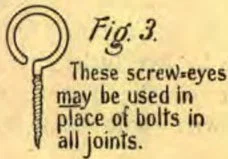
Fig. 3. These screw-eyes may be used in place of bolts in all joints.
Turning to the foods of our future, we find that the Klamath Indians alone eat forty kinds of vegetables that are unknown to us. Scientists are testing these vegetables, and are finding them to be palatable and nutritious.
Among them is the wichpi, which grows on the margins of the Western lakes. Its stems contain a white pith that, eaten raw, is as sweet and pleasant as a lump of milk chocolate.
Then there is the kotsonoka, or goose foot. The goose foot bears in August small black seeds. These seeds the Klamaths roast, grind, and make into cakes and gruel.
The wokas, or yellow water-lily, is the Klamath's staple food. It is made into bread and into porridge.
All over the world there are vegetables and fruits that, though they grow wild, are pleasant and nutritious. Cultivation will greatly improve them.
On the average table to-day only about a dozen food plants appear from one year's end to another. It is safe to say that not many years need roll by before at least two hundred will appear on the average table.—Philadelphia Bulletin.

How to Make an Instrument for Copying and Enlarging
THE drawing instrument explained this week is called a pantograph, and is very useful to draftsmen in enlarging plans, diagrams, and maps. It may also be used in reducing; that is, in making a diagram smaller than the original. I have seen some excellent work done by children with it in one of our church-schools, where they made neat enlargements of the maps in their geographies, colored them with water-colors, and tacked them up on the walls.
The construction is simplicity itself; and if careful attention is given to one or two essential points, a boy’s home-made pantograph will work quite as well as one costing several dollars.
The frame is best made of four bars of hard wood. The dimensions may be large or small, according to the size required, but a common and useful size has bars 13 x 3/4 x 3/16 inches. Holes are bored in these four bars an equal distance apart; say three quarters of an inch, and care is taken that this work shall be done accurately. The opposite bars must always work parallel to each other, and this is effected by having the holes bored right. If the holes are uneven, the copy, or enlargement, will surely be a distortion of the original, and will not please you.
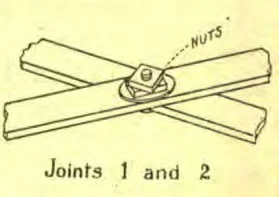
Another point to be careful about is the joints. Those which I have illustrated may seem somewhat complicated to you at first; but on the contrary, they are very simple and accurate, and better than those shown in Fig. 3, because they will not wear loose and “wobble.”
Joint No. 4.
Joint No. 4.
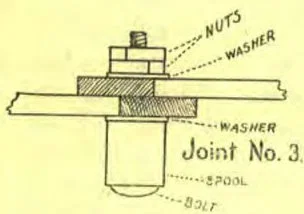
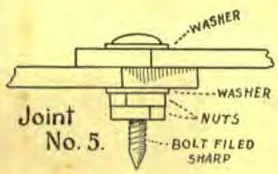
Notice that two nuts are used on each bolt. The reason for this is that one is used as a lock nut, to keep the joint from loosening or tightening while in use. Simply screw the first nut down on the washer till the joint is tight enough, then screw the second nut down on the first tightly, to lock it and keep it from turning.
Joint 3 is so arranged that the smooth head of the bolt slides over the paper or table without catching or jerking.
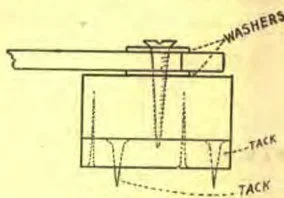
Joint 4 is the support of the pantograph, and requires sharp points projecting from its lower side, which may be forced into the wood of the table.
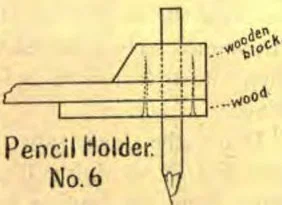
Joint 5 has a sharpened bolt, which is called a tracer, because it traces the outlines of the original picture. In drawing, the operator does not watch his pencil point at all, but leaves it to take care of itself while he gives the closest possible attention to the tracing point.
The whole cost of making a good pantograph of this description is not more than ten or fifteen cents.
EDISON DRIVER.

Grandpa’s Sunshine Maker

ONE gloomy, rainy afternoon Tom and Nellie came slowly and dejectedly into the library, where grandpa was reading, with their fair little faces very long indeed.
“Oh, ho!” said grandpa, looking up from his paper. “Something to do, is it? Well, well, suppose you come right along to the workroom with me, and see if we can’t find something to bring back the sunshine.”
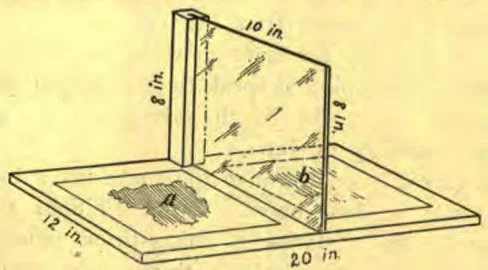
Once there, grandpa took a piece of glass from a drawer in the work-bench, and fixed it upright on a wooden baseboard. It was the work of but a few moments for him; and when it was finished, he carried it back to the library, amid a very fusillade of questions.
Glass Pencil Holder. No. 6
“Now,” said he, as the mysterious “what-is-it” was placed on a corner of the library table, “I will put this picture of the wise men and their camels on the left-hand side, toward the window. On the other side I will lay this sheet of drawing paper. Now bend your head a bit, Tom, and look through the glass from the left side.”
Joints 1 and 2
Joints 1 and 2
“It is just splendid, grandpa,” exclaimed the little boy; “It really looks as if the picture were right there on the drawing paper! I believe I can draw it there, too, don’t you?”
“Well, my lad, keep your eye in about the same place, all the time looking at the reflected picture, and you certainly should be able to copy it quickly, because you can see both the picture and your pencil point at the same time, and all you have to do is to trace over the outlines as you see them there.”
And now, with plenty of pictures to copy and plenty of grandpa’s writing paper to “borrow,” maybe you think one little boy and one little boy’s sister didn’t have a good time the rest of that long dreary day; but just ask Tom and Nellie.
EDISON DRIVER.

Interesting Experiment

Removing a Coin from a Glass Without Touching Either
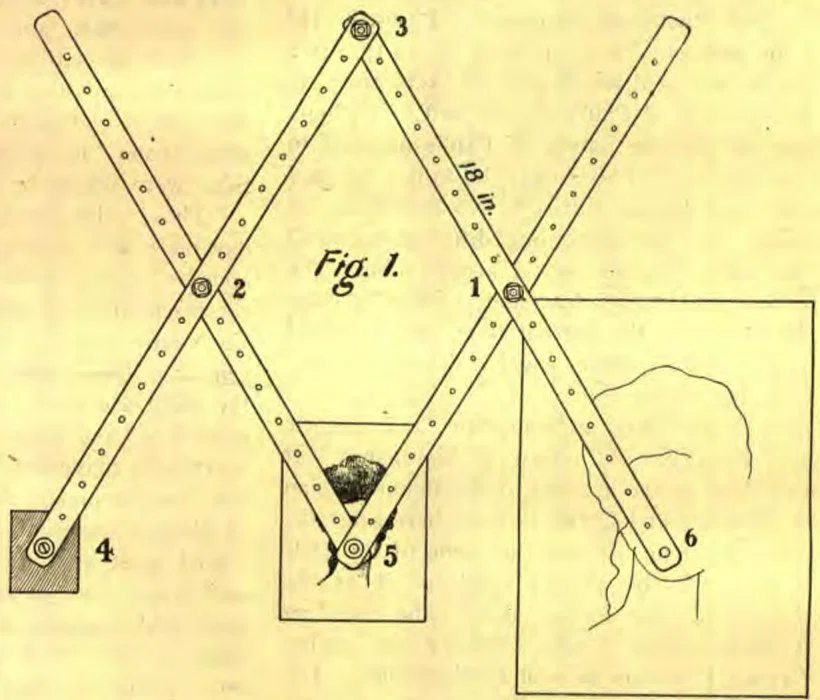
Fig. 1.
Fig. 1.
THE SUNSHINE MAKER
THE SUNSHINE MAKER
THIS simple feat is perplexing to one who has not seen it tried. Procure a small, tapering glass, the largest diameter of which is just a trifle greater than that of a silver dollar. Place a ten-cent piece in the bottom of the glass, and the silver dollar above it, to serve as a lid. Now ask your guests to take the ten-cent piece out of the glass without touching either coin or the glass that holds it. All sorts of devices will be suggested, but none that come within the limit of the rule you have laid down. After it has been given up, place your lips a few inches from the rim of the glass and blow downward, obliquely, but smartly, upon the edge of the dollar within the glass. The force of the air will turn the dollar over upon its own axis, and at the same time will force the smaller coin to leap out, as the dollar is turning.— Selected.
Continue reading: The Word Farewell and Its Meaning