The Youth’s Instructor, Vol. 30, No. 4.

DR. ISAAC WATTS

The Youth’s Instructor

Jan 25, 1882

S. D. A. Publishing Association · Battle Creek, Mich. · Jan 25, 1882

DR. ISAAC WATTS.

This illustrious man was born in the town of Southampton, England, in the year 1674. His father, also named Isaac, was the master of a very flourishing boarding-school in that town. This school had such a reputation that gentlemen’s sons were sent there from America and the West Indies, to be educated. The father was a pious, exemplary Christian, an honorable deacon of the church known as Protestant Dissenters, and was more than once imprisoned for non-conformity, or because he did not think it right to conform to all the rules and usages of the Established Church of England.
At a very early age the little Isaac began to show that fondness for learning for which he was afterward so distinguished. When only four years old, his father commenced to teach him Latin, and the child made such progress as to delight his friends and become the wonder and admiration of the neighborhood. At the age of sixteen he was sent to London for better educational advantages; and in his nineteenth year he professed religion, and became a member of the church under the care of Rev. Mr. Thomas Rowe, his tutor. He soon became distinguished for his religious fervor; and something more than a year after his profession, having finished his academical studies, he returned to his father’s house at Southampton, where he spent the next two years in reading, meditation, and prayer. This he did, as he himself says, to acquire ampler knowledge, and to prepare for that work to which he was determined to devote his life, and the importance of which greatly affected his mind. It scarcely need be said that this work was that of the gospel ministry.
At the end of this time, not yet feeling prepared for his work, Mr. Watts went to make it his home in the family of a gentleman near London, where he stayed for two or three years, acting as tutor to the two sons. Though thus employed, he did not cease his own studies, for not only did he make further improvement in those which he taught, but he steadily applied himself to reading the Scriptures in the original tongues, and to a close study of all the best commentators, critical and practical.
On his twenty-fourth birthday Mr. Watts commenced the work to which he had so long looked forward, by preaching his first sermon. The same year, he was chosen assistant to the pastor of a church in London. His public labors met with much appreciation, and so great was his zeal in preaching the gospel that he brought on a severe illness, which kept him from his work for six months. But this did not discourage him, and as soon as he was able, he returned to his delightful labors with all his old fervor. He was soon called to the place of first pastor in the church where he had been an assistant, and this to the great joy of the people whom he served.
This good and great man, for such he truly was, cultivated every kind of learning, and is said to have been the most thorough scholar of his age. In the year 1728 the universities both of Edinburgh and Aberdeen, in a most respectful manner, and without his knowledge, conferred on Mr. Watts the degree of doctor of divinity. He is said to have been remarkable for his quiet ease in the pulpit; and such was the beauty and propriety of his language, combined with an unaffected earnestness and solemnity of manner in speaking, that he had always a large and interested congregation.
With all his other labors, Dr. Watts was not idle as a writer. His prose works are various, and of a superior style both of thought and expression. One especially, entitled, “On the Improvement of the Mind,” should be read by every young person in the land. But Mr. Watts is best known by his poetical writings, which are numerous, and possess much real merit. His hymns are still sung the world over, and seem never to weary or grow old. Though his writings were enthusiastically received by the people of his time, he himself always put a very low estimate on his work, ever speaking of it in the humblest, most modest way.
The Doctor was of a feeble constitution, and suffered much from ill health throughout his whole life, yet he lived to the ripe age of seventy-four. In his last illness he proved the excellence of his principles and the greatness of his piety by his patience and serenity of mind, and by the calmness and even satisfaction with which he looked forward to death.
E. B.

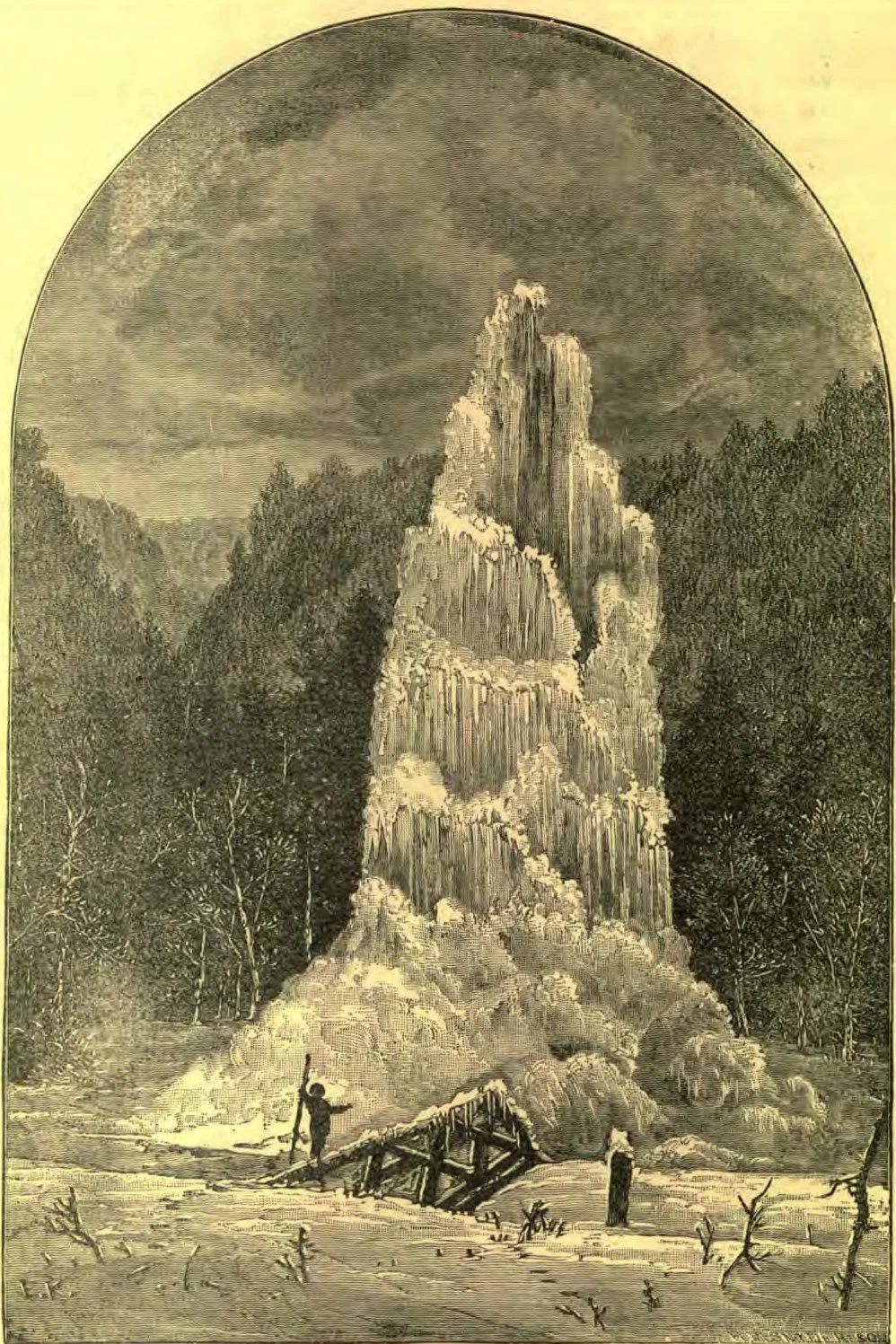
THE FLAMING FOUNTAIN.

THE State of Pennsylvania is famous for its vast mineral wealth. Mountains of coal furnish fuel for the country; mines of iron afford ore for the furnaces, and material for a thousand articles of necessity and comfort; and then vast fountains of oil, hidden in the earth, pour out their treasures to furnish light for millions of dwellings in all parts of the world. Sometimes, instead of oil, gases burst forth from the earth, furnishing illumination enough for the entire region.
In the town of Kane, on the summit of the Alleghany Mountains, near the Philadelphia and Erie Railway, there are noted sulphur and iron springs. Here, in the spring of 1878, a well was sunk more than two thousand feet into the mountain, which, though failing to strike oil, opened veins of oil gas, enough to light a city. The well was finally abandoned, and the casings used in boring pulled out, when the hole rapidly filled with water, which poured in until the imprisoned gas accumulated beneath in sufficient quantities to lift the column of water over a third of a mile deep, when it blew the water out in a volume of spray over the top of the well.
THE FLAMING FOUNTAIN.
From that time this process has been going on; and at intervals of from six to ten minutes this vast body of gas, spray, and water, is blown out into the air in a column a hundred feet high. Sometimes the gas is set on fire, and the flame and spray intermingling, produce most beautiful rainbows in the night.
In the winter the water freezes, and after weeks of cold weather the frozen foam stands in a mass more than a hundred feet high, sparkling in the sunshine, a most magnificent spectacle, bright with a light that seems to remind one of the jasper walls of the city of God, the New Jerusalem.

Willing Service Makes Burdens Light

NOTHING is troublesome that we do willingly.

IS YOUR NAME WRITTEN?

Were you ever in a large manufacturing establishment on pay day? What long lines of expectant faces! What eager interest to see if the pay is “all right”! Here and there are some who receive no such welcome reward. They did not work here last month, and their names are not on the pay roll.
Come with me to the town of B—. It is pay day in the large box factory. What bright, fresh faces, and eager, expectant looks! Here is a young lady who is going home to-day or to-morrow, and she is waiting with the rest for her pay. But no pay comes. Others receive their money and go gladly away, but her face wears an anxious expression. “Why am I not paid?” “No such name on the list.” And disappointed, she goes home without her money. To be sure, it is only a mistake that will be rectified next week, but one does not like such mistakes.
“Mother, I did not get my pay?”
“Why, daughter, how is that?”
“Oh, it was only a mistake. He did not put my name on the list. It will be all right next week.”
“All right”! but it brings thoughts of sadness to the mother’s heart as she remembers that other pay roll, that other book, and her daughter’s name “not on the list.” No mistakes in that book, and mother knows it, and daughter knows it, and yet the name “not on the list.”
Dear reader, is your name enrolled? “Is it on the list”? Can you with others “rejoice, because your names are written in heaven”? How sad to be left out when “pay-day” comes, and “no mistake”? Don’t wait another day before having your name enrolled. Soon “the city of the living God, the heavenly Jerusalem,” shall be seen “coming down from God out of heaven, prepared as a bride adorned for her husband.” “And there shall in no wise enter into it anything that defileth, neither whatsoever worketh abomination, or maketh a lie; but they which are written in the Lamb’s book of life.”—W. A. B.

Only a Word: Poem on Faithful Living

ONLY a word—but the work that it wrought Could never by tongue or pen be taught; For it ran through a life like a thread of gold, And the life bore fruit a hundred-fold.

HINTS TO GIRLS.

Give your best sympathy. There is no greater human power than the tenderness of woman. If you can minister to some one in sickness, lessen somebody’s distress, or put a flower in some poor home, you have done a thing you will always be glad to think of. You will be remembered; and a woman asks no grander monument than to live in hearts.
Not far from my home was the plain cottage of an Irish woman and her only son, a brave young fellow, dying of consumption contracted in the war. One day, in my visit to him, I carried him some lovely red roses. The next time I went, the mother said, “He never let the roses go out of his hand, miss. He held ’em when he died, and the last he ever said was, ‘Give my blessin’ to the young lady for bringin’ the flowers.’” And the desolate mother buried them with him, as the most precious thing he possessed. The blessing of that poor Irish youth will always be a pleasant memory.
Be gentle. Strength of character and sweetness of disposition are in nowise incompatible. Doubtless, the most winsome nature on earth is that which combines the naturalness and dependence of a child with the strength of a true woman. There are people whose touch is balm to us; restful persons, whose companionship is a benediction, who draw out the best of our natures, whose presence we may scarcely note, but whose absence creates a void which the heart hungers to have filled.
The remembrance of a tender word will last long after you are in your grave. A little ragged boot-black fell on the icy streets of Chicago one winter’s day. A cheery young lady passing, said, as she helped him up, “Did you hurt yourself?” His whole face beamed as, after her departure, he said to his companions, “I’d like to fall a dozen times if I could have her pick me up like that.”
A harsh voice in a woman is like a discord in the sweetest music. One can easily get into complaining and dissatisfied tones. Have a sunny face; and nothing will do this save genuine kindness in the heart. Every girl ought to try to make it possible to say of her, “She brightens every life she touches.” If you never do aught else in life, bring sunshine into every heart you meet.—Sarah K. Bolton.

A CURIOUS PLACE FOR A NEST.

The old clock in the tower of the First Presbyterian Church, Newark, has not been giving correct time lately. Charles Freeman, employed by the common council to regulate the town clocks, was puzzled by the antics of the ancient time-piece, and when it came to a stop recently, he decided to give it a thorough examination. In the wheels he found a tangled mass of hay, twine, grass, cotton, and feathers, amounting to nearly half a peck. A pair of birds had entered the tower through a hole in the dial, and attempted to build a nest in the machinery of the clock. The slow revolution of the wheels tore their work to pieces, but they kept on reconstructing it until they stopped the wheels.—Little Gem.

No Man Is Greater Than His Ideal

No man is greater than his ideal man.

Florence's Mistake.

It was Sabbath morning, and she was standing before the glass, tying the ends of her lovely new sash; and Carrie leaned on her elbows, and watched her for a minute, and wished that she was a little more like Florence. She was pretty and bright, and everybody admired her. This very morning she was going to do something so nice. In the next square was a new family, just moved in; Florence had already become acquainted with Weston, the fifteen-year-old son, and invited him to attend Sabbath-school, and he had laughed, and declared that he didn’t go to Sabbath-school very often; but at last had agreed to call, and be shown the way to church by Florence.
“I don’t believe they are people who go to church much,” Florence had said, as she drew on her long mitts with a pleased air; “but I shouldn’t be surprised if I could get him into the habit of going.” And then Carrie had sighed, and wished that she could do something; here she had to stay poked in the house this beautiful day, because she had a sore throat. Just then the door-bell rang, and Master Weston’s voice was heard in the hall. Then was Florence in a flutter. “Dear me! there he is, and it is time we were off. Where is my handkerchief? Carrie, haven’t you seen my handkerchief? You certainly must have taken it; I laid it right here. I do wish you would let my things alone! Mamma, have you seen my ‘Quarterly?’ I thought it was on the table; where can it be? Oh dear me, mamma, I should think you might help me find it. I hate to be late. Oh, never mind my money! I can take it next time. Mamma, please don’t keep me waiting to get it; I shan’t go at all, if I have to wait much longer. Carrie Marshall, I know you tucked my handkerchief somewhere. Mamma, won’t you please let me go this minute? You seem to just want to make me late. I don’t care if my hair is too low down; it is just the way all the girls wear it. I wouldn’t have it flying around my face in- the wild way that Carrie does, for anything. Carrie, hand me that book, quick! I shall go distracted!” Then I rejoice to tell you that she went out of the room, tripped down the stairs, and was off.
Her invalid mother drew a relieved sigh. “I wish Florence were not such an excitable girl,” she said, as she moved about picking up many things that the young miss in her hurry had sent flying hither and thither. “If she were a little more like you, dear, in some things, I should be glad.” Meantime Florence was tripping along beside her new friend, as bright as the morning itself.
She told him about their nice Sabbath-school, what a “perfectly splendid” teacher they had. She told him about the young people’s prayer-meeting, and asked him to attend; and with sweetness and skill she brought her question around until she asked him if he were a Christian. And she said, earnestly, “I am so sorry,” when he told her, “no!” Then she said a few sweet, earnest words that ought to have done him good, and she wondered in her heart why he was simply polite in return, showing not the slightest interest in the subject. If she could have looked into his heart, she would have found just this: “I wonder what this dainty little miss in her pretty hat and her frizzes would say if she knew I waited for her in the hall while she left her door open and talked to her mother and ‘Carrie’—whoever she is. The talk I heard then and the talk I am hearing now don’t match. How am I to know which she means?”
Poor Florence! Her thoughtless, disrespectful words at home that morning had spoiled the influence of her work abroad! And the worst of it was, she was so used to being careless in this matter that she didn’t suspect it.—The Pansy.

SCENES IN THE LIFE OF CHRIST.

LESSON 53.—VISIT TO CÆSAREA PHILIPPI.

About this time Jesus, with his disciples, left the people on the west side of the lake, and entering a boat, again went over to the east side. “Now the disciples had forgotten to take bread, neither had they in the ship with them more than one loaf.” And as they were on the way over, Jesus charged them, saying, “Take heed, beware of the leaven of the Pharisees, and of the leaven of Herod. And they reasoned among themselves, saying, It is because we have no bread. And when Jesus knew it, he said unto them, Why reason ye, because ye have no bread? perceive ye not yet, neither understand? have ye your heart yet hardened? Having eyes, see ye not? and having ears, hear ye not? and do ye not remember? when I brake the five loaves among five thousand, how many baskets full of fragments took ye up? They said unto him, Twelve. And when the seven among four thousand, how many baskets full of fragments took ye up? And they said, Seven.” He then asked them if they did not yet understand that he spake not to them of the leaven of bread, but meant to warn them against the false doctrines of the Pharisees.
And when they had come to the other side of the sea, to Bethsaida, the people brought a blind man to Jesus, and begged him to heal him. “And he took the blind man by the hand, and led him out of the town; and when he had spit on his eyes, and put his hands upon him, he asked him if he saw aught. And he looked up and said, I see men as trees walking. After that, he put his hands again upon his eyes, and made him look up; and he was restored, and saw every man clearly. And he sent him away to his house, saying, Neither go into the town, nor tell it to any in the town.”
On leaving Bethsaida, Jesus and his disciples went north into the region of Cæsarea Philippi. And while they were on the way, he asked his disciples, saying, “Whom do men say that I am?” And he answered, John the Baptist; but some say Elias, and others, One of the prophets. And he said unto them, But whom say ye that I am? And Peter answered and said unto him, Thou art the Christ.” He then charged them that they should tell no man of him, that he was the Christ.
And he began to teach his disciples “that the Son of man must suffer many things, and be rejected of the elders, and of the chief priests, and the scribes, and be killed, and after three days, rise again.” And when he had called the people unto him, with his disciples also, he said unto them: “If any man will come after me, let him deny himself, and take up his cross daily, and follow me. For whosoever will save his life shall lose it; but whosoever will lose his life for my sake, the same shall save it. For what is a man advantaged [profited], if he gain the whole world, and lose himself, or be cast away? For whosoever shall be ashamed of me and of my words, of him shall the Son of man be ashamed, when he shall come in his own glory, and in his Father’s, and of the holy angels. But I tell you of a truth, there be some standing here, which shall not taste of death, till they see the kingdom of God.”

QUESTIONS.

1. Where did Jesus and his disciples go soon after he had the talk with the Pharisees who came desiring to tempt him? Mark 8:13.
2. What did Jesus charge them as they were on their way across the sea?
3. Of what neglect did the disciples think he meant to reprove them by these words?
4. When Jesus knew that they reasoned thus among themselves, what did he say to them? Verse 17.
5. Of what miracles did he remind them, to show them that he was able to supply the want of bread?
6. Against what did he mean to warn them in his words about the leaven? Matt. 16:11, 12.
7. As they came to the other side of the sea, to Bethsaida, who was brought to Jesus? Mark 8:22.
8. What did the friends of the blind man beg the Saviour to do for him?
9. Where did Jesus take him?
10. What did he do to him?
11. What was the result of this?
12. What did Jesus say to the man who had been blind, as he sent him away?
13. Where did Jesus and his disciples go from Bethsaida? Verse 27.
14. In what direction would they have to travel to go to Cæsarea Philippi?
15. What did Jesus ask the disciples as they were on their way there?
16. How did they answer him?
17. What pointed question did he then ask them? Verse 29.
18. How did Peter reply?
19. What did Jesus then charge the disciples?
20. Why did not he want the people told that he was the Christ?—Perhaps he was afraid that they would again try to make him king.
21. While on this journey, what did Jesus begin to teach his disciples? Verse 31.
22. What did he say to them and the people about the duty of those who would follow him? Luke 9:23.
23. What did he say about losing and saving life?
24. By what question did he show the small value of the things of this world, when compared with eternal life? Verse 25.
25. What did he say about those who should be ashamed of him and his words?
26. What did he say of some of those who stood by?
27. Did he mean by this that they were really to live till he came the second time?—He only meant that some of them, three of the disciples, were to see the transfiguration, which took place a few days afterward.

NOTE.

Cæsarea Philippi was a town situated at the foot of Mt. Hermon. In the days of Christ it was a beautiful and prosperous city. Parts of the town still remain; it is now known as Panias, or Banias, and contains about two hundred houses. Here is the chief source of the Jordan; and as of old, the silvery clear stream still bursts from a cave at the foot of the mountain.

NEW-TESTAMENT HISTORY.

LESSON 66.—REVIEW.

1. At what different times did our Lord teach his disciples how to pray?
2. By what parable did he teach them to be persistent in prayer?
3. By what promises did he encourage faith in prayer?
4. How did he show the willingness of our Heavenly Father to bestow his Spirit upon those who ask him?
5. What astonished a Pharisee with whom Jesus sat down to eat?
6. What reproof did our Lord then administer to the Pharisees?
7. How did their custom of tithing show their lack of judgment and sincerity?
8. How did they manifest their pride?
9. How did they seek the applause of men?
10. What warning did Jesus give his disciples?
11. How did he teach them humility?
12. By what figure did he illustrate the character of the Pharisees?
13. What complaint did one of the lawyers make?
14. What reproof did this call forth?
15. How had these expounders of the law hindered others from learning the truth?
16. How did this generation bring upon themselves the guilt of slaying all the martyrs from Abel down to their own time?
17. How did Jesus mourn over Jerusalem?
18. What doom did he pronounce upon it?
19. How did Jesus condemn the proselyting spirit of the scribes and Pharisees?
20. By what sayings did they manifest their want of good sense in spiritual things?
21. What did Jesus say to his disciples about the influence of the Pharisees?
22. How did he encourage his disciples to boldness of speech?
23. What assurance of heavenly protection was given them?
24. What was said about confessing Christ before men?
25. What was said about receiving him?
26. What encouragement was given for being kind toward the people of God?
27. What did Jesus say his disciples would have to suffer from men?
28. What instruction was given them for such times of peril?
29. By what parable did our Lord show how unwise it is to set the heart on the things of this world?
30. What led him to give this parable?
31. After relating the parable, by what words did he enforce the lesson it teaches?
32. What further illustrations did he give?
33. What admonitions did he then give?
34. What did he say to inspire courage and hope?
35. Where is the only safe place to lay up treasure?
36. How may this be done?
37. Why does it become of the greatest importance that our treasure should be in the right place?
38. How did Jesus admonish his followers to be watchful?
39. What promise is made to all who will be thus vigilant?
40. By what further considerations does he urge to the utmost diligence?

CONSTITUTION OF STATE ASSOCIATIONS.

The following is a copy of the State Constitution as revised in obedience to the resolution passed at the late annual meeting. We now give it room, as several have requested its publication.

ARTICLE I.—NAME.

This Society shall be known as the —— Sabbath-school Association of Seventh-day Adventists.

ARTICLE II.—MEMBERSHIP.

This Association shall be composed of all the members of such Sabbath-schools as shall report quarterly to the Secretary.

ARTICLE III.—REPRESENTATION.

This Association shall be represented by all the members of Sabbath-schools within its limits who may be present at any regular meeting.

ARTICLE IV.—OFFICERS.

The officers of this Association shall be a President, a Vice-President, a Secretary, and an Executive Board of five, of which the President and Vice-President shall be members. These officers shall be elected at the annual meeting of the Association.

ARTICLE V.—DUTIES OF PRESIDENT.

The duties of the President shall be to preside at all the meetings of the Association and of the Executive Board, and to call special meetings thereof.

ARTICLE VI.—DUTIES OF SECRETARY.

SEC. 1. As Secretary (1) He shall keep a record of the proceedings of the Association, and present a yearly summary of its workings at the annual meeting. (2) He shall attend the meetings of the Executive Board and keep a record of its proceedings. (3) He shall execute all the correspondence ordered by the Association and by the Executive Board.
SEC. 2. As Treasurer.—He shall also act as treasurer of the Association, and shall receive and hold all moneys belonging to the Association, giving receipts therefor, and paying out the same as the Association or the Executive Board may direct.

ARTICLE VII.—DUTIES OF EXECUTIVE BOARD.

The functions of the Executive Board shall be: (1) To represent this Association when not in session assembled, and to execute all its recommendations and orders. (2) To assist, either personally or by authorized agents, in organizing and conducting Sabbath-schools and Sunday-schools in those places where an attendance can be secured, and where the truths of the Bible can be plainly taught. (3) To make all necessary provisions for rendering the sessions of the Association interesting and profitable; and in general, to labor to make our Sabbath-schools efficient in preparing their members to be fruitful members in the grand mission of the third angel’s message.

ARTICLE VIII.—FUNDS.

The funds for defraying the expenses of this Association shall be obtained by contributions from the several schools in the State, and by individual donations.

ARTICLE IX.—AMENDMENTS.

This Constitution may be altered or amended by a two-thirds vote of the delegates present at any regular meeting.
Continue reading: THE LITTLE SAILORS