A DECISION affirming the constitutionality of the New York statute "compelling the closing of grocery stores on Sunday" was rendered by Justice Davy at Rochester late in October. The question came up on the application for a writ of habeas corpus for the release of two Rochester grocers "who had been arrested for selling on Sunday," but upon just what grounds it was raised the report did not disclose.
After setting forth that "the statute of the state regulating the observance of Sunday prohibits all servile labor or work on that day, excepting works of necessity or charity, unless done by those who keep Saturday as a holy day, and whose labor does not disturb other persons in the observance of the first day of the week as holy time," and that "it also prohibits all manner of public selling or offering for sale of any property on Sunday, except that articles of food may be sold and supplied at any time before 10 o'clock in the morning, and except also that meals may be sold to be eaten on the premises where sold or served elsewhere by caterers, and prepared tobacco, milk, ice, and soda water in places other than where spirituous or malt liquors or wines are kept or offered for sale, and fruit, flowers, confectionery, newspapers, drugs, medicines and surgical appliances may be sold in a quiet and orderly manner at any time of the day," the judge declared that this section "shall not be construed to allow or permit the public sale or exposing for sale or delivery of uncooked meats or flesh foods, fresh or salt, at any time of the day." He thus decided against the contention that the law, or that portion of it especially prohibiting the sale, or exposing for sale, of meats, was unconstitutional. He said:11I am of the opinion that this statute violates no provision of either the Federal or State constitution. The Christian Sabbath is one of the civil institutions of the state, and the legislature, for the purpose of promoting the morals and good order of society, has power under the constitution to regulate its observance and prevent its desecration, by any appropriate legislation.
In this State the Sabbath exists as a day of rest by statute and also by the common law, and the legislature has passed acts regulating its observance. Sunday laws exist in nearly every state in the Union. The statutes of the different states differ somewhat in details and strictness, but in nearly all the states common labor and traffic are prohibited. Public amusements are restricted or prohibited, and the constitutionality of these laws has been sustained by highest state courts. In People vs. Moses (140 N. Y., 125) Judge Earl said: "The Christian Sabbath is one of the civil institutions of the state, and that the legislature, for the purpose of promoting the moral and physical well-being of the people, and the peace, quiet, and good order of society, has authority to regulate its observance and prevent its desecration by any appropriate legislation, is unquestionable."
It may be questioned whether Justice Davy rendered any service to the section of the Sunday statute upon the constitutionality of which he was called to decide. The profiting, of course, as much as possible by the religious sentiment with regard to Sunday, those who secured the enactment of this section a few years ago were not moved by religious sentiment and motives, nor did they have in view primarily the prevention of the "desecration" of the day, and in upholding this measure it would have been the policy of wisdom to have taken advantage of this and to have argued that it did not involve religion and possessed no religious character. But Justice Davy makes no discrimination between it and the Sunday statute as a whole, and places it upon the same religious basis.
His justification of the Sunday statute is thoroughly in accord with eminent precedents in the supreme court of the state, but that an American judge, especially at this late day, can deliver himself thus is really astonishing. There was a time once when the "Christian" church was a civil institution of the state, when church membership was a civil duty in the state, and when many religious things were part and parcel of the civil institution of society; but the time for the propriety for such things, and for their legality in this country, has long since passed. Instead of it being unquestionable that an American legislature, and especially the legislature of New York, "has authority to regulate" the observance and to prevent the "desecration" of "the Christian Sabbath," it is decidedly unquestionable that it does not have that authority; any more than it has the authority to regulate the observance and to prevent the desecration of "Good Friday" or "Ash Wednesday," or any observance or institution of religion.
Instead of establishing its constitutionality, the fact that a measure is grounded upon the proposition that "the Christian Sabbath is one of the civil institutions of the state" is the strongest possible demonstration that it is utterly and flagrantly unconstitutional. It is utterly unconstitutional in New York, and in other states, for "the Christian Sabbath," or any other institution and observance of religion, to be "one of the civil institutions of the state." That an American judge can fail to recognize and declare this palpable fact illustrates how blind and obstinate is established custom and tradition.
The compulsory observance in any degree of the religious Sunday is a thing so manifestly and decidedly at variance with the principles upon which this government was founded, that the thoughtful person can but wonder that such a thing is allowed to continue for a single day; and the increase of such occurrences, as those noted and commented upon herewith, indicate a rapid decline in healthy, liberty-loving sentiment among the people. That such things can occur in the United States, which has stood forth as the chief exponent of the great principles of the separation of church and state, and the complete freedom of the individual in all matters of religion, must cause astonishment even in the nations of the Old World that had begun to look to America as an example.
THE EXPENSE OF INDUSTRIAL PEACE.
A CORRESPONDENT of the Melbourne "Age," writing from New Zealand, on Industrial Arbitration as he found it in that land where experimental politics are carried further, perhaps, than in any other country, has penned the following striking sentences:
Like many other people in Australia and elsewhere, I had supposed before taking up my residence here that arbitration, by putting an end to industrial war, had created ideal social conditions. Study of the subject on the spot soon caused doubts to arise, and now it is a question with me whether industrial war is not healthier and less costly than industrial peace attended with commercial brigandage.
As employers have been forced to pay increased wages, the prices of all kinds of commodities have also increased, and landlords have availed themselves of the enhanced values of commodities by raising rents, so that Mr. Tregear, the secretary of the Labor Department, admits in an official report that "the increase in the cost of living has nullified the benefits of industrial arbitration." When the facts of the case are carefully examined it will, however, be found that the working man in New Zealand is actually worse off now than when he got his first award, for, according to Mr. Coglan, the New South Wales Government Statistician, while wages in New Zealand have advanced 8½ per cent., prices of foodstuffs, house rents, and other necessary things have advanced as follows: Meat, 100 per cent.; house rent, 30 to 50 per cent., and other things, 10 to 15 per cent. A remedy for these results, which were not foreseen, and, therefore, were unprovided for, is now being sought by many prominent New Zealanders; but apparently the only way out, which has yet been proposed, is the adoption of the socialistic principle of state industries.
It remains to be seen whether New Zealand is prepared to make any further experiments of a radical nature.—Australasian Signs of the Times.
A HORRIBLE SLAUGHTER.
THERE has been "glorious" killing in Maine the past season: no less than 4,295 deer, 221 moose, and 45 bears having been legally slaughtered by sportsmen. The bear and moose records are unsurpassed, while in only two years since 1891 have more deer been killed. In the past five years over 20,000 deer have been the trophies of hunters. During the season now ended, six persons were killed, being mistaken for deer, and fifteen fatalities among sportsmen have occurred. Nearly 1,200 persons from outside the state, sixty-four being women, engaged in the sport this year, Mr. Roosevelt need not fear for his country. The killing instinct, just for the fun of the thing, survives.—Springfield Republican.
SUNDAY-LAW AGITATION IN PENNSYLVANIA.
By Editor
At the sixty-fifth anniversary of the Pennsylvania Sabbath Association, held in Philadelphia, December 18, the secretary reported that there were forty-seven labor unions in that state, and more than eight hundred in the United States that have declared for a Sabbath rest day, and that a very large percentage of the shop-keepers in the state who open their places of business on Sunday would close them if their competitors in trade would do so. Several years ago this journal predicted that trades-unionism would eventually become an influential factor in the enforcement of Sunday-law intolerance.
Concerning this report of the secretary, the Sabbath Recorder, a Seventh-day Baptist paper, says that it "reveals a prominent influence in Pennsylvania and elsewhere for the enforcement of the Sunday law. The issue is purely selfish and the Sunday law is invoked in order that men may not lose their profits upon business that is secured by their competitors on Sunday. This reduces the question from the higher ground of Sabbath-keeping to a very low standard, and degrades a law that claims to be in the interests of the highest morality and of religion to a place where it is used as a club over the heads of business competitors."
The Recorder further quotes from a Harrisburg correspondent of the Philadelphia Ledger regarding the prospect of a sharp contest on the Sunday-law question at the coming session of the Legislature. This correspondent says:
With the agitation that is going on for the repeal of the Blue Laws, there is considerable speculation as to how the Governor in his message will treat the proposition. Regardless of what he may say on the subject, it seems almost a certainty that the rigid Sunday law will be wiped off the statute books by the Legislature, unless the Sabbatarians shall head a stronger opposition than has been waged in recent years to any proposed legislation.
THE WAR IN THE ORIENT.
ON January 2 the commander of the Port Arthur fortress, General Stoessel, sent word to the Japanese commander of the besieging forces that he was ready to discuss terms of surrender, as further resistance was useless. Articles of capitulation were signed that evening by representatives of the two commanders, and the Japanese are now in full and formal possession of the fortress they have been waging war against for so many months. The forts and city are described as being literally strewn with the fragments of exploded shells. The garrison was worn down to its utmost limit of endurance. There were some fifteen thousand sick and wounded in the hospitals. Even a number of the hospitals had been wrecked by Japanese shells. Disease was prevalent through lack of proper food. Forts that could not be defended were destroyed by the Russians; others that had been defended had been destroyed by the Japanese. Millions of dollars' worth of Russian improvements were destroyed by the Russians themselves to prevent their falling into the hands of the Japanese. The war-vessels that had not been destroyed by the Japanese shells the Russians destroyed for the same reason. Wharves were blown up, and the great dock for the repair of naval vessels suffered in the same way.
The soldiers of the defeated garrison will be held by the Japanese as prisoners, while the officers are allowed to return to Russia on signing a parole, agreeing not to engage again in war with Japan during the remainder of this campaign. The number of men in the garrison at the beginning of the war was 35,000. Of these 11,000 have been killed. Many of those among the wounded have returned to the ranks again and again after recovering from wounds. It is said that no one of Port Arthur's magnificent public works remains. The surrender of the fortifications and city of Port Arthur has brought to an end one of the most terrible sieges in history, but it can not put an end to the sufferings which that siege has occasioned. It is stated that the Japanese have lost more than fifty thousand men in the capture of the stronghold.
Russian officials declare that this loss will only make Russia the more determined to push the war with greater vigor than ever; that Russia will consider no terms of peace until she has won a substantial victory. A large portion of the army that has been operating against Port Arthur will soon be sent north to re-enforce the armies confronting General Kuropatkin. Russia plans to have 200,000 more men under command of General Kuropatkin before the close of February. It is quite generally felt that the czar will order a forward movement in the near future. Russia is working energetically to rebuild her navy, and Japan is working just as energetically to increase her naval forces so as to be able to meet her.
Suit has been brought by the United States Attorney-General against the General Paper Company, a trust, to enjoin that trust from doing business. It is alleged that this company, or trust, is responsible for the great increase in the cost of paper; that it is conducting its business in defiance of the laws, and that no dealers of newspapers or other consumers in the territory west of the Mississippi, except a few papers in Chicago and St. Louis, can purchase any paper, save through that trust.
The submarine road connecting Boston and East Boston is now completed and ready for public travel. The tunnel is double-tracked, one and four-tenths miles long, 2,700 feet of which is under the waters of the harbor. About four and one-half years have been consumed in constructing this tunnel, and the cost of construction was $3,000,000.
The British naval station at Esquimalt, B. C., is to be abandoned. In view of the fact that England intends withdrawing her war-vessels from Canadian waters, the Canadian officials are preparing a naval program of their own.
MISSIONS
By Elizabeth B. Zachariasen
REAPING.
BY ELIZABETH B. ZACHARIASEN.
WHILE the years are swiftly passing,
As we watch them come and go,
Do we realize the maxim,
We must reap whate'er we sow?
When the past comes up before us,
All our thoughts, our acts and deeds,
Shall they glean for us fair roses,
Or a harvest bear of weeds?
Are we sowing seeds to blossom?
We shall reap some day,—somewhere,
Just what here we have been sowing,
Worthless weeds or roses fair.
All around us whispering ever,
Hear the voice of Nature speak,
Teaching all the self-same lesson,
"As you sow so shall you reap."
Tho there's pardon for each sinner
In God's mercy vast and mild,
Yet the law that governs nature,
Governs e'en fair nature's child.
MISSIONARY LABORS IN NAINI TAL, INDIA.
By W. O. James
BY W. O. JAMES.
BAREILLY is a large military station, lying on the plains about ninety miles southwest of the foot-hills forming the outskirts of the great Himalaya Mountains. We were stationed here some time, working among all classes of people.
But, as the sun beats down upon the plains, making it dangerous to be out from ten in the morning until four in the afternoon, we decided to work the hill stations until the rainy season began. Accordingly, we left Bareilly at midnight, April 3, arriving the next morning at Kathgodam, which is the terminus of the railway at the foot of the hills.
After some delay, we secured a dandy (an arrangement in which one is carried by native coolies) for Mrs. James, a horse for myself, and two coolies for the luggage. Thus we started at eight o'clock to complete our journey, consisting of fourteen miles over a rough mountain path, to Naini Tal.
All the way along new beauties presented themselves. As we mounted higher and still higher, these beautiful scenes broadened. It reminds one of the highway of holiness cast up for the redeemed. We can not walk that highway without continually beholding fresh and glorious views which but a moment before may have been shut out by simply one rock of evil in our character. Mounting these hills takes energy, perseverance, and determination, if one succeeds in reaching the heights. Will the pathway leading heavenward require less?
Having made no previous arrangement concerning rooms, the Lord opened the way whereby we could stay with a Methodist minister until a location could be found.
Naini Tal is a beautiful place, ranging from 6,000 to 7,000 feet above sea-level. A lake, one mile long and one-fourth of a mile in width, situated 6,000 feet above the sea, is a wonder, and it is surrounded by mountains, upon the sides of which the people have made their homes. The highest of these encircling hills is 2,000 feet above the lake.
The next morning, after seeking guidance of our heavenly Father, I started in search of rooms. Three times during my search I passed by the sign-board of a private boarding-house, and each time felt a strong conviction that I ought to visit the place. But, thinking a boarding-house no place for those doing their own cooking, I passed it by. The sign was down on the road, but the house stood somewhere back on the hillside.
After running over the hills until almost worn out, a man directed me to a house, but before it stood a sign just like the one I had seen below. By this time, however, I was willing to enter, as no way had yet opened for rooms. Here we found just what was needed, being centrally located and a very healthy place. We were also placed under the same roof with those who needed help.
A woman on the verge of nervous prostration, with a small child to care for, pressed open the way to reach hearts. A widow, sixty-eight years old, trying to manage the place, needed a kind word and some one to answer applications for rooms. She had always thought Sunday was the seventh day. Several missionaries were in the building, also. I thought, How long it takes the Lord to get people where He wants them, and how much time we loose simply because we do not heed that still, small voice.
Many people were anxious for the paper, Oriental Watchman. One lady in charge of a hotel, hearing that an agent was in the place, immediately sent for me, that she might have the paper again. She had lost the address six months before, while moving, and wanted it, that she might place the paper before her guests. Thus is the truth published to those in high positions.
After canvassing a native man, head clerk in a large government office, he said, "If you allow a Mohammedan to subscribe, I will gladly take this Christian paper."
As a result of the paper work, the way is open for any number of Bible workers, especially in the large cities. Many times I am kept at one place for an hour or two, trying to help honest hearts to throw off deceptions, the theory of which has been ground into the very life. Surely the Lord has some one who will be willing, yea, anxious, to come and break the bread of life to these hungry souls.
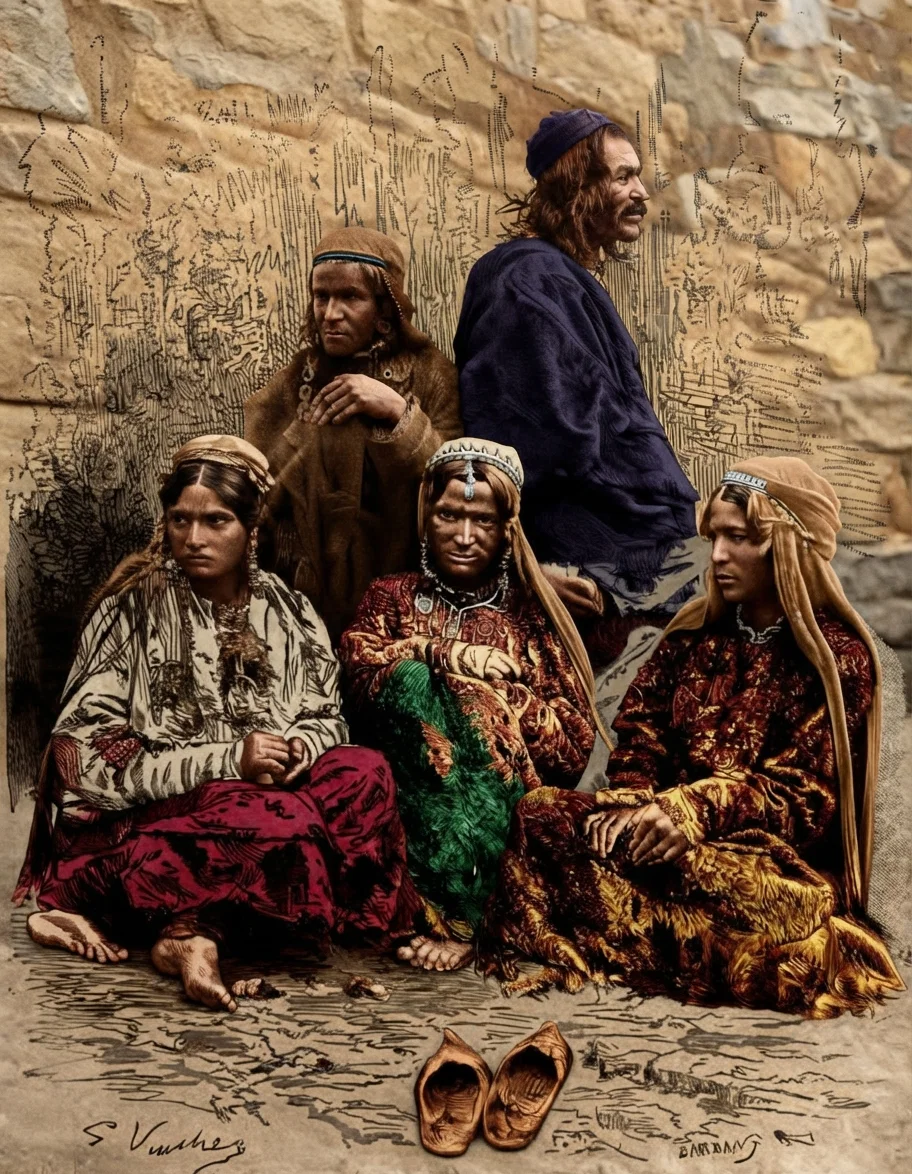
Type of North-India People.
Calcutta, India.
PEACE IN THE STORM.
A BEAUTIFUL story is told of Benjamin Parsons, who was one of the greatest preachers of his day. He was lying on his death-bed, and a friend, coming in to visit him, inquired, "Well, Parsons, how is it with you?" A smile of perfect peace shone on his face as he answered, "I am resting sweetly on three pillows, infinite power, infinite love, and infinite grace." All these meet in Jesus Christ, and one who lives close to Christ may pillow his head on these three pillows.—S. S. Times.
AGENTS WANTED
For Wall
Mottoes
New
Imported
Styles
Finest in
the World
*
YOU CAN
EARN
$4.00
Per Day
Selling
These
Mottoes
35c sample and agent's terms for 15cts.
Write at once to MRS. O. E. CUMMINGS,
Box 114, College View, Nebraska
OUR WORK AND WORKERS.
By Editor
FIVE new Sabbath-keepers at Senjen, Minn., are the fruit of labor by Brother George L. Budd.
BROTHER F. H. WESTPHAL, who recently went to Chile, reports having begun meetings in Spanish and German.
THE Southern Illinois Herald reports three new Sabbath-schools in that conference—at Tower Hill, Pontoosuc, and Carmi.
AT Detroit City, Minn., three persons have recently begun the observance of the Lord's Sabbath, as a result of the circulation of literature.
THE brethren at Ukiah, Cal., have erected a new house of worship, the first Seventh-day Adventist church building in Mendocino County.
EMMANUEL MISSIONARY COLLEGE, at Berrien Springs, Mich., was opened for the winter term on the 5th inst., under the supervision of Prof. N. W. Kauble.
THE missionary secretaryship of Southern Illinois Conference has fallen to the lot of Brother S. J. Quantock, formerly of Missouri. Miss Pearl L. Rees, who has held the position in the past, has been obliged to resign, on account of the ill health of her mother.
THE Mexican Field, organ of our Mexican Mission Field, reports six new members recently added to the church in Tacubaya, as a result of Bible-readings given by Brother F. C. Kelley. It may be worthy of note that Brother Kelley was formerly employed in the book department of this office, and took up the study of Spanish while thus engaged. He afterward went to South America as a self-supporting missionary, and has served the cause in various parts where the Spanish is the principal language. Our young people would do well to make a note of this.
FROM an interesting letter in the Wisconsin Reporter, written by Sister Minnie L. Westphal, from Mexico, December 10, we take this extract: "Five months ago to-day I arrived in Mexico—truly a stranger in a strange land, yet many have been the blessings which I have enjoyed from a kind Father's hand. My work as governess in a Spanish family, I have greatly enjoyed. Six girls, ranging from eight to eighteen years of age, are in my care, and, being with them constantly, I realize that my influence is unlimited, and that I need much heavenly wisdom in training these young minds in the right channel. Only a few years ago this family were staunch Catholics, but, through the instruction and influence of their former governess, Miss Winifred Peebles, who is at present teaching at College View, Neb., they gave up their Catholic ideas and began to study the Bible for themselves. They soon learned that Christ alone can forgive sins, and little by little caught new glimpses of light. They have much influence in their home town."
ONE of the institutions in the South that needs especial help just now, is the Nashville Sanitarium. On a small scale it is doing a good work, which started from the unaided efforts of two nurses—Brother L. A. Hansen and wife—a few years ago. An appeal from Brother Hansen for much-needed assistance to give the institution the facilities necessary for its important sphere of influence, says: "We are at present in rented buildings, that are partly equipped and furnished. We are in much need of some of the simplest sanitarium facilities. We have an excellent family of workers, physicians, and nurses. A good class of patrons are coming. We ought, of course, to be able to care for them. The institution is already self-supporting, but can not make advance moves in securing permanent buildings or equipment without assistance from others. We ask you now if you will help us in this good work. We realize there are many calls, both from your home field and elsewhere, but surely none will lose by giving heed to as many calls as possible. If the Lord presents openings for us, we must be glad and ready to fill them as far as possible. If you are not prepared to give as much as some one else, do something, even tho it be but a little. Drafts, money orders, or pledges, should be sent to Nashville Sanitarium, Church and Vine Streets, Nashville, Tennessee. If, for any reason, you send donations for this work to any other office, local or general, state plainly what it is for."
WANTED FOR MISSIONARY WORK.
(Always prepay postage.)
Any of our denominational periodicals and tracts. Address, George L. Stiles, 256 Center Street, Canandaigua, N. Y.
Patience
“PATIENCE is a noble virtue. Nothing requires more strength. Passion is a sign of weakness and want of self-control; patience is an evidence of inward might.”
HANDSOME
BISQUE DOLL FREE
Sleeping Bisque Doll.
OLIVOILINE
is the
Hygienic Cooking Oil of To-day
A Pure Vegetable Shortening. No Animal Fat. No Taste and No Chemicals.
Like Olive Oil, and Keeps in Any Climate
Price, F. O. B., Cash with order
5 gal. can, $3.50; 10 gal. can (75 lbs.), $6.75. Write for circulars on Bbl. and ½-Bbl. lots.
(Refined Cotton Seed Oil, 10 Gallons, $5.50)
Address O. C. GODSMARK
2005 Magazine St. LOUISVILLE, KY
The most careful farmers and gardeners everywhere place confidence in Ferry's Seeds—the kind that never fail. FERRY'S SEEDS have been the standard for 49 years. They are not an experiment. Sold by all dealers. 1905 Seed Annual free for the asking. D. M. FERRY & CO., Detroit, Mich.
Childs' Giant Pansies
Did you ever see a straight or singler one of
Did you ever see 5 straight or circular rows of Pansies side by side, each a different color? If so, you know that the effect is charming. Did you ever see Childs' Giant Pansies, marvels in beauty and true to color? If not, you have not seen the best
As a Trial Offer we will for 10 cts. mail 5 Pkts. Giant Pansies, Snow White, Coal Black, Cardinal Red, Pure Yellow, Azure Blue; also
Five Pkts. New Giant Sweet Peas for 10 cts., White, Pink, Scarlet, Blue, Yellow; also
Five Pkts. new early flowering Carnation Pinks for 10 cts., Scarlet, White, Pink, Red and Striped— or All 15 Pkts. for 25 cts.
Our Catalogue for 1905—Greatest Book of Flower and Vegetable Seeds, Bulbs, Plants and New Fruits. 148 pages, 500 illustrations, many plates —will be mailed Free. Scores of Great Novelties.
JOHN LEWIS CHILDS, Floral Park, N.Y.
INDIVIDUAL COMMUNION CUPS
Send for FREE catalogue and list of
nearly 3,000 churches using our cups.
Sanitary Communion Outfit Co.
29th Street, Rochester, N. Y.
THE NORTH-WESTERN LINE
RUSSIA-JAPAN ATLAS.
Send ten cents in stamps to R. R. Ritchie, No. 617 Market Street, San Francisco, for Russo-Japanese War Atlas, issued by the Chicago & Northwestern Railway, three fine colored maps each 14x20, bound in convenient form for reference. The Eastern Situation shown in detail with tables showing relative military and naval strength and financial resources of Russia and Japan.
NOTICE.
For sale or lease on profit-sharing basis, the equipment and good-will of Sanitarium Treatment Rooms, located in one of California's best towns. Address J. R. F., care Signs of the Times, Mountain View, Cal.
FOR SALE.—Treatment Rooms established three years. Equipped for management by man and wife. Address Mrs. M. E. Coffin, Santa Rosa, Cal.
OLIVES.
Good, large, ripe Olives—60 cents a gallon. Smaller ones 50 cents. Green, 50 cents. Address A. E. Crist, Yuba City, Cal.
Our New Mottoes
By Editor
Help the work for the blind by selling
Our New Mottoes.
Eight different designs. New in the United States. E. W. Hampton has sold 4,800 in the vicinity of Lincoln during the summer. It paid him; it will pay you.
These are pictures that speak. We are publishing literature for the blind, and the proceeds from the sale of these mottoes is used for carrying forward this work.
BUY YOUR MOTTOES OF US
Five doz. or more sent flat, express pre-paid. Less than five doz. sent by mail, post-paid, rolled. Sample of any 35c motto 15c, post-paid.
WRITE TO-DAY
L. N. Muck, Office of Christian Record, College View, Neb.
THE HOME
WHILE WE MAY.
THE hands are such dear hands;
They are so full; they turn at our demands
So often; they reach out,
With trifles scarcely thought about,
So many times; they do
So many things for me, for you—
If their fond wills mistake,
We well may bend, not break.
They are such fond, frail lips
That speak to us. Pray, if love strips
Them of discretion many times,
Or if they speak too slow or quick, such crimes
We may pass by; for we may see
Days not far off when those small words may be
Held not as slow, or quick, or out of place, but dear,
Because the lips are no more here.
They are such dear, familiar feet that go
Along the path with ours—feet fast or slow,
And trying to keep pace—if they mistake
Or tread upon some flower that we would take
Upon our breast, or bruise some reed,
Or crush poor Hope until it bleed,
We may be mute,
Not turning quickly to impute
Grave fault; for they and we
Have such a little way to go—can be
Together such a little while along the way—
We will be patient while we may.
So many little faults we find,
We see them; for not blind
Is love. We see them, but if you and I
Perhaps remember them some by and by,
They will not be
Faults then—grave faults—to you and me,
But just odd ways—mistakes, or even less—
Remembrances to bless.
Days change so many things—yes, hours,
We see so differently in suns and showers—
Mistaken words to-night
May be so cherished by to-morrow's light.
We may be patient; for we know
There's such a little way to go.
—Selected.
A TEMPERANCE PICTURE.
“It was in the beautiful bar-room of the Taber Grand in Denver,” said Eli Perkins. “A group of handsome young men were laughing and drinking, when a poor, tottering tramp pushed open the swinging door, and, with sad eyes, looked at them appealingly.
“ ‘Come in, senator, and drown your cares in the flowing bowl,’ they said jeeringly.
“ ‘I will come in, thank you,’ he said, ‘for I am cold and hungry.’ ”
“ ‘Take this brandy, senator,’ they said mockingly, ‘and drink our health.’ ”
“After swallowing the liquor, the tramp gazed at them for an instant, and then, with a dignity and eloquence that showed how far he had fallen in the social scale, he began to speak:
“ ‘Gentlemen,’ he said sadly, ‘I wish you well. You stand where I stood a few years ago. You and I complete the picture of my life. I was, alas, a senator! My bloated face was once as young and handsome as yours. This shambling figure once walked as proudly as yours. I, too, once had a home, and friends, and position. I had a wife as beautiful as an artist’s dream, and I dropped the priceless pearl of her honor and respect in the wine-cup, and, Cleopatra-like, saw it dissolve, and quaffed it down. I had children as sweet and lovely as the flowers of spring, and I saw them fade and die under the curse of a drunken father. I had a home where love lit the flame upon the altar and ministered before it, and I put out the holy fire, and darkness and desolation reigned in its stead. I had aspirations and ambitions that soared as high as the morning star, and I broke and bruised their beautiful wings, and at last strangled them, that I might be tortured with their cries no more. To-day I am a husband without a wife, a father without a child, a tramp without a home to call his own, a man in whom every good impulse is dead. All, all swallowed up in the maelstrom of drink.
“ ‘Young gentlemen,’ he said, as he passed out into the darkness, ‘whichever way you go, whether you follow your mothers’, wives’, and children’s, prayers, and enjoy their love on earth and dwell with them in heaven, or whether you become a saddened soul, forever lost, like me, I—I wish you well.’ ”
“I shall never forget that sad picture,” continued the humorist. “It was wit and humor ending in pathos. Tears dimmed the eyes of youth as they watched a despairing soul disappearing in the darkness.”