IT is in perfect accord with true scientific reasoning that we have been proceeding thus far. We have been reasoning from the known to the unknown, from the more perfectly understood to the less perfectly understood. We have tested the evolution theory by comparison with standards of truth concerning the value of which every Christian is perfectly settled. We have seen that the theory of man having been made through a long series of developing germs, molusks, quadrupeds and savages, up to his present state, is not only contrary to the express statements of the Bible regarding creation, but makes of the Creator a tyrant and a fiend, and is thus contrary to the whole tone and spirit of Christianity from Genesis to Revelation; and that, furthermore, its general acceptance is preparing the way, as nothing else could ever have done, for a religio-military despotism to take the place of democratic government.
The arguments in favor of Evolution are confessedly very obscure and intricate; and now having tested the general trend of the doctrine by other and far more certain standards of truth, we have found it wanting, sadly, wretchedly wanting.
How Men Came to Believe in Evolution.
But this much being settled, and the theory having been found to be a terrible delusion, we may next seek to find out just where and how the slip has been made; just how the scientific mind has been tricked and its reason fooled into believing it. For we can not think that men like Darwin, Huxley, and Mivart were guilty of palming off upon the world what they themselves knew to be only a delusion.
Our first means of testing the theory under examination must be in the field of ancient history and archeology. For if man has sprung from the lower forms of life up through the savage to the civilized condition, we shall be able to find something confirming it in the conditions revealed at the dawn of history. It is really most natural thus to work backward upon the supposed history of development; for there are certainly some leading facts about man's early history that are a thousand times more certain than most of the supposed generalizations of Darwinism or Geology.
What Does History Say?
What, then, are the conditions revealed as the curtain rises on the first scenes of recorded history? Briefly, I may say that we have well civilized tribes scattered over all the continents, in Peru, Mexico, the central plain of North America, Western Europe, Egypt, Babylonia, Assyria, and the East, each possessing a civilization seldom equaled, save in very modern times, and in some respects, not excelled by any, and of such a character, and so undeniably related to one another as to prove that their civilizations must have had a common source in some civilized state before they were scattered abroad. It is also very strongly suggested in many ways that this primal home of civilized man before his dispersion is somehow lost in the geological changes which have taken place. In addition we shall find that the history of languages confirms the record of Babel; while all nations have not only traditions of the Flood, but of an Edenic beginning; and at this first glimpse we get of human society, they give us in their social customs, and embalmed in the dry husks of their dead formalism and idolatry, glimpses of lofty ideals and forms of prayer to one supreme God, the Creator—all traces of a more intellectual, a more truly human state in the dim forgotten past, the afterglow of a once brighter day.
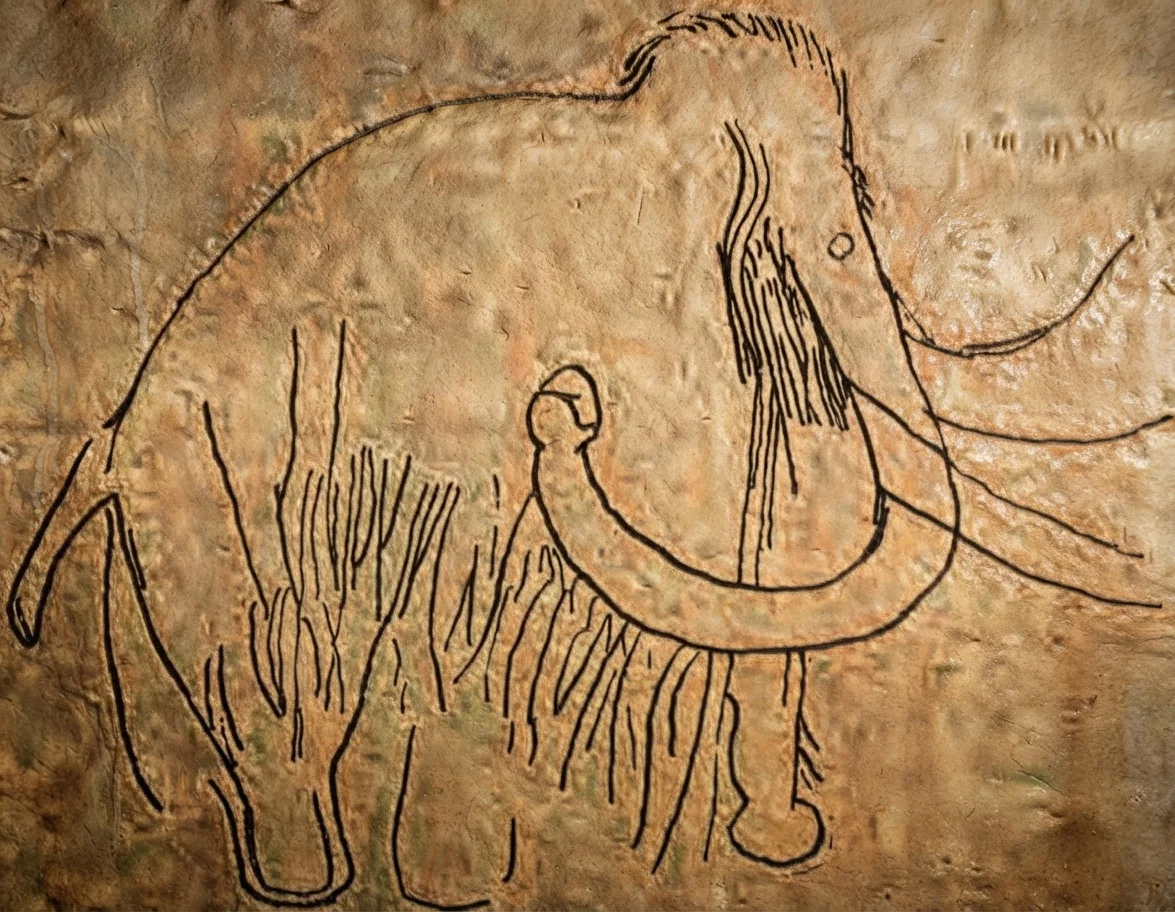
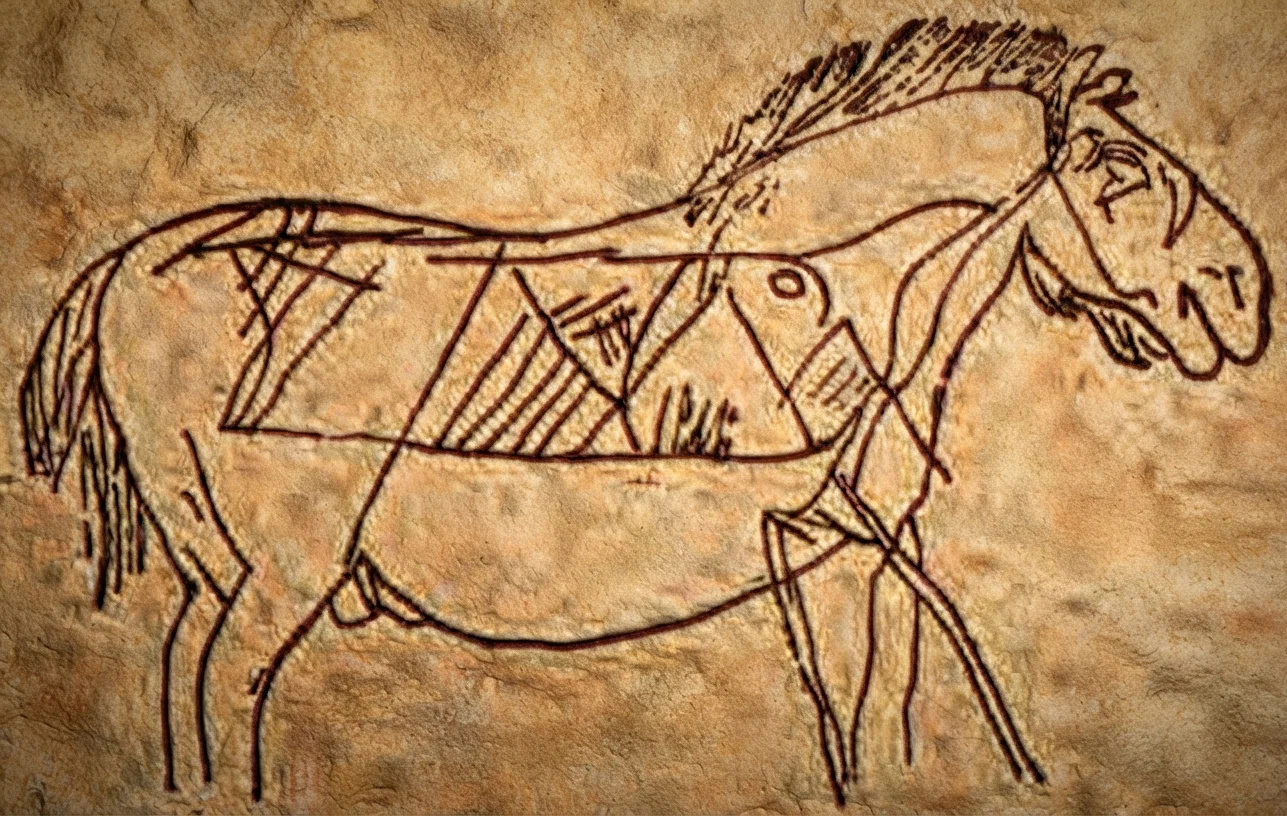
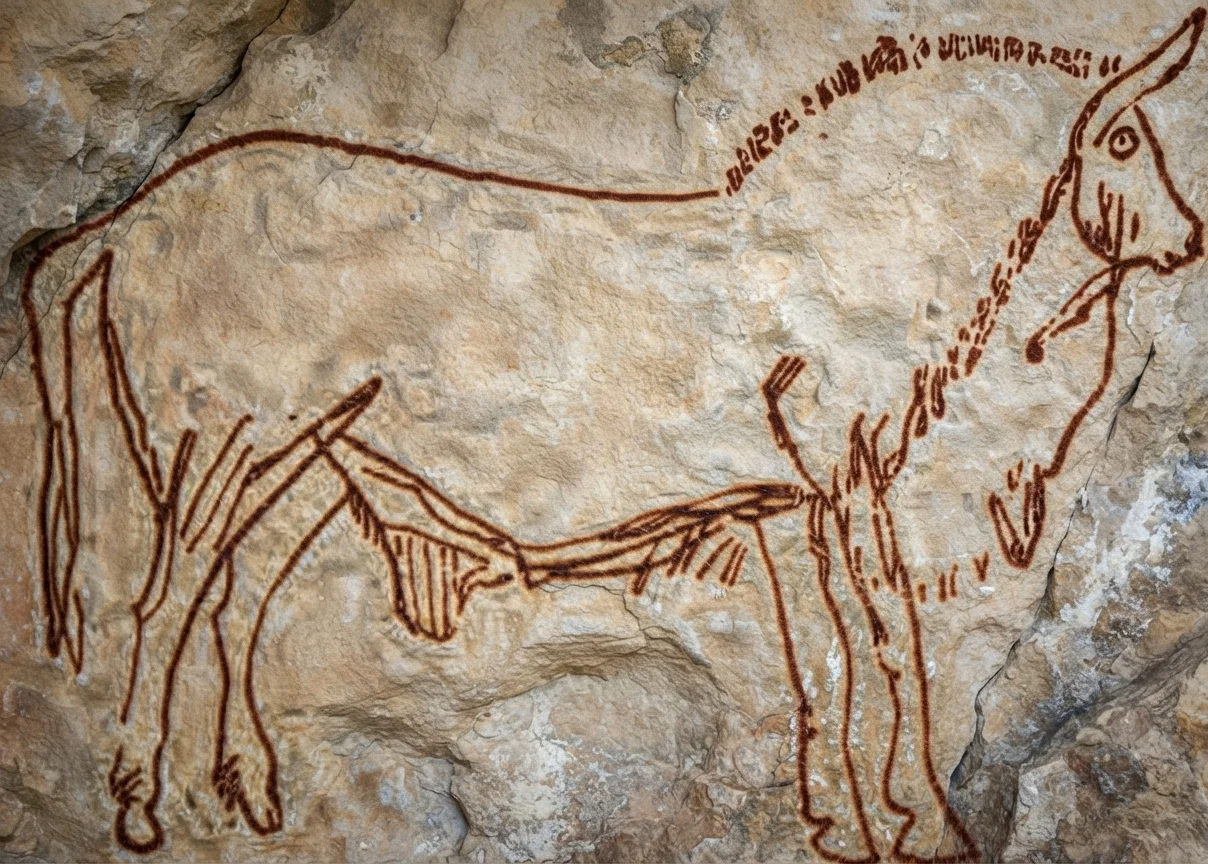
Figure of a mammoth chiseled on the walls of caves in southern France. This great elephant must have been contemporaneous with the man who drew his picture, and also with the other animals shown herewith, whose likenesses adorn the walls of the same caves—the horse, the gnu, and the reindeer. The saddle on the horse shows that he was used for the same purpose then as now.
The Connection between the Races of the Two Hemispheres.
We may first note, then, that about fifteen or twenty centuries before the Christian Era, there were peoples possessed of a high degree of civilization spread over practically all the northern hemisphere, and over some tropical countries. The monuments of Peru, Mexico, and Yucatan, which are the astonishment of every traveler, testify to this fact for the localities which they represent. Every one is familiar with those stupendous remains in Peru and Yucatan, and I can not enter into a detailed description of them here. Suffice it to say that there are very many points about these peoples which connect them closely with Ancient Egypt and the far East.
The Central American architecture resembles in many ways that of Egypt.
The Peruvians, Aztecs, and other American tribes embalmed their dead, as did the Egyptians and some others of the ancient oriental nations.
The hieroglyphic writings of the Mayas, so abundant on the walls of their ruins in Central America, are closely related to those of Egypt, and these are "the only two phonetic systems of the alphabet in the world"—Ignatius Donnelly, "Atlantis," page 232.
"It is a very remarkable fact," says Alfred Maury, "that we find in America traditions of the Deluge coming infinitely nearer to that of the Bible and the Chaldean religion than among any people of the Old World."—"Atlantis," page 98.
The skeletons of the Peruvians, Mound Builders, etc., show a remarkable degree of what scientists call "platicnemism," or flattening of the tibia or leg bones, a striking peculiarity found also in many of the skeletons of Western Europe, some of which, as we shall afterwards see, are clearly antediluvian, and others very early post-diluvian.
The races in America give us very numerous representations of the elephant (or the mammoth), which show a close resemblance to the drawings of the elephant on the cave walls of southern France, which certainly carry us back near to the time of the Deluge, or beyond.
Taken together, the above facts clearly prove (a) that the ancient American races are closely connected with the most ancient civilizations in the Old World, (b) that they were in a civilized state themselves before they separated from the latter, and (c) that this dispersion must have occurred long centuries before the Christian Era, probably (d) very soon after the Flood,—the latter being a well-defined event for which we shall find abundant scientific proof.
Is It Development or Deterioration?
If we go to the Old World, we have first the Dolmens or Cromlechs scattered over almost all Europe, North Africa, and parts of Asia. Some will have it that it was a rude state of life to which these people had attained. Certainly they had a hard lot, and possessed few of the comforts and luxuries of life. But I can not believe that the tribes who thus took so9much pains to construct elaborate and substantial tombs for their dead, involving with their rude implements a degree of skill and patient labor which we can scarcely imagine,—I say I can not believe that these people were of the type which we call savages. It is true they had no electric lights or morning papers, no telegraphs or telephones, not even brandy or cigars, all of which are, in the fancy of some superficial thinkers, the criteria of civilization. But we must own that they possessed what we call pluck to an unexampled degree.
Works left by the very earliest races on all the continents testify that these people possessed a strength of mind and body unequaled at the present time. It required an indomitable courage to attempt, and a patient perseverance to carry out, works before which any modern race of men, I care not who, would quail utterly and never think of attempting, if limited, like these their ancestors, to the rude implements which they could individually manufacture from the rocks and ores. Compared with the men who built the sphinx and the pyramids in Egypt, Birs Nimrod at Babylon, the temples and Teocallis in Cambodia and Java, and the almost identical, tho larger, ones in Mexico and Central America, Stonehenge in England, or even the mound of Cahokia in Illinois, we moderns are sadly degenerate in physical and moral courage.
We must also own that these ancient observers of nature, thus scattered almost contemporaneously over all the continents, who understood all the leading principles of astronomy, including the rotundity of the earth, twenty centuries or so before the Christian Era, and who in their wonderful works display a mastery of all the leading principles of civil and mechanical engineering, were not without mental training, albeit they had no sumptuously bound books, and no morning papers delivered at their door. With no facilities to help them, they accomplished wonders; hence they possessed abilities. We accomplish less, with every facility; have we evolved from them by development, or have we degenerated?
Egypt and the Development Theory.
But let us look at ancient Egypt a little nearer. There is no evidence that her civilization was developed in that country itself, and abundant evidence to show that it must have been received full grown from some other locality—doubtless through Babylon from the antediluvian world. As a writer in Blackwood's Magazine expressed it a few years ago:
Till lately it was believed that the use of papyrus for writing was introduced about the time of Alfred the Great. Then Lepsius found the hieroglyphic sign of the papyrus-roll on the monuments of the twelfth dynasty. Afterward he found the same sign on monuments of the fourth dynasty, which is getting back pretty close to Menes, the proto-monarch; and indeed little doubt is entertained that the art of writing on papyrus was understood as early as the days of Menes himself. The fruits of investigation in this, as in many other subjects, are truly
most marvelous. Instead of exhibiting the rise and progress of any branches of knowledge, they tend to prove that nothing had any rise or progress, but that everything is referable to the very earliest dates. The experience of the Egyptologist must teach him to reverse the observation of Topsy, and to "spect that nothing growed," but that as soon as men were planted on the banks of the Nile, they were already the cleverest men that ever lived, endowed with more knowledge and more power than their successors for centuries could attain to. Their system of writing, also, is found to have been complete from the first.
But what are we to think when the antiquary, grubbing in dust and silt of five thousand years ago to discover some traces of infant effort—some rude specimens of the ages of Magog and Mizraim, in which we may admire the germ that has since developed into a wonderful art—breaks his shins against an article so perfect that it equals, if it does not excel the supreme stretch of modern ability? How shall we support the theory [of development] if it came to our knowledge that, before Noah was cold in his grave, his descendants were adepts in construction and in the fine arts, and that their achievements were for magnitude such as, if we possess the requisite skill, we never attempt to emulate?
As we have not yet discovered any trace of the rude, savage Egypt, but have seen her in her very earliest manifestations already skilful, erudite, and strong, it is impossible to determine the order of her inventions. Light may be thrown upon her rise and progress, but our deepest researches have hitherto shown her to us as only the mother of a most accomplished race. How they came by their knowledge is matter for speculation; that they possessed it is matter of fact. We never find them without the ability to organize labor, or shrinking from the very boldest efforts in digging canals and irrigating, in quarrying rock, in building and in sculpture.
Or, in the words of Ernest Renan:
Egypt at the beginning appears mature, old, and entirely without mythical and heroic ages, as if the country had never known youth. Its civilization has no infancy, and its art no archaic period. The civilization of the Old Monarchy did not begin with infancy. It was already mature.
CLXXXVI
By J. E. Carmichael
How They Became Convinced
[Believing it would be of interest to our readers, the editor of the SIGNS OF THE TIMES has asked Sabbath-keeping ministers and evangelical workers to tell in a few words the scripture or scriptures, the truths and principles, which constrained them to accept the unpopular truth of the seventh-day Sabbath. These testimonies must not exceed 500 words. Let us hear from all.]
CLXXXVI.
FROM my earliest remembrance to my fifteenth year I attended Sunday-school, my mother being an earnest Sunday-school worker. At that age I had committed to memory several chapters and many short passages of Scripture, including the first three chapters of Genesis, the Ten Commandments, and the Sermon on the Mount. By comparing these scriptures with other scriptures as I read or heard them I became curious to know why the first day of the week was observed as the Sabbath instead of the seventh. I asked several preachers why and when the Sabbath was changed, and where any mention of the change could be found in the Bible. But I received only evasive and unsatisfactory answers, most of them claiming that the law was abolished at the Cross, because of man's inability to keep it; and that since then the commandments were not binding, and man was under grace.
By comparing the statement that God, at creation, rested and blessed and sanctified the seventh day (Gen. 2:1-7), with the Ten Commandments, wherein He commanded us to remember the seventh day to keep it holy, I was convinced that the Sabbath was instituted at Creation, and was also given in the written law at Sinai. However the claim of the preachers that the law was abolished, confused me, for Christ certainly taught that "till heaven and earth pass" even "the least of these commandments" are binding. Matt. 5:17-19. Also, according to Luke 4:16, it was Christ's custom to observe the Sabbath and to teach in the synagog on that day. And His disciples "rested on the Sabbath day according to the commandment." Luke 23:56. Likewise Paul's custom at Corinth, some twenty years later, was to work six days and spend the Sabbath day in preaching and teaching. See Acts 18:1-4, 11.
Yet in spite of these and other scriptures, the preachers contended that Sunday was the Sabbath, and that I did not understand the scriptures. So I became discouraged because they could not show me from the Bible why they believed as they did, and why they preached as they did on this and some other subjects. Finally, at the age of twenty I renounced religion as a myth, and preachers as hypocrites. I laid aside my Bible, and did not open it again for ten years, and then only after I had met, for the first time in my life, a person who observed the seventh day as the Sabbath.
A short time after this I had the privilege of hearing a series of sermons preached by a Seventh-day Adventist minister in a tent. I readily saw that he preached the plain Word of God as it is, upholding the commandments of God and the testimony of Jesus Christ. Then I soon rejoiced in identifying myself with this unpopular Sabbath truth, and united with those commandment-loving people.
J. E. CARMICHAEL.
THE POWER OF FORGIVENESS.
THE power of forgiveness even for an offense against human law is well illustrated in the following incident:
A soldier was about to be brought before his commanding officer for some offense. He was an old offender, and had often been punished. "Here he is again," said the officer, on his name being mentioned; "flogging, disgrace, solitary confinement, everything has been tried with him." Whereupon the sergeant stepped forward, and apologizing for the liberty, said: "There is one thing that never has been done with him yet, sir."
"What is that?" said the officer.
"Well sir," said the sergeant, "he has never been forgiven."
"Forgiven!" exclaimed the colonel, surprised at the suggestion. He reflected a few minutes, ordered the culprit brought in, and asked him what he had to say to the charge.
"Nothing sir," was the reply, "only that I am sorry for what I have done."
Turning a kind and pitiful look on the man, who expected nothing less than that his punishment would be increased with the repetition of his offense, the colonel addressed him, saying:
"Well, we forgive you."
The soldier was struck dumb with amazement; tears started in his eyes and he wept like a child. He was humbled to the dust, and, thanking his officer, he retired to be the old refractory, incorrigible man?—No! from that day forward he was a new man. He who told the story had him for years under his eye, and a better conducted man never wore the Queen's colors.—Selected.
The Spirit and the Bride Say Come
"The Spirit and the bride say, Come. And let him that heareth say, Come. And let him that is athirst come. And whosoever will, let him take the water of life freely."
RELIGIO-POLITICAL AFFAIRS IN EUROPE.
By Jean Villeumier
(From our own correspondent.)
WHAT will be the outcome of the present movement in France toward separating the state from the Church of Rome?—No one knows. One thing, however, is certain: M. Combes and his friends, of the governmental party, are in dead earnest in their antagonism to, and even hatred for, the papal church.
The bills that are now pending before the French chambers are remarkable in many respects. On the whole, they must be admired for their consistency. The principle of separation between the realm of politics and that of religion is carried to its farthest and most logical conclusions. All support to the clergy is withdrawn. All the church edifices, which are the property of the state, will be leased or sold to such church organizations as may desire the use of them. The embassy to the Vatican is to be suppressed. In a word, the divorce is to be a complete one. And from the standpoint of pure theory, the outlook, to liberty lovers, would seem very encouraging and bright.
But one important fact must not be overlooked. The issue in France is not parallel to that which brought about the separation between church and state in America one hundred and twenty-five years ago. Then, the idea was liberty based on the Gospel; now, it is liberty without, or even against, the Gospel. There, it was separation of the church from the state entanglements in the very interests of the church itself; here, it is separation of the state from the church in order to muzzle her, and with the secret hope of destroying her influence on society. In America, the issue had the sympathy of most of the churches concerned. In France, those most concerned by it—the Catholic clergy and people—consider the same issue with indignation and alarm.
From this entire dissimilarity, it would not seem reasonable to expect from the present movement in France the same peaceful results which were won in America, and the influence of which has been productive of so much good all over the earth. Undoubtedly, the intentions of many liberal politicians in France are excellent. So were the intentions of the men who inaugurated the French Revolution in 1789. The discourses of Mirabeau, for instance, were not only masterpieces of eloquence, but directly in favor of the rights of conscience and the separation of the church from the state. The charter of human rights drafted by the same men of 1789, and set forth as the basis of the Revolution, is admirable. But that did not prevent the Revolution from running into untold excesses.
The Catholic Church will never welcome the idea of being severed from the state. This is against her inmost life and principles; and yet, she will make the best of the separation when it does come. Once severed from its political attachments, she will ply all her forces toward increasing her influence over the masses, and thereby conquering a political majority which may bring her back to her former position. Count Henri d'Arnim was once discussing with the marquess Alfieri—niece of Cavour, the famous Italian patriot of the days of Garibaldi—the value of her uncle's famous maxim: Chiesa libera in stato libero (a free church in a free state). He thus summed up his views: "Do you wish to know the outcome of this foolish fancy?—It is this; it simply means: Chiesa armata in stato disarmato (an armed church in an unarmed state). The state has no more weapons with which to resist the church, while the church can make use of all her weapons." The best of these weapons is the ballot, which she is using now with so much success in Germany, Switzerland, Italy, and France.
To come back to the bills providing for the divorce between the French Government and the Catholic Church, several of these have been presented to a large legislative committee appointed for the purpose. Recently, M. Combes has been requested to present one, also, in behalf of the government. One article in this bill is significant. It authorizes religious associations to organize for the purpose of owning property only within the limits of each department (there are eighty-six in France), and requires that the trustees of any religious edifice must reside in the canton (county) in which said edifices are located. This would bring to naught—to say nothing of the Catholic Church—the present organization, and even the existence of most of the Protestant missionary organizations, in France. The idea is, evidently, to prevent the organization of large Catholic national boards for the owning and control of church property, when the separation shall become a fact.
This, like the whole story of the present cabinet and the one which preceded it, shows that in France there is a determined and desperate fight on the part of the liberals and freethinkers against the efforts of the Roman hierarchy toward controlling the minds and bodies of the nation. The weapons used are laws enacted under the colors of liberty, and enforced with a distinct smack of intolerance. But the same weapon, it must be remembered, can be used by the Catholic party, and it may be depended upon that they are preparing to use it with a vengeance. And should they ever—which is by no means an improbable event—control a majority of votes in the Chamber, it will not be long before this whole legislation will be thrown overboard, and a new class of laws introduced. This, at least, is what the conservative deputies boastingly and openly predict to their antagonists of the Bourbon Palace, and which has been the case in Spain since the short-lived republican government in 1873.
In Spain.
The religio-political agitation going on in France has had its reflection in Spain, in the form of a lively discussion between the clerical and the liberal press. The papers representing the former—El Siglo, El Futuro, El Universo—give all their sympathy to the hundreds of monks and nuns who have gone over to Spain to seek a refuge and a field of usefulness (?). These papers are shocked and indignant at the sight of the "eldest daughter of the church" talking of breaking loose from the Holy See, and this at the very time when the Spanish Government is discussing the adoption of a new treaty with Rome. This treaty (convenio) is said to be a complete surrender to all the claims of Rome and an endorsement of all the concessions made to the hierarchy by the conservative cabinets from 1876 to the present time.
On the other hand, the liberal press—El Heraldo, El Imparcial, El Liberal—and all the republican papers—claim that the break between the French Republic and the Vatican contains "useful lessons for Spain," which is, in their estimation, "the land upon which weighs most heavily the yoke of clericalism and Vaticanism." This fact is evidenced by the last census, which shows that there are in Spain hundreds of congregations, made up of 14,000 friars, 2,000 Jesuits, and 42,000 nuns. These figures were collected before the immigration of orders from the Philippines and France.
During this same controversy in the press, allusion was made by the liberal papers to the struggles which took place under even such monarchs as Charles V., Philip II., Philip V., and Charles III., and the resistance which they made against papal encroachments. The fact was recalled that, during the minority of Isabella II., in 1836, the "company of Jews" was suppressed, as it had been in 1767, in all the Spanish dominions.
All these struggles toward the intellectual and religious emancipation of France, Italy, and Spain will amount to very little, unless they are based on the Gospel of Christ, and unless the only weapon used is the Word of God. Would that Protestants in these lands where they number by thousands and tens of thousands might remember that it was the old Bible which conquered Rome in France, Bohemia, and Germany, in the fourteenth, fifteenth, and sixteenth centuries.
Sunday Laws.
Unless they do this, these very enemies of Rome will ultimately play as tools in her hands. They are even now doing this by giving their support to Sunday laws, which constitute a denial of religious liberty and an acknowledgment of the doctrinal authority of the Church of Rome against the Bible.
Spain has just passed a law enforcing the Sunday rest. Italy is greatly agitated over the question. France is being silently worked on the same question by a large organization which has hundreds of local committees. Belgium is rapidly ripening for the same thing, the government having adopted a system of postage stamp which provides for not delivering mails on Sunday, according to the wish of the senders. And in Switzerland, Geneva, after eight years' struggle, has at last succumbed to the persistent efforts of the friends of Sunday laws; a rather mild enactment has recently been introduced, and carried through the legislature of that canton, "with the hope that more stringent laws will soon follow" this entering wedge.
Thus do we see that the only effective opposition to Romish intolerance and control is that based on the Gospel, and that the only laws which can be operative against church-and-state union are those written, not in the statute books only, but in the hearts of the people. JEAN VILLEUMIER.