The Youth’s Instructor, Vol. 32, No. 14.

THE OSPREY

The Youth’s Instructor

Apr 2, 1884

S. D. A. Publishing Association · Battle Creek, Mich. · Apr 2, 1884

THE OSPREY.
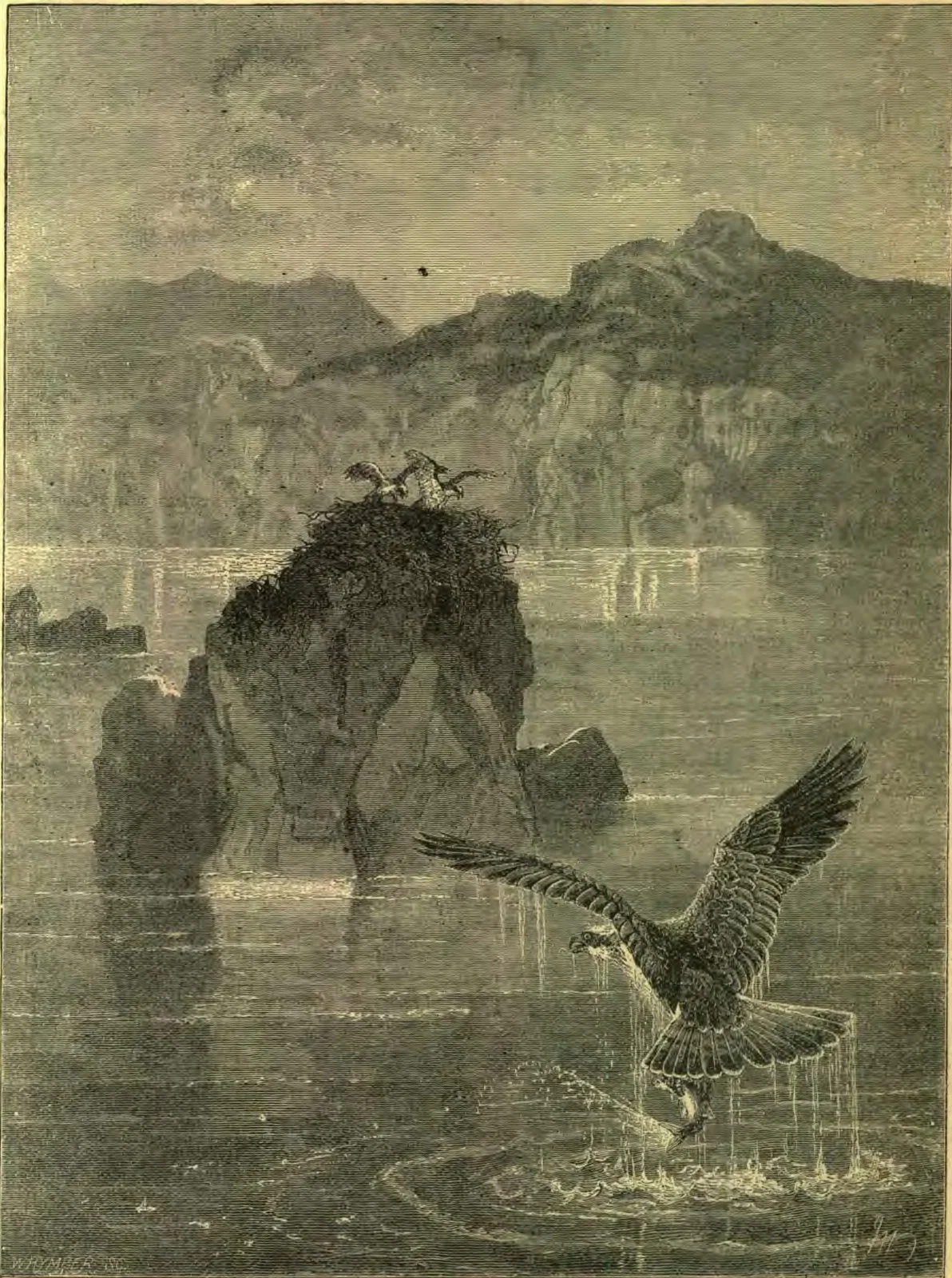
Soon as the sun, great ruler of the year, Bends to our northern climes his bright career, And from the caves of ocean calls from sleep The finny shoals and myriads of the deep; When freezing tempests back to Greenland ride, And day and night the equal hours divide, True to the season, o'er our sea-beat shore, The sailing osprey high is seen to soar, With broad, unmoving wing. Now, circling slow, He marks each straggler in the deep below; Sweeps down like lightning! plunges with a roar! And bears his struggling victim to the shore. — Wilson.
Most awful is thy deep and heavy boom, Gray watcher of the waters! Thou art king Of the blue lake; and all the winged kind Do fear the echo of thine angry cry. How bright thy savage eye! Thou lookest down, And seest the shining fishes as they glide; And poising thy gray wing, thy glossy beak Swift as an arrow strikes its roving prey. Ofttimes I see thee, through the curling mist, Dart, like a spectre of the night, and hear Thy strange, bewitching call, like the wild scream Of one whose life is perishing in the sea. — M'Lellan.

HOW A FAILURE BROUGHT SUCCESS.

About the year 1775, there stood near Canterbury Cathedral, in England, a very unpretending barber-shop. The apartment was small and plainly furnished, and the proprietor a poor man, earning a livelihood by his trade. But the shop was always neat, and the master always obliging, and so both grew to be favorites, and were patronized especially by the clergy, from the archbishop down. The barber was a sensible man, and from seeing so much of people of talent and culture, he learned to value very highly the advantages of education. He had an only son, a good boy of studious habits, and he took great delight in teaching him. But by the time the lad had turned fourteen, he had learned all his father could teach him, so far as books were concerned, and then the barber applied to his friend, the archbishop, to know what to do next. After examining the boy, and finding he had so well improved the opportunities he had already enjoyed, the archbishop obtained admission for him to the king's school; and a year or two afterward, still hearing good accounts of him, he resolved to “make the lad's fortune” by placing him in the cathedral choir, to fill a vacancy that had just occurred, where he would be comfortably maintained, and finally receive a salary of three hundred and fifty dollars a year. But another person had also applied for this position; and when the votes came to be counted, Charlie Abbott, the barber's son, despite the influence of his clerical friends, was found to have lost the election.
He was mortified and dispirited by this failure, but roused himself to action, determining that if he could not be what he would, he would, at least, be what he could. So he returned to school, studied harder than ever, prepared himself for college, entered Oxford as a free student, and, amid many obstacles and discouragements, graduated with high honors, and fought his way up to fame and fortune. Though born a barber's son, he lived to become a peer of England's proud realm, and was known as Lord Tenterden, chief-justice of the King's Bench, the highest of the English courts. When quite advanced in years, and loaded with honors, he, in company with an associate judge, attended service at Canterbury Cathedral. At the conclusion of the closing anthem, he looked wistfully up into the choir, and then, turning again to his friend, said, as he pointed upward to a gray-haired chorister: “There is the only person I ever envied, and I have lived to thank God that I was disappointed in the dearest wish of my heart, and driven out from the path in which I would fain have walked. When the old man and I were boys together, we were rival candidates for a vacancy in the choir to this cathedral. I was defeated, and for a time could scarcely be reconciled to the failure of my most cherished plans. But had I succeeded, he might now be accompanying you as chief-justice, and pointing to me as the church chorister. That early defeat was the door to victory; and that which I once regarded as my greatest misfortune, I now rejoice in as God's method of choosing for me far better than I could have chosen for myself.”—Christian Weekly.

LEAVING HOME AND NATIVE LAND

FOREIGN TRAVEL.—NO. 1.

LEAVING HOME AND NATIVE LAND.

HAVING been called by important business to leave our own country to travel for a season in other lands, and having received an invitation to furnish a series of articles for the INSTRUCTOR, we now attempt the fulfillment of our promise. The articles will be nothing more than homely sketches of the common experiences of a traveler in foreign lands, and scenes beheld from the ordinary standpoint; yet we trust they may impart some useful information.
The first experiences of such a trip are never pleasant. As we bid adieu to those we love, possibly never to see them again, thoughts of the dangers and disagreeable experiences we must meet in months of wandering from home and friends, among strangers whose language we do not understand, pass rapidly through the mind, as the cars whirl us onward to the place of sailing. How much pleasanter to stay with those whom we know and love!
Reaching New York City, the point of departure, our party spent some time in looking at objects of interest in this great metropolis of the Western World. It is a great city indeed. In the radius of comparatively a few miles, in the city itself and in those connected with it, over two millions of people live. Only five States in our great country have each as many people as are congregated within this small space. One or two millions more go through this city every year. Hundreds of thousands of seamen visit it, bringing their cargoes from every land and clime. Miles of ships are made fast to its wharves, loading and unloading their cargoes. Ferry boats, heavily loaded with passengers, constantly pass and repass each other upon North and East Rivers.
The elevated railroads are quite a curiosity. They run many miles up and down the island on which the city is built. They are raised up high enough so that other cars and vehicles can pass under them. They are built very strongly on high iron frames, and have little engines of a peculiar pattern. They carry vast numbers of people every day. It seems strange to be riding along high enough to look into the people's chambers. By means of these roads, people can at night be carried out ten or fifteen miles to their homes, and can come into the city to do their business in the morning, at an expense of only five or ten cents. So they can live almost out in the country, and yet in the city too. This is much better than to live so crowded as they would otherwise be obliged to do. On the elevated railroads they can in a few minutes go as far as they could in hours of travel on foot or in horse-cars.
But we must go on shipboard. We have started on a foreign trip, and this ship is to be our home for nearly two weeks. We are taken down stairs into a dark-looking room, and through a narrow passage to our own room. This room, called a state room, is some six feet long by eight in width. High up, there is a little circular window securely bolted. It is about ten inches across, with glass about an inch thick. It has on one side what one would call two shelves, one above the other, perhaps six feet long by two wide, with high side boards to each. These are called berths. A passenger sleeps in each. The side boards keep him from rolling out when the boat rocks. On the opposite side is a sofa berth. A wash-bowl, glass, and various toilet articles are provided, and all well fastened. A bottle of drinking water, with two glasses, are set down in holes cut for them in a frame constructed for the purpose, so the rolling sea cannot shake them out. Our quarters seem very small to a green land'sman. But we must remember we are not out in the broad country, but within a small space confined by strong walls. We are to cross the mighty ocean.
Our friends, who have great fears about fresh air, look at their windows and small quarters with some anxiety as to where the air is to come from. But it is well always to make the best of everything, and we are content.
The time arrives to depart. The whistle blows twice. Friends shake hands, and hurry away. The gangway is hauled off. The captain takes his position on the highest point, and calls out in strong, commanding tones to let go the ropes. The noble ship moves out into the stream. Hats and kerchiefs are waved by friends on wharf and boat, as we slowly fade from each other's sight. Shall we see their faces again? We hope to do so in this world; if not, in a better. We rapidly pass out to sea. The great city disappears from sight. Soon the great ocean appears to view.
After riding an hour or two along the Jersey shore on one side and the islands of New York harbor and Long Island on the other, we come in view of Sandy Hook, formed by a deep bay on the Jersey side, and a long point on the ocean side of it running up in the form of an immense fish hook. Up at the point it is a sandy beach. This is our last land. A little boat comes up to our ship's side, the engine stops, a rope is thrown out from our ship, the man in the boat grasps it, and the little boat swings up to the side of the great steamship. The pilot, who has guided our ship down the channel, runs down a rope ladder on the ship's side, and drops into the little boat. Then our engine starts again, and we are now out at sea. No more connection with native land till we return again. Will that ever be? So we hope.
UNCLE IDE.

EDITOR'S CORNER.

AGAIN “the time of the singing of birds is come,” and so musical are these little creatures after their long silence, that it is easy to imagine they are singing praises to the Creator for the glad spring-time. As we listen to their praise songs, we feel that it would become us to catch their glad refrain, and swell the chorus until the air should resound with “thanksgiving and the voice of melody.” David says, in Psalm 47, “Sing praises unto our King;” “for God is the King of all the earth.” The heart of the Christian who delights in God’s word, and feasts upon his promises, will at times run over with joy, and break forth into singing. We pity melancholy Christians, who seldom, if ever, sing. If they would give vent to praise in song, they would find a cure for their sadness, and would form a closer union with heaven.
“It is good to sing praises to our God.” Ps. 147:1. Try it, dear readers, not only when you feel the spirit of song, but when you are tempted and perplexed, and see how quickly the tempter will flee, and how easily you can dispose of troublesome things. There are some who know the worth of song to lighten the heart and the burdens of life. We have in mind a circumstance in the life of one who esteemed the privilege of singing more than wealth,—a poor, hard-working man, a linen-weaver by trade, who loved and trusted God. While engaged with his work, his clear, strong voice might be heard, early and late, singing hymns and innocent songs. Indeed, no other alarm was needed in the morning to arouse his neighbors.
But one of them, a wealthy merchant, who was so anxious about his money that he seldom slept before midnight, did not like to be disturbed by the weaver’s music so early in the morning, and he decided to put an end to it. He knew he had no right to forbid his singing in his own house, so he thought to hire him to stop. He accordingly sent for the weaver, and asked him what value he placed upon his singing. In reply he said he thought it was worth a day’s wages, as it helped him so much in his work. The merchant was satisfied with his price, and counted out a month’s wages in advance, and gave to him if he would sing no more.
The weaver took the money, promising to keep very quiet. It was more money than he had ever possessed, and he was very joyful as he carried it home. He counted it over, and looked at the bright coins for some time; then, for fear it would be stolen from him in the night, he placed it under his pillow. He would frequently awaken, for he was troubled to know what to do with it. In the morning he was so burdened with it that it seemed to weigh him down like lead. His hands refused to do their usual work, and he dared not sing as he had previously done, so that he had a very dreary day. Before bedtime he found his way back to the merchant, and gave him his money, telling him it was “an evil spirit which would not allow him to sleep quietly.” Before the merchant could speak to him, he had gone out, singing in his clear, full voice,
“A fresh and merry heart Is worth more than money or wealth.”
David says, “I will sing with the spirit, and I will sing with the understanding also.” “I will sing praises unto my God while I have any being.” Let us learn praise lessons from the birds, or, as Paul exhorts, let us sing and make melody in our hearts to the Lord. M. J. C.

SPRINGTIDE

Now fades the last long streak of snow, Now sprouts forth every maze of quick About the flowering squares, and thick By ashen roots the violets grow.
Now rings the woodland loud and long, The distance takes a lovlier hue, And drowned in yonder living blue, The lark becomes a sightless song.
Now dance the lights on lawn and lea, The flocks are whiter down the vale, And milkier every milky sail On winding stream or distant sea;
Where now the seamew pipes, or dives In yonder gleaming green, and fly The happy birds that change their sky To build and brood; that live their lives
From land to land; and in my breast Spring wakens too, and my regret Becomes an April violet, And buds and blossoms like the rest.
—Tennyson.

GOING WEST SEVENTY-FIVE YEARS AGO.

SEVENTY-FIVE years ago, young Samuel Hall left his wife and babies in the old home in the Connecticut Valley, and came into what was then “the West,” prospecting. If you look on the map, following the Mohawk River along its westward course, to where it seems to turn to the north, you will find its source in that direction. Just to the west of this turn you may find the city of Rome set down; not the Rome of ancient and sometimes fabled history, but our quiet little city of Central New York, known before the Revolutionary War as Fort Stanwix, and during the war as Fort Schuyler. It was Fort Schuyler which was besieged by Colonel St. Leger in 1777. He had under his command an army of British soldiers, some Americans who favored the Royal party and were known as Tories, and a large number of Indians. About seven miles east of the fort, at Oriskany, a company of American soldiers on the way to help the people at the fort, fell into an ambush, and four hundred of them were killed or taken prisoners by the Indians. General Herkimer was so badly wounded that he died a few days later. I have been upon this old battle-ground, and seen what is left of the tree under which they say the brave old general lay after he fell from his horse. After a while the army which St. Leger commanded was so much lessened by the withdrawing of the Indians, that he concluded to give up the siege.
It was here, on this historic ground, that young Mr. Hall determined to make a home for his little family. Striking out from the then small village of Rome, he passed through dense and unbroken woods, not only unbroken, but untrodden. A narrow trail led to some small settlements further on. At length his choice was made, the home was located. It was spring, and soon a clearing was made, ground plowed, and corn planted. A cabin of logs was built, and things were made as comfortable as possible. Then he went back for his family, expecting to return in time to harvest his crop of corn and get settled for the winter. With two strong horses and a covered wagon such as was called an “emigrant wagon,” he conveyed his family and all their household goods to the new country.
What a sad parting that was which took place as they all left the old home. It was then a long way to Central New York, farther than half around the world would seem now! Mails were infrequent, so that letters as well as visits must necessarily be rare. Day after day, for more than a week, they rode, until one morning, a few hours only after they broke up camp, they came out upon a rise of ground where there was a clearing before them, and Mrs. Hall exclaimed,—
“What a pretty view!” There was a stream of water winding through the valley, and Mrs. Hall afterward said,—
“I never dreamed it was to be my home, but I thought it was the prettiest spot I had ever seen, and I have never changed my mind about it.”
And it was home. Upon the brow of the hill stood their cabin in which they were soon settled. And after a little the neighbors began to call upon these new-comers. Their nearest neighbor was two miles away! three miles in another direction was the second! These settlers had helped the young pioneer with his log-rolling, and now came with their wives to welcome the family. Soon others came to settle near them, then others, until the whole country was inhabited. A school-house and a church were built, and presently a large frame house took the place of the little log one, and the children grew up and married, and the old people lived on in the same place till they died.
Only a few years ago, not many months since, I attended a golden wedding in the old house; the wedding of one of the little ones who traveled in that emigrant wagon on that long, slow journey up the valley of the Connecticut, winding through passes of the range of hills that bounds the New England States on the west, then keeping to the low ground of the Mohawk Valley. One of these had been fifty years married, and relatives and friends came together to celebrate. Some of the guests had likewise traveled in emigrant wagons and lived in log-cabins, and the younger ones gathered around to listen to their stories of pioneer life, and some way as we listened to these reminiscences, we seemed to be living in a very tame period. We said within ourselves, “What wonderful material these people have for story-telling. We shall have nothing like it to tell our grandchildren when we are old.” We never rode in a great canvas-covered wagon, nor hunted a bear, nor were lost in the woods, nor rode forty miles to mill and the post-office. But one old lady summed it all up by saying, “Marvelous are the ways by which the Lord has led us.” That comforted us; we could say that.—The Pansy.

NEW-TESTAMENT HISTORY.

LESSON 181.—PAUL MEETS WITH THE ELDERS AT EPHESUS.

1. On what occasion did Paul continue his speech until midnight? Acts 20:7.
2. What accident took place? Verse 9.
3. How was the young man restored? Verse 10.
4. How long did the meeting continue? Verse 11.
5. What arrangements had been made with reference to the continuation of the journey? Verse 13.
6. How were these arrangements carried out? Verse 14.
7. How long was the voyage continued? Verse 15.
8. Why did not Paul visit Ephesus at this time? Verse 16.
9. How did he obtain an interview with the elders? Verse 17.
10. How did he address them? Verses 18, 19.
11. How faithful had he been in teaching them? Verse 20.
12. How had he testified both to the Jews and to the Gentiles? Verse 21.
13. In what condition of mind was he now going to Jerusalem?
14. What evidence did he have? Verse 23.
15. How did Paul feel about these things? Verse 24.
16. What sad thing did he say about leaving them? Verse 25.
17. What did he call upon them to witness? Verse 26.
18. Why was he thus free from blame? Verse 27.
19. What solemn admonition did he give them? Verse 28.
20. What perils awaited them? Verses 29, 30.
21. What reference did he make to his own example? Verse 31.
22. What hope did he set before them? Verse 32.
23. What doctrine of kindness and generosity had he inculcated both by precept and example? Verses 33–35.
24. Describe the parting scene. Verses 36–38.
25. How was Paul’s voyage completed? Acts 21 : 1–3.

NOTES.

ACTS 20:7. And upon the first day of the week.— This is the only instance, in the entire New Testament, where a religious meeting is said to have been held on the first day of the week.
Ver. 9. Eutychus.—The meaning of this name is, one that had good fortune. This was remarkably true in his case.
Ver. 13. Assos.—A sea-port town in Mysia, on the north shore of the gulf of Adramyttium, over against the island of Lesbos.—Whitney. It was between Troas and Mitylene. The distance to it from Troas by land was about twenty miles, while the voyage around Cape Lectum was nearly twice as far, and accordingly Paul chose to go afoot.—Barnes. We must not forget that Paul took this long walk on the first day of the week. It was a very rough road. One of the ancient writers says, “It was enough to kill one to go on foot to Assos.”
Ver. 14. Mitylene.—The capital of the island of Lesbos, in the Ægean Sea, about seven miles and a half from the opposite point on the coast of Asia Minor.—Whitney. It was distinguished by the beauty of its situation, and the splendor and magnificence of its edifices.—Barnes.
Ver. 15. Chios.—A noted island in the Ægean Sea between Samos and Lesbos, belonging to Ionia in Asia Minor. Anciently it was celebrated for its wine.—Whitney. Samos.—Also an island in the Ægean Sea, near the coast of Lydia, about five miles from the promontory of Trogyllium, over against Miletus.—Ibid. Trogyllium.—This is the name of a town and promontory of Ionia in Asia Minor, between Ephesus and the mouth of the River Meander, opposite Samos. The promontory is a spur of Mount Mycale.—Barnes. Miletus.—It was a city and sea-port, and the ancient capital of Ionia. It was about forty miles from Ephesus.—Ibid.
Verse 22. Bound in the Spirit; i. e., impelled or directed by the Holy Spirit. Wakefield’s version reads, “I feel myself forced in my mind.” Sawyer’s translation reads, “I go constrained by the Spirit.” This makes the idea very plain that he felt a solemn sense of his duty through the witness of the Spirit of the Lord.
Ver. 26. Pure from the blood of all men.—He had discharged his duty in faithfully warning and teaching them; and now, if they were lost, the fault would be their own, not his.—Barnes.
Ver. 28. Flock of God—purchased with his blood.—In some of the Syriac Testaments it reads, “Flock of the Messiah.” Alford’s edition of the New Testament says, in a foot-note, “Some ancient manuscripts have, ‘the Lord.’” This gives a better sense. This last reading is adopted by Griesbach, Lachman, Tischendorf, and Tregelles.
Chap. 21:1. Rhodes.—This was also an island in the Grecian Archipelago. On the island was a city of the same name, which was principally distinguished for its brazen Colossus. It stood across the harbor, and was so large that vessels could pass between its legs. It was reckoned as one of the Seven Wonders of the world.—Barnes. Patara.—A maritime city of Lycia, in Asia Minor, over against Rhodes.—Ibid.

Go Forth to the Battle of Life

Go forth to the battle of life, my boy, With the peace of the gospel shod; And before high Heaven do the best you can For the great reward and the good of man, For the kingdom and crown of God.

Taking the Whole Armor of God

“FOR we wrestle not against flesh and blood, but against principalities and powers. . . . Wherefore take unto you the whole armor of God, that ye may be able to withstand in the evil day, and having done all, to stand.”

Guiding Souls Straight by the Cross

WHEN the English General Wolseley was setting out for his final battle in Egypt, he took an intelligent young Scotchman for his guide. Before the army started, he charged the young man most solemnly: “See that you guide me straight; guide me by the star.” The guide was mortally wounded in the battle that followed. When the commander heard this, he visited him; and when the dying man saw him, his eye brightened, and he said in broken words: “Didn’t I guide you straight, General! Didn’t I guide you straight!” And the General was glad to answer, “Yes.” We are set as the guides of souls across this world to God’s bar, and the prayer of every one in our class or church is, “Guide me straight.” When at the end we meet these souls, can we appeal to them and say, “Didn’t I guide you straight?” We must guide them by the cross if we would have this satisfaction at the last.—Westminster Teacher.

Notes on the Sabbath School Department

For additional Notes, see S. S. Department in Review for April 1.

STRIKING OUT FOR HIMSELF.

Somebody opened the door of a great counting-room—a small boy with patched pants. He spoke to the cashier.
“Can I see Mr. Allen?”
Mr. Allen, the proprietor, was often too busy to be seen. But the cashier, won by his pleasant face and funny little air of business, pointed the little stranger to an inner office.
“Thank you, sir,” said the boy, hastening to enter the door.
Mr. Allen sat before his desk, reading a letter. He was so interested that he did not see the boy, who stood a moment at his elbow, and then said, almost in his ear,—
“Good morning, Mr. Allen.”
Mr. Allen started, turned his head, and eying his caller from his smooth hair to the well-blacked but worn shoes, asked,—
“Do you wish to see me, youngster?”
“Yes, sir. I’m striking out for myself,” looking as tall as possible. “Mother’s sewed for both of us long enough. I’m going to earn my living now.”
“Ah,” said Mr. Allen, leaning back in his chair, and fixing his keen blue eyes on the brave young face, “can’t your father support you?”
“No, sir. He died when I was a baby. And before that mother had to sew for both. He never struck out, sir, except to drink.”
“You don’t propose to strike out in that way?”
“No, sir!” He spoke with manly decision. “Have you anything for me to do?”
“I fear we have nothing for a small person like you. My clerks, you see, are all men.”
The boy looked through the open door into the wide, elegant counting-room. Yes, they were all men, some gray-haired and dignified.
“Don’t you have any errands, sir?” he persisted. “I’ll do them very quickly.”
“Those two porters at the lower end of the room do all such work.”
“I should think one was too fat to get along very fast, there are such crowds in the streets.”
“Would you have him turned away on that account?”
“Oh, no, sir! I wouldn’t have nobody put out into the cold to get me in,” shivering as if he had often felt the cold. “I only thought I might slip about where he couldn’t. Maybe I ought not to bother you; but I liked your store, and mother heard say you was once a poor boy yourself!”
“So I was! So I was!” The fine blue eyes kindled. “That’s why I talked with you, my little man. I like your spirit. I believe you will be successful. Keep trying,—you’ll find a place,—apply at the large dry-goods stores that employ boys. Let me know how you succeed.”
Two weeks later, somebody entered the office again, dressed in a rubber coat so long and large that he looked like a small tent; but the bright face was instantly recognized by the cashier. As before, he asked to see Mr. Allen, entered the private office, and again startled the absorbed gentleman with a cheerful,—
“Good morning, Mr. Allen.”
“Well, how do you get on?”
“First-rate. I’ve just engaged at Mr. White’s, sir, for two dollars and a half a week. I thought I’d drop in, and let you know.”
How his eyes shone!
“That is good news. Where do you live?”
“At Cambridge.”
“Won’t the car fare make quite a hole in your salary?”
“No, sir. I walk.”
“You’ll succeed!” Again the merchant’s eyes kindled. “Well, call often, I’d like to hear from you.”
The boy lingered.
“I don’t go to work till to-morrow morning, sir,—loafing this afternoon. Haven’t you something I can do? I’d like to give mother a lift to-day.”
The gentleman’s hand moved toward his pocket, but was withdrawn as the boy suddenly receded, with a hot flush on his wan and hungry cheek.
“I wanted to earn money, sir. Have those men done up all your errands? Or maybe you’d like some windows washed? My rubber coat would come in handy.”
The idea of the little fellow cleaning the massive plate glass! But Mr. Allen did not laugh at him. “We have a regular window-cleaner,” he said.
The boy sighed.
“I wouldn’t want to spoil his job, especially if he had a family.”
The merchant laid aside his pen, rose and went into the counting-room.
“Can’t we hunt up something for the little chap to do?” he asked the cashier, as anxiously as if he were pleading for himself. “He ought to be encouraged.”
“Those three flights of stairs to the store-room need sweeping.”
“Very well, set him at them.”
So the cashier got the watering-pot and brushes, and led the way to the upper story, the atom in the tent rustling after, beaming and brisk.
“You may sweep the store-rooms too. It requires judgment not to throw dust on all those bundles of paper.”
“I’ll be careful, sir; you can depend upon me.”
“Well, take your time,” said the cashier, on leaving. “If any one interferes, send him to me.”
The boy fell to work with a will. By and by, the janitor heard a queer scratching noise along the neglected stairs. “What are you doing? Who put you here?” he asked sharply.
“Mr. Allen,” was the reply, without a pause in the brushing. “See here, Mister, when I get through, can’t you give me something to do too? You see, I’m loafing this afternoon. I’ve got a steady job to-morrow.”
“I don’t hire nobody,” said the crusty janitor, and went away.
When the sweeper had finished, received his pay and gone, Mr. Allen came out of his office.
“Where’s the little man?” he asked, and seemed disappointed when told he was gone. “I wanted him to carry these to my son.”
The good man held two small parcels that had lain in his desk a long time. He hunted them up for the sake of employing the boy. The cashier says Mr. Allen will keep his eye on that lad. If he continues faithful, self-reliant, and eager to aid his mother, possibly there will yet be a place in the stately counting-room for the boy who decided to “strike out” for himself.—The Well-Spring.

SPRING IS COME.

I'm very glad the spring is come: The sun shines out so bright The little birds upon the trees Are singing for delight; The young grass looks so fresh and green, The lambkins sport and play, And I can skip and run about As merrily as they.
I like to see the daisy And buttercups once more, The primrose, and the cowslip too, And every pretty flower; I like to see the butterfly Stretch out her painted wing, And all things seem, just like myself, So pleased to see the spring.
The fishes in the little brook Are jumping up so high; The lark is singing sweetly, As mounting to the sky; The rooks are building up their nests Upon the great oak-tree, And everything's as busy And happy as can be.
There's not a cloud upon the sky, There's nothing dark or sad; I jump, and scarce know what to do, I feel so very glad. God must be very good, indeed, Who made each pretty thing; I'm sure we ought to love him much For bringing back the spring.
— Book of Songs.

Letter Budget.

Eva Lockwood, of Labette co., Kan., writes. She says: “I am twelve years old. I have a little sister two years old, and a brother seven. We keep the Sabbath. I learn lessons in Book No. 3. We take the INSTRUCTOR, and I like to read it. I am trying to be a good girl.”
Orson R. Eager, of Waushara Co., Wis., writes: “I am nine years old. I keep the Sabbath with my pa and ma. My pa is superintendent of the Sabbath-school. I learn lessons in Book No. 1. We take the INSTRUCTOR, and like it very much. We are going to have Bible Readings every other Sabbath. I have a little baby sister. I love her dearly. I hope to meet the INSTRUCTOR family when the Lord comes.”
Flora B. Fish writes from Calhoun Co., Mich. She says: “I am nine years old. Mr. Richard Godsmark sends me the INSTRUCTOR. I think he is very kind. I love to read it. I have to stay at home from school now to help mamma, because she is sick. Mamma helps me in my studies, as she can, at home. We keep the Sabbath, and hope to meet the readers of the INSTRUCTOR in heaven.”
Gertrude M. Newell, of Antrim Co., Mich., writes: “I am eleven years old. I read the INSTRUCTOR, and like it very much. I go to Sabbath-school, and study in Book No. 4. I have two brothers and two sisters. My mother is dead, so I am staying with Bro. and Sr. Smalley. I want to be a good girl, so that I may be saved with the INSTRUCTOR family in heaven. This is the first time I have written for the INSTRUCTOR.”
Lizzie Brown, of ——, Iowa, writes: “We have taken the INSTRUCTOR ever since I can remember. I think it is a good paper. Ma says it is the best paper that was ever printed. Ma gave me a Bible, which I am trying to read through. I want to be a good girl. I have never been baptized, but I would like to be. I am nine years old. We have no Sabbath-school, but we have a day-school. I have three brothers, who go to school with me. Ma attended the State quarterly meeting. She says it was the best one she ever attended. Pa does not keep the Sabbath, but he is very good to help us in sending for our papers. I send my love to all the INSTRUCTOR family.”

You have reached the end of this edition.

The Youth’s Instructor · Apr 2, 1884