Your ShelfYour Projects

Review and Herald, Vol. 75, No. 1.

CHRISTIAN BENEVOLENCE. — NO 1

Review and Herald

Jan 4, 1898

Seventh-day Adventist Publishing Association · Battle Creek, Mich. · Jan 4, 1898

CHRISTIAN BENEVOLENCE. — NO 1.

MRS. E. G. WHITE.
“As Moses lifted up the serpent in the wilderness, even so must the Son of man be lifted up: that whosoever believeth in him should not perish, but have eternal life.” In the Word of God alone shall we find how to secure eternal life. We are not left to conjecture as to how we shall obtain it; we are to work out the statement made, and receive the truth into the heart. Religion that comes from God is the only religion that will lead to God. “He that believeth on the Son hath everlasting life.” “And as many as received him, to them gave he power to become the sons of God, even to them that believe on his name.” The love of God revealed for man is beyond any human computation; it is infinite. And the human being who is a partaker of the divine nature will love as Christ loves, will work as he worked. The love that is inspired by the love we have for Jesus will see in every soul, rich or poor, a value that cannot be measured by human estimate. The world sinks into insignificance in comparison with the value of one soul. This love can exist, and be kept pure, refined, and holy, only through the love in the soul for Jesus Christ, nourished by daily communion with God. There will be an inborn compassion and sympathy which will not fail nor be discouraged. This is the spirit that should be encouraged to live in every heart, and be revealed in every life.
Coldness on the part of Christians is a denial of the faith. But this spirit will melt away before the bright beams of Christ’s love in his follower. Willingly, naturally, he will obey the injunction, “Love one another, as I have loved you.”
And the love of God in the heart, manifested in true, unselfish missionary labor, will be more mighty than the sword or courts of justice in dealing with the evil-doer. Often the hearts of men will harden under rebuke, but they cannot withstand the love expressed toward them in Christ. The living missionary, with his heart overflowing with the love of God, can break down the barriers. The medical missionary, taking up his appointed work, can not only relieve bodily maladies, but through the love and grace of Christ, can heal the diseased soul, leprous with sin.
The Lord has enlisted every believing soul in his service, to bring the transgressor of his law back to obedience and loyalty to Christ. He will accept those who will devote themselves to him, to work with the combined influence of the heavenly, unfallen intelligences to restore the moral image of God in man. “We are laborers together with God,” he declares; “ye are God’s husbandry, ye are God’s building.” Bid the sinner have hope, and not feel that he is an outcast from his fellows. Reveal to the desperate, discouraged sufferer that he is a prisoner of hope. Let your message be, “Behold the Lamb of God, which taketh away the sin of the world.” Present before men in your life a love higher than it is possible for you to express in words. You are laborers together with God, to bring back lost faith in God.
There is a work to do for the wealthy, in awakening them to a sense of their responsibility and accountability to God to conduct all their business relations as those who must give an account to him who will judge the quick and the dead at his appearing and kingdom. The wealthy man needs your labor in the love and fear of God. He trusts in his riches, and feels not his danger. The eyes of his mind need to be attracted to things of enduring value. He needs to recognize the authority of true goodness, which says, “Come unto me, all ye that labor, and are heavy laden, and I will give you rest.” Put off that yoke which you have manufactured for your neck, and over which you have been perplexing yourself, and take my yoke upon you. “Learn of me; for I am meek and lowly in heart: and ye shall find rest unto your souls. For my yoke is easy, and my burden is light.” “If any man thirst, let him come unto me, and drink.” “Him that cometh to me I will in no wise cast out.”
O, if the man of wealth would only listen, if he would only hear, if he would only take time to consider, he could not but discern in these invitations the superior goodness that invites him! He would see that it is the voice of the true Shepherd that calls him, and that God will give him something of more value than gold, or silver, or precious stones. O that, in the place of trusting in uncertain riches, he would realize that he is a responsible agent, a steward of the means entrusted to him; that God calls upon him to be faithful in the use and improvement of his goods; and that he may, if he will, become a distinguished worker together with God in uplifting those whom Christ came to the world to save.
The Lord has endowed man with capabilities and power and influence; he has entrusted him with his money; but these gifts are not to be lavishly spent in self-gratification. To every man he has given his work. Man is to be a co-worker with God in the great redemption. The money that God has entrusted to men is to be used in blessing humanity, in relieving the necessities of the suffering and the needy. Men are not to feel that they have done a very wonderful thing when they have endowed certain institutions or churches with large gifts. In the wise providence of God, there are constantly presented before them the very ones who need their help. They are to relieve the suffering, clothe the naked, and help many who are in hard and trying circumstances, who are wrestling with all their energies to keep themselves and their families from a pauper’s home. God never meant that this misery should exist. He never meant that one man should have an abundance of the luxuries of life, while the children of others should cry for bread. The means over and above the positive necessaries of life are entrusted to men to do good, to bless humanity. God has entrusted his goods to stewards; and if these stewards love him, they will love those formed in his image.
But too often those who are enjoying the gifts of God add house after house, and farm after farm, to their possessions. Some even build for their dogs, homes that are like palaces, and keep hired attendants to take care of them, while their fellow beings are left to misery and crime, to disease and death. How long, O Lord! how long, shall this state of things exist? God will judge the world in righteousness by that man Jesus whom he hath ordained to judge the quick and the dead; and those who have long neglected to feed the hungry, to clothe the naked, to give relief and comfort to suffering humanity, will have to render an account to God for the misapplication of his entrusted talents. What a record will then appear of money spent on pleasures and the gratification of appetite in wine and liquor and rich dainties, for extravagant houses and furniture and dress, while human beings received not one pitying look, one word of sympathy.
The principle of worldlings is to get all they can of the perishable things of this life. Selfish love of gain is the ruling principle in their lives. But the purest joy is not found in riches, nor where covetousness is always craving, but where contentment reigns, and where self-sacrificing love is the ruling principle. There are thousands who are passing their lives in self-indulgence, and whose hearts are filled with repining. They are victims of selfishness and discontent in the vain effort to satisfy their minds with indulgence. Unhappiness is stamped upon their very countenances, and behind them is a desert, because their course is not fruitful in good works.
Those who feel no special pleasure in seeking to be a blessing to others, in working, even at a sacrifice, to do them good, cannot have the spirit of Christ or of heaven; for they have no union with the work of heavenly angels, and cannot participate in the bliss that imparts elevated joy to them. But Christ says to his disciples, “If any man will come after me, let him deny himself, and take up his cross, and follow me.” I lead in the path of self-denial. I require nothing of you, my followers, but that of which I, your Lord, give you an example in my own life.
By a chain of circumstances which should call forth their charities, God bestows upon men the best means of cultivating benevolence. He designs to keep them habitually giving to help the poor and to advance his cause. He sends his poor as the representatives of himself. By their necessities, a ruined world is drawing forth from us talents of means and of influence, of which it is in perishing need. And as we heed these calls by labor and by acts of benevolence, we are assimilated to the image of him who for our sake became poor. In bestowing, we bless others, and thus accumulate true riches.

THE SECRET SPRING.

“I WILL give thee the treasures of darkness, and hidden riches of secret places.”
The Holy Spirit, in his love, Hath precious lesson given; Through pencil gift, from friend beloved, Revealing truth from heaven; Upon its side a secret spring, Which ah! the given light did bring.
Within our lives may often come Some mystery unexplained, Awakening that divinest touch, And lo! surprise unfeigned: That which had most unsightly seemed, Transmuted by the light which gleamed.
God’s providence, his written Word, All life’s most wondrous plan, Have always precious secret springs, Unknown to careless man, Which only need faith’s pressure strong To show his hand ’mid seeming wrong.
Each heart hath its peculiar spring, Which love alone can know; And oft the “touch of sympathy” Hath helped some seedlet grow, Till one o’er whom the Spirit yearned Faith’s “button” touched and quickly turned.
When we can say, in love’s sweet tone, “My springs are all in Thee,” The bitterest draft to sweet is changed By heaven’s alchemy,— The secret of the secret spring, Best known to children of the King.
— Carrie Merrall, in the King’s Messenger.

OPTIMISM — PESSIMISM.

REV. A. BOWERS, D. D.
(Piqua, Ohio.)
The play on these words has become very familiar to modern religious assemblies; and it has come to pass that a large number of the clergy in most of the churches seem to feel it binding upon them frequently to declare that they are optimists; that the world is rapidly growing better, and that any one is to be pitied who cannot see things in that light alone. Within a short time the writer has heard several clergymen and ministerial gentlemen preface their sermons, or “lectures,” with the statement that they were optimists by birth, education, and instinct; and what followed in every case proved conclusively that they had no sympathy whatever with any one who could not agree wholly with their views.
There are always two sides to every question relating to the interests of mankind; and certainly this is true with reference to the question of morals and religion.
The writer distinctly recollects that half a century ago these two words were seldom, if ever, used in the vocabulary of the pulpit; now the one, particularly, is crowded to the front by the ministry, and made to do duty on many occasions to keep up the spirits of their congregations, and compel them to believe, if possible, that everything is bright and promising for the future of society and the world.
Now why is this extreme anxiety on the part of those who are so thoroughly optimistic in their statements? There are two reasons: first, they are in earnest; or, secondly, make a pretense of being so for the sake of position and influence. Of course we must not be understood as branding our optimistic brethren with insincerity; but at the same time it is hard to believe, in the face of all the facts in society to-day, that so many men whose business it is to discern the signs of the times, can be so completely blinded or prejudiced as to keep up this constant din concerning the greatness and glory of the church, before which everybody should fall down, make acknowledgment, and worship. This very fact throws suspicion upon the cry, in the minds of thoughtful people. Can any conscientious Christian minister, whose opportunities for intelligent observation are always among the best, shut his eyes to the great sins of Christian America, and shout to-day on the side of unqualified optimism? If so, what is our hope of reformation?
Think of the great sins which confront us on every hand, and cry to heaven for vengeance,—sins against the state, against society, the family, and the individual,—sins which would put to blush members of our race in less favored lands,—murders, drunkenness, adultery, slander, arson, bribery, theft, and so on, ad nauseam. All these, remember, in our highly favored land, where the gospel is preached, and the sacraments are duly administered. Certainly, we admit, most cheerfully, that there is more light and truth among us now than ever before; but at the same time there is more wickedness also, and in consequence of the light, it is more dreadfully wicked.
Nearly twoscore years in the pastorate and presiding eldership of the Methodist Episcopal Church have afforded the writer a good opportunity to study preachers and people; and his convictions are deep and strong, that, in vital godliness and aggressive power, the church has been steadily retrograding for a number of years,— not in wealth, numbers, or social éclat, of course, but in the things which are far more essential to the salvation of the world.
Revivals are written about which never exist except in the mind of the writer. “Leagues” and “endeavors” and “brotherhoods” are formed, and numbers counted, to throw dust in the eyes of the people, and make them believe, if possible, that great successes are constantly achieved in the church of God, when the exact opposite of these things is true.
Many of these so-called “Christian” organizations are honeycombed by dancing clubs and card parties, and are largely dominated by the spirit of the world. The sad fact is that many shepherds to-day are crying, “Peace and safety” when there is no peace; they are daubing with untempered mortar, and the people are led to believe that great victories for the church are nigh at hand, which will never be achieved on the line of her present policy and movements. It is greatly to be feared that the modern pulpit has become, in many instances, the refuge for place-seekers and ambitious adventurers, who love ease and position more than they love the souls of men. In consequence of this, many pulpits in all the churches throughout the land are filled with weaklings, who give no evidence in any way of a divine call to the great work of the Christian ministry. They are there professionally merely; they went to college, then to the theological school, and at length landed in the pulpit, because their fathers were ministers, perhaps, or a classmate or friend is such. A man of some eminence, at least with respect to the churches he has served, one who occupies a prominent church in one of the first cities of our land to-day, can confirm this statement. When, on commencement day, he was questioned by his classmates concerning his future calling in life, he answered, “I am going to preach.”
A hearty laugh followed, because he was known to all as anything but an exemplary young man. “Why not?” he questioned. “I have every qualification necessary, but religion;” and again the boys laughed.
We repeat that it is greatly to be feared that the deplorable condition of the churches in many places to-day is largely due to the fact that many men are in the ministry professionally, without any proper conception of the great sacredness of such a work, as calling men to Christ.
The church still stands, thank God! for everything good and noble in the world, although her efforts to advance are greatly hindered by the half-heartedness of the ministry, and the indifference and unconcern of the professed followers of Christ.
The women of the land just now seem to be running wild after clubs and societies, until the alphabet is well-nigh exhausted in giving names to their organizations; so that they bid fair to rival the men in spending their evenings away from home in worldly society, often leaving the boys and girls to spend their time on the streets, and to be governed by their own sweet will.
O, no, my dear optimistic brethren! everything is not so bright and hopeful for the church in this country as it might be, by a long way—we are sorry to say. Society is not growing perceptibly better, very rapidly; and the outlook, to God’s devoted children, is by no means cheering. What, then, can be done to change the state of things existing even in Christian society to-day?
In view of all the facts which might be brought before us in startling array, the writer is free to say that he hopes for nothing better until the Almighty shall make bare his arm in some supernatural manner in the sight of all the people. And in what way will this be? “To your tents, O Israel”! in humiliation, confession, and supplication, before the Lord of all the earth. Mighty events are impending; and yet how few, comparatively, are watching and waiting for the coming of the King!

FOLLOWING OUR FATHERS.

G. T. WILSON.
(Cooranbong, N. S. W.)
The redemption of Israel from the temporal bondage of Egypt was intended of God to teach his people a moral lesson in every age since then. One important reason given by the Lord in his Word is that they might not do as did their fathers. So he says: “Cast ye away every man the abominations of his eyes, and defile not yourselves with the idols of Egypt: I am the Lord your God.” Eze. 20:7.
This divine counsel they were not willing to heed, and clung to the wicked practises of their parents, which had been taught them in the land of Egypt. This we learn from the eighth verse.
The Lord brought his people out of that dark kingdom, that they might be free to serve him according to his commandments; and this is what he said to the children whose fathers made the golden calf: “But I said unto their children in the wilderness, Walk ye not in the statutes of your fathers, neither observe their judgments, nor defile yourselves with their idols.” Verse 18.
What had provoked God to destroy their fathers is stated in verses 13–17, which present before us a sad picture of man’s degradation by sin, and Jehovah’s forbearance toward him, especially toward the Israelites in the wilderness. The record reads: “Yet also I lifted up my hand unto them in the wilderness, that I would not bring them into the land which I had given them, flowing with milk and honey, which is the glory of all lands; because they despised my judgments, and walked not in my statutes, but polluted my Sabbaths: for their heart went after their idols. Nevertheless mine eye spared them from destroying them, neither did I make an end of them in the wilderness.”
That has always been the trouble with the sinful children of men,—“their heart went after their idols” instead of going out after the living God. It was this proneness to do as their parents had taught them that made the Lord take the young people of Israel and try to instruct them in his way, that they might not be influenced by the evils of long-established habits. He knew that his new wine must be put in new wine-skins to keep; but he found that their early training had left its corrupting mold on the minds of the youth, and so, in spite of what the Lord did for them, he had to make this sad lament: “Notwithstanding the children rebelled against me: they walked not in my statutes, neither kept my judgments to do them, which if a man do, he shall even live in them; they polluted my Sabbaths. . . . I lifted up mine hand unto them also in the wilderness, that I would scatter them among the heathen, and disperse them through the countries; because they had not executed my judgments, but had despised my statutes, and had polluted my Sabbaths, and their eyes were after their fathers’ idols.” Verses 21–24.
If the Lord is not enthroned in the heart, there is an idol taking the place which he should occupy. The language of Ezekiel, the prophet of God, is as true of many professors of religion to-day as when first written: “Son of man, these men have set up their idols in their heart, and put the stumbling-block of their iniquity before their face: should I be inquired of at all by them?” Eze. 14:3.
There are many people who, when they make a profession of Christianity, will still cling to old habits, which are idols as much as was Baal, the sun-god of the Phenicians, whom ancient Israel so often worshiped. Customs of eating and drinking which destroy health, and break down the moral barriers of the soul; habits of dress which exhaust the purse and deform the body,—these are among those who bear the name of Christ, and are often clung to after light has come. The practises of our fathers in violating the law of God in deal, and in trampling down the Sabbath of the Lord, are clung to by nominal Christians with a zeal worthy of a better cause. Those persons who persist in having their own way in the face of what God says in his Word, will be permitted to have it; but the Lord will cut them off from the midst of his people. Eze. 14:8.

“DESTRUCTION UPON DESTRUCTION IS CRIED.”

A. O. TAIT.
(Oakland, Cal.)
“Destruction upon destruction is cried; for the whole land is spoiled: suddenly are my tents spoiled, and my curtains in a moment.” Jer. 4:20.
The evidence presented in previous articles shows something of the awful part that war is to play in the “destruction upon destruction” that “is cried” for these last days. But there are one or two additional instruments of modern warfare that should not be passed by.
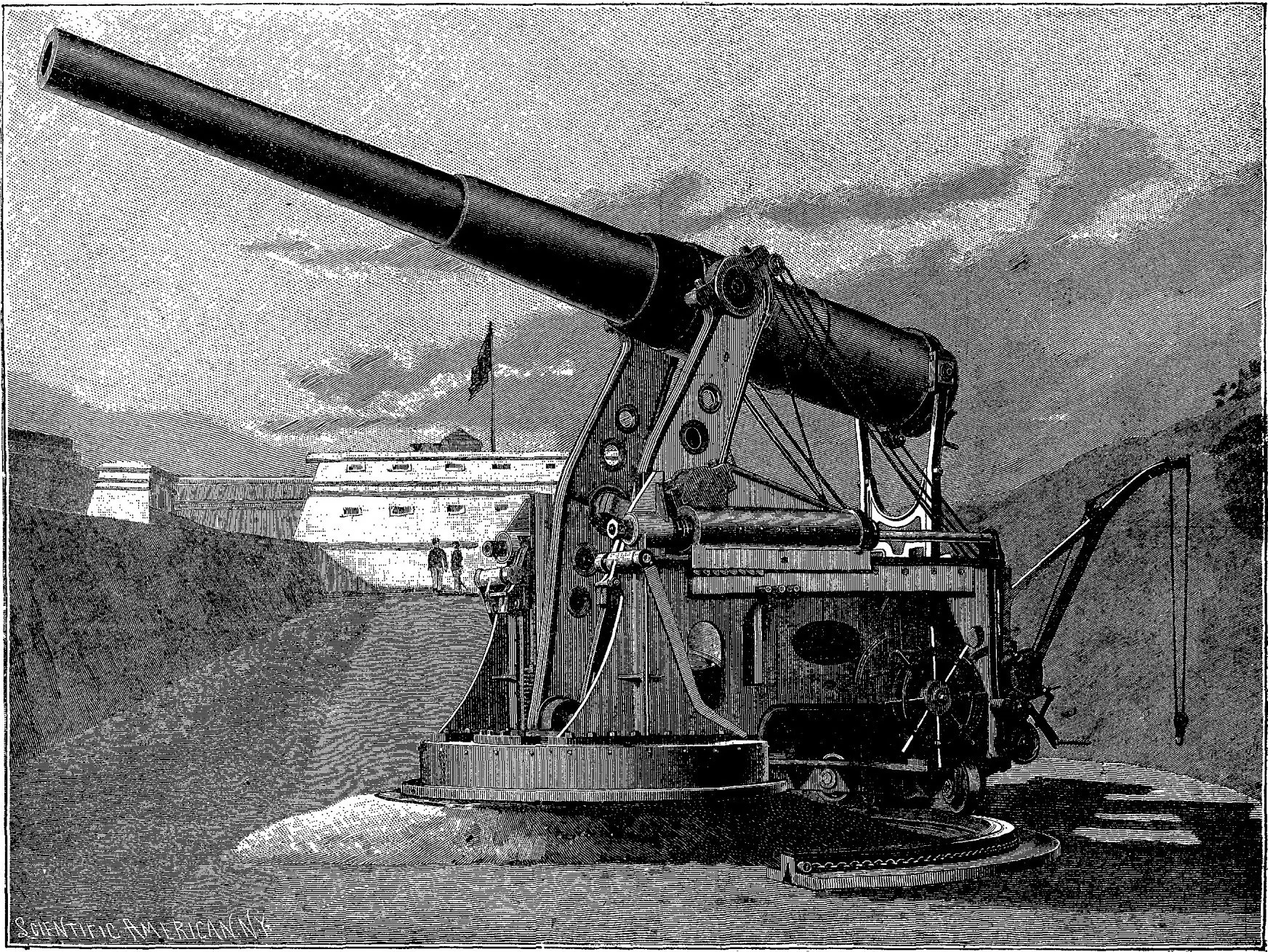
By permission of the “Scientific American.” The “disappearing gun” dropped behind the breastworks for loading. By an ingenious contrivance, this cannon is also aimed while in this position.
For genuine ingenuity, as well as powerful effect in death-dealing destruction, there is nothing superior to the “disappearing gun.” This is no less than one of the large cannon so mounted that it drops behind the fortifications for loading and aiming, and rises above them for firing. It is used, of course, mostly for coast defense and other operations on land. One of our pictures shows this gun as it appears when dropped behind the embankment, where it can be loaded and aimed without exposure from the enemy; and another shows it mounting above the embankment, like a thing of life, to fire. This gun is so quick in its action that it mounts up, fires, and drops back again before it can be seen by the approaching enemy, unless he chances to be looking at the very spot where it is situated. The ingenuity, as well as the power, of the mechanism that operates such a gun, can better be imagined than described.
There is yet another curious sort of torpedo used for coast defense, of which we are sorry that we cannot present an illustration, but it is impossible. The powerfully destructive work of the ordinary torpedo has been described and illustrated in a previous paper, so that part of it can be passed by here. The noteworthy thing about the torpedo designed expressly for coast defense is that it is propelled and guided by means of a small cable connected with an electric dynamo on land. This torpedo has, inside of it, an electric motor which drives a screw propeller, and it is also provided with a rudder. Both the electric motor and the rudder are connected with the dynamo on shore by a wire cable which reels off as the torpedo advances. A small float keeps the torpedo the proper distance under water, and also enables the operator to tell how to steer it toward the war-ship he expects to blow up. This torpedo can be guided from the shore with the same ease and accuracy that a sailor at the helm would guide his little boat. If desired, the operator can turn it around, and bring it back to land again.
When we think of the powerful cannon that have been devised and built within the last few years; when we consider the great rapidity with which they can be fired by means of the breech-loading devices; when we think of the machine guns, firing from five hundred to seven hundred times a minute; when we take into account the great accuracy with which all these guns can be aimed; when we stand in the presence of the awful power locked up in the modern torpedo, and contemplate how accurately it can be sent on its message of death and destruction; when we view the forts along the coast-line, and inland as well, and see how they are arming with these frightful weapons; when we look at a modern war-ship, and contemplate what a terrible fighting machine it is,—in the presence of all this array for furious slaughter throughout the whole world, is it any wonder that Jeremiah said, as he beheld it in vision: “My bowels, my bowels! I am pained at my very heart; my heart maketh a noise in me; I cannot hold my peace, because thou hast heard, O my soul, the sound of the trumpet, the alarm of war. Destruction upon destruction is cried; for the whole land is spoiled: suddenly are my tents spoiled, and my curtains in a moment. How long shall I see the standard, and hear the sound of the trumpet”?
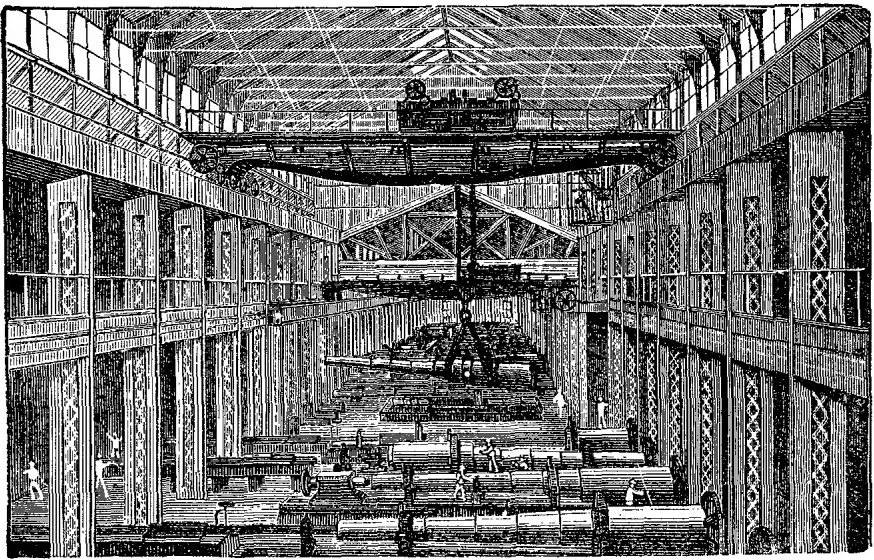
A little glimpse of the activity in the great gun factories, as well as the mammoth facilities for producing these slaughtering weapons, may be gathered from our picture of a part of the interior of the gun works at Washington, D. C. But this picture, or any other that could be made, falls far short of presenting the vivid facts. If one could get a view, not merely of a small part of the gun works at Washington, but of all the plants in the world for making guns, torpedoes, etc.; and if, at the same time, he could see the army of men building war-ships in the great navy yards of the nations; and, while viewing all this, if the ear could catch the sound of the “rumors of wars” as nation is quarreling with nation, and threatening, with maddened fury, to break forth into the arena of battle,—only then could he view the scene as it is.
By permission of the “Scientific American.” View of a corner of the factory for making guns in Washington, D. C.
And so, with the facts before your mind, allow the imagination to paint the picture of the terrible warlike preparations and warlike disposition of the world to-day, and then ask yourself the questions: Are we not, even now, standing in the very presence of “that great day of God Almighty”? Have we not reached the supreme moment when “the nations” are “angry, and thy wrath is come, and the time of the dead, that they should be judged, and that thou shouldest give reward unto thy servants the prophets, and to the saints, and them that fear thy name, small and great; and shouldest destroy them which destroy the earth”?
By permission of the “Scientific American.” The “disappearing gun” as it rises into position to discharge its immense projectile over the top of the breastworks.
Surely the evidence is increasing all about us, showing how unmistakably clear it is that the Saviour’s coming is right at hand. It should ever be borne in mind that it is not our Heavenly Father who is stirring up this dreadful spirit of war; but the “spirits of devils, working miracles,” have gone forth “unto the kings of the earth and of the whole world, to gather them to the battle of that great day.” And it being true that the “spirits of devils” are doing this terrible work, our God is simply pointing to it as one of the signs by which we may surely know that the end is near. And shall his gracious warning be all in vain?—God forbid!
The fact should never be overlooked that while Satan is preparing the nations for such an awful war, God is also preparing those who will accept him to join in the victorious song that will rise from every heart in the redeemed host who meet him at his coming. Our Master has reserved for this age of the world, when sin has plunged so many to the very lowest depths, a special luster and power for his “exceeding great and precious promises.” It is during this time, when “the devil is come down unto you, having great wrath,” that the third angel’s message proclaims the everlasting gospel to the ends of the earth, with a power and beauty never seen in the work of God before. We are even now in that time viewed by the prophet, of which he wrote: “After these things I saw another angel come down from heaven, having great power; and the earth was lightened with his glory.”
My brother, my sister, are you taking these things home to your heart and life? Are you using all your God-given powers in the service of the Saviour, and thus acting as a channel through which he can save souls from the wreck into which this world is plunging? To-day is the time of our great opportunity. What a terrible mistake if we fail to see and sense it!

Turning Away from God in Times of Need

“We seek for the power of wealth, and apply to human agencies for assistance in times of need, and to governments for protection; yet we remain deaf to the admonitions of God’s Spirit, and turn away from him who is the most potent of all benefactors.”

WHAT WOULD CHRIST DO?

MRS. S. M. I. HENRY.
(Sanitarium.)
It is perfectly clear that to be a Christian is to be like Christ; not simply to be a follower, as Judas was, nor yet as were those who were after the “loaves and fishes,” but to be like him in the mind that we carry in the hidden part, and also in the outer life, just so far as it embodies, and has its root in, any real principle of character.
The children of God have fallen into gross error, and have led the world after them into many hurtful lusts that have defiled the whole man, tainted everything he touched, and crucified the Lord again and again, because they have been so slow to understand the simple laws of life which are covered by the word “temperance.”
The great enemy of our peace long ago determined that Christ should be separated from our real lives as far as possible. Since he could not get him out of human thought, nor silence the cry of the soul that hungered for him, he has tried so to idealize him and surround him with mystery that it would be impossible for him to help us where we need him most; namely, in the sensual realm of human nature, where Satan has established his seat, and from which he so often rules the whole man. He has so trained human thought that it seems almost sacrilegious to the majority of people to speak of Christ as he really is, and has been from his birth,—a man among men.
When men and women learn the full meaning of Paul’s words when he said, “Whether therefore ye eat, or drink, or whatsoever ye do, do all to the glory of God,” and when they will live in all things in harmony with this teaching, they will begin to be Christians in truth.
Men and women are agonizing after, struggling for, praying for, the mind of Christ, with experiences which must make the angels weep, and testimonies which are practically denials of the truth, simply because they will not stop to think of what Christ would cook, and eat, and drink, what clothing he would wear, what temperature he would have in the house, and how he would conduct himself in the domestic and social relations which he himself has instituted, if he were here to live among us as a man of our own time.
Instead of taking the question up just as it is before us to-day, with consecrated common sense and intelligent consistency, they will meet every attempt to bring the truth before them with some rebuttal which seems to be found in the Bible or in the customs of former generations.
Christ turned water into wine. Why, then, should we not drink wine? Christ called fishermen to be his disciples. He gave them fish to eat. Why, then, should we not live on flesh, if we like it?
A man who had not been very long out of the gutter expressed himself on this point, in a gospel temperance meeting which I was leading, in a manner which I have never forgotten and have often quoted. He said: “Some people have been talking a good deal lately about the wine that Christ made; and I would like to tell you how it looks to me. If I should hear that Christ had come to this city, I should try to find him as soon as possible; and if at last I should come to the place where he was, and should find, apparently, two christs,—at least two men exactly alike in every way, one of whom was Christ and the other his counterfeit,—and I should be told that I had to find out which was the true, and which the false, by what they did, and I should see one of them turning water into wine,—such wine as we have these days,—and the other one trying to prevent people from taking it, while he tried to help its poor victims to sober up and learn to let it alone, I should know by this sign pretty quick which one was the true Christ. I should keep clear of a christ who would turn water into such wine as we have these days, and I should not hesitate to call the Christ who would say, ‘I will never again turn water into wine,’ ‘My Lord and my God!’”
This was from the standpoint of a man who had not yet learned of the true wine of the kingdom, which Christ has stored up in nature’s bottles, and hung on tree and vine, as food for man. To him “wine” meant only that which is poisoned by alcohol; but, unlearned as he was, he taught, in those few sentences, the great principle which alone can make possible in our day such a practical realization of Christ in the lives of men as shall illustrate what gospel temperance is.
Continue reading: A DRUNKARD’S SERMON