Review and Herald Publishing Assn. · Washington, D.C. · May 10, 1904
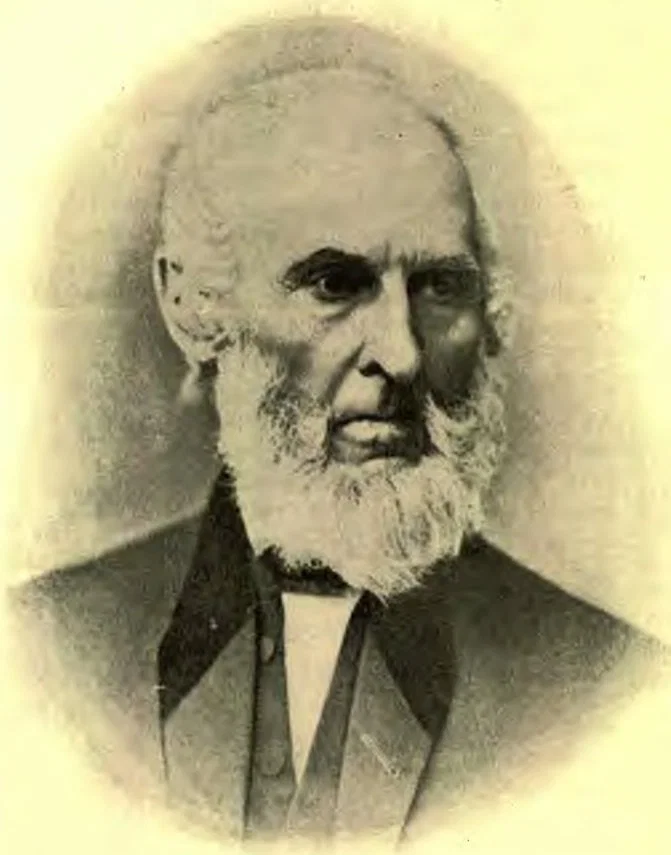
Jottings from the Life of John Greenleaf Whittier
By Carrie E. Robie
“If you wish to be successful in life, seek out some righteous but unpopular cause and stand by it till its triumph.” Surely truer words were never uttered; and to the truth of this principle an innumerable cloud of witnesses bears unerring testimony.
OUR QUAKER POET
Though Whittier’s poems in general delight our varied moods, my loving hope for our dear young people is that the principle in the man that caused him to dare stand alone, if need be, for right, in the face of unpopularity, derision, persecution, yea, even death itself, will most forcibly challenge their admiration and emulation; for we, too, have a cause to stand by, than which one more righteous never demanded our loyalty. And it is bound to triumph gloriously. Its triumph means not the suppression for a time of one evil in one little spot, but the utter annihilation of all evil forever from God’s entire universe. Its triumph means not simply the emancipation of a few thousand people from one little phase of slavery, leaving them still in vastly more galling soul-slavery, but eternal emancipation from every form of bondage, because of the chaining and final execution of the chief of slaveholders — Satan. And when this great struggle shall have thus ended, it will not leave us on this poor sin-cursed earth, to toil on a few years, then decay and die; but lands us with —
“Our toils all past, our joys complete,
Safe in our Father’s home.”
With these thoughts in mind, let us for a little time study the life of John Greenleaf Whittier, with the special object of viewing in that life “whatsoever things are true, whatsoever things are lovely, whatsoever things are of good report.”
Doubtless, as in the case of Timothy, those principles of loyalty to right dwelt first in his “grandmother Lois,” and in his “mother Eunice.”
Whittier was born a come-outer. His ancestors had severed from the English Church and cast in their lot with the despised Quakers, “when to be an advocate of this new doctrine was a sure road to martyrdom, when for preaching according to the dictates of conscience, men were flogged, chained in loathsome dungeons, half-starved, banished under pain of death, yea, more. — men of blameless lives were actually hanged as malefactors on Boston Common.”
As the history of those times was told around the old fireplace in the Whittier home, doubtless John Greenleaf’s boyish heart burned within him, and found vent in later years in earnest, fiery words resembling the lofty tone of the ancient prophets.
But let us now for a little time glance at the early life of our Quaker poet.
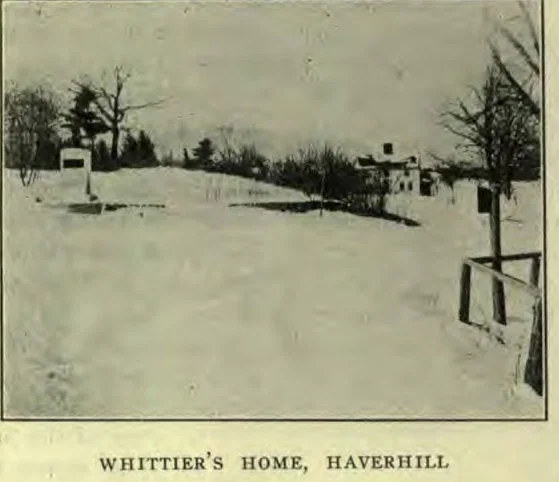
“About three miles from Haverhill, on the electric line to Amesbury, the conductor calls out, ‘Whittier’s Birthplace.’ I would very much enjoy having the INSTRUCTOR family visit this place with me. In fancy we may take the trip, stopping at a number of places of interest on the way. As we get off the car in answer to the conductor’s call, we notice a large granite slab by the roadside, bearing the inscription, ‘Whittier’s Birthplace.’ Looking up the road to our left, in plain sight from the main street, we see the house in which our poet first opened his wondering eyes. As we pass over the little old bridge spanning the brook made memorable in ‘Barefoot Boy,’ we realize we are entering memory-haunted grounds. As Whittier himself has so well described the place in ‘Snow-Bound,’ ‘Barefoot Boy,’ and other poems, I will not now go into details in my description.”
Within a few years the Whittier Club, of Haverhill, has obtained control of the place, and through the kindness of friends and relatives, has refitted it with many of the old Whittier furnishings, including chairs, tables, the poet’s old desk, his mother’s dishes, and various other things. In a large front room on the lower floor, John Greenleaf was born, December 17, 1807, the same year as his brother poet Henry W. Longfellow.
Among other interesting things in this room is a collection of old silhouettes of different members of his home. Also one of the little girls who, in his poem, “In School-Days,” says:—
“I’m sorry that I spelt the word:
I hate to go above you;
Because,”—the brown eyes lower fell,—
“Because, you see, I love you!”
But we must hasten on up the well-worn staircase to the room above, which Whittier occupied as a boy.
It has been but little changed since those boyhood days, and even now fits his description of it, where he says:—
“We heard the loosened clapboards tost,
And board-nails snapping in the frost;
And on us, through the unplastered wall,
Felt the light sifted snowflakes fall.”
Perhaps no other room is quite as interesting as the kitchen, the living-room of this estimable family. As we sit down in the now lonely and quiet room, we will let Whittier himself tell us about the dear ones who once made the room merry and bright as they sat around the very fireplace about which we are now sitting.
Of his mother he says:—
“Our mother, while she turned her wheel,
Or run the new-knit stocking-heel,
Told how the Indian hordes came down
At midnight on Cochecho town,
Then, haply, with a look more grave
And somberer tone, some tale she gave
From painful Sewell’s ancient tome,
Beloved in every Quaker home,
Of faith, fire-winged by martyrdom.”
From a picture we have seen of this sweet, benign, dignified mother, we do not wonder that her boy was a credit to her. A strong but very brief picture of his father also comes to mind. It is the first morning after the storm. We can easily see this resolute father at the foot of the old staircase, calling his boys to their share in the day’s toil; but we will still let Whittier speak from “Snow-Bound:”—
“A prompt, decisive man, no breath
Our father wasted: ‘Boys, a path!’”
In those few words it is not difficult to detect the sturdy character that would dare be loyal to an unpopular cause.2
His Aunt Mercy Hussey, for many years a member of the family, is thus tenderly remembered:—
“Next, the dear aunt, whose smile of cheer
And voice in dreams, I see and hear,—
The sweetest woman ever Fate
Perverse denied a household mate.”
Uncle Moses, his father’s brother, is not forgotten, and from the following description, one fancies that the poet was more like this uncle, in some respects, than like the very practical father. He thus speaks of him:—
“Our uncle, innocent of books,
Was rich in lore of fields and brooks,
Himself to Nature’s heart so near
That all her voices in his ear
Of beast or bird had meanings clear.”
Then came the description of his older sister Mary:—
“A full, rich nature,
free to trust,
Truthful and almost
sternly just,
Keeping with many a
light disguise
The secret of self-sacrifice.”
The large braided mat before the fireplace reminds one of his description of the baby of the family:—
WHITTIER'S HOME, HAVERHILL
“Upon the motley-braided mat
Our youngest and our dearest sat,
Lifting her large, sweet, asking eyes.”
This baby was Elizabeth, the noble sister of later years, who was so closely associated with her brother’s joys and sorrows, as well as in his literary pursuits.
At the time “Snow-Bound” was written, in 1866, the entire family except himself and his only brother, were sleeping in the cemetery at Amesbury.
The poet thus sadly writes:—
“Ah, brother! only I and thou
Are left of all that circle now.”
We must leave the old homestead, with its many pleasant memories; but we will still study the life which began in this old home.
Of Whittier’s babyhood we hear little; but his mother, doubtless, treasured in her heart his little experiences, including his baby lispings and childish trials, though of the latter we fancy he had less than the overpetted child of the present.
We do hear in due time of the little seven-year-old John Greenleaf as starting for school. There was usually but one three-months’ term of school in the year; and with a new teacher every winter, it is readily seen that Whittier’s educational advantages were limited.
Unlike George Washington, we have no record of immaculate copy-books, in connection with Whittier’s school record; but we do know that after-years proved most indisputably that somewhere, somehow, he had amassed a store of information and acquired an unusual mastery of his mother tongue. Who shall say that there was not a compensating string in his missing the privileges of a classical education? Had he been longer amid the clatter of the schools, might he not have missed hearing Nature’s finer notes?
In those early days Whittier’s reading was also limited in variety, which also may not have been so great a calamity, as it led him to dig deeper into the few books at his command. It is safe to say that the bulk of the future poet’s reading was the Bible. His cousin, Mrs. Gertrude Cartland, of Newburyport, thus describes Whittier’s Bible training: “In the Whittier home the reading of the Holy Scriptures was a constant practice. On First-day afternoons, especially, the mother would read them with the children, endeavoring to impress their truths by familiar conversation; and to this early and habitual instruction we may attribute in great measure the full and accurate knowledge of Bible history which the poems of Whittier indicate.”
The family attended church in Amesbury, eight miles away. The simple church still stands, a monument to Quaker simplicity. Neither steeple nor bell adorns it.
Well has Underwood, one of Whittier’s biographers, said: “If the energies and resources of Christianity are to be expended in building gorgeous temples furnished with luxury and adorned with triumphs of art, where professed musicians and singers are employed to display their accomplishments, and great men give scholarly lectures to people of the highest fashion, that is one thing. But if Christianity reverts to its primitive type, its home will be once more in the ‘upper chambers,’ among humble and sincere believers who are alive with divine love, and from whose hearts worship arises as naturally as fragrance from flowers, whose songs and ascriptions of praise are not echoes from the opera or the mass, and who are not ‘conformed to the world,’ but are ‘unspotted’ from it, and who live ‘as ever in the Great Taskmaster’s eye.’”
What would have been the result had the influences which molded the character of Longfellow, Bryant, Holmes, Emerson, and Lowell been thrown around Whittier, we can not say. Doubtless something gained, and probably something lost. May we not believe that God was training him in this quiet life for his future work, even as Moses was trained during those quiet years in Midian’s pastures?
“Whittier seems to have made the most of his opportunities, and his sincere and just mind and character, aided by unfailing tact, seem to have supplied the place of what are termed cultivated manners, so that the plowboy manifested the simple dignity and courtesy of a gentleman.”
A few years at Haverhill Academy supplemented his district school-days. During these days poems were frequently written by him. His first poem was published when he was about nineteen years of age. Up to this time he had only written poems to hide them; but his faithful sister Mary sent one of these hidden poems to a newspaper, and its appearance in print of course greatly surprised and delighted the young writer.
Burns and Scott are the only poets who can be said to have influenced in the least Whittier’s poetry.
Among his early poems was the well-known “Vaudois Teacher,” picturing the faithful Waldensians, who under disguise of peddlers, carried the “Pearl of great price” to the needy.
Another poem dear to us is a selection from “Tent on the Beach,” describing the wonderful dark day of May 19, 1780. He thus speaks of it:—
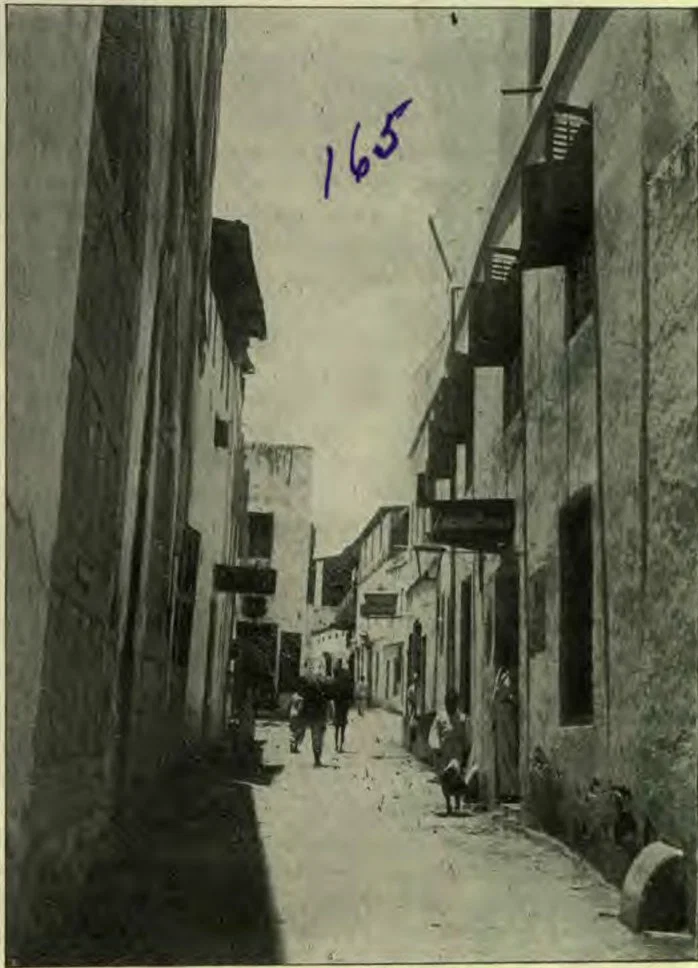
WIDEST STREET IN ZANZIBAR
“’Twas on a May-day of the far old year
Seventeen hundred eighty, that there fell
Over the bloom and sweet life of the spring,
Over the fresh earth and the heaven of noon,
A horror of great darkness, like the night. The low-hung sky
Was black with ominous clouds, save where its rim
Was fringed with a dull glow, like that which climbs
The crater’s sides from the red hell below.
Birds ceased to sing, and all the barn-yard fowls
Roosted; the cattle at the pasture bars
Lowed, and looked homeward; bats on leathern wings
Flitted abroad; the sounds of labor died;
Men prayed, and women wept; all ears grew sharp
To hear the doom-blast of the trumpet shatter
The black sky, that the dreadful face of Christ
Might look from the rent clouds, not as he looked
A loving guest at Bethany, but stern
As Justice and inexorable Law.”
As students of prophecy we are surely grateful for this testimony.
CARRIE E. ROBIE.
(To be continued)
The Meeting Waters
By J. G. Whittier
CLOSE beside the meeting waters, Long I stood as in a dream, Watching how the little river Fell into the broader stream.
Calm and still the mingled current Glided to the waiting sea; On its breast serenely pictured Floating cloud and skirting tree.
And I thought, “O human spirit! Strong and deep and pure and blest, Let the stream of my existence Blend with thine, and find its rest!”
I could die as dies the river, In that current deep and wide; I would live as lives its waters, Flashing from a stronger tide!
— J. G. Whittier.
Only a Piece of Paper
THE following illustration of what may be accomplished by good literature is recounted by an exchange:—
“I was asked to go to a public house in Nottingham to see the landlord’s wife, who was dying. I found her rejoicing in Christ as her Saviour. I asked her how she found the Lord. ‘Reading that,’ she replied, handing me a torn piece of paper.
“I looked at it, and found that it was a piece of an American newspaper, containing an extract from one of Spurgeon’s sermons, which extract had been the means of her conversion.
“‘Where did you find this newspaper?’ I asked.
“She answered: ‘It was wrapped around a parcel sent to me from Australia.’
“Talk about the hidden life of a good seed! Think of that! A sermon preached in London, conveyed to America, then to Australia, part of it torn off for the parcel dispatched to England, and after all its wanderings, giving the message of salvation to that woman’s soul! God’s word shall not return unto him void.”
Happiness Found in Giving, Not Getting
“THERE is no happiness in having and getting, but only in giving.”
Stanley in Africa
By Mrs. L. E. Labonti
STANLEY came to a number of intelligent tribes, who gave him information about the rest of the river to the coast. There were yet three great falls below him, and any number of dangerous rapids; also Boma, on the Atlantic coast, could be reached by easy journeys across the country. His main problem had been solved—whether the Lualaba and the Congo were the same. He had been following the Congo all the time, had seen its splendid forests and mighty affluents, its dashing rapids and bewildering whirlpools and falls. What need, then, to risk life further? He resolved to leave the river, and make direct for the coast. When he gave this welcome news to his men, they were overcome with joy. One poor man, the coxswain of the “Lady Alice,” went mad with rapture, and fled into the forest. Three precious days were spent searching for the poor fellow, but he was never seen again.
Leaving all unnecessary equipage at the cataract of Isangila, the party started for Boma, but gave out entirely within three days of it. A messenger was sent in advance for aid, and returned with abundance of food and carriers, in time to save the perishing men. Pressing on, they were soon receiving the care of the good people of Boma, and all forgot toil and peril, amid civilized comforts.
Stanley’s exploit is unparalleled in the history of African adventure. While not the first to cross the continent, he had hewed an unknown way, and had done more to unravel African mysteries and to settle geographic problems than had any other explorer. August 12, 1877—eight months after he set out from Lake Nyangwe to follow the Lualaba—he stood on the Atlantic shore at Boma, and gazing upon the mouth of the Congo, he could still hardly believe that this mighty flood pouring into the sea was the same that he had followed through wood and morass, rapid and cataract, rock-bound channel and wide expanse, for so long a time. In the three years’ journey of seventy-two hundred miles from Zanzibar, one hundred and fourteen of his original party had perished. The remnant which had survived were returned to their Zanzibar home, according to contract, Stanley himself going with them by steamer around the Cape of Good Hope. It was a joyful time when these people again beheld their home. Their friends rushed to the beach to welcome back the wanderers; wives, husbands, children, and parents “literally leaped into one another’s arms, and with weeping and laughter,” the wonderful story was told of their long and terrible journey. Stanley paid his followers in full, and rewarded some over their lawful claims. Many of his men were thus able to buy neat little homes.
The scene on the beach on the day of Stanley’s departure was affecting and strange. The people of the expedition wrung his hand over and over again. Then, lifting him upon their shoulders, they carried him through the surf to his boat, then on a lighter they followed his boat to the steamer, where they bade their beloved leader a last farewell. Stanley’s own feelings were almost beyond control, as his mind turned to the three strange, eventful years, during which these simple black people had followed him with a fidelity which had been simple and noble, childlike and heroic. To him, his comrades in travel through the Dark Continent would ever remain heroes; for their obedient, loyal aid had enabled him to accomplish the three tasks he had set himself to perform—the exploration of the great Victoria Nyanza Lake, the circumnavigation of the Tanganyika, and the identification of Livingstone’s Lualaba River with the Congo.
Immediately after this memorable journey, Mr. Stanley began enthusiastically working to found a great Congo free government and commercial empire. This was at last accomplished, and the Congo Free State was constituted and defined by the International Conference held at Berlin, February 26, 1885, placing it under the sovereignty of Leopold II, king of Belgium, and declared to be free to the trade of all nations for the period of twenty years. Besides the most rigid injunctions enforcing free trade, absolute religious liberty and freedom of worship are guaranteed; special favor and protection are provided for all missionaries and religious and scientific enterprises. The slave trade, also, is not to be tolerated in any part. We can not fail to see the hand of God in this result, a marvelous providence guiding the decisions of men.
Until the missionary explorations of Dr. Livingstone had given the knowledge of the interior of Africa, nothing could be done toward evangelizing its teeming population, and all efforts were confined to the coast. To Livingstone, the end of his geographical work was to be the beginning of missionary enterprise. When the news of his death reached England, it was felt to be a call for a new effort for evangelizing the central part of Africa. Thus, in May, 1875, as Stanley was solving the problems of the great lakes, a party from the Free Church of Scotland started to ascend the Zambezi, and by way of the Shire to reach Nyassa Lake. They took with them a steam launch, and putting it together at the mouth of the Zambezi, ascended as far as the Murchison Cataract on the Shire. Then the steamer was taken to pieces, and transported, in seven hundred loads, on the heads of natives, past the cataracts, reconstructed, and, in October, they steamed into Lake Nyassa, and a week later the foundation of the Livingstonia settlement began. Many other societies have since entered this part of Central Africa, as well as northward portions, and along the Congo, until this central part of the Dark Continent is studded nearly from the east to its western shore, with missionary stations.
Roughly we may describe the basin of the Congo as extending from the fifth degree of north latitude to the twelfth degree of south latitude, and from the hills on the coast of the Atlantic Ocean to the thirty-first degree of east longitude, an area of 1,056,200 square miles. The Congo Free State has an area of about nine hundred thousand square miles. The resources of this region are exhaustless. The forests are dense and valuable. Their rubber wealth is untouched. Everywhere there is a vast amount of ivory, which is turned into the commonest utensils by the natives. There are palms which yield oil, and plantains, bananas, maize, tobacco, peanuts, yams, wild coffee, and soil, equal to any in the world for fertility. Europeans must guard against the climate, but it is possible with care to become inured to it. Day temperature averages ninety degrees the year round, but the average of the night is seventy to seventy-five degrees. Rain falls frequently, mostly in the night, often with violent tornadoes. The natives are hostile only where they have suffered from Arab slave dealers.
Many and wonderful have been the changes during the years since Stanley followed the course of the Congo. To-day over two hundred and fifty miles of railway along the river from the west coast obviate the difficulties of navigation; and from Stanley Pool for eleven hundred miles, twenty-four steamers ply its waters. Steamers have also been placed upon the great lakes in the interior. Our own training-school at the Plainfield Mission, in Cholo, Central Africa, is situated west of Lake Nyassa, within the free territory. Lake Nyassa was discovered by Livingstone, September 16, 1859. It is three hundred miles long and sixty wide. Its shores are overhung by tall mountains, down which cascades plunge into the lake. These mountains are high table-lands, stretching off in all directions. The inhabitants are the wildest kind of Zulus, and carry formidable weapons, painting their bodies in fiendish devices. They have been the victims of the slave traders, to an extent which would shock even the cruel Arab brigands of the White Nile. Elton and Thompson, exploring the country north of Nyassa, found it to be full of elephants, and the mountain heights were sublime, the valleys deep and fertile. The mountains rise to a height of twelve thousand to fourteen thousand feet, and are snow-capped. In the valley of the Shire lie the bones of many an African explorer. Bishop Mackenzie is buried in its swamps. Thornton found a grave at the foot of a cataract. And a few miles below its mouth, beneath a giant baobab tree, repose the remains of Mrs. Livingstone. Near her is the resting-place of Kirkpatrick of the Zambezi Survey of 1826.
Many things combine to make the location of the Plainfield Mission one of deep interest, even the fact that Dr. Livingstone yielded up his life not far to its west, on the southern shore of Lake Bangweolo. Surely our God has so shaped events in the past history of this dark land that now, even so late, the third angel’s message may be sounded in the very heart of Africa.
MRS. L. E. LABONTI.
Out of Touch
By Jean H. Watson
ONLY a word, yes, only a word,
That the Spirit’s small voice whispered “speak;”
But the worker passed onward unblessed and weak,
Whom you were meant to have stirred
To courage, devotion, and love anew,
Because when the message came to you,
You were “out of touch” with your Lord.
Only a note, yes, only a note
To a friend in a distant land;
The Spirit said, “Write,” but then you had planned
Some different work, and you thought
It mattered little. You did not know
’Twould have saved a soul from sin and woe—
You were “out of touch” with your Lord.
Only a song, yes, only a song
That the Spirit said “sing to-night,
Thy voice is thy Master’s by purchased right;”
But you thought, “’Mid this motley throng,
I care not to sing of the city of gold”—
And the heart that your words might have reached grew cold,
You were “out of touch” with your Lord.
Only a day, yes, only a day,
But O! can you guess, my friend,
Where the influence reaches, and where it will end,
Of the hours that you frittered away?
The Master’s command is, “Abide in me:”
And fruitless and vain will your service be
If “out of touch” with your Lord.
— Jean H. Watson.
Polish Versus Kindness
By Mrs. D. A. Fitch
In society one may pass as polished, and yet in no sense fulfil the command, “Be ye kind one to another.” A polished surface may cover much that is undesirable, but real kindness must win; for it comes from a heart in touch with the Author of all good. Favors may be extended that are actuated by a selfishness of which the giver himself would be ashamed had he not gradually become blinded to his own character. Selfishness may be set aside and kindness cultivated, even late in life, if one allows the Spirit of God to enter the heart and exercise its benign and purifying influence. The youth have the advantage in the fact that they are not so strongly entrenched in habit as those in middle or aged life. Characters are more readily changed in youth than in age, but the grace of God is sufficient for any work in any stage of life or in any place on earth. MRS. D. A. FITCH.
The Parkersburg Society
THE Parkersburg, West Virginia, Society seems to be growing. The members are distributing literature, the work for the present hour. The Society publishes a small typewritten bi-monthly, named The Parkersburg Observer. A few selections from the paper will be given below:—
Sow for Sheaves
I DROPPED a seed of grain one day.
And covered it with earth,
And left it alone there to die:
But, lo, its death gave birth,
And from its silent tomb came forth
A stalk of green and gold:
And when the harvest-time drew on,
I reaped a hundredfold.
How oft we drop a seed of truth,
And think perhaps ’tis dead;
But lo, it germinates, and bears
A hundredfold instead.
Then, brother, sow in youth’s bright morn,
Sow in thy manhood’s noon,
Scatter the good seed near and far,
Life’s evening cometh soon.
The harvest-time comes by and by,
And we may yet behold
The seeds we’ve sown in weakness here
Return in sheaves of gold.
— Selected.
If the leader would ask a number of persons or all of the Society one week before the lesson study to be prepared to give at the next meeting a short, terse statement relative to the fourth topic, it would add to the interest and profit of the study. Why the Sabbath reform is necessary, is the real meaning of the topic. Since many are innocently keeping Sunday, why couldn’t the work be closed up without the reform movement?
Obstacles
Obstacles to the advancement of the work of God will appear; but fear not. To the omnipotence of the King of kings, our covenant-keeping God unites the gentleness and care of a tender shepherd. Nothing can stand in his way. His power is absolute, and it is the pledge of the sure fulfilment of his promises to his people. He can remove all obstructions to the advancement of his work. He has means for the removal of every difficulty, that those who serve him and respect the means he employs may be delivered. His goodness and love are infinite, and his covenant is unalterable.
The plans of the enemies of God’s work may seem to be firm and well established, but he can overthrow the strongest of these plans, and in his own time and way he will do this, when he sees that our faith has been sufficiently tested, and that we are drawing near to him, and making him our counselor.—“Testimonies for the Church,” Vol. VIII.
Our Responsibility
There are times when a distinct view is presented to me of the condition of the remnant church,—a condition of appalling indifference to the needs of a world perishing for lack of a knowledge of the truth for this time.
God has made his people stewards of his grace and truth, and how does he regard their neglect to impart these blessings to their fellow men? Let us suppose that a distant colony belonging to Great Britain is in great distress because of famine and threatened war. Multitudes are dying of starvation, and a powerful enemy is gathering on the frontier, threatening to hasten the work of death. The government at home opens its stores; public charity pours forth; relief flows through many channels. A fleet is freighted with the precious means of life, and is sent to the scene of suffering, accompanied by the prayers of those whose hearts are stirred to help. And for a time the fleet sails directly for its destination. But, having lost sight of land, the ardor of those entrusted with carrying food to the starving sufferers abates. Though engaged in a work that makes them co-laborers with angels, they lose the good impressions with which started forth. Through evil counselors, temptation enters.
A group of islands lies in their course, and, though far short of their destination, they decide to call. The temptation that has already entered grows stronger. The selfish spirit of gain takes possession of their minds. Mercantile advantages present themselves. Those in charge of the fleet are prevailed on to remain on the islands. Their original purpose of mercy fades from their sight. They forget the starving people to whom they were sent. The stores entrusted to them are used for their own benefit. The means of beneficence is diverted into channels of selfishness. They barter the means of life for selfish gain, and leave their fellow-beings to die. The cries of the perishing ascend to heaven, and the Lord writes in his record the tale of robbery.—“Testimonies for the Church,” Vol. VIII.
A View of the Conflict
“In vision I saw two armies in terrible conflict. One army was led by banners bearing the world’s insignia; the other was led by the blood-stained banner of Prince Emmanuel. Standard after standard was left to trail in the dust, as company after company from the Lord’s army joined the foe, and tribe after tribe from the ranks of the enemy united with the commandment-keeping people of God. An angel flying in the midst of heaven put the standard of Emmanuel into many hands, while a mighty general cried out with a loud voice: ‘Come into line. Let those who are loyal to the commandments of God and the testimony of Christ now take their position. Come out from among them, and be ye separate, and touch not the unclean, and I will receive you, and will be a Father unto you, and ye shall be my sons and daughters. Let all who will, come up to the help of the Lord, to the help of the Lord against the mighty.’”
“The battle raged. Victory alternated from side to side. Now the soldiers of the cross gave way, ‘as when a standard-bearer fainteth.’ Isa. 10: 18. But their apparent retreat was but to gain a more advantageous position.
“At last the victory was gained. The army following the banner with the inscription, ‘The commandments of God, and the faith of Jesus,’ was gloriously triumphant. The soldiers of Christ were close beside the gates of the city, and with joy the city received her King. The kingdom of peace and joy and everlasting righteousness was established.”
Duty and Principles
By Hazel Amick
Duty rounds out the whole of life, from its beginning until the end. An abiding sense of duty is the very crown of character, and makes one strong and full of courage.
When one does not do his duty, he becomes selfish, and selfishness is one of the most destructive vices of the world. Every act of duty is an act of faith, and it commands one to look neither to the right nor to the left, but straight ahead, which is the only sure road to real greatness.
Duty rests upon principles, which are the foundation of all action. No young person can hope to rise in society who lives without plan, without object, spending his time in idleness and pleasure.
There is nothing better for any young person than to have his character firmly established upon true principles, and to always be willing and ready to do his duty, notwithstanding what the idle world may say.—Hazel Amick.
Report of Young People’s Society of Rome, N. Y.
By Florence M. Kidder
Like all other small Societies, our means for working are limited, yet we are doing what we can, and the Lord is blessing our efforts greatly. Our first active work was done with “Paradise Home.” The proceeds from the sale of this book were sent to Sister Robinson to be used in supporting a teacher in India. Our next work was with the Signs. Between two and three hundred of the special number were distributed in the city; however, we had the financial aid of one older brother.
We are now working with the Anti-cigarette number of the Life Boat, and are also preparing to send a barrel, packed with quilts, pictures, and various things to the Pedicord Farm. We feel that the Lord has especially blessed in this part of the work. The vice-president, Miss Groff, wrote to an absent member about the needs of the Pedicord Farm. Soon after we received a letter from her containing one dollar. She also gave us a number of quilts to put in the barrel.
Our meetings are held Friday evenings. Generally some from the city are in. We take up the lessons in the INSTRUCTOR, and besides add music and other features to the program. May all the young people keep in mind that our aim is, “The Advent Message to the World in This Generation.”—Florence M. Kidder, President.
Labor in the Harvest Field for Jesus
“There’s surely somewhere a lonely place
In earth’s harvest field so wide,
Where I may labor through life’s short day
For Jesus, the crucified.”
Young People's Society, Rock Hall
By Lula I. Tarbell
The meeting of the Young People's Society at Rock Hall, Maryland, is held every Sunday evening, for we find at this time that many strangers come to our church who would not come at any other time. We have in attendance a goodly number of young men who are not Christians, and for the benefit of these we present from time to time programs bearing upon the subject of temperance.
Our studies in our meetings are along the lines presented in the INSTRUCTOR, and we are enjoying these important lessons. Not long ago a family living some distance was found who needed help. Some of our younger members gathered together food, clothes, and money, and our vice-president and another gentleman took them with a team to the family. We all felt repaid for the little which we had done, as we heard of the joy and happiness which our small efforts had given.
A few of our members are giving Bible readings, and others are giving away our literature. We are just about to start on the work of distributing our tracts, and trust that it will be successful.—Lula I. Tarbell, President.