The Youth’s Instructor, Vol. 31, No. 20.

ST. PAUL'S CATHEDRAL

The Youth’s Instructor

May 16, 1883

S. D. A. Publishing Association · Battle Creek, Mich. · May 16, 1883

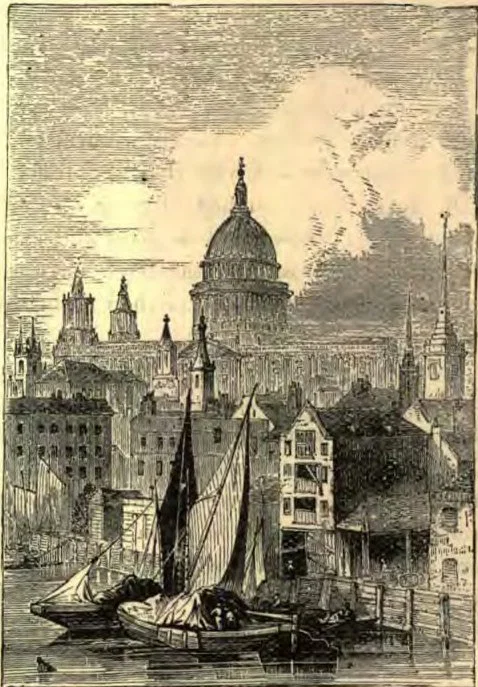
ST. PAUL'S CATHEDRAL.

NEXT to that of St. Peter's at Rome, the largest church building in the world is St. Paul's Cathedral in London. Its immense dome, rising from out the heart of the city, and overtopping the tallest church spires, can be seen for many miles. Owing to its symmetry, however, one gets but a faint idea of its vast size until he visits the interior, gazing up into its sky of stone, wandering amid its long, arched galleries, climbing its winding stairways, and gaining higher and still higher views, until the houses below look like the abodes of some fairy race.
The streets around the Cathedral are so crooked and narrow, and the houses so near to it and so high, that it is difficult to get a good view from the outside. One of the cuts on this page shows the south side as seen from a distance over the tops of the houses. Like Westminster Abbey, and in fact most cathedrals, the ground plan of St. Paul's is in the form of a Latin cross. The dome rises directly over the intersection of the two arms of the cross. The main, or front, entrance is at the end corresponding to the foot of the cross. It faces the west, and is at the left end of the building, as it is seen in the picture. At the corners on either side of this entrance are two towers, each 222 feet high. One of these contains a clock, and is called the clock-tower. The other is called the belfry. Besides the front entrance, there are two others, one at each end of that part of the building corresponding to the short arm of the cross. These parts of the building are called the north and the south transept.
The length of the Cathedral is 500 feet; the width at the main entrance 180 feet, while from one transept wall to the other it is 285 feet; from the top of the cross over the dome to the ground it is 404 feet. The whole structure covers two acres of ground.
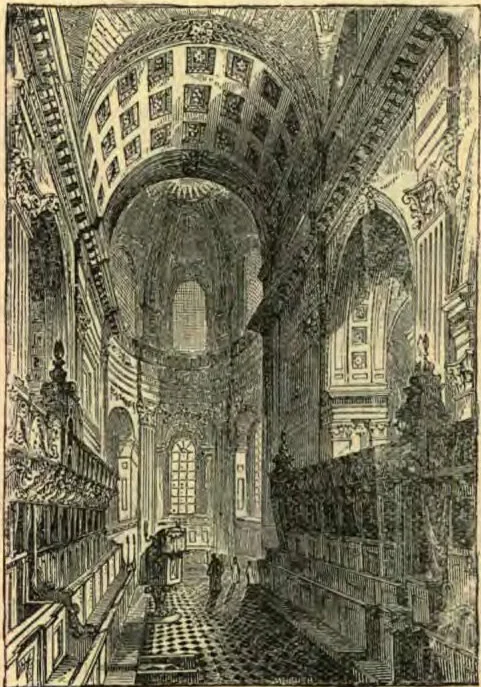
Entering the Cathedral from the west, one sees on each hand a long line of beautifully carved columns, stretching away into the distance, and supporting an arched ceiling, the highest part of which is 84 feet from the floor. The space between these colonnades is 41 feet wide, and is called the nave. Between the nave and each outer wall are other long spaces of smaller dimensions, being 19 feet wide, and 38 feet from the floor to the highest part of the ceiling. These are called aisles. Passing on down the nave, and just before coming out under the dome, one finds seats on either hand provided for singers. This part is called the choir, and is shown in the second picture. Passing on through the choir, one stands directly under the dome. Thus that portion of the building corresponding to the lower part of the cross is divided lengthwise into three sections, the nave and choir occupying the middle section, and the aisles the two outer ones, the latter being about one-half the height and width of the nave. The portion corresponding to the upper part of the cross is called the chancel, and contains the altar and other furniture used during the church service.
This description of the ground plan of St. Paul's applies, with little variation, to all cathedrals, so that whenever you see the terms nave, choir, aisle, or chancel, you will know at once to what part of a cathedral they apply.
On the inside of the dome are paintings, executed by great masters, representing scenes in the life of St. Paul. These are best seen from an inside gallery running around the base of the dome. This gallery is called the Whispering Gallery, from the fact that a whisper spoken against the wall on one side can be heard by persons holding their ear against the wall on the opposite side of the gallery, nearly two hundred feet distant. Above this gallery are two others, on the outside of the dome, the highest being just beneath the tall, round structure over the dome called the lantern. From these outside galleries, when the air is clear, an excellent view of the city, river, and surrounding country, can be obtained. About one hundred feet above the base of the lantern is a hollow ball large enough to hold eight or ten men. This is open to visitors, but few care to climb to so dizzy a height.
In the belfry are three bells. One of these weighs 11,474 pounds, and the clapper used in tolling it weighs 180 pounds. It is only tolled when a member of the royal family or the mayor of London dies. The hours are struck on it by a hammer which is worked by machinery. The two other bells are smaller, and chime the quarter hours.
One is surprised on visiting the clock-tower to see how large and massive all parts of the machinery are. The dials are 57 feet in circumference; the minute hand is a bar of steel nearly 10 feet in length, and weighs 75 pounds; the pendulum is 16 feet long with a weight of 108 pounds at the end.
But that part of the structure which is to many the most interesting of all is the crypt. This is a range of subterranean chambers where are buried scores of illustrious dead. Here lie England's greatest naval and military heroes,—Nelson and Wellington. And all around are statues and monuments of soldiers and statesmen, painters and poets, philosophers, and philanthropists. Chief among them all is the tomb of the architect and builder of the Cathedral itself, Christopher Wren. On a slab by his grave are these words, “Do you seek my monument? Look about you.” Thus this huge pile, costing $4,000,000, and requiring thirty-five years of toil, now only repays its builder by witnessing to the fact that some two hundred years ago he and his workmen lived, labored, and died.
C. H. G.

UNDER THE LEAVES.

Thick green leaves from the soft brown earth, Happy spring-time hath called them forth; First faint promise of summer bloom, Breathes from the fragrant, sweet perfume, Under the leaves.
Lift them! what marvelous beauty lies Hidden beneath, from our thoughtless eyes! May-flowers, rosy or purest white, Lift their cups to the sudden light, Under the leaves.
Are there no lives whose holy deeds— Seen by no eye save His who reads Motive and action—in silence grow Into rare beauty, and bud and blow, Under the leaves?
Fair white flowers of faith and trust, Springing from spirits bruised and crushed; Blossoms of love, rose-tinted and bright, Touched and painted with heaven's own light, Under the leaves—
Full fresh clusters of duty born, Fairest of all in that shadow grown; Wondrous the fragrance that sweet and rare Comes from the flower-cups hidden there, Under the leaves.
Though unseen by our vision dim, Bud and blossom are known to Him. Wait we content for his heavenly ray— Wait till our Master himself one day Lifteth the leaves.
—Selected.

MEG’S WORK.

“But, Miss Laura,” said Meg, rather mournfully, to her Bible-class teacher, “it seems as if I must give up trying to be good. Everything hinders me so at our house,—mother’s sick so often, the children are so much trouble, how can I do my work heartily? And it’s such common, every-day work. Now, if I only had something like real good work to do—”
“Dear Meg,” said Miss Laura, smoothing the drooping head before her, “most of us have common, every-day work of some kind; that is most often the work our Lord gives us. You think, perhaps, if you were teaching a class of heathen girls, you could serve the Lord Jesus better than by making bread or amusing the little ones. But you see that is just the very thing he has put in your hands to do. And surely, Meg dear, it is worth trying to do. Don’t forget to ask him to help you even in the commonest work; and try to remember, when you are doing it, that that is just the work he wants you to do.”
“I’m afraid I do forget too often,” said Meg thoughtfully. “You help me ever so much, Miss Laura. But it is getting late; and I must go now; Ellen will be tired looking after the children, and the boys will want their supper.”
Meg hastened down the street, thinking over what her teacher had said. She nodded her head very decidedly as she stepped across the threshold of her home.
“Well! I thought you never would come, Meg,” was Ellen’s impatient greeting, as Meg entered the sitting-room. “Tot and Rob have been as cross as could be, and mother’s headache’s worse; I’m just as tired as I can be!”
“Say, Meg!” called a voice at the foot of the stairs, “are we going to have any supper? I’m hungry as a hunter.”
“When were you ever anything else?” answered Meg rather impatiently. “If you ever were, I didn’t know of it.”
“There ain’t no bread for supper,” affirmed Sam decidedly.
“No bread!” exclaimed Meg. “Why, I looked into the bread-box before I went out, and there was a loaf and a half.”
“Well,” said Sam hesitatingly, standing first on one foot, then on the other, “you see me and Jimmy got awful hungry, and Ellen wouldn’t find us anything left from dinner—and the Brown boys came home with us from school, and—so—and—”
“And so you went to work and ate up everything you could put your hands on,” said Meg angrily, throwing off her bonnet and gloves.
There was a moment or two’s silence, during which an angry spot burned on Meg’s cheek. Then there was a little rustle in the sick-room.
“Meg,” called a feeble voice.
“Yes, mother,” said Meg more softly.
“Send Ned to the baker’s, daughter; it is too late for you to go to baking. I was afraid the boys were in mischief; but be patient, dear.”
“I think you might set the table, Ellen,” said Meg, as she passed Ellen in the dining-room. “The fire is out, and I must make it up for mother’s tea.”
“It wouldn’t have been out if you had not stayed so long at Miss Laura’s,” returned Ellen; “and I’m just worn out with those children.”
“Oh dear, dear!” sighed Meg, as she opened the stove door; “how can I be good and cheerful when Ellen’s so cross, and the boys make me so much extra work? To think of their eating up all the bread!”
“I’ll make the fire, Meg,” cried a voice at her elbow, and there was Jimmy, bright and willing, with a basket of kindlings.
The fire was soon burning briskly; and Meg found that Ellen must have repented of her cross speech; for there was the table neatly set, and Ellen singing good-naturedly to Rob, who was awake, and must be amused by some one.
“Maybe it’s I that am cross, after all,” said Meg to herself.
Mother was not better the next day, and so many things fell on Meg’s hands. Ned was teasing, Ellen indifferent, Tot and Rob fretted after mother, and Sam and Jimmy seemed to invent the most ingenious methods of getting in the way, and increasing work for their elder sister.
But Meg toiled bravely; she kept the sick-room dark and quiet, she tried not to notice Ellen’s provoking ways and speeches, or the boys’ tiresome pranks.
It was not always easy to do so; for everybody knows that great romping boys are not usually very thoughtful of others’ comfort. And, sometimes, when something more provoking than usual occurred, Meg had hard work to prevent herself bursting out in a fit of impatience, or else sitting down in a flood of discouraged tears. Ellen, too, did not seem to notice the brave struggle which her sister was making to do her work well and patiently, and Meg suffered almost as much from Ellen’s speeches as from the boys’ doings.
Just at nightfall, when she had seen Tot and Rob safely in bed, and told the stories of Moses and Joseph over and over until the sleepy eyes shut, she stole into her mother’s room.
“You are so tired, daughter,” said her mother sympathetically. “I know how hard it is for you, Meg, but you are doing so well.”
“I don’t know, mother,” said Meg wearily; “if I could only be patient! I do try, but the least thing puts me out, and makes me forget.”
“We all forget too often, dearie. But just as surely as we try to do our work heartily, as unto the Lord, he will help us over the hard places. He never fails, Meggie.”
Meg swallowed a sob, and thought, “I ought not to think no one wants to help me; mother does, and I know Jesus won’t fail.”
Then Meg ran away to her own room, and though she knelt down, she could only say: “Lord Jesus, I do want to work for thee right here at home; oh, help me!” when some one called, “Meg!” and she had to run down again.
“I wouldn’t have called you, Meg,” said Ned, “but the butcher sent the meat, and I didn’t know where to put it.”
“I’ll attend to it,” said Meg cheerfully.
“But I’ll carry the basket for you,” said Ned, picking it up.
“Thank you,” said Meg gratefully. “You’re a dear fellow, if you are such a tease.”
Meg lay down very weary that night, but with a sweet consciousness that if much of her work was not as she wished it might have been, she was really trying to do it unto the Lord.
True, things were very contrary, mother was still sick, there was much care to fall into the hands of a sixteen-year-old girl. Ellen’s moods were very trying, the boys would tear their clothes, and make all manner of unexpected work for hands and feet. It was all very homely work,—sweeping rooms, making bread, keeping quiet in and worry out of the sick-room; but Meg was striving to say truly and earnestly, “This is the place the Lord wants me to work, just here at home, and I must try to do it heartily.”
Where is your work, my young reader, and are you doing it heartily, as unto the Lord?—Lucy Randolph Fleming.

EVENING

How like a tender mother, With loving thoughts beguiled, Fond Nature seems to lull to rest Each faint and weary child! Drawing the curtain tenderly, Affectionate and mild.
Hark to the gentle lullaby That through the trees is creeping,— Those sleepy trees that nod their heads Ere the moon as yet comes peeping, Like a tender nurse to see if all Her little ones are sleeping.
One little fluttering bird, Like a child in a dream of pain, Has chirped and started up, Then nestled down again; Oh! a bird and a child, as they sink to rest, Are as like as any twain. —Charlotte Young.

THINKING

One of the best and most useful habits a child can acquire is the habit of thinking.
It is not those who read much, who commit to memory, that become intelligent, wise, noble, and great; but those who do a good deal of thinking. It is thinking which develops the faculties and capacities of the mind, and prepares children for the duties and responsibilities which are before them in the coming years. Prepare them to do well all that God would have them do while they live in this world. How very few, comparatively, of children and even grown persons think much.
There is a vast amount of reading done, and a greater amount of talking; but how little thinking. Reading only gives the materials of knowledge; thinking makes it ours. Children should be taught to think first by the parents, then by the teacher,—to think about what they see; about what they hear and read; above all, before they act. So will the foundation for future usefulness be laid.—S. S. Gem.

PICKING OUT THE SPECKED ONES.

In the big barn, fanned by the wind sweeping through it, sits Nancy, a barrel on one side, and a pile of apples on the other.
“What are you doing, Nancy?”
“Picking out the specked ones, and packing the rest for winter. All rotten apples were only specked ones, once. Let alone a specked one now, and by and by your teeth will be only too glad to let alone a rotten one.”
Picking out the specked ones!
All sin starts in a speck. Let alone small offences, and there will be large sins to wail over by and by. Say, “With God’s help, I will be strict with myself.” Remove the little things that are wrong. Turn your barrel upside down, and pick out the specked apples.

NEW-TESTAMENT HISTORY.

LESSON 135.—STEPHEN'S DISCOURSE AND MARTYRDOM.

In our last lesson we left Stephen addressing the Sanhedrim. Beginning with Abraham, he had traced the history of God's people down to the burial of Jacob. In this lesson the remainder of his discourse is given. He continues as follows:—
“But when the time of promise drew nigh, which God had sworn to Abraham, the people grew and multiplied in Egypt, till another king arose, who knew not Joseph. The same dealt subtilely with our kindred, and evil entreated our fathers, so that they cast out their young children, to the end they might not live. In which time Moses was born, and was exceeding fair; and he was nourished three months in his father's house: and when he was cast out, Pharaoh's daughter took him up, and nourished him for her own son. And Moses was learned in all the wisdom of the Egyptians, and was mighty in words and in deeds. And when he was full forty years old, it came into his heart to visit his brethren, the children of Israel. And seeing one of them suffer wrong, he defended him, and avenged him that was oppressed, smiting the Egyptian; for he supposed that his brethren would have understood how that God by his hand would deliver them: but they understood not. And the next day he showed himself unto them as they strove, and would have set them at one again, saying, ‘Sirs, ye are brethren; why do ye wrong one to another?’ But he that did his neighbor wrong thrust him away, saying, ‘Who made thee a ruler and a judge over us? Wilt thou kill me, as thou didst the Egyptian yesterday?’ Then fled Moses at this saying, and was a stranger in the land of Midian, where he begat two sons.
“And when forty years were expired, there appeared to him in the wilderness of Mount Sinai an angel of the Lord in a flame of fire in a bush. When Moses saw it, he wondered at the sight; and as he drew near to behold it, the voice of the Lord came unto him, saying, ‘I am the God of thy fathers, the God of Abraham, and the God of Isaac, and the God of Jacob.’ Then Moses trembled, and durst not behold. Then said the Lord to him, ‘Put off thy shoes from thy feet; for the place where thou standest is holy ground. I have seen, I have seen the affliction of my people which is in Egypt, and I have heard their groaning, and am come down to deliver them. And now come, I will send thee into Egypt.’”
“This Moses whom they refused, saying, ‘Who made thee a ruler and a judge?’ the same did God send to be a ruler and a deliverer by the hand of the angel which appeared to him in the bush. He brought them out, after that he had showed wonders and signs in the land of Egypt, and in the Red Sea, and in the wilderness forty years.
“This is that Moses who said unto the children of Israel, ‘A prophet shall the Lord your God raise up unto you of your brethren, like unto me; him shall ye hear.’ This is he that was in the church in the wilderness with the angel that spake to him in the Mount Sinai, and with our fathers; who received living oracles to give unto us; to whom our fathers would not be obedient, but thrust him from them, and in their hearts turned back again to Egypt, saying unto Aaron, ‘Make us gods to go before us; for as for this Moses, who brought us out of the land of Egypt, we wot not what is become of him.’ And they made a calf in those days, and offered sacrifice unto the idol, and rejoiced in the works of their own hands.
“Then God turned, and gave them up to worship the host of heaven; as it is written in the book of the prophets:—
‘Did ye offer unto me slain beasts and sacrifices Forty years in the wilderness, O house of Israel? And ye took up the tabernacle of Moloch, And the star of the god Rephan, The figures which ye made to worship them; And I will carry you away beyond Babylon.’
“Our fathers had the tabernacle of witness in the wilderness, as he had appointed, speaking unto Moses that he should make it according to the fashion that he had seen. Which also our fathers that came after, brought in with Joshua into the possession of the nations that God thrust out before the face of our fathers, unto the days of David; who found favor before God, and desired to find a tabernacle for the God of Jacob. But Solomon built him a house. Howbeit the Most High dwelleth not in temples made with hands; as saith the prophet,—
‘The heaven is my throne, And the earth the footstool of my feet: What manner of house will ye build me? saith the Lord; Or what is the place of my rest? Did not my hand make all these things?’
“Ye stiff-necked and uncircumcised in heart and ears, ye do always resist the Holy Ghost; as your fathers did, so do ye. Which of the prophets have not your fathers persecuted? and they have slain them which showed before of the coming of the Just One, of whom ye have been now the betrayers and murderers; ye who have received the law by the disposition of angels, and have not kept it.”
When the Jewish council heard these cutting words, they were so angry at Stephen that they gnashed their teeth at him; but he, looking upward, had a vision of heaven, and said, “I see the heavens opened, and the Son of man standing on the right hand of God.” Then his enraged accusers stopped their ears, and with loud vociferations ran upon him, thrust him out of the city, and stoned him to death. As Stephen was receiving this cruel treatment, he kneeled down, prayed that God would be merciful to his murderers, and having said, “Lord Jesus, receive my spirit,” fell asleep.

QUESTIONS.

  1. How did the last lesson close?
  2. How far had Stephen traced the history of God's people?
  3. What did he say of the prosperity of the Israelites in Egypt? Acts 7:17.
  4. What did he say about their subsequent treatment? Verses 18, 19.
  5. What did he say about the birth and childhood of Moses? Verses 20, 21.
  6. What of his manhood? Verse 22.
  7. To whom was his heart drawn out? Verse 23.
  8. What action did he take in defense of one of the Israelites? Verse 24.
  9. What led him to make such a venture? Verse 25.
  10. Relate his experience on the following day. Verses 26–28.
  11. Relate his experience in the land of Midian.
  12. To what important mission was Moses called when he was about eighty years of age?
  13. Tell how the Lord called him.
  14. What did the Lord say about having a care for his people?
  15. How did Stephen show from the example of Moses that men are apt to reject the very ones appointed for their deliverance? Verse 35.
  16. What application do you think he meant to make of this principle?
  17. What did Stephen say of the bringing of the children of Israel out of the land of Egypt into the land of Canaan?
  18. What prophecy and instruction did Moses give concerning Christ?
  19. What living oracles did Moses receive? Ex. 20.
  20. How was Moses treated by the fathers? Verses 39–41.
  21. How did God deal with them for this? Verse 42.
  22. What prophecy did Stephen then quote? Verses 42, 43.
  23. What did he say about the tabernacle? Verse 44.
  24. What was done with the tabernacle when the Israelites came into the land of Canaan?
  25. What did David desire to do for the Lord?
  26. How was this design finally carried out?
  27. What did Stephen say about God's dwelling place?
  28. What scripture did he quote in proof of this statement? Verses 49, 50.
  29. What strong accusation did Stephen then bring against the rulers of his people? Verse 51.
  30. What question did he ask them?
  31. What charge did he bring against them with reference to Christ?
  32. What with reference to the law?
  33. How was the Sanhedrim affected by these cutting reproofs?
  34. What encouragement was then given Stephen? Verse 55.
  35. What did he say?
  36. What did his enemies then do?
  37. Describe the death scene of Stephen.

NOTES.

Chap. 7. Ver. 29. In the land of Midian. It was a part of Arabia Petraea, and lay along the eastern branch of the Red Sea, the Elanitic Gulf. It reached to the wilderness of Sinai on one side, and the territory of Moab on the other. The Midianites seem to have been a wandering people.—Rev. Com.
Ver. 33. Loose the shoes from thy feet. It was, and is still, in the East, a mark of reverence to take off the shoes, or sandals, in the presence of a superior. The Mohammedans always enter their mosques barefoot. God sanctifies whatever he touches, and this spot became holy ground, as did the temple on Mount Zion. Stephen indirectly argues from this that holiness belongs exclusively to no one earthly sanctuary.—Ibid.
Ver. 38. Living oracles. The law received on Sinai. They were not dead, powerless words, but such as had the power of God working in them, and were capable of giving life.—Schaff.
Ver. 39. Turned back in their hearts unto Egypt. They were weary of the severe restraints imposed by the worship of Jehovah, and longed for the idol service of Egypt, and the enjoyment of the license which was permitted and even sanctioned in most of those ancient systems of idolatry. Ex. 16:3; Num. 11:4.
Ver. 42. But God turned. That is, changed toward them, withdrew from them his favor, laid no check upon their passions and follies. Acts 14:16. The host of heaven. The stars, sun, and moon. This idolatry prevailed especially in Chaldea, and also in Phoenicia, as well as in Egypt. Manasseh built altars to the “host of heaven,” and worshiped them. 2 Chron. 33:3, 5.—Rev. Com. The sin of Israel was that it worshiped the created host instead of Jehovah Sabaoth, the “Lord of hosts.”—Plumptre.
Ver. 43. Ye took up the tabernacle of Moloch. This was a small portable tent which sheltered the image of the idol. Moloch was most probably identical with the Tyrian Baal, the sun god. According to rabbinical tradition, a fire was kindled beneath the idol, which was a hollow metallic figure with the head of an ox with outstretched arms; a child was placed in the arms of the figure, and thus was burned to death, while the priests beat their drums so as to stifle the child's cries. The image received the name Tophet (Jer. 7:31) from tophim, drums. The worship of Moloch was forbidden by Moses (Lev. 18:21; 20:2), but afterward practiced (Jer. 32:35), and even Solomon erected a place for it. 1 Kings 11:7. And the star of the god Rephan. Rephan is the Coptic name for Saturn, who was worshiped by the Arabians, Phoenicians, and Egyptians. The descriptions of the horrid child-sacrifices offered at Carthage to Saturn resemble the rabbinical account of the worship of Moloch.—Rev. Com.
Ver. 58. Cast him out of the city. The rabbinical books say: “The place of stoning was outside the city; for all walled cities were considered to correspond to the camp of Israel.”—Alford. The exact place of Stephen's death is not known. There are two traditions—an ancient one which places it on the north, beyond the Damascus gate; and a modern one, which leads travelers through what is now called the gate of St. Stephen to a spot near the brook Kidron, over against the garden of Gethsemane.—Conybeare and Howson. Stoned him. The Jewish writers of the Talmud mention four modes of death awarded by the court of justice,—stoning, burning, slaying with the sword, strangulation. Of these, the first was deemed the most severe, and was the punishment of blasphemy. The way in which it was carried out was as follows: The culprit, pinioned and stripped of his clothes, ascended a scaffold, erected outside the city, twice the height of a man, whence one of the witnesses pushed him down, so that he fell with his face to the ground. If death ensued, there was no occasion for stoning; but if in the accused there still remained life, then the other witness flung a very large stone at his chest; and if after this the culprit was still not dead, the people pelted him with stones till life was extinct, thus conforming to the command in Deut. 17:7.—Schaff. And the witnesses. According to the law of Moses, the witnesses were to cast the first stone (Deut. 17:6, 7), as a guard against making careless or unjust charges. The witnesses here mentioned are those false witnesses who accused Stephen of blasphemy.—Gloag. Laid down their clothes. They disencumbered themselves of their loose outer garments, that they might be light and unimpeded in the throwing of the stones.—Alford.

Heigh-Ho: Daisies, Buttercups, and Daffodils

And haply one musing doth stand at her prow. O bonny brown sons, and O sweet little daughter, Maybe he thinks on you now!
Heigh-ho! daisies and buttercups, Fair yellow daffodils, stately and tall— A sunshiny world full of laughter and leisure, And fresh hearts unconscious of sorrow and thrall! Send down on their pleasure smiles passing its measure, God that is over us all! —Jean Ingelow.

EFFIE'S TRIUMPH.

There were four boys and four girls in the party, and each one had a nice round hoop.
“Now for a race and a game,” said Ned Lewis, as he seized his hoop; “there is just time before the bell rings. The one who gets to the corner the fourth time ahead has won the game. Come on!”
Away they went all together, spinning their hoops before them, Charlie Thomas, who had been sick and could not run, being the one appointed to keep count and see which beat. It was wonderful how each one of them wanted to win! To see their little legs flying through the square, and the eager light in their eyes, you would have thought, “Surely there must be an apple made of silver to win in the end,” so eager were they.
Effie Brown was the swiftest runner of them all, unless it was Ned Lewis. The rest were never quite certain which was really the very swiftest, for sometimes Effie beat and sometimes Ned; but they certainly were ahead of all the others. A shout went up from two or three of the party as the third run was made.
“Jolly!” said Fred Wilson, “that little Miller girl is going to beat, I do believe! Who knew she could run so? She has got there right along with Effie every time. Ned’s a little mite behind this time, and I believe that those girls are both going to beat him.”
Effie heard, and she didn’t like it. The little Miller girl was a year younger than she, and a shy little girl. She didn’t want to be beat by her—that would be worse than to have Ned beat. She didn’t even want to be equal with her. It would soon be settled. She ran with all her might; her hoop fairly skimmed over the ground, and she kept her eye all the time on the little patched shoes that clipped along right by her side. A loud shout, a clapping of hands, and the cries of “Hurrah for Effie!” told that the race was won.
“She was a trifle ahead,” Charlie said, “just a trifle—it wasn’t more than half an inch; but that makes it a beat.”
The little Miller girl looked up with a quick, eager glance. She knew her own little patched shoes shoe touched the goal before Effie’s did. Did n’t Effie know it? If Mamie Miller had been any other girl among them, she would have shouted it loudly, and insisted on having her rights. But dear me! Mamie wasn’t quite sure she had any rights in this world. Did n’t she wear faded calico dresses, and a sun-bonnet, and patched shoes?
The racers walked back very slowly, wiping their faces and saying it was fun, but that it made them very warm. Only Effie kept still. Yes; she knew all about it. She was certain that Mamie Miller’s foot reached the corner before hers—hardly a second; so short a time that Charlie, who was watching, did not see it. But she did.
“I can’t help it,” she said. “I am not to decide the game. It was Charlie’s business, not mine. If I had been ahead, and he had decided that I wasn’t, I wouldn’t have said a word. What difference does it make anyway? It’s real babyish to care so much about a race.”
There’s no use, Effie; your heart does n’t feel good about it, and you can’t talk it into beating quietly, as if it made no difference. If it is such a little matter, you know it troubles you. She kept on thinking about it after they had reached the school-room, and stood waiting for the bell.
“No use to begin anything new,” Ned said; “there would n’t be time before the bells.”
Nellie Howell came up gayly with a tuft of spring blossoms from the woods. “There is just time to crown the victor,” she said, laughing. “Bend your head, Queen Effie, and I’ll put these blossoms in your hair, in honor of your beating us once more. We’re getting used to it, so we don’t mind it at all.”
Effie drew her head back quickly, and looked around for Mamie Miller. “Put them in Mamie’s hair,” she said. “She won the race; her foot touched the corner just half a second before mine did.”
“Oh! oh!” chorused all the voices but Mamie’s.
“Are you sure? Why, Charlie Thomas, couldn’t you see?”
“I did see. Effie got there first. I saw her.”
“No, you did n’t,” said Effie, shaking back her brown hair. She could laugh now; she felt very happy. “If your eyes had been sharp, you would have seen that her foot got there ahead of mine. I saw it, anyhow; and I was nearest to her. Come here, Mamie Miller, and I’ll fix the flowers in your hair.”
It was such a little bit of a thing, but you don’t know how happy it made Mamie Miller. She felt more as if she was “one of them” than she ever had before.
“I wonder you did n’t let it go,” Ned Lewis said to Effie after school, still talking about the race; “you came so near winning, and the umpire thought you did. What did it matter, anyhow? I’d have let it go.”
“I almost did,” Effie said; “then I thought it was surely big enough to make a speck on the snow.”
“What are you talking about—snow in April?”
Effie laughed. “It is my verse,” she said,—“the golden text, you know, ‘Wash me, and I shall be whiter than snow.’ The snow gets all specked, you know; and mamma says that the specks are like little bits of sins. I don’t want specks all over the snow.”
“Humph!” said Ned. It was a new thought to him, and he went home thinking about it.—Selected.
Continue reading: Letter Budget