V. What His Coming Will Mean to the Incorrigibly Wicked
THE great day of the Lord will surely come. Suns may rise and suns may set; a few months or years may run their course; men may continue their forgetfulness and their mad rush after earth’s fleeting treasure and pleasure: but some day the end will be reached, and the opening heavens will reveal the awful glory of an approaching Christ. The trumpet tones of Michael will announce the drama of time ended, and the curtain will be rung down, to rise no more.
That terrible day, tho fully declared and set before the world by faithful servants of God, will find the last generation of mankind all unprepared. Men have heard but not heeded. And when at last, by veiled sun, by mighty earthquake, by rended heaven, and by suspension of nature’s laws, the day of His appearing actually comes, there will go up from the millions of unprepared and awe-stricken inhabitants of earth the mournful wail, “The great day of His wrath is come; and who shall be able to stand?” Rev. 6: 14-17.
Indeed, we may well ask, and ask now, Who shall be able to stand in that day? What will that day demand at the hand of each and all who will live to meet it? Especially, what will it mean to those, whether living or dead, who have no hope in Christ?
There is no room here for speculation. The issue is too great, the results are too momentous and far-reaching to admit of idle fancy or undemonstrated theory. What says the Bible?
First of all, the Scriptures certainly make it plain that the second coming of Christ is the time of general reward for mankind. “Behold, I come quickly,” is the word; “and My reward is with Me, to give every man according as his work shall be.” Rev. 22: 12. “The Son of Man shall come in the glory of His Father with His angels; and then He shall reward every man according to his works.” Matt. 16: 27.
The record is plain and unimpeachable. All men will be rewarded when He comes. But notice, dear reader, that the reward shall be determined according to man’s works. There will be no arbitrary bestowal either of blessing or curse. What men receive in that day of settlement, will be what they themselves have chosen, and to which and for which they have fitted themselves long before.
Character Alone
will determine the outcome. What man really is, what God finds him actually to be, will be the only item considered by the great Judge. A heavenly character will naturally pass up and into the heavenly abode, while a satanic character will find its level elsewhere.
In character alone men are like or unlike God. And character is but the result of a life lived,—the result of thought, of word, of act. Character, indeed, is but the fixed habits of life, tied into a bundle by man’s choice. Therefore the works of every day determine the great question of whether or not we shall stand in the great day, of whether we shall have life or death.
This truth is strikingly set forth in the letter of Paul to the Corinthians. Speaking of Christ, the great Foundation of all Christian character, he said: “Let every man take heed how he buildeth thereupon. . . . If any man build upon this foundation gold, silver, precious stones, wood, hay, stubble; every man’s work shall be made manifest: for the day shall declare it, because it shall be revealed by fire; and the fire shall try every man’s work of what sort it is.” 1 Cor. 3: 10-13. Character symbolized by wood, hay, and stubble, will not endure the terrible realities of the day when Jesus comes.
Everything in the form of sin, or which is connected or identified with sin, must perish when the glory of the King is revealed. Men who have refused God a place in their lives, refused to allow the “spirit of burning” (Isa. 4: 4) to purge away the “dross” and the “tin” (Isa. 1: 25) of their characters, must have that dross and tin consumed by His presence at His coming. But at that time, the destruction of the dross means the destruction of the men themselves.
Afraid of God Their Saviour
In ages past, men were afraid at the slightest revelations of God’s glory. At the base of Sinai, Israel pleaded with Moses, “Speak thou with us, and we will hear: but let not God speak with us, lest we die.” Ex. 20: 19. Said Manoah to his wife, when only an angel had spoken, “We shall surely die, because we have seen God.” Judges 13: 22. Even Isaiah feared because of a vision, saying, “Wo is me! for I am undone; . . . for mine eyes have seen the King, the Lord of Hosts.” Isa. 6: 5. God Himself had said, “There shall no man see Me, and live.” Ex. 33: 20. What, therefore, must be the portion of those who, without the protecting shield of Christ’s righteousness, are ushered into the very presence of the King of Kings, when He shall come, not only “in His own glory,” but in all the glory of the Father, and the glory of the angelic host? Luke 9: 26. “Our God is a consuming fire.” Heb. 12: 29. Said the psalmist, “Our God shall come, and shall not keep silence: a fire shall5devour before Him, and it shall be very tempestuous round about Him.” Ps. 50: 3. No wonder that sinful men will then call for the very mountains to fall upon them and hide them. But there will be no hiding-place in that day. His consuming glory will be everywhere, it will find out all; and the wicked shall perish at His presence. 2 Thess. 1: 7-10; 2: 8; Rev. 6: 15, 16; Isa. 2: 19.
Prophecies of That Day
Many were the prophets who spoke of the terrible glories of that day, and what the day would mean to those out of harmony with God’s great Gospel plan. Said Zephaniah: “The great day of the Lord is near, it is near, and hasteth greatly, even the voice of the day of the Lord: the mighty man shall cry there bitterly. That day is a day of wrath, a day of trouble and distress, a day of wasteness and desolation, a day of darkness and gloominess, a day of clouds and thick darkness. . . . And I will bring distress upon men, that they shall walk like blind men, because they have sinned against the Lord.” Zeph. 1: 14-17. Isaiah wrote: “Howl ye; for the day of the Lord is at hand; it shall come as a destruction from the Almighty.” “Behold, the day of the Lord cometh, cruel both with wrath and fierce anger, to lay the land desolate: and He shall destroy the sinners thereof out of it.” Isa. 13: 6, 9.
Joel also saw in vision the events of the great day. “Let all the inhabitants of the land tremble,” he wrote, “for the day of the Lord cometh, for it is nigh at hand.” Joel 2: 1.
Ah, that will be a dreadful day to the shelterless wicked! When the Lord shall begin the marvelous manifestations of His power, and “shall cause His glorious voice to be heard, and shall show the lighting down of His arm, with the indignation of His anger, and with the flame of a devouring fire, with scattering, and tempest, and hailstones” (Isa. 30: 30); when the very “earth shall reel to and fro like a drunkard, and shall be removed like a cottage” (Isa. 24: 20); when all the great cities are reduced to ruinous heaps (Jer. 4: 26); then will men awake as from long sleep, but only to learn that salvation’s day is closed and they are lost. Then, in despair, they will begin to search for God’s Word (Amos 8: 11-13); they will cast their hoarded treasures to the moles and to the bats (Isa. 2: 20); they will earnestly tho selfishly pray, but their prayer will not be heard. Prov. 1: 27-29.
That day will be a day of destruction to the heathen. Obadiah 15, 16. It will also be a day of awful disappointment and anguish to the hypocritical, faithless churchman. Said Jesus, “Many will say to Me in that day, Lord, Lord;” but He will declare unto them, “I never knew you: depart from Me, ye that work iniquity.” Matt. 7: 22, 23. Many will learn, when too late, that the robe of selfish pretense will not pass the test of God’s all-seeing eye; and they will mingle their wails with the great lost multitude in the outer darkness. Matt. 22: 11-13. They will inherit the portion of hypocrites. Matt. 24: 51.
On Which Side?
We are living in momentous times. The lines are fast being drawn, and men are ranging themselves for the final action. We shall soon be able to “discern between the righteous and the wicked, between him that serveth God and him that serveth Him not.” Mal. 3: 18. There will be but two classes when Jesus comes,—those who are truly and wholly the Lord’s, and those who are incorrigibly evil. Great power from God will perfect one class in holiness, and great power from Satan will confirm the other in sin.
As to which class we shall belong to, it is for us to say. “Now is the accepted time.” Probation’s hour is still lengthened; but let no one presume upon present mercy, or think that perhaps another probation waits. This is our only testing time, and the fast westering sun of time admonishes us to hasten our preparation.
May God help you and help me so to choose Him that when the great day comes we may not be found calling for rocks and mountains to hide us, but gladly and safely hidden in Him.
Biblical Paradoxes — No. 3
By H. A. St. John
“As SORROWFUL, yet always rejoicing; as poor, yet making many rich; as having nothing, and yet possessing all things.” 2 Cor. 6:10. There are many things to occasion sorrow in this world. Jesus was a man of sorrows; but with all His sorrow at the sense and sight of what sin had wrought in this world, He had a constant, abiding, and internal peace and joy that all the sorrows of the world could not take away, or swallow up. It was the sweet peace and joy of hope and Heaven. He never lost sight of this joy, and He desires to give us the same joy, that we may rejoice, even in sorrow.
We may be poor in this world’s goods, and poor in spirit, and at the same time be rich in faith, and in good works, and hence be able through God to make others rich in the grace of God in this life, and rich in the eternal glory of God hereafter.
Again, we may have nothing in this world; like our divine Lord, we may not have a place to lay our heads, in life or in death. But Jesus is heir of all things; and if we are Christ’s, then are we Abraham’s seed, and joint heirs with Him of all things. All things are mine, if I am His. How can I keep from singing?
H. A. ST. JOHN.
Our Bible Reading
The Origin of the Sabbath
1. For whom was the Sabbath made?
"And He said unto them, THE SABBATH WAS MADE FOR MAN, and not man for the Sabbath." Mark 2: 27.
2. When was it made?
"It is a sign between Me and the children of Israel forever: for IN SIX DAYS THE LORD MADE HEAVEN AND EARTH, and on the SEVENTH DAY HE RESTED, and was refreshed." Ex. 31: 17.
3. What was the first step in its making?
"And HE RESTED ON THE SEVENTH DAY from all His work which He had made." Gen. 2: 2.
4. What was the second step?
"And GOD BLESSED THE SEVENTH DAY." Gen. 2: 3.
5. What was the third step?
"And God blessed the seventh day, and SANCTIFIED IT." Gen. 2: 3.
6. Why did He do this?
"BECAUSE THAT IN IT HE HAD RESTED from all His work which God created and made." Last part of Gen. 2: 3.
7. What does the psalmist declare that God has done concerning His wonderful works?
"He hath made His wonderful works to be remembered: the Lord is gracious and full of compassion." Ps. 111: 4.
8. What great twofold truth then is revealed in the Sabbath?
"And hallow My Sabbaths; and they shall be a sign between Me and you, that ye may know that I AM THE LORD YOUR GOD."
"Moreover also I gave them My Sabbaths, to be a sign between Me and them, that they might know that I AM THE LORD THAT SANCTIFY THEM." Eze. 20: 20, 12.
NOTE: In the Sabbath God has made His wonderful works to be remembered. Just so long as man kept the Sabbath as God gave it they did not know idolatry. His own people never went into idolatry until they had forsaken the Sabbath. Just as long as they observed the Sabbath they kept in mind two great things concerning God. One was that He was God and God only, the Creator of the heavens and the earth; and the other that He was not only the Lord who created them, but He was the God who sanctified or saved them. That is what the design of the Sabbath is now just as truly as it was in the past.
Be Bearers of Sunshine
By Pacific Coast Gazette
IN this old world of ours there is much of heartache and sorrow. Many people are always going about bearing these things. It is therefore our duty, so far as possible, to be bearers of sunshine. By being sunny and cheerful ourselves we can add greatly to the happiness of others. Have you not noticed even in crowded places, where nearly all were strangers, how a radiant and cheerful personality brightened up everybody? The bright smile of a young lady has put all in a thronged street-car in good humor, and made them forget the discomforts of hanging on to a strap and being jostled and squeezed by others trying for a place. The prattle of a little child, the matronly look of a happy mother, have all radiated sunshine in a despondent looking throng.
Just be cheerful yourself, and you will soon realize what a benediction it is not only to those with you, but also to yourself. Many of us have burdens heavy enough to weigh us down if we do not get just a little lift now and then.— Pacific Coast Gazette.
The Revelation of Jesus Christ
By Milton C. Wilcox
"Let the Revelation speak and tell what is truth. . . . Uplift Jesus as the center of all hope"
V. The Church in Ephesus
We begin this week the study of the internal or spiritual conditions of the church of God from the days of the apostle to the end, presented before us in the symbols of seven churches in Asia, characteristics of which, together with the names perhaps, were symbolical of the whole church throughout her career.
First, it is well to note that while the symbols are of individual bodies of believers, local in the apostle's day, they do not symbolize organizations, but conditions. There were no such hard and fast organizations in the apostolic times as have been developed by men in subsequent periods. The important thing in God's sight then and now and always was character and service, character in service for the salvation of souls and the glory of His name. Conditions in these simple organizations in Asia Minor were symbolical of different periods and conditions in the churches as a whole.
Then, too, we can not mark a definite time when one condition succeeded to another. Sometimes they telescope each other or overlap or are contemporaneous. The most that we can do is to indicate the approximate time when a condition began and could be said to be evident and prominent.
Some of these conditions apply to individual believers in all ages. This is indicated in the seven-times repeated exhortation, "He that hath an ear, let him hear what the Spirit saith unto the churches."
The promises to the overcomer are likewise to all overcomers, even as our Lord is to all what He reveals Himself to each; but the revelation of Himself and the promise to each church are especially fitting to the condition represented by the church named. For instance, all overcomers will eat of the Tree of Life, all will have the new name, all will reign with Christ; yet these promises are peculiarly appropriate to the class to which they are addressed. Keeping in mind the foregoing suggestions will help to our understanding of the messages to the churches.
The Answer of the Book
[The answers to the questions are from the American Revised Version. Omitting questions, and disregarding sometimes the capitals at the beginning and the period at the close on an answer, the text may be read continuously. In notes and comments both versions are used without designation.]
1. To whom is the first letter addressed?
"To the angel of the church in Ephesus."
2. Who sends the letter?
"These things saith He that holdeth the seven stars in His right hand, He that walketh in the midst of the seven golden candlesticks."
3. What words of approval does He speak to Ephesus?
"I know thy works, and thy toil and patience, and that thou canst not bear evil men, and didst try them that call themselves apostles, and they are not, and didst find them false; and thou hast patience and didst bear for My name's sake, and hast not grown weary."
4. What reproof does He bring to Ephesus?
"But I have this against thee, that thou didst leave thy first love."
5. What earnest admonition does He give?
"Remember therefore whence thou art fallen, and repent and do the first work."
6. What would be the consequence if the admonition were rejected?
"Or else I come to thee, and will move thy candlestick out of its place, except thou repent."
7. For what other thing did He commend Ephesus?
"But this thou hast, that thou hatest the works of the Nicolaitans, which I also hate."
8. What call does He make for attention?
"He that hath an ear, let him hear what the Spirit saith to the churches."
9. What is the promise to the overcomer?
"To him that overcometh, to him will I give to eat of the Tree of Life, which is in the Paradise of God."
Notes on the Text
1. To the angel.—The word "angel" means messenger, and is applied in other scriptures to men, but in the Revelation it invariably refers to a spirit being, whether good or evil. To God's heavenly messengers is given charge over things earthly. This is especially emphasized throughout this book. We see no reason, then, why the message from the Son of God to the churches may not be addressed to the angel over the particular church addressed, he representing that church with her ministers. "Ephesus."—The city of Ephesus was one of the largest and most important in Asia Minor. Here was the great Temple of Diana, or Artemis, one of the seven ancient wonders of the world, marvelous in its richness and structure. In this city was raised a strong church of God. See Acts 19. It is not the church of Ephesus, but in Ephesus; literally "to the Ephesian assembly." The name denotes "desirable," and fittingly symbolizes the first stage of the Christian church, down to about the year 100, when love began to wax cold.
2. The Sender of the letter is our Lord, holding the seven stars (the angels, 1:20) and walking among the candlesticks (the churches). He thus shows His care and knowledge of His people. And He who knows and cares is always ready to help.
3. "I know thy works."—A wonderful assurance, whatever may come, if the soul is true to God; but a fearful thing to the soul unfaithful. God knows our works, our motives. That early church did not have an easy time. Her course was marked by toil which demanded patient endurance. She was true to God. She knew His Word, and by that Word could weigh the hollow, false impostors and reject them. Let the church hold ever to the sinful, sinning soul as long as she can help him and her own faith hold dominant; but when he will not be helped, when he would lead others astray, let the church find him false and reject him. The same apostle through whom God gave the Revelation and who was minister of the local church at Ephesus writes: "If any one cometh unto you, and bringeth not this teaching, receive him not into your house, and give him no greeting: for he that giveth him greeting partaketh in his evil works." 2 John 10, 11. It may well be believed that our ultra Higher Critics would have found cold welcome at Ephesus. That early church proved true to God, bore the cross for Christ's sake, and did not grow weary of her burden. Happy indeed is that church who can receive such approval from the Master.7
PATMOS
4. "Somewhat against."—O, it is an awful thing for the Perfect One to have aught against us; because however slight it is, it will stand. He seeks our justification, not our condemnation, and He can not condemn unless eternal justice and righteousness demand it. He does not condemn because we are unlovable, because He does not like us, because of our height or color or social condition, because of any whim or prejudice; but solely and always because we identify ourselves with sin, and it would as truly prove our destruction to justify as it would to condemn. It is a sad thing to lose one's first love, ardent, warm, tender, impulsive yet constant, solicitous, anxious for the work of God, unselfishly, joyfully sacrificing for others' salvation. The first love ought to be preserved for deeper, truer, sweeter experience. To lose or leave one's first love, is to lose all joy in Christian life.
5. "Remember, . . . repent, . . . do."—There is but one way to regain that first love, and that is the Master's way. Remember where you wandered from the way, turn again to the Wronged One, and do the first works. How did you do at first?—You went as a poor, wretched, fallen sinner, confessing your sin and pleading for your cleansing. He heard you, welcomed you, forgave the sin, bestowed upon you the Spirit of adoption, and smiled upon you; and there was born within your heart the new, sweet, first love of the soul to its Saviour. Would you have that love restored?—Do the first works.
6. "Or else."—There is but one alternative. To return is to live. To fail to do the first works is to admit some rival in your heart to Jesus Christ. Then you can give no light to the souls in darkness, your candlestick becomes useless. You let the light die out, and the Master must remove the dead candlestick, and put in its place one which holds the burning, shining light of His Gospel. Even so it was with that early church. Falling in her first apostolic love and zeal, philosophy and formality took the place of life and religious zeal, and the candlestick was removed. A persecution came upon the church, and the true souls in Ephesus passed to Smyrna.
7. "The Nicolaitans."—An immoral, corrupt sect said by some to have sprung from Nicolas (Acts 6: 5), one of the seven deacons, who apostatized. Some say that it was based upon a wrong conception of his too liberal teaching. Others hold that the sect were followers of another Nicolas. Generally, however, it is held that their teaching was corrupting, making no distinction between meats offered to idols and clean meats, and permitting a plurality of wives. God hated these deeds of the flesh which doomed to death the doer; so also did Ephesus.
8. The Spirit.—The letters to the churches are from Jesus Christ, but they are inspired and pressed home by His Spirit. Do not slight His Spirit's teaching.
9. The Tree of Life.—It is first mentioned in Gen. 2: 9, a tree in the midst of the Garden of God, perpetuating life by its wonderful fruit. When man sinned he was barred from the garden and tree, because God would not perpetuate sin. Gen. 3: 24. That Garden of Eden planted of God, it is not unreasonable to believe, was removed from the earth till that time when all God's creation shall be redeemed from sin, and the curse forever removed. Then will the Tree of Life again be upon the earth, and to it all God's children shall have access. Rev. 22: 1, 2. (See also 2 Esdras 7: 26.) That tree is a fitting symbol of Jesus Christ and the Word of God, even as His children are called "trees of righteousness." Isa. 61: 3. The overcomers in Ephesus, who have by faith fed on Christ, shall be actual partakers of the Tree of Life. The promise is the pledge of a universe free from sin.
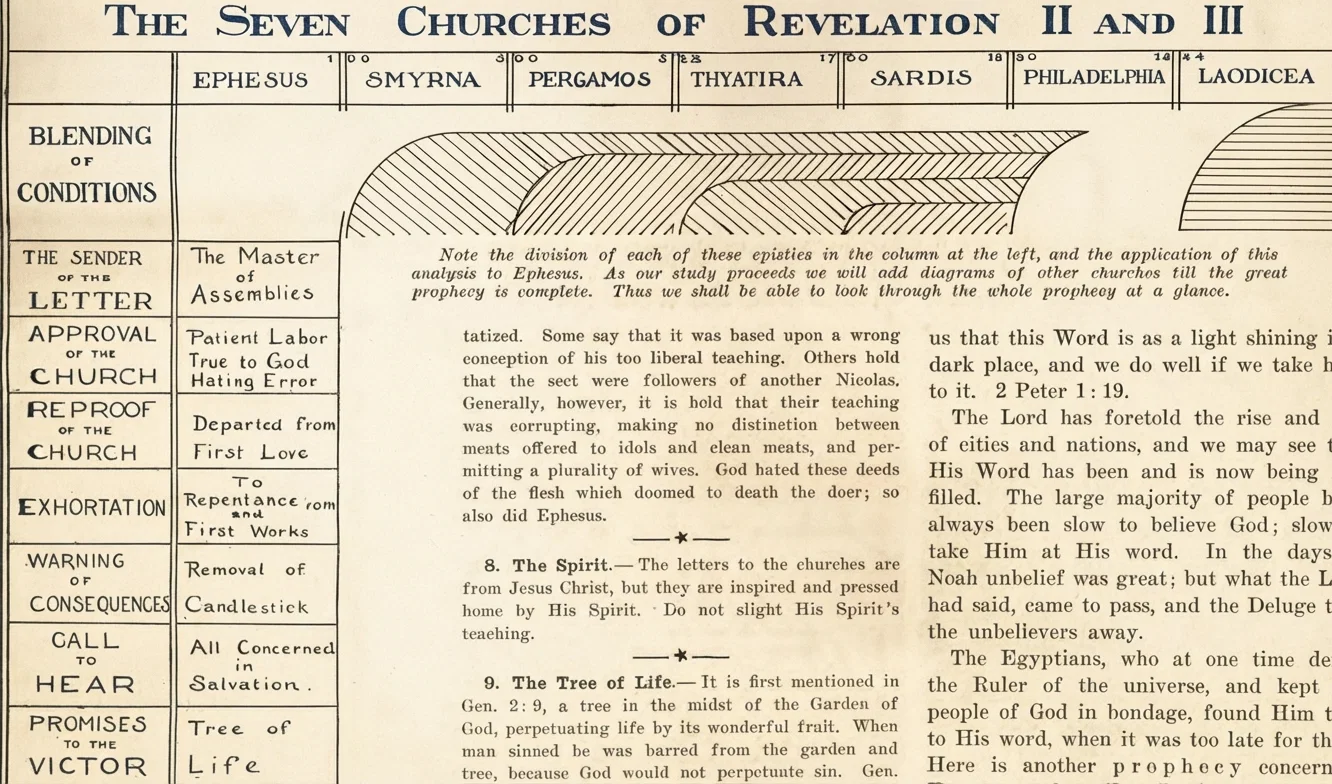
Note the division of each of these epistles in the column at the left, and the application of this analysis to Ephesus. As our study proceeds we will add diagrams of other churches till the great prophecy is complete. Thus we shall be able to look through the whole prophecy at a glance.
1. Unto the angel of the church of Ephesus write; These things saith He that holdeth the seven stars in His right hand, who walketh in the midst of the seven golden candlesticks;
2. I know thy works, and thy labor, and thy patience, and how thou canst not bear them which are evil: and thou hast tried them which say they are apostles, and are not, and hast found them liars:
3. And hast borne, and hast patience, and for My name's sake hast labored, and hast not fainted.
4. Nevertheless I have somewhat against thee, because thou hast left thy first love.
5. Remember therefore from whence thou art fallen, and repent, and do the first works; or else I will come unto thee quickly, and will remove thy candlestick out of his place, except thou repent.
6. But this thou hast, that thou hatest the deeds of the Nicolaitans, which I also hate.
7. He that hath an ear, let him hear what the Spirit saith unto the churches; To him that overcometh will I give to eat of the Tree of Life, which is in the midst of the Paradise of God.
The Gospel Lighthouse
By H. C. J. Walleker
By H. C. J. Walleker
THE Lord, Jehovah, the One who made the heavens and the earth, is the only true God. "He revealeth the deep and secret things: He knoweth what is in the darkness, and the light dwelleth with Him." Dan. 2:22. "Declaring the end from the beginning, and from ancient times the things that are not yet done, saying, My counsel shall stand, and I will do all My pleasure." Isa. 46:10. One of the greatest kings of this world was at one time so powerfully convinced of the truthfulness of the above words, that he exclaimed, "Of a truth it is, that your God is a God of gods, and a Lord of kings, and a Revealer of secrets." Dan. 2:47.
A large part of the Bible consists of prophecies, but there are comparatively few who study this portion of the good old Book. Yet the Author Himself invites us to "seek ye out of the book of the Lord, and read." Isa. 34:16.
If we will search the Book of God, we have the assurance that He will teach us to profit, and lead us in the way that we shall go. Isa. 48:17. The prophetic Word shows us indeed that God knows the end from the beginning. The apostle Peter tells us that this Word is as a light shining in a dark place, and we do well if we take heed to it. 2 Peter 1:19.
The Lord has foretold the rise and fall of cities and nations, and we may see that His Word has been and is now being fulfilled. The large majority of people have always been slow to believe God; slow to take Him at His word. In the days of Noah unbelief was great; but what the Lord had said, came to pass, and the Deluge took the unbelievers away.
The Egyptians, who at one time defied the Ruler of the universe, and kept the people of God in bondage, found Him true to His word, when it was too late for them. Here is another prophecy concerning Egypt; see how literally it has been fulfilled:
"And I will bring again the captivity of Egypt, and will cause them to return into the land of Pathros, into the land of their habitation, and they shall be there a base kingdom. It shall be THE BASEST OF THE KINGDOMS; neither shall it exalt itself any more above the nations: for I will diminish them, that they shall no more rule over the nations." Eze. 29:14, 15.
All must acknowledge that Egypt is one of the basest of nations to-day. The Lord said of the great kingdom of Babylon:
"And it shall come to pass, when seventy years [beginning 606 and ending 536 B.C.] are accomplished, that I will punish the king of Babylon, and that nation, saith the Lord, for their iniquity, and the land of the Chaldeans, and will make it perpetual desolations." Jer. 25:12.
Babylon was taken by Cyrus two years before the seventy years closed, 538 B.C., and in course of time the prophecy was completely fulfilled; and to-day where once the beautiful city stood is a waste desert, a dwelling for the wild beasts. Isa. 13:19-22. To the proud Chaldeans, this prediction spoken by the servant of God, seemed as empty words; but when the time came, God's word was fulfilled.
Many prophecies foretold the first coming of Christ, and different events in His life here on earth; but even His disciples were slow to believe that which was written. Hear what He says to them: "O fools, and slow of heart to believe all that the prophets have spoken: ought not Christ to have suffered these things, and to enter into His glory?" Luke 24:25, 26. If they had taken heed to the prophetic Word, they would have found hope and comfort in the dark hour when their Master was taken from them by the cruel Roman cohort. He Himself had likewise told them at different8times what was coming; but their minds were so filled with the "orthodox" teaching of that time in regard to the Messiah, that they could not understand. O, how slow men are, to-day even as then, to believe God!
After the apostles received the Holy Ghost, they preached with great power, that Christ would come again the second time. Peter says, "For we have not followed cunningly devised fables, when we made known unto you the power and coming of our Lord Jesus Christ." 2 Peter 1:16. John says, "We know that, when He shall appear, we shall be like Him; for we shall see Him as He is." 1 John 3:2. They were not following the teachings of men when they wrote thus, but their statements were based upon the sure word of prophecy. May we, living in the days which are so filled with events pointing to His second coming, take heed and learn a lesson from the failure of others, lest that day come upon us unawares.
We know that there shall not fail one word of that which God has revealed through His servants. The day is fast hasting on when all shall be fulfilled. "For the prophecy came not in old time by the will of man: but holy men of God spake as they were moved by the Holy Ghost." 2 Peter 1:21.
God and His Creature Man
By Emma Hildreth Adams
In What Form Did God Appear to Men in Early Old Testament Centuries?
THE question can be answered definitely only from the Word of God itself. Aside from that volume, not all the treasured libraries of the world can set forth the intensely interesting truth in the case.
None of them contain an ante-Flood portraiture of Him who lifted up the young hills, set the first streams to flowing, decorated the new valleys with flowers.
No other volume touches authoritatively the Creator's relations with mankind before the Deluge. Therefore to it we turn for illumination upon our inquiry.
In Gen. 1:26 there gleams a definite clue to the form of God. In His proposal there recorded to Christ, the active Creator of the earth, occur these very significant words:
"Let Us make man in Our image, after Our likeness." And the result?—"So God created man in His own image, in the image of God created He him."
This announcement alone, of the grand inception of the once noble human form, ought to prohibit forever and under all circumstances, every member of the race from doing any deed which can dishonor the "image of God." It should impel men to live godlike lives; to cease from all the infernal things they now do to each other; to stand up for purity, justice, and right.
But there is more. In Gen. 5:1 occurs this very emphatic statement: "In the day that God created man, in the likeness of God made He him." Can there be denial of that assertion?
More than fifteen centuries after that final act of creation, after the great Flood had accomplished its tremendous purpose, after Noah and his sons had again set foot upon solid matter, and again were giving thought to gaining a livelihood, God, in a kind, instructive talk with the great primitive navigator, made this startling declaration:
"Whoso sheddeth man's blood, by man shall his blood be shed: FOR in the IMAGE of GOD made He man." Gen. 9:6.
The swift years pushed by, and in anno Domini 60, twenty-four centuries after God's decisive utterance to Noah, the apostle James, writing to the "twelve tribes scattered abroad," urging them, inspiring them, to nobler courses of life, said, "But the tongue can no man tame. . . . Therewith bless we God, . . . and therewith curse we men, which are made after the similitude of God."
These scriptures, if words at all deserve our confidence, if simple, direct assertions can, in any case, stand unshaken, must lead to the conclusion that God created man an image, a likeness, a copy, a representative, of Himself, not only in respect to bodily form, but in mental, moral, and spiritual likeness as well, yet vastly, inconceivably inferior to Him in knowledge, might, and power.
True, God is a spirit-being, while man is of the earth, earthly; yet the inference must be that man's physical form, at creation, was an image of God's spirit form, and was undoubtedly a nobler form than that of any of his successors who walk the earth to-day.
The total history for 2,000 years succeeding the fall, indicates that God appeared to men, conversed with men, instructed them, reproved them, in the form of man. The interviews with Adam, Cain, Noah, bear that impress.
A notable instance to such conclusion is portrayed in the charming visit which God or Christ and two angels paid to Abraham, one fervid noonday, as he sat at his tent door in Hebron on the plain of Mamre. Especially is this apparent in the magnanimous concessions made to Abraham's requests of God when they two were deliberating upon Sodom's fate.
In that same year God held an intensely interesting talk with His "friend" Abraham, touching the birth of Isaac. The purpose settled, it is said that God "left off talking" with Abraham, thus indicating that the two persons had communed together.
Other instances might be cited of personal meetings between the Author of the universe and leading members of the race. A very remarkable occasion occurred in the life of Jacob at the ford of Jabbok, where, it is stated, "there wrestled a man with him until the breaking of the day."
That was an extraordinary scene. Both members in the contest asked of the other his name. Gen. 32:24-30. Jacob announced his name readily. His Opponent answered the question by pronouncing a rich blessing upon the human wrestler. Thereby Jacob knew Him, and cried, "I have seen God face to face, and my life is preserved."
The book of Exodus teems with instances wherein God and Moses, that most remarkable character of all history, held close converse concerning the transcendent scenes and deeds in which the latter acted a most distinguished and honored part through over forty years of his life. Chapter 33:11 states, "And the Lord spake unto Moses face to face, as a man speaketh unto his friend."
Joshua also, upon assuming the position of leader of Israel at the withdrawal of Moses, acquired strength, wisdom, courage, for his mammoth task, from cheering, personal conference with God before the great host crossed the Jordan.
All that keen, pointed instruction, those mighty promises of needed power, those exact, penetrating commands, appear to have come from lips distinctly visible to the new general in authority.
The many subsequent centuries of Bible history down to the close of prophecy, furnish indications of God's personal presence upon the earth, and His communication with the race in the form of man.
Still, in the vast majority of cases, during Israel's long, stubborn, backsliding career, He chose to make known to them His grief, His disapproval, His threats of punishment, through 'seers, visions, prophets, angelic messengers, and startling dreams.
The entire Bible narrative glows with pathetic evidence that the beings God has created in His own image, are inexpressibly dear to Him; that He craves to be near to them; that He welcomes communion with them, and desires to smooth their rough pathway till it ends in glory eternal.
Lo, He Comes
By Marion E. Hull
By Marion E. Hull
THROUGH the twilight, through the gloaming
Of the swiftly passing day,
God is flashing to the nations
Signals of the coming fray.
Men may read it in the judgments
That are falling on the world
For the deeds that quench the Spirit,
Where Sin's banners are unfurled.
They may read it in the reckless
Race for riches, place, and fame,
While the racers crush the helpless
In their mammon-maddened game.
It is written in the records
Of the strivings of the soul
That has bartered all of heaven
For a gilded, crumbling goal.
God is waiting, sternly waiting,
Justly balancing the scale;
And no power of man's devising
'Gainst that justice can prevail.
Sure as shines the sun above us,
Sure as rivers seek the sea,
God will soon declare, "'Tis finished—
Time is now eternity."
Heed, ye careless! Heed the warning
God is flashing forth to-day!
Earth and heaven are loudly telling
That our God will not delay.
He is coming, say the prophets—
Shout it till the welkin rings!
He is coming—earth declares it—
Lord of Lords and King of Kings.