Your ShelfYour Projects

Review and Herald, Vol. 79, No. 11.

Go Ye
Earlier text: The End, or Purpose, of Health Principles

Note and Comment

The following figures pertaining to the liquor traffic in the United States are given in a preliminary report issued by the Census Bureau, says the Lutheran Witness:—
“The whole number of establishments reported is 2,849, an increase of forty-eight per cent over the number reported ten years ago; and the total capital invested is given as $457,674,087, an increase of seventy per cent. The average number of wage earners employed is 44,417, which is an increase of twenty-three per cent. The total of wages paid during the past year was $28,005,484, an increase of twenty per cent. Other general figures are reported as follows: Miscellaneous expenses, $183,099,796, an increase of sixty-one per cent; cost of materials used, $70,512,042, a decrease of twelve per cent; value of products, $340,615,466, an increase of eighteen per cent.”
“Thus does the worship of this Moloch grow apace,” adds the Witness, “while the churches barely hold their own, and must curtail their work for lack of money.”

The Scandinavian Union Conference

Of the five European union fields organized last summer during our European General Conference at Friedensau, the Scandinavian contains by far the smallest population—about twelve and one-half millions of people. Within its territory are the three organized Conferences of Denmark, Norway, and Sweden, and the mission fields of Finland, Iceland, and Greenland. Nearly all the inhabitants of these lands are professed Protestants; and, considering the high standard of their education, their industry and frugality, and the liberties they enjoy, no other field in Europe is more promising than this. As early as 1877, Elder Matteson began his labors here; and through his efforts, for many years the membership in Scandinavia was larger than in any other European field. But the late financial difficulties somewhat checked the progress, and were productive of wounds that are but slowly healing.
Under the circumstances, it was thought best for Brother W. C. Sisley and the writer to visit these Conferences and the institutions located therein, this winter, preparatory to attending the Scandinavian Union Committee meeting at Stockholm. This Union Committee consists of each conference president in Scandinavia, the director of the Finland Mission, Dr. Ottosen, and the two general canvassing agents employed in the field.

The Danish Conference

Brother Sisley arrived at Hamburg, January 30. He looked over our books there, and the evening after the Sabbath, we left for Frederikshavn, near the extreme north of Jutland. Here, in 1894, a high school was opened, and it was in operation for a few years; but later on, because of financial embarrassment, it was found advisable to turn it over to the Skodsborg Sanatorium, for a summer health resort. As Dr. N. P. Nelson is now to take charge of the place, we may expect that it will receive a larger patronage, and make both ends meet. Last year's loss was nearly two thousand dollars.
BUILDINGS ON ELDER P. A. HANSEN'S FARM, NEAR SINDAL, DENMARK
Returning a few stations, we stopped at Sindal, where Elder P. A. Hansen has, on his own account, and at very reasonable figures, recently bought an estate of seven hundred and thirty acres. As he found many of our people in need of work, and desired to see something done toward starting an industrial school, he felt it his privilege to make provision for the beginning of such an enterprise. On the farm are most excellent and commodious buildings,—a roomy dwelling-house, large barns and stables, and a thriving creamery,—and the terms of payment are very easy.
We next went to Skodsborg, where the annual meeting of the sanatorium stockholders was opened February 4. Many things here have improved. Last year was the most prosperous one the institution ever had, its income from treatment, board, etc., being about twenty-seven thousand dollars, a net income of nearly four thousand. The sanatorium enjoys an excellent patronage from the best classes, both in Denmark and in adjacent Sweden. We spent five days here, looking over the books and investigating the general management of the institution. As the Skodsborg Sanatorium really started with nothing, and had to pay a high rate of interest for its money, it had a hard time; but we are assured that, with careful management, it can soon be put on a good, sound basis. The buildings being only cottages, more work is required than would be necessary if the buildings were nearer one another, and, again, the institution has to pay a high rent for outside cottages, in order to have sufficient room for its patients.
What the promoters of this enterprise sorely need is sufficient capital, at reasonable interest, to enable them to erect a suitable building on the sanatorium ground, and also to build a food factory in Copenhagen, where there is a small plant, which is able to satisfy the ever-increasing demands for health foods only by the greatest self-denial and under the most unfavorable circumstances. Dr. Ottosen enjoys the confidence of the medical fraternity, and we are assured that, if the new board of management work together in the bond of love, and our brethren come forward with the necessary capital, this institution will have a bright future.
While at the sanatorium we spoke to the patients and helpers, and on Sabbath, to the church in Copenhagen as well. At Skodsborg we received a donation of about forty dollars for the Oriental Mission.
The Danish Conference was also deeply involved in debt, but through the careful management of Elder P. A. Hansen, it is fast paying its liabilities. Already, its income is greater than that of any other of the Scandinavian Conferences. The canvassing work has suffered somewhat under various restrictions, but we hope it may be revived, as Brother Sherrig expects to give it special attention.

At Christiania

In company with Elder P. A. Hansen and Dr. Ottosen, we next went to Christiania, where we spent February 9-11. We found the situation much changed for the better. The two old presses, which were of no use to us, have been taken by the manufacturer in exchange for an excellent new press, without cost to us, and an old English press has been newly set up, and works well. The composing room has been moved to the basement, and the first floor is now occupied by Brother Lorenz's bindery. A good, new heating apparatus has been placed in the building, and it also furnishes steam for the old house. One would scarcely recognize this old building. It has been fitted up for a health home. In the basement are bath rooms, while above are dwelling-rooms for patients and helpers. Elder O. A. Johnson has been using the hall for a course of lectures during the winter, which were well attended. Thus every inch of the present buildings is not only occupied, but these buildings bring in sufficient rent to meet the running expenses and the interest on the property. Times, in general, are even worse than they have been before, and there would be no prospect of selling the property at present, for any reasonable sum. However, there is some probability of our disposing of the back lot. Of course the Norway Conference has suffered heavily because of this financial depression, and many of our brethren have gone to the United States; but the Conference expects to hold its own this year, and is paying off its debt. Elder O. A. Johnson here joined our party, en route to Stockholm.

The Swedish Conference

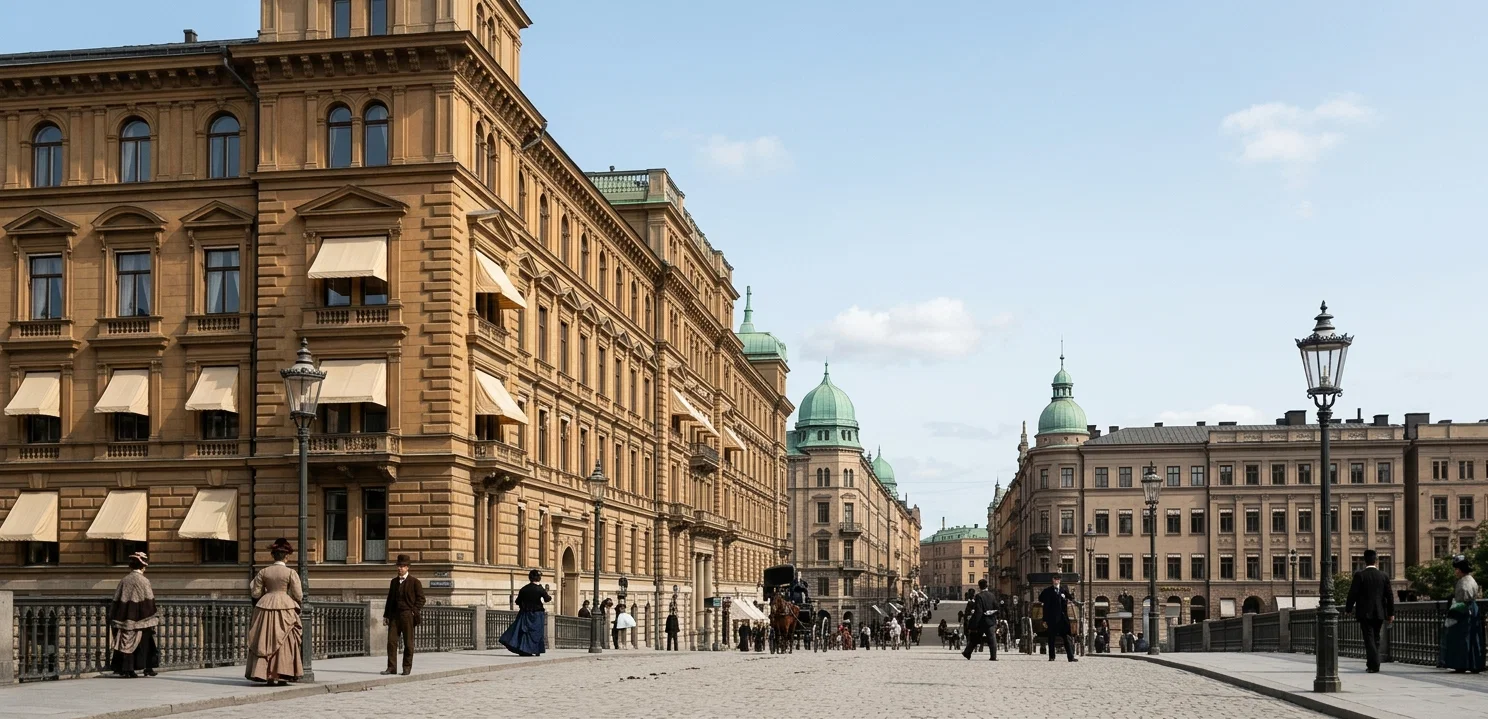
While the most of us went directly to the Swedish capital, Brother Sisley accompanied Brother Lind to our industrial farm, located near Jernboas. He brought a favorable report from the school, stating that there were thirty students in attendance, and that the spiritual interest was good. Stockholm with her three hundred thousand people, is the finest city in the territory of the Scandinavian Union Conference. Our offices here are favorably located in the heart of the city, near the main depot. In the cut, the corner building to the left contains our meeting-hall and offices. You can see the word Tecken over the basement window. This is a part of the words, Tidens Tecken, meaning in English, Signs of the Times, the name of our Swedish paper. This was our first visit to Stockholm, and we were pleased to meet Elder Erikson, who had recently arrived from Massachusetts, U. S. A., to assist in the work in this Conference.
All the laborers of the Scandinavian Union Committee were present, except Elder Hoffman, of Finland, who was kept at home by his interest in that country. Both he and Brother Anderson seem to have a good interest there. Last year the Finnish book sales amounted to over $4,540, but what they need in that field is more capital.
KING STREET IN STOCKHOLM
Until recent years, Sweden was, numerically, the strongest Conference in Europe; but, not having its own local president to look after matters, it has gradually fallen behind, until now it occupies the fifth place in membership; and in finance, it is even weaker; but we hope that this meeting has given a new stimulus to the work in this field. Our outside attendance at the evening services was good. While we had to talk quite plainly in our consultation meetings, yet the good Spirit of the Lord came in, and knit the hearts of the brethren.
In one thing Sweden still takes the lead—the success of its canvassing work. Last year the thirty-nine canvassers working there took orders for $22,178 worth of books, and delivered $22,515 worth.
Thus far the donations and the tithe of the tithe of the local Conferences has gone toward the support of the presidents of these Conferences; but it was resolved to use these donations, as far as possible, in the mission fields,—Finland, Greenland, and Iceland being their present mission territory,—and thus make the work of the union a practical one. During the last half-year, the Scandinavian Union paid $179.86 toward the support of the European General Conference.
We can truly say that the Lord was with us during this meeting, and the desire of the Scandinavian Union Conference, with its twenty-one hundred members, is to press unitedly forward in the great work committed to this people for these last days.
L. R. CONRADI.
THE RELIEF OF THE SCHOOLS

Some Blessed Experiences

The Lord is giving some blessed experiences to those who are in sympathy with the movement to sell “Christ’s Object Lessons.” These experiences would be very interesting to our people; but for lack of space, I will relate only a few of them.
One of the ministers of Wisconsin visited his home church to interest the members in selling “Christ’s Object Lessons.” They felt that it would be a difficult work, and said that they had little courage to undertake it. The minister was finally told that they believed it would be impossible for him to make a success in selling the book. He realized that the usefulness of that church largely depended upon his course. He had never canvassed, and began to realize that he was placed in a position where he must close his mouth, or show what he could do in selling “Christ’s Object Lessons.” He said that he never passed through a struggle much more severe than this one. But there was only one thing for him to do if he would obey God, and that was to go out with the book. He struggled and prayed over the matter all night, and until three o’clock in the afternoon of the following day. At three o’clock he started out, and worked one and three-fourths hours. He took the portion of the town that the church had said was the most difficult part. It was Friday afternoon, and he could not canvass longer; but when he had finished his work, he found that he had sold twenty-two books. He realized that God had done it through him.
When the story of his experience was told to the church, they still seemed to be doubting, and said that they did not believe that he could sell books in the resident portion of the town. The minister was obliged to leave the place Monday, yet He made up his mind that he would demonstrate to them that they were wrong on this point, too. Sunday afternoon he spent two hours in the resident portion of the town, and took eight orders. The church had nothing more to say. They ordered their quota of books, and began at once to sell them, and have had success.
The brother made thirty-two canvasses in all, and sold thirty books. He says now that he understands the meaning of what has appeared in the Testimonies of late to the ministers,—that they should canvass; that there are many who have been only consumers, and not producers; and that all should be put to the test in order to determine their power with God.
One of the churches in Wisconsin took no part in the sale of “Christ’s Object Lessons” last year. The conference president asked me to visit this church. When the church learned that I was coming, some of the members said that it would never do for me to come and find them in the condition that they were in, but that they must do something before I reached the place. Five of them went out, and seventeen hours were spent in canvassing. One brother sold twenty-five books, his wife five, his sister five, and two others five,—total, forty. This little experience brought great courage into the church, and they had a wonderful social meeting as the result; and when I reached them, their interest was up to a white heat, and all that was necessary was to organize them into four companies, placing over each company an officer of the church, and an earnest young person as an assistant. They agreed to sell four books for every name on the church roll, even though about one half of the members were not active ones. God has vindicated His promise to this church, in that He has unified them, and brought in a spirit of courage and love as the result of the little work that has been done.
In one church in this State there are no English brethren. Elder Daniells’s letter was translated by one of the brethren, and read to the church. They were deeply moved, and decided that they would sell their quota. They at once ordered fifty English books, but as these brethren are not familiar with the English language, they will have to sell these books at considerable disadvantage.
In another church a sister who had dreaded the canvassing work for years, and felt that she never could go to her neighbors with literature, was so pricked by the Spirit of God that she completely yielded herself to the Lord, and gave herself to the work. It was a fearful struggle, yet after it was over, she went out with good courage. She sold her four books to the first four persons she met. She is deeply interested in the work, and is having success.
In another church a woman not of our faith was told the story of “Christ’s Object Lessons,” and she became interested. She secured one of the books, and in one afternoon sold eight copies. She was very happy over the result, and when her husband, who is a business man, returned in the evening, she told him her experience. He was led to try it also, and sold three books the next day.
Books have been sold by those who were unable to go out, and even by some who were compelled to remain in bed, but the work was resting so heavily upon their hearts that when friends came to visit them, they were obliged to speak of the book, and thus secured orders. Nothing can stop the spirit that is working upon the hearts of those who are inclined to work for the Lord.
Another church has had a remarkable experience. The membership is made up entirely of sisters. They have sold their quota, which was sixty-eight. Three sisters canvassed one day, and sold thirty-six books. They enjoyed the work, and are still canvassing, and probably will succeed in helping some of our dear brethren in other churches who have not the courage of these sisters.
E. A. SUTHERLAND.

An Appeal for Help in Providing Buildings in Which to Train Medical Missionary Workers

It is now more than sixty years since the angels' messages foretelling our Lord's return to earth have been ringing through the world. The period of time which has elapsed since the General Conference of 1901, and especially the last few months, has been marked by the spirit of reorganization, reform, and revival in the hearts of thousands of God's people.
A spirit of work, conceived in prayer and heart consecration to God, is being born into many lives. We thank God that the offerings during the past year are larger than ever before in the history of the denomination. The sales of “Christ's Object Lessons” for the relief of our schools have been unprecedented during the last few weeks.
From the beginning of our work, the health reform and medical missionary truths have been cherished as a precious heritage from Heaven to the waiting remnant people. The health reform is the right arm of our message; the medical missionary movement is the entering wedge to hearts.
The work done among our churches by our medical workers during the last five or six years has brought health and happiness, both physical and spiritual, to thousands upon thousands. The past decade has witnessed great changes in our modes of living. And during the last few weeks The Forward Movement has caught up this work, and is still further spiritualizing and purifying it.
We have been eager to have this health reform and medical missionary work done among our own churches. We have been desirous that it be carried on among those not of our faith. To this end we have willingly given of our means to establish restaurants in our large cities. Donations have freely been made for the support of cheap hygienic lunch counters and homes for the homeless poor. Orphanages are being systematically maintained. Bath and treatment rooms are doing a noble work in many places. Our sanitariums dot the land, and girdle the globe.
But now comes the strange part of it all. As a denomination we have never yet appropriated a single dollar for the founding of a college in which to train our sons and daughters for the health reform and medical missionary work. We have invested between half and three quarters of a million dollars in colleges and academies in the United States, in which to train young men and women for other branches of the message. This is a large sum when the size of the denomination is taken into account. At the same time, while saying that the medical missionary work is to the Third Angel's Message as the right arm to the body, we have never made any attempt to raise a fund for a medical missionary college. Brethren and sisters, we will all say, with one heart and voice, This thing ought not so to be.
The work of training Christian physicians and medical missionary workers has been done under somewhat discouraging circumstances. During all these years a large school of pupils preparing for medical work has been carried on without any school building in which to give the instruction.
It is true, of course, that the north end of Battle Creek College has been occupied for a few years by classes composed of those preparing to become physicians. But the physicians are only a very small part of those in training for medical missionary work. There are always from ten to twenty nurses in training where there is one physician. Then there are those preparing to teach in schools of health, those who are taking up courses of study in healthful cookery, and those who expect to engage in rescue work in our large cities.
The inconveniences which teachers and students in these lines of work have suffered have been great. Classes have been held in basements of our sanitariums, in corners of bath rooms, in small treatment rooms, in gymnasiums, in buildings in Chicago so infested and unsanitary that they were hardly fit to live in. But now the day has come when this work must have a suitable college in which to train our medical workers. Medical college buildings are one of the crying needs of the hour.
The flames have burned the main buildings of our Battle Creek Sanitarium, but the people of the world are coming forward with offers of money with which to help in rebuilding it.
And now while the world is doing this, shall not we provide the money for a medical missionary college? Shall not the remnant people among whom Heaven has made the deposit of this precious light, furnish a place where young men and women can be trained to man our sanitariums and treatment rooms, and to fill our medical missionary ranks all over the world?
By faith we hear the voices of thousands upon thousands of God's friends responding, “Amen and Amen. In the hour of calamity to the mother Sanitarium, we will come up to the help of the Lord. In a most practical and tangible manner we will manifest our sympathy for leaders and their assistants in the medical missionary work. And above all that we may do to comfort the hearts of our brethren and sisters in arms, we will demonstrate in no uncertain voice or action our loyalty to Him ‘who went about doing good, and healing all that were oppressed of the devil,’ and who ‘himself took our infirmities and bare our sicknesses.’”
At the last General Conference it was agreed that the Battle Creek College buildings should be transferred to the medical interest, and used for a medical missionary college. Some of the debts of the Battle Creek College have been paid by money received from the sale of “Christ's Object Lessons,” but a large sum still remains unpaid. All told, we ought to raise one hundred thousand dollars for our medical missionary college.
We have raised more than half a million for our eight principal colleges and academies in which to train laborers for other departments of the work. This being so, there is no question but what we can easily raise one hundred thousand dollars for a medical missionary college. The Battle Creek College was the first and the mother of our denominational colleges; henceforth it is to be the mother of our medical colleges.
The Missionary Acre Fund has been consecrated by authority of the last General Conference to the securing of this plant for a medical school. The springtime is near at hand. Soon the minds of our brethren and sisters all over the land will turn toward the kindly earth, from whose bosom, by their labor and the blessing of our Heavenly Father, will spring forth food for the sustenance of our bodies. And will it not please our Heavenly Father if, as we prepare the soil and sow the seed, we consecrate a portion of that soil and seed to Him, by giving its proceeds to the Missionary Acre Fund, which is to be used to provide “a holy house” from which will come forth missionaries whose special work will be to teach men how to preserve their God-given health, and to bring back to the fullness of life those whom disease has stricken low?
And now shall we all help to swell this fund—every one whose heart stirs him up, and every one whom his spirit hath made willing? Shall we be “wise-hearted” men, and bring the Lord's offering as they did in the ancient days when the tabernacle was built in the wilderness?
Every soul of us can and should aid the Missionary Acre Fund. Wise and liberal-hearted men can plant one, two, three, perchance five or more, acres. The harvest will be a kind of first fruits—holy unto the Lord. Others can dedicate a certain part of the returns from their orchards, their vineyards, or their berries. Those with stock farms can devote a portion of the increase of their flocks and herds. Another class may choose to plant a garden, and make their offering from its yield.
Besides the brethren dwelling in the country, there are many who live in cities and villages, and work at trades and for wages. Such can dedicate a portion of their salaries to the Lord.
The sisters can also help. They can plant gardens, raise poultry, and with their needles make useful articles for sale. Other sisters can consecrate their spare time to canvassing for our smaller books, and give the proceeds.
The children also can be enlisted to assist in this good work. Their parents can help them to do many things which will yield returns.
The chief thing necessary to make this work a success is to put away unbelief and doubt, faultfinding and criticism, and to come to the missionary acre movement with heart stirred up and “spirit made willing,” determined with the help of God to see the thing accomplished.
At present we are not asking any to make definite pledges. It is too early for that. We want all our brethren and sisters joyfully, hopefully, and prayerfully to consider this matter and God's claims upon them in regard to it. We do want each one to purpose in his heart, and then to give “according as he purposeth.”
Everywhere throughout America during the next two weeks, let there be praying and purposing over this matter. Then on Sabbath, April 5, let us all come together in our various places of worship, and have a blessed meeting, relating our purposes and experiences in this work. A special reading will be sent to all church elders for use on this Sabbath. No offering will be taken up at that time, and the exercises will be wholly those of devotion, praise, and melody to the Lord. At a later date a definite plan to ascertain just what our brethren and sisters have decided to do will be inaugurated.
In the meantime, if any have money which they believe the Lord wants them to give for this purpose, they may send it to the Treasurer of the General Conference, H. M. Mitchell, Battle Creek, Mich.
With the prayer that this appeal may be blessed to many hearts among the waiting people, we leave this matter with God and with those whom He calls His friends on the earth.
(Signed) W. W. PRESCOTT, Vice-Pres. General Conference; S. H. LANE, Chairman of Acre Fund Committee; P. T. MAGAN, Financial Sec. S. D. A. Gen. Conf.

Encouraging Words

A FRENCHMAN whom I visited on my recent tour in Québec, and with whom I left French reading-matter for himself and others, writes: “I have read most of the book that you gave us [“Readings for the Family;” another name for “Bible Readings” prepared especially for Catholics]. It interests us very much, and we have been enlightened by the truths it contains. As for myself, the more I read, the more I find that the old routine is ridiculous, is an outrage on good sense, on reason, and religion.” He is a grocer, and acknowledges the truth of the Sabbath.
A French lady residing in a distant Western State, to whom I sent quite an assortment of French tracts after returning to Michigan, sends me these encouraging words: “I thank you for your tracts. I have read them, have searched in the Bible, and found the truth. . . . My children unite with me in sending you salutations.”
The French company at Namur, Quebec, report that they have good meetings and an interesting Sabbath-school, and that they spend their evenings and much of their time on the Sabbath in reading our French “Life of Christ” and “Great Controversy.” With them these books take the place, to a considerable extent, of the living preacher. A brother belonging to this dear company says, in a recent communication: “We think of you every evening while reading “La Grande Controverse [“Great Controversy”]. What blessed evenings we pass together in reading the chapters of this book! It brings us nearer heaven and heavenly things. We have read most of the book, and will soon pass it to another.” And similar words of appreciation come with regard to “The Life of Christ.”
D. T. BOURDEAU.

General Notes

At Grey Eagle, Minn., twenty souls have accepted the truth, as the result of meetings conducted by J. O. Peet and Benjamin Francis. Some others have begun the observance of the Bible Sabbath.
Elders Meyer and H. Schultz, who have been laboring at Woollam, Mo., report that the work there is in a very encouraging state. A number have accepted the truth, and others are deeply interested. Elder J. M. Rees reports that five persons are awaiting baptism at Rolla.
Cottage meetings are being conducted in the vicinity of Cedar Lake, Mich. A meeting held at the Dopp schoolhouse, February 16, by appointment which had been made by some of the workers at Cedar Lake Academy, resulted in bringing several to signify their acceptance of the truth. Brother M. S. Burnham reports a good interest at Otsego, where he has been distributing literature.
Four adults and four children have been added recently to the company at Ingersoll, Ontario. One family near Muskoka has begun the observance of the Sabbath, as the result of missionary activity on the part of Sabbath-keepers in that community. The interest at Scotland, where Brethren William Simpson and W. A. Young are laboring, continues good. At the first Sabbath meeting thirty-nine were present, all but ten being adults. From Lindsay, the report is that a number of families are convinced of the truth, some of whom are expected to obey.
At the town of Perry, N. Y., meetings were begun in a private house, November 22, and continued through the winter, by J. B. Stow, assisted by his wife, and a part of the time by several lady canvassers. Visits were made from house to house, literature was distributed, some subscriptions for periodicals were obtained, and forty-five dollars' worth of books was sold. The work was conducted against much prejudice and opposition. One person, however, has accepted the truth, and several who had been partial believers were led fully into the light, so that there are five who are now holding up the standard of truth in that place.
Continue reading: Current Mention