The Youth’s Instructor, Vol. 34, No. 50.

LITTLE SINS

The Youth’s Instructor

Dec 15, 1886

S. D. A. Publishing Association · Battle Creek, Mich. · Dec 15, 1886

LITTLE SINS.

WHEN preparing to journey to Europe, I found, among the articles of clothing I needed, some woolen goods which at first appeared all right, but when brought to the light and shaken thoroughly, revealed the destructive work of moths. Had we not made close inspection, we should not have discovered their depredations. The moth is so small a creature as to be scarcely observable; but the traces of its existence are apparent, and the destruction that it makes with fur and woolen goods shows that it is a practical worker, although out of sight and unsuspected.
Thinking of the secret but destructive work of these moths, reminded us of some human beings we had known. How often our hearts have been pained by some sudden revelation in the outward actions of those for whom we had hoped better things, bringing to light their true character, that had heretofore been hidden from the sight of all! When held up before the light of God's word, the character is found to be like the moth-eaten garment, which, when shaken out and examined, reveals the destructive work that has been going on secretly for years. While they have a form of godliness, sins small in their eyes have been eating into the warp and woof of their character; and that which at a casual glance appeared lovely, is unsightly and disgusting to look upon. Could the actor, as he entered upon this path of wrong, have seen himself as he appeared when his true character was opened to the light, he would have been as terrified and startled as was Hazael when Elisha told him what a wicked and cruel course he would pursue in the future. He made answer, “What, is thy servant a dog that he should do this great thing?” Little sins oft repeated become habit, and demoralize the soul. They work for a time unperceived, but are at length brought to the light.
The formation of character is a work that is steadily advancing, and how careful children and youth should be in regard to the habits they form! You will be for time and eternity what the habits you now form make you. Your principles and practices once formed determine your character. No one suddenly develops, as did Hazael, into a deep-dyed sinner, cruel and merciless. It took time for the moth to do its work of destruction so quietly in the dark; and it takes time, little by little, for a child or youth to be easy and happy and feel secure in a course of prevarication, a course of sin hidden from human eyes. Any one act, either good or evil, does not form the character, but thoughts and feelings indulged, prepare the way for acts and deeds of the same kind. A single glass of wine may lead to the formation of a habit most difficult to overcome, and is the first step which may lead to dishonesty, theft, and murder. What you do once, children and youth, you will do more readily the second time. It is the starting in any wrong course that must be guarded against. Be careful not to let your feet take the first step in any evil way. If you will lay the foundation for your character in a pure, virtuous life, seeking help and strength from God, your character will not be like the moth-eaten garment, but it will be firm and solid.
The fear of the Lord is the beginning of wisdom. If you are indeed a child of God, you will be a partaker of the divine nature, having escaped the corruption that is in the world through lust. Let the youth ever remember that there is something to escape, evils to shun. God has given his children faculties, the right employment of which would make them happy. The Lord never designed that they should be employed for our destruction. The structure of a strong, well-balanced character is made by a faithful performance of individual acts of duty in little things. You need, dear youth, to be particular in regard to your words. Your deportment, the spirit and feelings that you cherish, care and thoughtfulness in the things which are least in every-day life, form the true test of character.
This life is full of gracious opportunities, which you can improve in the exercise of your God-given abilities to bless others, and in so doing bless yourself, without considering self in the matter. Trivial circumstances oftentimes prove a decided blessing to the one who acts from principle, and has formed the habit of doing right because it is right. Seek for a perfect character, and let all you do, whether seen and appreciated by human eyes or not, be done with an eye single to God's glory; because you belong to God, and he has redeemed you at the price of his own life. Be faithful in the least as well as in the greatest; learn to speak the truth, to act at all times the truth. Let the heart be fully submitted to God. If controlled by his grace, you will do little deeds of kindness, take up the duties lying next you, and bring all the sunshine into your life and character that it is possible to bring, scattering the gifts of love and blessing along the pathway of life. Your works will be far-reaching as eternity. Your life-work will be seen in heaven, and there it will live, through ceaseless ages, because it is found precious in the sight of God.
Mrs. E. G. White.

WINTER SCENES.

THROUGH the hushed air the whitening shower descends, At first thin wavering; till at last the flakes Fall broad and wide and fast, dimming the day With a continual flow. The cherished fields Put on their winter robe of purest white. 'Tis brightness all; save where the new snow melts Along the mazy current. Low the woods Bow their hoar heads; and, ere the languid sun Faint from the west emits his evening ray, Earth's universal face, deep hid and chill, Is one white dazzling waste, that buries wide The works of man. Drooping, the laboring ox Stands covered o'er with snow, and then demands The fruit of all his toil. The fowls of heaven, Tamed by the cruel season, crowd around The winnowing store, and claim the little boon Which Providence assigns them. One alone, The redbreast, sacred to the household gods, Wisely regardful of the embroiling sky, In joyless fields and thorny thickets leaves His shivering mates, and pays to trusted man His annual visit. Half afraid, he first Against the window beats; then brisk alights On the warm hearth; then hopping o'er the floor, Eyes all the smiling family askance, And pecks, and starts, and wonders where he is; Till more familiar grown, the table crumbs Attract his slender feet. The bleating kine Eye the bleak heaven, and next the glistening earth, With looks of dumb despair; then, sad dispersed, Dig for the withered herbs through heaps of snow.
—James Thomson.

FRED'S PUZZLE AND HOW HE SOLVED IT.

Fred came home from school one day with such a troubled face that his mother was sure something had gone wrong.
She did not urge him to tell her what it was, because she knew he would come to her sooner or later with the whole story; he always told her everything. He wondered why all boys didn’t do the same. “Even if it is a scrape, your mother is sure to know the best and the right way out of it, and how not to get into it again,” Fred always said. So Mrs. Tompson waited.
“We were placed to-day,” observed Fred, finally, as they sat at dinner.
“O Freddy, are you ahead again?” broke in his little sister.
In Fred’s school, the pupils were seated monthly, according to rank.
“That’s just what I don’t know,” said Fred, with a puzzled laugh.
“That is a very unhappy state of affairs,” said his mother. “Wouldn’t it be well to find out?”
“I wish I could,” he returned uneasily. “What do you think about it? You know I’ve been head for four months, ever since the beginning of the term, and Will Bacon has been number two. Last year we just about took turns at it. If I was head one month, he’d be sure to come in for it the next. But somehow, this winter he’s just two or three behind me in his per cent. every time.”
“I shouldn’t think he’d like that,” observed little Sue, sagely.
“I don’t think he does, much,” said Fred. “But Will and I have always been such good friends, that wouldn’t make any difference to us. Only Will feels pretty bad, because his father is so particular about his rank. And this month we came out exactly even. So Mr. Parker said we would draw lots for the head seat, and I drew the long straw. I was glad not to lose number one, but all the fun went out of it when I saw Will’s face go down, and I can’t feel right about it, somehow—it doesn’t seem to belong to me.”
“I don’t wholly like that arrangement of drawing lots,” said Mrs. Tompson; “but since the master chose to settle it in that way, the seat fairly belongs to you, I suppose. Sometimes, though, Fred, it’s a right thing not to claim one’s rights.”
Fred looked at her with a puzzled face. “I don’t think I know what you mean, mother,” he said.
“Try and think it out,” replied Mrs. Tompson, with a smile, as she rose from the table.
It troubled Fred all the afternoon. It spoiled his game of tennis, and came between him and the pages of his story-book. In despair he betook himself to the morrow’s lessons; he would begin with his examples, he thought. Had he lost his pencil, he wondered, as he fumbled in his pocket? Two handkerchiefs, one old mitten, a piece of rubber, two fish-hooks twisted in a bit of paper, three little rolls of twine, a crumpled piece of paper, and some crumbs—these were the treasures he drew out one by one and laid in a heap on the table. What was that scrap of paper, by the way? He smoothed it out carefully. Oh, that was just a verse he had learned for a Sabbath-school concert long ago, when this old jacket was his best one: “In honor preferring one another.” It was so long ago he had almost forgotten what it meant. “Let me see,” said Fred. “Rights that it’s right not to claim. ‘In honor preferring one another.’ They meant the same thing, I do believe! They mean that I ought to give the other fellow a chance, even if it is mine by right. And when my mother and the Bible agree about a thing, it’s time I did it!”
With which words, and a decided nod of his head, Fred dismissed the subject and went in quest of the lost pencil.
Will Bacon came into the schoolroom next morning just before nine o’clock, with a discouraged air. He had made a special effort last month in vain, and lost the place his father so desired to see him occupy by no fault of his own. He walked up to the second seat,—his seat,—where Fred Tompson was sitting. “Good-morning,” said he, making an effort to speak cheerfully.
“Halloo, old fellow,” said Fred, nodding brightly at him as the bell rang, but not rising. Will waited a moment—Fred sat still. “Well,” said Will, “you seem to have taken a fancy to my seat. The bell has rung; don’t you hear?” somewhat impatiently.
“Oh, yes, I hear,” returned Fred, with a twinkle in his eye. “But you see I have taken a fancy to this seat, and you’ll find your books in number one.”
“But,” objected Will, flushing deep, as he understood his friend’s words, “that seat doesn’t belong to me, and this does. The straws decided it.”
“No, they didn’t,” said Fred. “It’s time you had the first seat again; and I prefer you to have the honor,” he added with a smile whose full meaning was known only to himself, as Mr. Parker rang the bell sharply a second time, and looked at the two boys who should have been quietly settled in their seats with the rest of the school.
It was no time to argue the matter, so Will seated himself at number one, and felt remarkably at home when he found his books stowed away in its desk. And by recess, his first chance to attack the matter, it had become such an accomplished fact that Fred easily overruled all his objections and obtained Mr. Parker’s sanction.
And, for a long month, whenever Fred looked across the aisle at Will’s happy face bent over desk number one, he couldn’t help saying to himself,—
“I’m glad I did it. Things always turn out right when I go by the Bible and my mother!”—The Well-Spring.

DECEIVING THE NATIVES.

At one time it was thought by the Maories to be almost as honorable to own a blanket as to be chief; so they would oftentimes work a year for the white man if by so doing they could obtain one; or they would work a month for a plug of tobacco.
It is reported that when the missionaries first went to New Zealand, they were well treated; for the natives were religiously inclined. They had such regard for the right that when they were properly instructed respecting God's moral law, they readily fell in with its teachings. But they were not treated as they should have been by many of the missionaries; neither were they treated according to the wishes of the societies that sent these men to convert and civilize them.
The London Missionary Society furnished tools to be distributed among the natives, as soon as they learned to use them in cultivating the soil. These articles were prized very highly by them. Especially did they prize the clothing of the white man. But instead of giving these things to them, as was the design of the society, the missionaries sold them at enormous prices, thus taking advantage of the ignorance of the natives, who knew nothing of the worth of such things. As they had no money, they would pay for them in land, sometimes giving hundreds of acres simply for a hoe. The missionaries encouraged the natives to use tobacco, and then for a small plug obtained large tracts of land.
For a time the natives confided in the missionaries, and trusted everything in their hands. The latter advised them not to make friends with the white settlers, in order that they might hold an influence over them, which they could not otherwise do. But in process of time the natives learned that they had been robbed of their land, and they were greatly enraged. Trouble immediately followed; the natives made war, killing the missionaries and burning their missions.
At the present time there is nothing that would cause the natives to look upon a stranger with greater suspicion than for him to propose to purchase land of them. It is very difficult for any one to have an influence with them excepting those whom they know to be their friends, and who have always treated them kindly.
It is a singular fact that while many of these missionaries have died, and left to their children a large amount of wealth, the judgments of God have seemed to follow their posterity. In almost every case they have become poor and worthless. Some of them are the vilest of the vile, and others are in insane asylums. God has not only frowned on these men who so enriched themselves by the ignorance of those who knew not God, but also upon their children.
S. N. HASKELL.

Sea Tales: Gales and Heavy Seas in the Southern Atlantic

SEA TALES.—NO. 6.

We had strong westerly gales right along in the southern Atlantic, the wind almost always being dead aft. The winds in this region blow from the west nearly all the year, and are so strong that in the North Atlantic they would be called gales. The waves were frightful to look upon, reaching far above our top-masts when the brig descended into the sea. There was never a dry spot on the vessel, the seas sometimes breaking over her in every direction. They would come rushing over and over astern, roaring and foaming, and looking as though they would bury our little craft beneath them; but at the stern they would part, and lifting her high out of the water, go roaring along by her side, every now and then giving her a slap, generally amidships, possibly tumbling aboard at the forward shrouds, to catch the cat napping, or to douse a sailor just after he had been below to put on dry toggery; then meeting at the bow and forming a broad sheet of foam. With such gales, such seas, and such ugly clouds overhead, and a barometer down to 28.75, it is not strange that those of our sailors who were in this region for the first time, would grow white with fear; neither is it strange that, with their superstitions, they should throw salt over their left shoulder to propitiate “the god of the waves,” when they would be ordered to the wheel. However, after a few days of such sailing, one gets used to it, and the terror passes away.
In old times the winding of the Cape was a terror to seamen. They hugged the land, striving to get around as closely as possible. This cruise gave them up to the mercy of the gales and currents, often contrary, and compelled them to sail a long distance, though apparently going by the shortest route. Since Professor Maury’s great discovery, vessels take the “great circle” route; and instead of forty-five or fifty days, a captain thinks he has hard luck if he does not reach from fifty degrees in the Atlantic to fifty degrees in the Indian Ocean, in nineteen or twenty days. The latitude of the Cape is about thirty-three degrees south. Now to sail on the “great circle” route means that instead of trying to round the Cape in thirty-three degrees, you swing far south in a big circle, so as to weather the Cape in forty-five to fifty degrees south. This sailing in such a large circle would seem, without an explanation, to force a vessel to traverse hundreds of miles without a cause; but it is a less distance on the circle than in a straight line. At thirty-three degrees, a degree of longitude is sixty miles, but towards the poles the degrees decrease in width, until at forty-five degrees they are not over forty-five miles in width. A glance at a globe map in a geography will make this plain to you.
After rounding the Cape, the first land sighted was the islands called the Crozettes. I was fortunate enough to be the first one to sing out the always glad tidings at sea,—“Land Ho!” and won the prize usually given to the man who first sights land. In two hours after sighting the Crozettes, we had the east or last island abeam. I was greatly surprised to find it to be the largest island of the three. At first only the upper and the lower parts of the island could be seen, with a large bay between, but in a short time the fog lifted, and showed towering hills behind that connected these two ends and made an island larger than any two of the others. On the sailing chart the island is represented as having only the two promontories and bay, as it first appeared to us, and I therefore became very much interested in procuring an accurate sketch of the whole, which I succeeded in doing. I was so absorbed in my drawing that I paid no attention to what was taking place on board, until I was aroused by an unwonted stillness, the roar of the sullen waves as they dashed upon the rock being the only sound that was audible. Glancing around, I saw the captain standing on the house bareheaded, as motionless and as rigid as a stone, and both mates and every sailor on deck, and each man at his post. We were becalmed! The hill had shut off the wind. The brig was heading then southeast. Slowly she swung off to the southwest, then west, and so on completely around until she faced the island, all the time drifting nearer and nearer the huge black rocks upon which the waves incessantly dashed. Not a breath of wind could be felt. The captain dashed water on his head and hands, and tried to feel the breeze, to guide him in tacking.
After many tacks, consuming over three hours, we began to slowly forge ahead and to gain an offing. By six P. M. we were on our course again. The absence of any sea on the lee of the island had providentially saved us from shipwreck. W. S. C.

MORAL LESSONS.

What are some of the moral lessons to be taught in the Sabbath-school? We would first suggest reverence. There should be reverence for the house of God. The church should not be entered as one might enter an ordinary dwelling, neither is it a place for hilarity. Then there should be reverence for the word of God. Pupils should handle the Bible as if they had respect for its contents and its author. Reverential demeanor during the school hour, especially during prayers, should be required. Respect to teachers and officers should be thoroughly enforced. Lessons in justice are to be learned by a proper regard for the rights of classmates and neighboring classes. Principles of proper decorum are to be established by the thorough government of the school by teachers and superintendent.
Lessons in these things and in truth, honesty, and integrity are to be given in the teachings of the classes, in the demeanor of the officers, and in the management of the school.
While teaching that all things be done in the fear of the Lord, and in his name, let us teach that the “things” themselves are such as are worthy of followers of Christ.—S. S. Journal.

PARABLES OF CHRIST.

LESSON 14.—THE WICKED HUSBANDMEN.

1. WHAT attracted many people to Bethany on the last Sabbath our Lord spent upon the earth? John 12.
2. Under what circumstances did he enter Jerusalem the next day? Matt. 21.
3. What did he say when the Pharisees asked him to rebuke his disciples for shouting his praises? Luke 19:39, 40.
4. What important thing occurred on the second day of the week? Matt. 21:12, 13.
5. How did this rebuke affect the chief priests and scribes? Luke 19:47.
6. How were they perplexed? Verse 48.
7. How did they confront him the next morning when he came into the temple? Matt. 21:23.
8. How did Jesus confound them? Verses 24-27.
9. What parable did he then put forth? Verses 28-30.
10. How did Jesus make this parable condemn the Jewish rulers?
11. What other parable did he put forth for the same purpose?—The parable of the wicked husbandmen.
12. With what words did he introduce the parable? Matt. 21:33.
13. Who were the characters introduced in this parable?
14. Give a brief account of what the householder did at first? Verse 33.
15. What did he do when the time of fruit drew near? Verse 34.
16. How were these servants treated? Verse 35.
17. What was his next effort, and how did it succeed? Verse 36.
18. What did he then do as a last resort? Verse 37.
19. How did the husbandmen reason among themselves when they saw the son? Verse 38.
20. How did they carry out their purpose? V. 39.
21. When our Lord had thus related the parable, what question did he ask the scribes and Pharisees? Verse 40.
22. How did they answer him? Verse 41.
23. How is God the Father represented in this parable?
24. How are the holy prophets and true religious teachers represented?
25. How was Jesus himself represented?
26. How were the Jewish people and especially the priesthood represented?
27. How did God plant the vineyard?—By dispensing the seeds of divine truth.
28. What fruit had he a right to expect?—The fruit of righteousness; due honor to himself, and acceptable worship; and character ripe for the kingdom of heaven.
29. Could the priests and Pharisees understand and apply this parable? Matt. 21:45.
30. Instead of being penitent for their sins, what was their chief trouble? Verse 46.
31. How did Jesus show that in rejecting him they were fulfilling the Scriptures? Verse 42.
32. What did he say should happen to them? Verse 43.
33. With what words did Jesus conclude his remarks? Verse 44.

TIME

YOUTH is rich in time, It may be poor; Part with it as with money,— Sparing; pay no moment, But in purchase of its worth. —Young.

“THE NINETY AND NINE.”

A WRITER mentions witnessing a scene on the Aletsch Glacier which brought forcibly to his mind our Lord’s parable of the “Ninety and Nine.” The following is his description of it:—
“I saw a strange, a beautiful sight—the parable of the ‘Ninety and Nine,’ reacted to the letter. One day we were making our way with ice-ax and alpenstock down the glacier, when we observed a flock of sheep following their shepherds over the intricate winding between crevasses, and so passing from the pastures on one side of the glacier to the pastures on the other. The flock had numbered two hundred, all told. But on the way one sheep had got lost. One of the shepherds, in his German patois, appealed to us if we had seen it. Fortunately one of the party had a field-glass. With its aid we discovered the lost sheep far up amid a tangle of brushwood on the rocky mountain side. It was beautiful to see how the shepherd, without a word, left his hundred and ninety-nine sheep out on the glacier waste (knowing they would stand there perfectly still and safe), and went clambering back after the lost sheep until he found it. And he actually put it on his shoulder and ‘returned rejoicing.’”

AN ANCIENT EGYPTIAN INDUSTRY—ARTIFICIAL EGG-HATCHING.

In California it is quite general for poultry dealers to have an incubator, that is, “a machine by means of which eggs are hatched by artificial heat,” and hatch a brood of chickens in one “sitting” that would make some of our little American farmer boys stare. There are incubators manufactured with a capacity for upwards of one thousand eggs at a time. Thousands upon thousands of chickens are hatched yearly in this way. Yet one hundred and fifty years ago, Charles Rollin, the eminent historian, could hardly believe it could be done; but, notwithstanding, it was a common thing with the Egyptians many hundreds of years before. So it is with many of the productions that art and science use to-day; we find that the ancients in nearly all of the great kingdoms carried learning in the various arts and sciences to a high state of perfection. Rollin gives us the following:—
“I could not believe that Diodorus [an ancient Roman who wrote concerning Egypt] was in earnest in what he relates concerning the Egyptian industry; viz., that this people had found out a way, by an artificial fecundity, to hatch eggs without the sitting of a hen; but all modern travelers declare it to be a fact, which certainly is worth our curiosity, and is said to be practiced in some places of Europe. Their relations inform us that the Egyptians stow eggs in ovens which are heated to such a temperature, and with just such proportion to the natural warmth of the hen, that the chickens produced from these means are as strong as those which are hatched the natural way. The season of the year proper for this operation is from the end of December to the end of April,—the heat in Egypt being too violent in the other months. During these four months upwards of three hundred thousand eggs are laid in these ovens, which, though they are not all successful, nevertheless produce vast numbers of fowls at an easy rate. The art lies in giving the ovens a due degree of heat, which must not exceed a fixed proportion. About ten days are bestowed in heating these ovens, and very nearly as much time in hatching the eggs. It is very entertaining, say these travelers, to observe the hatching of these chickens, some of which show at first nothing but their heads, others but half their bodies, and others again come quite out of the egg; these last, the moment they are hatched, make their way over the unhatched eggs, and form a diverting spectacle.”—Book 1, part 2, chap. 5, par. 4. W. A. BLAKELY.

FOR THE LITTLE GIRLS.

The little girls who sometimes amuse themselves with dolls will read with interest the following from the “Young Folks’ Cyclopedia:”—
“Dolls are by no means a modern invention. Dolls of baked clay, of wood, and of other things, have been found in Egypt in tombs, where they have lain buried since before the time of Christ.
“Dolls are now much more carefully made than they were in former times, and a great deal of skill is needed in their manufacture. In the little town of Sonneberg, in Germany, hundreds of thousands of dolls are made every year. Most of the dolls are made out of papier mache, but many fine ones are made with wax or china heads. All dolls of the same size which have like faces are made in one mold, and there have to be as many molds as there are different kinds of faces. It takes thirty or forty persons to make a single doll, as each workman does only one thing.
“In Japan, children have every year what is called a ‘feast of dolls.’ This is held only on one day of the year, at which time all the dolls that have belonged to the family are brought out from the safe places where they are usually kept, and put upon tables with many kinds of playthings. Sometimes there are more than a hundred dolls, some of which are dark with age, for often dolls two hundred years old are shown at this feast. They are dressed in all sorts of ways, some like court ladies and gentlemen, and some like common ladies and gentlemen. Some of these dolls are very small, and some are as large as a little girl. The feast of dolls lasts only one day, yet the toys are shown for many days.
“Dolls used by East Indian children are very different from any in this country. They are all made of wood painted with different colors. Each doll has a baby in its arms, and is fixed to a wooden block so that it can stand up. The clothes are only painted ones, its arms are not jointed, and the only thing that can be taken off is the head, which is fastened into the body with a peg. Common wooden jointed dolls are made mostly in Germany by poor people, who whittle them out by hand.”

WONDERFUL WATCH DIAL.

Has any one seen a more unique dial than the one thus described by a writer in a late copy of Golden Days?
“A Boston friend of ours has a very ingenious and curious piece of workmanship, in the shape of a watch dial. Each minute point is a word or part of a word, invisible to the naked eye, but discernible with a lens. Beginning with twelve, and going round, we find, painted with a brush, the following quotation from Shakespeare’s ‘King Lear:’ ‘Have more than thou showest. Speak less than thou knowest. Lend less than thou owest. Ride more than thou goest. Learn more than thou trowest. Set less than thou throwest.’ Also the words, ‘Fait par Justin Raymond, painter St. Imier, Canton Berne, Suisse,’ and the motto, ‘God Save the Union.’ The hair stroke of the X forms the name of the owner, Edward Huntley. Under the numerals XII and VI, carved on the dial in a style of workmanship known as vermilion engraving, are two more names.
“Mr. Raymond, the artist who painted the dial, was engaged ten days, and was laid up for two weeks from partial loss of sight. It is said to be the only thing of the kind in the country, and competent judges pronounce it to be the best piece of workmanship they have ever seen.”

A VALUABLE INVENTION.

A French inventor has perfected an apparatus which enables railway dispatchers—men who control by telegraph the movement of trains on the several divisions of the road—to see in a mirror the entire section under their charge. The apparatus consists of a sheet of opaque glass, on which the rails are indicated by horizontal lines, and the stations by vertical ones, numbered. Little arrows, representing the trains, move along the horizontal lines. They are put in motion by aid of electricity, developed by the contact of metallic brushes attached to the locomotives with zinc bands placed along the rails. The train thus continually traces its movement on the glass indicator. The apparatus was exhibited a few weeks ago in Germany to a commission of Berlin scientists.

CHINESE ADVERTISING.

As an example of Chinese advertising, the effort of an ink manufacturer in Canton is worth recording: “At this shop Tae shing (prosperous in the extreme), very good ink; fine! fine! Ancient shop, great-grandfather, grandfather, father, and self made this ink; fine and hard, very hard; picked with care, selected with attention. This ink is heavy; so is gold. The eye of the dragon glitters and dazzles; so does this ink. No one makes like it.”

THE BATTLE OF LIFE.

There exists in the shop window of a naturalist in the East End of London a glass frame containing a carefully-mounted group, thus composed: In the center of the frame a small moth is pursued by a dragon-fly in the air above and by a trout in the water beneath; the dragon-fly is itself about to fall into the jaws of a swallow, which in its turn is pursued by a large bird of prey, while the trout at the same moment is about to furnish a meal to a hungry pike.

THE DROPPED STITCH.

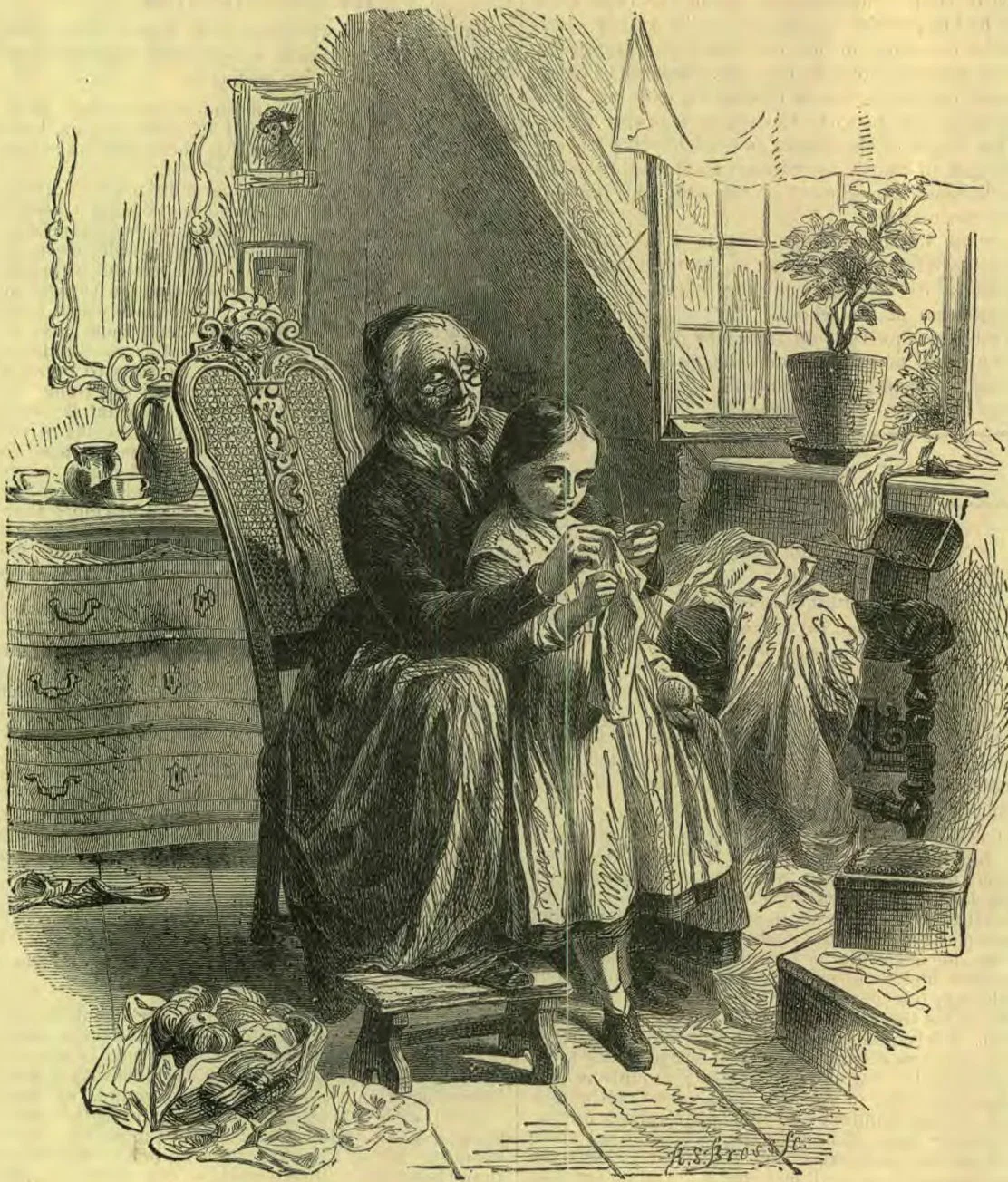
CLICK, clack, in and out See the needles flash about, Nellie's nimble fingers flitting Over her first task of knitting: Stitch by stitch the stocking grows, Thread by thread in even rows. But now she stops, and, puzzled, lingers What troubles now those busy fingers? Ah, a stitch is dropped, and she Eyes it rather doubtfully. At first quite cheerfully she works; At last, with quick, impatient jerks, And one by one the threads pull out, Until with many a tear and pout She throws her task upon the floor, And thinks that she will knit no more. Grandma, from her quiet corner, Watched the tearful little mourner, Called her, “Bring your work to me,” Then gently drew her to her knee. Deftly showed her how to trace Each wayward stitch to its proper place. As Nellie worked in quiet thought, Another lesson Grandma taught:—
“Life is a woven garment, dear, We weave the threads in year by year, A stitch of good or a stitch of sin, Day by day we knit them in. Each thought, each deed, each word we say Will show in the woof some future day, When time is gone, And the garment done.
“Some of our threads will tangled lie, And we cannot straighten, howe’er we try; Or a stitch will drop, and we find undone Some beautiful thread we in gladness spun; And human wisdom or human strength Cannot right the wrong. Discouraged at length With doubts and fears, We sit in tears.
“But God looks down. He sees our grief, And bids us in him seek relief. And if we answer the gracious call, He'll heal our sorrows, one and all; Smooth the rough threads; the stitches set in; Right all the wrongs; till, cleansed from sin, The garment's done, And a 'white robe' won.”
S. ISADORE MINER.

RECOMMENDATION

“WELL, sir,” said Mr. Sanderson, looking up from his books, “what do you want with me?”
“I want to get some work to do, very much indeed,” was the quick answer of a boy, whose name was Willie Thompson.
“Some work; what makes you think I have any work?”
“I read your advertisement in the paper.”
“So you read the paper, do you? Well, do you answer the description that I gave?”
“I do not know, sir. I thought perhaps you would be willing to try me and see.”
“Well, now, that’s fair; what can you do?”
Willie hesitated a minute; there was a good many things he thought he could do; he didn’t see how he was to get them all into a short answer; at last he said: “I can do what I am told.”
“Can you, indeed? Now if you are entirely sure of that, you are a very unusual boy.”
“Well, I mean,” said Will, his cheeks getting red, “that I can try to do it. I suppose a gentleman would not give me things to do that he knew I couldn’t do.”
“But suppose I should hire you, and the next morning I should tell you to go to my store, and roll down the hill at the back door twenty-five times; what then?”
“Why,” said Willie, and he could not help laughing, “I am sure I could do that, and I would go at it as fast as I could.”
“But what would you think of me for giving you such work as that?”
“Why, I might think you a very silly man; but that wouldn’t hinder my doing the work, you know, as fast as possible.”
“Well, suppose I should tell you to go to the shop next door to mine, and watch your chance, and seize the nicest looking codfish you saw, and run back with it, and put it on my counter; what then?”
“That I couldn’t do, sir,” Willie said.
“Why not? You told me you could do what you were told to do.”
“So I can, but I had my orders about that a good while ago. ‘Thou shalt not steal,’ is one of my orders; I have to follow that.”
“Ah, ah, then! my orders come next to those, do they?”
“Yes, sir, always.”
Willie’s voice was as firm as before; but he began to think that Mr. Sanderson must be a wicked man, and it would be just as well not to work for him; but just at this point, the gentleman held out his hand:—
“We’ll shake hands on that, my boy,” he said, “and we’ll try each other for two weeks, if you say so. I want a boy who puts God’s orders first, and mine next.”—Young Reaper.
Continue reading: Letter Budget