The Youth’s Instructor, Vol. 38, No. 27.

VICTOR HUGO AND THE MOUSE

The Youth’s Instructor

Jul 2, 1890

S. D. A. Publishing Association · Battle Creek, Mich. · Jul 2, 1890

VICTOR HUGO AND THE MOUSE.
GRAY Victor Hugo, in his nook, Sat musing o'er a favorite book, When lo, half timorous, half intent, As on some serious errand bent, His daughter and his grandchild brought A mouse the pantry trap had caught. The poet turned with loving heed To hear the little maiden plead With piteous face and eager cry, “Say, grandpa, shall the mousey die?”
“Behold the thief,” the mother said, “The pixy, with its nibbling knife, So busy round my cheese and bread! Just now, made prisoner while it fed, We found it squeaking like a fife; And, melted at its shrill complaint, Our Jeannie, like a tender saint, With tearful pity begged its life. Her pleading charmed away my frown; I spared my victim, doomed to drown, And told its gentle advocate Her grandsire should decide its fate.”
“Poor little mouse!” the old man smiled, And drew his darling to his knee. “See how it trembles,” lisped the child; “It’s just as scared as scared can be, And sorry, too, I guess it feels, Because my mamma says it steals. All such a mite could eat and drink Is no great stealing, I should think! Its head could cuddle in my ring; Its ears—are like a midge’s wing; Its tail—is just a bit of string; Its wee, bright eyes—the cunning thing! Its body scarce a spoon would fill; It isn’t big enough to kill! And oh, it looks at you so shy— Say, grandpa, shall the mousey die?”
Fondly the aged poet spoke, “The boon you ask is grand to give, Jeannie, I stay the fatal stroke, And bid your tiny prisoner live.”
Then, as with kiss and blessing sped, The child to free her captive ran; The old man closed his eyes, and said: “So Heaven decides man’s lot for man. The mouse that nibbles on the shelf Knows not its fate, nor know I mine. I own a Providence divine, Since to that small, four-footed elf I was a providence myself; And as my grace a life could spare That feels no thanks, and knows me not, I well believe celestial care Has oft my own deliverance wrought Without my knowledge or my thought.” —Wide Awake.

GLADSTONE AT EIGHTY.

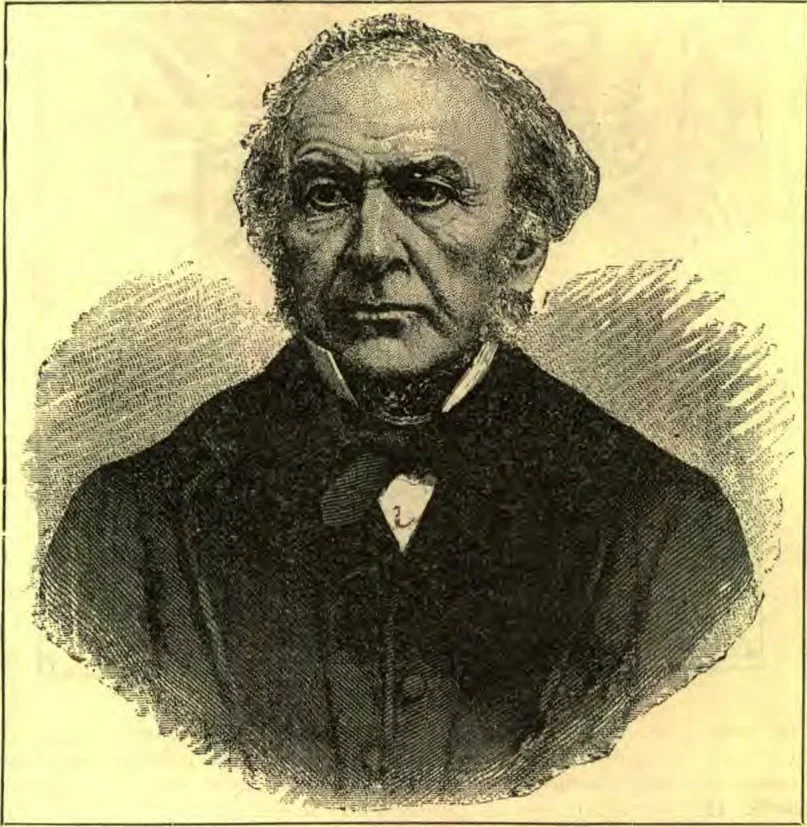
The following description, taken from a popular youth’s paper, of one of England’s greatest statesmen, together with the accompanying engraving, will no doubt be of interest to those of the INSTRUCTOR boys who are studying the great political movements of the world, and the men who stand at the head of them:—
On the 29th of last December, Mr. Gladstone, still hale and hearty in body and mind, completed his eightieth year. As he entered the House of Commons in 1832, he was able on his eightieth birthday to look back upon fifty-seven years’ continuous service in that body.
Nor was this service, even at its outset, obscure. There was, in Mr. Gladstone’s case, no long and toiling climb up the hill of fame. He had not been in the House a year before his brilliant talents were recognized, and two years after he made his first appearance within its walls, he became a member of the Ministry.
Ever since, he has been a conspicuous figure in British politics, and during more than one half of the time he may be said to have occupied the highest position in British political life.
Of his great achievements as a statesman and as a party chief, it is needless to speak here. His titles to the gratitude and veneration of his countrymen, and to the respect of all the world, are too many and too clear to need recounting.
The thought uppermost, perhaps, in most people’s minds, when they heard of the widespread celebration of Mr. Gladstone’s eightieth birthday, was of the marvelous strength and sturdiness of his green old age. He has always been noted, indeed, for his physical robustness. Thirty years ago some one was remarking to Sidney Herbert, Mr. Gladstone’s colleague and intimate friend, what a wonderful mind Mr. Gladstone had.
“Don’t talk to me about Gladstone’s mind,” retorted Herbert. “It is nothing compared with his body.”
The secret of Mr. Gladstone’s unrivaled powers of physical as well as mental endurance may be found in an originally strong constitution, aided and fortified by health-giving habits. Like the great Napoleon, Mr. Gladstone is a good sleeper, and can apparently summon sleep to his eyes at will. No matter how long or how frequent have been his speeches, he has always been able to secure at least seven and a half hours of deep and serene slumber every night.
In his taste for recreation, Mr. Gladstone differs from most Englishmen of his social rank, who are addicted to field sports. He never has been known to follow the hounds but once. That was more than forty years ago, and on this one occasion an accident with the gun cost him the index finger of his left hand.
But other open-air pastimes have always attracted him. He is known as an expert feller of great trees, and this is a recreation in which he still, at eighty, takes a keen delight. He is also fond of taking long, fast, and vigorous walks in the open air. Some years ago, he was in the habit of saying that he could easily make forty miles a day without over-fatigue.
It is rarely the case, even now, that Mr. Gladstone is seen in a carriage or a cab. When in London, he always walks to and from the House, or from one part of the great metropolis to the other, and this even in severe and stormy weather.
Mr. Gladstone does whatever he has to do, whether it be work or play, with all his might. Addressing some school-boys once, he said, “If a boy runs, he ought to run as fast as he can; if he jumps, he ought to jump as high as he can.” This expresses the keynote of Mr. Gladstone’s own character. He always uses his varied gifts of body and mind to the uttermost strain.
At eighty he not only keeps up regularly his vigorous physical exercises, but continues to justify the remark made by a political antagonist, that “Gladstone is the most indomitable worker in England.”
To-day he conducts the leadership of a great party; makes speeches as long and as full of mental force as he did in middle age; writes an uninterrupted succession of review and magazine articles on a wide variety of topics; maintains a heavy correspondence, much of it with his own hand; keeps abreast of all the prominent questions of the day by steady reading, and sustains, almost without any falling off, social relations which have been the growth of sixty years.
Rarely is it, indeed, that the world is called upon to witness such a robust, active, young old age, and to perceive in a man of eighty the possibility of great usefulness and lofty achievements yet to come.

A GOOD PLACE TO PRACTICE.

One hardly likes the word “etiquette” when the question is that of being kind and lovely in one’s own family. Yet if members of the same household used a little more ceremony toward each other, no harm would be done. What true gentleman would treat his mother or his sister with less courtesy than he would a chance acquaintance? No one would greatly respect a boy whose custom it was to let his sister trot about on his errands—run upstairs for his handkerchief, fly hither and thither to bring his bat or his racket. I well remember the surprise of a young lady when, in a certain family, the brother sprang up to light the gas for his sister, and when the latter attempted to put some coal on the open fire, quickly took the hod from her hand, and did the work himself.
“You wouldn’t catch my brother being so polite to me!” she said.
“So much the more shame to your brother!” I thought.
Every boy ought surely to feel a certain care over his sister, even if she be older than he. As a rule, he is physically stronger, and better able to bear the burdens of life than she. There is nothing more charming than the chivalrous protection which some boys lavish on their fortunate “women folk.”
As for you, dear girls, you would never be so rude as to fail to acknowledge any courtesy which your brother paid you? If you would deem it extremely unladylike not to thank any person who gave up his seat in the horse-car to you, or who helped you across an icy spot on the sidewalk, you would blush to be less grateful for a similar kindness on the part of your brother. If he is ready to place a chair or to open a door for you, to make sure that you have an escort after dark, to take off his hat to you on the street, surely you are eager to please him; to sew on a stray button or mend a rip in his gloves; to thank him for taking pains to call for you and bring you home from a friend’s house; to bow as politely to him, and to greet him with the same pleasant smile, which you would have for some one else’s brother.
A boy should learn the habit of easy politeness in all circumstances, but if there be one place on earth where one should use freely his very best manners, it is in his own home.—Harper’s Young People.

ROUND THE WORLD.—17.

A DAY AT POINT DE GALLE, CEYLON.
“Ceylon, from whatever direction it is approached, unfolds a scene of loveliness and grandeur unsurpassed,” says Sir J. Emerson Tennant. In all ages and in all times it has been celebrated for its beauties and its productions,—its gems, ivory, pearls, and spices,—and although the poet’s raptures regarding it fade before modern commercial pursuits, still there are many most interesting features connected with Ceylon. Its length is over 271 miles, and its breadth 137, and in 1876 the population, exclusive of the military, amounted to 2,556,777.
Four-fifths of the country consists of undulating plains, the remainder, occupying the center of the island, being a mass of mountains, which rise from six thousand to eight thousand feet. Every district, from the depths of the valleys to the highest summit, is clothed with perennial foliage. The island has been gradually rising above the sea, and this is especially visible in the northern peninsula, where the whole of the land, and forty or fifty miles to the southward, is composed of corals and madrepores, which form a singular bank known as Adam’s Bridge.
Colombo is the commercial capital, though it would be difficult to say why this site was chosen for such an important town. It occupies a projecting, rocky headland, which was fortified by the Dutch. It contains within the walls of the fort some modern buildings, which are a clumsy adaptation of European architecture to tropical requirements. With the exception of the military officers, most of the European residents live in the cinnamon gardens, the most famous of which is Kadarani, or else in the cocoanut groves of the charming village of Colpetty.
The chief industries of Ceylon at the present day are tea and coffee culture. Lately cinchona, from which quinine is made, has been raised in large quantities.
In olden days the island was infested with elephants and tigers, but they have been shot off in large numbers.
Point de Galle, where we touched, is said to be by far the most venerable emporium of foreign trade now existing in the universe. It was the resort of merchant ships at the earliest dawn of commerce. It was the Kalah of the early Arabians, and centuries before, the Sabeans came hither; it was the mart of Portugal and afterward of Holland. It is also asserted by writers of note that the long-sought-for locality of Tarshish is identical with that of Point de Galle. But at present it only exists, and that by being a coaling station for merchant ships going to all parts of the world.
No sooner had the Umtata cast anchor than she was surrounded by a multitude of the native boats. These are called catamarans, and are exceedingly curious in their structure. They are made of the trunks of cocoanut trees hollowed out so that there is just enough space to put one’s legs down into them. On one side are two long poles, lashed so as just to clear the water line, and to the ends of these is made fast a heavy spar. This rests on the wave, and is always kept to windward, so as to balance the boat and keep her from drifting, just as American navigators would use a center-board. The natives will put to sea, and cross the surf in one of these, where an European boat could not live for an instant, and they are seldom wrecked.
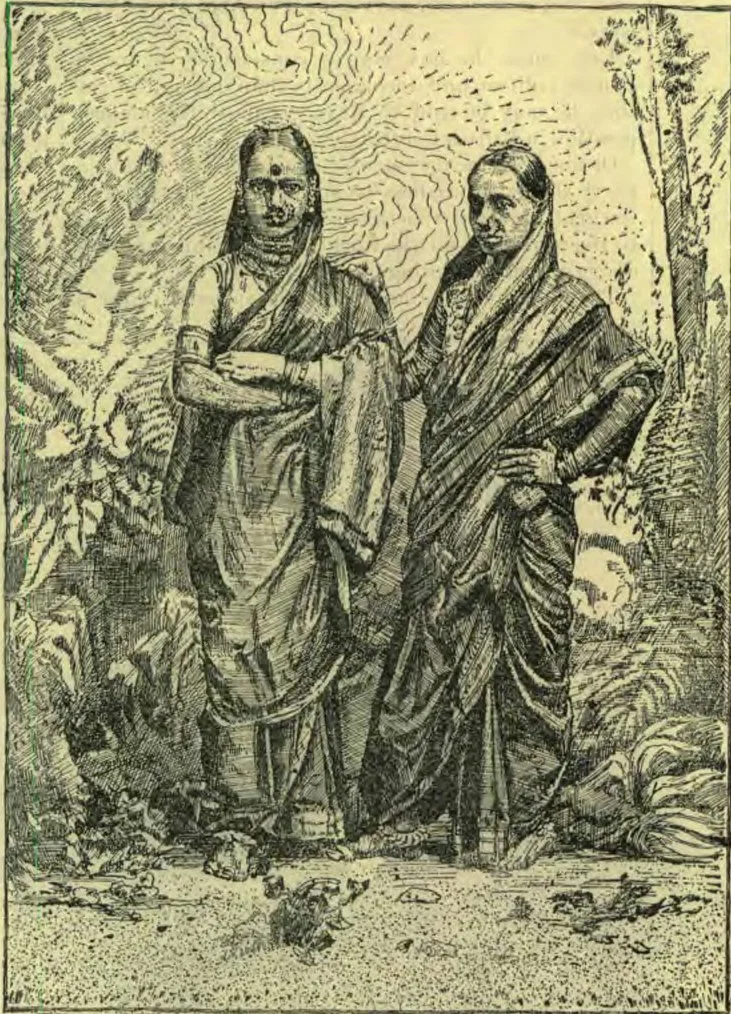
HINDOO GIRLS.
HINDOO GIRLS.
The natives crowded all over the decks, some of them begging, others wanting to take our clothes that needed washing, saying that they would return them all finished in three hours, and still others selling little ornaments made of tigers’ claws or tortoise shell, and desks and boxes of ebony and porcupine quills. They invariably commence by asking about three times what they expect to receive, and they cheat and lie without any compunction, if they think they can make anything by it.
The town itself is very old; there are some old forts that bear the date of 1669. They are made of stone, and are exceedingly massive, the walls being four feet thick. They are not used now, and are covered with moss and ivy; they look as if one shell would put a speedy termination to their existence. The streets are lined with beautiful Niem trees, but everything wears a deserted appearance, as if all the inhabitants had forsaken their homes. The natives all reside outside of the forts, and their houses are pictures of slovenliness and poverty. They are mostly situated in the groves of cocoanut and Jack-fruit trees, which abound all over the island.
There is also a Buddhist temple, a singular looking place. It is circular in shape, and at the entrance is a hideous figure, half man, half animal, suspended by a cord from the roof. To him all take off their hats, and pass on to the interior of the sacred pile. The different gods are arranged in a circle in the middle. Some of them look like Egyptian statues, others are representations of the Indian cobra, a large and venomous snake. Great, indeed, must be the moral darkness of a people who can see anything to be admired or imitated in such idols. All round on the outer walls are pictures of heaven and hell. Their idea of a perfect heaven, according to these portraits, seems to be a place where they can feast on all the cocoanuts they desire; while those in torment for smaller sins, such as stealing this most coveted fruit, are allowed only to walk up and down beneath the trees, the fruit being beyond their reach. Buddhists are not nearly so particular as to who enters their temples as are the Hindus; it is seldom that these will let foreigners go inside their places of worship.
There appeared to be but few horses. Most of the wagons were little two-wheeled vehicles, with a few boards nailed on the axle, and covered with an immense hood of cocoanut matting. They were drawn by two little cows, with a driver walking behind them. These animals were covered all over with designs of every description, which we supposed were charms to keep away evil, and to call the favor of the gods upon the owners.
P. T. M.

THE CITY OF NARA.

In this old, old city of Japan, one of the ancient capitals, are to be seen many strange sights. However, strangeness is one of the peculiarities of all that belongs to this wonderful country. At Nara and Tokio, as at no other place in this region of wonders, will a traveler be sure to meet marvels of a comical and unexpected turn. After quitting the funny little streets, gaily decked with painted lanterns, a stranger will pass down the cool, quiet garden, among the bamboo, and camelias, and snow-white Fuji-san, to the inn. At its hospitable door, he will leave his shoes, and enter amid a shower of welcomes from the host and his family of barefoot girls,—welcomes spoken in such a low, caressing way as to sound very musical. “O-hayos,” all say; “Yo ide nasai-mashtas,” from the host, repeated by the maidens, who scatter to make ready a room above for the new arrival.
A change of dress after traveling is a necessity here as elsewhere, and seems eminently proper before sitting down on the soft white tatamis to drink tea and smoke the kiseru (the universal custom), while the attendant sings the songs of the Dragon King’s Daughter, who, with Uroshina, so a popular legend of the country says, discovered the Fortunate Islands, upon which they dwelt a thousand years most happily. But before the traveler has completed his toilet, and while he is listening with delighted ears to the love songs of one or more of the little barefooted maidens below, whose shapely brown feet go pitter-patter over the floors as they prepare a meal for him, it is quite probable that he will hear an altogether different kind of clatter, loud and unseemly, upon the stairs leading to his room. There is no privacy, no doors, to a Japanese house, and so the unwelcome intruder boldly enters, and, in his peculiar fashion, demands attention. The visitor is a young deer, graceful, pretty, and fearless, who advances to the stranger, and looks up in perfect confidence into his face, as much as to ask, “What did you bring for me?” If he receives nothing, he deliberately proceeds to toss over whatever baggage may be visible, and finally disappears backwards through the hole in the floor containing the stairs, with many a snort of disapproval at his treatment.
Hundreds and thousands of these animals are found in the city. The streets, gardens, parks, and the beautiful temple groves are thronged with them, and they are protected by law. A legend of the city says that over a thousand years ago the reigning empress, touched by the moans and cries of a hind whose mate had been killed by hunters, issued a decree that, in all ages to come, no deer should be killed within the limits of the Imperial Court. No man's hand has since been lifted against these harmless creatures, and they have multiplied beyond all calculation. They are absolutely fearless, mingling with the people, in and out of their homes, as members of the family, whom they outnumber, ten to one. No door is ever shut against them, and when hungry, they surround the pedestrians upon the streets, and refuse to release them until sweet cakes are purchased of the peddlers who deal in them, and who are always on hand in such emergencies. The sale of crisp biscuits to the deer, through the kind-hearted, is one of the trades of Nara, and supports many families.
W. S. C.

Holding Back an Angry Word

It is not an easy matter to hold back an angry word when it is at the tongue’s end; but even this is a great deal easier than it is to recall an angry word when it is once spoken. If the angry word be not spoken now, it can be spoken by and by—if necessary; therefore it is wiser to hold it back until there is no doubt that it needs to be spoken.—Sunday-School Times.

THREE THINGS.

Three things to admire: Intellectual power, dignity, and gracefulness.
Three things to love: Courage, gentleness, and affection.
Three things to hate: Cruelty, arrogance, and ingratitude.
Three things to delight in: Frankness, freedom, and beauty.
Three things to wish for: Health, friends, and a cheerful spirit.
Three things to avoid: Idleness, loquacity, and flippant jesting.
Three things to contend for: Honor, country, and friends.
Three things to govern: Temper, tongue, and conduct.
Three things to think about: Life, death, and eternity.—Selected.

THE FOUR WINDS.

In winter, when the wind I hear, I know the clouds will disappear; For 't is the wind that sweeps the sky And piles the snow in ridges high.
In spring, when stirs the wind, I know That soon the crocus buds will show; For 't is the wind that bids them wake, And into pretty blossoms shake.
In summer, when it softly blows, Soon red I know will be the rose; For 't is the wind to her that speaks, And brings the blushes to her cheeks.
In autumn, when the wind is up, I know the acorn's out its cup; For 't is the wind that takes it out, And plants an oak somewhere about. —Selected.

A BAD NEIGHBOR.

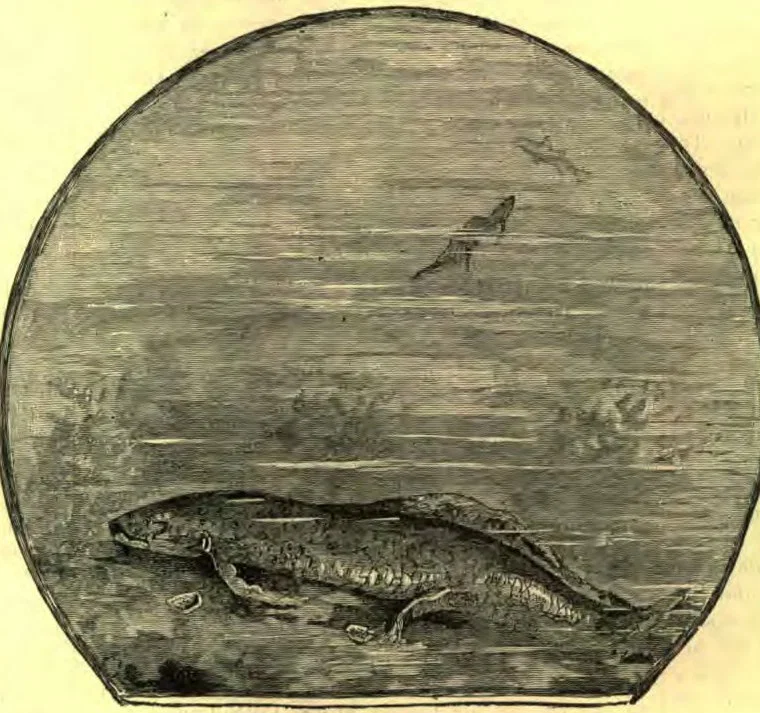
THE next time you go to Africa, my dears, you be sure to bring me back a lepidosiren, will you? I am very anxious to have one. Lep-i-do-si-ren. Can’t you say that? Well, it is rather a hard word. You may call it mud-fish instead, if you like that better, though I am not sure that it is a fish.
There is a difference of opinion on the subject of this creature. One very learned man, with green spectacles, calls it a fish; another, whose spectacles are blue, vows that it is a reptile. Now I don’t wear spectacles, so really I cannot pretend to decide the matter; but suppose you and I just please ourselves, and call it the mud-fish, whether or no.
There is some reason for that name, because at home it lives in the mud. When you are in Africa, as I was saying, and in some very hot place, you must know how to look for the mud-fish.
If it is in the rainy season, it will be easy enough to find him; for he is swimming about, like any other fish, in some pretty little river. But in the hot season it will be harder to find him. The river is dried up then; there is not a drop of water; the reeds and rushes that were once so fresh and green, are withered and dry, and even the mud of the river-bank is baked into a hard, stony flooring, which looks as though it had never known a drop of moisture.
Surely no living creature can be here, save such as can live on land. Not so fast! Take your spade, and dig up carefully some of this hard-baked earth. Dig deeper!—carefully now; spread out the earth you have dug up. Ah! what is that queer-looking lump, from which the dry earth falls away? That is what you have been looking for. That is Mr. Mud-fish’s cocoon, and Mr. Mud-fish is comfortably asleep inside it. You see he knew well enough what to do when he found the water was all drying up around him. He wriggled his way deep, deep down into the mud, his eyes being so conveniently made that the wet soil does not hurt them. When he has gone deep enough, he curls himself round, and wraps his tail around his head by way of a nightcap. Then he brings out of his body a quantity of a smooth, slimy substance, which he carries somewhere about him, and with this he plasters the inside of the mud-cell in which he is lying, making it all smooth, and binding the particles of earth together so that there is no danger of their cracking apart from the heat. Having done this thoroughly, Mr. Mud-fish goes to sleep, and he sleeps, and sleeps, and sleeps; and never wakes up until the rains have come again, and the welcome drops, sinking down through the softening mud, loosen the walls of his cell, and let him out again.
If you were to put one of these earthy cocoons into a tub of water, it would fall to pieces at once, and you would see the sleeper, with his tail wrapped round his head, just as I have told you. At first he would be very stupid and sleepy, but after a time he would wake up; and if he should live and do well, you would find him as curious a creature in his waking as in his sleeping hours.
Did you say you had an aquarium? That is very fortunate, for now you can watch all the queer ways of the mud-fish. Take a small piece of raw meat in your hand, and make a splashing in the water with your finger. He will rise slowly, snatch the meat away, and go down to the bottom to eat it. Now watch him as he eats it. He takes the very tip of it between his sharp teeth, and gives it a tremendous bite, seeming to bite with his whole head; then he sucks it in a little farther, and gives it another bite; this he does again and again, till he has bitten through the whole length of the piece. Then, if you please, he shoots it out of his mouth, catches it by the tip again, and bites it all over again, and then again. Three times he goes through this singular process, and then, with a quick jerk, he swallows the meat. He will always do this, every time you feed him, and will never swallow the food until he has chewed it all three times. It is a very good thing to chew one’s food thoroughly, but I do not recommend this way of doing it, except for a mud-fish.
Oh! oh! I forgot to tell you that you must not keep him with the other fish, but in a separate part of the aquarium, for he has very cruel and unmannerly ways. He will swim quietly up under another fish till he is quite close to him; then, with a quick dart, he will seize the poor creature, and bite a great piece right out of him, his strong, sharp teeth cutting through scales, flesh, and bones. He never takes more than one bite out of each fish, but takes his morsel down to chew, and leaves the poor victim bleeding and dying in misery. That is why I have called him a “bad neighbor,” and it is a good name, for him; for, say what you will, a good neighbor does not bite.—Our Little Ones.

CLEAN HANDS.

“SAY, Harry, what has made you take this wonderful clean fit all of a sudden?” asked John Shelford of his little brother, who was drying his hands after a vigorous pumping. “This is the seventh time I have seen you go to the pump and wash your hands to-day.”
“Because I want to be strong,” replied Harry.
“Well, but washing your hands won’t make you strong.”
“Yes, it will; the Bible says so.”
“I don’t believe it does,” said John.
“I’m sure it does, though,” returned Harry, positively; “papa read it at prayers this morning: ‘He that hath clean hands shall be stronger and stronger.’”
“Well, you don’t suppose that means really clean hands; you are a silly boy. You have had all your trouble for nothing.”
“No, I haven’t. I’ll ask papa to-night if the Bible doesn’t really mean what it says.” So, in the evening, when Mr. Shelford had come home from business, as soon as he had finished his tea, Harry began: “Papa, doesn’t the Bible say that if you have ‘clean hands,’ you’ll be stronger?”
“Certainly, my boy,” said Mr. Shelford, smiling; “I see you remember what we read this morning, how Job said, ‘The righteous also shall hold on his way, and he that hath clean hands shall be stronger and stronger.’”
“There,” cried Harry, “I knew I was right; and washing your hands will make you strong, won’t it?”
“It is very good for little boys to wash themselves, and it helps to make them strong and healthy if they keep clean; but there are some stains that we can’t get out with soap and water, and it was freedom from those stains that the Bible meant. The other day I saw a little boy lift his hand to strike his sister; that made it far dirtier than if it had been making mud pies for a whole day.” Harry blushed, and his father went on: “When I was a little boy, I was taught that it was my duty to keep my hands from picking and stealing—picking, you know, means taking little things that don’t belong to you, like stealing lumps of sugar from mamma’s cupboard, or picking fruit off the young trees that I tell you not to touch.”
“Then Eve made her hands dirty when she took the forbidden fruit,” put in John, who feared the conversation was getting personal.
“Yes, indeed she did; and no one can tell the number of soiled hands that have been the result of that action. Who took water and washed his hands, saying, ‘I am innocent of the blood of this just person’?”
“Oh, that was Pilate, papa,” said Harry, “when he let the people crucify Jesus.”
“Yes; but the stain of the sin was just as much on his soul after he had washed his hands as before; and it is the same with our sins, whether we call them little or great; we cannot get rid of them, or of their consequences, however we try to clear ourselves. No washing of our own will do it. So, what must we do, Harry? When you make your hands dirty with doing wrong things, how can they be made clean?”
“God can wash them, papa; that is what you mean, isn’t it? because David said, ‘Wash me, and I shall be whiter than snow.’”—Young Reaper.

A SPONGE OR A CANDLE—WHICH?

Are any of you acquainted with a selfish boy or girl? They always want people to be doing something for them, but they never want to do anything for any one else.
They always want the largest apple, the nicest piece of cake, the easiest chair, and the best of everything.
But I know several unselfish boys and girls. They are just as cheery and pleasantly about the house as they can be. Whenever they are asked to do an errand, they do it willingly, and always seem to be trying to think of something that will make somebody happy. They are a joy and a comfort to every one in the house.
Now take a glass half full of water, and a sponge such as you use for bathing. Put the sponge in the glass, and you will find that it will take up every drop of the water. How like the selfish child, taking everything for itself that it comes in contact with! But here is a candle. Let us light it, and see what it does. It doesn't make any noise, yet it makes a good light. It really uses itself up in helping others, just like the unselfish child.
Which would you rather be, a sponge or a candle? Which does God commend? “Let your light so shine before men, that they may see your good works, and glorify your Father which is in heaven.”—Selected.

A LESSON FROM A MOUSE.

“Is Uncle Thomas here? I have caught a mouse! See, I have it here, and now I am to have a penny, for he told us he would pay a penny for every one we caught.” Pearl’s face was flushed from excitement. She had caught the mouse, and brought it in to prove the fact. The little creature was put into a pasteboard box, to be kept until evening, that Uncle Thomas might see it; for he had gone to his office before Pearl brought in her captive.
Mousie made some effort to escape from her hands, but finally the tiny creature was fastened in the box.
“Now we have him safe, and I will get my penny,” said Pearl.
She supposed the mouse would nestle quietly in the box, until Uncle Thomas should open it to look in; for as soon as the cover was placed on the box, there was not a stir. Then she thought the mouse was dead until she shook the box, and the mouse hopped about. Pearl placed the box out of reach of the little folks, and went away, content to wait until evening.
But young mouse had other plans. When all was quiet near him, he began to nibble, nibble, nibble, and in a very short time out hopped the prisoner, down to the floor, away into a closet, and has never been seen since. Of course Pearl was much disappointed and surprised when she found the mouse was gone. She began to think about it, and here is quite a lesson for boys and girls. When the mouse was compelled to go into the box, he at once made an effort to release himself. He did not lie down to wait the time when he should be killed. He worked diligently until he made a hole large enough for his body to pass through; then he was free.
Children, isn’t there a lesson here for you? Haven’t you sometimes sat down with a frown or a pout, saying that there is no use trying when you have not at first succeeded at some task?
When a lesson is very hard, have you not looked it over, and said, “I can’t learn it, I will have to give it up,” and then sat back in your seat in idleness until recitation time came? You enter the class, and it is soon known that you are not prepared to recite. A few such days, and you will learn that you must remain another term in that same grade, while the other members of the class pass into a higher grade. Better nibble, nibble, nibble at the hard lesson. Learn it by littles. Soon you will have learned the whole. Then you can pass right along to something higher, never to be troubled again with that lesson. Perseverance is a grand trait of character. You can cultivate it in early life, until you will have such strength that you can master every hard thing which you must undertake. Never settle down in despair when you are placed in close quarters. Go to work and find a way out.—The Lily.

HEATHER

One of the commonest of plants in the Old World, and one which has qualities enabling it to grow in profusion where nothing else will thrive, on barren wastes or moors, is the heath, or heather, to which, owing to its very commonness, the botanists have given the name of Calluna vulgaris. “Heather” is a pretty word, and the bloom of the heath is a very beautiful thing. It consists of a sort of rosy spike of tiny flowers, and when the plants are in blossom, they give a rich, purple glow to the landscape.
Every English-speaking child has heard of heather, but extremely few American children have ever seen it, because it cannot be made to grow continuously on the North American continent.
Until lately it has been supposed that the heath was native to New England, Nova Scotia, and Newfoundland, because it has been found growing, very sparingly, in certain localities in those sections, where there seemed to be no reason to suppose it had been planted by human hands.
Recent investigations, however, and particularly those of Professor Goodale, of Harvard University, have proved that what little heath we have in New England is disappearing, and that the few scattered clumps which exist in America do not date farther back than the accidental or intentional scattering of seeds by the hand of man.
One thing is certain: If we cannot make the heather grow here, we can dispense with it more easily than could the poor peasantry of many northern European regions, to whom it is useful in almost as many ways as the date palm to the Arab.
The heath is used not only to make brooms, but its dry, brittle, shrubby masses form an excellent thatch for cottages. And the cottages themselves are sometimes built of alternate layers of heath and black earth or clay.
Bees everywhere make excellent honey from the heather blooms, and the plant is often cultivated to feed them. The Scotch Highlander makes beer of the tops of the plant, and, if he is very poor, sleeps at night upon a bed composed of the branches and leaves.
A decoction of the plant is extensively used in tanning leather; and, as a last resort, cattle, sheep, and goats can be pastured upon it, though they will not eat it if they can get anything else.—Youth’s Companion.
Continue reading: POSTAL SERVICE IN CHINA