The Youth’s Instructor, Vol. 33, No. 1.

New Year Thoughts

The Youth’s Instructor

Jan 21, 1885

S. D. A. Publishing Association · Battle Creek, Mich. · Jan 21, 1885

New Year Thoughts

In the natural order of events, we know the old year will give place to the new one; yet many of us are sorry to part with it; for it has been to us like a good friend, bringing blessings and opportunities in great number. Even though it may have dealt out to us the bitter cup of sorrow, we saw through all the Guiding Hand; this sweetened the draught. We recognized the voice of our heavenly Father, saying, “Whom the Lord loveth, he chasteneth; and scourgeth every son whom he receiveth.”
Before parting with our old friend, we would be glad to make amends for neglected opportunities, for wasted privileges, and for the good left undone which we might and should have done; but Father Time will not wait for delinquents—the old year rushes on to make room for the new. Hoping to cherish its pleasant memories, and to profit by past experiences, we tenderly bid it adieu, turning our attention to the one before us.
“A Happy New Year” is the greeting exchanged by friends as they enter upon the new year, which is really a wish that the persons to whom they speak may have a happy year all the way through. It is truly a beautiful custom, although none of us can rest upon the good wishes of our friends for a happy year. It will depend upon our own efforts whether it will be so or not, and then only as we pursue a course of action in harmony with the will of God.
The new year is before us; shall we make it a happy one? If we start right, and live well, it may be such. Fortunately we have only to provide for one day at a time. If we can get through it all right, we can get through the year all right; for the days make up the year. Supposing it was only one day’s effort, and the reward of faithfulness would be given; would you think it a very hard trial? Don’t you think you would receive the prize? We believe you would; for you would watch, and pray, and strive; and all earnest seekers God delights to honor. So begin the year, dear friends, determined to make “to-day” a success, unmindful of the future, striving to grow in knowledge and love, and you will have the victor’s reward.
Possibly some who read these lines have failed so many times in all their good endeavors that they think it will be of no use to try again. But dear young friends, take new courage; you have this to console you,—the wisest and best have made fearful mistakes sometimes; but the Lord says, “To this man will I look, even to him that is poor and of a contrite spirit, and trembleth at my word.” If you will make an entirely new beginning, and instead of tugging your mistakes along with you, leave them with the Saviour, carrying only the lessons of experience which you can learn from them, you, too, may succeed. Trusting that you will make another effort, and try the plan of living one day at a time, we greet all our readers with “A Happy New Year.”
M. J. C.

A MILLION DOLLARS.

“If I had a million dollars!” said Rosy.
She was sitting on the grass in a corner of the front yard. It was a very pleasant corner. The old pine tree shaded it from the afternoon sun, and the red rose-bush was in full view. Rosy liked to sit there when there was nothing to keep her indoors. On some days there was plenty to interfere,—days when mother had so much sewing that she could not stop to put baby to sleep, or wash the dishes, or read to grandmother. On those days, Rosy stayed in the house, and, as her mother said, did a “good day’s work,” going to bed at night very proud and tired, with a good hug from mother and grandmother for reward.
To-day there was nothing to do but to look after baby a little, as he tumbled in the warm grass near by; and Rosy sat and looked up into the still, blue sky, and wished that she had a million dollars.
“What would you do with it?” asked a voice.
Rosy started and looked up. A young lady stood leaning over the fence, smiling down at the small dreamer. Rosy laughed back in spite of herself. “I didn’t know I was talking out loud,” she said.
“But tell me about the million dollars,” said the lady, coaxingly. “I would really like to know. I used to wish for the same thing when I was a little girl.”
Rosy leaned against the fence on her side.
“You see I like to wish things,” she said, confidentially. “It’s fun; and I do think it would be nice to have so much money. You could buy almost everything! I’d have a bigger house, first thing. Ours is so little. I’d have piazzas all around it, and a big rocking-chair for grandmother, and another for mamma; and she shouldn’t have to do anything but read or go driving. I’d have two horses. And I’d buy some splendid dresses for us all, and a new carriage for baby, and—oh, everything! And that wouldn’t take a million dollars, ’cause grandmother says it takes nearly a month to count a million. So I’d have some left to give away. I’d have my missionary box full up to the very top; and I’d send lots of money to the poor children our minister talks about, that want to go to the country, you know, and all that! Oh, I wish I had it!”
“You’d make as many people happy with it as possible, wouldn’t you?” said the young lady, with her bright smile. “You’d make it go as far as you could, to give every one a good time.”
“Yes,” said Rosy, “that’s just what I’d do.”
“It’s pleasant that you can do the same now, isn’t it?”
“The same!” said Rosy, lifting a pair of puzzled blue eyes. “I don’t know what you mean. I’ve only ten cents in the world.”
“I meant that you can make what you have go as far as possible in the way that your million dollars would go, making yourself and others happy. You’ll find that you can do a good deal, too. It seems to me that you are a rich little girl.”
“How?” asked Rosy, looking at the little brown house, and then at the patched apron.
“Why, must I count your riches? Well, then, here are two little hands that look as though they could do a good deal to help mother and make her happy. And here are two feet to run errands and walk with baby brother. And here are two eyes to look about you at all the lovely things that God has made for you to see, and two lips to tell the pleasant thoughts that come to you, and to”—
“Say gentle words,” said Rosy.
“And there is your happy heart to make the best of everything in life; and there are your mother, and baby, and all whom you love. You can think it out for yourself, I know. Only remember that, if we can’t all have a million dollars, we can all live as though we had, in the way of making the most of the wealth that God has given us, for ourselves and others. He has given each of us enough to make plenty of sunshine in our corner of this beautiful world, if we only look about for our riches, and spend them freely in gaining happiness.”
Rosy’s face was as bright as one of the pansies in the round bed by the gate. “I think it’s lovely,” she said. “I’ll see if I can’t spend what I have in just the best way there is.”
Then the pretty lady stooped and kissed the eager lips, and said “Good-by.” Rosy watched her go up the street, and then turned and caught up baby for a frolic. All day she tried to “make the most of things.” And she felt richer than ever when she heard her mother singing at twilight this song:—
“God’s flowers everywhere Brighten field and meadow; God’s sunlight shimmers down Through each passing shadow. God’s child need never know Poverty and sadness, For God’s love o’er all the earth Gleams in golden gladness.”
—The Well-Spring.

To a Bird: Lines on a Lost Friend

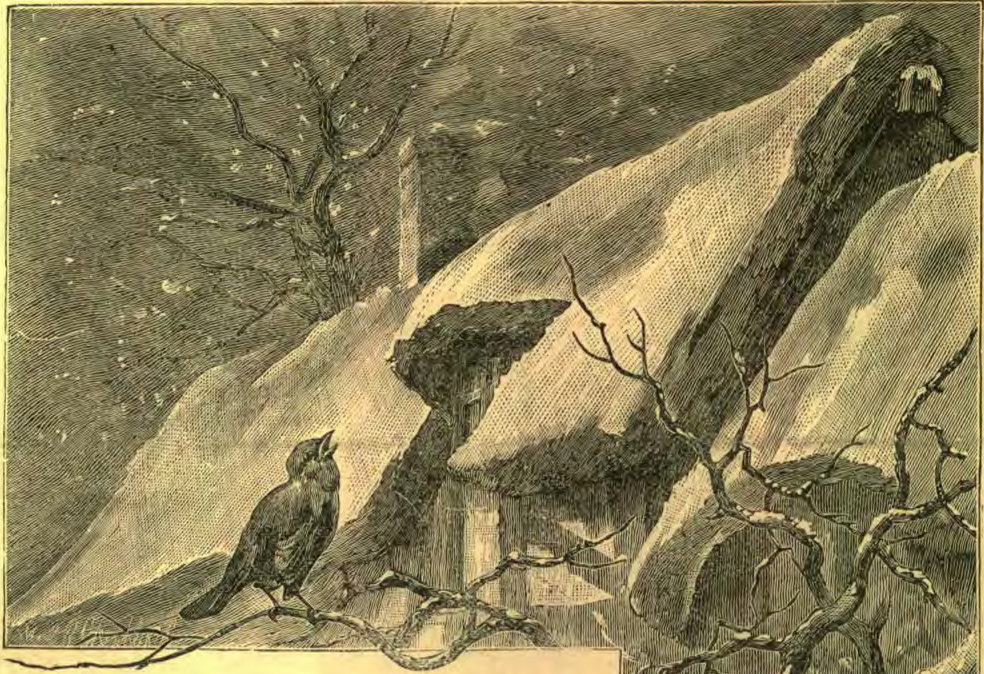
Blithe bird of the morning, how sweet is thy song; Thou'st caroled it bravely, thou'st kept it up long; I've heard it since day-break, so strong and so clear; What makes thee so joyous, so brimful of cheer?
Is't praise to thy Maker that swells thy bright throat? Art pouring thy gratitude forth in each note? Art telling to mortals, in sweet roundelay, That night has given place to the new, gladsome day?
Dost wait for the maiden that one sunny morn Released thy torn wing from the grasp of the thorn? When from their tormentors thy kin had all fled, And over the hedge-row thy dear mate lay dead?
The white hand that fed thee, the face that caressed, Will no more be laid 'gainst thy feathery breast; Neath the snow-covered roof, near the window before thee, Lies in death the sweet maid that to life did restore thee.
She heeds not thy song, she sees not thy form; Alike to her now are the sunshine and storm; But the kind heart that pitied a birdling distressed, Will yet beat with rapture in climes of the blessed.
Sing on, pretty troubador, songs are not vain, Though the ear of your lady you ne'er charm again; You may cheer the sad mourners, who wearily come From the grave of their child to a desolate home.
Sing on, brave evangel, the Father above Will crown with a blessing your mission of love; Thy matins are heard in the heavenly land, Thou'rt kept by the power of an almighty hand. E. R. L.

THE INVINCIBLE ARMADA.

AFTER the death of Mary, Queen of Scots, Philip the Second, King of Spain, who had been Mary’s friend, and who was a Catholic, and consequently displeased because Queen Elizabeth had restored the Protestant faith in England, threatened to bring war upon England; and if he should conquer, he declared that he would dethrone Elizabeth, and force upon her subjects the Catholic religion. These threats aroused the spirit of the queen, and she sent Sir Francis Drake with a fleet, in order, if possible, to cripple the Spanish forces beforehand. He succeeded in reaching a port of Spain, and destroyed a large number of ships; some historians put the number at one hundred, others give a smaller number.
But in spite of this loss, Philip fitted out a fleet of one hundred and thirty vessels, carrying nearly twenty thousand soldiers. This fleet was called the “Invincible Armada.” Now if you look in the dictionary, you will find that “invincible” means not to be conquered, and “armada” means a fleet of armed ships. So you see the Spaniards were very boastful, and indeed they were very powerful at that time. England trembled in view of the threatened invasion; for the English navy was comparatively weak. Though at first almost dismayed, the queen determined to resist the invaders, and her subjects were no less resolute. Even the Catholics were on her side; and although she had but thirty-four war ships to begin with, the number rapidly increased; for the merchants fitted up private vessels for the occasion, and from all over the kingdom, men rallied to support the queen.
The queen herself rode along the line of her troops at Gravesend, and made a speech to encourage the men. She said that rather than have her country dishonored, she would take up arms herself, and be their leader. How the men must have loved her as she rode by on her milk-white horse, and how they cheered her as she spoke to them in words that were at once brave and womanly!
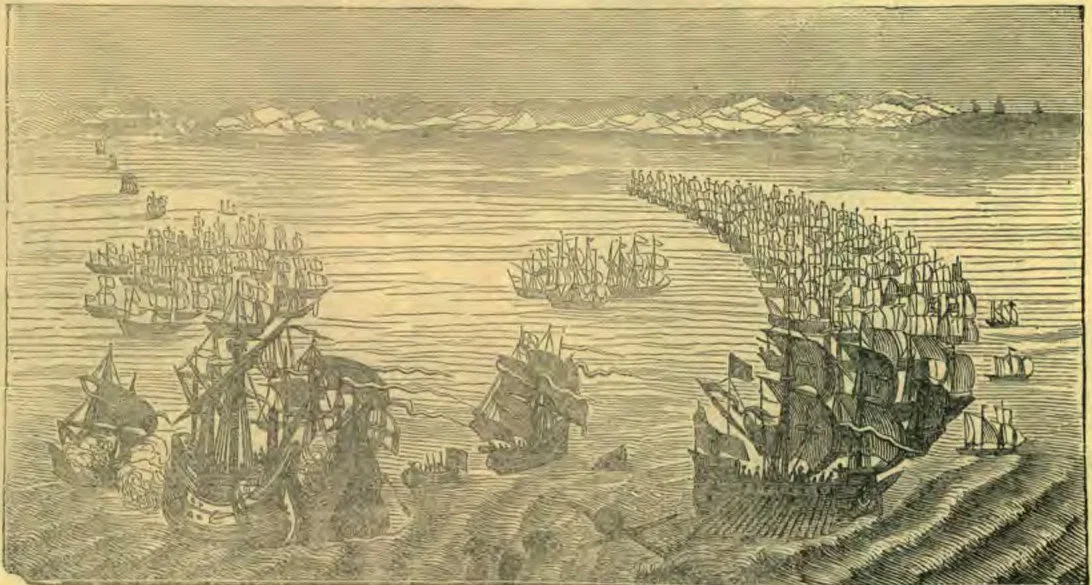
The Spanish armada must have presented a splendid appearance as it sailed into view. It was so vast that it stretched out its length for seven miles! The ships were arranged in the form of a half-moon, and they kept in line as they sailed into the English Channel. The English commanders avoided a general engagement, though they attacked any of the enemy’s ships that fell out of the line. But during the night, Sir Francis Drake sent fire ships into the midst of the fleet. Do you know what fire ships are? This is the way they managed. They chose several of their vessels which they could best afford to lose, and filled them with tar, gunpowder, and pitch, and floated them out in the rear of the Spanish fleet. Then they set fire to them; the wind carried them right into the midst of the enemy’s line, and they caused a terrible panic among the Spaniards. Many of their ships took fire, and were burned. A storm coming up scattered the fleet, and some were driven upon the rocks, and went to pieces; others were destroyed or captured by the English the next morning. Of the grand array of men and ships that sailed into the English Channel that summer’s day, only about fifty ever reached Spain again. Philip must have been disgusted with the result of his attempt to conquer England, and I have no doubt he mourned for his brave men who met their death in the effort to carry out his plans. The English commanders made preparations for defense in case the attack was renewed; but Philip seemed to have had all he cared for of English defense, and never made another attempt to invade England.
Of course there was great joy at the English court over the victory. Good Queen Bess, as she was called, rejoiced in the skill and bravery of her subjects, and rewarded the leaders with lavish generosity. Queen Elizabeth’s reign was one of the most prosperous periods of English history. Though the queen had many faults of personal character, she did many good and noble deeds, and was adored by her subjects.—The Pansy.

Riches Measured by the Heart, Not Possessions

No one can tell whether he is rich or poor according to his ledger. It is the heart that makes a man rich. He is rich or poor according to what he is, not according to what he has.

New Year, Be Happy.

First day of the year in the morning Comes wrapped in a snowy fold; Each falling flake is a frozen tear The New Year sheds for the Old.
O New Year, cease thy weeping, Happy shouldst thou be; For thou who art young like the children Like them shouldst be glad and free.
Last night, when the stars were shining, They gathered with laugh and shout; And with hearts and voices merry, Snowballed the Old Year out.
At morn, earth awoke from slumber To answer their joyful call; For with many a “Happy New Year” Thy coming was hailed by all.
So, New Year, cease thy weeping, Be glad with us this day; ’Twill be time enough to sorrow When we’ve all grown old and gray.
S. Isadore Miner.

THE FINAL REWARD.

In the great weaving-room of a Connecticut cotton-factory, one of the largest mills of its kind in the world, more than a thousand looms ply their busy shuttles, each loom tended by a single person. To stand in the center of that room, in the working hours of the day, and see the long lines of looms, with the flitting forms of their attendants, and to hear the confused hum and rattle of the machinery, one would think it hardly possible to keep an oversight of the individual workers, and to know the relative efficiency and faithfulness of each. The personality of the several attendants seems lost in the great sweep of common industry; and one is inclined to think that if two or ten of the loom-tenders are careless or clumsy, it is not likely to be known among so many in that thronged and clattering room. Yet each worker there is both known and noted; and not only every hour’s, but each moment’s faithfulness is a matter of record and of correspondent recompense.
To each loom there are thirty-six hundred fine cotton threads, forming the warp of the muslin; and to each inch of the growing web are supplied ninety-six threads of the filling from the flying shuttle. One thread of either warp or filling dropped, or broken, or entangled, and the perfectness of the web is destroyed. If a thread of the filling breaks, the loom must be stopped, and patient fingers must pick out the filling until the broken end is reached and newly fastened to the shuttle. If the eyes of the loom-tender have wandered, and a break in the filling (forming a “pick-out”) has passed unnoticed, however fair and firm what follows may seem, the later work must all be taken out, and the “pick-out” corrected; and this at the cost of the loom-tender himself, who is paid, not by the hour, but by the amount of cloth he weaves. If, perchance, a defect in the weaving, from broken warp or woof, is not corrected at the loom, then, when a measure of fifty-three yards, or, as it is called, a “cut,” of cloth is finished, the piece is taken from the loom; on the outer margin of its roll is penciled the name of the weaver who tended it, and it passes to the inspection-room. There it is examined; and when the break, or “smash,” is found, the amount of the consequent loss is charged to the weaver’s account. When on pay-day the books are opened, every weaver receives according as his work has been. Each defect in the cloth woven at his loom is charged against him, and he must bear its loss. Then also he finds that every moment of his delay, through that lack of attention and faithfulness at the loom, which necessitated his doing over again the work which at first he slighted, has diminished in proportion the aggregate of his wages. His pay corresponds with his fidelity and efficiency, rather than with his opportunities and with the time given by him to his assigned work.
Thus while the thousand looms whirl and hum, and the thousand shuttles fly back and forth, and the thousand loom-tenders have before them the millions of on-moving, separate threads, and all seems a labyrinthian confusion in the great weaving-room of that great factory, the individuals apparently lost in the shifting multitude,—each man or woman, each boy or girl, set to the care of a single loom, watches the forming web “as one that must give account;” for the product of each loom is to come before him “who, without respect of persons, judgeth according to every man’s work,” and whose word goes forth “to render to each man according as his work is.” And in the day of final reckoning, if any man’s work shall be found at fault, “he shall suffer loss.”
Is there not a lesson in this factory-weaving room to every Sabbath-school teacher? The school may be a large one. Hundreds of classes may be busy in the same great room. The hum of voices and the bustle of the many workers may be confusing, and may seem confused. The individual may appear lost in the multitude. The faithful and the careless are side by side. Who can know the difference? “By their fruits ye shall know them.” One moment’s carelessness, one moment’s inattention to a single scholar, may mar the teacher’s work for all that day. New and patient endeavor may yet, it is true, undo the wrong teaching, or supply a lack of the right word at the fitting season; but this only at the cost of precious time, that might have been better improved. If, however, the neglect is not promptly remedied, it is by no means forgotten; “for we must all be made manifest before the judgment seat of Christ, that each one may receive the things done in his body, according to what he hath done, whether it be good or bad.” And He who is to judge us there, says, as to the little things in our teaching and conduct, “that every idle word that men shall speak, they shall give account thereof in the day of Judgment;” and as to any failure in ministry to his loved ones before whom he has set us, his word will come: “Inasmuch as ye did it not to one of the least of these, ye did it not to me.” Ah! there is a weight of meaning in the reminder of that Judge, as he calls his every representative in this sphere of preparation for that day: “Behold, I come quickly, and my reward is with me, to render to each man according as his work is.”
Then, then, “they that are wise [margin, teachers] shall shine as the brightness of the firmament; and they that turn [they that influence] many to righteousness [shall shine], as the stars for ever and ever.”—H. Clay Trumbull.

Solomon's System of Self-Defense

“Do you think it would be wrong for me to learn the noble art of self-defense?” a youth inquired of his pastor. “Certainly not,” answered the minister; “I learned it in my youth myself, and I have found it of great value during my life.” “Indeed, sir! Did you learn the English system, or Sullivan’s system?” “Neither. I learned Solomon’s system.” “Solomon’s system?” “Yes. You will find it laid down in the first verse of the fifteenth chapter of Proverbs—‘a soft answer turneth away wrath.’ It is the best system of self-defense of which I have any knowledge.”

IMPORTANT BIBLE SUBJECTS.

LESSON 28.—PUNISHMENT OF THE WICKED.

[NOTE TO THE STUDENT.—Do not consider the lesson learned until you can give at least the substance of every text, with the correct reference for each. The references in black letters indicate those texts that should be committed to memory. A little diligent application each day will enable you to do this.]
  1. How many classes of people does the Bible recognize as existing in the world? Matt. 13:24, 25.
  2. What are these classes? Verse 38.
  3. How long do they remain mingled together? Verses 28–30.
  4. When is the harvest? Verse 39.
  5. Is there any class between these two? Matt. 12:30.
  6. Can one be in both these classes at the same time? Matt. 6:24.
  7. When will the separation between the two classes be made? Matt. 25:31–33.
  8. Briefly describe the character of these two classes. Verses 34–45.
  9. What will finally become of them both? Verse 46.
  10. When it is said that the righteous shall go into “life eternal,” what is meant? Luke 20:35, 36.
  11. Define the words “everlasting” and “eternal.”
  12. How much difference in duration will there be between the reward of the righteous and the punishment of the wicked? Matt. 25:46.
  13. What is to be the punishment of the wicked? Rom. 6:23.
  14. Since their punishment is to be “everlasting,” or eternal, what can you say of the death which is the wages of sin?
  15. What is said of the punishment of those who do not obey the gospel? 2 Thess. 1:7–9.
  16. From whom does the apostle say this “everlasting destruction” comes?
  17. What is it that comes from God and destroys the wicked? Rev. 20:9.
  18. Will any wicked person escape punishment? Nahum 1:3.
  19. How many of earth’s inhabitants have never sinned? Rom. 3:10, 23.
  20. Then how will it be possible for anybody to escape eternal death? 1 John 1:7.

NOTES.

EVERLASTING: “1. Lasting or enduring forever; existing or continuing without end; immortal; eternal. 2. Continuing indefinitely, or during the present state of things; perpetual.”—Webster.
ETERNAL. “2. Without end of existence or duration; everlasting; endless; immortal. 3. Continued without intermission; perpetual; ceaseless.”—Ib.
Since “everlasting” and “eternal” have the same meaning, and, moreover, are both translated from the same Greek word, it necessarily follows from Matt. 25:46 that the punishment of the wicked is of exactly the same duration as is the reward of the righteous. That punishment, as we learn from Rom. 6:23, and many other texts, is death; and we may therefore say that the punishment of the wicked is eternal death; that is virtually what Paul says in 2 Thess. 1:9.

RULES

Get up immediately when called.
Dress in five minutes.
Never tell a lie or deceive in any way.
Never take anything that does not belong to you, without leave.
Mind immediately when spoken to.
Never be late to school.
Go to Sabbath-school every Sabbath.
Get the lessons perfectly.
Never be cross or sulky.
Always be cheerful.
Try to make others cheerful.
Set a good example for others to copy.
Never cheat anybody.
Take care of baby.
Do to others as you want them to do to you.
Never break a promise.
Never make a promise if you think of anything that could possibly hinder you from keeping it.
Help as much as possible.
Do a favor whenever there is a chance.
Be polite to everybody.
Be quiet in the house.
Let the older people do the most of the talking.
If you have done anything, never deny it.
Do not tattle.
Do not associate with bad company.
Help one’s self as much as possible.
Not talk bad talk.
Never talk about people behind their backs.
Be contented with what you have.
Be kind to all.
Never make fun of anybody.
Do not read bad books.
Do not talk cross.
Never quarrel with anybody.
Put things where they belong.
Never fret and scold.
She should have a kind and gentle disposition.
Help about all meals.
Set the table and clear it off.
Speak kindly to her brother.
I am going to try to keep the rules as best I can. VIEVE.

A LITTLE GIRL'S RULES.

I HAVE a little girl at home, who is about twelve years old. I am very anxious to do all I can for her to make her happy, and her life pleasant. But I know that, simply nice things won't do it; to be left to do just as she has a mind to won't do it; to go anywhere and everywhere she pleases won't do it. Such children are generally unhappy.
So I asked her to write to me everything she could think of that a little girl ought to do at home to be a good girl and be happy. She wrote out and sent me the following rules. I think they are real good. If she keeps them well, I shall have an excellent girl and a pleasant home; and she will have a happy heart. Hoping they may benefit other little children, I send them for the INSTRUCTOR. I leave her own wording unaltered, as you will see. She has a little brother nine years old, and a baby brother one year old.
D. M. CANRIGHT.

THE MOLE CRICKET.

THE mole cricket is a very homely fellow, as you will see by this picture. He does not look much like the crickets we commonly find in the gardens. He is about twice as large as a house cricket, being nearly two inches long. His fore legs look like those of the common garden mole, and for this reason he is called the mole cricket. These legs are broad and strong, with four finger-like projections on the lower side. The other two pairs of legs are strong, too; but the first pair are so unusually large that these look slender beside them.
His great gauzy, three-cornered wings are handsome. The small pair of wings, or wing-covers, do not half hide the folded wings.
With its fore feet this cricket can burrow rapidly.
Its home is under ground. There is only one chamber, with neatly smoothed walls, in this little house; and a long, winding passage leads up to the door. The roof is near the surface, so that the warm sun can shine on the hundreds of eggs inside, and hatch them.
The little crickets do not get their full growth till the third year. When full-grown, they are very strong, having been known to push forward a weight of six pounds with the front feet. They eat vegetables for the most part; but when they can get little else, they do not mind eating other insects.
They generally work beneath the surface, and you cannot see them. But you can tell where they are by the withered patches in the garden stuff.
In the autumn they bury themselves deep down in the ground, to sleep through the winter, coming to the surface in the spring-time, ready to attack the vegetables. D. E. H.

NEW BOOKS!

Do the readers of the INSTRUCTOR know that the publishers are offering them some valuable books in the new prize list? You can’t afford to miss the opportunity of getting them at the low rates they are offered you. Once in your possession, you would not willingly part with them. Among the number is a choice one entitled

“THE SEA AND ITS WONDERS.”

This is a handsomely bound book, and would be an ornament to any parlor table. It is eight and one-third inches long by six and one-half wide, and more than an inch thick, printed on the best of paper. It contains more than three hundred pages, and one hundred and sixty-six illustrations, representing as many of the wonders of the great deep. But its real worth does not lie in its outward appearance alone. The subject of the “great sea, wherein are things creeping innumerable, both small and great beasts,” is one of the grandest and most entertaining for the youth. Animals, plants, and insects have a home in the depths of the ocean; and in this book, a life-like representation is given of them, from the tiny coral to the great whale. “How wonderful are the works of God!” and the sea alone is a world of wonders.
This book is written in an easy style, and is printed in open type, with short paragraphs, which makes it particularly adapted to children. It is also a most engaging book for persons of all ages.
The price of the book is three dollars. Any one sending us twenty-five new subscribers will be entitled to one copy free, post-paid. M. J. C.

Make Somebody Happy Each Day of the Year

The shades of the evening were fading away, And brightly was dawning the opening day; Then softly there whispered a voice in my ear, “Make somebody happy each day of the year.” And oh, when the years with their burdens are past, And smiling and weeping are ended at last, Around the white throne may we gladly appear, With happiness brought from each day of the year.

Letter Budget.

WILLIE D. WOODS, aged ten years, writes from Jasper Co., Mo., that he lives too far from Sabbath-school to attend; but he reads the INSTRUCTOR with interest, and hopes to be one of the readers of this paper who will be saved in the kingdom of God.
There is only one way to the kingdom, Willie. Christ is the way and the life.
We have letters from two members of the INSTRUCTOR family in Nassau Co., Florida,—Daniel Hughes, aged fourteen years, and Fernandina Roberts, aged twelve years. Both are trying to keep the Sabbath.
When they write again, can they not tell their Northern friends some things of interest about Florida?
MARY JANE CLASBY, of Calusa Co., Cal., writes: “As I have seen no letter from this place in five years, I thought I would write a few lines. We go to Sabbath-school every Sabbath. There are twenty-six scholars in our school, and we have four classes. I can say I do love to go to Sabbath-school. We have six miles to go to reach the school. I have two sisters and three brothers. Pa is away most of the time working in wells, but he is home on the Sabbath. Mamma writes this letter for me. I am nine years old. Pray for me that I may be a good little girl, and meet the INSTRUCTOR family in the new earth.”
It is good evidence that you love the Sabbath-school when you ride six miles every Sabbath to attend it; and it is easy to pray for the little folks who are so persevering in trying to study the Scriptures.
We have letters that have been waiting some time from two little girls in Mahoning Co., Ohio,—Nellie Alderman, nine years old, and Katie Jack, aged eleven years. Both attend Sabbath-school. Nellie is learning to play on the organ. She has a little brother five years old, named Roy. We give also the names of some who have written letters very neatly for the INSTRUCTOR, but they contain just what so many have said that the Letter Budget would be dull, and tiresome to read, if we should print them all. Make your letters real interesting, and then they will not only be printed, but they will be read with pleasure. “Try again,” little friends. Here are the names: Miama Floyd, Cedar Co., Mo.; Esther Richmond, Worcester Co., Mass.; Bertha Brown, Todd Co., Minn.; Dora Ludington, Boone Co., Ind.; Bertie and Ida McOmber, Warren Co., N. Y.; and Eddie Seymore, Vermillion Co., Ill.

GROWING

“And what have you been doing Through the last happy year?” I asked a tiny maiden; Who answered, “Auntie, dear, I’ve been just growing higher, Papa says, like a weed. Come see my birthday measure; You’ll think me grown indeed.”
She tripped away and left me; Her words remained behind, A silvery little echo Of music in my mind. Not taller only—higher! What weed could do so well? I changed the “weed” to “flower,” My dainty Isabel.
What work so sweet as growing For any Christian child, Who, like the gentle Saviour, Would fain be meek and mild? He grew in wisdom truly, In grace and stature too, In favor with the Father, In beauty daily new.
That home where Mary pondered, And hid within her heart Thoughts solemn, glad, and sacred, Which made her quick tears start,— The home where Christ was growing! It must have been a shrine Lit up with beams of heaven By that fair Child divine.
Our children are not sinless. Alas! we see with pain Upon their baby features Full oft the shadow-stain; And they must meet the tempter And fight with many a foe; But they shall win the battle, If like the Lord they grow.
What joy, when growing higher And leaving folly’s ways, They tune their lips to sweetness, And walk life’s path with praise, Just growing every hour, And finding all things prove A help to upward training, Devised by sovereign love.
And we, whose birthday measures Are not in penciled lines On wall or door, are growing, If Christ our mind inclines To study well his image And like the Master grow, Till we shall see his glory Where living waters flow. —Mrs. M. E. Sangster.

You have reached the end of this edition.

The Youth’s Instructor · Jan 21, 1885