The Youth’s Instructor, Vol. 65, No. 5.

Fifty Reasons Why I Shall Vote for Prohibition
Earlier text: The Serpent in the Cañon Home

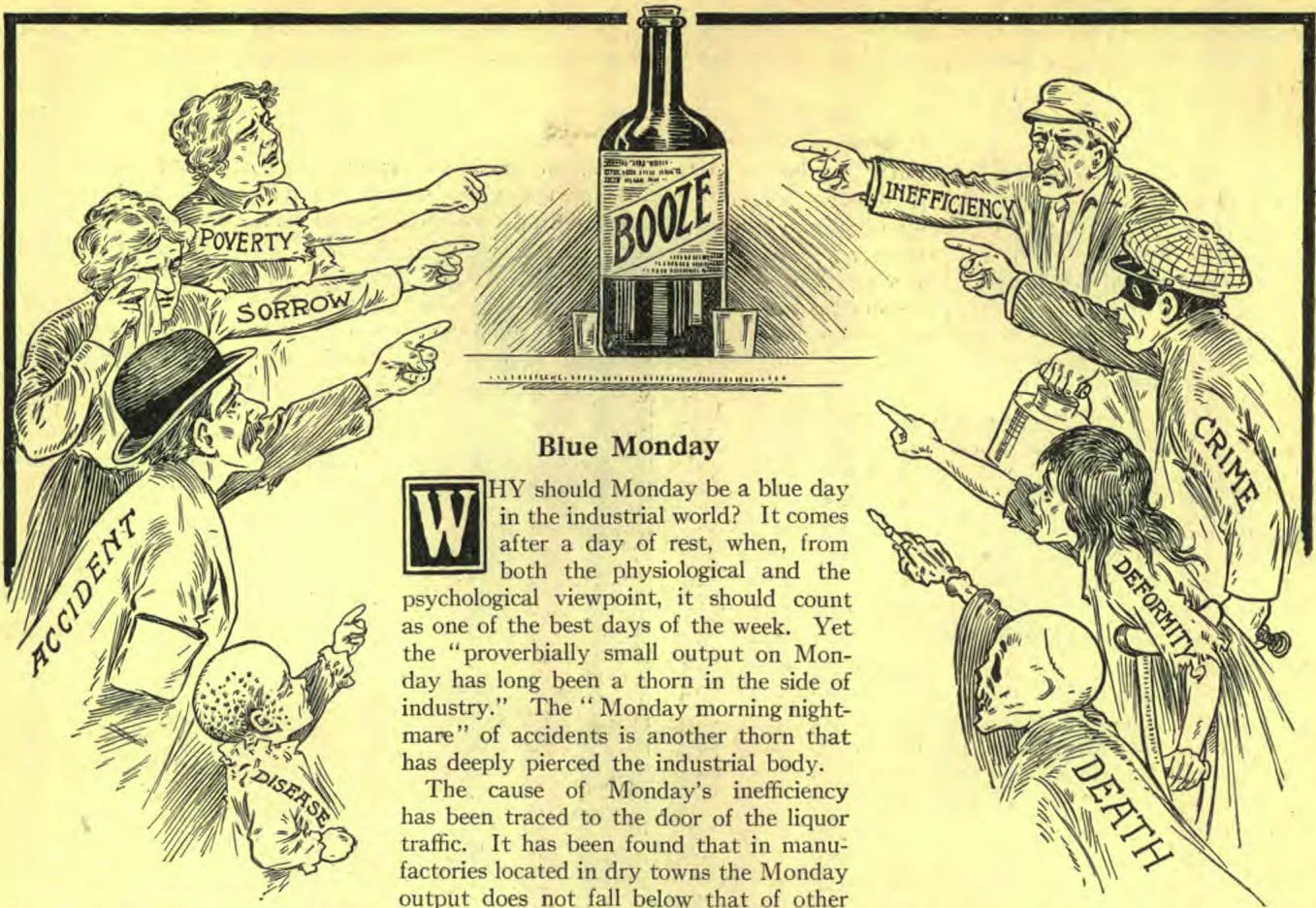
Blue Monday

WHY should Monday be a blue day in the industrial world? It comes after a day of rest, when, from both the physiological and the psychological viewpoint, it should count as one of the best days of the week. Yet the “proverbially small output on Monday has long been a thorn in the side of industry.” The “Monday morning nightmare” of accidents is another thorn that has deeply pierced the industrial body.
The cause of Monday’s inefficiency has been traced to the door of the liquor traffic. It has been found that in manufactories located in dry towns the Monday output does not fall below that of other days; and also that after prohibition has wrought its work in places where Monday had been a perplexity, that day “soon stepped up with the other days of the week.”
Employers in Seattle, Wash., say that Monday labor has become 50 per cent more efficient than before prohibition was enacted.
A leading Kansas manufacturer says: “Manufactories have no off day in Kansas; the men are as fresh at the beginning of the week as at the close,” an unnecessary statement in any other connection, but a significant one here.
Before Russia’s prohibition of vodka, there were shops that habitually shut down on Monday because so few men were sober enough to be present. These same shops now turn out more work, we are told by Russia’s minister of finance, than they did before the war decimated their working force.
On all ranks of the industrial ladder Monday is the fatal day. In the Raritan Cooper Works of Perth Amboy, N. J., more accidents occur on Monday than on any other day, except the days that follow holidays. The Zurich Trades found that there are three accidents on Monday to two on other days.
These facts point an accusing finger at alcohol. Scientific investigation has demonstrated that alcohol is the “industrial vampire” that is responsible for not only Monday’s increasing fatalities, but for a large share of those of other days. Annually 2,000,000 of our industrial workers are injured and 3,500 killed. Rarely, if ever, is a great mechanical or industrial enterprise completed without some accident. In the construction of the new subway and the new elevated railroad in New York, seven thousand accidents were reported. Insurance adjusters assert that a large percentage of accidents are traceable to mistakes which result from the use of spirits.
American medical directors of three great life-insurance companies estimate that from seven to forty-three per cent of all accidents are due, either directly or indirectly, to alcohol.
The vice president of the J. E. Bolles Iron and Wire Works says that “90 per cent of serious accidents occur among men who drink.” This company has largely eliminated Monday’s blue record by paying off its men on Tuesday instead of Saturday.

Drink and Automobiles

Thirty out of forty automobile accidents investigated by one writer were caused by drink. Three insurance companies claim that 10 per cent of all automobile accidents are due to alcoholic liquors. “If a man takes one drink of liquor,” says Judge Richardson of Los Angeles, “he is not fit to drive a car; if he takes two or three, he wants to step on the throttle and let her out.” He advises that patrolmen be stationed near cafés to prevent persons who have been drinking from acting as chauffeurs. And why not?
Automobile fatalities and injuries at grade crossings are so numerous that the chief claim agent of the Pennsylvania Railroad goes farther than the California judge, and pleads for a law denying a driver’s license to any man who uses liquor.
We are a long way from that Thanksgiving Day in 1895 which saw the first proof of the practicability of the automobile, and a long way, too, from the day that saw the first auto race held in this country, the Chicago race, in which the winning car compassed the fifty-seven-mile route in seven hours, a little more than eight miles an hour. The 1916 winning car ran 350 miles at an average rate of more than 100 miles an hour. The 3,000,000 machines on the road today, with their present speeding capabilities and accident possibilities, present a sufficiently serious problem when guided by clear brains and steady hands; and when otherwise directed, they are a scourge in the earth.
The Ingot, the publication of a copper company’s general safety committee, says: “Cut down the booze, and as surely as day follows night you will cut down the accidents.”
Safety First, as well as every other humanity-serving agency, is against the liquor traffic.
The American Car and Foundry Company says that during the last six months of the open saloons in their town, there averaged one accident to every nine cars built; while during a like period after two years of prohibition, the accidents had decreased 74 per cent; or in other words, there had been an increase of 266 per cent in cars built per accident.
Students of industrial statistics estimate that only about one third of our preventable accidents can be stopped by the mechanical guarding of machinery. The remaining two thirds depend upon the man on the job; and he must refrain altogether from the use of alcohol in order to secure absolute release from accidents.
All accidents entail a loss upon society, a waste of wealth, a destruction of productive energy. Then it is a patriotic duty incumbent upon each of us, from “the economic interests involved, as well as from pity for the mutilated of tomorrow,” to do all in our power to banish alcoholic liquor from the industrial world.

Foundry Substitutes Coffee and Mineral Water for Beer

The Useder Foundry, Germany, in 1901 arranged for limiting the use of beer to its employees by the substitution of coffee and mineral waters. It was found that in the fourth year of this régime accidents had decreased 73 per cent as shown by the following diagram: —

Untasted Cocktails

A WORKMAN in the Illinois Steel Company accepted a good position in Pittsburgh. Before his departure his fellow workmen gave a banquet in his honor at one of the hotels, with twenty-five foremen and men holding clerical positions as guests. When these men went to the table, there was a cocktail at each plate. When they left the table, there was still a cocktail at each plate, not one having been touched. Why not?—Because the Illinois Steel Company disapproves of its employees’ drinking, and because the men themselves know that even one cocktail is a thing to be avoided.
Laboratory wizards, whom the world honors and must believe, are chiefly responsible for the untasted cocktails. They have given the deathblow to booze in American industry. When a man can count and weigh atoms, when he can mechanically weigh thought, and do the thousand other things that the modern scientist with his delicate instruments can do, men are obliged to sit up and take notice when he begins to experiment on booze.

Alcohol Dulls Sight, Hearing, and Sense of Smell.
Prof. Angelo Mosso with his ergograph, by repeated experiments, has shown conclusively that one glass of Bourdeaux wine or its alcoholic equivalent,—about one-third ounce of alcohol freely diluted with water,—diminished ability to withstand the fatigue of weight lifting amounting to seven and six tenths to eight per cent. His experiments have been duplicated hundreds of times by other European scientists. In every case a definite loss of muscular efficiency was shown.
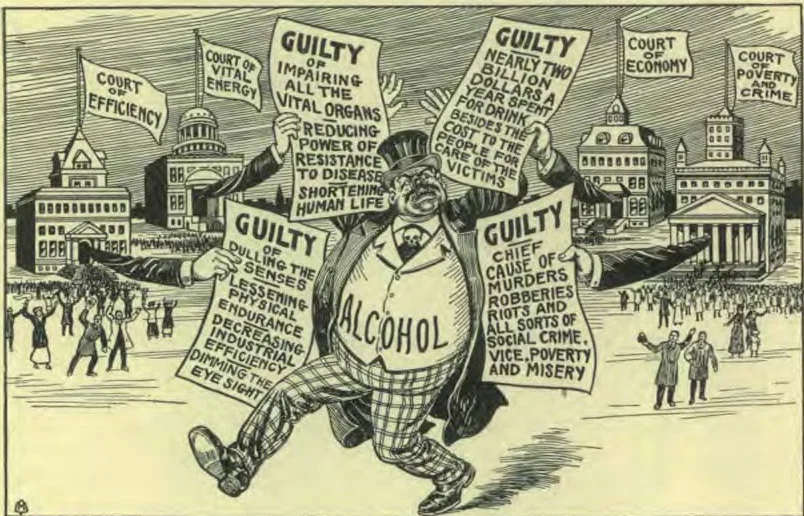
Tried and condemned
Tried and condemned
Dr. Kraepelin, whose experiments have attracted much attention, is regarded as the most eminent living author on mental and nervous diseases. He is professor of mental diseases at the University of Munich. By means of his writing balance, the time required to write a set of characters can be computed with an error of less than one two hundredth of a second. He, too, has made some convincing experiments. Subjects were required to write three stints, each succeeding one requiring greater expenditure of mental energy. The time for the men in their normal condition to perform each task was noted. Then each one was given his allotment of wine. After five minutes the subjects resumed their writing, repeating the previous requirement. It was found that invariably every man slowed up appreciably, there being five and six-tenths per cent loss in quickness on the easiest task, seven per cent on the next harder, and seven and three-tenths per cent on the most difficult. Again and again similar results have been secured.
Dr. Kraepelin also performed experiments testing the effect of alcohol upon the power of association of ideas. The taking of a drink at night resulted in a loss in coördinating power as high in some instances as twenty-seven per cent.
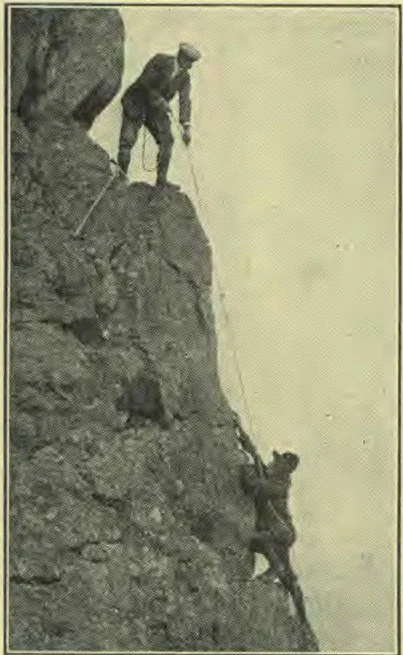
Professor Druig, an expert mountain climber, found that on days when he took two glasses of beer, his instruments showed that he expended fifteen per cent more energy than on the days when he did not drink, and that it took him twenty-one and seven-tenths per cent longer to reach the top of Mt. Bilkencraft, 8,000 feet high. Yet such is the deceptive power of this poison that he felt he worked more easily on alcohol days.
A mountain-climbing scientist experimented and found that it took him over twenty-one per cent longer to get up a peak on the day when he drank two glasses of beer than it did on abstinent days.
Tests of Swedish marksmanship illustrated the effects of alcohol upon endurance in such repetition work. Upon the alcoholic days the soldiers averaged only three hits out of thirty shots, while on their abstinent days they averaged twenty-three to twenty-six hits out of thirty. They, too, thought they were shooting better after they drank, though their skill and endurance were both greatly lessened by the alcohol.

Cannot Memorize So Quickly

Memory tests showed equally serious indictments against alcohol. Dr. Vogt, of the University of Christiania, in his experiments found that the time required for repetition of twenty-five lines of Homer without mistake averaged 18 per cent longer during the alcoholic period than on the abstinent days. The amount of alcohol that he gave was equal to slightly more than one-half pint of four-per-cent beer.
The unfaltering decree of science is that “even one glass of beer daily, decreases a man’s efficiency by an average of seven per cent. In other words, it would require fifteen men, indulging in one glass of beer daily, to do approximately the work which properly should be done by fourteen abstainers. Scientists have found that a drinking man cannot stand extremes of temperature so well, that he cannot hear or see or smell so well, that he cannot lift so much or so often, that he cannot walk so far, dig so much, or carry so enduringly as if he were abstinent.”
These findings of science, with many others of a similar nature, supplemented by personal observations, have made American industry declare almost unanimously against the liquor traffic.
“The great god Industry may not care for the social or moral phase of the drink problem, but when alcohol begins to tease and harass his pet mascot, efficiency, that is quite another matter. Drastic measures must be taken.” And these measures help to bring nearer the day of national prohibition of the liquor traffic.

What Insurance Men Say

WHAT is one year of life worth? Some men, when they have felt the cord of life breaking, would have given millions for another year of life; and yet some of these same men have themselves cut the cord by wrong habits of living.
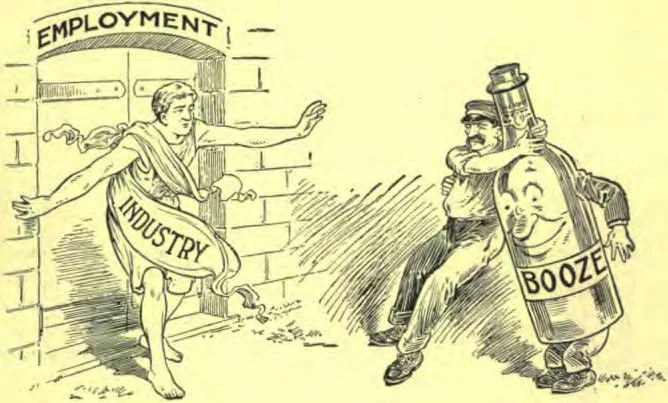
Booze and Industry have parted company. More than 1,000,000 jobs are now closed to the American workman who drinks.
Insurance records show that drink shortens a man's life by at least 11 per cent. The Mutual Life Insurance Company of New York, from observations covering a period of fifteen years, found that out of 100 abstainers who were expected to die, only 78 died, while out of 100 drinkers who were expected to die, only four escaped death, 96 having died.
The Scepter Life Insurance Society of London found that in a period of twenty years, out of 100 abstainers expected to die, only 55 did die, while out of 100 drinkers expected to die, 79 died. The Scottish Temperance Life Assurance Company, Scotland, obtained almost the same figures from similar observations.
Another reliable insurance investigator found that the average mortality among drinkers covering a period of sixty years, was 36 per cent higher than among abstainers.
The actuary of the United Kingdom Temperance and General Provident Institution, England, says that “abstainers show a marked superiority to nonabstainers throughout the entire working years of life for every class of policy and for both sexes, however tested.”
The Danes are said to have a passion for statistics second only to the Germans. As a result of this passion, a governmental commission was able to obtain from the records of Denmark’s physicians the following accurate deductive information concerning the adult deaths occurring in their practice in one year:—
“Every pint of brandy consumed steals eleven hours out of a man’s normal expectation of life, and every pint of beer drunk cheats him out of approximately twenty-five minutes of earthly activity.”
Based upon a report of two million cases, tabulated from the records of American and Canadian life insurance companies in the past twenty-five years, Mr. Arthur Hunter, chairman of the central bureau, Medico-Actuarial Mortality Investigation, says that it is conclusively proved that total abstainers are longer lived than nonabstainers, the span of human life being reduced from four to six years as a result of the use of alcohol.
The Prudential Insurance Company, New York, claims to have lost 1,522 policyholders in four years through alcoholism, an economic loss to the country of $1,522,000, counting a man’s life worth only $1,000.
The statistics from Leipzig Benefit Societies show that death carried off in the prime of life from two to three times as many drinkers as other insured men. Lombroso, the great Italian scientist, says: “The man of twenty who drinks has a probable life of fifteen years before him, the abstainer one of forty-four years.”
These facts remind one of the unintentional admission in the notice of a picturesque little church in a suburb of Berlin. The church was surrounded with peaceful graves, whither artists often resorted to sketch. Close by the entrance was a notice saying, “The key to the graveyard is to be found in the neighboring brewery.” The brewery and distillery hold the key to many graveyards. They hold the key to the world’s house of misery and death. How long shall we suffer this outrage upon our fellow men?

Who is on the Lord’s Side?

When this question was first put to the waiting multitude at Sinai, every man was compelled to take sides, and to do it definitely and at once.
Now in this great hour the challenge is again given, “Who is on the Lord’s side?” and men by force of circumstances are being compelled to line up for or against the liquor traffic. This is the way it is being done: In Elgin, Ill., a vote on the saloon question revealed the fact that one brewer, one distiller, one daughter of a distiller, nine ex-saloonkeepers, four ex-saloonkeepers who afterward became blind-piggers, one expressman, seven wet leaders and workers, most of whom circulated the petitions for pay, voted for saloons; while the better part of Elgin voted for prohibition.
Elgin voting is a fair sample of the general personnel of the dry and wet voting. It also shows the way things are fast tending throughout the country.
When Secretary Daniels learned of the many admissions to the hospital for alcoholism in the American navy, he concluded that if alcohol was sending so many to the hospital, it must be rendering inefficient a still larger number of men who did not get to the hospital. He therefore, for the sake of efficiency, debarred alcohol from the United States Navy.
Mayor Smith of Philadelphia barred liquor from 10,000 city employees, with the statement that “rum and efficient public service are an impossible combination.”
The Brotherhood of Locomotive Engineers in convention declared for State and national prohibition, saying that “drink and efficiency do not run hand in hand.” The New York City Board of Health has inaugurated a temperance crusade.
The United Mine Workers of America at once remove from his position any officer or employee convicted of intoxication. National parks and forest reserves have been made dry by order of the National Congress. According to Adjutant General McCain, liquor is absolutely forbidden in all our army camps.
“The National Guard is a sober organization,” said Capt. Stanley W. Root, of Company I, Pennsylvania National Guard. “It takes a good sober body to stand the strain of the service nowadays. The drunkard is the first man who becomes a straggler, and we don’t want him. The personnel of the National Guard in my time has improved one hundred per cent in this respect.”
Adj. Gen. I. Van Holt, of Georgia, says, “There will be no drinking among the Georgia troops as long as I am at their head. Woe unto the man who takes a drink if I ever hear of his having done so. Drunkenness for a soldier is an unspeakable disgrace, especially in the case of an officer; and it is my purpose to have any such man court-martialed and subject him to the full penalty of the law.”
“General Clark, in command of Missouri National Guard, at Camp Clark, Nevada, Mo., issued stringent orders against the use of liquors by either officers or men, or even its presence on the reservation.”
The Philadelphia Quartz Company of Chester, Pa., has declared an increase of ten per cent in wages for each one who will pledge himself to abstain from intoxicating liquors.
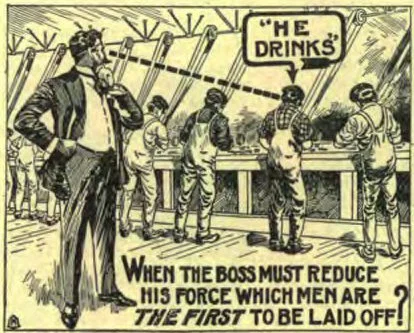
WHEN THE BOSS MUST REDUCE HIS FORCE WHICH MEN ARE THE FIRST TO BE LAID OFF!
The Cambria Steel Company of Johnstown, has also taken official steps to curb all drinking by its employees, on the principle that no man has a right to drink and expect to sell his lessened efficiency to the Cambria Steel Company. The Hershey Chocolate people, among the largest manufacturers of their line of products in America, have taken a similar step.
The Pittsburgh and Lake Erie Railroad dismissed one hundred twenty-six employees at one time for drinking.
Socialist leaders of Norway, Finland, Germany, France, Belgium, and Austria have expressed themselves strongly against the sale of alcoholic liquor. Vandervelde, one of the giants of the European socialist movement, says: “We must have the courage to tell the workers that those who are filled up with gin are not capable of marching with us to the conquest of a better future. It is the imperative duty of the socialist to attack not only the enemy without, capitalism, which exploits him, but the enemy within that gnaws his entrails and wastes his resources.”
The verdict of a commission appointed by the mayor of Chicago is that alcoholism is the greatest single cause of crime and insanity.
The rules of the barkeepers’ union forbid its members’ using intoxicating drink. “Booze is made to sell, not to drink,” said one barkeeper.
The Rand Company, of North Tonawanda, N. Y., manufacturers of improved bank and office equipment, when asked to donate one-fourth per cent of a certain bill to aid in fighting prohibition, said:—
“We consider it an insult for you to ask us to help you in preventing the introduction and enforcement of one of the best laws that could be put upon our statute books. We would rather give ten times the amount of this bill for the introduction and enforcing of a prohibition law than one cent to fight it.”
An easy problem
An easy problem
The Carnegie Company at Youngstown, Ohio, promotes only employees who are abstainers from intoxicants.
The Maryland Steel Company, perhaps the largest single corporation in the State, got an act through the legislature forbidding the manufacture and sale of liquor within two miles of its plant.
The Winton Motor Company, of Cleveland, Ohio, which employs about 1,200 men in Cleveland, and about the same number in other cities, has never employed any but total abstainers.
Ten large American steel concerns also employ none but abstainers.

To Uncle Sam

Dear Uncle: I wish to engage in a new business; a business that I am sure will in a short time net you larger revenue than at the present time comes from the liquor traffic. In brief, I desire a United States license that will give me and other “citizens of good moral standing” a right to steal horses and automobiles for “personal use.” I want a federal license that will make the business of stealing horses, buggies, automobiles, bicycles, and accessories lawful, and give it the protection and support of the United States government. At first my request may seem unreasonable; but please waive judgment until I give you my reasons for making the request.
I am aware that the people of my State have passed laws prohibiting the stealing of these things, but, Uncle, could you not put me in touch with some good judge or attorney-general who understands law sufficiently to be able to find some technicalities that would make it possible at least for me and my associates to steal horses and automobiles from other States for “personal use”?
First, you may be interested to know how I stand regarding local option and this prohibition movement that is sweeping over the land. Well, I am not so much opposed to prohibition as I once was. I believe in prohibition that will prohibit all foreigners from stealing horses and automobiles for personal use or any other use. I want to see this business carried on decently and only by American citizens “who are of good moral character.” I am willing to abide by a law prohibiting my business on Sundays, election days, or after twelve o’clock at night. I am also willing to be prohibited from stealing from minors. But if I am altogether denied the privilege of stealing these things, the result will be, that, just like the bootleggers, a lot of sneak thieves and liars will, under cover, unlawfully steal them anyway. And you will then receive no revenue to help reduce taxes. You know that prohibition against stealing does not prevent stealing in any country. “Prohibition does not prohibit.” A refusal of such a license would only be an interference with my personal liberty.
My associates and myself are willing to pay a liberal fee to the government for this federal license. We are also willing to put ourselves on record not to steal colts, or horses that have no sense, neither would we take old broken-down plugs. We would not take automobiles that had been used over one year, and would agree to steal but a limited number of Fords each year. Can you not readily see that my proposed business would greatly increase all lines of legitimate business throughout the country? And, furthermore, we would agree to steal only from well-to-do people and the laboring men.
I feel confident that you will agree with me when I say that my proposed business would not be nearly so injurious or dishonorable as the business of selling drugged liquors for drinking purposes. For instance, my business would not cause any man to beat his wife and children or raise a disturbance in the community. Neither would my business wreck homes, fill jails, asylums, or county hospitals, for the sober, industrious, and respectable part of the community to support. My work of stealing would not condemn wives and mothers to lives of drudgery and want. Neither would we wreck manhood, debauch politics, or bind people to a hellish slavery. We would do nothing to steal the honor of the man, the virtue of the woman, or the future of the child.
In your one hundred and forty years of experience, have you ever known of any thief or band of outlaws whose record can approximate the awful results of the liquor traffic? Can you think of one word that can be said in favor of the open saloon or the personal-use plan that is not in some way dictated by self-interest? Candidly, would it not be saner and more just to grant me a federal license to steal or burglarize, and protect me in that business, than to grant to others license to sell intoxicating liquor for drinking purposes and protect them in that business?
I therefore hereby petition you to grant me and my associates the privilege of calling special elections, so that each county, town, or precinct may vote on the question of whether or not they will license “white slavers,” gamblers, thieves, and murderers to commit their crimes, and thus have local option on thievery, murder, etc.? And then each community for a license fee could license thieves, and murderers, and throw certain restrictions around them so that they could carry on their business in a decent and respectable manner, and then we would not have thieves and murderers going around, like the bootleggers, committing their crimes in violation of our laws.
Awaiting your reply, I am.
Faithfully yours, W. L. SIMMS.

A Patriotic Prohibition Prophecy

God's clock has struck the hour that knells the final doom Of base resorts that flourish in shades of moral gloom. Our country's sacred honor conditions new commands, And pulpit, press, and platform unite in firm demands. No legalized temptation shall lure the feet of youth To wander from the pathway of purity and truth; No revenue degrading our treasury shall claim; No partnership with evil shall mar Columbia's fame; No breweries, no distilleries, no wineries, no bars, Shall purchase their protection beneath Old Glory's Stars! O statesmen wise, who legislate beneath the great white dome! O patriotic Chief, within historic White House home! This vision will be realized. High on the scroll of fame, In characters of fadeless light, will shine each honored name Through whose supreme endeavor and by whose earnest thought Were moved the forces which this glorious conquest wrought. Leaders of our Republic, this prophecy fulfil! Be brave! dare face the issue! it is the people's will! Then victory bells will peal above the liquor traffic's grave, And o'er our nation's dome at last a stainless flag shall wave!
MRS. NELLIE HAZARD BRADLEY.

British Testimonies

Lord Roberts's Last Appeal: “Thousands of young recruits are having their work interfered with and their constitutions undermined by being tempted to drink by a friendly but thoughtless public. I therefore beg most earnestly that the public generally do their best to prevent our young soldiers from being tempted to drink.”
Sir Thomas Barlow, K. C. V. O., M. D., F. R. C. S., president of the Royal College of Physicians and of the Seventeenth International Congress on Medicine, says: “Alcohol makes a man less effective.”
Field Marshal Lord Methuen: “Drink ruins body and mind alike, besides being intensely degrading.”
Sir John French, commander in chief of the expeditionary forces: “Abstinence and self-control make a man more serviceable.”
Sir Frederick Treves: “If you want to be officers, don't touch alcohol;” and again: “Alcohol is a poison. You cannot be fit if you take it.”
Lord Kitchener: “Your duty to your country can only be by hard work and strict sobriety.”
Glasgow Municipal Poster: “Alcohol increases the risk of consumption.”
Sir Arthur Conan Doyle, M. D.: “Don't drink alcohol. You will be happier without it, healthier without it, and richer without it.”
Sir George White, M. P.: “Drink is the greatest black spot on our civilization.”
Dr. Forbes Winslow, M. B., LL. D., C. L. B.: “Drink, crime, and lunacy go hand in hand.”

A British Poster

To All Men Serving the British Empire

It has been proved by the most careful scientific experiments, and completely confirmed by actual experience in athletics and war, and attested by Field Marshal Lord Roberts, V. C., K. G., K. P., Field Marshal Lord Wolseley, K. P., G. C. B., Field Marshal Lord Kitchener, K. P., G. C. B., and many other army leaders, that alcohol or drink— Slows the power to see signals. Confuses prompt judgment. Spoils accurate shooting. Hastens fatigue. Lessens resistance to disease and exposure. Increases shock from wounds.
We therefore most strongly urge you for your own health and efficiency, that at least as long as the war lasts you should become total abstainers.
Thomas Barlow, K. C. V. O., M. D., F. R. C. S. Frederick Treves, G. C. V. O., K. C. V. O., C. B., LL. D., F. R. C. S. G. J. H. Evatt, C. B., M. D., R. A. M. C. Victor Horsley, F. R. S., F. R. C. S., M. B., B. S., M. D. G. Sims Woodhead, M. A., LL. D., M. D., F. R. C. P., F. R. S. E.

Quotations on Liquor Traffic and Society

A coward in politics is worse than a coward in war.— Lats.
“Every barroom whitens a skeleton for every other room in society.”
“The liquor traffic stifles enterprise, and breeds treason everywhere.”
Preparedness cannot come until the liquor traffic goes.— Fred E. Landis.
“Rum rots the brain of the drinker, and grinds to powder the girders of society.”
“Local option is too local and too optional. National evils are not cured by local treatment.”
“Prohibition doesn't make blind pigs. These are the product of blind officers and blind voters.”
Every city in South Dakota voted dry at the November election; so did every city in Montana except Butte.
Continue reading: Master Frog as Doctor