The Youth’s Instructor, Vol. 33, No. 44.

THE MOTHER'S BLESSING

The Youth’s Instructor

Nov 18, 1885

S. D. A. Publishing Association · Battle Creek, Mich. · Nov 18, 1885

THE MOTHER'S BLESSING.

It was the gray dawn of a winter's morning. A mother stood in the doorway of a New England farm-house, with her hand upon her eldest son's shoulder. He was a tall boy, and she was a little woman, with a fresh, young look in her face, notwithstanding her forty years. Albert Morrison, her first-born child, was standing upon the threshold of his old home, ready to pass out of the door into the great, broad world, and take his place among its countless workers. His overcoat was buttoned tightly up to his throat, for it was a very cold morning; and his traveling-bag stood by his side. The team was waiting in front of the house, and his father sat in the sleigh, looking for his coming through the open door, for it was almost time to drive his son to the station.
As the words, “Hurry up, my son, or we shall be late!” fell upon the mother's ear, she lifted up her face for the good-by kiss; and when her much-loved boy bent down to receive it, she put her arms around his neck and said: “The Lord bless thee and keep thee; the Lord make his face to shine upon thee, and be gracious unto thee; the Lord lift up his countenance upon thee, and give thee peace.”
After giving his mother a loving kiss, he bounded out of the door, and was gone. She stood by the window and watched the retreating form of her boy until he was out of sight, and then went into the empty room, and kneeling down by his bedside, she committed him to the Lord.
A few days afterward, the young man stepped off from the train that had just stopped in the large depot of a western city. He was going to take a position in a wholesale business house in that city; and after a few hours had passed, he reported at the desk of the senior partner of the firm, and was assigned to his immediate post of duty. He was a young man of great energy and an apt scholar, and soon became quite familiar with his particular duties. He had taken a room in a boarding-house where there were a number of other young men, with whom he was thrown in close companionship. The first few Sabbaths after he came to the city, he attended church in the morning, and in the afternoon he wrote long, loving letters to his mother. But his young companions did not go to church. They told him no one in the large city churches took any interest in strangers; besides, as they worked all the week, they needed that time for rest. It was not long before Albert fell into their ways of thinking, and spent his Sabbaths with them, lounging about in the parlor, reading the newspapers or wandering about the streets of the city. His employer paid for one of the highest priced pews in the largest church there, but he never inquired where his clerks attended church, or even if they went at all.
It was then for the first time that Albert heard arguments made and opinions expressed unfavorable to the truth of the Bible. His mother's teaching from that holy book had been so plain that hitherto he had “walked by sight,” so implicitly did he believe in them. But now the child of faith was beginning to take the first steps away from the little fence of trust which had hedged in his pure life. “The first steps are those that tell.” Soon Albert began to accompany his companions to places of resort that would have brought a blush to his face had his mother looked in upon him. He had already begun to take the “social glass.” He was a generous, whole-souled fellow, and of course he must treat his companions and be treated by them. All his companions spoke of “wild-oat sowing” as a necessity to be gone through with in order to reach a high degree of manhood. Of course they expected to reform by and by. They never calculated upon the harvest this “wild-oat sowing” produces.
Albert Morrison was faithful to his business trusts; but when the office door was closed for the day, he thought it his privilege to go where he enjoyed himself the most. His mother's letters came to him every week, full of loving counsel. When he read them, the consciousness that he was traveling far away from his mother's teachings made him resolve for the moment to do as he knew his mother firmly believed he was doing, honoring her name and her loving counsels. But the thought of what his companions would say was too much for his foolish, wicked pride to overcome.
The “social glass” began to become a necessity to him. He found at certain hours that he could not resist “taking a drink.” One night, after he had treated to an extra degree, he started to go to his room. When he left the saloon, his step was unsteady; and in making an attempt to cross the street-car tracks, he fell in front of the wheels of a coming car. The driver instantly stopped the car, but it was only just in time to save the prostrate man from being killed. Albert Morrison was taken up in an unconscious state, and carried into a drug store. He was recognized, and his companions had him carried to his room.
When he recovered himself, the sound of church bells calling the worshipers to God's house, came in through the window. In a moment the scenes of the past night came to his mind. Then he listened to the solemn sound of the bells; their sacred music filled his heart with anguish and remorse. He thought of the little church at home; of his dear mother sitting in the pew, perhaps at that very moment with bowed head, thinking of and praying for him; and then he remembered he had a letter, still unsealed, from his mother, in his overcoat pocket. He took it from its neglected hiding place, and opening it, read it with tearful eyes. It began with bright pictures of the home life, and the loved ones there, and their pleasant talks about the absent one; then followed the bits of news in the neighborhood, and then some kindly, loving counsel. The letter closed with the same words the mother had spoken in blessing when she bade her son good-by. “The Lord bless thee, and keep thee; the Lord make his face to shine upon thee, and be gracious to thee; the Lord lift up his countenance upon thee, and give thee peace.” Oh, how vividly the scenes of the morning when he left home came before his face! The sweet words sounded in his ears just as they did when they fell from her loving lips. He buried his face in his hands, and repeated: “The Lord be gracious unto thee.” How much he needed grace and mercy! Then he prayed, as he had never prayed before, that the light of God's countenance might shine upon him and give him peace—“For Christ's sake and my mother's sake, O God, turn me not away!” It was a true repentance. When Albert Morrison resolved with the strength of his mother's God to take up the new life, he felt that he must leave all his old companions and begin entirely anew. But on second thought, he felt assured that right there was the very place for him to stay and do a great work for others as well as for himself. It was a bold stand; but his influence was slowly gaining ascendancy as day by day passed. Success is never gained by easy stages. There are failures many times—discouragements, oh! so often. It is a constant warfare, but to the persistent soul, God giveth the victory.
A year afterward, Albert visited his old home for the first time; and when his mother sat alone with him in the golden twilight of the summer's day, he told her all his temptations, and how God helped him to resist them.
“I couldn't get away from my mother's God and my mother's blessing, even in that distant city!” he said, as he concluded his story, and imprinted a loving kiss upon his mother's tearful face.—Christians at Work.

A DOUBTING HEART.

WHERE are the swallows fled? Frozen and dead Perchance upon some bleak and stormy shore. O doubting heart! Far over purple seas, They wait, in sunny ease, The balmy southern breeze To bring them to their northern homes once more.
Why must the flowers die? Prisoned they lie In the cold tomb, heedless of tears or rain. O doubting heart! They only sleep below The soft white ermine snow While winter winds shall blow, To breathe and smile upon you soon again.
The sun has hid its rays These many days; Will dreary hours never leave the earth? O doubting heart! The stormy clouds on high Veil the same sunny sky That soon—for spring is nigh— Shall wake the summer into golden mirth.
Fair hope is dead, and light Is quenched in night; What sound can break the silence of despair? O doubting heart! The sky is overcast, Yet stars shall rise at last, Brighter for darkness past, And angel's silver voices stir the air.
—Adelaide A. Proctor.

A TROPICAL SCENE.

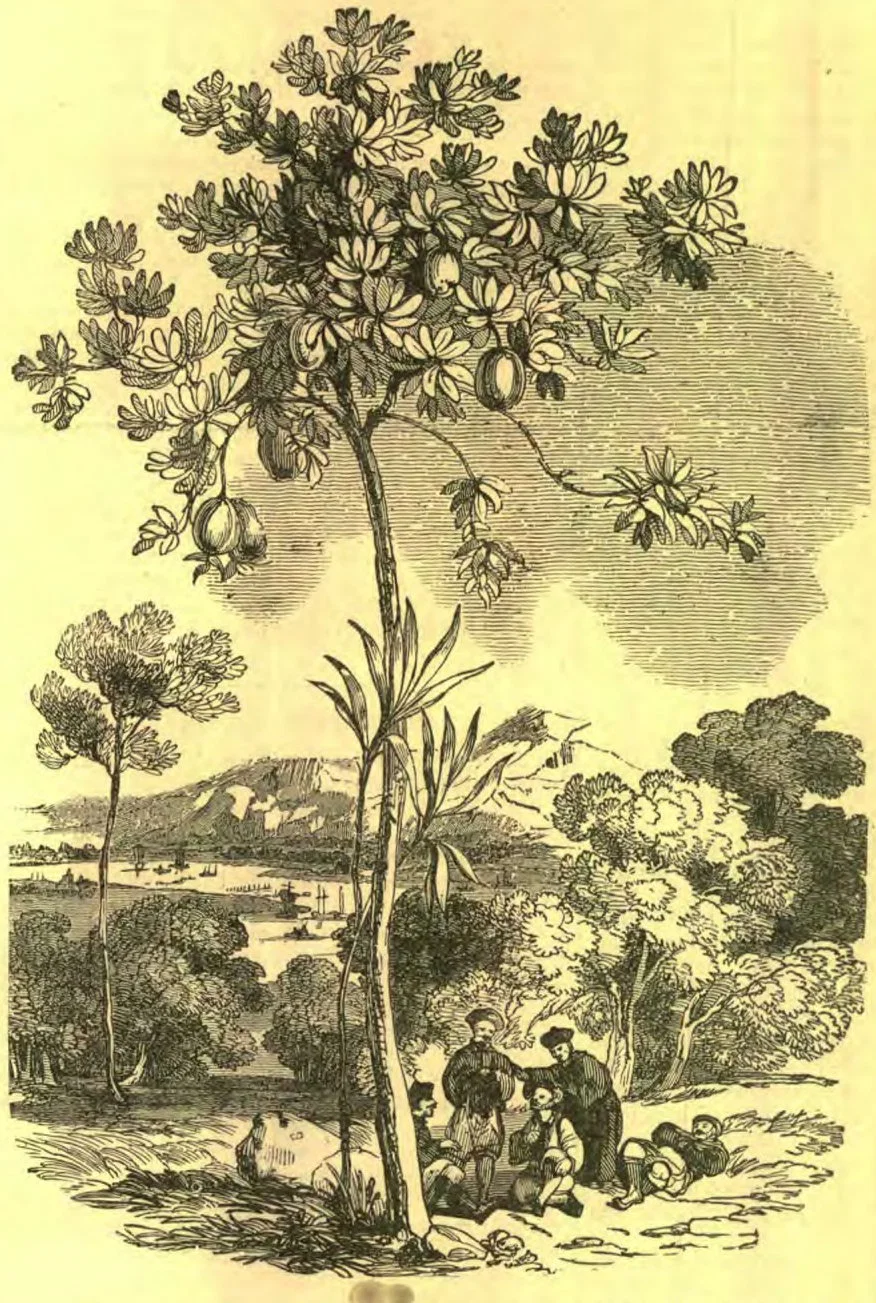
WHAT a pleasant place this must be that we see in our picture! On every side spreads a most luxuriant growth of shrubs and trees. Close at hand winds the river, alive with boats and sailing vessels; while in the background rise the tall mountains. In the foreground stands a strange-looking tree, such as we do not see in our temperate climate. Perhaps it is the shaddock tree, that grows in Cochin China and the East Indies. In among its clustering leaves hang great globes of pale yellow fruit, often weighing over eight pounds. We might expect such fruit to be delicious, since it is a relative of the orange; but unfortunately it is of a very inferior quality. After penetrating the thick, bitter rind, we come to a greenish, watery pulp, of which little use can be made.
Those fellows stretched at their ease under the trees seem to be having a very enjoyable time. In most of the tropical countries, nature seems to have been very prodigal of her gifts. There is little need to cultivate the soil in order to obtain the necessaries of life; for the native has only to stretch out his hand to find all these within his grasp. Just the place, we might think, where life would flow on in perpetual happiness; where having to give so little thought as to what we shall eat, and wherewithal we shall be clothed, we might find abundant opportunity for quiet study and meditation. Yet Nature has not been so lavish as she seems; she has preserved the same law of equality that can be seen in all her works. While she has greatly favored the dweller of the tropics with a surplus for all his animal wants, she has also given him a climate so enervating in its effects as to shut off all desire for the higher enjoyments of life; and we find him little above the wild animals in his mode of life, or his ambitions. Doubtless, after we had spent a season in this seemingly favored portion of the earth, we should find that there was no land like our own land, where God has so provided as to call into exercise the higher faculties of the mind, thus raising us above the brute beasts of the field.

DOWN BY THE SEA.

LEAVING South Lancaster a few weeks ago, in company with some friends I started for the island of Martha's Vineyard. Arriving at New Bedford, we took the boat for the island. As it steamed out into the bay, we sat on the upper deck, enjoying the cool, salt air from the ocean. On either side stood the old stone forts, with their gray, frowning walls, while Buzzard's Bay stretched out before us. The water was not rough, but the waves in the bay, as far as we could see, were capped with foam; and a sail boat which we passed, seemed to be having a lively time of it, bobbing up and down on the water. In about an hour our steamer stopped at Wood's Holl, a small town on the most southern extremity of Cape Cod.
Opposite this place, and separated from it by a narrow channel, is one of the Elizabeth Islands. These islands, as well as Martha's Vineyard, were discovered by Bartholomew Gosnold in 1602, eighteen years before the Pilgrims landed at Plymouth. On one of them, now called Cuttyhunk, he concluded to begin a plantation. At the northwestern end of the island, is a pond of fresh water two miles in circumference, and in this pond a small rocky islet, on which his men built a storehouse. It was the first house built by the English on the New England shores. While his men were engaged at this, Gosnold crossed the Bay in his vessel, traded with the Indians, and discovered the mouths of two rivers, on one of which New Bedford now stands. After his return to Cuttyhunk, the men who had intended to remain there became discontented, and the settlement was given up. The cellar of the storehouse still remains.
After leaving Wood's Holl, we passed through the narrow strait, and out into Vineyard Sound, where the water became rougher. Here and there in the distance we could see a vessel under full sail, looking like some great bird with its wings spread wide. We passed by a fisherman with his boat at anchor, and his lines out. In some places the water looked green, in others, deep blue, while in still others it had a reddish purple tinge.
Before long we came near Martha's Vineyard, and after passing the harbor of Vineyard Haven, reached Oak Bluffs, or Cottage City, on the eastern part of the island. As our boat was made fast at the wharf, the band on shore struck up a lively air by way of greeting.
Cottage City is a favorite resort in summer, but in winter it is almost deserted. There are two camp-meetings held here annually, the Methodist and the Baptist. The Methodists have an iron tabernacle. The cottages are pleasantly situated among oaks and flower-gardens. All the streets are concreted, some being broad and straight, while others are narrow and crooked.
Leaving Cottage City, a ride of about a mile brought us to a little cottage on a hill overlooking the town of Vineyard Haven, its harbor, and the ocean beyond.
This island is nineteen miles long, with an average width of about five miles. In 1642 a colony was established, and soon after, with the neighboring islands, it was annexed to Massachusetts. These islands were included in a grant given to the Duke of York by his brother, Charles II., and thus became a part of New York. The name of Duke's County was given them in honor of the Duke. They were left, however, to manage their own affairs, mostly, and in 1692 again became a part of Massachusetts. The Indians on the island were more friendly than those on the mainland, and before many years, through the influence of the colonists, they all professed Christianity. When King Philip's war broke out, the governor of the island had such confidence in them that he supplied them with arms and ammunition, telling them what to do in case of an attack.
The colonists themselves kept but little guard, and the Indians proved true to their trust, although the savages on the mainland tried many times to have them join King Philip and the united tribes against the whites.
The best land on the island is at Gay Head. This was reserved by the Indians, and some of their descendants still live there. This place is noted for its cliffs. They are about one hundred feet high, and are mainly composed of red, yellow, blue, indigo, black, and white clay. Viewed from the water near the shore, they present a beautiful appearance, especially after a rain when the sun shines on them; hence the place derived the name of Gay Head.
There is a depression here in the earth called Devil's Den, which is four hundred yards around, and one hundred feet deep. The Indians say that long before the white men came to this country, a giant, who had a great care for them, lived here, and in the den broiled whale and other fish for them over a fire made of the largest trees, which he pulled up by the roots. There is a ledge of sunken rocks called Devil's Bridge, from Gay Head to Cuttyhunk; and they say that the same giant began to build a bridge here, and had thrown in a shoeful of earth which he had scraped from the Devil's Den; but one day while he was working in the water, a crab bit his toe, which so vexed him that he gave up the project. Of course this story is not true, but the Indians used to believe it.
Edgartown, on the eastern side of this island, was formerly a whaling port of considerable note, but at present little is done at that business there.
Part of the island is well-wooded, but the trees are not very large, and are mostly oaks. The sea-shells found on this coast are not so pretty as those in warmer climates, but the sea-mosses are very beautiful. They grow in the bottom of the ocean, and wash ashore after a storm or hard wind. There are a great many kinds, and some look very pretty after they are pressed on cards. They are of different colors at different seasons of the year, the most delicate colors being found in the winter or early spring.
Is it not wonderful how many beautiful things God has made, even in the bottom of the great ocean? Wherever we look, we find evidences of the love of our kind heavenly Father, who cares for his children, and wants them to be happy in the enjoyment of the things he has created.
LAURA C. BEE.

The Shepherd and His Bible.

A poor shepherd once took his hard-earned money and bought a Bible. It was an old Bible, and did not cost him a very large sum. He read it carefully every day. One day he found two leaves were pasted together. He opened them, and found within nearly one hundred dollars. There was a note with the money, on which was written: “I gathered together this money with great difficulty, but having none as natural heirs except those who need nothing, I make thee, whosoever shall read this Bible, my heir.”
Now, if every Bible had money hid in it, I believe many would “search the Scriptures” more than they do. But, dear children, there are treasures more precious than money in your Bibles. “Search the Scriptures, for in them ye think ye have eternal life; and they are they which testify of me.”

"SMILES WHEN SHE SPEAKS."

The power of unconscious influence was illustrated recently by the following little incident:—
A lady called at the house of a neighbor on an errand; but, as the family were away, she asked the man in charge of the house to tell his employer that she would call again. Being in a hurry, and not thinking but that the man knew who she was, she did not leave her name. The lady of the house returned before the rest of the family, and the man told her that a lady had been there who said she would call again.
“Who was it?” inquired Mrs. H.
“Oh, I don't know her name,” replied the man.
“But you should have asked her,” said Mrs. H., “so we might know who had been here. Can't you think of anything by which I can tell who came? Where does she live?”
“I don't know,” said the man; “but she's the one that always smiles when she speaks.”
The pleasant look and the courteous manner in which this lady had spoken to the servant had been noticed and remembered, leaving a sunbeam in that man's heart. Let us each remember that religion is recommended by the way in which we treat even the servants. The command, “Be courteous,” reaches to all with whom we have to do.—The Youth's World.

FROM SYDNEY TO MELBOURNE.

There are some places of interest in and around Sydney. The Botanical Gardens are finely laid out, and attract many visitors. The approach to these gardens is by a broad, nicely paved roadway, which has chains extending along its sides to protect the lawns decorating its edges. Near the large iron gateway which forms the entrance to the gardens, and directly in front of it, stands a handsome drinking fountain, where the thirsty visitor may moisten his parched throat after a long walk in the excessive heat of an Australian summer day. Passing inside the gate, one finds himself in the midst of trees, shrubs, and plants of almost every known variety. The foliage of some of the trees is very beautiful, and much more abundant than that of others around them, which came from the colder climates. Here may be seen the American pine and the African calabash growing side by side; the cypress pine and the native black apple, with the poisonous upas of Java; and the English oak with the Norway spruce. Winding among these trees are footpaths leading to the several parts of the inclosure. These paths are bordered with flowers of every hue and shade, whose pleasant perfume fills the air at every step. Crossing a sort of lagoon on a rustic foot-bridge, one notices in the pool beneath, the several varieties of water-plants, with their leaves and flowers quietly reposing on the surface, those nearest the shore shaded by the heavy growth of ferns that thrive on the banks of the lagoon.
Thirteen miles from Sydney, up the Paramatta River, is the town of Paramatta. At this place, the governor of New South Wales has a summer residence. It is also the seat of several orphan asylums and hospitals. Here, too, are grown nearly all the oranges used in Australia. The fruit, however, is quite sour, and is in no way comparable to that grown in California and Florida; yet the groves are none the less beautiful, and are just as fragrant as those of America. It would seem as though fortune smiled on every effort to grow fruits of the citrus species, in whatever country the attempt is made. One cannot fail to be struck with the contrast between such localities, and those only a little way removed from them, where these fruits are not cultivated. In the vicinity of Los Angeles, California, when one enters the orange district, nature immediately assumes a different aspect, and the scene gets to be so beautiful, compared with that of other parts of the country, that one almost becomes bewildered in contemplating the sight for the first time. It is the same in the vicinity of Paramatta; here the orange and lemon groves, with their dark green foliage thickly dotted with golden fruit, occupy all available space that is adapted to their growth. Pretty carriage drives and foot-paths lead from distant parts of the groves to handsome villas, surrounded with gardens laid out with the most artistic skill, and filled with flowering shrubs and plants, whose fragrance perfumes the atmosphere around.
Botany Bay, five miles from Sydney, is a place of some renown, on account of having been at one time a place of banishment for English convicts. The bay is an indentation in the east coast of Australia, about three miles wide and five miles long. It received its name from the new plants found on its shores, when discovered by Captain Cook in 1770. The beach is covered with sand, and looks very barren. It is not a very inviting place, and few people live there. The most prominent object in the vicinity, is a plain monument, about twenty feet high, inclosed by a neat iron fence. This was raised in honor of a French navigator named Perouse (pronounced pa-rooze), who, while on an exploring expedition in 1778, landed at Botany Bay. Upon leaving there, nothing more was heard from him till about 1826, when it was ascertained that he and his party perished by shipwreck near Mannicolo, an island of the Pacific.
The day we left Sydney was really fine; the sun shone out clear and bright; and as its rays fell upon the calm waters of the harbor, down which our vessel was smoothly gliding, we regretted that we must so soon exchange the calm of a miniature inland sea, for the boisterous, turbulent waves of the broad ocean. But five hundred miles of our journey was yet before us, and we must brave the stormy waters once more for a brief period. The ship in which we took passage was only about one-fourth as large as the one in which we had crossed the ocean, and was, therefore, more subject to the caprice of the troubled waters of a stormy coast. This proved to be the hardest part of the voyage; for though having been nearly a month at sea, and pretty well accustomed to the motion of the larger ship, our little craft was so tossed about by the tempest, that the most of our company kept their rooms the greater part of the journey.
Toward morning of the third night after leaving Sydney, we passed in by the heads at the inlet of Port Phillip, where we were again in comparatively smooth water. It was a pleasant run from there to the mouth of the Yarra Yarra River, a distance of forty miles. At this point the pilot came on board to conduct our vessel up the narrow, crooked and muddy stream that has been dignified with the title of river. Nine miles up this winding stream we made our way, after running aground two or three times, and about midday landed at Melbourne, the metropolis of the colony of Victoria. J. O. Corliss.

THE ADVISERS OF THE PRESIDENT.

It was stated in No. 15, present volume of the Instructor, that the President’s Cabinet “is composed of seven distinct heads, chosen by the President; men who are at the head of the executive department with the President, who is head of them all, bringing them into harmony.” These men are the President’s advisers; and the duty of each Cabinet officer is defined in the following paragraphs from the Teacher:—
“The Secretary of State is the most responsible and important member of the U. S. Cabinet; is in charge of foreign affairs, and is the medium of communication with foreign or State governments.”
“The Secretary of the Treasury has charge of the national finances. He digests and prepares places for the improvement and management of the revenue, and for the support of the public credit. He superintends the collection of the revenue, and prescribes the forms of keeping and rendering all public accounts and making returns; grants all warrants for money to be issued from the treasury, in pursuance of appropriations by law; makes reports and gives information to either branch of Congress, as may be required, respecting all matters referred to him by the Senate or House of Representatives, and generally performs all such services relative to the finances as he is directed to perform; controls the erection of public buildings, the coinage and printing of money, the collection of commercial statistics, the marine hospitals, the revenue-cutter service, and the life-saving service. Under his superintendence the Light-House Board discharges the duties relative to the construction, illumination, inspection, and superintendence of light-houses, light-vessels, beacons, buoys, sea-marks, and their appendages; makes provision for the payment of public debt under enactments of Congress, publishes statements concerning it, and submits to Congress at the commencement of each session estimates of the probable receipts and of the required expenditures for the ensuing fiscal year.”
“The Secretary of War performs such duties as the President, who is the commander-in-chief, may enjoin upon him concerning the military service; and he has the superintendence of the purchase of army supplies, transportation, etc.”
“The Secretary of the Navy has the general superintendence of construction, manning, armament, equipment, and employment of vessels of war.”
“The Secretary of the Interior is charged with the supervision of the public business relating to patents for inventions, pensions, bounty lands, including mines, the Indians, the census (when directed by law), the custody and distribution of public documents, and the management of certain hospitals and eleemosynary institutions in the District of Columbia. He also exercises certain duties and powers in relation to the Territories.”
“The Postmaster-General has the direction and management of the Post-Office Department. He appoints all officers and employees of the department, except the three Assistant Postmasters-General, who are appointed by the President, by and with the consent of the Senate; he appoints all postmasters whose compensation does not exceed one thousand dollars; he makes postal treaties with foreign governments, by and with the consent of the President; he awards and executes contracts, and directs the management of the domestic and foreign mail service.”
“The Attorney-General is at the head of the Department of Justice, and the chief law officer of the Government; he represents the United States in matters involving legal questions; he gives his advice and opinions on questions of law when they are required by the President, or by the heads of the other executive departments, on questions of law arising upon the administration of their respective departments; he exercises a general superintendence and direction over United States attorneys and marshals of the States and Territories, and provides special counsel for the United States when required by any department of the government.”
“In regard to questions of policy and matters of importance, the members of the Cabinet consult the President, and are often consulted by him.”

IMPORTANT BIBLE SUBJECTS.

LESSON 11.—THE LITTLE HORN OF DANIEL SEVEN.

[NOTE TO THE STUDENT.—Do not consider the lesson learned until you can give at least the substance of every text, with the correct reference for each. The references in black letters indicate those texts that should be committed to memory. A little diligent application each day will enable you to learn them, although this need not be considered a test of scholarship.]
1. What new and very striking feature is brought out in Daniel 7? Verse 8.
2. How was Daniel affected by the momentous subjects introduced in this vision? Verse 15.
3. How did he seek relief? Verse 16.
4. What general explanation did the angel give him? Verses 17, 18.
5. On what three points did Daniel desire further knowledge? Verses 19, 20.
6. What instruction was given him on the first point? Verse 23.
7. With what must this kingdom be identical? Dan. 2:40.
8. What similarity may be noticed in these two descriptions of the fourth kingdom?
9. What explanation did Daniel receive concerning his second point of inquiry? Verse 24, first part.
10. How had this same division been indicated in Nebuchadnezzar’s dream?
11. How does it appear that Daniel was especially anxious about the third point; namely, the little horn?—Because he remarks upon it at length. See verses 20-22.
12. What seems to have been the cause of this special anxiety? Verse 21.
13. What three startling specifications are given to show what power is meant by this little horn? Verse 25.
14. According to the judgment of all Protestants, what power is distinctly pointed out by these specifications?—The church of Rome under the popes.
15. What is this power commonly called?—The papacy.
16. How has the papacy fulfilled the first specification? (See note.)
17. How has the papal power worn out the saints of the Most High? (See note.)
18. How has it thought to change times and laws? (See note.)

NOTES.

He shall speak great words against the Most High.—This specification is most emphatically fulfilled in the pope of Rome; for he styles himself his Holiness, Vicegerent of the Son of God, Lord God the Pope, King of kings and Lord of lords, King of the world, Holy Father, etc. He allows himself to be addressed in the following manner: “Thou art our shepherd, our physician, in short, a second God upon earth.”—A Venetian Prelate. “The sight of thy Divine Majesty does not a little terrify me; for I am not ignorant that all power, both in heaven and in earth, is given unto you.”—Lord Anthony Pucci. Dr. Clarke, in commenting on this passage, says: “To none can this apply so well or so fully as to the popes of Rome. They have assumed infallibility, which belongs only to God. They profess to forgive sins, which belongs only to God. They profess to open and shut heaven, which belongs only to God. They profess to be higher than all the kings of the earth, which belongs only to God. And they go beyond God in pretending to loose whole nations from their oath of allegiance to their kings, when such kings do not please them. And they go against God when they give indulgences for sin. This is the worst of all blasphemies.”
Shall wear out the saints of the Most High.—The most terrible persecutions that the world has ever known were carried forward by the ecclesiastical body called the Church of Rome. It is estimated that more than fifty millions of saints were destroyed by this power, often in the most cruel manner. See Dowling’s History of Romanism, Fox’s Book of Martyrs, Clarke’s Commentary, etc.
Shall think to change times and laws.—Secular powers have changed human laws in every government and age of the world, and hence no one government can become a special subject of prophecy on that account. The papal power, however, has attempted to go farther than that and change the laws of God. It has taken out the second commandment to make room for image worship, and has divided the tenth to make up the number. It has also changed the observance of the Sabbath from the seventh to the first day of the week. See Catholic Catechisms.

Linking New Lessons to What Pupils Already Know

You may take it as a rule in teaching, that the mind always refuses to receive—certainly to retain—any isolated knowledge. We remember only those facts and principles which link themselves with what we knew before, or with what we hope to know or are likely to want hereafter. Seek, therefore, to bring to light what your pupil already possesses, and you will then always see your way more clearly to a proper adaptation of your teaching to his needs.

Lines on Walking Astray in Error

WHEN people once are in the wrong, Each line they add is much too long; Who fastest walks, that walks astray, Is only farthest from his way. —Matthew Prior.

CURIOUS COINS.

As published in the Boston Globe, a dealer in old coins recently exhibited some of his specimens to a reporter, giving, at the same time, a short history of each. The first held out for inspection was a curious, copper-looking piece used in Rome about 2,200 years ago,—the Roman Aes. The dealer said of it:—
“It is an original piece; it could not be spurious, and for the reason that though the coin itself, so far as its outward shape is concerned, might be counterfeit, it would be impossible to imitate the red patina, or coating, upon it. This coin has two coatings of colored matter—one green, and the other red. The green can be imitated by modern ingenuity, but the red stuff cannot be put upon counterfeit coins by any process at present known to the world.”
In reply to the reporter’s question where he found these ancient coins, the dealer said:—
“People in those ancient times did not have bank vaults in which to deposit their wealth for safe-keeping. As you know, the Romans were almost constantly engaged in warfare with others, and those who had money frequently hid it in the earth, or secured it in the walls of their dwellings when they went to the wars. Those who were killed, left, quite often, no trace of where their wealth was hidden, and so it remained to be resurrected by some modern relic-hunter. A great many ancient coins have also been found in river beds, placed there in many instances, perhaps, by people who wished to have their history remembered by the coming ages. There have been coins found in the Thames, near old London Bridge, by which we can trace many of the Roman emperors. The fact that they have thus been found in order, seems clearly to indicate that they were deposited on purpose, by persons desirous of perpetuating the names of the rulers. By these coins of ancient Rome, many things pertaining to that great empire which ruled as mistress of the world are made known to us. One of the best educators of the history of a country is a collection of its coins. The symbolic devices and inscriptions upon them have a priceless value in fixing upon the mind the great facts and epochs to which they refer. Not only does this apply to ancient coins, but it is equally true of modern coins.”
Displaying another coin, the dealer said:—
“Here is something that to the thinking man indicates a great social and business revolution in the manner and customs of the people who use it; for it is a specimen of the largest coin ever known to be in use anywhere. This huge, square, copper, platter-like coin is a Swedish piece, and generally weighs from 6 to 7 pounds. This one weighs 6¾ lbs. It is 10½ inches wide by 9¾ inches long, and is a very rare coin. It was made during the reign of Frederick, king of Sweden, in the year 1723. In the center of the piece, inclosed in a circle, you see the stamp ‘4-daler,’ and underneath, the words, ‘Silf mynt’ (silver money); and in each of the four corners, and in order to prevent the stamp being clipped, they were stamped with the royal coat of arms.”

The Iron Crown of Lombardy.

This crown is perhaps one of the most celebrated in the world, and is supposed to have been in existence for more than fourteen hundred years.
It is not a crown of iron, as its name would seem to imply, but a broad band of gold set with large emeralds, rubies, and sapphires, the spaces between the stones being filled in with blue and gold enamel.
Some may ask: “Then why is it called an ‘iron crown’?” If we look at the inside of the crown, we shall see, passing around the middle of the band, a narrow strip of iron about three-eighths of an inch broad and one-tenth of an inch thick. This narrow strip of iron gives the crown its name. Tradition says it was made from one of the nails of our Saviour’s cross, which the Empress Helena gave to her son Constantine to protect him in battle. The priests who exhibit the crown fully believe in its sacredness; they point out the fact that no speck of rust can be found on the iron, though it has been in existence so many hundred years.
In ancient times, when offering rich gifts of gold and jewels at the sacred shrines of the church, it was customary for kings and queens to give imitations of their own crowns. Sometimes however, they gave the royal crown itself, and the Iron Crown of Lombardy was thus offered.—Selected.
Continue reading: BEE-HUNTING IN AUSTRALIA