The Youth’s Instructor, Vol. 29, No. 17.

THE AQUARIUM

The Youth’s Instructor

Apr 27, 1881

S. D. A. Publishing Association · Battle Creek, Mich. · Apr 27, 1881

THE AQUARIUM.
It is very interesting to study the various plants and animals which God in his wisdom has created, and to observe their manners and habits—for botanists tell us that plants, as well as animals, do have habits. To do this most successfully we must go to their homes, for there only do we find them really in a natural state. But this is not always practicable,—few can traverse foreign lands, few can go to the depths of the sea or to the heart of old tropical forests, and many not even to the lakes and woods of their own country,—so men have devised various ways of bringing rare plants and curious creatures where they may be admired and studied by all. Thus we have the menagerie and zoological gardens, where one may go and see birds and animals from every part of the world; and conservatories and green-houses, where are plants and flowers of all kinds, from our simple home-flowers to the rare exotics of the tropics. This is all very nice; and though it is not of course as pleasant as to see them in the freedom of their wild state, it is much better than not to see them at all.
Aquatic plants and animals, or those which naturally live in the water, are perhaps most difficult to preserve in their natural state. The aquarium is one device by which they are kept alive and in a condition to be watched and studied. Aquaria are of various sizes and shapes, and may be simple and cheap, or elaborate and expensive, according to the taste and means of the owner. Into a glass globe or tank of some description is placed either salt water or fresh—it matters not which, only so the plants and animals whose home it is to be, are those which live naturally in the kind of water used. In the bottom of the reservoir are also placed sand, shells, and rock-work, to make the new home of the occupants as much as may be like the old one.
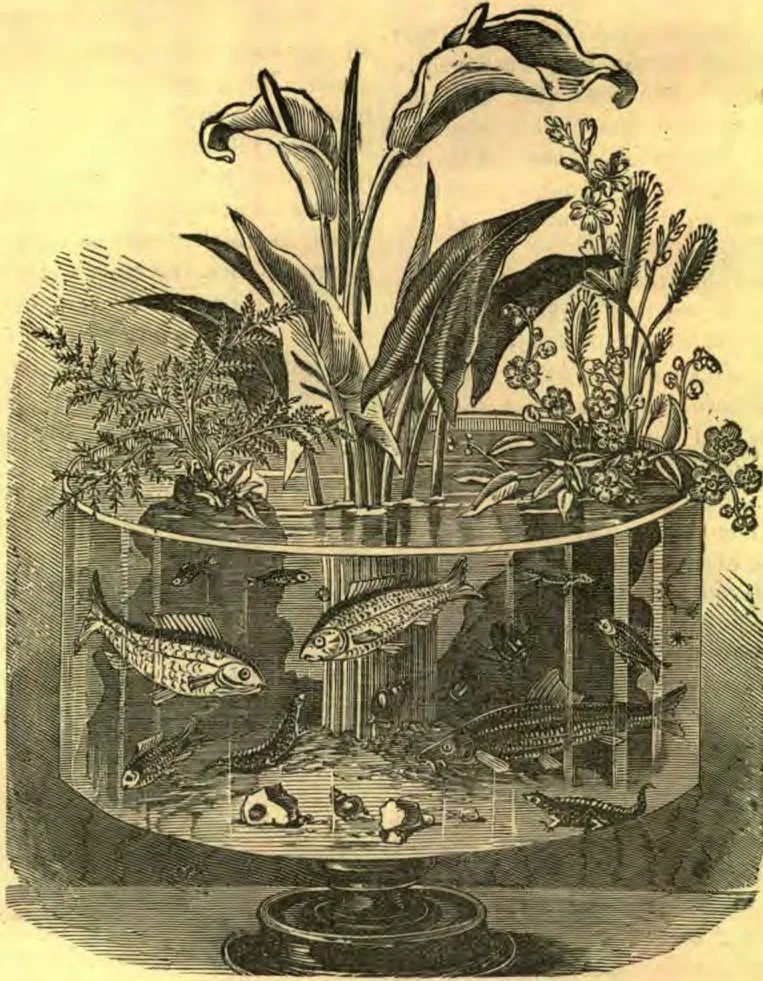
Our picture represents a small though very beautiful fresh-water aquarium, such as might find room upon the table of any of our sitting-rooms; but sometimes the aquarium itself is larger than an ordinary room. A very large one—said to be the largest in the world—was erected in Regent’s Park, London, in 1853. It is a glass building some sixty by twenty-five feet, and is in the form of a parallelogram. The walls are of thick plate glass. It is divided into different compartments, or tanks, some of which are supplied with salt-water and aquatic plants and animals, and others with fresh. The former are supplied with sand, gravel, rocks, and sea-weeds, to imitate the rock-pools left on the sea-shore by a receding tide.
Though requiring some intelligence and considerable skill and care in its management, an aquarium is certainly a very beautiful ornament, and at the same time furnishes an ever-changing volume for study. To the student of natural history it presents an opportunity for the close observation of the habits of the occupants of the waters, such as is afforded in no other way, while a new source of amusement is furnished continually in watching by one’s own fireside the maneuvers of animals whose haunts are ordinarily the obscure recesses of oceans, rivers, and ponds.
Much might be said about the manner of arranging and conducting both a fresh and sea-water aquarium, but probably it would be of little service to most who will read this, and must therefore be tedious. The principal thing is to maintain a proper equilibrium between the plants and animals, otherwise the animals must soon die.
One or more of these miniature seas is usually found in every floral or horticultural garden; and when you visit such a place, be sure to take a good look at the aquarium, and see what you can learn. E. B.

ATTENTION AND WORK.

“He did not sit down and wait for his friends to do for him, but he went to work, and kept on working, determined to do his best all the while. He gained his honors by close attention and hard work.”
So grandpa spoke of a man who had risen to distinction as an author and a man of character, and one of whose books the young folks had been reading.
“Dear me!” said one of the children, “I thought it was as easy to write a book as to read one, if not a little easier.”
“Ah! there you are altogether mistaken,” said grandpa. “There must be long preparation to be able to write a readable and instructive book. Books are called ‘works,’ because it takes so much work to bring forth a worthy book. Even when people have studied and worked so as to be able to write sensibly about things, it takes a vast amount of attention and labor to compose a book, and to put it in shape for the reader.”
“Then,” said the child, “nothing worth having can be had without work.”
“That is just the point,” said grandpa. “Nothing worth having can ever be gained without work. If you would ever be or accomplish anything, you must set your mind on it, and keep hard at work. ‘Six days shalt thou labor,’ is God’s command; and this is just as much his will as that we remember the seventh day to keep it holy.”
“God does not tell us how we shall direct our labors; he leaves us to choose and decide that for ourselves; but, if we are ever to accomplish anything, we must attend to it, and work; and that which we are to be most concerned about is what is the nearest to us, and which calls for our present attention. So it is said in the Scriptures, ‘Whatsoever thy hand findeth to do, do it with thy might.’
“Then it is our business to study our lessons well, to serve one another, to be prompt, to do all that falls to us to do, and to make the best of all our opportunities to do good and improve ourselves,” said one of the boys.
“You have hit it exactly,” said the good grandfather.
“Just do faithfully what comes to you to do, and what you undertake, go through with; for there is nothing like attention and work.”—Busy Bee.

PERSEVERANCE

One step and then another, And the longest walk is ended; One stitch and then another, And the largest rent is mended; One brick upon another, And the highest wall is made; One flake upon another, And the deepest snow is laid.
So the little coral workers, By their slow and constant motion, Have built those pretty islands In the distant dark-blue ocean; And the noblest undertakings Man's wisdom hath conceived, By oft-repeated effort Have been patiently achieved.
Then do not look disheartened On the work you have to do, And say that such a mighty task You never can get through; But just endeavor day by day Another point to gain, And soon the mountain which you feared, Will prove to be a plain!
“Rome was not built in a day,” The ancient proverb teaches, And Nature, by her trees and flowers, The same sweet sermon preaches. Think not of far-off duties, But of doing what is near; And having once begun to work, Resolve to persevere.

The Wonderful Asbestos.

One day after a feast given by Charlemagne, the guests were amused to see a page enter, and on bended knee, present to his royal master a salver, upon which was carelessly folded a soiled white table-cloth. Charlemagne, not in the least surprised, threw it into a fire, evidently prepared for the purpose. All eyes were fixed on the fabric, which did not smoke nor blaze, but only assumed a red-hot appearance. A few moments passed, and the monarch raised it from the furnace unharmed and white as snow. “A miracle! a miracle!” they all exclaimed.
“No, good friends,” answered the king; “this cloth is woven of a substance which fire purifies, but cannot destroy. It was known to the Greeks, who named it asbestos, meaning unchanged by fire; and an Italian writer, who lived hundreds of years before our time, speaks of a cloth made from some vegetable product which could not be injured by heat. Another mentioned, with apparent sincerity, that it was manufactured ‘from the hair of certain rats that lived in volcanoes.’ We read also, that the marvelous cloth was used to wrap the dead, before placing them on the funeral pile, that their ashes might be gathered separate from those of the wood.”
Thus spoke the mighty emperor for the instruction and edification of his guests. While Charlemagne did not quite partake of the wild fancies of the southern nations, it is not probable that he had a very clear idea of the real structure of this mysterious substance. As time advanced, it was fully understood; and now that it has become of practical use, we often see the advertisement “Asbestos Materials.”
Asbestos is a fibrous variety of a dark-colored rock, resembling iron ore; this is known by the name of hornblende. Pyroxene, another mineral, also assumes this appearance, but not so often as the former. We cannot understand how one of the toughest stones can be transformed into a substance as soft, flexible and white as floss silk; neither can we comprehend how the sparkling diamond is produced from charcoal. Yet we must accept these facts, and try to learn all about them.
When the hard rock took this beautiful form, it was called by the Greeks amianthus, meaning undefiled, in reference to the manner of cleansing it by fire. This name is now used to distinguish it from the coarser and more impure varieties known as asbestos. It occurs in narrow seams in the rock, and is occasionally found in fibers two-thirds of a yard long. These have a rich satin lustre, and the slender filaments can easily be separated one from the other. A single one, if thrown into the fire, changes into a drop of enameled glass, while a quantity can be heated without producing any change.
The silk-like appearance of amianthus gave to some ingenious ladies the thought of carding, spinning, and weaving it into cloth of different degrees of fineness. Purses, gloves, caps, handkerchiefs, and napkins were made of it, and sometimes articles were knitted from the soft, exquisite thread. The inhabitants of the Pyrenees wore girdles of this substance, mingled with silver, which they esteemed not only for their beauty, but for some mysterious charm they were thought to possess.
When Napoleon went to battle, he wore a skirt woven of amianthus, which was easily cleansed by throwing it into the fire. In France and Bohemia firemen’s clothes and gloves for handling hot iron were made from it. The Russians have also attempted the manufacture of incombustible paper. At one time it was hoped that an important branch of industry might be established for the manufacture of this delicate and useful fabric; but the rarity of amianthus and the difficulty of carding it into durable thread, in consequence of its brittleness, have caused them now to be regarded only as curiosities.
Asbestos, besides being of a coarser texture than amianthus, differs from it in color; the latter is a creamy white, while the former is brown, green, and grayish white. It sometimes occurs in thin interlaced sheets between the cracks and fissures of rocks, and feels something like kid; it is then known as mountain leather; when in thicker masses, it is called mountain cork, referring to its elasticity. It is also found very hard and compact, and then receives the name of ligniform asbestos, from its resemblance to petrified wood.
Asbestos is found in many parts of Europe and various localities in the United States, and is now mined and transported to factories, where it is assorted, cleaned, and prepared for the various purposes for which it is used. It is often made into paints of different colors, which are used to protect surfaces exposed to heat or water.

DO IT NOW.

Do not live a single hour of your life without doing exactly what is to be done in it, and going straight through it, from beginning to end. Work, play, study, whatever it is, take hold at once, and finish it up squarely and cleanly; then do the next thing, without letting any moments drop between. It is wonderful to see how many hours those prompt people contrive to make of a day; it is as if they picked up the moments that the drawlers lost. And if ever you find yourself where you have so many things pressing upon you that you hardly know how to begin, let me tell you a secret; take hold of the first one that comes to hand, and you will find the rest all fall into file and follow after, like a company of well-drilled soldiers; and though work may be hard to meet when it charges in a squad, it is easily vanquished if you bring it into line. You may have often seen the anecdote of the man who was asked how he accomplished so much in life. “My father taught me,” was the reply, “that when I had anything to do, to go and do it.” There is the secret—the magic word, now.

SCENES IN THE LIFE OF CHRIST.

LESSON 14.—JESUS ATTENDS THE PASSOVER.

After the marriage at Cana of Galilee, Jesus and his disciples, with his mother and his brethren, went down to Capernaum, which was on the western shore of the Sea of Galilee, and about twenty miles from Cana. But “they continued there not many days”; for “the Jew’s passover was at hand, and Jesus went up to Jerusalem” to attend it.
Many years before, when the Lord would bring his people out from bondage in the land of Egypt, he brought plagues upon the king and people of the land because they refused to let the Israelites go. The last of these plagues was the slaying of the oldest child in every house of the Egyptians. On the night before this terrible plague, every family of the children of Israel had, by the command of the Lord, slain a lamb and sprinkled its blood on the lintel and door-posts of their houses; and the destroying angel, seeing it, passed over them, and spared their first-born when he smote those of the Egyptians. And on that very night the king and his people rose up and sent the children of Israel out of the land in haste; “for they said, We be all dead men.” In memory of their great deliverance the Israelites were commanded to keep that day as the sacrifice of the Lord’s passover throughout all their generations. “And ye shall observe this thing for an ordinance to thee and to thy sons forever.”
So now that they were come into the land which the Lord had promised to give them, they still observed the passover; and every spring the people must all go up to Jerusalem to attend it. This feast commenced on the fourteenth day of the first month, which would be about the middle of April with us. It continued seven days, and during this time the people ate none but unleavened bread, as their fathers had done on the night when they left Egypt. It was to attend this yearly gathering that Jesus and his disciples went from Capernaum down to Jerusalem.
Now when Jesus had come into the city, he found in the courts of the temple those who sold oxen and sheep and doves, and the changers of money sitting there. These animals were there to be sold to those who came to the temple to make sacrifices, as many would be needed at a time when such numbers of the people were coming to Jerusalem to attend the feast. But Jesus was not pleased to have so little respect shown for the house of God; “and when he had made a scourge of small cords, he drove them all out of the temple, and the sheep and the oxen, and poured out the changers’ money and overthrew their tables; and said unto them that sold doves, Take these things hence; make not my Father’s house an house of merchandise.”
And when the people saw the miracles which he did, many of them believed in his name. And a certain great man named Nicodemus, who was a Pharisee and a ruler of the Jews, came to Jesus by night and wanted to speak with him. He may have come by night because the Saviour was so thronged with people by day that he could get no time to talk quietly with him. Nicodemus seems to have had great respect for Jesus, and to have partly believed in him,—for he said to him, “Rabbi, we know thou art a teacher come from God; for no man can do these things which thou doest, except God be with him.” Jesus then talked with the man some time, showing him that he must have a new heart, leading him to live a new and better life, before he could ever enter the kingdom of God; and that without faith in Christ no man could inherit eternal life. Nicodemus seems to have accepted the words of Jesus and to have believed on him; for afterward we read of his coming to help bury the body of the Lord after his crucifixion.

QUESTIONS.

  1. Where did Jesus and his disciples go immediately after the marriage at Cana of Galilee? John 2:12.
  2. Who went with them?
  3. Where was Capernaum?
  4. How far was it from Cana?
  5. How long did they stay at Capernaum?
  6. To what place did they start to go after a few days?
  7. Why did they go to Jerusalem at this time?
  8. Where had the Lord’s people been in bondage many years before?
  9. Whom did he send to deliver them?
  10. What did the Lord bring upon the Egyptians because they refused to let his people go? Ex., Chaps. 8–11.
  11. What was the last and most terrible of these plagues?
  12. Why were not the first-born of the Israelites slain also? Ex. 12.
  13. How were the people of Israel to keep in mind that night of their great deliverance from death and bondage?
  14. How long were they to observe this custom? Verse 24.
  15. At what time of the year was the feast of the passover held?
  16. Where was it celebrated?
  17. How long did it continue?
  18. Why did the people eat unleavened bread during this time?
  19. When Jesus and his disciples had come to Jerusalem to attend this yearly feast, what did he find in the courts of the temple? John 2:14.
  20. How did the Saviour show his displeasure at their want of respect for the house of God?
  21. What did he say to those who sold doves?
  22. What caused many of the people to believe on Jesus?
  23. What great man came to Jesus by night? Chap. 3:1.
  24. How was he honored among the Jews?
  25. In what words did he speak to Jesus when he came to him?
  26. What great truth did the Saviour teach Nicodemus?—That he could not enter the kingdom of God without a new heart, and that before he could have this, he must believe in Christ.

LEARNED IT IN THE SABBATH-SCHOOL.

WALKING along with a little girl about nine years old, we met a lady to whom I bowed, and said, “Good morning!” After passing, I asked my little friend if she knew who that lady was. “Why, no!” she quickly replied. “Don’t you know her?”
As I answered in the negative, she looked up into my face with surprise, and said, “What made you speak to her, then?”
“Why,” said I, “don’t people ever speak to others unless they know them? ‘If ye salute your brethren only, what do ye more than others’?”
“Oh, I know all about that,” she answered with delight, as she skipped along by my side; “we learned that whole fifth chapter of Matthew in our Sabbath-school.” Then she added thoughtfully, “What does ‘salute’ mean?” “Well,” I said, “I think it means to bow, and say ‘good morning’ when we meet our friends; and not only that, but I think the text means that we should not forget to say ‘good morning’ sometimes to persons whom we don’t know”; and as the little girl walked more quietly and thoughtfully along, I felt sure the lesson she had learned more than a year before had received a practical illustration which would not soon be forgotten.
C. C. L.

What Our Faces Reveal About Our Thoughts

WHAT we think, is more or less revealed by our faces. Those versed in human nature can discern the workings of the mind by the expression of the countenance. Envious thoughts give a dissatisfied expression to the face, and all evil thoughts cut the features into ugly shapes. Pure, noble, and beautiful thoughts leave their impress upon the countenance, and fashion the features into loveliness.

TRIFLES

THE massive gates of circumstance Are turned upon the smallest hinge, And thus some seeming pettiest chance Oft gives our life its after tinge.
The trifles of our daily lives, The common things scarce worth recall, Whereof no visible trace survives,— These are the mainsprings, after all.

APRIL

Now no longer tempests savage Come to ravage Field and forest, hill and plain; When the heavens of April darken, Glad we hearken To the silver sounding rain.
Nature everywhere rejoices: Thousand voices Fill the ear with melody; Life and strength feel strangely newer— Skies are bluer— Naught but beauty can we see.
As we feel the quickening measure, With new pleasure Let us serve the Lord above, Who with nature’s bounties crowns us, And around us Throws the mantle of his love.

NEW-TESTAMENT HISTORY.

LESSON 27.—SERMON ON THE MOUNT.—CONTINUED.

“Ye have heard that it hath been said, An eye for an eye, and a tooth for a tooth. But I say unto you, that ye resist not evil; but whosoever shall smite thee on thy right cheek, turn to him the other also. And if any man will sue thee at the law, and take away thy coat, let him have thy cloak also. And whosoever shall compel thee to go a mile, go with him twain. Give to him that asketh thee, and from him that would borrow of thee, turn not thou away.
“Ye have heard that it hath been said, Thou shalt love thy neighbor, and hate thine enemy; but I say unto you, Love your enemies, bless them that curse you, do good to them that hate you, and pray for them which despitefully use you, and persecute you; that ye may be the children of your Father which is in Heaven; for he maketh his sun to rise on the evil and on the good, and sendeth rain on the just and on the unjust. For if ye love them which love you, what reward have ye? do not even the publicans the same? And if ye salute your brethren only, what do ye more than others? do not even the publicans so? Be ye therefore perfect, even as your Father which is in Heaven is perfect.
“Take heed that ye do not your alms before men, to be seen of them; otherwise ye have no reward of your Father which is in Heaven. Therefore, when thou doest thine alms, do not sound a trumpet before thee, as the hypocrites do, in the synagogues, and in the streets, that they may have glory of men. Verily, I say unto you, they have their reward. But when thou doest alms, let not thy left hand know what thy right hand doeth; that thine alms may be in secret; and thy Father which seeth in secret, himself shall reward thee openly.
“And when thou prayest, thou shalt not be as the hypocrites are; for they love to pray standing in the synagogues, and in the corners of the streets, that they may be seen of men. Verily, I say unto you, They have their reward. But thou, when thou prayest, enter into thy closet, and when thou hast shut thy door, pray to thy Father which is in secret; and thy Father which seeth in secret, shall reward thee openly. But when ye pray, use not vain repetitions, as the heathen do; for they think that they shall be heard for their much speaking. Be not ye therefore like unto them; for your Father knoweth what things ye have need of before ye ask him. After this manner therefore pray ye, Our Father which art in Heaven, hallowed be thy name. Thy kingdom come. Thy will be done in earth as it is in Heaven. Give us this day our daily bread. And forgive us our debts as we forgive our debtors. And lead us not into temptation, but deliver us from evil, for thine is the kingdom, and the power, and the glory, forever. Amen. For if ye forgive men their trespasses, your Heavenly Father will also forgive you; but if ye forgive not men their trespasses, neither will your Father forgive your trespasses.”

QUESTIONS.

1. Why did Christ say, “Ye have heard”? See Note.
2. Who had said the things referred to? Ex. 20: 22; 21: 24.
3. What did this law require? Lev. 24: 20; Deut. 19: 21.
4. How had the Jews abused this law?
5. What lesson does Christ mean to teach us by referring to it? See Note.
6. What kind of evil does Christ refer to in the words, “Resist not evil”?—The evil done us by others, probably our persecutors.
7. What is meant by the words, “Resist not evil.”—That we should not retaliate. 1 Thess. 5: 15.
8. What should we do, if a person should smite us on one cheek?
9. What seems to be the lesson taught by this precept?—See Note.
10. By what precept does our Lord teach that it is better to suffer wrong upon wrong than to take part in a strife which would be likely to result in something more serious than a loss of property?
11. What custom is probably alluded to in verse 41?—See Note.
12. What would be the probable result of such generosity and good-will as would be manifested in carrying out the precept given in that verse?—It would be likely to awaken similar feelings in the one that was served.
13. Are we to give indiscriminately to every one that asks us? Deut. 15: 7-10.
14. Which would be the greater error—to give to the unworthy, or to withhold from the needy?
15. On what principle should we lend? Luke 6: 35.
16. What texts can be referred to to justify the language of verse 43?—The sentiment of the last part of the verse has no support in the Scriptures, but the Jews seemed to take it for granted that it is right to hate our enemies, because we are in so many places enjoined to love our neighbor. See Lev. 19: 18; Matt. 19: 19; 22: 39; Mark 12: 31; Luke 10: 27; Rom. 13: 9; Gal. 5: 14; James 2: 8; etc.
17. What should be the nature of our prayers for those who persecute us? We should pray for their conversion. See Note.
18. What do we become by taking this course?—Verse 45.
19. What example has God set us?
20. What is said of people who love none but those who love them? Verse 46.
21. In what respect should the standard of the Christian be higher than that of publicans and heathen?
22. In what sense are we to be perfect? Verse 48; Luke 6: 36. See also Note.
23. How should we do our righteousness? Matt. 6: 1, 2.
24. What will be the result, if we do it to be seen of men?
25. What is meant by sounding a trumpet before us?—Probably making any kind of display to attract the attention of men.
26. What do we understand by the expression, “Let not thy left hand know what thy right hand doeth”?
27. What will be the result of this course? Verse 4.
28. How may we know the prayer of the hypocrite? Verse 5.
29. What was the nature of the prayers in which they engaged at the corners of the streets and other public places?
30. What is a characteristic of the prayers of the heathen? Verse 7.
31. What mistake do they make?
32. What consideration should guard us against this error?
33. Repeat the prayer that Christ has set before us as a model prayer.
34. On what terms does our Heavenly Father offer us forgiveness? Verses 14, 15.

NOTES ON THE LESSON.

Ye have heard.—The Jews themselves did not have a copy of the law, but it was read to them by the priests and scribes on the Sabbath-day and other great occasions.
An eye for an eye.—This law required that the offender should be punished by receiving the same injury that he had done to another. Many had abused this law by inflicting punishment with their own hands instead of leaving it to the civil authorities. Christ means to teach us that we should leave the punishment of offenders to God, or to those authorized by law to execute its penalties.
“*Resist not evil, or the evil person. . . . Our Lord’s meaning is, ‘Do not repel one outrage by another.’ He that does so makes himself precisely what the other is, a wicked person*.”
“Turn to him the other also.—That is, rather than avenge thyself, be ready to suffer patiently a repetition of the same injury. But these exhortations belong to those principally who are persecuted for righteousness’ sake. Let such leave the judgment of their cause to Him for whose sake they suffer. The Jews always thought that every outrage should be resented; and thus the spirit of hatred and strife was fostered.
“And if any man shall sue thee at the law.—Everywhere our blessed Lord shows the utmost disapprobation of such litigations as tend to destroy brotherly kindness and charity. It is evident that he would have his followers to suffer the loss of all their property rather than to have recourse to such modes of redress, at so great a risk. Having the mind averse from contentions, and preferring peace and concord to temporal advantages, is most solemnly recommended to all Christians. We are great gainers when we lose only our money, or other property, and risk not the loss of our souls, by losing the love of God and man.”—Clarke.
“Shall compel thee to go a mile.—This is supposed to refer to the Persian Angari, or State couriers, who were empowered to compel any person they met to assist them, or to surrender his horse to them; and a like arbitrary authority was exercised over the Jews by the Roman governors.”—Cottage Bible.
“Bless them that curse you.—Give them good words for their bad ones.
“Do good to them that hate you.—Give your enemy every proof that you love him. We must not love in tongue only, but in deed and in truth.
“Pray for them which despitefully use you,—those who are making continual war upon you, and constantly harassing and calumniating you. . . . We cannot change that wicked man’s heart. . . . God alone can change it; then we must do that which will not only secure the poor man’s salvation, but contribute so much to our own peace.”—Clarke.
“If ye salute your brethren only.—The rigid Jews would not salute the publicans, nor would even the publicans salute the heathen.”—Harmer.
“Be ye therefore perfect.—Ye shall be filled with the spirit of that God whose name is Mercy, and whose nature is love. God has many imitators of his power, independence, justice, etc., but few, of his love, condescension, and kindness.—Clarke.
“Do not your alms.—Some ancient copies and versions read, ‘Practice not your righteousness,’ which Doddridge and Campbell explain as containing the three following duties,—alms, prayer, and fasting.—Cottage Bible.”
Before men.—“It is right to do that which men may and must see, but not for the sake of being seen by them. The difference lies in the motive.”—Fuller.
“Do not sound a trumpet.—It is very likely that this was literally practiced among the Pharisees, who seemed to live on the public esteem, and were excessively self-righteous and vain. Having something to distribute by way of alms, it is very probable they caused this to be published by blowing a trumpet, or horn, under pretext of collecting the poor; though with no other design than to gratify their own ambition. There is a custom in the East not much unlike this. ‘The derveeshes carry horns with them, which they frequently blow when anything is given to them, in honor of the donor. It is not impossible that some of the poor Jews who begged alms might be furnished like the Persian derveeshes, who are a sort of religious beggars, and that these hypocrites might be disposed to confine their alms-giving to those that they knew would pay them this honor.’—Clarke.
“We have no proof that the Pharisees literally ‘sounded a trumpet;’ the expression may only mean, as Mr. Harmer says, that they sought publicity, like the stage-players and gladiators of ancient times, who were thus introduced to the spectators.—Cottage Bible.”
“They have their reward,—that is, the honor and esteem of men, which they sought. God is under no obligation to them—they did nothing with an eye to his glory, and from him they can expect no recompense. They had their recompense in this life, and could expect none in the world to come.
“Shall reward thee openly,—will give thee the fullest proofs of his acceptance of thy work of faith and labor of love, by increasing that substance which, for his sake, thou sharest with the poor; and will manifest his approbation in thy own heart, by the witness of his Spirit.”—Clarke.

The Words of Christ as a Guide to Youth

As a lighthouse to a ship nearing a rock-bound coast, and as a guide to a traveler in an unknown land, so are the words of the Lord Jesus to the young. They throw light upon the dangers of life's voyage, and they direct willing feet in the way they should walk.

ORIGIN OF EASTER.

Easter Day is celebrated in honor of the resurrection of our Lord, and is sometimes called the Christian pass-over. It seems to have been observed by the early Christians soon after the time of Christ. Early on the morning of that day they were wont to salute each other with the words, “Christ is risen”; to which the response was made, “Christ has risen indeed, and hath appeared unto Simon.” Perhaps the children do not all know that Easter is celebrated “on the first Sunday after the full moon which happened upon or next after March 21,” so that it may come as early as March 22 or as late as April 25. The following, from an exchange, may perhaps be interesting to those who wish to know more particularly in regard to the origin of the day.
“‘Please, mamma,’ cried a chorus of voices, as the drawing-room door flew open; ‘please, mamma, you promised to tell us where the Easter eggs came from.’”
“‘Or, at least,’ corrected Evelyn, ‘why they are called Easter eggs.’”
“‘We are told,’ said the mother, ‘what is well-known to be the reason of their name, which is just because they have, from ancient times, been used as gifts at the time of the festival of Easter. In very early times people learned to look upon eggs with a kind of wondering admiration, because of the knowledge they had gained that there, hidden in the egg, was the possibility of a little living bird. By degrees, as they watched and thought more, they began to think that winter and spring were something like the egg. Trees and flowers looked still and dead, but in reality their life was only shut inside winter’s shell, and spring came and chipped away the shell, and out sprang the living leaves and flowers.’”
“‘Oh, I see,’ exclaimed Zoe, ‘and so they called them spring eggs—at least, oh, no,’ disappointedly, ‘but they didn’t, they called them Easter eggs.’”
“‘That meant the same thing, my child. The Easter festival was in honor of the sort of fairy-being people believed in in those days, and called a goddess, who was supposed to belong to the spring, and look after it.’”
“‘But, mamma,’ asked Evelyn in a puzzled tone, ‘if it was in those once-upon-a-time days that people had these eggs, I don’t see why we have them now, and at our Easter, which is kept for such a different reason.’”
“‘Well, dear, that comes from several different causes. When Christians began to teach the poor ignorant believers in imaginary gods and goddesses, the true faith of Jesus Christ, they made use of everything the poor people already thought of to help in the teaching, and among other things they made use of Easter. ‘You see,’ they said; ‘how Nature rises again from sleep in spring, and you rejoice. Go on rejoicing and giving thanks for this mercy, but give your greatest thanks of all at this season, because the Lord of all also, in like manner, has slept and risen again for our sakes.’ And the egg, which the heathen had taken as the sign of hidden life, the Christians adopted as the same symbol. So you see, little people, that Easter eggs have a very beautiful and glorious meaning attached to them,—the happiest and most joyful hope of any that we can have,—besides being pretty and pleasant, like the green leaves and flowers, and many other things which our loving Father gives us at this season.’”

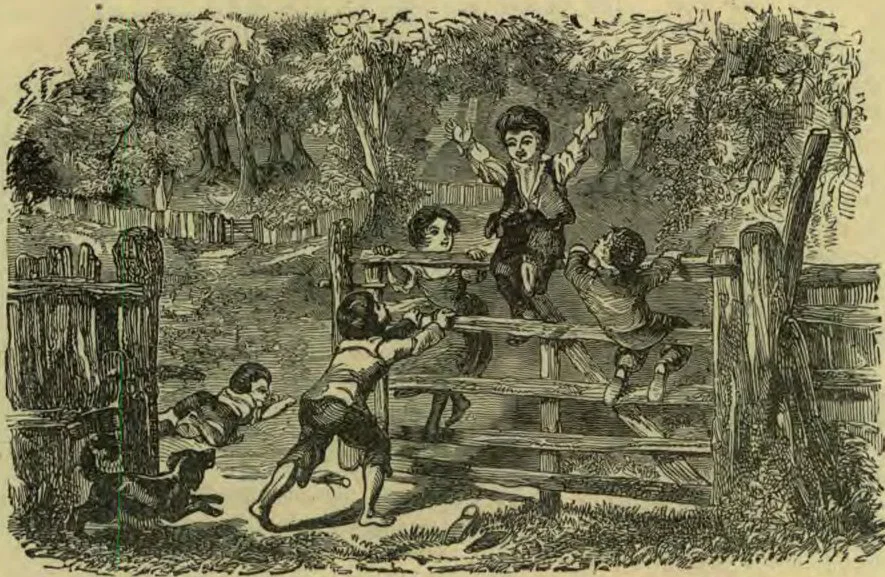
“WHEN WE WERE BOYS.”

O the days when we were boys! Life had sunshine, health, and joys; Rosy, hearty, fresh and fair, Full of life, we children were.
Shoeless, hatless, coatless too, Through rent garments breezes blew; Active, agile, playful, wild, Who is happier than a child?
Quick to laugh, and jump, and run, Fond of sunshine, full of fun, Shouting, swinging on the gate, Bound for school—“You’ll be too late!”
Ah, those days have passed away, Brows are wrinkled, hair grown gray; Yet I love their cheer and noise, And my heart says, “Bless the boys!”
Bless the laughing, shouting boys, With their pleasures, plays, and joys; May they think on God in youth, And grow up in grace and truth.
H. L. H., in Little Christian.
Continue reading: A GRAIN OF MUSK