The Youth’s Instructor, Vol. 49, No. 27.

THE MEADOW-LARK

The Youth’s Instructor

Jul 4, 1901

Review and Herald Publishing Company · Battle Creek, Mich. · Jul 4, 1901
THE MEADOW-LARK
THE MEADOW-LARK

THE MEADOW-LARK

You are no doubt well acquainted with the meadow-lark: it is a bird that has much to say in the spring. Every hour of the day, it would seem, we can hear his long-drawn-out notes. There is in the song an element of cheer, and we feel certain, when we hear it, that the bird must be in a happy frame of mind. We might call him a merry minstrel. As one has said, the song of the meadow-lark, “as he springs from the dew-laden grass, and sails up into the blue sky, is so fresh and pure that it seems to come on the wings of the morning, and gives the deeper beauty of that day in June when heaven would try the earth if it be in tune.”
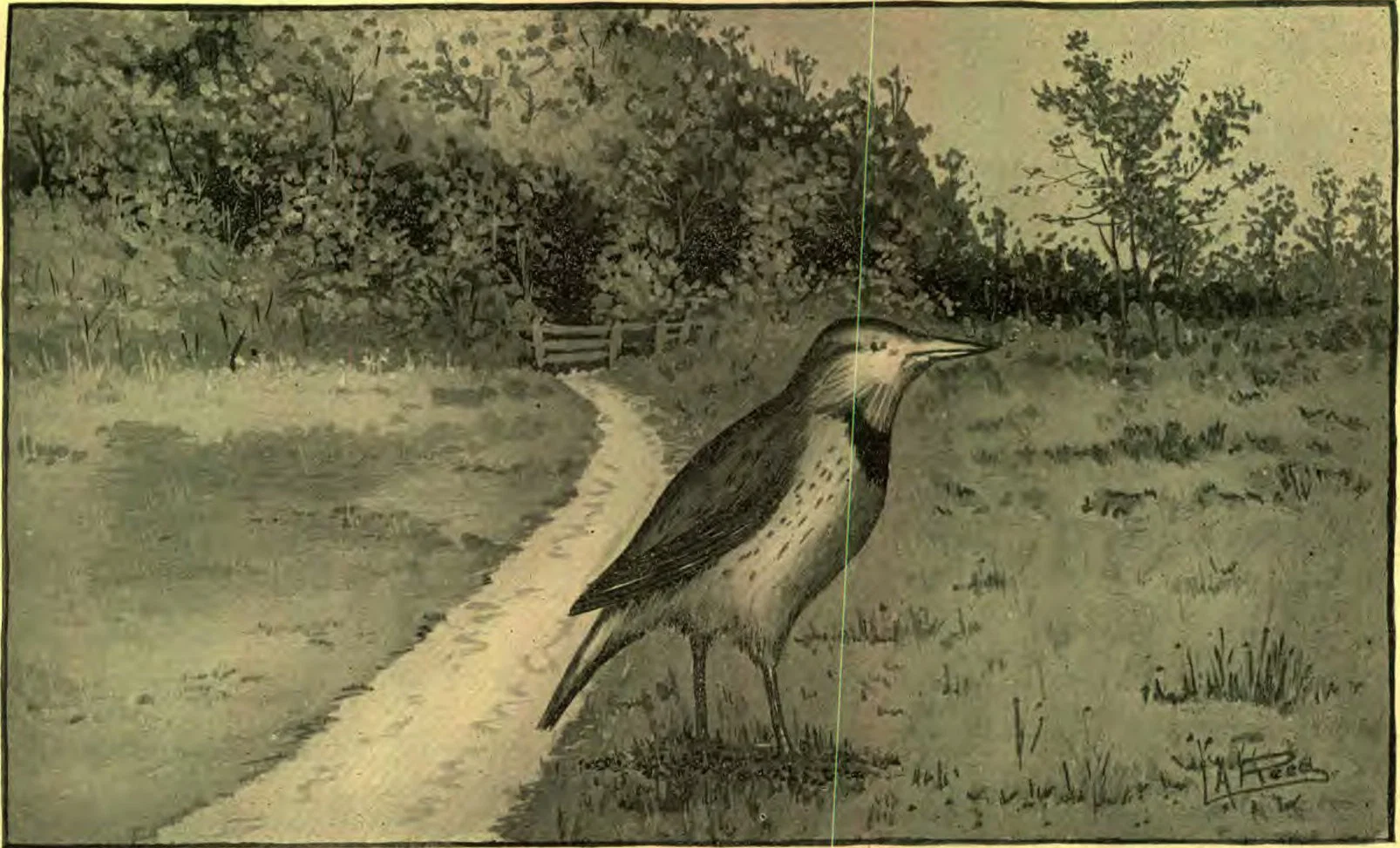
The meadow-lark is so nearly the color of the meadow in which he feeds that it takes a keen eye indeed to make the creature out. His back is dull brown, streaked with black and white; his breast, golden-yellow, with a black crescent.
This bird lives largely upon grasshoppers, May beetles, ants, bugs, caterpillars, etc. He is therefore of great aid to our farmers, and should never be killed wantonly or for food. It has been estimated that the value of the grass crop alone saved by meadow-larks on a township of thirty-six square miles, each month during the grasshopper season, is about twenty-four dollars.
In our picture the bird seems somewhat larger than it really is. Its actual length is about eleven inches. It sometimes remains in the northern States all winter, but is not at all numerous at that season. The meadow-lark is a great walker, and does not fly unless it is necessary. Its nest is built in the ground, in open fields, or meadows, and sometimes in marshes. Its eggs are white, spotted or speckled with reddish-brown. It comes north to us late in March, and leaves late in the fall. Its notes are not the same in all localities. Many bird lovers fancy that it calls, “Spring o’ the y-e-a-r!” but in Illinois it seems to say, “Fee-o-wheedle-dee-dee.”
L. A. REED.

A FIRST LESSON IN WARBLERS

“WHAT kind of bird was it that I saw this morning,—a very small bird, full of motion, as active as a witch, all yellow like a canary?”
This, in substance, is a question that I am frequently asked, especially in May and June. Generally it turns out that the bird is what is called in books the “summer yellowbird,” or “golden warbler,” though a cross-examination of the witness may show that the bird was not all yellow, but yellow with black trimmings,—black wings and tail, and a black forehead. In that case, the inquirer has seen an American goldfinch, a seed-eating bird, with a thick, short, seed-eating bill.
The summer yellowbird, on the other hand, has a sharp, slender bill, appropriate to a bird that lives on insects. It belongs to a very numerous family, known commonly as “warblers,” but more properly as “wood-warblers.” They are American birds strictly, and America may well be proud of them. They are a numerous family, I say. About a hundred kinds are known, and of these about seventy visit the United States. More than thirty kinds have been found in a small State like Massachusetts.
Formerly, before I knew one bird from another, as our common saying is, I used to wonder what a man like Thoreau meant by talking so much about the “warblers” he had seen in his rambles. It was a rather affected manner of speech, I thought. Why couldn’t he say “bird,” or “singer,” and be done with it? Why so constantly use that pretty, poetical word “warbler”? I supposed, you see, that he was speaking simply of some bird that he had heard singing, and, since he was writing prose, I had a wise, critical notion that he ought, as a general thing, to use prose words.
A reference to any “bird-book,” or even to a dictionary, would have shown me that “warbler” is a family name, like “swallow” or “sparrow.” Its use does not imply that the bird is of necessity a fine singer, any more than to call a man “Mr. Taylor” implies that he gets his living by making clothes. As a matter of fact, the warbler family is not highly musical, and even its best singers do not, in any proper sense of the word, warble. Their voices are mostly thin and sharp, and their tune is only a short, quick sentence or phrase, with nothing of the smoothness and flowing quality which the word “warble” naturally suggests.
The golden warbler is probably seen by more persons than any other member of its family. It is not fond of woods, but of shrubbery patches along roadsides, and in gardens, especially in the neighborhood of water. This preference brings it often into sight, while its bright color renders it conspicuous enough to attract general attention. I have seen it spoken of as the “blue-eyed warbler,”—a very pretty name, surely, though I do not know whether it is, in any peculiar sense, appropriate. As to “yellow warbler” and “golden warbler,” you have only to look once at the bird to see that either name fits it perfectly.
In the case of the male bird, the under parts are streaked with brownish-orange; but the marks are hardly striking enough to catch the eye of a chance beholder. Nine persons out of ten, I suppose, after watching the pretty creature as it flits about in a clump of bushes, would pronounce it “all yellow.” That, at any rate, is the way in which my inquirers are accustomed to speak of it.
According to my experience, this warbler is very punctual in his annual home-coming. On one of the last days of April, or, more likely, on one of the first two or three days of May, I am pretty certain to hear him singing in his old places. And when I hear him, I always wish to go near and look at him. It is like a flash of sunlight after a week of rain to see the lively fellow back again after his seven or eight months of absence and his four thousand miles—more or less—of journeying.
The happy pair build their nest in a bush, often directly upon the roadside, at a height of four or five feet from the ground,—a peculiarly thick, warm-looking, closely woven, cup-shaped structure; and in it the mother-bird lays four or five speckled, bluish-white eggs. Then, in the course of time, if nothing happens,—if a cowbird does not drop one of her larger eggs among them, or a crow or a jay find them out, or a squirrel or a cat devour them, or a boyish collector carry them off,—the eggs are hatched, and as many young warblers crowd the nest.
As for knowing the birds, I was going to say that nothing could be easier. That would be an exaggeration. Yellow warblers are not so thick as robins, nor can they be seen so far away as crows; but they are common, in their season, are readily made out, and—what I wish especially to emphasize—the knowledge of them may easily become the door to much other knowledge of a very pleasant sort.
If you know them, I mean to say, and pay attention to them, you will soon begin to notice other birds that are built like them and act like them, but are differently colored. Here, for example, is a little bird in a swampy place, always near the ground. He is largely olive and yellow,—olive above, and yellow underneath,—but is most curiously marked with a broad black band, which crosses the forehead and folds back upon the sides of the head. This is the Maryland yellow-throat,—the male. His song is in triplets: Fidgety, fidgety, fidgety, or, Witchery, witchery, witchery, or whatever else your ears can make of it. The female wears no black head-band, and is even prettier than her husband,—or so I think,—one of the very prettiest birds that live.
Here in the woods, but not too far in,—in woodlands rather than in the forest,—is another. This one keeps farther from the ground than either of the other two, and is very richly and elegantly dressed,—jet-black and pure-white, with vivid splashes of red on the wings and sides of the body, and also on the tail,—a gorgeous creature, though very small,—an American beauty, if there ever was one. You might take him for a chance wanderer from the tropics. He is incessantly on the move, flitting among the green branches, his bright color flashing, and his tail constantly snapping open, as if on purpose to show itself. This is the redstart.
And these three are, perhaps, enough for a first lesson in the bewildering warbler family. When you know these, and ten or fifteen like them (like, and yet unlike), you may begin to feel that you have made a really prosperous start in bird study. And, having gone so far, you will not be likely to turn back.—Bradford Torrey, in Sunday School Times.

THE OVEN-BIRDS

Little brown birds, I have found you, led Half by the sound of your startled tread Over the woodland paths made brown By last year's leafage that drifted down, Half by the hurried, insistent notes That ring so clear from your tender throats,— “Teacher! Teacher!” Do you, too, yearn Some of the spring's deep thoughts to learn?
What are the questions that trouble you? I have been puzzling the morning through Over the secrets the young days hold,— The glory hid in the burnished gold Of dandelions, the wondrous way That new life springs from the old decay. “Teacher! Teacher!” my heart's cry, too; Little brown birds, let me sing with you.
—Selected.

MY CLOCK

My clock has a beautiful face and an attractive form. Its mission is supposed to be not only that of keeping time, in harmony with the sun, but to be an indicator of true sun-time to those from whom the sun is hidden. Its maker purposely placed within it a regulating device by which its time-keeping might be adjusted to the great time-maker with which it was designed to be kept in harmony.
But, strange to say, my clock utterly fails to obey its regulator. Touch it as often as I will to correct the clock’s waywardness, it seems to make little difference with the actions of the hands; for they still persist in moving around the dial in an aimless manner. Sometimes, as if in very exuberance of spirit, they dash away at a rapid rate, as much as to say, “We don’t wish to be restrained.” Again, they lag in their round, as if in despair, and desiring to give up the business altogether. For months have I touched and retouched the regulator, to correct these habits, but all in vain. Though seeming to do better for a little while, the clock soon lapses into its old ways.
Only this morning I said: “It is of no use; I can do nothing with it. Since it can not be depended upon in its present condition, it must be sent back to the shop, and be set in order.”
Then I thought, Ah me! how many of us humans need to be returned to our Maker, and be made over into “new creatures.” Then his law, which has been provided for our hearts, will regulate our lives, and so make us true to the Sun of righteousness, and faithful to those who need to know that the day of salvation is at hand.
LULA V. CORLISS-GREGORY.

THE PUNCH-BOWL

“Miss Ettie R— presided at the punch-bowl,” was one of the items in the description, by a country editor, of a recent reception given to a newly married pair.
Smilax, roses, and lilies-of-the-valley, sweet-scented and pure as paradise itself, decorated the lovely home, where were music and song and happy laughter, with never a thought of care.
Lightly and thoughtlessly, the young girl filled to the brim the beautiful glasses, and handed them to the guests. She was not more than fourteen,—a womanly little maid, with straight, erect form, and lovely features,—but what a beginning!
My heart felt like lead as I read the item, and thought of the terrible words, “At the last it biteth like a serpent, and stingeth like an adder.”
And this dear girl, pouring out the “biting,” “stinging” stuff for her gay companions to drink!
I can see them not very far in the coming years, going down into dishonored graves, lost and ruined souls, just because of that “punch-bowl in the corner.” And Ettie herself, perhaps a miserable drunkard’s wife, or a sorrowful widow, with wild, reveling boys to break her heart.
Let the punch-bowl alone. Better never go into society than go where punch and wine are provided.
MRS. S. ROXANA WINCE.

ONE SIN

THERE was only one crack in the lantern, but the wind found it, and blew out the light. How great a mischief one unguarded point of character may cause us! One spark blew up the magazine; and shook the whole country for miles around. One leak sank the vessel, and drowned all on board. One wound may kill the body, one sin destroy the soul.
It little matters how carefully the rest of the lantern is protected, the one point which is damaged is quite sufficient to admit the wind. And so it little matters how zealous the man may be in a thousand other things, if he tolerates one darling sin, Satan will find the flaw, and destroy all his hopes.
The strength of the chain is measured not by the strongest, but by its weakest link; for if the weakest snaps, of what use are the others?
Satan is a close observer, and knows exactly where our weakest points are; we have need of very much watchfulness, and we have great cause to bless our merciful Lord, who prayed for us, that our faith fail not.—Spurgeon.

The Lasting Harm of Unkind Words

“Unkind words may be forgiven, but long years go by and they are not forgotten. We who spoke, and they who heard, may desire to have them drop out of remembrance; but they come back to thought again in spite of us, and hinder love. How brief the gratification of their utterance! How indelible their record in the heart!”

Harvest

The harvest is ripe, and the reapers are waiting; Though bright beams the morning, no sickle is laid. O, why do we linger, the bright moments freighting With loss unretrieved when the evening shall fade?
The harvest is great, and the reapers not many; Then how shall we gather the bright, golden grain? Who is there will help us? The call is to any; At eve they may join in the reapers' refrain.
The harvest is precious. No price that is given Can ever repay for a grain that is lost— This harvest of souls, whose redemption's from heaven— Eternity whispers its wonderful cost!
Then linger no longer; be our best endeavor Put forth, in the work, in the broad, open field! Faint not in the noontime, nor turn aside ever, But faithfully gather the plentiful yield.
When darkness has settled, and bright stars are shining, And man has forgotten the place of our rest, We'll slumber, our sheaves to our Saviour resigning, Awaiting the dawn in the land of the blest.
B. F. M. Sours.

STUDIES IN THE CHRISTIAN LIFE

Chapter II — The Sinner’s Need of Christ

(July 7–13)
  1. WHAT change did sin work in man?
  2. What was man’s joy before he sinned?
  3. In what things has the sinner no joy?
  4. From what would he shrink and hide?
  5. What great thing is it not in our power to do?
  6. What can not education, culture, and will-power do for us? What can they do?
  7. How only can a sinful being become holy?
  8. What idea often deceives people?
  9. What led Paul to exclaim, “I consent unto the law, that it is good”? What made him cry out, “O wretched man that I am”?
  10. What conclusion is to be drawn from this experience of Paul’s?
  11. Under what circumstances did Jacob find his Saviour?
  12. To whom else did Christ similarly reveal himself?
  13. How necessary to us is Christ?
  14. What five agencies are enlisted in our behalf?
  15. What mighty incentives urge us to give our hearts to Jesus?
  16. On the other hand, what warnings are there against the service of Satan?
  17. What is the final restoration to be wrought in us?
  18. After studying this chapter, what answer do you find to the subject: “The Sinner’s Need of Christ”?

IMPORTANCE OF BIBLE STUDY IN CONNECTION WITH THE LESSON

The foregoing questions are answerable from the Bible as well as from “Steps to Christ.” When you can not find a text of Scripture that will forcibly apply, look for your answer in some Bible experience. Often the experiences of men are greater evidence of certain truths than texts would be, culled here and there. We find the thoughts of our lesson verified in both ways. While there are fifteen or more Scriptural references, there are also the experiences of three men, Paul, Jacob, and Nathanael. What connection have they with the subject of our lesson?—A very great one! Each recognized his great need of a Saviour. Jacob was so discouraged that he feared he would not find Him; Paul, in his great wretchedness, cried out, “Who shall deliver me?” and Nathanael was praying for help under a fig-tree. They each found the One whom they were seeking. Study their lives afterward, and see the results of finding the Saviour.
It is very important that we use the Bible for our evidence of the truth. Unless we do, we shall not be able to give to every one that asketh a reason of the hope that is within us. There are many persons who believe the Bible, but know nothing of the Spirit of Prophecy. Like the disciples at Ephesus, they have not so much as heard whether there be any or not. Such must be met where they are. But we can not give to others what we do not have ourselves. Now is our opportunity to prepare. How would you show from the Bible the sinner’s need of Christ?
G. E. A.

OUR MOTTOES

“The Advent Message to the World in this Generation”
“Love Teaches the Way”
Perhaps last week, as you noticed the words engraved in our department heading, and thought a little of their meaning, it seemed to you that that is rather a large subject for young people to handle. It may be that, half-unconsciously, you lifted your eyes from the little part of “the world” that lies close about you to some remote corner of the earth, and thought, not really putting the idea into words, but still keeping it in your mind, that that work is too great for young people,—that it is all right for those who are older, but that you can have no real part in it.
Never was there a more serious mistake. It is true that it is a vast work,—a work whose extent and influence can not be estimated, whose results can not be measured. That is one reason that you, with every other faithful Christian, young as well as old, are to have a place in it. It is an important work, too,—the most important in all the world; for it concerns every soul who lives. Men, it is true, think other things of greater moment,—the opening of the East to Western civilization; the death of one monarch, the coronation of another; the visit of a prince and his train to a distant land; the subjugation of this province, or the annexation of that territory; the putting down of a rebellion; a storm in the West; a lynching in the South,—how many things there are to divert the attention from the one great Event before whose solemn hour all these details of earthly governments and affairs will quickly vanish away! Like the eunuch of old, many are wondering what all these things mean; but how can they understand the import of the signs of the times unless they are taught?
And this Advent message, with its solemn warning and its gracious invitation, must be given to “all the world.” It will be given, and given soon; for the Lord has declared that he will make a “quick work” in the earth. Some one will have a part in giving it. Who so prepared for this momentous work as those who, from their cradles, have been familiar with its truths; who have fortified their bodies to resist disease by attention to the laws of health; and who, by their very profession, declare that this message is to them the dearest thing in life?
“The Advent message to the world in this generation.” I like the sound of these words. They are definite; they are sincere; they voice a great purpose; they are in themselves an inspiration. Shall not we, as young people, write them in our hearts, and allow their wonderful, solemn meaning to transform our lives?
And the world—the field—is all about you. The Lord needs you now, to-day. Begin where you are, in your own little part of “all the world,”—the world of home, of school, of daily employment; your own neighborhood, or village, or town,—wherever there is one aching heart to be reached with the comfort of the message. Think for a moment what it would mean if every young person who has confessed Christ would thus arise, and, laying aside all selfish plans and aspirations, begin, in every sort of service, to give this message. How soon would there be recruits for the work at home! what a trained army to go into fields abroad!
But the giving of this message, that is to go to “all the world” and in this generation, requires our best powers. How shall we take it up, and not fail? How shall we know what methods will bring the best results?
This is where our second motto will help us. “Love teaches the way.” It would be impossible for any one to make a set of rules that would fit every case; and even if they could be made, they would be of no use. But if love, the love of God,—not our weak, changeable, uncertain love for him, but his unbounded, changeless, all-comprehending love for all his creatures,—is shed abroad in our hearts, we shall be able to approach people so as to win their confidence. We shall know how to give the message in a way to attract, not repel, souls.
Thus, love taught, we shall, each in our appointed place, bravely, fearlessly, yet in all gentleness and tenderness, sound the message for this generation. Then, indeed, will the message go to all the world, “for a witness; . . . and then shall the end come.”

WHO SHALL DELIVER ME?

“Such is the cry that has gone up from burdened hearts in all the lands and in all ages.”—“Steps to Christ,” page 20. Paul appreciated that his body, his flesh, in its natural state did not harmonize with the divine life that was dwelling within him. “For in this we groan, earnestly desiring to be clothed upon with our house which is from heaven.” Paul recognized that the body which he would receive in the resurrection morning would be in perfect harmony with that divine Spirit which dwelt in him.
And he further declared, “For we that are in this tabernacle [our bodies], do groan under its burden.” 2 Cor. 5:4, Syriac Translation.
Everywhere humanity is groaning under the fact that it can not, somehow, carry out its ideals. Men’s bodies seem to hinder and hamper them. They seem to be at cross-purposes with the noble desires that the Spirit of God prompts them to carry out. What is the solution of the problem? What is the remedy?—The verse offers its own explanation: “But clothed upon, that mortality might be absorbed in life.” 2 Cor. 5:4, Syriac Translation.
The beautiful flower takes the dead particles of earth, and absorbs them into life. So the divine life within, if only allowed an opportunity, can absorb, or swallow up, the dross and sin until our associates shall see the divine character shining forth in our lives. “We are saved by his life.” “We have this treasure in earthen vessels, that the excellency of the power may be of God, and not of us.”
DAVID PAULSON, M. D.

THE BATTLE CREEK SOCIETY

At a meeting of the young people of the Battle Creek church, held Sabbath afternoon, June 22, it was decided to abolish the constitution which was adopted at the organization of the society. Arrangements were made to appoint a committee that will have the oversight of the meetings in the future. From this time forward the young people's work will bear the same relation to the church work as does the Sabbath-school. We shall be glad to report from time to time the progress made under the new plan of organization.
E. H.

SUGGESTIVE PROGRAM

1. OPENING EXERCISES. (Ten minutes.)
(a) Singing: “Jesus, Engrave It on My Heart” (Hymns and Tunes, No. 366).
(b) Responsive Reading: John 15.
(c) Prayer, in which several may take part.
(d) Singing: “Only Thee” (No. 1215).
2. Bible Study: The Sinner’s Need of Christ. (Twenty minutes.) For helps see the lesson and article on this subject in this week’s INSTRUCTOR.
3. Testimonies, reports of labor, and suggestions for the work of the next week. (Twenty minutes.) Besides the many little openings that naturally suggest themselves as opportunities for the labor of love, there are many of our young people who would engage in definite work for the Master if they knew what to do. A few minutes might be profitably spent in suggesting different kinds of work,—such as a cottage meeting to be held; the giving out of addresses of persons who might be encouraged by a good missionary letter; mention of some special meeting or other opportunity where papers or tracts might be distributed; and many other lines of work that count so much in giving the gospel to those around us, but which are not always noticed by the inexperienced. Let those who see these openings be constantly on the lookout, that the latent talent among the young people may be utilized.
4. Closing exercises. (Ten minutes.)
(a) Five-minute talk on the great need of Christ in the world. As a basis for this talk, some excellent help may be gleaned from the July issue of the Missionary Magazine.
(b) Song: “All Hail the Power of Jesus’ Name” (No. 1229).
(c) Benediction.

HUCKLEBERRY MOUNTAIN

THE Creator always deals out his bounties with a generous hand. The needs of all his creatures are abundantly supplied. There is always enough and to spare. Sometimes, alas, too often, men monopolize his benefits to the exclusion of their fellows. Then there is a lack. But never do the children of men suffer in one place, but some otherwhere there is going to waste that which would supply their needs. “The earth hath he given to the children of men;” and if the children of men only loved one another, what a happy world it would be! If each one but loved his neighbor as himself, how quickly would sorrow and sighing flee away! It will be so some day; but not till the harvest time; not till the wheat is garnered into the Master’s barn, and the tares are gathered together and burned. Until then we must be patient, and stablish our hearts unto the coming of the Lord.
It is not always easy to do this when we see want and misery on one hand, and abundance and waste on the other. When we see needs that we can not supply, and sorrow we can not comfort, our hearts sometimes grow sick. When we see sickness that we can not heal, and wrongs we can not right, our courage sometimes fails. When the mask of hypocrisy falls from a trusted face, and we see the unfeeling skeleton of selfishness and deceit, our faith sometimes falters. Then it is that the child of God ought to seek solitude. The Master spent his time between the mountain and the multitude. His followers may not always be able to do that, but they can always find a solitary place where he will meet with them. But nothing will comfort the sorrowing heart, nothing will strengthen the failing courage, nothing will renew the wavering faith, like the solitude of the mountains, away from the jostling, hurrying, bubble-chasing crowd, where one can see nature as nature’s God created it, and learn how bountifully the kind Father supplies the needs of all his creatures. Such a spot as this is Huckleberry Mountain.
It lies in southern Oregon, in the heart of the Cascade Mountains, within a few miles of the summit of that great range, where the Storm King reigns all winter long, piling up snow so deep that the feeble efforts of spring are baffled, and only the fierce rays of the midsummer sun are sufficient to reclaim the hidden earth.
To reach the mountains, one must travel 'two days’ journey from the nearest village, along the Rogue River road, to where another road, almost as much used as the main thoroughfare itself, branches off to the south, and ends, within a mile, in a magnificent grove of fir-trees. As far back as the memory of white men goes, or the legends of red men tell, this road has been used for a camp-ground during the brief season when huckleberries are ripe. At other times it is silent and deserted, with only the names and dates that are cut in the tree trunks, the rusty cans and broken bottles scattered on the ground, and the dead embers of camp-fires half hidden in the leaves, to tell the story of the last year’s camp.
From the camp-ground a well-worn trail leads to the berry patch. Over a foot-log, which spans the big, noisy Union Creek; up along the narrow edge of a “hog-back;” then down into a forest-grown cañon, where woodman’s ax has never fallen, not even to cut the trees that lie across the trail; again climbing the steep mountain-side; over the rocks; around the fallen trees; out of the dense timber, and into the more open forests of the higher altitude; then through grassy meadows and great patches of fragrant wild flowers; still higher and higher, until the berry patch is reached, four miles from the camp-ground.
Several varieties of the berries grow side by side; but all greatly exceed in size, and excel in flavor, the common sort found in the market. They are round, but not globular, being considerably flattened on two sides. The bushes are usually quite close together, and are often loaded to the breaking-point with the delicious fruit. But each berry must be picked separately, and it requires a good picker to gather five gallons in a day.
The patch covers a divide ranging from one to eight miles wide, and fully twenty-five miles in length. The fruit begins to ripen about the tenth of August, and continues until the first snow-storm, usually about two months. During that time the patch is visited by hundreds of Indians and white settlers from the surrounding country. Thousands of gallons of berries are picked, but thousands of barrels are left for the birds, the bears, and the fall frosts. J. EDGAR ROSS.

A MOTHER’S SELF-SACRIFICING LOVE

In the suburbs of a city in Scotland lived a widowed mother who had but one child, a little baby girl. One day this mother’s duties required her to fasten up her home, leaving the child inside, asleep.
During her absence a fire broke out in the neighborhood. She heard the news when on her way home, and, of course, with fears aroused, hurried along as rapidly as possible. When she reached her house, to her horror she found it almost wrapped in flames. The firemen had succeeded in removing a few articles of furniture, but were entirely ignorant of the fact that a babe lay sleeping within. The mother was horror-stricken to learn that the child had not been rescued; and in spite of those who tried by their entreaties to arrest her in her desperate attempt, she threw some garment over her head, and bravely dashed into the burning building. Knowing, of course, exactly where to go, she succeeded in securing her still sleeping child, around whom she wrapped the bedclothes in which it had been reposing. Turning toward the door, she made her way through the flames, and succeeded in escaping with her precious burden. Her garments were nearly all on fire; but loving friends awaited her return, ready to aid her, and so with a severe burn on the side of her face, and her hands almost ruined, she escaped a terrible death.
Years passed on, and the rescued babe was a girl of about eight years. She had often wondered at the fact that her mother always wore gloves, and that through the years, as long as she could remember, she had never seen her mother’s naked hands. Often had she been anxious to learn the reason, but there was something in the mother’s demeanor that checked her from asking.
One day when she was eight years old, however, on coming in from school, and seeing her mother preparing the dinner with her gloved hands, she quickly asked: “Mother, why have I never seen your hands ungloved?”
The query deeply agitated the mother; and as the question had to be answered, she decided that the time had come when her daughter, who had never been informed of her narrow escape from the burning dwelling, or the cause of the mother’s scarred and crippled hands, should be told the whole story. Before beginning the narrative, however, the mother pulled off her gloves, and held up her hands, so mutilated and disfigured. With a cry of horror the child burst into tears, and rushed away from the terrible sight. Her conduct filled the mother’s heart with deepest sorrow; but mastering her emotion, as soon as the child’s first outburst was over, she described to her fully the sad scene, her narrow escape from the burning house, and her own desperate effort, which resulted in burning her own hands so terribly, but which saved her child from an awful death.
As the girl listened to the story of her own narrow escape, and her mother’s self-sacrificing love, she began to caress the hands so wounded for her. Then suddenly throwing her arms around her mother’s neck, she burst into an agony of tears, as she realized that she had not only caused that scarred face, but also those poor, withered hands, that had risked so much for her.
From that hour the mother’s love was viewed by her in a different light. She had ever been a kind, obedient child; but this revelation of the mother’s sacrifice to save her life, and the affliction which she had since endured, gave her such an insight into that maternal heart, that it seemed as if she could never do enough for the one who had risked so much for her. “Those beautiful hands,” as the daughter called them, though so burned and scarred, were frequently moistened with tears of gratitude, and often she would be heard to say: “And this for me; and this for me.”
When we hear of such incidents, we see the appropriateness of the illustration of a mother’s love to represent, even if faintly, the great love of Him who “was wounded for our transgressions,” “bruised for our iniquities,” and by whose “stripes we are healed.”—Selected.

A QUESTION BOX

Will be opened in connection with these studies, and you are invited to send in any question or questions that may occur to you on the lesson. These will be answered either by personal letter or on this page of the INSTRUCTOR.

WHERE THE CROWN IS WON

Not on the shining river Where summer shadows glide, Our oars at rest in the rowlocks, Borne by the silent tide;
Not in sweet-scented gardens Through lapsing summer days, Where the smoke of the fierce world-battles Is changed to a rosy haze;
But out on the field of contest, Where wrong is at war with right; Girded with sword and buckler In the thickest of the fight;
Respite the soldier earneth; Peace is the fruit of strife. “To him that overcometh Is given the crown of life.” — Mary F. Butts.

A STITCH IN TIME

“In the grand parade on the Fourth of July, I'm going to march,” said Rosabel Fry. “There's a rip in your frock,” said mama, “that I Would mend, were I you: there's time.” “The rip is so small ’twill attract no one's eye, And I must be off.” But a rosebush sly Thrust its thorns in the rip as she passed nigh, And she turned to the house with face awry. She saw the procession go marching by, She heard the drums beat, and saw the flags fly, While the sun smiled down from a cloudless sky; But all she could do that Fourth of July Was sit in her room all day, and cry, For lack of a stitch in time.
Johnny ran through the room where Grandma Lee Sat knitting as busy as busy could be; And she peeped o’er her near-seeing “specs” to see (Or I mightn’t be writing this rhyme). “There's a button gone off your shoe,” said she, “Just bring the button-box here to me.” “A button’s no very great thing,” said he, “And I’m in a hurry, dear Grandma Lee.” So he ran down the path, with a shout of glee; But a stick in the way he did not see, And it caught in the place where the button should be, And down went Johnny and hurt his knee; And a lame little boy for a week was he, For lack of a stitch in time.
ELIZABETH ROSSER.
Continue reading: HOW THE BEES SHOW GOD’S LOVE AND WISDOM