The Youth’s Instructor, Vol. LII, No. 38

A Trip Through Egypt—II

The Youth’s Instructor

September 22, 1903

Review and Herald Publishing Assn. · Washington, D. C. · September 22, 1903

A Trip Through Egypt—II

The Environs of Cairo
A visit to Materieh is both interesting and instructive. The village is situated on the site of the ancient city of Heliopolis, or On, the headquarters of an important priestly order, one of the members of which we read in Genesis as having given his daughter in marriage to Joseph (see Gen. 41:45). The railway from Cairo traverses a portion of the perfectly level pasture of the upper delta anciently known as the “Land of Goshen.” Taking a donkey at the station, we are led for half a mile through a rich farming district, when we reach a large garden which contains the famous “Virgin’s tree,” a large sycamore, under which the Virgin Mary and her child are said to have rested after the flight into Egypt. The trunk and branches of the tree are covered with “inscriptions,” few of which, however, are dated earlier than the nineteenth century.
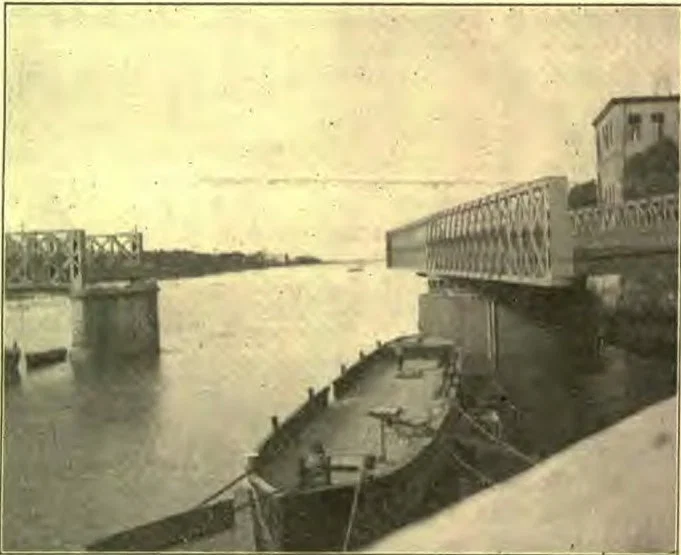
THE KASR EL NIL BRIDGE, CAIRO. THE SECTION SHOWN IS OPEN TO ALLOW SHIPS TO PASS
Near this tree is a red granite obelisk, about seventy feet high, which was brought from Assuan. It is the oldest obelisk in existence, dating from the twelfth century.
Near Materieh is a large ostrich farm, where nearly a thousand birds are kept. The beautiful birds are in fine condition, and a large annual harvest of feathers is reaped. A large plume is worth about five dollars.
Returning to Cairo, we at once arrange for a moonlight visit to the small petrified forest. Starting at about five o’clock, we make our way past the citadel, arriving about sunset at the summit of the Mottokam mountain. Here we pause to admire the magnificent view. The spectacle of an Egyptian sunset is one of the sublimest the writer has ever witnessed. As the sun sinks behind the desert hills, the golden zone next the horizon fades rapidly through the most exquisite shades of pink, violet, and purple, settling finally into a deep blue, from whose fathomless depths the stars shine out with a subdued yet brilliant splendor. As the full moon rises over this scene, the charm increases. From Helwan to the barrage the country is spread out before us like a map. At our feet lies Cairo, glittering with ten thousand lights. Up from the south comes the Nile in a broad, dark band, and, sweeping past the city, breaks up into a dozen waving ribbons of shimmering, silvery light as it winds in and out among the isles and palm-trees of the upper delta. Beyond are the massive profiles of the Pyramids, standing like mighty sentinels of the desert against the advance of the moonlight, casting their deep purple shadows, like a protecting arm stretched backward far out over the white glare of the sand. It is with difficulty that we break away from this imposing and fascinating spectacle, but at length we move on.
The road now leads over a desert abounding in precipitous rocks and little steep-walled canons. The intense whiteness of the boulders, in the brilliant moonlight sharply contrasting with their inky shadows, produces a weird, almost supernatural effect, and the distant howl of a famished jackal or hyena does not tend to allay the creepy feeling which is very likely to attack the nervous traveler.
The “petrified forest” is a narrow plain, strewn with the fallen branches and trunks of great trees, all turned to solid stone by the action of the desert climate. It is not supposed that these trees grew here, but that they were bodily transplanted to this locality by some upheaval of nature. Many interesting fossils have been found here, such as petrified fish, insects, various kinds of fruits, etc. A much larger forest of a similar nature farther on in the desert is said to contain many of these interesting specimens as yet untouched.
There are many other interesting places around Cairo, especially the fine botanical gardens of Ezbekieh and Gizeh, where the rarest tropical plants can be seen flourishing in all their native vigor. Helwan, with its far-famed mineral springs and bracing desert climate, is worthy of a visit, also the great barrage, or dam, south of Cairo, and the beautiful gardens near it,—Cairo’s favorite picnic grounds; but we are too anxious to see the antiquities, the real attraction of Egypt, to give these more than a passing glance; so we retire, with great expectations for the morrow.
Glen Wakeham.

Rambles in Bermuda—III

St. George's

I had heard much of St. George's and its peculiarities before I had time to explore it for myself, and my curiosity was fully aroused; so it was with pleasure that I accepted an invitation to spend the Easter holidays there at the home of a friend.
I rode down from Hamilton on my bicycle along the North Shore road, passing the governor's residence on Mt. Langton, and here and there a tiny village like Devonshire Dock, Crawl Point, The Flatts, and Barley Bay. The road is everywhere very near the ocean,—so near that it is dashed in many places by the salt spray. The constantly changing hues of the water, now a bright sapphire blue, now shading into reds and purples under the setting sun, present a picture that, if seen in an artist's studio, would be at once declared untrue to life. The coloring is so vivid—the blue so intensely blue, the white so white!
“The Flatts” is a collection of houses near the outlet of Harrington Sound to the Ocean. A post-office, a grocery, and a bicycle shop, with one or two hotels for the accommodation of winter guests, form the business part of the little village.
The road leads past Shelley Bay, named from Captain Shelley; Bailey's Bay, a beautiful little inundation where the path hugs close to the water's edge, and down to the causeway connecting St. George's Island with the Great Bermuda. The causeway is two miles long, divided into two sections by Bird Island. It was once built of solid masonry, but the severe storm of September, 1899, one of the most disastrous that has ever visited the islands, destroyed it, the great waves heaping the masses of sandstone one on another like children's toy blocks. In rebuilding, it was decided to leave free passage to the water by supporting the roadway on piers and arches.
My first trip to St. George's was taken before the storm, and was uneventful. After the storm I rode down again on my bicycle, intending to take the ferry that had been established to accommodate travel until the causeway could be rebuilt. Just as I reached the ruined causeway, I saw the ferry-boat leaving the landing several rods away. It was Sunday, and the trip was made once in three hours. I had promised to attend church with my friend in St. George's at eleven o'clock, and it was now ten. I looked at the causeway, and saw that a narrow plank bridge about a foot wide had been laid for the convenience of the workmen. Two men were coming toward me, and in desperation I decided that what others had done I could do. My wheel was in the way; but I picked it up and started.
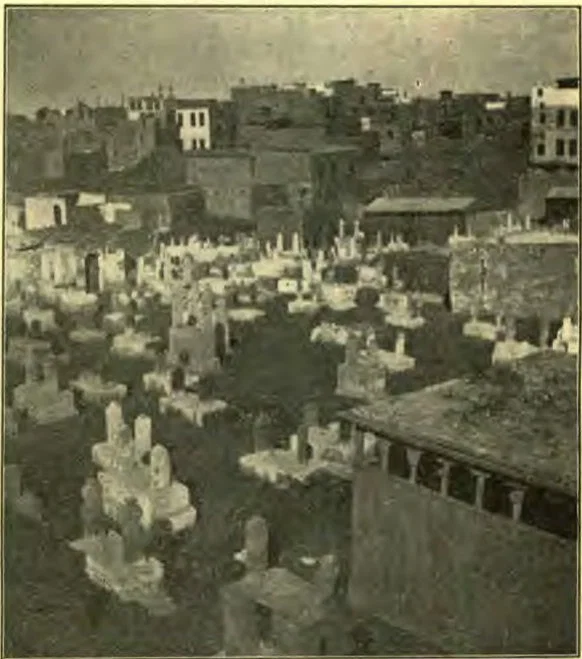
MOHAMMEDAN CEMETERY IN THE SUBURBS OF CAIRO
It took some courage to keep on, when I looked down at the waters swirling against the piers; but I had gone the distance of three arches when the two men, soldiers of the garrison, passed me, also carrying their bicycles. I noticed that they looked at me rather strangely, but attributed their manner to a man's natural surprise at seeing a woman carrying a bicycle over a footpath in mid-ocean. I had gone but a few steps, however, when I heard a voice behind me, and, turning, saw one of the soldiers approaching. He told me that there was a strong wind blowing, and that it was with the greatest difficulty they had gotten across. In fact, more than one person had fallen in that morning, and he would not think of attempting to cross again. He begged me to turn back, and let him look up a boat that could take me to the still unharmed part of the causeway. It was an hour's work to find an old negro who had a boat and time to spare; but I was glad enough to take him at any price.
I did not attend church that day, however. Before leaving Bermuda, I had the privilege of riding over the new causeway.
After reaching the Island of St. George's, the road winds in and out, curving along the water's edge, skirting the hillside with a fringe of houses on either side. The houses are quaint and old-fashioned, and in the town itself are build closely, one upon another in Spanish style. St. George's is said to be Spanish in appearance. It nestles at the foot of a range of hills bordering the ocean and has one of the finest harbors in the islands. Castle Harbor was once the stopping place of all vessels that visited Bermuda. At present it harbors a few coal-barges and merchantmen.
To a stranger the most noticeable feature of the town is the narrowness of the streets. In some of them two persons in the center, holding hands, can easily touch the houses on either side. Many are not only narrow but crooked as well.
On one of the principal streets is an old church that appeals to one in search of antiquities. Services have been held in it for nearly four hundred years. One may see there a silver goblet presented by the Company in 1626 and an entire silver service presented by William and Mary in 1693. Along the walls are marble slabs with curious epitaphs, inscribed to former governors and great ladies. The following inscription on a tablet in honor of one Governor Papple, as nearly as possible an exact reproduction in arrangement, spelling, and capitalization, is an example of these epitaphs:—
“Died at Bermuda, Nov. 17, 1744, In the 46th Year of his Age, After Nine Days Illness of a Bilious fever, The Good Governor, Alured Pappie, Esq. During the Course of his Administration, Which to the inconsolable Grief of the Inhabitants Continued but Six Years, Of the many Strangers who resorted hither The observing easily discovered in Him Under the graceful Veil of Modesty An Understanding and Abilities equal To a more important Trust. The Gay and Polite were Charmed with the Elegance and amiable, unaffected Simplicity of his manners, And all were cheer'd By his Hospitality and diffusive Benevolence Which steadily flowed, and Undisturbed From the Heart. To praise according to his Merit The deceased Would be but too sensible a Reproach To the Living; And to enumerate the many rare Virtues Which have united in the Governor of that little Spot Were to tell how many great Talents, And Excellent Endowments, are Wanting in Some, Whom the Capriciousness of Fortune Exposes In a more elevated and Conspicuous Station.
In the churchyard are other epitaphs quite as curious. In Bermuda the dead are buried, not in graves, but in tombs; and one raised slab or stone or marble marks the resting-place of an entire family. In the Public Gardens there is a tablet erected to the memory of Sir George Somers, whose heart was buried in that place, though his body received interment in England.
The Public Gardens are exceedingly interesting from the variety of tropical and semi-tropical trees and shrubs gathered there. Different varieties of palms—the date palm, sago palm, cabbage palm, the monkey tree and the bamboo, are among some of the most interesting.
St. George's, like Hamilton, is surrounded by forts. Fort George is on a hill overlooking the city, and is a fine look-out station. The garrison is not so large as that at Hamilton, and the soldier's barracks are nearer the town.
There can be few sights in the world more beautiful than the view of Castle Harbor from Fort George,—the bay of Naples, to which it is often compared, included.
Opposite the town is the Island of St. David's, where the smaller of the two lighthouses is situated. This, with Castle Island and the other islands inclosing the harbor, will furnish material for another chapter. WINIFRED M. PEEBLES.

Nature Reveals God's Power but Not God Himself

“NATURE reveals the power, existence, goodness, and wisdom of God, but does not reveal God himself.”

The Power of Sin

I once read of an artist who wished to portray his ideal of innocence and purity. To secure a model he searched a long time among thousands of people in a great city, and finally found a beautiful little boy, whose innocent face was just what he desired. Years afterward he conceived the idea of painting the picture of a fiend. He searched the slums among thieves, murderers, and thugs, and finally found a desperate character, foul and depraved beyond description—just the model he needed. He painted him, and then discovered that in both instances he had painted the same person. Once an innocent child, the pride of a mother's fond heart,—a child who might have grown up a noble man, and filled a place of honor and usefulness, the youth allowed his feet to stray into wrong paths, and chose the pleasures of sin. Yielding to its power, he was changed from an innocent boy into a savage vagabond, feared and shunned by all.
Sin is a terrible deceiver. It promises much, but gives nothing but trouble, sorrow and disgrace. None are able of themselves to withstand its seductive power. It lures its followers on, step by step, until they are completely under its control. “Blessed is the man that walketh not in the counsel of the ungodly, nor standeth in the way of sinners, nor sitteth in the seat of the scornful.” These words reveal the steps by which many have been betrayed into sin. First they walked down that way, to see, perhaps to gratify a vain curiosity . Next time it did not seem so bad, and they stood and viewed the scene, only later perhaps to sit down in the haunts of sin.
Beware of the first step in transgression. King Saul was chosen by the Lord, and by special direction was anointed by the prophet for his work. Then the Lord gave him a new heart, changed him into another man. But he was not loyal and true. He permitted himself to take the first step into disobedience, and in a while we see him seeking the counsel of the witch at Endor, holding converse with fallen angels. What a sight for heaven to behold! Yet it was only the logical sequel of transgression. Demas was a follower of Christ at one time, and numbered among Paul's fellow laborers. But he clung to some wrong thing. The love of the world crept into his heart, and he forsook the work; he turned traitor to his Lord. So with Judas. He had great natural ability, but he was covetous, and step by step he was led on until he sold his Lord for thirty pieces of silver, and died a self-murderer.
How good it is to know that Jesus knows how to deliver us from sin, and will cleanse us, and keep us from falling if we are only willing. None need be overcome. His keeping power is free to all. G. B. THOMPSON.

The Angel of Patience

To weary hearts, to mourning homes, God’s meekest angel gently comes: No power has he to banish pain, Or give us back our lost again; And yet in tenderest love, our dear And heavenly Father sends him here.
There’s quiet in that angel’s glance, There’s rest in his still countenance, He mocks no grief with idle cheer, Nor wounds with words the mourner’s ear; But ills and woes he may not cure He kindly trains us to endure.
Angel of Patience! sent to calm Our feverish brows with cooling palm; To lay the storms of hope and fear, And reconcile life’s smile and tear; The throbs of wounded pride to still, And make our own our Father’s will!
O thou who mournest on thy way, With longings for the close of day; He walks with thee, that angel kind, And gently whispers, “Be resigned: Bear up, bear on, the end shall tell The dear Lord ordereth all things well!”
— Whittier.

Things People Ought to Know

THAT a quiet voice, courtesy, and kind acts are as essential to the part in the world of a gentleman as of a gentlewoman.
That roughness, blustering and even fool-hardiness, are not manliness. The most firm and courageous men have usually been the most gentle.
That a brain crammed only with facts is not necessarily a wise one.
That the labor impossible to the boy of fourteen will be easy to the man of twenty.
That the best capital for a boy is not money, but the love of work, simple tastes and a heart loyal to his friends and his God.— Selected.

Coming to Jesus: The Desire of the Heart

COMING to Jesus is the desire of the heart after him. It is to feel our sin and misery, and to believe that he is willing and able to pardon, comfort and keep us; to ask him to help us and to trust him as a friend. To have the same feelings and desires as if he were visibly present, and we came and implored him to bless us, is to come to him, though we do not see his face nor hear his voice. The penitent’s desire for pardon, his prayer, “Lord, save me; I perish,”—this is coming to him.—Newman Hall.

Flower-Growing for Young People

(Concluded)
When the bulbs arrive, plant them as soon as possible. In the bottom of each can or pot, place an inch layer of the drainage material collected, and over this put a covering of excelsior, leaves, or moss to hold up the potting soil. The five- and six-inch pots (measuring across the tops), also the quart tin cans, should usually be well drained; but the smaller pots and cans will not need it, as the moisture dries from them so rapidly that enough water can not remain in the soil at any time to harm the bulbs.
The pointed, conical end of a bulb is the top; and the flat end, with “warty” projections, the roots to be, is the bottom. Always plant the bottom end down; and have a good, roomy space between it and the drainage material. Usually the top should come about even with the rim of the dish. Fill in around it with soil, and water very thoroughly. As the soil settles, add more until the dish is full.
As stated before, these bulbs must be set away in the dark for several weeks, to form roots; if one has a cellar, it will usually be just the place in which to store them, provided it is not inhabited by mice. Rodents are very fond of bulbs, and they should be outwitted. A large wooden box, with a shelf in it, may be fastened to the ceiling; or the bulbs may be set away in closets and cupboards in the living rooms, which are dark and cool and have plenty of air. Don’t place the bulbs too near the fire, as this will cause them to start into growth too quickly.
Bulbs differ so in size that one can not tell exactly how to plant them. Generally, however, those as large as hyacinths may be set one in a three- or four-inch pot or pint tin can, or three in a six-inch pot. Daffodils, narcissus, and tulips may be set three in a four- or five-inch pot or one in a three-inch receptacle. One bulb of the large-sized crocuses may also be put in a three-inch pot, while extra large bulbs of hyacinth and narcissus may need to be planted in nothing smaller than a five-inch dish. In planting, always consider the depth of a receptacle rather than its width.
The Chinese sacred lily, one of the most beautiful and interesting of plants, should be given a six-inch pot or gallon pail if it is grown in soil, which is the most satisfactory element in which to cultivate this lily, especially if one is planning to sell the bulbs when in flower. However, it is an interesting sight to witness a thrifty, blooming plant richly feeding on water and pebbles, and apparently enjoying it. As this is the way the sacred lily of China is generally grown, I will give that method of culture for those who wish to grow it in water.
Remove all the rough, brown covering from the bulb, and pare away the old roots, detaching all the smaller bulbs but two or three. Select a glass dish that will hold the bulb comfortably, and fill it with pieces of charcoal, pretty pebbles, or shells. Place the bulbs on these securely—two or three large stones may be used if preferred—so that the base comes about even with the rim of the dish. Fill with water and set away in a cool, semi-dark place, until growth begins, which will generally be within eight days.
After the leaves show, give a good light and replenish the water frequently. It may be necessary to pour all the old water off, every week, substituting new. The Chinese lily often comes into flower within one month from the time of planting, so it is not a difficult matter to decorate the Thanksgiving and Christmas tables with the fragrant, waxen beauties. Successive plantings should be made throughout the fall, in order to have a continuous display of the flowers.
Hyacinths and other bulbs that require to be set in the dark after planting, should be examined frequently, and watered well if dry. The usual rule is, not to bring a bulb up to the living rooms until the tips show well above the soil; and while one should ordinarily follow this advice, it is sometimes necessary to bring many of them up to the light and warmth before the leaves show, especially if they are wanted to flower for any particular day.
Try to have a box or cupboard, in one of the living rooms, that will not be too near the fire and in moderate light, and in this put each pot of bulbs as it comes up from the cellar. In such a convenience the green shoots will soon appear, and when the buds begin to show, the bulbs may be placed in the window to blossom.
This window should preferably face west or north, as the flowers will last much longer and be much better in a practically sunless window than in a place where the excessive light and warmth make quick work of the blossoms. Therefore, in the beginning, plan for a cool, even temperature for your bulbs, and you will not be disappointed with the results. Keep the soil well moistened, after the buds begin to grow, and if no nutritive elements were added to the soil in the first place, it would be well to procure a package of plant food, and work some of it into the soil, as directed on the package. Generally, however, this will not need to be done.
If some of the hyacinths show a tendency to come into bloom before the flower stem has had a chance to grow up out of the neck of the bulb, make a small funnel out of a piece of writing-paper, cut it down to the right length, and slip it between the leaves and undeveloped flower spikes or over the whole plant. This will cause the stem to grow up higher and blossom as it ought. However, this will not need to be done if one is careful not to bring the bulbs from the dark too soon, or put them in the warm window directly after bringing them from the cellar.
After New-Year’s the growth of the bulbs will be more rapid, and the windows may be kept full of them, in all stages of development.
Of course, all things considered, the first year may not be a complete success; but the second year there will be a decided gain, and in time any boy or girl ought to make a little money by carrying on this branch of flower-growing. Bulbs that are planted in tin cans may be dressed in crape paper and baby ribbon, which will add much to their appearance, and contribute to their value in the eyes of the purchaser.
The prevailing custom of sending flowering plants to the sick or poor is one that should be encouraged; but often, in many communities, there are no plants to send. For weddings, funerals, receptions, and other functions, cut flowers are always in demand, and often it is difficult to secure enough blossoms to go around.
Flower growing “pays” in more way than one. Is it worth your attention, boys and girls?
BENJAMIN B. KEECH.

In the Books

An idle word, at random dropped, I fain would call it back; But it is gone, and others, swift, Still follow on its track. O Angel with the pen of fire! How many idle words Have been set down against my name, Thy book of truth records.
And angry words, a bitter train, And unkind, sinful, vain,— How black the list grows as I gaze, How filled my heart with pain! The angel’s eyes are sad to know The record he must keep— Nothing left out—a fearful list With which my God to meet!
O Heavenly Father! For his sake Who loved humanity, My sinful words, my every act Of dark iniquity, Blot from thy books! and in their place Write “Pardoned,” O my God! So shall I know, not guilt but grace, Saved by his precious blood.
LUCINA MOON.

Famous Grape-Vines

WHEREVER the fame of Santa Barbara has gone, that of her big grape-vine has likewise spread. The Scientific American gives an interesting account of this famous vine, as well as of some others as remarkable, if not so widely known:—
There was many a pang of regret when, in the Centennial year, it was known that the old landmark in the Montecito Valley was to be cut down and a portion of it removed to the exposition at Philadelphia; but it was whispered that relentless Age, who is no respecter of grape-vines, was beginning to impair its vitality, and that the inevitable was only hastened a little by the intervention of man.
No record was kept of the time of planting, but from events connected with the family upon whose grounds it grew, it was believed to be seventy-five or one hundred years old. The measurement of its trunk is given as three feet ten inches in circumference, and the arbor about seventy-five feet square. Its death was believed to be premature, the result of changing the course of a small stream that had flowed near its roots.
But another vine near by, a cutting from the original, had attained to nearly this size, so Santa Barbara could still boast of having “the biggest grape-vine in the world.” In 1899 this vine succumbed to a disease of the roots, perhaps invited by age, and its body now rests in the Santa Barbara Chamber of Commerce. Its irregular trunk attained a girth of four feet four inches at eighteen inches above the ground, and five feet seven inches at forty-two inches, and its maximum yield was four tons in a season. It was believed to be seventy-five years old.
In the Carpenteria Valley, a few miles farther from the city, a third vine surpassed both of the others in size. It was planted in 1842 by Joaquin Lugo de Ayala, and has therefore recently completed its threescore years. The first election in Santa Barbara County under American rule was held beneath its ample shade. This latest candidate for the world’s record is double from the surface of the ground up; the two parts are knit together in a David-and-Jonathan-like embrace, to a height of about five feet seven inches, where they separate into large branches, the largest having a circumference of three feet. Six inches above the ground, the vine measures eight feet five and one half inches in circumference, and it covers an area one hundred and fifteen feet square (the whole back yard), sixty posts supporting the framework. The owner says that, were provision made, it would spread over a greater surface, but it is pruned every year. Fabulous tales are told of the grapes this vine produces. That it did actually yield ten tons in a recent season seems to be authentic.

Young People's Conference at the Indiana Camp-Meeting

THURSDAY, August 6, was set apart for the Young People's work at the Peru camp-meeting. The forenoon session was devoted to the Young People's Societies, and the afternoon and evening to the educational work.
I wish to speak especially of the young people's part in the work of the day. Fathers and mothers and others in the congregation who have not before been keeping pace with the Young People's work, listened attentively while the various phases of the movement were presented and discussed by the young people themselves.
The plan and aim of the organization, the needs of our young people, and the various lines of missionary work in which they can engage, were set forth as fully as the time would permit. Many realized for the first time that there is indeed a definite call to our young people to have a definite part in preparing the way for the soon-coming Saviour, and that “the movement truly is of God at this time, and to meet the call of the hour.”
A very practical demonstration of what the young people can do was shown in their work of distributing tracts. The city was districted, and companies formed, who went out in twos, carrying to each home a package of the late tracts. Many of these were sold, and many people interested. One company reported sixteen families in their territory desirous of knowing more of the truth. Through their efforts nearly every home in the city was reached. Only the judgment will reveal the results of the work begun at this meeting.
As our young people consecrate their lives to the service of God, and go forth to work for the salvation of souls, they have the assurance that “they are co-workers with the angels; rather, they are the human agencies through whom the angels accomplish their mission. Angels speak through their voices, and work by their hands. And the human workers, co-operating with heavenly agencies, have the benefit of their education and experience. As a means of education, what “university course” can equal this?”
“With such an army of workers as our youth rightly trained, might furnish, how soon the message of a crucified, risen, and soon-coming Saviour might be carried to the world! How soon might the end come,—the end of suffering and sorrow and sin?” Mrs. R. W. McMAHAN.

THE WEEKLY STUDY

The Supreme Cost of Life
SCRIPTURE LESSON: —
A divine paradox. Matt. 16:24-26; Rom. 8:13.
Paul’s death struggle from the truth. Romans 7: and 8:1-14.
Death is the road to life. Col. 3:1-5, 9, 10; John 12:24, 25.
PARALLEL READING: —
“Great Controversy,” Chapter Six.

Lesson Notes

Huss was the first “great sacrifice in the long struggle by which liberty of conscience was to be secured;” and Jerome soon followed him to the ordeal by fire. Our hearts burn within us as we read the thrilling story, and we rejoice that the religion of Jesus Christ has the power in it which enables those who know him to lay down their lives for him.
The questions will arise in many hearts, “How would I stand such a test?” “Will I be called upon to give my life as did the martyrs of old?” As we see the storm gathering for the last great conflict, do our hearts fail us as we think of what may come to try the genuineness of our experience? The glorious triumph of these noble men, even in the hour of death, should be a cheering inspiration to us.
But let us not spend our precious moments in idle speculation over what may come to us in the form of outward persecution. The inward secret struggle, the crucifixion of this body of sin, the daily death which all must die, is of vital importance just now. Have you experienced the refining fire? Have you been nailed to the cross? Is the old man of sin put out of the way? If so, death has lost his terrors, and you have experienced the only sure preparation for outward persecution.
A martyr’s fate is before all who would enter into life. Jesus purchased our life on the cross, and opened a way of salvation for us; but that way leads us to the cross where we must die. The Saviour’s great struggle with sin was in the daily battle with temptation. He mortified the deeds of the body; he kept the tendencies of the flesh under control; and his daily victory over sin was an unfailing preparation for the crucifixion.
To-day is the great searching, testing time for those who will be translated. The crisis of the ages is upon us. Soon the winds of strife and trouble will be let loose, and the material with which we have builded will be revealed. The old man of sin will not stand the test. If he has been put away, that new man will bear off a glorious victory. When the supreme trial comes, we will do “as aforetime.” Daniel’s three friends had walked with Jesus long before he walked with them through the fiery furnace.
The Reformation of which we are now reading was brought about by men who had died to self, having conquered sin and fear; and so in the last great reformation the men who under God erect the standard of truth, and carry the burden of the Prince of Life over the last rampart of the enemy will be men who have died to sin and conquered the foe in private battle, before the day of open conflict.

To the Leader

May the dear Lord greatly bless your Society in the study of this lesson. As far as possible direct every feature of your program toward the central thought of these lessons on the Reformation. The world’s greatest Reformation is now overdue. Stalwart characters are required for the work. To-day those characters are being formed. In some way—by prayer, by study, and with the blessing of God—give vital power to these truths, and make them ring with the true spirit of our times.

Prayer

SOMETIME, between the dawn and dark, Go thou, O friend, apart, That a cool drop of heaven’s dew May fall into thy heart.
Thus with a spirit soothed and cured Of restlessness and pain, Thou mayest, nerved with force divine, Take up thy work again.
—Anon.

Notes From the Field

THERE are two active Societies of young people in San Francisco. At the Laguna Street church, young people’s meetings are held each Sabbath after the regular morning service, and the young people assemble in large numbers for a pleasant and profitable three-quarters of an hour. The young people of the Valencia Street church also hold interesting meetings. The members of this Society used three thousand copies of the Life Boat during the last month.
Children can do very effective missionary work. In one of the cities on the Pacific Coast, a lad of thirteen and his sister aged ten, sold from house to house about nine hundred papers in six weeks. The proceeds from these sales were used for charitable and missionary purposes.
The Young People’s Society of the Los Angeles, California, church, has forty members. They have recently undertaken the financial support of a young man, enabling him to receive an education in the Avondale School, Australia. The Secretary writes: “Our plan for doing this was suggested by Elder Gates while he was here after the General Conference. He thought that we could sell papers, and donate the proceeds from the sales to the support of this young man. Our Society has taken up this work with real zeal and earnestness. Even little children sell the papers, and tell the people about the young man we are educating for a missionary. Often they receive donations to this fund from different persons. Our young people here are beginning to realize the real object and purpose of their organization, and are starting in to work with great interest.”
A few of the Societies are interesting themselves in the circulation of literature especially directed against the evils of tobacco-using. Elder H. F. Phelps, one of the pioneers in our work, is the editor of a paper and leaflet each entitled “Save the Boys.” Our young people can do a good work by securing subscribers to this paper, or by selling the leaflet and paper. Address orders and requests for sample copies to H. F. Phelps, 18 West Minnehaha Boulevard, Minneapolis, Minn. L. F. P.

Seattle, Washington

ON August 1, we were pleased to have with us Brother Sadler, of San Francisco, who took charge of the meeting for an hour, giving us some helpful thoughts concerning work for the Master. The principal points he sought to bring out were how Paul, Moses, and many of our forefathers started out in the work while very young, and that we as young people professing Christ should begin work for his cause, even if it is but in little things.
The meeting closed by singing “Not a Wasted Moment.” E. BLUMN.

Joplin Young People's Society Completes Garments for Nyassaland Mission

Miss BIRDIE CRUZAN writes that the Young People's Society of Joplin, Missouri, is doing nicely. They have just completed twenty-eight garments for the Nyassaland Mission. We shall look for an early report from this Society.

Naming Battleships After States Runs Short

THE United States has a law that battleships of the first class shall be named for States, and as there are at present only six States for which such ships have not been named, and these six will soon be given out, the government will presently find itself in the queer plight of having used up all its available names for this class of vessels! No doubt, however, some way will be found out of the difficulty, and the work of building more and larger battleships will go merrily on.

Wolf Lake, Indiana

The Willing Workers of the Young People's Society of Wolf Lake, Indiana, meet each Thursday at the home of some sister or neighbor, who needs help in her sewing. Viola Graham, the assistant secretary, writes that this work is much appreciated. The spiritual interest in the Society is good. The members find pleasure in this work for the Lord, and nearly all take part in the prayer service at the close of their work each week.
Continue reading: A Summer's Work