The Youth’s Instructor, Vol. 27, No. 44.

THE IGNIS FATUUS

The Youth’s Instructor

Nov 5, 1879

S. D. A. Publishing Association · Battle Creek, Mich. · Nov 5, 1879

THE IGNIS FATUUS.
This singular light, frequently seen in marshy places, differs so much from common lights that it has received the name of Foolish Fire. It is also called “Will-o’-the-wisp,” and “Jack-with-a-lantern.”
It is a pale, bluish-colored flame, and generally appears a little after sunset. Sometimes it shines steadily all night, at other times disappears, and returns after short intervals. It floats in the air about two or three feet from the ground, and travels away from any one who attempts to approach it. Sometimes two or three appear together, dancing merrily up and down.
The ignis fatuus is of frequent occurrence in Northern Europe, but is seldom seen in this country. In one place in Massachusetts it has appeared several times. Once it was seen about ten o’clock in the evening, and was as large and brilliant as the light of a lantern. It passed up the road two or three rods distant from the persons who saw it, and did not vanish until it had floated some forty or fifty rods. Just below the place where this light started, was a low piece of ground. The weeds on this ground had been pulled, and piled in heaps; and it was supposed that the gas rising from these decayed weeds produced the light. Indeed, it has been clearly ascertained that the gas arising from decaying matter sometimes takes fire on coming in contact with the air, and thus produces this strange light.
In former times, however, this light was an object of superstition, and was believed to be caused by some evil spirit, attempting to lead the benighted traveler to his destruction. Thus, Parnell, in his “Fairy Tale,” says,
“Then Will, who bears the wispy fire, To trail the swains among the mire.”
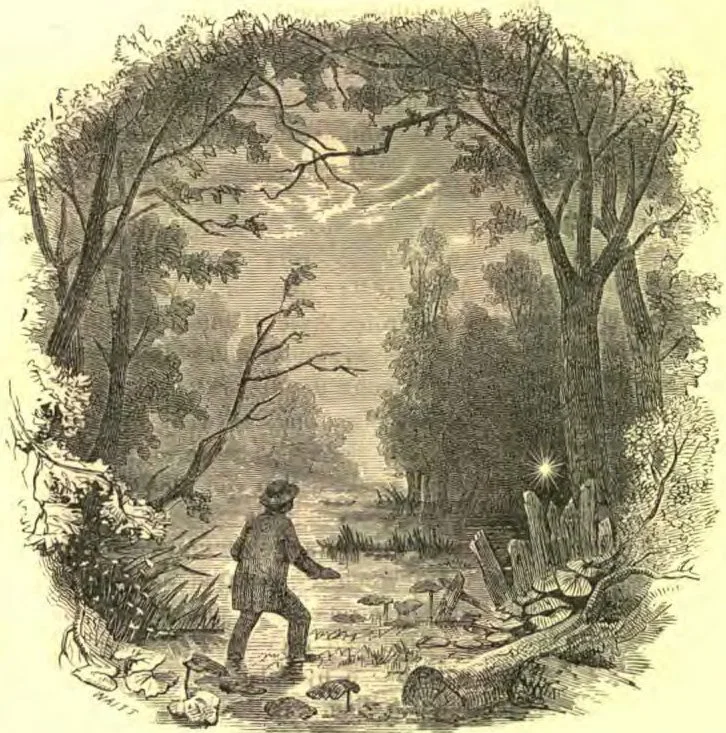
There are instances on record, of travelers, who, mistaking this flame for a lamp, have followed it until they were decoyed into some swampy spot, where they perished.
The man in the picture is attempting to go to one of these lights. It is in the night. See, he is now wading in the water. Soon the deceptive light will disappear, and he will be left in the marsh, perhaps to die.
This is a striking illustration of the experience of many who seek so earnestly for the pleasures of this world. Infatuated by the weird flame, they press eagerly on toward the glittering prize, which is ever just beyond their reach; and finally, when seemingly within their grasp, the false light will vanish entirely. Whoever is thus enticed from the path of right, will find at last that he is, like the traveler, led away but to perish.
E. B. M.

A BOY'S LEISURE HOURS.

WHAT a boy does with his leisure is most important; what he gets in school is mainly drill or exercise; it is a gymnasium to him; he must eat elsewhere. What he does with his spare hours determines his destiny. Suppose he reads history every day, or scientific books; in the course of a few years he becomes learned. It matters very little what he undertakes, Latin, Greek, Hebrew, Sanskrit, all disappear if he uses his spare time on them.
A boy was employed in a lawyer's office, and had the daily paper to amuse himself with. He commenced to study French, and at that little desk became a fluent reader and writer of the French language. He accomplished this by laying aside the newspaper and taking up something not so amusing but far more profitable.
A coachman was often obliged to wait long hours while his mistress made calls. He determined to improve the time; he found a small volume containing the Eclogues of Virgil, but could not read it, and so purchased a Latin Grammar. Day by day, he studied this, and finally mastered all its intricacies. His mistress came behind him one day as he stood by the horses waiting for her, and asked him what he was so intently reading. “Only a bit of Virgil, my lady.” “What, do you read Latin?” “A little, my lady.” She mentioned this to her husband, who insisted that David should have a teacher to instruct him. In a few years he became a learned man, and was a useful and loved minister in Scotland.
A boy was hired to open and shut the gates to let the teams out of an iron mine. He sat on a log all day by the side of the gate. Sometimes an hour would pass before the teams came, and this he employed so well that there was scarcely any fact in history that escaped his attention. He began with a little book on English history that he found in the road; having learned that thoroughly, he borrowed of a minister Goldsmith's History of Greece. This good man became greatly interested in him and loaned him books, and was often seen sitting by him on the log, conversing with him about the people of ancient times.
All of these examples show that in this country any one can learn that wants to. If he is at work, he still has three hours that he can call his own. Let him use those wisely and he can fill his mind with stores of knowledge.—Scholars' Companion.

DAILY DYING.

The maple does not shed its leaves In one tempestuous scarlet rain, But softly, when the south wind grieves, Slow wandering over wood and plain, One by one they waver through The Indian summer’s hazy blue, And drop at last on the forest mold, Coral and ruby and burning gold.
Our death is gradual like these; We die with every waning day; There is no waft of sorrow’s breeze But bears some heart-leaf slow away; Up and on to the vast To-Be, Our life is going eternally! Less of life than we had last year Throbs in your veins and throbs in mine; But the way to Heaven is growing clear, And the gates of the city fairer shine; And the day that our latest treasures flee, Wide they will open for you and me. — Sel.

THE CHINESE IN CALIFORNIA.

It may be safely said that in California the Chinese outnumber any other one nationality, except the American. Their headquarters are in San Francisco, where, according to the received opinion, they number forty thousand. They come directly from the mother country to this city, in the vessels of the Pacific Mail Steamship Co., as many as nine or ten hundred coming on one steamer.
On their arrival they are conveyed to “China town,” and taken in charge by agents of what are known as the Six Companies, who provide them with food and lodgings. The laws of China require these companies to take care of “John,” as the Chinaman is called, for one year after his arrival; so they put him to work at any price, while he can be called by no other name than their slave.
The Chinese laborers are employed as laundry-men, cigar and shoe makers, cooks, makers of ladies’ underwear, etc. They also peddle vegetables, their outfit for this purpose being a strong stick with a basket at each end. This they carry balanced on their shoulders. From three to five hundred pounds is their average load. They are quick to learn, and are hard workers in every sense of the word. When laboring for themselves, you will find them toiling away from early morning till late at night, every day of the week, observing no Sabbath.
The first thing a Chinaman does when he rises in the morning is to thoroughly wash his head and hands in very hot water. He then pays his devotions to his god, by burning lights in a little niche in the wall.
His meals are simple, the principal dish being rice; the utensils are bowls and chopsticks. The latter are straight pieces of wood or gutta-percha one-fifth of an inch wide and about a foot long. For half their length these sticks are round; the other half is square. The favorite drink, of course, is tea, which is taken strong and unadulterated. Much talk and laughter are indulged in at meals, and altogether these are the times most highly enjoyed. Every one helps himself at table; for if he did not, nobody would help him.
A Chinaman’s bed is a shelf made of plain boards covered with matting, on which he lies, with a few coverings; his pillow is a hollow block of wood placed under the back of the neck, that he may not disarrange the long braid, or “cue,” in which he takes so much pride. You might suppose he could not enjoy much rest on such a couch, but I assure you he sleeps as soundly as any one could desire.
In their dwellings, the Chinese are huddled together, literally in swarms. This practice was carried so far in San Francisco that the authorities were obliged to pass an ordinance requiring that every Mongolian should have fifteen cubit feet of air to breathe, where he slept. I remember a case in which about fifty Chinamen lived in a house containing six rooms; in another, eight hundred occupied three houses which were about 50x75 feet, and three stories high. The people do not pay the slightest attention to order, and their dwellings are filthy, inside and out. Much disease results from these habits; small-pox, cholera, leprosy, and similar diseases, are common among them.
As a class, they are very dishonest. Religion is embraced more for the benefit of their pockets than for the good of their souls. Revenge is sweet to them, and many murders are committed in San Francisco which the sharpest detectives are not able to ferret out. If one of their number is arrested and they wish to clear him, they will do so by false testimony; but very few of them can be believed, even under oath.
When a Chinaman dies who has means or sympathizing friends, he is honored with a funeral. He is laid in a coffin, and conveyed to the grave in a hearse. On the way, one of his friends sits on the box, beside the driver, and continually throws gold-colored papers, one by one, into the street. They believe the devil to be following the corpse, and that he, mistaking these papers for gold, stops to examine them, thus enabling the body to arrive at the grave before him. The friends and relatives follow the hearse in hacks, which are always full. At the end of the procession comes an express wagon loaded with roast pig, boiled rice, lights, gold papers, etc. All the eatables are buried with the person, and the lights are left burning on the grave. Once a year the Chinese go to their grave-yards, disinter the bodies, clean the bones, pack them in boxes, and ship them to China, where they are reburied. Two years ago this practice became such a nuisance to those living within a mile of the San Francisco burying-ground, that a law was passed requiring a new place to be selected, nearer the ocean.
JOHN A. WALL.
Battle Creek College.
(To be Continued.)

WHAT HAVE I DONE FOR CHRIST?

“I gave my life for thee, What hast thou done for Me?”
IN view of the great sacrifice which Christ has made in the redemption of fallen humanity, we do well to ask ourselves often, “What have I done for Christ?” What greater blessings could be bestowed upon the human family than their purchase from eternal death and their presentation with the glories of the future inheritance? Christ has made this bountiful provision for all who will accept him fully and joyfully.
Dear reader, we can in no way better manifest our love and gratitude for these heavenly benefits than by consecrating our lives to the service of God, showing by our daily walk that Christ is the chiefest, and the one altogether lovely. The same spirit of meekness, of humility, of sacrifice, of labor and of love, must characterize our lives; yes, to meet his approbation, we must reflect fully his holy image in all things.
“What have I done for Christ?” A record is kept of all that we do in his service; and, too, a record is kept of all the duties left undone. How shall we meet them in the Judgment?
What are we doing for Christ? Are we gathering with him, winning sheaves for the heavenly garner? Let us each and all seek a new conversion, and become so imbued with the spirit of the Master that we may have the same power to win as did a certain good missionary, as testified by a Brahmin who felt his influence. Said this heathen, “I am afraid to see that man. There is something so winning about him that if I were to be much with him, I am sure I should be a Christian.” Let us, too, be so thoroughly educated in the school of Christ that we may exert the same Christianizing spirit and power, and thus be able to fill the Record with deeds which shall endure the test of the Judgment.
M. J. C.

WHAT'S A LIFE?

AND what's a life? A weary pilgrimage, Whose glory in one day doth fill the stage With childhood, manhood, and decrepit age.
And what's a life? The flourishing array Of the proud summer meadow, which to-day Wears the green flush, and is, to-morrow, hay.
Quarles.

SABBATH-SCHOOL REVIEWS.

THERE is hardly any department of Sabbath-school work of greater importance than that of reviews; and yet it has received but little attention. A valuable little work entitled, “Review Exercises; Their Value and Methods,” by Rev. H. Clay Trumbull, contains the following excellent words on this subject:—
“Truth is fastened in the mind only through its frequent repetition. A child does not know its own name merely from hearing it once called. Each letter of the alphabet must be many times repeated to fix it in the young learner’s mind. The multiplication table is memorized by the brightest scholar only through saying it over and over again. The simplest truths of religion require quite as many repetitions to give them a permanent place in the mind of a beginner in knowledge as do facts of a less important character. A hymn or a text, though committed with perfect accuracy, will soon fade from the memory, unless the impression of it is revived by frequent repetition.”
“That which is fully understood one day will often be forgotten the next unless it is revived and reviewed. Scholars who recited well their lessons last week do not necessarily carry those lessons with them still, if nothing has been said of them since their first recital. Many who seemed intelligent and appreciative in their study of last quarter’s lessons, cannot now tell from what book of the Bible those lessons were taken, nor name a person mentioned in them, because they were never called to a review of the truths once passed over.”
“It is a rare thing for any person to have clearly in mind a truth he has heard but once. Not with children alone, but with all, ‘precept must be upon precept, precept upon precept; line upon line, line upon line;’ to give full force to wise injunctions. When our Lord would lay a new command on the penitent Peter, he not only asked, ‘Simon, son of Jonas, lovest thou me more than these?’ but ‘He saith to him again the second time, Simon, son of Jonas, lovest thou me?’ Nor content with one such repetition, ‘He saith unto him the third time, Simon, son of Jonas, lovest thou me?’ And three times also he enjoined upon the disciple the care of his flock. Who doubts that this reinforcement and review of his first utterance gave manifold power to those words of our Lord to Peter?”
“The truth that has been once stated—the lesson that has been once taught—is not on that account to be passed without further mention. It is the very one to be repeated and reviewed, that it may be fairly and fully in the mind of the pupil. Only through often repetition does truth find a final lodgment in the memory.”
Reviews give a new and better understanding of any subject, and are necessary to show the unity and harmony of a series of lessons. They help forward those who for any reason have fallen behind, and are the surest test of the scholar’s proficiency.

“WEEKLY REVIEWS IN THE CLASS.

“It is well for a teacher briefly to review the lesson of the day at the close of each recitation. The more important points touched in the first examination of the lesson are worthy of repetition, to fasten them in the memory, to give them new prominence, and to show their mutual relations. Five minutes spent in this way will often be more effective in teaching the truth of the day’s lesson, and giving the scholars a sense of it as a whole, than all the time before taken. For lack of this kind of review, many a class separates without a clear idea and positive impression of the lesson in the mind of one of its scholars. This brief review need not interfere with earnest words from the teacher in the spiritual application of the lesson, if he desires to close with them. They can as well follow the review as follow the first statement of the lesson truths.”
“However brief is the time allotted to the lesson, a share of that time should be given to review. It is better to say one thing twice over, or ten times over, and have it understood and remembered, than to say two things, or ten, but once, and have them misconceived or quickly forgotten. Whatever is worth teaching to a scholar is worth reviewing. Indeed, if it is not reviewed it can hardly be said to be taught. And subsequent reviews are more likely to be effective through a prompt review on the day of first teaching.”
“A few minutes may profitably be given to a review of the last Sabbath’s lesson, at the opening of each class recitation. Scholars who learned that lesson well have it now but faintly, if at all, in mind. A review will bring it up afresh. Its truths are perhaps essential to a full understanding of to-day’s lesson. At all events it is important to keep up the connection of the series of lessons.”

“SUPERINTENDENT’S WEEKLY REVIEW.

“After the class recitations, the superintendent can review the school as a whole on the lesson of the day. While no superintendent’s review can do the work of the class teacher with his scholars singly, there are advantages in a general review from the desk. Unity in the school thought and teaching is thereby secured. One view of the lesson is given alike to all. The lack in classes poorest taught is in a measure supplied by the instruction of the superintendent—who ought to be the best teacher in the school. New prominence can be thus given to the most important truths of the day’s lesson; and fresh beauties in it can be disclosed. What the superintendent points out as true and precious is most likely to be accepted without question; and what the school collectively receives, shapes the school character, and influences all its membership.” W. C. W.

LESSONS FOR CHILDREN.

LESSON XLIV.—REVIEW OF LESSONS XLI-XLIII.

1. What nations did David subdue? 2 Sam. 8.
2. Where did he set garrisons?
3. What treasures did he take from the kings of those countries?
4. Who was Mephibosheth? Chap. 9 : 1–6.
5. What kindness did David show to him?
6. How was David rewarded for his friendly attentions to the king of Ammon? Chap. 10.
7. How did David treat Uriah? Chap. 11.
8. Who reproved him for his wicked conduct? Chap. 12.
9. In what way did he do it?
10. What was the parable that Nathan told David?
11. What did David say when Nathan had finished his story?
12. How did Nathan explain the parable?
13. Describe Absalom. Chap. 14 : 25, 26.
14. How did Absalom escape punishment for killing his brother? Chap. 13 : 37, 38.
15. How did he afterward steal the hearts of the people? Chap. 15.
16. How did he raise a rebellion against David his father?
17. What did David do when he heard what course Absalom had taken?

BIBLE LESSONS FOR YOUTH.

LESSON LXX.—REVIEW OF LESSONS LXII-LXIX.

1. How did David first learn of the death of Saul?
2. What reproof and punishment did this untruthful messenger bring upon himself?
3. How was David affected by the death of Saul and Jonathan?
4. What instructions did the Lord give David?
5. Between what two rulers was the government of the kingdom divided?
6. How was Ishbosheth raised to power?
7. Give a brief history of his reign and overthrow.
8. How were Joab’s ambition and cruelty manifested?
9. Give the history of the ark from the time it was taken by the Philistines until it was brought to the house of Abinadab.
10. Describe David’s first attempt to bring it to Jerusalem.
11. Why was Uzzah smitten?
12. How was David finally enabled to bring up the ark in safety?
13. When God had given him peace with all his enemies, what did David desire to do?
14. Who encouraged this desire?
15. What message did the Lord give the prophet concerning it?
16. What encouraging promise was given to David?
17. When David gave Solomon a charge in regard to building the temple, what did he say he had laid up to be used in its construction?
18. How did David obtain so much gold and silver?
19. By what kind act did David show his regard for Saul and Jonathan?
20. In what way did he greatly displease the Lord?
21. By what parable did the prophet Nathan convince David of the wickedness of this deed?
22. Describe Absalom, and the circumstances that led to his banishment.
23. Give a brief history of his rebellion against his father.
24. Relate the circumstances of David’s flight.
25. How was Absalom induced to delay his pursuit?
26. Where was a great battle finally fought?
27. Describe the battle, and the fate of Absalom.
28. What severe reproof did Joab give David?
29. Describe David’s return to Jerusalem.
G. H. BELL.

LESSONS FOR THE LITTLE ONES.

SOME schools which adopted the book entitled “Bible Lessons for Little Ones” as soon as it was published, have finished it, and now ask, “What lessons shall we use for the Infant Classes of our school?” We would recommend that all such classes review the book, studying two lessons each week. This will be much better for most of these classes than to advance on new lessons, and the second study can be made quite as interesting as the first.
If the teacher has failed heretofore to secure that thoroughness which he desired, the review will give the class a chance to improve. In almost every case more will be gained by the class in the review than by the first study.
Some classes should not be given two lessons every week, while a few others could learn three or four.
In one of our best schools, after completing the book, the children reviewed, taking two lessons a week; then reviewed again, taking four or five each week; and now are reviewing the whole book in five lessons. These scholars have not lost interest in the subject, but like it better each time; and now many of them can tell a very interesting story, bringing in all the important points of history from Adam to Moses.
W. C. W.

Clearly Defined Facts Outweigh Uncertain Knowledge

LEARN thoroughly what you learn, be it ever so little, and you may speak of it with confidence. A few clearly-defined facts and ideas are worth a whole library of uncertain knowledge.

THE HARDEST THING.

“CAN say it to-night, auntie,” said Carrie, earnestly.
“Say what, dear?” inquired her aunt.
“The whole of the Lord’s prayer.”
“I thought my darling niece had repeated that prayer entire night and morning ever since she lisped it first at auntie’s knee.”
“I have, auntie, till last week, when Fannie Mayville ruined my beautiful bird book. Since then I didn’t like to say, ‘Forgive us our trespasses as we forgive those that trespass against us,’ so I left out that part. Only think, auntie, Fannie was angry with me because I wouldn’t tell her the answers in the geography class, and when we were coming down the walk after school she gave me a push, and my book fell into the gutter. Then Fannie said she was glad of it. That was the last present papa ever gave me; and I had been so careful of it, and only took it to school because Miss Ball wished to see it.”
Carrie’s aunt put her arm lovingly around her niece, and the little girl, brushing away her tears, said warmly, “I can pray it now, auntie, but it was the hardest thing to do.”
Seeing her aunt’s questioning look, she went on, “It has been vacation this week, and I have n’t seen Fannie until to-day. I went on an errand for mamma, and was coming home with Florence Mills and her cousins, when I looked across the street, and there was Fannie in front of her father’s house. At first I thought I would walk straight on and not even notice her; but that seemed a rude thing to do, and I knew my polite mamma would not approve; she is always careful to speak to every one she knows. Still I could not make up my mind to notice Fannie, it was such a hard thing to do, auntie, until something spoke right in my heart the sweet hymn you once taught me, about the Saviour being our ‘childhood’s pattern,’ and Christian children all should be ‘mild, forgiving, good as he.’ Then, too, I remembered what Jesus once said, that our Father in Heaven would not forgive us if we did not forgive those who had done us harm, and I crossed right over to where Fannie stood. Florence called to me to come back, but I stopped and spoke to Fannie as kindly and pleasantly as I could, though I could n’t make the smile come.”
“But,” said Carrie’s aunt, “you felt much happier for having spoken to Fannie?”
“Oh, yes!” was the quick reply. “And I am going to try to love her, too, just as I want the Saviour to love me.”—Selected.

A HOT WATER RIVER.

THERE is said to be a river in South America the water of which is so hot that you cannot bear your hand in it, and clouds of steam rise from its surface as it flows along. Some very hot springs are its source—boiling hot, indeed—claimed to be 196° Fahrenheit. A most singular circumstance is, that flowers and plants not only grow along the banks of this hot river, but in the water itself. The Indians of this hot-river country speak the Quichua language, and their name for mother is mamma. It would certainly be very odd to hear those babies say, “Mamma,” and that would be the only word in their language which we could understand.

SUFFICIENT EXPLANATION.

A BROTHER of the distinguished Edmund Burke, after listening to one of his eloquent speeches in Parliament, was found in a very thoughtful mood, and on being asked what he was thinking about, replied, “I was wondering how Ned had contrived to monopolize all the talents of the family; but then I remember that when we were all at play, he was always at work, studying.”

HOW THE FUCHSIA WAS INTRODUCED INTO ENGLAND.

SOME time in the first quarter of the present century, a gentleman from Liverpool, while walking through a street in Wapping, saw in the window of a humble-looking tenement a graceful little shrub, with dark green leaves and beautifully pendulous carnation blossoms. He was charmed with the new floral gem, and when he returned to Liverpool called upon a celebrated florist, to whom he described the plant. The curiosity of the florist, who did not know any plant which came up to the description, was so greatly excited that he set off immediately for London.
Having found the house, by seeing the plant in the window, he entered, and ascertained that its owner was the wife of a sailor, and that her husband had brought the plant home from the West Indies as a love-offering to his young bride. The delighted florist made overtures for the purchase of the fuchsia, which were at first strenuously refused. After some little time, however, he got possession of the much-coveted prize. Having given the sailor’s wife a handsome sum of money in hand, and a promise that the first plant raised from it should be sent to her, he started for Liverpool, and after proper treatment, he soon had the plant exhibited in his show-room, where it instantly attracted the attention of amateurs. After fulfilling his promise to the sailor’s wife at Wapping, he realized some £1500 the first year the plant was exhibited, and was thus well repaid for his enterprise.

Peking Gazette and Its Long History

The Peking Gazette is one thousand years old. The editor has never had a visit from the man who “taken your paper ever since it started.”

“WALK IN LOVE.”

CHILDREN, all along your pathway Let the light of kindness shine; Evil thoughts and selfish actions, Harsh, cold words, and frowns resign.
Jesus loves a heart that's cheerful, Full of gentle, kindly words; For the voice of love is sweeter Than the songs of singing birds.
Kindness cheers the broken-hearted, Makes the sick and weary smile; Loving words full oft the sadness From earth’s sorrowing ones beguile.
Then, dear children, e’er speak kindly; Look to God in humble prayer; Heaven is growing ever nearer, Where all things are pure and fair.
Christ, the gracious Saviour, sees you From his home in bliss above; Then speak ever kindly, gently; Darling children, “Walk in love.”
—S. S. Advocate.

A WORK SONG.

To work and to win I am trying, From day to day; Because the moments are flying Swiftly away, And this of my day is the dawning, When I must sow The seed that if sown in the morning Is sure to grow. So I'll sow and sing, In my youth's bright spring; And I'll sing and sow, For my seed must grow!

You have reached the end of this edition.

The Youth’s Instructor · Nov 5, 1879