The Youth’s Instructor, Vol. LIII, No. 1

Visiting the Yosemite Valley

The Youth’s Instructor

January 3, 1905

Review and Herald Publishing Assn. · Washington, D. C. · January 3, 1905

Visiting the Yosemite Valley
For several years I had been saying that I would not like to go “back East” and have to admit that I had spent several years in California without seeing Yosemite Valley; but the opportunity to make the trip to the valley did not come until after I had the chance to face that reproach. I firmly resolved, however, that I would visit Yosemite on my return to the Pacific Coast.
The second summer after my return to California we succeeded in completing arrangements to visit that most peculiar and wonderful of nature’s workshops. With baggage enough for a trip to Dawson, and with costumes that would have done justice to the average mountain climber, we left Oakland one bright afternoon in the latter part of June, took ferry to San Francisco, and then embarked for an all-night’s ride up the bay and winding river to the city of Stockton.
Bright and early we arrived there, and bright and early we found ourselves with our pyramid of baggage deposited on the wharf, waiting the arrival of the conveyances that were to take us to our destination. They arrived after we had endured some hours of most tedious waiting; but we were prepared to endure some hardships, and there was little grumbling. It was nearly eleven o’clock when we finally found ourselves really on the road to the valley, bag and baggage, seven of us all told, happy in the prospect of three weeks’ release from the cares and routine of office, household, and schoolroom.
At least an hour before the sun went down, we were tired enough to pitch tent and prepare for supper and bed. We had covered thirty miles of the one hundred twenty between Stockton and Yosemite, and were now near Oakdale. We went to sleep listening to the night songs of three hundred swine of all sizes and dispositions. With that one exception, it was an ideal camping place, but had we known at night what we learned during the night, that one exception would have been considered ample excuse for choosing another camping place; for in no place in all this fertile and productive State is the California flea more in evidence.
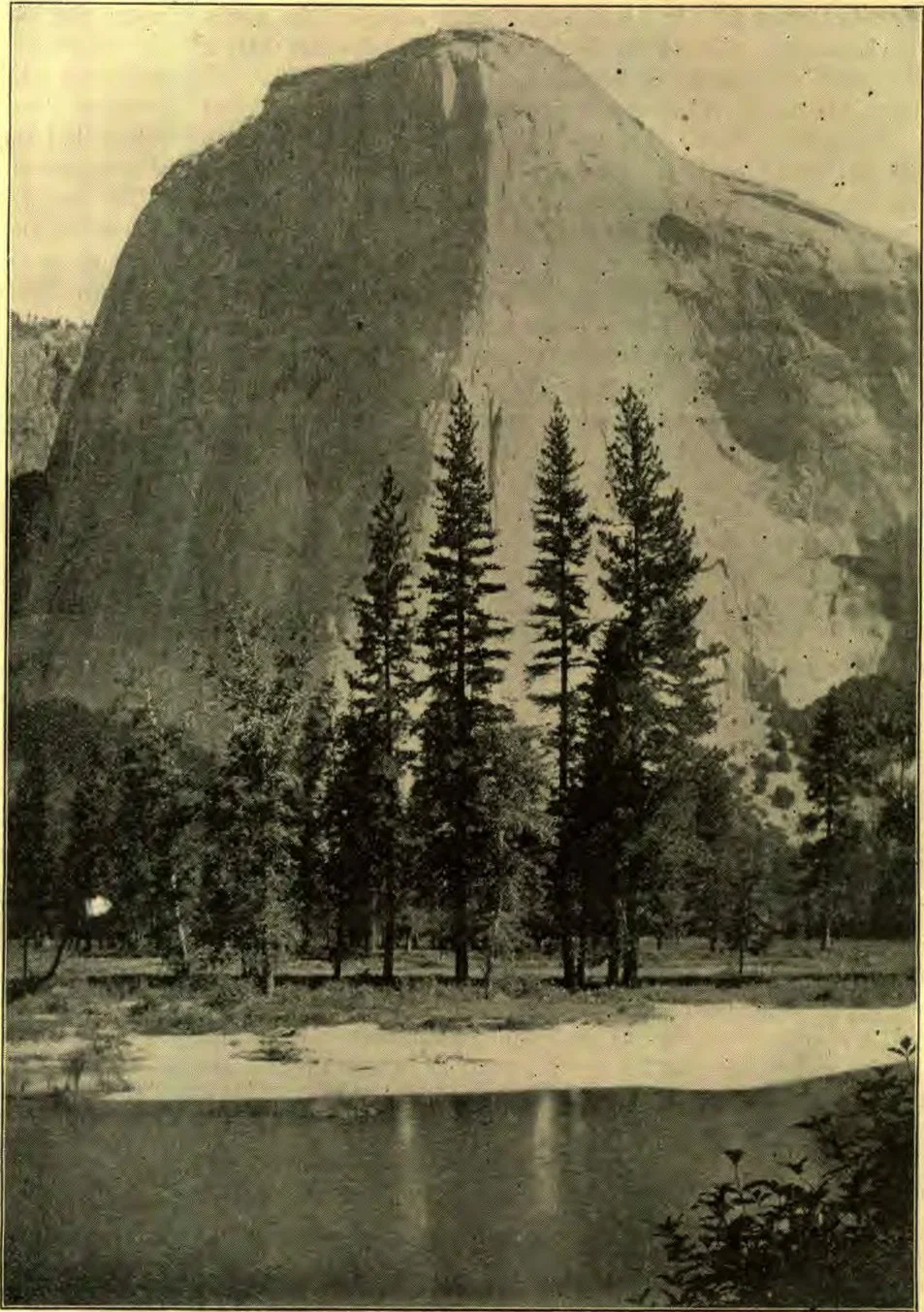
El Capitan. It is three thousand three hundred feet high. More than three times as tall as the Eiffel tower, the highest structure built by man
Photo by Mrs. T. H. Moore, a member of the party.
El Capitan. It is three thousand three hundred feet high. More than three times as tall as the Eiffel tower, the highest structure built by man Photo by Mrs. T. H. Moore, a member of the party.
Bright and early we were on the road again, speeding away toward the mountains, now and then catching a glimpse of their snow-covered crest, and now and again a refreshing breath that seemed to come from their cool abode. It was gratefully received, too; for the San Joaquin Valley does not stop to get warm in the summer-time—it is simply wonderfully hot when the sun is up. We took dinner under the cool shade of a cluster of the largest fig trees in the State, and the ripe figs were not the least portion of that pleasing repast. They grow by the side of the road, and are considered public property. The largest of the trees must have been over sixty feet in height.
When nightfall came again, we were sixty miles nearer our goal than when we folded our tent in the morning, and were now well up in the foothills in a cooler, fresher, more invigorating atmosphere. This place was a well-known mining camp in early days, and is known as Chinese Camp, or Chinese. The Chinese are still there, but there was little evidence now to be seen of the wealth that has been taken out of that part of the golden State. It was Friday night when we arrived at Chinese; so we rested there the following day, “according to the commandment,” and were up long before the sun on Sunday morning; for the great task of the journey was before us—the climbing of Priests’ Hill, that steady, inclined plane of three and one-half miles. There are no level spots on that grade, the same steep pull from the bottom of the hill to the hotel at the top. We all dismounted at the beginning of the grade, and the ladies of the party went ahead on foot. They were at the top nearly an hour before we reached there with the teams. We carried blocks to trig the wheels, and they were in almost constant use. At eleven o’clock we were at the top of the hill, three hours having been consumed in its ascent. One mile an hour is not considered very rapid traveling; but there was more real work in that piece of road than in any other of its length which I have ever seen.
The hillsides along this part of the journey were covered with holes, where the pick and shovel of the mining prospector had been busy testing the ground for “pay dirt,” and little paths ran along the hills from cabin to cabin, looking much like the little paths that the farmer boys find in the fields in the spring from one mouse nest to another.
After a half-hour’s rest at the summit, we drove on to that little mining village whose name has been made famous throughout the West by the number of stage robberies that have occurred in its vicinity—Big Oak Flat. Here we took dinner with the miners in a real miners’ eating house—a rough but good-natured lot of men they were.
We were now in the mountains, and sixty miles a day was an impossibility for horses unaccustomed to mountain traveling. Nightfall found us at Hamilton’s, and an apple orchard was placed at our disposal for a camping place. We were not the only campers there; for a great pipe line was being laid from the headwaters of some river whose name we did not learn, across hills and valleys to a large placer mine, and the workmen were camped in the same orchard. They were a pleasant and gentlemanly lot, and entertained us until a late hour with much better music than one might expect to hear in such a place.
There was nothing in the texture of the ground upon which we spread our blankets to induce one to take a morning nap, so we were up with the birds; and while they were picking up their breakfast, we were picking the ever-present “stickers” from our bedding and clothing. This was the one drawback to the pleasure of a trip through that part of the country; for whatever fabric the “stickers” touch they proceed to go through as if they were alive, and it does not take long to ascertain the direction they are taking. All the grass seems armed with them, and they are as penetrating as the quills of a porcupine.
Some of us had vaguely hoped that by the close of this day we should be at our journey’s end; but such was not to be. After a day of traveling in the midst of most delightful scenery, we found ourselves still within three miles of “The Summit,” and consequently seventeen miles from Sentinel Hotel in the valley. We pitched tent again, this time in the vicinity of some deserted buildings. We thought we had reached a little village; but on investigation found that, though the doors of the buildings were invitingly open, and easy chairs were on the veranda of the principal house, there was no sign of a living human being near. It made a peculiar feeling come over one to find this dead village where we had expected a live one, and the deserted chairs and tables and other furniture added to the uncanniness of the place.
But it was growing late, and by the time we had the horses taken care of, supper prepared and disposed of, darkness had come down over the scene. We were now in the high mountains, and the little cleared patch where we were camped was surrounded by the dense forest. We had not yet rolled ourselves in our blankets, when from every quarter of the dismal woods there came the most hideous noises we had ever heard. It seemed as if the woods were full of howlings, and that a horde of monsters was ready to swoop down upon us in revenge for disturbing the quiet of their abode. We had heard enough of the noise-producing powers of the coyote to know in a moment the source of the disturbance. It is probable that there were not more than two of them, yet it seemed as if the woods were full of them.
The sun was well up next morning before we were again on our way. By nine o’clock we had reached “The Summit,” where we gave the tired horses a rest, while we laid in a supply of fresh bread and milk, procured from the one lone house at this point. Then we began the journey down into the valley. It was ten miles from “The Summit” to the floor of the valley, but unlike Priests’ Hill, it was not steady down grade all the way.
It was not long after leaving “The Summit” until we reached the place known as “Inspiration Point,” where the eye looks out into the blue haze of a deep and far-winding valley. Five paces from the road at this point one could leap into eternity in a moment. We are standing on the side of a great promontory whose foot is seemingly hid in the blue ethereal depths. Miles on miles we can look out over the receding hills, and over the deep, winding valley far below, with a narrow, silvery ribbon threading its floor. It is not Yosemite, but it is a view that is worth a trip to the Yosemite to see.
Before we reached the floor of Yosemite Valley, dinner time had arrived, and people and horses were ready for it. At a sharp turn on the mountainside we took our nooning, and the whole floor of the glorious Yosemite was below us. El Capitan, the guardian of the gate, was towering majestically above us, while across the valley Bridal Veil Fall was shaking out its filmy folds of lace-like spray, whipped into fantastic drapery by the gale that rushes up the face of the cliff over which it pours. Imagine a great, beautiful lace curtain about nine hundred feet in length hanging down the face of a great perpendicular cliff, with the breeze catching it, bending it, folding it up, and swaying it now far to one side, and again far out of its course to the other side, with continual meteors of spray shooting down from the bended body of the fall, and you have a slight likeness of the Bridal Veil. C. M. SNOW.
(To be continued)

The Risen Saviour

“I AM the resurrection, and the life.” He who had said, “I lay down my life, that I might take it again,” came forth from the grave to life that was in himself. Humanity died; divinity did not die. In his divinity, Christ possessed the power to break the bonds of death. He declares that he has life in himself to quicken whom he will.
All created beings live by the will and power of God. They are recipients of the life of the Son of God. However able and talented, however large their capacities, they are replenished with life from the source of all life. He is the spring, the fountain, of life. Only he who alone hath immortality, dwelling in light and life, should say, “I have power to lay down my life, and I have power to take it again.”
The words of Christ, “I am the resurrection, and the life,” were distinctly heard by the Roman guard. The whole army of Satan heard them. And we understand them when we hear. Christ had come to give his life a ransom for many. As the Good Shepherd, he had laid down his life for the sheep. It was the righteousness of God to maintain his law by inflicting the penalty. This was the only way in which the law could be maintained, and pronounced holy, and just, and good. It was the only way by which sin could be made to appear exceeding sinful, and the honor and majesty of divine authority be maintained.
The law of God’s government was to be magnified by the death of God’s only begotten Son. Christ bore the guilt of the sins of the world. Our sufficiency is found only in the incarnation and death of the Son of God. He could suffer, because sustained by divinity. He could endure, because he was without one taint of disloyalty or sin. Christ triumphed in man’s behalf in thus bearing the justice of punishment. He secured eternal life to men, while he exalted the law, and made it honorable.
Christ was invested with the right to give immortality. The life which he had laid down in humanity, he again took up and gave to humanity. “I am come,” he says, “that they might have life, and that they might have it more abundantly.” “Whoso eateth my flesh, and drinketh my blood, hath eternal life; and I will raise him up at the last day.” “Whosoever drinketh of the water that I shall give him shall never thirst; but the water that I shall give him shall be in him a well of water springing up into everlasting life.”
All who are one with Christ through faith in him gain an experience which is life unto eternal life. “As the living Father hath sent me, and I live by the Father: so he that eateth me, even he shall live by me.” He “dwelleth in me, and I in him.” “I will raise him up at the last day.” “Because I live, ye shall live also.”
Christ became one with humanity, that humanity might become one in spirit and life with him. By virtue of this union in obedience to the word of God, his life becomes their life. He says to the penitent, “I am the resurrection, and the life.” Death is looked upon by Christ as sleep,—silence, darkness, sleep. He speaks of it as if it were of little moment. “Whosoever liveth and believeth in me,” he says, “shall never die.” “If a man keep my saying, he shall never taste of death.” “He shall never see death.” And to the believing one, death is but a small matter. With him to die is but to sleep. “Them also which sleep in Jesus God will bring with him.”
While the women were making known their message as witnesses of the risen Saviour, and while Jesus was preparing to reveal himself to a large number of his followers, another scene was taking place. The Roman guard had been enabled to view the mighty angel who sang the song of triumph at the birth of Christ, and hear the angels who now sang the song of redeeming love. At the wonderful scene which they were permitted to behold, they had fainted and become as dead men. When the heavenly train was hidden from their sight, they arose to their feet, and made their way to the gate of the garden as quickly as their tottering limbs would carry them. Staggering like blind or drunken men, their faces pale as the dead, they told those they met of the wonderful scenes they had witnessed. Messengers preceded them quickly to the chief priests and rulers, declaring, as best they could, the remarkable incidents that had taken place.
The guard were making their way first to Pilate, but the priests and rulers sent word for them to be brought into their presence. These hardened soldiers presented a strange appearance, as they bore testimony to the resurrection of Christ, and also of the multitude whom he brought forth with him. They told the chief priests what they had seen at the sepulcher. They had not time to think or speak anything but the truth. But the rulers were displeased with the report. They knew that great publicity had been given to the trial of Christ, by holding it at the time of the Passover. They knew that the wonderful events which had taken place—the supernatural darkness, the mighty earthquake—could not be without effect, and they at once planned how they might deceive the people. The soldiers were bribed to report a falsehood; and the priests guaranteed that if the matter should come to Pilate’s ears, as it most assuredly would, they would be responsible for the action of the soldiers. They bribed Pilate to silence, and by special messengers sent the report they had prepared to every part of the country.
MRS. E. G. WHITE.

A Sensible Printer

A NEW ORLEANS paper tells of a printer who, when his fellow workmen went out to drink beer during working hours, put in the bank the exact amount which he would have spent if he had gone out to drink with them. He kept to his resolution for five years. He then examined his bank account and found that he had on deposit $521.85. In the five years he had not lost a day from ill health.
Four or five of his fellow workmen had, in the meantime, become drunkards, were worthless as workmen, and were discharged. The water drinker bought a printing-office, went on enlarging his business, and in twenty years from the time he began to put by his money, was worth one hundred thousand dollars.—Youth’s Friend.

Secret Prayer

“SECRET prayer is the secret of prayer.”

Doing God's Work Without Noise and Bustle

“We mar our work for God by noise and bustle; Can we not do our part and not be heard?”

A Simple Work Basket

(Concluded)
For stakes cut nineteen pieces of No. 4 reed thirteen inches long. Point one end of each by a slanting cut with the shears. Place base and stakes in hot water for a few moments; then lay the base, convex side up, on the table; at the right of any spoke push the awl through the weaving as far toward the center of base as possible; withdraw it; and insert the pointed end of a stake. It should enter the base a distance of at least one and one-half inches. In the same manner place a stake at the right of each spoke.
FIG. 4
FIG. 4
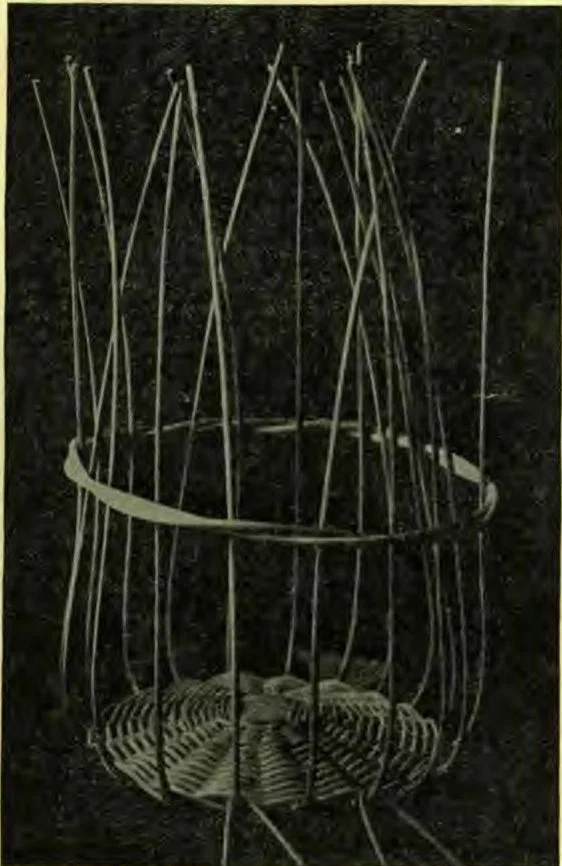
Coil a piece of reed to form a ring about the size of base. Gather up the loose ends of stakes, and slip the ring over them. Fig. 4. Be sure to have convex side of base on inside of basket. Give the lower part of stakes the shape you wish the basket to assume, and allow to partly dry in that position. Take two long well-soaked No. 3 weavers; measure off from one enough to loosely compass the basket; bend as previously directed, slip the loop over any stake, leaving the short end at the left. Bend the second weaver near the center, and slip over second stake at right of one just used. Fig. 4.
FIG. 5
FIG. 5
This basket will have a rope twist around the bottom.
FIG. 6
FIG. 6
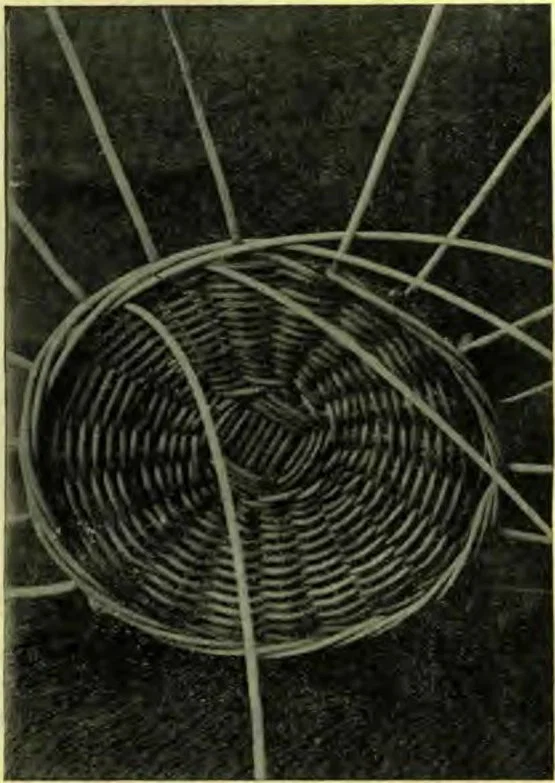
To form it remove the ring, place the basket on its side with the bottom toward the worker; take the weaver at the left (the short end), pass it over the other three weavers, in front of three stakes, and back of one stake, and out at first vacant space at right. Repeat, taking the left-hand weaver each time until you have worked entirely around the basket. Draw very tight at each stroke, so that the rope will lie close against the base, entirely covering the ends of the spokes. The importance of having this part of the work very tight can not be too strongly emphasized. This is really the joint which unites the base and sides. The rope and the method of forming it are shown in Fig. 5.
FIG. 7
FIG. 7
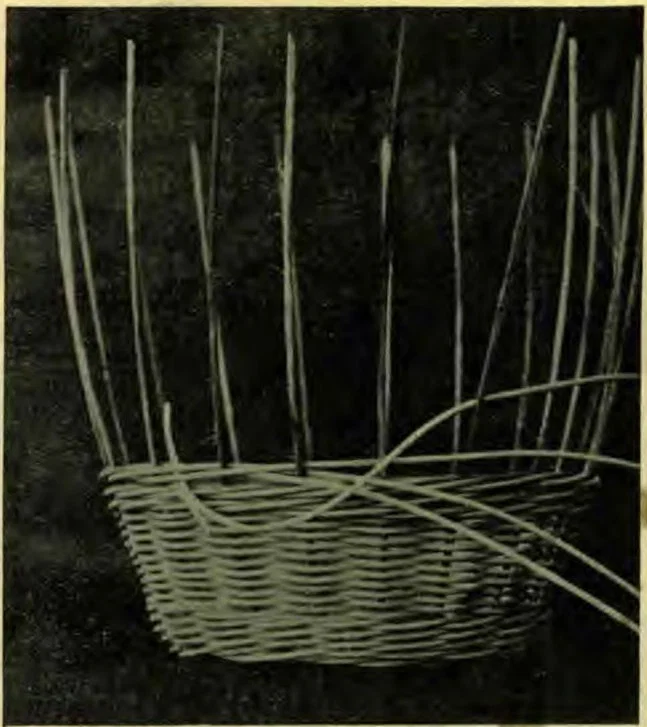
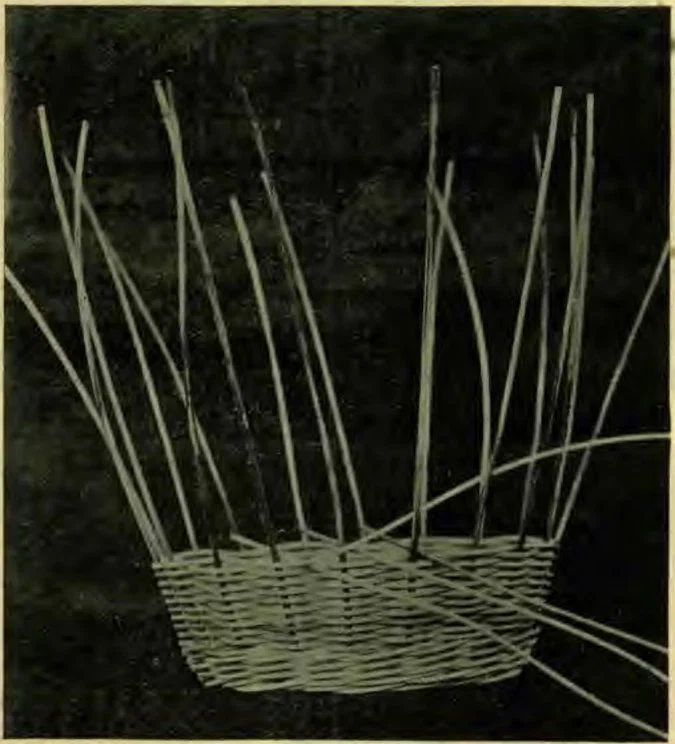
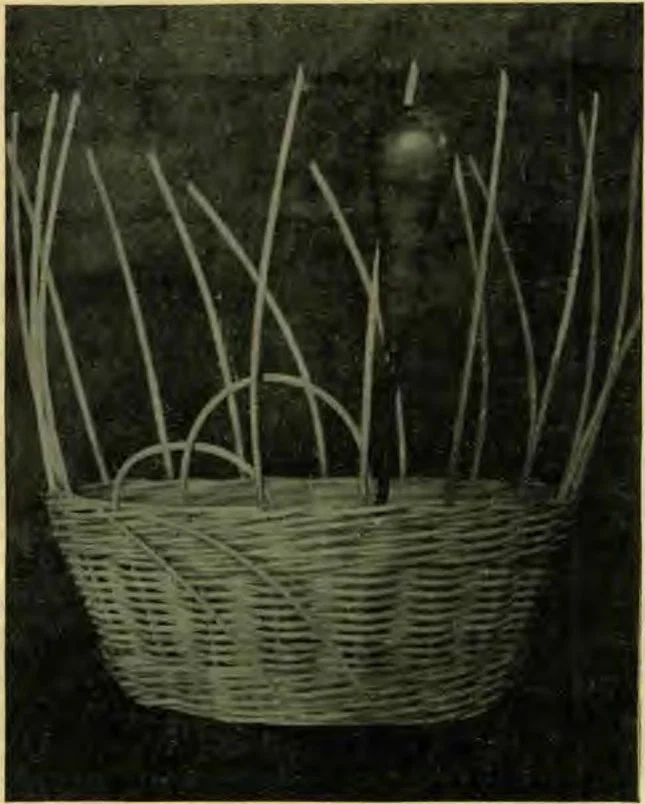
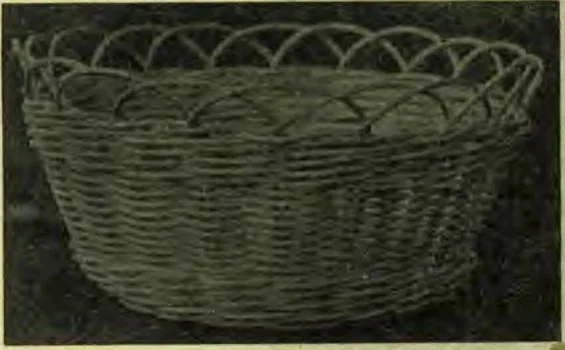
At the finishing point of the rope drop the short weaver, and with the remaining three weavers form four rows of triple twist by passing left weaver over the other two, in front of two stakes, back of one stake, and out at first space to right. Let the weaving be drawn tight enough to give the basket the desired shape. To splice either the triple or waling twist, bring the short end forward, insert a new weaver behind it, and proceed as before, leaving the end of the old weaver on the outside, and one end of the new weaver inside, to be trimmed short when the work is finished. Method of splicing is shown in Fig. 6. When the four rows of triple twist are completed, drop two weavers by cutting them so each end will rest against a stake on inside of basket. The rope and the triple twist form the “upset.” Use the one remaining weaver for single weaving—in front of one stake and back of the next. Keep the stakes bent slightly outward, and see that the slant is uniform. To splice single weaving leave the last end of the old weaver and the first end of the new one back of the same stake. When sufficiently high,—about one and one-half inches of single weaving,—insert three long weavers, one in each of three consecutive spaces just in front of weaver already in use. Fig. 7. Form the waling twist by passing left weaver over two weavers, in front of two stakes, back of two stakes, and out at first space to right. Repeat, using left weaver each time. Remember the method of splicing already given. Placing the weaver back of two stakes makes the work the same inside and out. Complete four rows of waling twist; drop two weavers, leaving ends inside, each cut to rest against a stake. With the remaining two weavers, form one row of pairing by placing one weaver before and the other back of the same stake, crossing weavers between stakes. When the row is completed, bring both weavers to the front under last row of weaving. Fig. 8. Trim each to rest against a stake. This binds off the work ready for open border. Cut stakes to six and one-half inches with slanting cut. Take any stake, pass it to right back of two stakes; at right of second stake push it down through the waling, siding, and upset, leaving a loop at top about one inch deep. Fig. 8. Use the awl to open a passage for the stake. Treat each stake in the same manner, giving special attention to the placing of the last two. This lesson thoroughly mastered will make the succeeding ones easy.
FIG. 8
FIG. 8
FINISHED BASKET
FINISHED BASKET
MRS. EMMA M. LONG.

January Field Study

(January 14)
Opening Song.
Service of Prayer.
Scripture Reading.
Song.
Remarks by the Leader: What we can do for missions during 1905.
Field Study:—
Malaysia.
India and its needs.
A trip to South America.
Peru unentered.
Brief map exercise, locating recent openings in mission fields.
Closing Exercises.

Notes

The following texts may be used as a Scripture reading. In this way a large number can take part.

Missions

The Provision to Supply: Luke 2:30-32; 1 John 4:14; John 3:16, 17.
The Prophecy: Isa. 49:6; Matt. 24:14; Acts 1:8.
The Commission: Rev. 10:11; Matt. 28:18-20.

Ingathering Service at Columbus, Ohio

SEPTEMBER 24 the Columbus church held their first “Harvest Ingathering” service, and it surely was a day long to be remembered on account of God’s presence.
Last spring, at one of our children’s meetings, the plan of a “Harvest Ingathering” service was presented, and each child was provided with a little bag in which to save his earnings. All were enthusiastic, and their little heads seemed full of plans for earning money to give the gospel in the regions beyond. The hope and earnestness of the children inspired many an older heart, and all went to work with a determination to “do with our might what our hands find to do.”
At last the long-expected day came. The house of God had put on a festive garment such as God alone can provide. Tall, majestic corn with its golden ears gleaming through the foliage, beautiful goldenrod which seemed to have stored all the sunshine, flowers, berries, and leaves from the forest in all their autumn glory proclaimed that God is good, and refreshed our weary eyes. Kind friends had loaned a profusion of potted plants, and these, with the many flowers of every kind, made a beautiful place of the house of worship. Every heart was softened and subdued, and when the children came marching from the room below, each carrying a small sheaf and singing “Bringing in the Sheaves,” our hearts sent up the prayer that at last we might all lay a sheaf at the Saviour’s feet, just as the children brought their sheaves to the altar. Appropriate songs, with prayer and Scripture readings by the elders, were part of the program. Among the interesting features, the kindergarten and primary classes deserve to be mentioned. As they stood on the platform, the very smallest one in the front holding a beautiful lily while quoting Matt. 6:28, 29, then all together singing “God Made the Lilies,” many an eye became dim, and silent prayers were offered that God might keep his little people as white as the lilies. The intermediate class of girls gave an instructive Bible reading on “The Gospel Commission and How We Should Give.”
But the best of all was when eight boys with little white baskets stood before us, each one repeating a verse, while the four smallest went among the congregation to take up the offering. The children marched around and dropped their bags into the two larger baskets held by the remaining four boys. When all was gathered, they held up their baskets and presented their offering to the Lord, and asked his blessing upon it, that it might aid in giving the bread of life to hungry souls.
While the offering was being counted, the children told how they had earned their money. Some had missionary hens, some gardens. Others had mowed lawns, picked berries, sold vegetables, scissors, the Little Friend, the Life Boat, and Signs. Those too small to work had saved their pennies, and as result the little bags ranged all the way from fifty cents to five dollars. More than fifty-nine dollars was collected. The older people offered heartfelt praise to God for what their eyes had seen and their ears heard.
“Praise God from Whom all Blessings Flow” closed this, our first Harvest Ingathering service, which I hope was only a beginning in this direction. MRS. LENA GRANMAN.

“El Hafed”

Upon the banks of Indus long ago El Hafed dwelt, with modest wealth content. His orchard trees their weighted boughs hung low; His grain fields caught the sunbeams’ golden glow; His money was for honest gain well lent; A gentle wife sat ’neath his roof tree’s shade, And happy children in his garden played.
There came one day, within his door to rest, A Persian priest, El Hafed’s countryman; And as he entertained his welcome guest, The conversation, howe’er it began, Always on diamonds, ere it ended ran.
“One diamond, though no larger than your thumb, Would buy your fields and orchards, fair and wide,” The priest declared; “of many such, the sum Would make you lord of all the countryside.”
El Hafed listened long; and as he heard, His acres shrank; he felt that he was poor, To discontent his tranquil soul was stirred, Until his heart with envious longing burned, And all his slowly gotten wealth he spurned.
And to the priest he said: “Now tell me where Others have found these gems in richest store, And I will journey far to seek them there.”
“Where rivers deep o’er beds of white sand flow, ’Twist mountains high—there are the diamonds found.”
So spoke the priest. In anxious haste to go, His host disposed of orchard, house, and field To one content with sure though moderate yield; And soon ’twas known through all the country round El Hafed to the diamond fields was bound.
Long years he wandered, and in many lands; Looked on the pyramids, and later trod, Always with searching eyes and empty hands, The regions hallowed by the Son of God.
He passed to Europe; where proud rivers flow ’Neath mountain crags crowned with eternal snow His quest he urged, in valleys far and nigh Sought vainly for the diamond’s flashing eye.
At last he stood by Barcelona Bay. Heart-broken, weary, hungry, bowed with care; Gazed long where sunlit waters stretched away, Whose calmness seemed to mock his own despair. “No more for wealth I long; but peace I crave,” El Hafed sighed, and sought it ’neath the wave; And the blue sea smiled on above his grave.
One day there came again the Persian priest, El Hafed’s countryman and former guest, And sat within the door to rest himself, And glancing idly round the room, espied A gleam of light from something on a shelf. “And has El Hafed then returned?” he cried, “With wealth to purchase all the countryside? Yon diamond’s flash betokens prosperous quest.”
But he who dwelt there calmly made reply: “That is no diamond; ’tis a stone I took From out the sand beside the garden brook. One day I led my camel down to drink; And, as I waited there upon the brink, This point of light flashed out and caught my eye; I had forgotten that I laid it by.”
Forth to the brook in haste the Persian came, Followed his host; and, as they stirred the sands, Lo, other gems more precious than the first, Kissed by the sunlight, into splendor burst Or unresponsive lay within their hands. El Hafed’s garden held within its bound The wealth he sought afar, but never found.
Its owner made himself an honored name, That still is read upon the scroll of fame.
Why point a moral when there is no need, Since ’tis so plain that “he who runs may read?” —Selected.

Mystic Maidens of the Silver Shield

“WE, the undersigned members of The Mystic Maidens of the Silver Shield, do solemnly promise:—
1. To think kindly and lovingly of one another, and to be charitable in our judgments of every one.
2. Not to be fretful or faultfinding, but always to hope for the best.
3. To be patient with one another and with ourselves.
4. To have courage to do right under all circumstances, and that means to act right, to read good books, and to choose good companions.
5. To be polite to every one, to our own family and to one another as well as to strangers, on the street as well as in company.
6. To think the best of every one, and to believe in and trust one another.
7. To be just always, and that means never to speak evil of any one.”
The secret of attaining the beautiful ideals portrayed in these seven rules lies in seeking through the Saviour strength to live a sincere Christian life. A young woman whose life reveals the fragrance of holy living is one of the chief charms of earth.

Notice to Basket Makers

WHERE TO GET THE MATERIAL.—The necessary material for making the basket described in this article, and also for the one illustrated in the INSTRUCTOR of December 20, can be secured for thirty-five cents each, postpaid, if ordered at once. This is an especially low price, and orders should be sent in promptly, with remittance accompanying. Address South Lancaster Academy, South Lancaster, Massachusetts.
Continue reading: What Is the Way?