The Youth’s Instructor, Vol. 30, No. 31.

PUBLIC PARKS

The Youth’s Instructor

Aug 2, 1882

S. D. A. Publishing Association · Battle Creek, Mich. · Aug 2, 1882

PUBLIC PARKS.
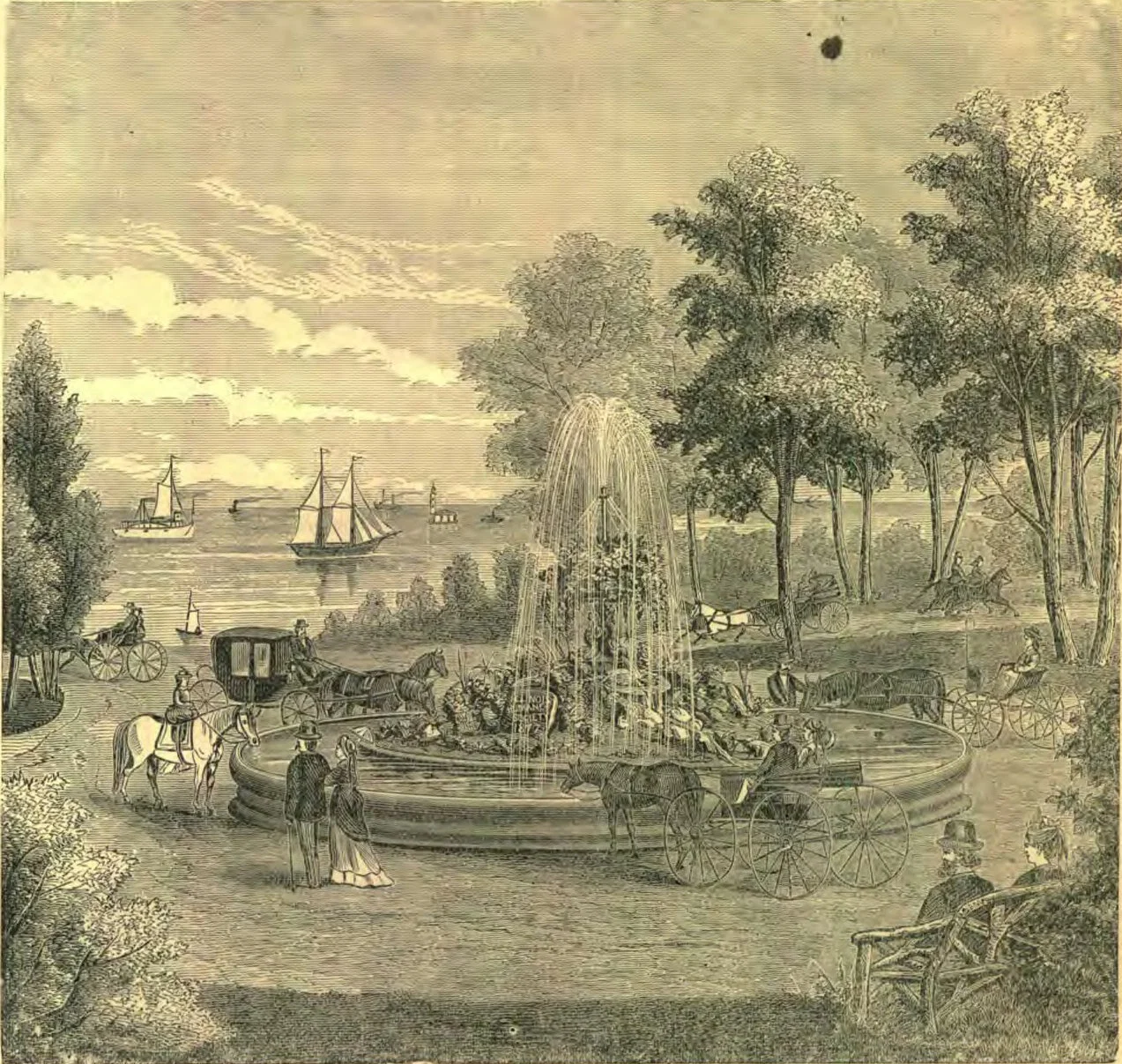
MAN seems to possess an inbred desire to enjoy the delights and beauties of nature. Although often deprived of such enjoyment by being obliged to labor in the cities where the artificial often crowds out the natural, yet we see his longings and desires manifested in frequent excursions to quiet, retired places in the country, where, uninterrupted by the busy cares of city life, he may rest, and recover health and strength in viewing the natural beauties around him.
It is, undoubtedly, for the purpose of satisfying this demand, as far as possible, that the large cities have established parks, where the rich and poor may resort to enjoy themselves. Thus New York has its Central Park, covering an area two and one-half miles long and one-half mile wide. This is perhaps the most interesting to the public of all the parks in the United States, and is visited at times by at least 100,000 persons in a single day. Philadelphia has its Fairmount Park, which covers a still larger area than Central Park; Boston boasts of its Common; Brooklyn inhabitants recreate at Prospect Hill, and Baltimore, St. Louis, and other cities all have their parks, which they make as beautiful as possible for the enjoyment of the people.
Our illustration gives a very fine representation of one of the entrances to Lincoln Park, to which Chicago points with especial pride as being the largest and most beautiful park in the city. The fountain in front was placed there by the Illinois Humane Society, a society that was established for the prevention of cruelty to animals. The park borders on Lake Michigan, where, in the distance, may be seen a peculiarly shaped house surmounted with a tower. This is called the “crib.” What is that house placed there for? some of our young readers may ask.
Well, the “crib” is at the end of a tunnel three miles in length, which has been dug from the land, under the bottom of the lake. At the “crib” a large fine sieve covers the opening of the tunnel, through which the pure, fresh water from the lake flows in, and is conducted by the tunnel to the water works, situated on the shore of the lake. The water works contain four large and very powerful steam pumps, which force the water through iron pipes laid in the streets, to all parts of the city. It is in this way that the fountain in our engraving is supplied with water. Chicago’s system of parks embraces an area of over 2,000 acres, divided between six or seven parks, all of which are connected by broad parkways, or boulevards, as they are called, so that a person can drive all around the city following these boulevards, and pass through the principal parks, such as Humboldt, Central, South, and Lincoln Parks. These are the largest and most beautiful parks in the city, and they are visited during the summer by thousands of people, especially on Sundays.
South Park is approached from the north by a wide, wood-paved boulevard, in the middle of which extends a winding gravel walk, ornamented with smooth lawns, beautiful flower beds, and fine shade trees.
Lincoln Park is situated in the northern part of the city, on the shore of Lake Michigan. With its well-kept lawns, large, noble shade trees, miles of drives and walks, beautiful flower beds and conservatories, and the cool, refreshing breezes from the lake, it is not astonishing that it is so well patronized as it is. Here the poor man can take his family, away from the close, dingy city, and, free from care and labor,
“Look through nature up to nature’s God.”
The student of natural history may also find here something of interest to him. In a large basin, supplied with cold, fresh water from a never-failing artesian well, may be seen a couple of sea-lions, basking in the water, as though they were in the sea. Further on are large cages containing alligators, turtles, owls, eagles, doves, squirrels, crows, Guinea fowls, prairie chickens, quails, &c. At another place are dens, containing wild cats, foxes, wolves, bears, raccoons, &c.
One of the most interesting sights, and one which continually attracts a great many people, is a colony of prairie dogs. They are enclosed in a hollow, from which they cannot escape, and in this they have their mounds and holes. They do not seem to be very industrious, as they appear to be continually playing. Their amusing antics are watched by a great many people. All of these animals are in a public place in the park, where they may be seen free of charge.
These places of resort are certainly a great benefit, especially to the poorer classes in the cities, and the city governments are certainly deserving of praise for their kindly efforts in the direction of furnishing public places of rest and recuperation for the weary, confined city dwellers, and of improving and beautifying the surroundings of the people.
A B. OYEN.

SONG OF THE SUMMER WINDS.

Up the dale and down the bourne, O'er the meadow swift we fly; Now we sing, and now we mourn, Now we whistle, now we sigh.
By the grassy fringèd river, Through the murmuring reeds we sweep; Mid the lily-leaves we quiver, To their very hearts we creep.
Through the blooming groves we rustle, Kissing every bud we pass,— As we did it in the bustle, Scarcely knowing how it was.
Down the glen, across the mountain, O'er the yellow heath we roam, Whirling round about the fountain, Till its little breakers foam.
Bending down the weeping willows, While our vesper hymn we sigh; Then unto our rosy pillows On our weary wings we hie. —George Darley.

“COME ALONG, BROTHER.”

“Why! what is the matter, Uncle Robert?” asked Herbert in astonishment, as his uncle laughed out loud, and laughed and laughed again.
“I’ll try to tell you,” responded Uncle Robert. “I was thinking of the old rhyme that we used to sing when we were boys and girls:
“If I had a donkey and he wouldn’t go, Do you think I’d wallop him? Oh, no! no! I’d give him some corn, and I’d say, Go on, Gee up Neddy!”
and then I thought of a story that I had read one day, and the comical picture with which it was illustrated. As I thought of all this, I thought of a boy I know and—
“Oh, but please never mind about the boy, uncle; tell me about the donkey,” interrupted Herbert.
“I will. Some men wished to get a donkey on board a ship, but vainly attempted to induce him to walk the gang plank, which led from the pier to the vessel. Threats and angry words failed, and so did beating and kicking.
“By and by one of the men positively put his arms around the donkey’s neck, and in the most coaxing manner possible, said to the obstinate donkey: ‘Come along, brother.’ Would you believe it!—away went the donkey most contentedly. The bystanders laughed, but, Herbert, I could not help thinking you might get a suggestion here.”
“Why, uncle, what could I learn from a donkey?”
“To tell you the truth, nephew, it was something concerning yourself that led me to think of the donkey. Did not a boy whom you know, this very morning, get very angry because his brother would not come and play with him? Did he not threaten to tell father, and call his disobliging brother ugly names?”
A strong glow of crimson rose just at this time to Herbert’s cheeks, that said, ‘Yes,’ as distinctly as lips could have spoken it.
“Now, nephew, that boy failed to make his brother budge an inch, and so he has been lonesome and miserable for an hour or more. For future guidance, I am going to suggest the use of what I shall call the ‘Come-along-brother’ plan. Do you understand?”
Uncle Robert was quite sure that Herbert did understand, when, not many hours after, he heard the merry shouts of the lad and his brother Willie in the garden. Though proof against threats and anger, Willie had yielded to Uncle Robert’s “Come-along-brother” plan.
“Upon my word,” said the good hearted man, “I do believe my remedy is like some of those nostrums advertised everywhere, which are warranted equally good for man and beast; and, after all, there is a good deal of the donkey nature in every one of us.”—New York Observer.

I CAN AND I WILL.

HOW MANY boys there are who can, but never do, because they have no will power, or, if they have, do not use it! Before undertaking to perform any task, you must carefully consider whether you can do it, and once convinced that you are able to accomplish it, then say, “I will do it,” with a determination that you will never give it up till it is done, and you will be successful. The difference between “Give up” and “I can’t” and “I can and I will” is just the difference between victory and defeat in all the great conflicts of life.
Boys, adopt for your motto, “If I can, I will,” and victory will be yours in all life’s battles. “I can and I will” nerves the arm of the world’s heroes to-day, in whatever department of labor they are engaged. “I can and I will” has fought and won all the great battles of life and of the world.
I know of a boy who was preparing to enter the Junior Class of the New York University. He was studying trigonometry, and I gave him three examples for his next lesson. The following day, he came into my room to demonstrate his problems. Two of them he understood, but the third—a very difficult one—he had not performed. I said to him:—
“Shall I help you?”
“No, sir, I can and I will do it if you will give me time.”
I said, “I will give you all the time you wish.”
The next day he came into my room to recite another lesson in the same study.
“Well, Simon, have you worked out that example?”
“No, sir!” he answered, “but I can and will do it, if you will give me a little more time.”
“Certainly, you shall have all the time you desire.”
I always like these boys who are determined to do their own work, for they make our best scholars, and men, too. The third morning, you should have seen Simon enter my room. I knew he had it, for his whole face told the story of his success.
Yes, he had it, notwithstanding it had cost him many hours of the severest labor. Not only had he solved the problem, but what was of infinitely greater importance to him, he had begun to develop mathematical powers which, under the inspiration of “I can and I will,” he has continued to cultivate, until to-day he is professor of mathematics in one of our largest colleges, and is one of our ablest mathematicians of his years in the country.
My dear young friends, let your motto ever be: “If I can, I will.”—Golden Days.

THE SCARECROW.

“Those are the robbers!” grandpa said To neighbor’s boy, Gold-locks, and Ted, Out on the doorstep. As he spoke, Over toward a distant oak He pointed, where in fluttering rows Were perched the black and noisy crows
Brown, and smelling an earthy sweet, The field spread out beneath the heat, With faintest lines of green to show Where the corn had just begun to grow; Hither had come the thieves in flocks— “Little black hens,” said wise Gold-locks.
“What shall we do?” with aspect grim, To the three small folks who watched with him, Said grandpa—he whose gentle hand Spared even the spoilers of his land, And who always planted thoughtfully With an eye to squirrel, bird, and bee:
His frown was only a thin disguise To hide the gentleness of his eyes; For the veriest worm before his tread Could lift unhurt its humble head. But Ted, half cheated by his tone, Thought gravely something must be done.
“We’ll build a scarecrow, Jack, hurrah!” (Hark! distant answer—“Caw, caw, caw!”) And, glad of a novel work to do, Up to the attic stores they flew; Sought for the worst of everything; Then off to the field went scampering.
There, soon, a figure gaunt uprose, With grandpa’s long-discarded clothes Hung from its limbs, no fit at all, Too large in parts, in parts too small, His hat upon its bristling hair, Waving a threatening arm in air.
What did the sentry on the bough Say to his pilfering comrades now? Why, when the direful thing he saw, He croaked serenely, “Caw, ca-aw, ca-a-aw!” And still along the corn’s green track Stalked the thieves in glistening black.
Never a stately step showed fright, Never a wing took hurried flight; But still the flocks came, day by day, To find where the yellow kernels lay. No whit did the saucy creatures care For the broom the scarecrow waved in air.
Gold-locks puzzled her little mind, The secret of their ways to find; She pondered; counseled much with Ted, And, at last—a bright discovery—said: “I know: if we wanted to scare the crows, We shouldn’t have put on grandpa’s clothes!”
— Wide Awake.

AGAINST JESUS.

WHEN it is remembered that Jesus left his glory in heaven, came down to earth, and took on himself the form of a servant, and became obedient to death, even the death of the cross, to save the children of men from that eternal ruin to which they had exposed themselves by sin, it would seem impossible that a human heart could be found that was against him. To be against one who had always sought our ruin would not seem strange, but to be against one who did more to prove his love for us than all beside, is so strange that we cannot account for it in any other way than to conclude that the spirit of the great enemy of Jesus, Satan, must dwell in human hearts. Jesus himself says, “He that is not for me is against me.” To be for Jesus is to believe in the heart that he is what he claims to be, “The Christ, the Son of the living God”—that he is right on all questions upon which he has expressed his mind, and then take a stand with him, advocate his cause, and oppose everything that he would oppose.
How many of us are thus for Jesus? Remember that it matters not what our claims to morality may be, what our profession may be, if we are not over on his side really and actively, we are regarded by him as against him.
Can it be that many of our dear young readers are against Jesus? See once where you are. Oh, do be the friends of Jesus, for he is indeed your dearest friend.

SCENES IN THE LIFE OF CHRIST.

LESSON 80.—OUR SAVIOUR'S LAST JOURNEY.

“And the disciples were astonished at his words. But Jesus answereth again, and saith unto them, Children, how hard is it for them that trust in riches to enter into the kingdom of God! It is easier for a camel to go through the eye of a needle, than for a rich man to enter into the kingdom of God. And they were astonished out of measure, saying among themselves, Who then can be saved? And Jesus looking upon them, saith, With men it is impossible, but not with God; for with God all things are possible.” As it would require a miracle for a camel to pass through the eye of a needle, so it requires a miracle as great, or even greater, to make a sinful man fit for the kingdom of heaven. We cannot save ourselves, without the help of God, any more than a camel could pass through the eye of a needle. But with the help that God freely offers to give, all may be saved who will believe in Jesus, submit to him, and be obedient. The spirit of God working upon the heart can cause a rich man to think less of his money than of his God, and his fellow-men, and to use it in doing good.
“And they were in the way, going up to Jerusalem, and Jesus went before them; and they were amazed; and as they followed, they were afraid. And he took again the twelve, and began to tell them what things should happen unto him, saying, Behold, we go up to Jerusalem; and the Son of man shall be delivered unto the chief priests, and unto the scribes; and they shall condemn him to death, and shall deliver him to the Gentiles: and they shall mock him, and shall scourge him, and shall spit upon him, and shall kill him; and the third day he shall rise again.” Plain as were these words of our Saviour, the disciples did not understand what he meant. It seems that it was not best for them to understand these things until they should come to pass. When our Saviour's words were fulfilled, then the disciples remembered that he had spoken them, and their meaning was plain.
It was on this same journey that James and John, the sons of Zebedee, were so anxious to know that they were to have a place of honor when Jesus should set up his kingdom. “Then came to him the mother of Zebedee's children with her sons, worshiping him, and desiring a certain thing of him. And he said unto her, What wilt thou? She saith unto him, Grant that these my two sons may sit, the one on thy right hand, and the other on the left, in thy kingdom. But Jesus answered and said, Ye know not what ye ask. Are ye able to drink of the cup that I shall drink of, and to be baptized with the baptism that I am baptized with? They say unto him, We are able. And he saith unto them, Ye shall drink indeed of my cup, and be baptized with the baptism that I am baptized with; but to sit on my right hand, and on my left, is not mine to give, but it shall be given to them for whom it is prepared of my Father. And when the ten heard it, they were moved with indignation against the two brethren. But Jesus called them unto him, and said, Ye know that the princes of the Gentiles exercise dominion over them, and they that are great exercise authority upon them. But it shall not be so among you; but whosoever will be great among you, let him be your minister; and whosoever will be chief among you, let him be your servant; even as the Son of man came not to be ministered unto, but to minister, and to give his life a ransom for many.”
It always makes trouble when people get anxious to be placed above others, and besides this, God is very much displeased with such a spirit, either in men or in children. Instead of following the example of the wicked world, we should look to the life of Jesus, and learn of him who was meek and lowly in heart.

QUESTIONS.

  1. With whom was Jesus talking in the latter part of the last lesson? Matt. 19 : 16-22; Mark 10 : 17-22; Luke 18 : 18-23.
  2. To whom did he make his last remark? Mark 10 : 23.
  3. How did the disciples receive his words?
  4. What stronger statement did he then make?
  5. How did this affect them?
  1. What did they say among themselves?
  2. What explanation did Jesus make?
  3. What is required to fit sinful men for the kingdom of heaven?
  4. What would be as difficult for us, as for a camel to pass through the eye of a needle?
  5. How may all be saved?
  6. What help does God offer to give? Luke 11 : 13; Ezek. 36 : 26, 27.
  7. What are we to do on our part?
  8. What effect may the spirit of God have upon a rich man's heart?
  9. To what place did Jesus go soon after raising Lazarus from the dead? John 11 : 53, 54.
  10. Why did he go there?
  11. What do we next learn about his journeying? Matt. 20 : 17; Mark 10 : 32.
  12. For what purpose did he take the twelve disciples apart and talk with them?
  13. What did he say was about to be done to him at Jerusalem?
  14. What did he say should take place on the third day after his death?
  15. Did the disciples understand the true meaning of what the Saviour said? Luke 18 : 34.
  16. When were these words remembered and understood?
  17. For what did James and John become very anxious, as they were on this journey?
  18. Whose sons were they?
  19. Tell how they were called to be disciples.
  20. What request did their mother now present to Jesus? Matt. 20 : 20.
  21. What did Jesus say to her? Verse 22.
  22. What question did he ask them?
  23. How did they reply?
  24. What did Jesus promise them?
  25. Why could he not grant their request?
  26. How did the ten feel when they heard what James and John desired?
  27. When Jesus had called them to him, what did he say about the Gentiles?
  28. What entirely different course did he say should be pursued among his disciples?
  29. What did he say about his own example?
  30. What always follows when people get anxious to be placed above others?
  31. How does God regard such a spirit, either in men or in children?
  32. What should we do instead of following the example of the wicked world in these things?

NEW-TESTAMENT HISTORY.

LESSON 93.—REVIEW.

1. How did Jesus illustrate the rebellious course of the Jews, by a parable concerning the marriage of a king’s son? Matt. 22:1–6.
2. How did he in the same parable indicate the punishment which awaited this wicked nation? Verse 7.
3. How did he illustrate the preaching of the gospel to the Gentiles?
4. How was the work of the investigative Judgment brought in?
5. Who tried to entangle Jesus in his talk?
6. Describe the attempt made by the messengers they sent.
7. Tell how Jesus confounded them.
8. What other sect made a similar attempt the same day?
9. Give an account of their effort.
10. How did Jesus answer them, and to what effect?
11. How did he disprove their peculiar doctrine?
12. What question was asked Jesus by a Pharisee who was a lawyer?
13. Repeat our Lord’s answer.
14. How did the lawyer acknowledge the wisdom of this reply?
15. What questions did Jesus then propose to the Pharisees, and with what result?
16. Repeat the warnings that Jesus gave the people against the Pharisees. Matt. 23:1–3; Mark 12:38–40; and Luke 20:45–47.
17. In what way did Jesus show how gifts are valued in the sight of God? Mark 12:41–44; Luke 21:1–4.
18. Tell how certain Greeks sought an interview with Jesus? John 12:20–22.
19. What did Jesus on this occasion say concerning his own death?
20. To what objection did these remarks give rise?
21. What wonderful miracle was performed in token of the divine mission of Jesus?
22. Why were the Jews unable to believe when they had such evidences presented to them?
23. How did Jesus talk concerning his mission? John 12:46–50.
24. As Jesus was leaving the city, at close of the day, on Tuesday, what words passed between him and his disciples concerning the buildings of the temple? Matt. 24:1, 2; Luke 21:5, 6; Mark 13:1, 2.
25. When they had gone out as far as the Mount of Olives, and sat down there, what questions did the disciples ask him?
26. Relate the brief outline of history which he gave them.
27. What did he say to them about the destruction of Jerusalem?
28. What did he say about the great persecution which the church was to suffer?
29. What did he say about the signs which were to follow close upon this persecution, and immediately precede his coming?
30. How did he describe his coming?
31. What did he say they must do when they should begin to see these things come to pass?
32. What other admonitions did he give them?
33. What duty did he especially seek to impress? Mark 13:33–37.
34. By what parable did he seek to enforce it? Matt. 25:1–13.
35. To what period of the church’s history must this parable relate?
36. When will the final separation take place between the righteous and the wicked? Matt. 25:31–33.
37. What class of actions will, as well as others, be taken into account, in the Judgment?
38. From the words of Jesus in this connection, how can you prove that sins of neglect will be sufficient to shut people out of the kingdom of heaven?
39. How did Jesus foretell what was soon to happen to him?
40. Who held a council to arrange for taking his life?
41. Tell how Judas planned to betray him?
42. What preparations did Jesus make for celebrating the passover with his disciples?

THE TEACHER'S AUTHORITY.

To many little children, the teacher's word is final authority. The primary teacher can hardly realize how completely she is enthroned in the confidence of the child. One teacher of our acquaintance one day taught her class that Jesus was born in the City of David, omitting to mention that it was Bethlehem of Judea. After Freddie came home, his father asked him what the lesson was about.
“About Jesus and where he was born,” said Freddie. His father read to him about the birth of Jesus.
“One thing, papa,” said Freddie, “you said wrong. Jesus wasn't born in Bethlehem.”
“Why, yes, Freddie, here it is, right here in the Bible.”
“I don't care,” said Freddie, “my teacher said he was born in the City of David, and I guess she knows.”
Next Sabbath, the teacher reviewed the last lesson, and said, in passing, “Jesus was born in Bethlehem of Judea, sometimes called the City of David.” Just here, Freddie broke out, “Then the Bible was right, after all.”—Well-Spring.

THE TEACHER OUTSIDE THE SCHOOL.

A FAITHFUL teacher not only leads his class to Christ, his presence is a benediction to the entire community. The author of the hymn “I love to steal awhile away,” was for many years a Sabbath-school teacher in one town. It was a remarkable fact that, if she had charge of a scholar for a year, that scholar was almost sure to become a Christian. There was a feeling in the community that, if a child could be placed in her class, he would be converted. A wicked man who never attended church called on her one morning, and said: “I have an only daughter. I want you to take her into your class.” “Why, do you attend meeting?” said the lady. “No,” was the reply, “I don’t expect to be saved myself, but I want my daughter to. I want you to take her, and make her a Christian.”

MINDING THE FIRST TIME.

The other day I heard a mother say to her little girl, “Come, Minnie, get mamma some wood for her baking, and right away, for I am in a hurry.” But Minnie kept on with her play as if she had heard nothing. “Come! Come!” said the hurried mother, “don’t you hear? I want some wood.” Still the little girl did not stir; and not until the mother had said, “Minnie, if you do not get that wood at once, I shall punish you,” did the child make a move. Then she went along very sullenly, muttering and snivelling as she went.
“Oh dear!” said the tired mother, “it’s more work to get anything out of children than to do it yourself.” And so it was all day—every time Minnie’s mother asked her to do any little chore, there was just about such a scene. Minnie is a bright little girl, and can play on the organ, and do many things very nicely; but before night we were all tired out with her waiting and whining about everything she was told to do.
Did any of you ever see Minnie? If you haven’t, I think most of you have seen some one very much like her. At any rate, whenever I see a boy or a girl start to do a thing at the first bidding, I look up surprised and pleased; but it isn’t often I am made glad in that way. Now, children, don’t you know that willing service is always best? When you ask any of your playmates for some little favor, are you not better pleased to have them do it for you at once than to sulk around half an hour, and then do or give it grudgingly? And don’t you think and sometimes say, “I wish you wouldn’t do it at all, if you are going to act so?” And quite likely your parents feel in the same way when you are so unwilling to do what they ask of you; but they know you must be made to do it for your own sakes.
Now this not “minding the first time” is a very bad habit for children to get, for many different reasons. In the first place, it makes both yourself and those around you unhappy; and at the same time makes you more disagreeable than you perhaps desire to be. Then such a habit formed while you are young will be quite likely to cling to you when you are older, and will cause much trouble all your life, by making you put off till the last minute things which should be done promptly. It is in this way that many losses and accidents come about every day.
Then if you get into this way of putting off these little duties which your parents expect of you, it will be quite natural for you to put off giving your hearts to Jesus, and doing the duties which he wants you to do. And if you are trying to serve him now, you must remember that it is in these little ways that you are to serve him, and you must know, too, that you cannot please the Saviour while you are disobeying your parents.
Now, children, how many of you have been in the habit of waiting a second or third bidding to do things? Who can answer truly, “I have not”? But now, how many, from this time on, are going to try hard to mind the first time you are told?
E. B.

THE LEGIONARY ANT.

Among the various species of ants, there is, perhaps, none more calculated to excite our curiosity and arouse our admiration than the legionary ant, a species found in Southern Europe. The following account of their operations from “Work Days of God, or Science and the Bible,” by Herbert W. Morris, D. D., will perhaps be interesting and instructive to the readers of the INSTRUCTOR:—
“The legionary ants live in great part by plunder, and enslaving ants of another class. The history of one of their marauding expeditions, as given by Huber, is full of interest, and will serve to convey an idea of their general character. Whilst walking in the environs of Geneva, toward the close of a fine summer’s day, ‘I observed,’ says he, ‘close at my feet, traversing the road, a column of legionary ants. They moved with considerable rapidity, and occupied a space of from eight to ten inches in length, by three or four in breadth. They soon approached a nest inhabited by a colony of the negro ants, the dome of which rose above the grass. Some of the negroes were guarding the entrance; but, on the discovery of an approaching army, darted forth on the advancing legion. The alarm spread instantly into the interior, whence their companions rushed forth in multitudes to defend their homes. The legionaries, the bulk of whose army lay only at the distance of two paces, quickened their march, and when they arrived at the hill, the whole battalion fell furiously upon the negroes, who, after an obstinate though brief contest, fled to their subterranean galleries. The legionaries now ascended the dome, collected in crowds on the summit, and taking possession of the principal avenues, left some of their companions to excavate other openings into the exterior walls. They soon effected this, and through the breach the remainder of the army made their entrance; but in about three or four minutes afterward issued forth again, each carrying a pupa, or grub, with which booty they retraced their route. On arriving at their own encampment, thus laden with the trophies of victory, their domestic servants, of the same negro race, came forth to welcome the returning warriors, caressing them, and presenting them with food; whilst the legionaries in their turn, handed over to them their baby captives to be carried into the interior of the nest, there to be nursed and cared for until they arrived at maturity. From which it appears that the only object of these predatory expeditions, is to obtain possession of the young, while in the insensible state of pupa, or ant, babyhood. The plunderers never make prisoners of the old negroes. The consequence is, that all their captives become domesticated without difficulty, and become obedient and useful servants to their owners—nursing their young, transporting them from one part of the colony to another, gathering provisions, building new galleries, and acting as faithful guards and sentinels to their captors, who rest tranquilly at the bottom of their subterranean city, till the hour fixed for another expedition arrives.
To witness such performances carried on among insects, amazes, and well-nigh confounds us! And the reader, while he wonders at the striking indications of intelligence which they exhibit, may be startled, and, perhaps, shocked, to discover thus a perfect system of invasion, capture, and slavery, even among ants. But a moment’s reflection may serve to relieve his mind. The captives are as well off here as they would have been in their own colony; they are conscious of no degradation, and fare, in all respects, as well as their masters.”

Finding Happiness in Loving One's Work

WHEN one comes to love his work, his life is a happy one.

LETTER BUDGET.

Eld. G. C. Tenney, who is preaching in Wis., says that he is very much interested in the “Letter Budget,” and would like to write a letter for it, if it would be proper for one who has been a little boy to do so. He writes:—
“We are having meetings in a large tent in a village on the west shore of Lake Michigan. And for want of a more convenient spot, our tent is pitched in a gentleman’s door-yard, where it covers a balsam tree about twelve feet high. The tree stands by the desk like a huge bouquet of evergreens. Being strangers in the place, we were not sure whether we would have a congregation or not. But after our tent was up, we discovered that the tree was inhabited by a family of sparrows consisting of the parents and four small children. They seemed to object to our proceedings; but we settled with them by leaving an opening in the tent wall, through which they could pass in and out, and all was satisfactory. The parents had their day’s work done early, and were on hand at the beginning of each meeting, all remaining very quiet until the close. They never ran in and out, or went for a drink of water during meeting time; and in this they set a good example for many larger parents and children.
But their story has a sad ending. Soon the children began to think they were old enough to act for themselves, and one by one they left their nice home and the good influences of the meetings, and hopped out under the tent wall, much to the sorrow of their parents, who wished them to remain a little longer, until they were better prepared to care for themselves. The parents tried to induce them to return, and it was pitiful to hear their cries as they foresaw the danger of their children. But these little ones now had a taste of what they thought was freedom, and cared not for the good advice and cries of those who loved them. Perhaps they thought the sermons too long or did not like the singing, or they were thinking of other little birds who did not have to go to meeting. What became of all of them I know not; but I saw a cat spring upon one and kill it before it could be rescued, and a few days after, I saw the remains of another.
How much better it would have been for them to have heeded the good teaching they had received than it was to have their own way and come to such a cruel fate. At first I was reminded of Psalm 84: 3, 4. But at last I thought of the proverb, “The ear that heareth the reproof of life abideth among the wise. He that refuseth instruction despiseth his own soul: but he that heareth (obeyeth) reproof getteth understanding.”
Continue reading: GOD SEES ME