Signs of the Times, Vol. 41, No. 36.

Europe’s Crashing Armies
Earlier text: Is the Catholic Church the Successor?

European War and Its Outcome

Speculations Concerning It—Praying for Success in Battle—Mark Twain's Satire on Such Prayers
Speculation is rife on every hand regarding the war prospects. Every move by the Germans and the Austrians on one side, and of the allies on the other, is watched with the keenest interest. Newspaper opinion is freely delivered, to become the burden of animated discussion. Some even go so far as to predict the prospective outcome of the whole affair, among the most prominent of which is the Independent, of New York.
In an editorial of its August 24 number, that journal undertakes to tell what would result were Germany to capture Paris. In that case, it sees Servia and Montenegro annexed to Austria, Poland becoming a part of Germany, etc. But if, on the other hand, the allies should succeed in winning against Germany, then Alsace and Lorraine would be returned to France, the German colonies in Africa would be taken over by France and England, and so on.
The writer then draws an illustrative conclusion after this fashion: Inasmuch as the defeat of France in 1870 transformed that country into a republic, so with Germany's defeat that country would follow the same course, and draw all the minor nations after her to form a galaxy of republics, wherein all the civilized world will be governed by the people, in a long drawn out peace, to grow into the kingdom of heaven.
This is a masterpiece of beautiful theory which many would fain cherish. But the trend of human frailties, in the avenues of jealousy and selfish ambition, would forbid all this unless the rank and file of all these nations would first yield their hearts to the control of Christlike gentleness, by which alone any person or nation may be made great. Besides all this, the prophetic Word points out that the closing days of this world's history will be marked by emphasized evil, which will make the times perilous. After
enumerating the eighteen prominent vicious characteristics of these days, such as blaspheming, fierceness, truce-breaking, being traitors, etc., the apostle adds that the people possessing these will have a form of godliness, but deny the power thereof.
It would be folly to deny that we of the present generation have fallen upon just such times as these. In fact, it is just these characteristics—truce-breaking, fierceness, and the like—which have fostered the spirit in Europe that brought on the present bloody conflict. It is well known that the emperor of Germany
is a professed Christian, and a preacher of righteousness as well. And yet he calls others who are also members of the professed church of Christ, to do battle, and kill their fellow men who are also professing Christians, in order to sustain national distinction.
He, as other great war generals have done, prays to God for success in battle—that is, in killing the enemies of his government. But such a prayer really means, in the face of the daily news, what was implied in a supposed war prayer said to have been written by Mark Twain not long before his death, a portion of which was as follows:
“O Lord, help us to tear the soldiers of the foe to bloody shreds with our shells. Help us to cover their smiling fields with the pale forms of their patriot dead. Help us to lay waste their humble homes with a hurricane of fire. Help us to wring the hearts of their unoffending widows with unavailing grief. Blast their hopes, blight their lives, water their way with their tears.”
Mark Twain refrained from publishing this prayer, because he was told by his friends that it would be sacrilege. But is it sacrilege to mention such things when they are implied in any prayer for war victory? Would it not be well for all to remember these awful things when the war spirit is rife?
Not long ago the Los Angeles Tribune printed some lines, a few of which are here reproduced as a proper sentiment to cherish in view of the direful conditions now prevailing in Europe:
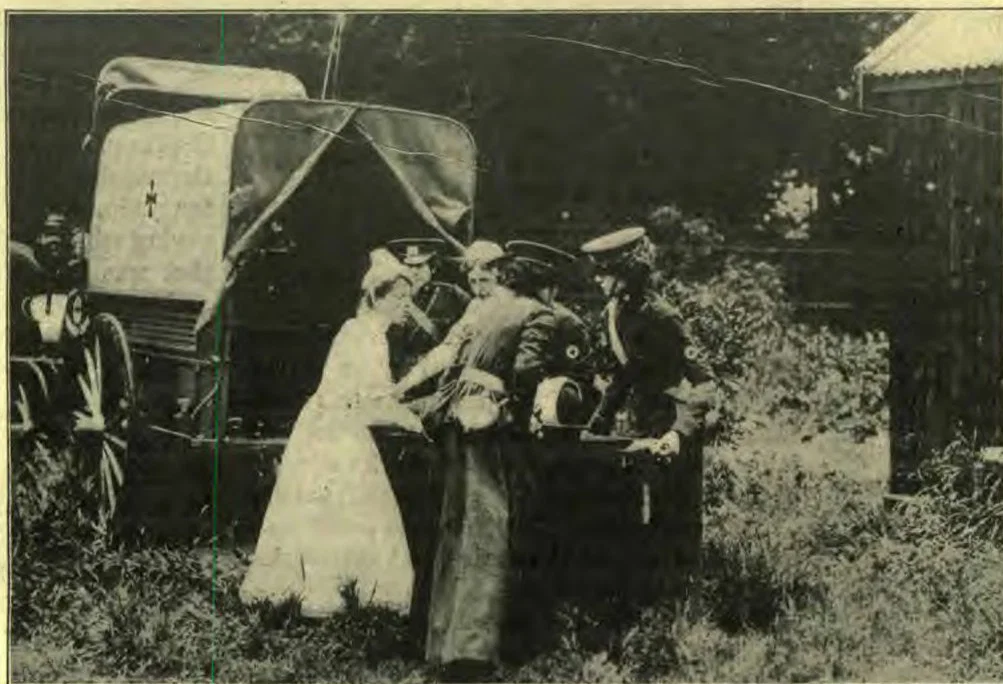
Photo by Paul Thompson. BRITISH ARMY RED CROSS LADIES ON THE FIELD OF ACTION
“All Europe trembles 'neath the tread of marching feet. The clank of sword and spur, and din of martial music, fills the air. A sad and fearful murmur rises from the troubled earth, And heaven seems black to hearts in dire despair. What means this awful, grim display of serried ranks in untold numbers marshalling now? Is God preparing—for that day when sinful man before His throne must bow? O God, Thy righteous wrath delay! For this we pray.
“Almost two thousand-years have passed Since Christ, the lowly Nazarene, Walked here upon the earth. He taught, with wisdom unsurpassed, The laws that give diviner birth To all that human hearts aspire, Of love, and truth, and pure desire. How illy we have learned of Thee, Thou pierced one of Calvary!” J. O. C.

A WORD TO OUR READERS

We send no papers from this office to individuals without pay in advance. When persons receive copies without ordering them, they are sent by other parties, and we can give no information in regard to them. Persons thus receiving copies of the SIGNS are not indebted to the office, and will not be called upon to pay for them. Please read the papers you may receive, and hand them to your friends to read.

DATE OF EXPIRATION

The SIGNS wrapper bears date of last issue due on your subscription. Unless renewed in advance, paper stops with expiration date.
If herewith is an order-blank, you will know you have overlooked sending renewal. You will not wish to miss a single issue. Back numbers often can not be furnished.

SCRIPTURE QUOTATIONS

Our authority for the doctrines we teach is the Bible. Quotations are usually from the King James Version or the American Standard Revised.

Question Corner

Conducted by MILTON C. WILCOX
Professor of Biblical Exegesis of the Faculty of the College of Medical Evangelists, Loma Linda, California
NOTE.—This department is for the purpose of helping Bible students. Answers must of necessity be brief, often only suggestive, never exhaustive, never infallible only as they agree with the infallible Word. Such questions only will be answered as seem to the editors to minister to the mission of the paper. Questions of the same import can not be answered repeatedly in the same volume. Name and address must be given, not for publication, but as evidence of good faith and to insure reply by letter if thought best. It is well always to enclose stamp, not stamped envelope, unless answer is desired by letter alone.

16—THE KINGDOM OF HEAVEN SUFFERETH VIOLENCE, MATT. 11:12

Please explain Matt. 11:12.—“And from the days of John the Baptist until now the kingdom of heaven suffereth violence, and the violent take it by force.”
The teaching is clearly this,—that when John came and began to preach his tremendous gospel of repentance, there was mighty earnestness manifested by those who heard. Men were strenuous in their effort to make things right and enter the kingdom. Some evidently were feeling that unless such effort was put forth they would not be saved. “The kingdom of heaven suffereth violence,” or, as the margin reads, “is gotten by force,”—not that men were slain, or that this violence was put forth against man. It was not manifested in strife. Those who accepted the Lord Jesus had calmer, sweeter rest in place of strife.

A SIGNIFICANT RECORD

THE following record of “assassinations of exalted personages in all countries in the last fifty years,” excepting the last two items, which we add, is clipped from the New York Thrice-a-Week World:
Abraham Lincoln, president of the United States, April 14, 1865. Michael, prince of Servia, June 10, 1868. Prim, marshal of Spain, December 28, 1870. Earl of Mayo, viceroy of India, February 8, 1872. Abdul Aziz, sultan of Turkey, June 4, 1876. Alexander II, czar of Russia, March 13, 1881. James A. Garfield, president of the United States, July 2, 1881. Marie Francois Sadi Carnot, president of France, June 24, 1894. Stanislaus Stambouloff, premier of Bulgaria, July 25, 1895. Nasr-ed-Din, shah of Persia, May 1, 1896. Canovas del Castillo, premier of Spain, August 8, 1897. Juan Idiarte Borda, president of Uruguay, August 25, 1897. Jose Maria Reyna Barrios, president of Guatemala, February 18, 1898. Elizabeth, empress of Austria-Hungary, September 10, 1898. Humbert, king of Italy, July 29, 1900. William McKinley, president of the United States, September 6, 1901. Alexander, king of Servia, June 11, 1903. Draga, queen of Servia, June 11, 1903. Bobrikoff, governor-general of Finland, June 16, 1904. Von Plehve, Russian minister of the interior, July 28, 1904. Charles, king of Portugal, February 1, 1908. Louis, crown prince of Portugal, February 1, 1908. Sergius, grand duke of Russia, March 13, 1908. Prince Ito of Japan, October 26, 1909. Peter Arcadovitch Stolypin, premier of Russia, September 14, 1911. Jose Canalejas, premier of Spain, November 12, 1912. Nazim Pasha, Turkish minister of war, January 23, 1913. Shafket Pasha, grand vizier of Turkey, June 12, 1913. Francisco I. Madero, president of Mexico, February 23, 1913. Jose Pino Suarez, vice-president of Mexico, February 23, 1913. George, king of Greece, March 18, 1913. Archduke Ferdinand, heir to the Austrian throne, June 28, 1914. Jean Jaures, editor, legislator, socialist, philosopher, of France, July 31, 1914.
Such methods were common in the barbarous ages of the past; but in the increasing light of Christianity and extended civilization, such things should not exist. Yet while fourteen of these assassinations occurred during the first thirty-five years (1865-1899) of the period named, nineteen occurred during the last fifteen years (1900-1914). Such things may be expected when Christianity is held as a form and not as a life, when religion is but a veneer and not a matter of character.
This record may be taken as among the troublous things that cause crowned heads to lie uneasy, nations to be perplexed, and men's hearts to fail them for fear. But these are tokens of the coming of the Prince of peace. Luke 21: 25-27. M. C. W.

17—THE SABBATH DAYS, COL. 2:16

Please explain Col. 2:16, especially the Sabbath part of it. L. C. L.
The first expression in Col. 2:16 is the core of the whole matter. ‘Let no man therefore judge you.’ Why?—Because, as the previous verses show, we have acknowledged Jesus Christ the Lord, been buried with Him in baptism, and arisen to a new life in Him. The mere ceremonies of the past are nothing in Him. The sins that were recorded against us have been all blotted out; and those past ordinances, which call to remembrance our sins year by year, from time to time, are gone. Jesus died for us once for all, and blotted out that which ‘was against us, which was contrary to us.’
Now there may have been in the Colossian church Jews who were still following the Mosaic ritual regarding meats and drinks, still observing the yearly sabbaths, of which we have mention in the twenty-third chapter of Leviticus—‘beside the sabbaths of the Lord.’ Verse 38. Some were condemning the observers of sabbaths and feasts. Others condemned those who did not keep the various feasts and holy days. Some were so free in the Lord Jesus that they did not have any desire to observe these yearly typical festivals at all. There were those who did observe them, as we learn in Romans 14. The injunctions of the apostle are: Let no man judge you. Let us not judge one another. Those were shadows, symbols, types, pointing forward to Christ. The body is Christ. We believe the body. Cleave to Him.
The expression ‘of the sabbath days’ does not refer to the seventh-day Sabbath. That is not in any sense a shadow which pointed forward to Christ. It antedated sin. Man was in duty bound to observe it before sin entered. But all those ceremonial and ritual holy days and sabbaths were symbolic and typical in their nature. If the convert in Christ did not observe these things, he should not feel condemned over it. No one should judge him because of it. He has Christ, which is the fulness of all these.

18—SHAVING THE BEARD

Rev. 13:17 reads, “And that no man might buy or sell, save he that had the mark, or the name of the beast, or the number of his name.” Would the shaving off of the beard constitute a mark of the beast? F. L. B.
The instruction which God gives to His children regarding the cutting of the hair, etc., was that He would not have His people appear as idolaters. According to the idolatrous religions, there seem to have been those who indicated their kind of worship and the class to which they belonged by the trimming or cutting of the hair or beard. See Jer. 9:26; 25:23, A. R. V.; Eze. 44:20.
On the other hand, there were times when the Lord’s children would cut their hair and shave. See Jer. 7:29; Amos 8:10; Num. 6:18; Acts 18:18; 21:24. From these texts it will be seen that it is not the mere cutting of the hair or the shaving of the head or the shaving of the beard that the Lord prohibited, but that in this they should not appear like the idolatrous worshippers around them. With the idolaters it was a mark of submission to a certain god or religion. The ordinary shaving of the beard in these days has nothing to do with religion or religious cults of any kind. Some men wear it one way and some another, regardless of religion; and in that case it could not be regarded as the mark of the beast. It is simply the taste, convenience, or necessity of the individual.

SYSTEMATIC BIBLE STUDY

MANY people are confused in regard to what is truth in religion. You will frequently hear the statement that there are so many different churches, one does not know what to believe. But the individual who is constantly reading his Bible, and thus acquainting himself with God, is not beset with this difficulty. He knows for himself what the good Book contains. We trust that many of our readers are either following the schedule that we present from week to week, or else in following a schedule of their own, have the resolute purpose to read the Bible through at least once a year.

SCHEDULE FOR THE WEEK ENDING SEPTEMBER 19

Read three chapters each week-day, and five on the Sabbath.

Another Kind of Warfare in German Possessions

The Great Message Progressing in German East Africa Mission Schools Pushing a Strong Educational Work Consecrated Men and Women Yielding Up Their Lives to Advance the Work
By L. R. CONRADI
This article was mailed by Elder Conradi from Hamburg shortly before the breaking out of the war. He had promised us a number of articles telling of the interesting missionary operations of our European division, in Africa; but this war will leave him for some time with his hands and heart so full that he may not be able to continue this writing until things settle.
This article shows something of the splendid work begun. This work and the workers in that field are cut off from support while the awful European war lasts, as was stated in our issue of last week. Our friends in America will have to send them funds, or they will be left in a starving condition. We will not permit them to suffer. From our abundance in this favored land, we must send them what they need, until normal conditions prevail again, and they can be supplied from the European treasury. While this war is on, all the means that Europe has will be consumed within her own borders.
Funds intended for the relief of those workers in Africa may be sent to the treasurer of the Pacific Press Publishing Association, Mountain View, California. EDITOR.
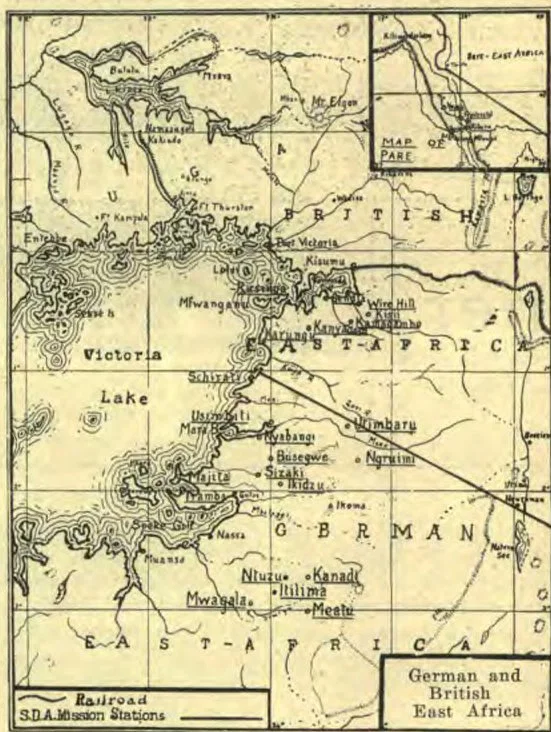
WITH the increase of our members and finances in the German Empire, the desire grew to send missionaries to the German colonies. German East Africa, in size nearly twice as large as the German Empire itself, but with a population of only eight millions, presented the most favorable opening. Even then our eyes turned to the Victoria Nyanza, and to the large and populous country on the western side of the lake; for this territory joins Uganda, where the gospel has attained such wonderful achievements.

The Valley of Peace

The governor of German East Africa advised us not to enter that field, as it was mostly ruled by native sultans, and the Roman Catholics had already obtained great influence there. He directed us to the South Pare mountains, midway between the coast and the Kilima-Njaro mountains. Two of our missionaries, Brethren Ehlers and Enns, explored the land, and found a suitable location at about 3,000 feet elevation in a valley, and called the station Friedenstal, or “the Valley of Peace.”
The Pare people are but a small tribe. Most of them live scattered here and there in little settlements, far up in the valleys of the mountains. Their language had not been converted into writing. Their only covering was skins of animals; and their huts, having no windows nor chimneys, and being low, were unfit for dwellings. Only mountain paths led to these small settlements. Our missionaries had hardly built their homes when a mission fifty miles north claimed this territory.
Mission Station, German East Africa. Photograph taken from Brother Sanders's grave.
Six months later, the writer went out there, with further workers and their wives, and plans were laid for three stations among the 25,000 people in South Pare. Since, a fourth one has been added.

Transformations and Successes

Seeing the great need of having missionaries trained as linguists, we sent several to the Oriental Seminary in Berlin. Four years later, when I visited this field again, the railway, which at the time of my first visit went only fifty miles into the interior, carried us as far again, and we were then within a day’s journey of our field.
GERMAN EAST AFRICA
GERMAN EAST AFRICA
Three good mission buildings and schools had been erected. Good roads had been made. Five hundred children had been gathered into the schools. A grammar had been written, also a small primer. Some hymns had been translated, and there were six converts—all young men.
When I visited the same field in the winter of 1912-13, there was a still greater change. The railway now passed at the very foot of our mountains; and several hundred pupils, with their teachers, met me at the station, and accompanied me up the mountains.
On the Sabbath mornings, hundreds of natives, in clean white linen, came from every direction to the Sabbath-school, having received their first impulse in our day-schools.

Still Clothed with Skins

At the time for the sermon, hundreds of the older people, still covered with skins, would come, being influenced by their children. On my first visit, we could only make ourselves understood by signs. At the second, I could tell the people, through our interpreters, what Christianity had done for us and for other people in far-off lands. Also I could point to scores of their own sons and daughters, in their very midst, who had experienced the converting power of Christ, and who gladly arose as witnesses of the truthfulness of my preaching.
As we moved on from station to station, we would find every few miles an out-school; and from a hundred to two hundred pupils, with their teacher, greeted us and bade us welcome. Chiefs came with their presents, and some even desired that we start schools in their villages, because their children had to go so far.

The Progress of Twelve Years

Twelve years have passed, and what a change has been wrought among this heathen mountain tribe! Four churches have been established, 225 young people have been baptized, as many more are preparing for baptism, some forty teachers have been educated, and not less than 2,300 pupils are in our schools. A number of books have been translated, and parts of the Gospels. A translation of the entire New Testament is nearly completed. Several of their young people, who had done good work as teachers and soul winners, gladly accepted a call to the Victoria Nyanza, where they have become successful helpers for our missionaries.
The mission efforts of our German brethren inspired also our English brethren, and in 1906 a mission site was selected on the eastern shore of the Victoria Nyanza, about twenty miles from the terminus of the Uganda railway. When I went there two years later, a good station had been built up, and some students gathered in. We looked up sites for two other stations, and one station was built. But somehow we did not succeed in obtaining others until the last visit of the writer. Then the British government sold us one of its old military stations; and since that time, four other sites have been secured, and building operations have been commenced on them.
Six of these stations are among the Kavirondos. One is among the Kisiis. Our missionaries have worked up a grammar, a small hymn-book, and a primer. A small printing-press has been secured, and a paper is published in the Kavirondo language. Portions of the Bible have been translated. About fifty young people have been converted, and about five hundred young people are in the schools. In order to facilitate travel, and to convey the goods for our missionaries, a nice sailing vessel, the Kavirondo, has been built.

A Vast Territory Occupied

In 1908 a site was secured in the German territory adjoining. Since then eleven new sites have been secured, and stations put up and manned. Some seventy converts have been gathered out, speaking three different languages. Considerable linguistic work has been done. Over two thousand children are enrolled in their schools.
Thus a vast territory, extending over all the eastern side of the lake and some fifty miles south, has been occupied, and probably nearly a million people have been brought under the influence of our message. But the work is only begun. We have reaped only the first-fruits. Our missionaries had spent most of their time in learning the language, and in becoming acquainted with the ways of the natives, and putting up their homes, schools, and meeting-houses. They also spent time to cultivate the land, growing some cotton, maize, etc. There are about one hundred native helpers now, and a corps of thirty-five white workers.
If, under the trying circumstances and the difficulty of commencing mission operations with a small and inexperienced force, three hundred and fifty souls could be gathered out in from six to ten years, what might we expect in the near future under altogether more favorable conditions?

Lives Are Sacrificed

Seed must be sown ere we can expect a harvest; and the more plenteously we sow, the greater the harvest. In mission work, we have not only to sow the seed of truth in the hearts. On account of the fatal climate, men and women have even to lay down their lives. But every life sacrificed is a precious seed sown, which yields an abundant harvest. Christ Himself was the first seed, laid in the earth, and sprang forth to life eternal, bearing a harvest which no man can measure. His followers must expect the same. There are in German East Africa not less than six graves of noble pioneers of this field, and two more in Germany. But alongside these graves in Africa, church buildings are raised, filled with the precious fruit of the seed thus sown.

The Drawing Power

It is the love of Christ shining forth in these missionaries which draws souls to Him. And what God has done in Uganda, on the northern shore of the Victoria Nyanza, we have a right to expect that He will do among the Kavirondos, the Kisiis, the Majitas, the Wasukumas, and others, on the eastern shore of the same lake, and among the Wapares near the coast.
Surely we have every reason, from the results thus far attained, to be of good courage, to increase our gifts, to send forth more of our sons and daughters, and to expect great things of our God.

VITAL QUESTIONS ANSWERED

The pamphlets described below ought to be read now. They will help you to understand better the significance of great world movements and events. See list of our depositories on page 15.

The Sure Word of Prophecy

A small booklet that you will appreciate as a help in the study of the prophetic Word. Primarily it deals with the prophecies of the book of Daniel and their fulfilment, and shows their application to present-day world affairs. 10 cents.

The Sanctuary Question

Christ our Advocate is now doing a certain very important work in the sanctuary. Do you wish to know more about it? Then secure and read a copy of “Christ Our Advocate.” The building and purpose of the earthly sanctuary is set forth, and the great prophetic 2,300-day period is thoroughly explained. 112 pages; 10 cents.

Can We Communicate with the Spirits of the Departed?
Great minds in the scientific and theological world are trying to answer this question. Read the pamphlet “The Spirit World and a Future Life,” and see for yourself what the Bible plainly teaches on this important question. 10 cents.
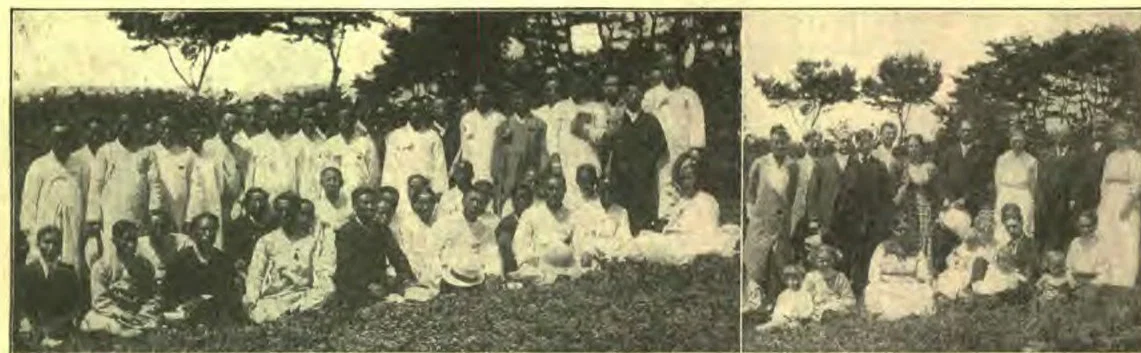
NATIVE WORKERS MEETING IN SEOUL, KOREA, ON THE LEFT; AMERICAN WORKERS AT THE RIGHT

The Korean Mission in Annual Session

Good Attendance of Both Native and Foreign Workers — A Year of Prosperity in the Work
By C. L. BUTTERFIELD
Superintendent of Our Work in Korea
The fifth annual meeting of the Korean Mission was held at Seoul, May 19 to 26. A total of 189 Koreans were in attendance, some having walked more than 200 miles. Most of those present were from the north-western part of Korea, where our work first started; but there were others present from the extreme south, east, and west, also one man from Manchuria, where many Koreans have located. It was the most representative meeting we have ever had.
The meetings were held in our new chapel at the headquarters of our work, outside the great east gate. It was the first time that many of those present had ever seen the capital city, but they did not do any sightseeing until after the meeting had closed. The attendance was the same at all the six sessions each day. All wanted to receive all of the instruction there was for them.
We were glad to have with us during the meeting Elder and Mrs. R. C. Porter and C. N. Woodward, of Shanghai, China, and Elder F. H. DeVinney, of Tokyo, Japan. The Bible studies given by these workers were timely, and greatly appreciated by all, as was also their counsel in the business and committee meetings. At the close of the meeting, they went on to Soonan, where our training-school is located; and from there to Shanghai, by way of Mukden, Peking, and Hankow.

A PROSPEROUS YEAR

Reports rendered at the meeting showed that 139 persons had been baptized and taken into church fellowship during the past year, and the Sabbath-school attendance had increased more than 400, now numbering a little over 1,100. The native receipts in tithes and offerings for 1913 were 1,787.83 yen, or $893.91. When we consider that only a small part of those giving this amount earn as much as $100 a year, we can understand better what it means for them to raise even that amount. However, the receipts for the first quarter of 1914 were only $20 less than for the first two quarters of 1913, and we believe that the receipts this year will far exceed those of last year.
The business session on the last day of the meeting was a missionary meeting. All were thankful for the blessings received during the meeting, and for the knowledge of a soon-coming Saviour. Literature had been prepared; and 18,100 tracts, or about 220,800 pages of truth-filled literature, were bought, paid for, and carried home to be used in “preaching the gospel to every creature.” The printed page has been a strong factor in the work here; and we know that much good will result from the distribution of these tracts.
Ministerial licenses were given to thirteen native workers, and missionary credentials to twenty-one who are engaged in other lines of the work. We praise God for what has been accomplished, and ask your prayers that the work of winning souls for Christ may go forward in this field this year as never before.

Are You One of Them?

Thousands of thoughtful men and women read the Signs of the Times Magazine regularly. Why?
  1. Because it keeps abreast of the times.
  2. Because, unlike most other periodicals, it tells the Bible meaning of recurring storms, social unrest, and wars.
  3. Because of the variety of subjects treated—prophecy, religious liberty, temperance, etc.

Front Cover Picture
Front Cover Picture
The October number is one of the best ever issued. It makes clear that Armageddon is not yet. A reproduction of an autographic letter, in our possession, written by Cardinal Gibbons, appears, in which the writer reiterates the claim that the Sabbath was changed by the Catholic Church from Saturday to Sunday. “The Hazard of Sunday Laws” is the title of an article. “The Eastern Question and This War” is the title of another. But you must see it for yourself. Don’t fail to do so.

FORECAST

The editor of the Signs Magazine announces that in November he will begin a series of articles to run for several months, in which he will consider those signs which immediately precede our Lord’s second coming. Among them are increasing crime, disease, disasters, and the pouring out of the plagues.
Why not subscribe now?
$1 a year
SIGNS OF THE TIMES MAGAZINE
MOUNTAIN VIEW, CALIFORNIA

Facts That Will Please All Except the Liquor Trust

It May Be Interested—Liquor Business and Prosperity
Compiled by M. C. Wilcox, from United States Census Reports
Fifteen Leading Industries, Each of Which Consumes Over $150,000,000 Worth of Material, Compared with the Liquor Business
Industry Amount paid for material Per cent of value of products paid for material
Smelting and refining lead $168,958,076 91.0
Sugar and molasses refining 244,752,802 88.5
Flour and grist-mill products 619,971,161 87.0
Smelting and refining copper 196,736,986 81.7
Iron and steel, blast-furnaces 178,941,918 77.2
Leather tanned, curried, and finished 191,175,073 75.8
Steel works and rolling-mills 441,204,432 65.6
Cotton goods 282,047,648 63.8
Boots and shoes 197,363,495 61.7
Slaughtering and meat packing, wholesale 706,230,069 52.5
Bread and other bakery products 155,999,318 52.5
Men's clothing 185,793,436 52.2
Steam railway cars and shop construction 151,140,250 48.8
Foundry and machine-shop products 278,074,203 40.5
Lumber and timber products 183,786,210 31.7
Liquors—distilled, malt, and vinous 129,851,855 27.0
Of all these great industries, the liquor business uses the least material, and pays the smallest percentage of products for materials. And its products are a curse and only a curse to any land.
Continue reading: ALCOHOL NOT A STIMULANT