The Youth’s Instructor, Vol. 38, No. 34.

THE FATHER'S LOVE

The Youth’s Instructor

Aug 20, 1890

S. D. A. Publishing Association · Battle Creek, Mich. · Aug 20, 1890

THE FATHER'S LOVE.

The father's face is pale and sad, His words are grave and slow, He treads the path where roses nod, His heart is great with woe. The splendid mansion seems but dark, The banquet is not gay; At every sound he whispers, “Hark!” And thinks of one away.
Down the long path, at morn and night, He walks and shades his eyes; He looks afar, with yearning sight, And all the road descries. Alas! alas! his son comes not, He questions every one; His wayward boy is all his thought, O where is his lost son?
At night he lingers at the grate, He keeps the coals aglow, He listens to the clicking gate; Perhaps he comes! but no, It is the wind; and there he weeps, And there he kneels to pray, And e'en in dreams, as light he sleeps, He mourns for one away.
“Forget the vagrant. Weep no more; He is not worthy it;” So say the neighbors at the door, And show their shallow wit. Forget him! No; his yearning heart A father's love doth keep, The scornful words hurt like a dart, His soul within doth weep.
He thinks he may be sad and poor, He may be wrecked with ill, He may be wandering on the moor And in the bitter chill; The dens of vice may hold his feet,— O, life is no more gay,— And through his soul his yearnings beat For him who is away.
The father stands without the gate, He strains his eager eyes, His heart, his feet, can hardly wait; Who is that he descries? Is that his son, so pale, so poor, So ragged? His eyes grow dim; He starts a-running from the door, And hastes to welcome him.
“My son! my son!” the father weeps; He clasps him to his breast, He leads him up the homeward steeps, He sends for many a guest; He brings the best robe from the stand To clothe him for the feast, He puts a ring upon his hand, A chain upon his breast.
What could he more? He cannot eat For loving his dear son. The lost is found! Praise God, 'tis sweet To sit no more alone. And O, his wayward son loves much; For he has been forgiven, He's like a little child, and such Are sons and heirs of heaven.
O, think you of the Father's love, Ye wanderers of his; He watches from the gate above, His love unfailing is. Poor prodigal, the feast is rare, The Father yearns to-day; The best robe waits, and Heaven's all care Since thou art still away.
FANNIE BOLTON.

THE WRONG TURNING.

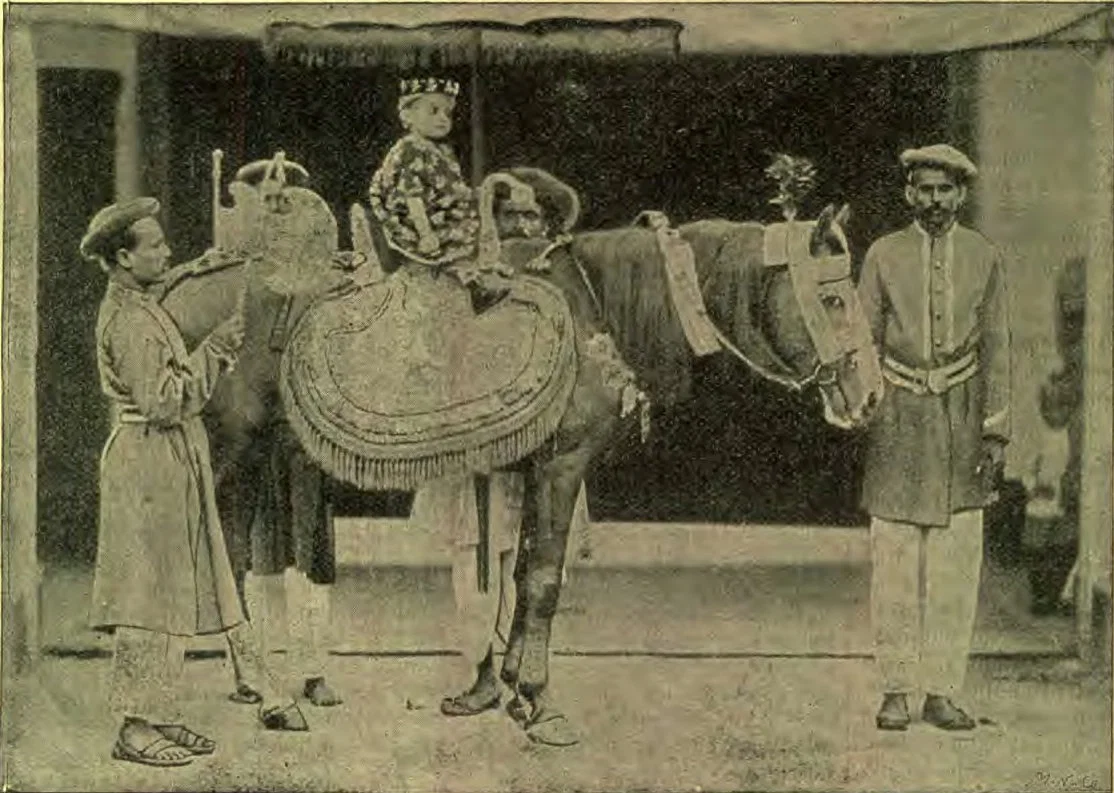
HINDOO MARRIAGE PROCESSION.
WHEN I was a boy, my father sent me on an errand to a farm-house a few miles in the country. “You must go,” said he, “straight along the turnpike-road till you come to the second mile-stone, and then, passing the big house with the rookery in the elm-tree, you must take the first turn to the right, which will lead you to Farmer Gilbert’s house; but mind, whatever you do, that you do not take the wrong turning!”
Boy-like, I was so pleased with the prospect of a pleasant walk into the country that I did not attend so carefully as I ought to have done to the directions which my father gave me; so that, when I had passed the second mile-stone, and arrived at the big house with the rookery in the elm-tree, I could not at all remember whether I was to take the first turning to the right hand or to the left. I did so, and thereby took the wrong turning.
Well, on I went, as I thought, for Farmer Gilbert’s, till the lane got very narrow, and the road very dirty. At one part there was a gate across it, and, getting over the gate, I did not perceive that the bottom hinge was off it; so that, no sooner had I mounted the gate, than it swung on one side, and flung me into the mire, and a fine dirty state I was in. A dog came growling out of the cottage by the roadside; to get rid of the dog I clambered over a hedge, and in my haste almost tore off the skirt of my jacket. With the intention of defending myself against the dog when I should return, I pulled out my pocket-knife to cut a stick, but in doing this, I cut my finger, and dropped my knife into the ditch, and could not find it again. But after all my misfortunes, no Farmer Gilbert’s could I find.
At last I asked a man who was working in a field to tell me the nearest way to Farmer Gilbert’s, mentioning at the same time which way I had come. “I do not wonder,” said the man, “at your being puzzled; why, my lad, you have taken the wrong turning.”
I soon set off back again, blaming myself for not having paid more attention to the directions of my father. I found no further difficulty in my way to Farmer Gilbert’s, and having done my errand, I returned home, heartily repenting the error I had committed in taking the wrong turning.
No sooner did my father see me than he began thus: “Why, Robert, where have you been? What a pickle your shoes and stockings are in; and the skirt of your jacket is almost off. What have you been about?”
I then told my father the whole of my mishaps, just as they had occurred to me; and I acknowledged that they had all been brought about by my foolishly taking the wrong turning.
“Ah, my lad,” said my father, “you are not the first, by a great many, who have smarted by neglecting their Father’s directions, and by taking the wrong turning.”
All of us who live in the world have an errand to perform, and have to find our way to heaven. The path of duty is the road along which we are to go; and the Bible contains the instructions of our heavenly Father, giving us the plainest directions, that we may not be perplexed by losing our road. Those who attend to these directions find their way easily; but those who neglect them get into a thousand troubles. Remember, friend, when traveling toward another world, it is a terrible thing to take a wrong turning!—Selected.

ROUND THE WORLD.—24.

INDIAN CUSTOMS AND DRESS.

Hindoo homes, save those of Rajahs and Maharajas, are generally small and simple dwellings, wretchedly uncomfortable, and where those rich blessings which God has made so free to all, light and air, are total strangers. Europeans have but little access to native social circles. With the exception of the rich princes and kings of native States, or Maharajas, as they are called, who love to display their wealth and give banquets to the British, it is seldom that the Asiatic invites his white brother to share the hospitalities of his mansion. A religious Hindoo dare not eat with a European; to do so would break his caste, and cause other terrible calamities to fall upon him.
At one place where we stopped in the Province of Oudh, a lady friend told how she once went to visit a Hindoo woman. This was soon after she had come to the country. When she entered the house, the dinner was cooking on the hearth, and out of mere curiosity to see what was in the vessels, she took hold of a spoon in one of them, and lifted up some of the contents. Afterwards she took her leave, and no sooner had she gone than the Hindoo woman came to the door with the steaming pots in her hand, and flung them as far as she could from her. The lady wondered what was the matter, but thought that the food must have burned, or something of the kind, from need of attention while they were talking, never for a moment dreaming that she was the cause of the loss of the dinner. She was not conversant with the language, and could not understand from the Hindoo woman what the real trouble was. But knowing that she was very poor, she went home and took some of the best food she had in her own house, and then returned. But no, the Hindoo would not touch it; she simply smiled, but would not lay a finger on it. The lady was half angry, half amused, and the next day when her “Munshi” (teacher of Hindustani), came to give her her lesson, she told him of her adventure of the day before. He laughed, but answered that it would be very sinful for a Hindoo to eat anything or out of anything that a Christian had touched. Even beggars will refuse such food when it is offered to them.
A missionary told me that when she first commenced to teach in the zenanas (native houses, where the women are kept secluded), she would, when thirsty, ask for a drink; for on seeing the bright brass lotas on the shelves, she thought that a draught of cold water from them would be very refreshing. But by way of complying with her request, a woman would go out to the bazaar, buy a little mud cup, and bring her water in that. “We cannot let you drink out of our lotas,” they said; “for if we did, we would have to throw them away, as they would be unclean to us.”
In a previous article we mentioned the juvenile ages at which marriages were celebrated, and the fabulous amount of money expended at them. A South African heathen always rejoices at the birth of a daughter; for he knows that when she is old enough to have a suitor, he himself will be enriched by receiving at least six or eight cows as a dowry for her. But not so with Hindoo parents. The event is pain and grief to them. According to custom and the rules of caste, they must give the girl a large amount of jewelry, and also present a handsome sum to the one who takes her. More than that, they must make a feast and bid all their friends. Everything must be carried on in royal style, and they sometimes mortgage all they possess, even their homes, to raise money for merriment on this occasion.
From a work on Hinduism the following quotation is clipped, concerning an interesting and curious part of the ceremony: “The ceremony cannot be commenced till after the ‘Jyotishi,’ or family astrologer, has fixed the auspicious day and hour. The bride is given away by her father, or his representative, at her own home. Perhaps the most important part of the proceeding is the ‘Saptapadi,’ or the leading of the bride three times around the sacred fire,—each time in seven steps,—the offering of the burnt oblation, by the bridegroom, the binding together of the bride and bridegroom by a cord passed around their necks, and the tying together of their dresses. The rite is of course commenced by the worship of the god Ganesa, who wards off the obstacles by which all undertakings are liable to be thwarted through the malice of the demons.” It is easy to recognize when a Hindoo girl is married or single; for the former always has a small vermillion spot painted on her forehead. After the above-named ceremony, the bride is placed on a horse, and a procession takes place.
The dress of a poor Hindoo is too scant to require description. But the custom of the Hindoo gentleman, or the “Babu,” as he is termed, consists of two pieces of cotton cloth, one of which is folded around the waist, reaching to the calf of the leg, and the other cast gracefully over the shoulders. These clothes are often ornamented by borders of silk and cotton, and, with a huge turban wound about the head, the costume is complete. Shoes are worn, but are often left off.
This is the kind of robe that the servants, or “bearers,” wear, and I was told, and heard with considerable horror, that they had three uses for the fold that hangs down loosely in front. I never detected my bearer making use of it in either of the first two ways mentioned below, but can safely vouch for the third. And concerning the first two, I have seen other Hindoos doing so. He is said to strain rice through it, to carry food in it, and eat out of it, ex itinere, and to dust off Sahib’s toilet requisites with it.
The women wear a single piece of broader silk or cotton cloth, plain or colored, and from ten to twelve yards long. It is first partly tied around the waist, forming a skirt which touches the feet; the rest is passed around the body and over the head, and falls to the right side and down the back. A tight bodice is worn beneath. They make very picturesque tableaux when carrying on their heads the burra lotas, or large vessels of water from village wells, or river-banks. Sandals are generally worn by both sexes when they walk abroad. Sometimes these are all glittering with precious stones, and beautiful with embroidery work, with long toes to them, turned up and curled over like the dash-board on a cutter. The garments of the women, when arrayed in their best, are ablaze with gold and silver and precious gems, till they glitter and sparkle in the sunlight. Their fingers and toes are covered with rings, the number of ornaments fastened to their ears is legion, and a huge ring, sometimes four inches in diameter, is fastened to the nose. On occasions of festivals, Hindoo men wear necklaces, earrings, and bracelets. They are exceedingly proud, and think there is no place like India. But as Oliver Wendell Holmes aptly puts it, “There is no village in the world, where the axis of the earth does not stick out.”
Hindoos are passionately fond of their children, and provide them with quantities of toys, and everything that will keep them quiet and contented. Candy is for sale everywhere, and the natives are very fond of it. P. T. M.

CULTIVATING DISEASES.

PROBABLY the most curious greenhouse in the world is supported at Washington by the United States Government. It has a hospital for diseased plants, but differs from ordinary hospitals in that the injuries and disorders from which the patients suffer have been purposely inflicted upon them by the doctors, in order that the nature of the complaints may be studied, and methods of curing them discovered.
The Department of Agriculture has agents in many parts of the country whose business is to travel about and collect specimens of diseased plants. These plants are promptly sent to Washington, with full particulars of the injuries done, and the extent of the depredations. Professor Galloway, who has charge of this department, upon receiving a leaf or a twig exhibiting morbid symptoms, sets at work to discover what sort of fungus is responsible for the mischief.
Nearly all disorders of plants are caused by parasites, of which there are fifty thousand known kinds, and it is not easy to tell off hand, in any given case, just which one is the destroyer. Often this must be determined by a resort to the germ incubator.
Suppose the professor has received a leaf affected by some mysterious disease, turning it brown. His experienced eye at once detects the presence of the fungus. He breaks off a bit of the leaf, and chops it up in distilled water. When the water is filled with the germs, he takes a drop, and lets it fall into a tube which already contains a small quantity of gelatinous substance called “agar,” derived from a Japanese fish. This substance has previously been rid of all germs by boiling, and the tube is now tightly corked up again to prevent the ingress of other germs.
The fungus germs find this agar most nutritious food, and at once begin to feed and multiply. If there is only one to begin with, it soon divides into two, and so on until, it may be within a few hours, there are billions.
To be certain that these fungi caused the disease of the plant in question, the professor fishes a few of them out on the end of a platinum needle, and rubs them on a healthy leaf of the same sort in his greenhouse. If the disease is reproduced in the plant thus inoculated, he has found the enemy. That is the first important step; it only remains to discover something that will kill the parasite without injury to the infected plant.
Within the four years during which Professor Galloway has been in charge of this department of vegetable pathology, much has been done. Twelve of the fifty kinds of dangerous fungi that attack the grape have been treated with success, and a cure has been discovered for the fire-rot, which turns the limbs of pear-trees black and dead so quickly. The germ of the potato-rot, too, has been identified, and means found of fighting it cheaply and effectively. The same may be said of more than a dozen other vegetable diseases.—Youth’s Companion.

IF

“If you were I, and I were you, And all the world were twisted too, What do you think that you would do, If you were I, and I were you?”
“If I were you, and you were me, I’d be as good as good could be; I’d never fret nor tease, you see, If I were you, and you were me.”
“If you were I, and I were you, You think that you’d be good and true? Well, it’s an easy thing to do When I am I, and you are you.”
“Since I’m not you, and you’re not me, Suppose we try each day to be So good that nobody can see Which I is you, and which is me?”
—Selected.

THE MISSIONARY TURKEYS.

“And now, Mabel, you must see my dear little missionary turkeys,” said Evelyn to her school friend, who was spending a day or two with her on the farm. “They are just the dearest little pets, and I do love so to watch them grow.”
“Are they all your very own?” asked Mabel.
“No; papa and I are to share in the profits when they are sold. He made me that offer in the spring. He said, ‘Sis, do you want to try your hand at raising turkeys? If you will take all the care of that brood of turkeys, you can have half the profits. I’ll furnish all the feed.’”
“Weren’t you pleased? I should be delighted with such an offer,” said Mabel.
“Indeed I was, but I hesitated to undertake it; for I was ignorant of the business, and I had heard that turkeys were very tender and hard to raise; but I remembered some old poultry journals in the house, and I concluded to try, as I could consult them if necessary. There, Mabel, do you see? they have two mothers—chicken hens. That White Brahma is a cross old thing, but she is a good mother; she won’t let anything touch her little ones without a protest. I have been pecked unmercifully by her, even while giving them food and drink.”
“That is like some persons I know,” thought Mabel. “Is the other one cross, too?” she asked.
“Oh, no; that is a quiet old lady, dignified and calm. It’s just amusing to watch them, and see their queer ways. If Madam Brahma pecks me, Madam Plymouth Rock pecks her in return, as if to say, ‘Have you no manners? Will you peck the hand that feeds you?’ And then she stands back, and looks at her to see if her advice will be heeded.”
“I should think they would fight.”
“So should I, but they do not; papa thought one hen could take care of them all—nineteen of them—but I could not bear to see either hen deprived of her brood; so we decided to let them both stay, although we had but this one place for them.”
“Why are they hard to raise, Mabel?”
“They are tender while young, and easily affected by dampness and cold. I found one in the wet grass one morning. It had strayed too far from home, and had been out all night. It acted dumpish and sick. I gave it some hot milk with bread and pepper, kept it wrapped in a warm flannel half a day, and then put it with its own mother at night. It was all right the next day.”
“They must be quite a care. Do you like to do it?” said Mabel.
“Yes, I do now. At first I did not like the bother; but I did not want to lose them through my carelessness, nor be foolish enough to neglect them; so I concluded to do my very best, and learn all I could for their benefit. I love them now, and should feel very bad if any died from my neglect. Besides, I want them to bring me a nice little sum for the mission box, and this is the only way I have of getting anything for it.”
“I do not wonder, Evelyn, that you love your pets. I should like to live on a farm, and raise something all my own, too,”
“I wish you might,” replied Evelyn cordially; “perhaps you will some day.” M. E. D.

FREEING HIS MIND.

“I BELIEVE I’ll sit down,” said Stanton, “and give that man a piece of my mind.”
“Do so,” said Lincoln; “write him now, while you have it on your mind. Make it sharp; cut him all up.”
Stanton did not need a second invitation. It was a bone-crusher which he read to the President.
“That’s right,” said Abe. “That’s a good one.”
“Whom can I get to send it by?” mused the secretary.
“Send it?” replied Lincoln; “send it? Why, don’t send it at all. Tear it up. You have freed your mind on the subject, and that is all that is necessary. Tear it up. You never want to send such letters; I never do.”—Selected.

THE WIND.

THERE is a queer old fairy, who lives where no one knows, For none can see him coming, or tell where ’tis he goes.
Down from his mountain fortress he rushes through the land, Leaving a track behind him as made by armed band.
But on the mighty ocean he rolls the booming wave, And sends the shipwrecked sailor down to a lonely grave.
But, oh, not always wildly, not always full of wrath, Comes this old fairy, bringing destruction in his path.
Sometimes all softly, gently, on velvet wing he goes, To kiss the cheek of girlhood, or dally with the rose.
Sometimes in madcap frolic he joins the boys at play, And far, far up to cloudland, he bears their kites away.
Who is this queer old fairy, now tell me, children all. Sometimes so big and angry, sometimes so soft and small?
In winter, wildly howling across the open moor, In summer, sweetly sighing beside the cottage door?
It is the Wind, dear children, who lives where no one knows, For none can see him coming, or tell where ’tis he goes.
—Nellie M. Garabrant.

THE CHRYSANTHEMUM OF JAPAN.

CHRYSANTHEMUM means “golden flower,” and it is the national flower of Japan.
A day is yearly set apart in Japan for “The Festival of Chrysanthemums.” On that day His Majesty, the Emperor, will allow us to go into his garden; and each man that cultivates this flower is ready to show us his “flower paradise,” for that is the name he gives to his garden.
In most of these gardens the flowers are arranged as in ours. But the gardeners of Tokio, the capital of Japan, train their plants, and often their trees, to look like pictures or statues. As we walk along, we see a Japanese hero dressed in bright pompon chrysanthemums. There is a picture of the setting sun, made out of gold-colored blossoms.
The Japanese are fond of seeing these flower pictures, but there is one that is a great favorite. It is the picture of an old hero fighting with an eight-headed monster. A fair lady sits near by, looking on. She is made of yellow, red, and white chrysanthemums. This picture is thirty feet long.
From very early days there have been two royal crests, or Japanese badges. One of these is the Paulonia-tree. This is seen only on the seals of the emperor’s family. The other crest is an open chrysanthemum, and is used for government purposes outside of the palace.
The soldiers of the army wear the chrysanthemum crest on their caps and coat buttons, and it is seen on their barracks.
The flower is embroidered on flags and banners, and printed on important papers. Some coins have both the Paulonia-tree and the chrysanthemum flower engraved on them. Silk dresses and the finest porcelain have had the golden flower to decorate them for hundreds of years.
You have read about the English “Wars of the Roses.” Well, the Japanese once had a “War of the Chrysanthemums.” This was a war between two branches of the family whose badge was the chrysanthemum. The soldiers of one army wore red caps and carried red flags. The soldiers of the other army wore white caps and carried white flags. The war lasted fifty-six years.
Japanese boys think of that war as they play some of their games to-day. The boys on one side will wear red caps, and those on the other, white caps. They often name their kites, too, of which they have a great many, after heroes of this old war.—Our Little Men and Women.

A BAD SOWING.

ONE time a Scotchman took ship, and sailed away over the seas to Australia. He did not find the country at all like his native land. It was wild and new. How nice it would be, he thought, if he could plant some of the native flowers from Scotland in this country. Then it would seem more like home to the other Scotchmen who would come there to live.
So when he got home again, he prepared a package of seeds. Now a Scotchman thinks a thistle a very fine flower. It has been chosen as the national flower of Scotland, because it was once a means of saving the loyal Scotchmen from falling into the hands of the enemy. The Scotchman thought nothing would look so good to his homesick countrymen in that far land, as a bunch of bright-flowered thistles. So he sent the seeds.
Now thistles are not nice things to cultivate, as every little boy who lives in the country knows.
The Scotchman who received the seeds hesitated to plant them, but he thought, “It is only one little package of seeds. I will only plant it in my garden.” And accordingly the seeds were planted.
But when they blossomed, the wind came and carried the feathery seeds far and wide, and these grew into ever so many thistle plants, which blossomed and made ever so many more thistle plants, until the country was overrun with them. It would have been a good deal better for the people of Australia if the ship that carried the thistle seeds had never reached land.
Now I thought, when I heard that story, that little children were often as unwise as the Scotchman who planted the thistles. They sometimes let things into their heart-gardens that will by and by grow up and crowd out all good and beautiful thoughts and actions.
Let us see if we can find out what some of these things are. There is a little boy who has let a very naughty thought, like a tiny seed of evil, lodge in his heart. If he does not make haste to pull it up, it will grow like a rank weed. It is the thought that he knows better what is good for him than his papa and mamma do. It makes him fretful and cross around the house. It makes him disobedient. If mamma does not punish him to make him mind, he will not do what she wants him to. It makes him run on the streets with naughty children, where he learns very much that is evil. So you see how this naughty thought grows and leads to many wrong actions.
Besides, it makes him break one of God’s commandments,—the one that says, “Honor thy father and thy mother.” This is called the first commandment with promise. Do you know what the promise is that belongs to this commandment? It is the promise of a long life in the land the Lord God will give us. And that land is—heaven. I am sure none of us want to fail of having a home there.
But God cannot keep his promises to us unless we ask him to help us do what he wants us to do, and then try with all our might to do it. We must not let the naughty weeds grow in our heart-gardens; for they will spread faster than the Scotch thistles. We must ask God to help us keep them out. —W. L. K.

MISS CLOUD AND MISS SUNNYBUN.

My window overlooks a yard where two little girls play almost every day. I call one Miss Cloud, and the other Miss Sunnybun. The first one makes a great friend of a pout that twists her small red lips round so,—. The other's persistent companion is a smile that gives to her sweet lips a scarlet curve like this,—. Can you guess how they look?
The other day they trudged off into the woods and pastures for wild flowers, bringing back bunches of blue violets, star-eyed daisies, buttercups, and dandelion blossoms,—all green-and-gold looking,—and delicate, plumy ferns, which had already begun to wilt. They were a very tired but happy little couple, with muddy shoes, scratched hands, and soiled aprons. Sunnybun gave some of her treasures to mamma, some to her sister, and some to me. Miss Cloud said she had worked too hard to give hers away, and wanted to keep them all herself.
By and by, after eating her supper, she forgot them, and the next morning there they were on the windowsill, quite limp and dead. Sunnybun's had been put into water, and were now tossing their heads as gayly as if in their own native soil.
“Let’s play pony,” said Miss Cloud.
“You may drive,” said Miss Sunnybun.
“All right!” and away they went in fine style.
One of the lines breaks. Miss Cloud stamps her foot. “We never play anything without something happens.”
“I can fix it in a minute,” says Sunnybun cheerily.
“The yard isn’t large enough to play in,” says Miss Cloud.
“Oh, yes; it will do very well,” I hear Sunnybun answer, who knew they were not allowed to play outside the gate.
“You ain’t a good pony, and I won’t play, anyway!” and Miss Cloud goes into the house with such a scowl!
Sunnybun then runs around all by herself, and looks like a sunbeam chasing a sunbeam.
I wanted to surprise my little girls one afternoon. When they came home from school, under the apple-tree in the yard they saw a table spread with a white cloth. There were tiny cream-biscuits, a small glass jar of honey, rice-cakes split open and jelly spread between, cocoanut-cakes, apple-turnovers, and for a crowning ornament a tall glass dish of nuts and candy right in the center. Such screams of delight, such shouts of joy, and such a scampering after wax dolls and china tea-sets!
After it was all done, I heard Miss Cloud ask, “Don’t you hope she will give us another?”
“Oh, I don’t think about another,” said Sunnybun; “I think about this. Isn’t it splendid?” and her radiant face smiled all over with happiness.
These little girls are both my pets, but I do wish that unpleasant little pout would go away and stay away from Miss Cloud’s face; for which do you think I like best? Which do you?—Watchman.

Laziness Grows on People

LAZINESS grows on people. It begins in cobwebs, and ends in iron chains. If we do not wish to be fettered like a prisoner, we will not let Satan throw this chain about us.

IN A HOSPITAL.

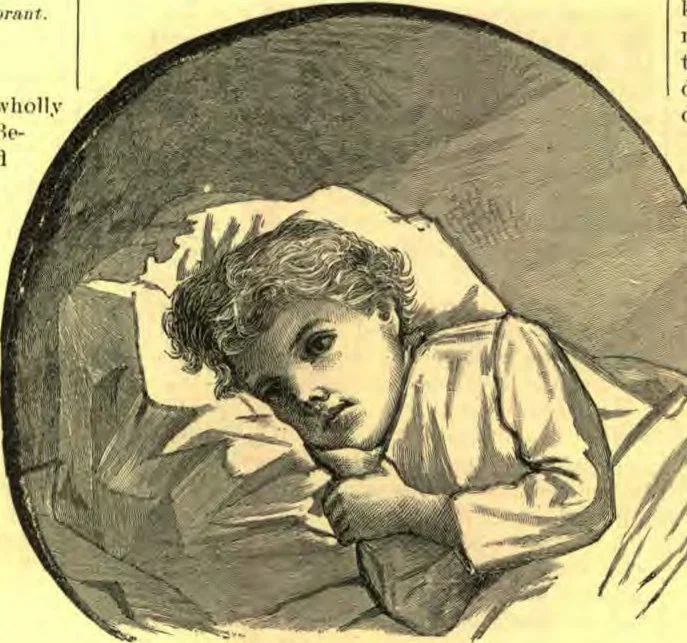
When little Jay’s mother died, he was wholly an orphan, and without a home. Besides, he was very ill. Jay was carried to the hospital of a Children’s Home in the city. There he soon made friends by his sweet disposition and pleasant ways.
One day, as he lay in his little white bed, flushed with fever, a nurse brought a cup of medicine, and said, “Drink it, dear, and I hope it will make you better.”
The sick child swallowed it bravely. It was bitter, so that he could not help making a wry face.
“Please excuse me,” lisped Jay; “I wasn’t complaining. Thank you.”
When too weak to speak aloud, he would whisper “Thank you” for everything that was done for him. On days when the patient was most comfortable, one of the well children was allowed to sit by his bed for awhile, and amuse him with pictures and toys. Or his nurse would read to him from a pretty book. Then Jay, although he could scarcely play or talk at all, would look grateful and happy.
God has been pleased to make dear Jay almost well again. At the Home they were so glad, that the other day a supper was given the children in honor of his recovery. There I first saw Jay.
A lady who had visited the hospital, and pitied him much during his illness, sent three large bouquets for the table, also plenty of cream-cakes and candy. Her little boy and girl emptied their banks to buy pinks and rosebuds for the children to wear on that occasion. The brother and sister in a happy home came to see the party at the hospital.
A piano gave the signal, and in marched all the children, and stood around the long table in the dining-room. Trim and bright they looked, as they quietly admired everything there. One very small girl did nothing except to smell of the pinks and rosebuds on her bosom.
At the head of the table was placed an arm-chair, with cushions and pillows in it. Across its top was a fresh garland of roses, and smilax drooped from either side. You could have guessed for whom the chair was waiting.
The door opened, and colored Jimmy, showing his white teeth in a broad smile, appeared with Jay in his arms. At sight of their little friend the children began clapping their hands. The very small girl, so busy with her flowers, forgot until it was over, and then clapped all alone; which made every one smile.
Jay sat in the great chair crowned with roses, his cheeks like them, and a sparkle in his eyes. He had said that he felt able to walk downstairs; but the nurse said he must not exert himself till he should grow stronger.
The children sang a verse, and slipped into their chairs, ready for their supper. As they were being helped to oyster-stew, I came away to write this story.
Don’t you hope that somebody in a good home will adopt little Jay?—Lavinia S. Goodwin.
Continue reading: JACK-A-DANDY