The Youth’s Instructor, Vol. 34, No. 10.

STOCKHOLM

The Youth’s Instructor

Mar 10, 1886

S. D. A. Publishing Association · Battle Creek, Mich. · Mar 10, 1886

STOCKHOLM

Stockholm, the capital of Sweden, is situated near the mouth of Malar Lake, where it empties into the Baltic Sea. The city of Stockholm (from stock, pile, and holm, island, island of piles, so called because part of the city is built on piles) is beautifully located on a number of islands, whence the names, Riddarholmen (the Island of Knights), Kingsholmen (the King's Island), etc. One of these islands is used solely as a park, called Djurgarden, which is one of the most beautiful public resorts in Europe, if not in the world. The city itself is spoken of by travelers as one of the most beautiful in Europe.
That it was early inhabited is seen from the fact that no less than 15,000 people died in Stockholm from pestilence in the year 1484. At present the city has about 250,000 inhabitants. Its circumference is about fifteen miles. It contains two hundred and ninety streets, and fifty squares and market places. The real estate taxed in 1881 was valued at eighty million dollars.
In the old city lies the king's palace, a magnificent building in Italian style, 420 feet long, and 390 feet wide, with a large yard inside. The interior of the chapel is highly adorned, and glitters with gold and marble. Here is a royal throne of silver, presented by a French nobleman to Queen Christina. At present the palace is not kept in very good repair outside, but its numerous halls and rooms are renowned for their costly furniture, and the precious works of art which they contain.
Near the castle lies Storkyrkan, a church edifice founded in 1264 by Birger Jarl. In this church all the kings of Sweden, from Frederick I. (except Gustavus IV.) have been crowned; and at the beginning and close of every session of parliament, opening and closing services have been held in this place.
On Riddarholmen we find the old Riddarholms church, which was at first the Catholic cloister of the Gray monks. No services are held here now, but the church is remarkable as a royal burying place. It is adorned with numerous coats of arms, and contains no less than six thousand flags, standards, and trophies, taken by the Swedes from their enemies in war.
The whole floor is covered with tombstones, memorials of the many renowned men who lie buried here. Among the many sepulchral chambers is the Gustavian. Here are the remains of Gustavus II. in a sarcophagus of green marble made in Italy. In honor of him, we find the following inscription in Latin under one of the windows: “He undertook difficult things; he loved piety; he conquered his enemies, extended his kingdom, exalted the Swedes, and delivered the oppressed; and he triumphed in death.”
Next to this chamber is another, belonging to the present royal family. In this is a sarcophagus of Charles XII., of black marble, resting on a pedestal of green marble. On the top of this sarcophagus is a lion skin of gilt copper, on which rests a crown, a scepter, and a sword.
In a central part of the city is a fine Jewish synagogue, built in 1870, in ancient oriental style. It is spacious inside, and finely ornamented. It is well filled with worshipers every Sabbath. They have a large, fine reed-organ and an excellent choir.
Moses and the prophets are still read every Sabbath-day in the synagogue. How clearly this shows that God committed to the children of Abraham the keeping of his word! And how deeply the wonderful providence of God has impressed this upon their minds! Eighteen hundred years of exile and unbelief have not been able to obliterate a sense of duty in regard to this. Still they consider it a solemn duty to preserve the word of God, and to continue reading it.
There are many Jews in Stockholm, and in other parts of Sweden. It is a singular fact, that while the Jews have been hated in Norway, and excluded from that country till late years, they have been tolerated and favored in Sweden, and are, as a class, counted among the best citizens. Yet their sagacity and keenness in trade have here also raised an opposition party against them, which would like to drive them out of the country.
In another central place, lies Blasieholm church, a fine, large edifice built in 1867 for the use of a certain branch of Lutheran dissenters. In this temple a larger congregation assembles for worship than in any other church in the city.
The Baptists have a fine chapel that will seat some 1,200 persons. The members of their denomination in Stockholm number about 2,000. There are also two Methodist congregations, and a Catholic church, beside many other denominations. English services are held in the Episcopal church, and French in the French Reformed church. In the last-named place many of the finest people attend. The Salvation Army is tolerated in Stockholm, and they are very active and prosperous there. They do not act quite as fanatical as in America. A rich Baptist brother, who is interested in their work, has built a large, fine chapel for them, which can seat about 1,200 persons, and is situated in Villa-staden, a part of the city where most of the rich people live.
Among the hotels may be mentioned the Grand Hotel, the largest in Scandinavia. It contains more than three hundred rooms, and is arranged in the most modern style.
The national museum has been built at a cost of $600,000. The porticoes are of marble. In the halls are found eighty pillars of different kinds of precious marble. Among its collections of Egyptian mummies is found that of Queen Tapert, wife of Psammetis I., about 2,500 years old; and there are some Apis oxen of stone, which are at least 4,000 years old. The museum contains fine collections from all ages.
Among the benevolent institutions, the general asylum for poor children is the largest. It was founded by Queen Christina, and it cares yearly for about four thousand poor children, of whom the greater part are born of parents unknown. These children are not only given good care, and well educated, but when they grow up, good places are found for them, where they can be employed.
The national library contains about 200,000 volumes and 10,000 manuscripts. Among these is the very rare Codex Aureus, a Latin translation of the Gospels, with alternate white and violet parchment leaves, and gilt letters; and another Codex, which contains not only the whole Bible, or Vulgata, but also the Antiquities of Josephus. Here is the so-called Devil's Bible, which was said to be written by a monk condemned to death. He was promised pardon if he in one night could fill out with writing as much parchment as could be made of one hundred and fifty ass-skins. This he did by the help of the evil one, who, however, left his portrait in the book. It was evidently written by monks between the ninth and thirteenth centuries. It was captured by the Swedes in a cloister library in Prag, when they took the city. In the reading-room of the library are sixty seats, with desks for those who come in to read. Most of the books can be borrowed and taken home.
A large part of Stockholm is built on lots mined out in the rocks. From a high elevation called Mosebacke, in the south part, the whole city may be seen, as in a panorama. This affords a beautiful view on a clear day, for the whole is arranged as though it were laid out for a painting.
J. G. MATTESON.
Copenhagen, Denmark.

THE NEW YORK AND BROOKLYN BRIDGE.

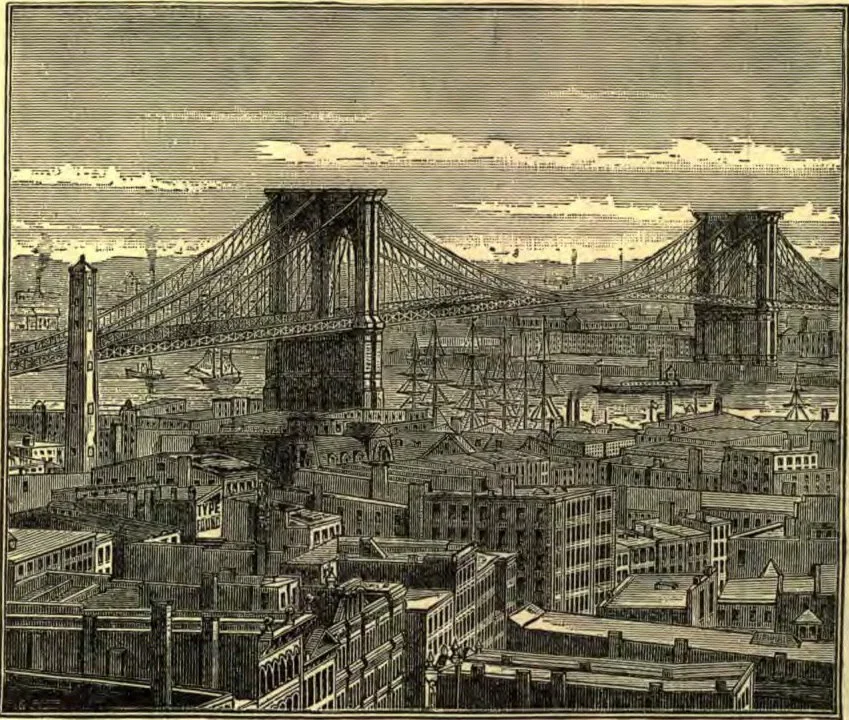
This famous structure spanning the East River, was begun in 1870, and occupied thirteen years in building. It cost $15,000,000. Brooklyn furnished two thirds of the amount, and New York City the remainder. The designer and engineer was John A. Roebling, “the master bridge builder of the world,” but meeting with a fatal accident, while making surveys for the towers, his son Washington A. Roebling, who was associated with him in the work, carried out his father’s designs. Though he did not lose his life, he parted with the next best thing—his health, in his devotion to his work. He is an invalid for life, through exposure in and around the water, while laying the foundations of the towers.
During the thirteen years of its construction, twenty-five men were accidentally killed while working on the bridge. This bridge is suspended from four granite towers, two on either bank of the river, 378 feet above high water mark and standing 45 feet below the water. It is one and one eighth miles long, and has three spans, the middle, or river span, being over a quarter of a mile long, and 135 feet above the water. The two land spans make a gradual descent to either city from the great height.
The four large cables are composed of 5,296 parallel (not twisted) galvanized steel, oil-coated wires, closely wrapped to a solid cylinder 15¾ inches in diameter. The length of each single wire is nearly three fourths of a mile. The strength of each cable is 12,200 tons. Running from each tower, are several guard ropes of steel, protected from rust by a coating of white paint.
The width of the bridge is 85 feet. A wide promenade for foot passengers occupies the center, and on either side are the carriage ways, and the railroad tracks on which the cars are run by a wire cable operated by machinery at each end of the tracks.
The trains consist of two ordinary coaches; and running one and one half minutes apart, can transport 7,000 passengers an hour. They carried more than seventeen millions of passengers last year; and three millions crossed on foot. The car fare is three cents, and the toll for foot passengers is one penny. And yet these insignificant pennies swelled to $618,914 in the yearly report of earnings.
A force of policemen are detailed for duty on the bridge, and are called the “Bridge Police.” Sometimes queer incidents occur here, as you will see.
Last summer a professional acrobat from Washington thought he could jump from the bridge into the river with safety, but he fatally miscalculated, and was picked up, bruised and insensible, by friends waiting below in a boat. He recovered sufficiently to ask if he made “a good jump,” and then died. That was his last thought while looking eternity in the face.
A few days later, a poor German, out of work, and failing after repeated efforts to get food for his family, wrote a letter telling his despair, and went to the bridge to end his life by jumping into the tide below. Fortunately, a policeman prevented him, and had his letter published in the papers. The next day his humble room was so filled with provisions sent in by kind-hearted persons who had read his story, that it looked like a prosperous grocery store; and employment was given him. Several others, hearing of his good fare, tried the same thing, but only met with arrest and imprisonment for attempting to take their own lives.
The promenade seems to be always thronged with people, some hurrying away to business, some taking it leisurely, enjoying the pure air and the view seaward, which includes Governor’s Island, with its forts; Bedloe Island, with the foundation of the Statue of Liberty; and the distant shores of Staten Island. The low line of smoke along the horizon tells of the out-going ocean steamer; while nearer, the ferry boats and busy river craft make an interesting sight.
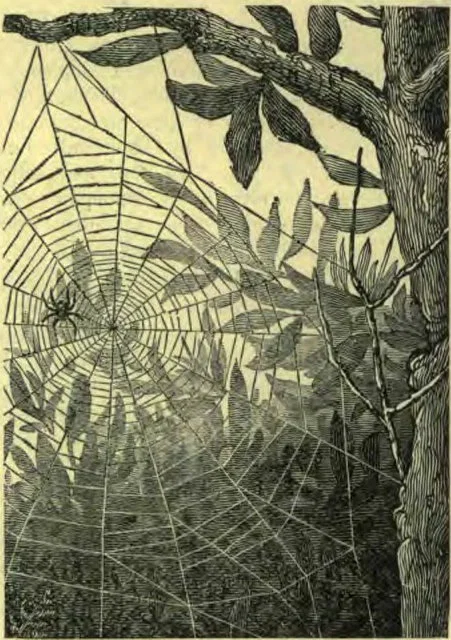
Coming up the bay, the bridge is so high that it looks like a huge spider’s web spun from city to city; and at night its row of electric lights seem like a string of diamonds flashing across the river. It is the largest suspension bridge in the world, and has the greatest span.
New Yorkers always want to show the bridge to visiting friends as the first sight. They have something of the feeling Nebuchadnezzar had when he exclaimed, “Is not this great Babylon that I have built?”
Brooklyn, L. I.
L. E. ORTON.

A TIME FOR ALL THINGS.

There's a time for laughter, a time for tears, A season for hope and an hour for fears; There's a time to sing and a time to sigh, A time when the hours go speeding by On golden wings, and a time again When the moments are weighted with grief and pain.
Our life is a checkered page at best— Much time for work and a little for rest. It has its seasons of doubt and gloom, When about our path the shadows loom, When the sun shines never a golden ray, And happiness seems to be far away;
And then again when the clouds roll by, And show a glimpse of a sunny sky; When the heart is free and our spirits light, And life is joyous and fair and bright; When with happy laughter and merry song We smile and are gladsome all day long.
Ah, yes, in our life we'll have time for all— Our cup of honey, our drop of gall, Our season of feast and our day of fast, The sunny ray when the cloud is past; For life is indeed a checkered page, From golden youth to silver age.

ABOUT COBWEBS.

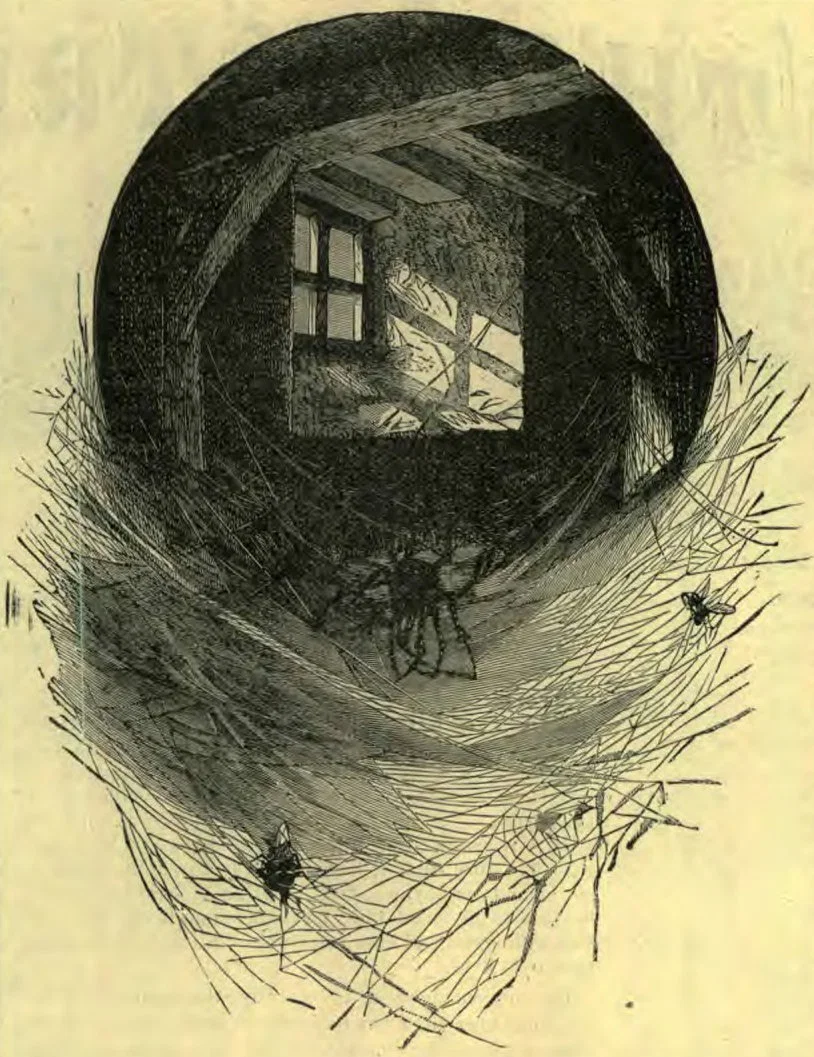
There it hangs, from the rafters in the old barn, an unsightly cobweb, thick and heavy with dust. Before you ruthlessly tear it down, let us examine it a little. Only a spider’s web, but how delicate the threads are, finer than the finest silk! How patiently the spider toiled, back and forth, back and forth, hundreds of times before his weaving was completed. Here hang two luckless flies, literally wound up hand and foot by their captor. Over in the darkest corner sits the grim bluebeard waiting for another fly to fall into his toils.
Out in the garden you may see these webs in greater perfection, as they hang suspended between the grass blades, and sparkling with the morning dew. You will almost invariably find the hostess at home, hanging in the middle of the web; or perhaps she is hidden under a leaf near by, with a telegraphic cord running up to her house to tell her when an intruder comes. Here is a fly, lazily brushing along, hardly awakened from sleep. Just a little too close he sails, and is tangled fast in the sticky, beaded threads that the spider has woven in among the others. The spider feels the vibration, and putting out her foot, tries all the threads that radiate toward the center, till she finds the one her prisoner is on. Then she runs out, and approaching the fly, throws out a fine thread which she guides with her hind foot, winding it round and round until her captive is compelled to forego his struggles. She remorselessly eats him, throwing away those parts that she is unable to chew. After that she repairs her broken net, and goes back to wait for another unhappy victim.
Let us take a closer look at her. She has eight long, hairy legs, which she is careful to keep free from dust and dirt. There are six or eight eyes on the top of her head.
Spiders are different in a great many respects from insects. The butterfly, you know, is first a caterpillar, and after a time he rolls up in a silk cocoon, next year to come out a beautiful butterfly. With the spiders this is not so, though the young are not at all like the old ones. Perhaps you have found in the autumn a little silken ball hidden away in some corner of the piazza, or tucked under the loose bark of a tree. This is the soft nest that the mother spider spins for her little ones. In this ball are a hundred or more eggs, only waiting for the warm spring weather to come and hatch the little spiders out, when they will make themselves free from their covering. At first they are so small you could hardly see them. They cast off their old clothes a good many times before they are fully grown.
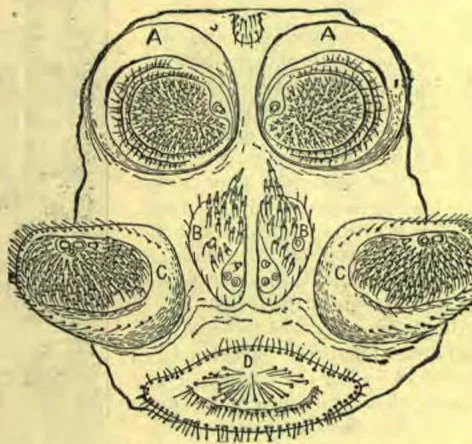
The most wonderful thing about the spider is her ability to spin gossamer threads. This is how she does it. On the under side of the abdomen are six little spinnerets, each having, at least, one hundred holes. In the engraving at the right you can see these six spinnerets greatly magnified. Behind these are glands which secrete the fluid, and this hardens into silk when exposed to the air. Think how very fine these threads must be so that when six hundred of them are put together, it would still take over a million of the larger threads to make one as great as a hair. The spider can control these spinnerets perfectly, opening and closing them at will, and making the threads fine or coarse.
There is another wonderful thing in regard to their spinning. Spiders’ eyes, as I have told you, are in the top of the head, and their spinning apparatus is on the under side of the back part; so they cannot see what they are spinning. They do it by the sense of touch, for they spin as good webs in the dark as in the daylight.
Notwithstanding spiders spin such quantities of silk, they are very economical in regulating the supply, and never spin when there is a storm approaching. If they did not take this precaution, the quantity of silk would soon be used up in rebuilding their homes so many times. There are many curious things you can learn by watching the habits of these interesting little creatures. And now spring is coming, in fact, is really here, and all created things are waking up from their long winter’s sleep, I hope the boys and girls of the INSTRUCTOR family will make good use of their eyes, and really find out for themselves what a wonderful world they live in. W. E. L.

MASTER B. WIRT.

“Any mail for our folks?” asked Ben Wirt, as he paused before the long rows of letter-boxes. The surly postmaster looked over the contents of the general delivery box, ending his search by throwing him a postal card. Ben glanced at the address, and was surprised to read, “Master B. Wirt,” instead of the customary name of his master. Who could have written to him? It was post-marked Mifflin, and the superscription indicated a business hand. As soon as he passed out of the office, he stopped to examine its contents. All that it contained was, “Master B. Wirt: I am happy to inform you that out of over twenty answers to my advertisement, I have decided to give you the situation, more because you are an orphan than for anything I know of you, as I have never seen you, or even heard of you, until I received your note yesterday. Your duty will consist in folding and wrapping goods, and it will require but little practice to make you proficient. I will pay you three dollars a week besides furnishing you with board and lodging. I shall expect you by Friday noon. Yours, etc., W. Golden.”
Ben read and re-read the card, although he was certain that it did not belong to him, for he had never answered an advertisement. There was a mistake somewhere; but it did seem strange that in a town of two thousand inhabitants there should be two orphan lads others. I named B. Wirt, and both wanting for the same thing—good, honest work.
Ben could not resist the good fortune that seemed to have come to him unmasked. No one would ever know of his treachery, and how much better times he would find behind Mr. Golden’s counter than in doing all manner of drudgery for the hard task-master he now served. The other B. Wirt would never know of the answer sent, and consequently would be no worse off than before.
SPINNERETS, MAGNIFIED.
All the evening, Ben went round whistling, for was not this the last evening he would be compelled to perform work he so much detested? But when he had crept up the rickety stairs to his hard bed in the loft, better thoughts came crowding in upon him. He fancied that the little stars looked reprovingly in at his window, and he seemed to hear the voice of his dead mother in the deep silence that prevailed. “My son, always be true to yourself, to others, and to God.”
“God knows, and I know, and that is enough; and back that card must go, even if I have to do chores all my life,” he said determinedly. So by day-break he arose, and was waiting at the post-office when the postmaster made his appearance.
“There is a mistake about this card,” he said quickly. “It belongs to some other B. Wirt.”
“That must be for the boy who seemed ready to cry because there was no mail for him last night,” answered the postmaster, examining the card attentively. “Come to think of it, he did say his name was Wirt. They live in the old Dixon house, and are mighty hard run.”
“As I have been the cause of the trouble, I’ll take the card to him,” Ben said quietly.
“It is the least you could do,” replied the man, tossing the card into his hands.
The joy that card brought to that distressed household more than repaid Ben for doing his duty. The blessings that the mother heaped upon his head when she heard his story brought back the early teachings of his own dear mother, and he returned to his hard life, glad that it was Barton and not Ben Wirt that had been meant.—S. S. Classmate.

Cheerfulness: Its Effect on Mind and Countenance

CHEERFULNESS makes the mind clearer, gives tone to thought, and adds grace and beauty to the countenance.

IMPORTANT BIBLE SUBJECTS.

LESSON 12.—THE MILLENNIUM.

1. What blessing is promised to those who have part in the first resurrection?
2. To what are they called?—To the marriage supper of the Lamb.
3. What blessing is recorded in Luke 14:15?
4. How is the same blessing recorded in Rev. 19:9?
5. What is said in verse 7 about the marriage of the Lamb?
6. What is meant by the Lamb’s wife? Rev. 21:2, 9.
7. When is this bride presented to him?—At his coronation. Dan. 7:13, 14.
8. What does he do on receiving this bride, the capital of his earthly kingdom?—He comes to the earth for his saints, and takes them to the marriage supper.
9. Describe the scene that will take place when they all arrive in heaven. Rev. 7:9-12.
10. How are the saints to be engaged during this thousand years?—In a work of judgment. Rev. 20:4.
11. What will be the nature of this work?—They will unite with Christ in examining the cases of wicked men and fallen angels.
12. How is this work alluded to in 1 Cor. 6:2, 3?
13. What will be the condition of the wicked during the thousand years?—They will all be silent in death. Rev. 20:5.
14. What will be the condition of Satan during this period? Verses 1-3.
15. What do we understand by the bottomless pit? (See note.)
16. What will take place at the end of the thousand years?—The wicked will have a resurrection, and Satan will be loosed. Rev. 20:5, 7.
17. What will Satan induce the wicked nations to do? Verses 8, 9.
18. How does the beloved city come to be upon the earth? Rev. 21:2.
19. How are those to be destroyed who besiege the holy city? Rev. 20:9.
20. What is to be done with Satan? Verse 10.
21. What will be the fate of all those whose names are not found written in the book of life? Verse 15.
22. What did John see after this? Rev. 21:1.
23. Who will inhabit the new earth?—The righteous. See 2 Pet. 3:13.
24. Seeing we look for such things, what admonition is given us? Verse 14.

NOTE.

Satan’s abode,—the bottomless pit.—The original word signifies an abyss, bottomless, deep, profound. Its use seems to be such as to show that the word denotes any place of darkness, desolation, and death. Thus in Rev. 9:1, 2, it is applied to the barren wastes of the Arabian desert; and in Rom. 10:7, to the grave. But the passage which specially throws light upon the meaning of the word here, is Gen. 1:2, where we read that “darkness was upon the face of the deep.” The word there rendered deep is the same word that is here rendered bottomless pit; so that that might have been translated, “darkness was upon the face of the abyss, or bottomless pit.” But we all know what is meant by the word deep as there used; it is applied to this earth in its chaotic state. Precisely this we believe it means in this third verse of Rev. 20. At this time, let it be borne in mind, the earth is a vast charnel house of desolation and death. The voice of God has shaken it to its foundations, the islands and mountains have been moved out of their places, the great earthquake has leveled to the earth the mightiest works of man, the seven last plagues have left their all-desolating footprints over the earth, the burning glory attending the coming of the Son of man has borne its part in accomplishing the general desolation, the wicked have been given to the slaughter, and their putrefying flesh and bleaching bones lie unburied, ungathered, and unlamented, from one end of the earth to the other end thereof. Thus is the earth made empty and waste, and turned upside down. Isa. 24:1. Thus it is brought back again, partially at least, to its original state of confusion and chaos. See Jer. 4:19-26, especially verse 23.—Thoughts on Daniel and the Revelation, p. 757.

TWO HUNDRED MILLION.

When Wm. H. Vanderbilt died, Dec. 8, 1885, you remember it was announced that the richest man in the world had fallen, and that his wealth was estimated at $200,000,000? We all knew that was an immense sum of money, but we were not able to comprehend the vastness of his riches. The fact that the interest of his money brought him about twenty dollars every minute, both night and day, gives some idea of the value of so much money; but the following clipping from the Christian Union will make the worth of this vast estate more comprehensive to the young mind:—
“Nothing is more difficult than for the human mind to fully grasp the idea of numerical immensity. Certain Australian tribes cannot count beyond ten. To other races low in intelligence, twenty is the limit; to others, a hundred. As we advance in civilization, our mathematical comprehension broadens, yet it is doubtful if many of us really know what a hundred million is. The New York Times thus describes in terms of linear, square, and cubic measurement the late Mr. Vanderbilt’s great fortune:—
“‘If this sum of $200,000,000 were in standard silver dollars, it would present such features as these:—
“‘Put lengthwise, dollar after dollar, it would stretch a distance of 4,672 miles, making a silver streak from New York across the ocean to Liverpool.
“‘Piled up, dollar on dollar, it would reach a height of 355 miles.
“‘Laid flat on the ground, the dollars would cover a space of nearly sixty acres.
“‘The weight of this mass of silver would be 7,160 tons.
“‘To transport it would require 358 cars, carrying twenty tons each (this is the capacity of the strongest freight cars), and making a train just about two and a half miles long.
“‘On ordinary grades it would require twelve locomotives to haul this train. On roads of steep grades and sharp curves, fifteen or twenty locomotives would be needed.
“‘In one-dollar bills this two-hundred-million-dollar fortune would assume such shapes as these:—
“‘The bills stretched lengthwise would extend 23,674 miles, or nearly the circumference of the earth at the equator.
“‘Piled up one on another, close as leaves in a new book, they would reach to a height of twelve miles.
“‘Spread out on the ground, they would cover 746 acres, or nearly the whole surface of Central Park, including ponds and reservoirs.
“‘A safe deposit vault to contain these bills would require to be 23 feet long, 22 feet wide, and 20 feet high.’”
The impressive words of Matthew Henry are very appreciable here: “There is a burden of care in getting riches; fear in keeping them; temptation in using them; guilt in abusing them; sorrow in losing them; and a burden of account at last to be given up concerning them.”

SIX REASONS FOR ATTENDING TEACHER'S MEETINGS.

  1. To encourage the Superintendent and teachers by our presence.
  2. To discipline the mind by study and the contact of other minds.
  3. To gain information from the leader and teachers, and get the benefit of their study and research on the lesson.
  4. To give the teachers any thoughts, points, or ideas we may have on the lesson.
  5. To meet all fellow-teachers at the throne of grace, and with them invoke wisdom from on high for the study of the word of God.
  6. And so, by these reasons, be ready to meet our classes, and instruct them in Bible history, geography, commands, invitations, warnings, and doctrines, and exalt over all, Jesus Christ, the Redeemer of a lost world, and win souls to Christ.

HOW MUCH SALT DOES THE OCEAN CONTAIN?

Of the ocean’s saltness, C. K. Bolton said in an article in the Independent:—
“One of the first things a boy will do, on arriving at the sea-shore, is to taste the water to see for himself if a whole ocean can be salt. If a box six feet deep were filled with sea water, and allowed to evaporate under the sun, there would be two inches of salt left on the bottom. Taking the average depth of the ocean to be three miles, there would be a layer of pure salt 230 feet thick on the bed of the Atlantic. If all the seas could be dried up, there would be 1,000,000,000 cubic miles of common salt. Where a fresh-water river empties into the sea, the surrounding water is, of course, more free from salt; and where there is little outlet, and continual evaporation, as in the Dead Sea, and Salt Lake, Utah, there is correspondingly more sediment to a thousand parts. In the Dead Sea, the water is so dense that a man’s body will easily float.”
But there are other lakes more appropriately called salt lakes than is the Salt Lake of Utah, if the captain who claims to have crossed them gives an accurate description of them. An exchange says:—
“In the Murghab Valley, Afghanistan, are two lakes of solid salt, which Captain Yate has ridden over and described. One, from which the Tekke-Turkomans of Merv get their supplies of salt, is in a valley about six miles square, which is surrounded by a steep, almost precipitous descent, impassable for baggage-animals except by a single road. The bed of the lake, which is about 1,430 feet above the sea, is one solid mass of hard salt, perfectly level and covered by only an inch or two of water. To ride over it was like riding over ice or cement. The bottom was covered with a slight sediment, but when that was scraped away, the pure white salt shone out below. No one has ever reached the bottom of the deposit.”
“The second lake is the one from which the Saryks of Penjdeh take their salt, and is about 800 feet above the sea. The salt in this lake is not so smooth as in the other one, and does not look so pure. It is dug out in flakes or strata, generally some four inches in thickness, and is loaded into bags and carried off for sale without further preparation.”

HOW THE SALMON JUMPS.

It seems very natural that fish should descend water-falls, in fact, one would think they could hardly avoid it; but that they can climb those of much height, seems almost incredible. Naturalists, however, have frequently made the discovery that they will ascend a fall of several feet in height. A few paragraphs from a late paper are of interest in showing their manner of doing this. We quote as follows:—
“Professor A. Landmark, chief director of the Norwegian fisheries, has published some interesting particulars of his studies of the capability of salmon to jump water-falls. He is of the opinion that the jump depends as much on the height of the fall as on the currents below it.
“If there be a deep pool right under the fall, where the water is comparatively quiet, a salmon may jump sixteen feet perpendicularly; but such jumps are rare, and he can only state with certainty that it has taken place at the Hellefos, in the Drams River, at Haugsend, where two great masts were placed across the river for the study of the habits of the salmon, so that the exact measurement may be effected. The height of the water in the river varies, of course, but it is, as a rule, when the salmon is running up stream, sixteen feet below these masts. The distance between the two is three and one half feet, and the professor states that he has seen salmon jump from the river below across both masts.
“As another example of high jumping, he mentions some instances of Carratunk water-fall, Reumbec, in North America, where jumps of twelve feet have been recorded. Professor Landmark further states that when a salmon jumps a fall nearly perpendicular in shape, it is sometimes able to remain in the fall, even if the jump is a foot or two short of the actual height. This, he maintains, has been proved by an overwhelming quantity of evidence.
“The fish may then be seen to stand for a minute or two a foot or so below the edge of the fall in the same spot, in a trembling motion, when, with a smart twitch of the tail, the rest of the fall is cleared. But only fish which strike the fall straight with the snout are able to remain in the falling mass of water. If it is struck obliquely, the fish is carried back into the stream below.
“This, Professor Landmark believes to be the explanation of salmon passing falls with a clear descent of sixteen feet. The professor believes that this is the extreme jump a salmon is capable of, and points out that, of course, not all are capable of performing this feat.”
Continue reading: OUR COINING MINTS