Pacific Press Publishing Company · New York · Apr 18, 1895
THEY HAVE BECOME AGGRESSIVE.
A most significant sign of the times in connection with the constantly augmenting Sunday law crusade is the active, aggressive action taken of late by Roman Catholic prelates for the legal enforcement of Sunday observance. When the compulsory Sunday observance movement began several years ago, Roman Catholics fought shy of it, but now all this is changed, and they not only openly favor the movement, but are beginning to assume the leadership.
On the evening of April 7, two thousand Roman Catholics of this city were addressed by the “Paulist Fathers” Doyle and Elliott on the subject, “The Preservation of the American Sabbath.” Among other significant things, the latter said: “The law given on Sinai was a law, and please God, there will be a Sunday law as long as our Government lasts.”
And now comes the announcement in the Northwestern Chronicle, a Roman Catholic paper of St. Paul, Minn., of the organization of a Roman Catholic association, called the “Sunday Law Observance League.” Priest John Gmeiner, chairman of its press committee, has issued an address “To the W. C. T. U. and all Friends of the American Sabbath,” which is signed by “Mrs. A. V. Nicholas, State Superintendent of Sabbath Observance.”
This address, which has been sent to the leading papers of Minnesota for publication, begins with a quotation from Crafts’ “Sabbath for Man,” and continues in a strain not distinguishable from an American Sabbath Union document. It concludes with the following appeal:—
All W. C. T. U.’s and Y.’s, churches, pastors, young people’s societies, temperance organizations, Law and Order leagues, and individuals are called upon to help maintain our Sabbath as a day of the Lord, for the people, without regard to race, sex, or condition, for a day of rest and worship. To this end let us make Sabbath observance week in Minnesota marked by sermons, public meetings, Sunday-school exercises, distribution of literature, and prayer for the better enforcement of law against all infringement of the right of Sabbath observance and particularly against that arch-enemy of God and man, the saloon.
Priest Gmeiner accompanies the address, as published in the Northwestern Chronicle, of April 5, with a statement of the Protestant organizations that have already indorsed the new Roman Catholic movement. He says: “It has been heartily indorsed and approved by the Methodist Episcopal ministers’ meeting at St. Paul, March 25, and by the Baptist Ministerial Conference held about the same time in the same city.”
The priest next quotes the indorsement of a leading Presbyterian minister of St. Paul, and closes with a request to “all ministers of St. Paul and throughout the State,” “to lay the question of Sunday observance before the members of their congregations at the earliest convenient occasion, so that a decided move in the right direction may be made at once throughout the State.” A mass meeting is announced at St. Paul for the 15th inst., at which the editor of the Northwestern Chronicle will preside.
Now, all this is most significant. It shows that Roman Catholics are forging to the front in the universal Sunday-law stampede. For years the W. C. T. U., the National Reform Association, and the American Sabbath Union have appealed with indifferent success to Roman Catholics for assistance in the enactment and enforcement of Sunday laws; but now Roman Catholics have assumed the leadership and call upon these same societies to coöperate with them in enforcing the observance of Sunday which they claim has no Bible support, and is therefore a sign of the power of the Roman Catholic Church to ordain feasts and holy days, the observance of which by Protestants they declare “is an homage they pay in spite of themselves to the authority of the [Roman Catholic] Church.”
The people who publish the AMERICAN SENTINEL have long expected that Roman Catholics and Romanizing Protestants would unite to enforce the Sunday, the mark of papal apostasy upon all. This expectation was based on the “sure word of prophecy,” and was published to the world before there was a sign of such a union, and when such an unnatural union was scouted at as impossible. It has come and it behooves the people who knew it would come, and the thousands who knew of this prediction and who have been watching to see whether it would be fulfilled, to be up and doing while the day lasts, “for soon the night cometh when no man can work;” when the opportunity will be forever past of proclaiming to the world the message: “If any man worship the beast and his image, and receive his mark in his forehead, or in his hand, the same shall drink of the wine of the wrath of God.” Rev. 14:9, 10.
SIN FROM A ROMAN CATHOLIC STANDPOINT.
The Roman Church claims the “power to command feasts and holy days,” and to “command them under sin.” That is, the church claims the power to ordain holy days and the manner of their observance, and the power to pronounce any disobedience of these commands to be sin, which, if not repented of, results in the eternal ruin of the disobedient one. With this assumption of the church in view, a few observations regarding the laws of the church regulating Lent, just past, may be interesting and profitable.
The following are the commands of the church regulating the fast of Lent, as promulgated by Cardinal Gibbons:—
1. All the faithful who have completed their twenty-first year, unless exempt by dispensation or some other legitimate cause, are bound to observe the fast of Lent.
2. They are to make one meal only a day, except on Sundays.
3. The meal permitted on fast-days is not to be taken till about noon.
4. A small refreshment, commonly called collation, is permitted in the evening.
5. The following persons are exempt from the obligation of fasting: Persons under twenty-one years of age, the sick, nursing women, those who are obliged to do hard labor, and those who, through weakness, cannot fast, without great prejudice to their health.
6. The faithful are reminded that, besides the obligation of fasting imposed by the church, this holy season of Lent should be, in an especial manner, a time of earnest prayer, of sorrow for sin, of seclusion from the world and its amusements, and of generous almsgiving.
Let it be remembered that to disobey these commands of the cardinal is sin. The reader, unacquainted with the rules of the church, will think that these commands are very severe. However, the pope has granted an “indult,” that is, an indulgence to the Roman Catholics of the United States, by which they can violate the above commands, without sin, where others in less favored countries, should they disobey them, would be counted sinners. Here is the indulgence:—122
II.
By virtue of an indult to the United States, dated August 3, 1887, the following special dispensations are granted:—
1. The use of flesh meat is permitted at all meals on Sundays, and once a day on Mondays, Tuesdays, Thursdays and Saturdays, with the exception of the second and last Saturdays of Lent. But flesh meat and fish are not to be used at the same meal during Lent, even on Sundays.
2. The use of butter, cheese, milk and eggs is also permitted every day in Lent.
3. It is allowed to take in the morning some warm liquid, as tea, coffee, or thin chocolate, made with water, and with this liquid a mouthful of bread.
4. Those for whom the hour of noon may be an inconvenient time for dinner, may invert the order and take their collation in the morning, and their dinner in the evening.
5. The use of hog’s lard, or dripping, instead of butter, is authorized in preparing permitted food.
6. Persons exempt from the obligations of fasting are free to take meat more than once on those days when its use is granted by dispensation.
III.
The Paschal time extends from the first Sunday of Lent till Trinity Sunday, during which time all persons who have attained the proper age are bound to receive worthily the holy communion. The holy season of Lent is a very proper time also for children to make their first confession, which they ought to do generally about the age of seven years. Parents should see to this.
By order of his eminence the cardinal,
W. A. REARDON, Chancellor.
Baltimore, Feb. 15, 1895.
It will be noticed that while it is a sin to eat flesh on certain days, it is not sin to eat fish. It will be interesting to note further what is included under the term “fish.”
The American Ecclesiastical Review, a Roman Catholic monthly, “published for the clergy,” with the authority of superiors (“cum approbationes superiorum”), in its April issue, publishes the following question and answer:—
Qu. Does the privilege, which exists in the Southern States, of eating seal-duck on days of abstinence, extend to all parts of the country?
Resp. . . . Wherever this species of sea-fowl is commonly reckoned in the same category of food as turtles, lobster, frogs, oyster, etc., which though they cannot be called fish, are nevertheless held to be lenten food, there the practice of serving seal-duck is licit. Some regard as included in this category even the meat of beavers, otters, coots, and other semi-marine animals which live almost exclusively in the water and obtain their food there.
From this we learn that, according to the church of Rome, it is a sin to eat flesh on certain days, but it is not a sin to eat fish, seal-duck, turtles, lobsters, frogs, oysters, beavers, otters and coots. In other words, the church damns a man who eats beef or mutton, and commends him when he eats turtles, lobsters, frogs, oysters, beavers, otters and coots.
“Sin is the transgression of the law” (1 John 3:4), but the Roman Catholic Church has thought to change that law which the Lord, by the Psalmist, calls “perfect,” and by Paul calls “spiritual,” “holy,” “just,” and “good,” and has erected another standard of righteousness, a part of which declares that it is a sin to eat beef and mutton on certain days in certain countries, but righteousness to eat turtles, lobsters, frogs, oysters, beavers, otters and coots.
Oh that Roman Catholics would turn from the burdensome traditions of men to the law of God; from the “vicar of Christ” and “the virgin,” to Him who said, “Come unto me.”
THE EDUCATIONAL WORK OF THE ADVENTISTS.
The closing of the Adventist academy in Rhea County, Tenn., by the persecution at that place, naturally suggests some question as to the extent and nature of the educational work conducted by this people.
The educational facilities of the denomination are summarized by Prof. W. W. Prescott, their educational secretary, in his recent report to the General Conference, as follows:—
Battle Creek College, at Battle Creek, Mich.; Union College, at College View, Neb.; Healdsburg College, at Healdsburg, Cal.; Walla Walla College, at College Place, Wash.; and Claremont College, at Claremont, South Africa. There are four academies, or schools, doing work of academic grade, in this country; at South Lancaster, Mass.; Mt. Vernon, Ohio; Keene, Texas; and Graysville, Tenn.; and one abroad [Frederikshavn, Denmark]. There are also the West Virginia Preparatory School, the Australasian Bible School, a school in Mexico in connection with the Medical Mission; schools for native children upon Pitcairn Island, upon Raiatea of the Society group, in the South Pacific Ocean, upon Bonacca of the Bay Islands in the Caribbean Sea, about fifteen church schools in this country and abroad, two General Conference Bible schools, and quite a number of local colporters’ and conference schools not regularly organized.
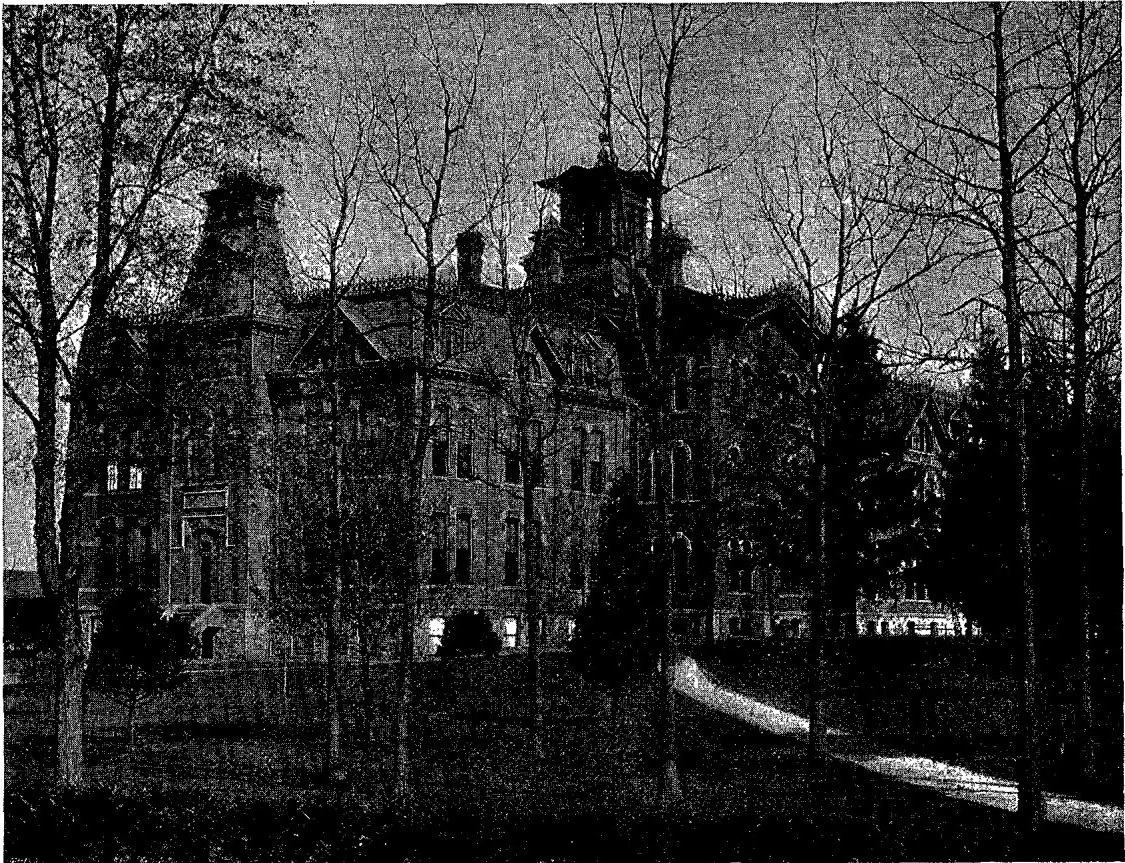
SEVENTH-DAY ADVENTIST COLLEGE, BATTLE CREEK, MICH.
At the time of the making of this report, February 17, there were enrolled in the regular schools, not including the local colporters’ and conference schools not regularly organized, over three thousand pupils. The total number of instructors and helpers engaged in school work was at the same time one hundred and seventy, approximately. This does not include Bible schools, schools for the education of colporters, or local church schools.
Thus it will be seen that for a denomination numbering only about fifty thousand communicants, the Seventh-day Adventists are doing a large amount of educational work.
Battle Creek College, Battle Creek, Mich., has an enrollment of six hundred and twenty-eight; Union College, Lincoln, Neb., has an enrollment of four hundred and thirty-six; and Graysville Academy, the school closed by the imprisonment of the principal and his first assistant, is credited with an enrollment of one hundred and five. The number of teachers in the Graysville Academy was nine; at Union College, thirty-seven; and Battle Creek College, thirty-four. A larger number at Union College is due to the fact that there are German and Scandinavian departments.
The educational work done by the Adventists is by no means superficial. In fact, they aim at thoroughness in all their work. Education is essential to any people who espouse unpopular doctrines. They must be able to defend their positions, and to defend them intelligently, and this they cannot do without education. Of course, their educational work differs somewhat from that of other denominations, for it has reference more to religious training than perhaps that given by any other denomination. Bible truth is taught in all their schools, and almost everyone takes the “Book of books” as one of his studies. However, the sciences are not neglected, and students leaving some of their institutions and entering various colleges in the country, have passed very satisfactory examinations; in fact, some of the Adventist schools have been highly complimented on the quality of their work by those who have learned of them by coming in contact with students who have entered other and higher institutions of learning.
The Adventists are a practical people, and as far as possible, give a practical education. Most of the students in their colleges and academies have some definite purpose in view, and are studying to fit themselves for some particular sphere of usefulness. Being reared in Christian families, and having Christian aspirations themselves, their students, as a rule, work from a conscientious standpoint, and not simply to be able to pass certain examinations and receive a diploma at the end of their course. They realize that they are fitting themselves for active work in the cause of God, and that their time and even themselves are not their own. Hence a different spirit pervades these institutions from that found in many schools.
SEVENTH-DAY ADVENTIST COLLEGE, COLLEGE VIEW, NEB.
The medical missionary work is receiving a good deal of attention from this people. They have at Battle Creek the largest and best equipped medical and surgical sanitarium in123the world, and here are educated nurses who receive a thorough training and preparation for active work. Those desiring to take a medical course are encouraged to go to Ann Arbor and enter the regular course there; and many of them subsequently take a post-graduate course at Bellevue, New York. A number of these have already gone to foreign fields and others are preparing to go ere long.
Tennessee and other States may persecute this people, and attempt to drive them from their borders, but they cannot stay the onflowing tide of their work. They are not fanatical, but they are enthusiastic, and have the courage of their convictions. They are willing to suffer reproach, loss of property, loss of liberty, or even loss of life, for the sake of the truth which they profess. No people make their religion a part of their daily lives more than do the Adventists, and prison bars have no terrors for them when they have the consciousness that they are doing God’s service.
As related in these columns four weeks ago the academy at Graysville is closed, owing to persecution; but it will not be permitted to remain so. It is the purpose of the denomination to re-open it at the usual time for the beginning of the fall term.
Peaceable Fruits of Christ's Teachings Versus Persecution
WHEN the teachings of Christ rule in the hearts of individuals, then behold the peaceable fruits of righteousness; when men assume to have authority from Christ to rule other men by means of the civil law, then behold the unpeaceable and unequal fruits of persecution.—Midland (Mich.) Republican.
A MEMORIAL.
To the Honorable, the Senate and House of Representatives of the State of Tennessee:—
We, the undersigned residents of Rhea County, Tenn., respectfully petition your honorable body to repeal Section 2289 of the Code of said State, prohibiting secular employment on Sunday, for the reason that said Section is in contravention of Section 3 of the Declaration of Rights which declares “That no human authority can, in any case whatever, control or interfere with the rights of conscience; and that no preference shall ever be given by law to any religious establishment or mode of worship.”
In support of this, our petition, we beg to submit the following facts and considerations:—
The American principle of government does not recognize in the majority any authority over the minority except in matters regarding the conduct of man to his fellow-man. Hence, Section 3 of the Declaration of Rights of the State of Tennessee, regards the conscience of the Jew as sacred as that of the Christian, and gives no more authority to adopt a measure affecting the conscience of a solitary individual than that of a whole community.
But Section 2289 of the Code of this State requires all men, whether Jews, Christians, or agnostics, to observe the first day of the week by abstaining on that day from all secular employments; and thus interferes with the conscience of every man: for it leaves no man free to change his opinion and practice in this regard. This is especially patent in the case of the Jew and seventh-day Christian, who, after having kept the seventh day according to the fourth commandment of the Decalogue, are required by said Section 2289 to observe Sunday also.
The law, moreover, works a special hardship upon your petitioners, who are Seventh-day Adventists, because we believe that the fourth commandment requires not only the observance of the seventh day, but that it forbids us to show a like regard for another day.
MEDICAL AND SURGICAL SANITARIUM, BATTLE CREEK, MICH.
The divine law of the Sabbath separates the seventh day from the other days of the week, and requires all men to respect that distinction. To treat two days alike by refraining from labor and business upon them, is to destroy that distinction which the fourth commandment makes between “the Sabbath of the Lord” (Ex. 20:10) and the “six working days” (Eze. 46:1); and is, therefore, to defeat the object of the divine law. For this, and analogous reasons, your petitioners cannot conscientiously refrain from secular employments, habitually, upon the first day of the week.
But notwithstanding the fact that this is a matter directly affecting the conscience, and that Section 3 of the Declaration of Rights contains a seemingly ample guarantee of freedom of conscience, Seventh-day Adventists have been repeatedly prosecuted in the courts of this State, under the said Section 2289 of the Code, have been mulcted in fines and costs, have been imprisoned in county jails and workhouses, and have even been set to work upon the streets with the chain-gang. At the March term of the Circuit Court in this county, nine of your petitioners were convicted on seventeen indictments under the said law, and in default of payment of costs, were committed to jail for terms of from nineteen to seventy-six days; and to-day Eld. G. W. Colcord (a minister of the gospel), E. S. Abbott, M. C. Sturdevant, William Burchard, and Dwight Plumb, are still in prison for no other offense than exercising the common vocations of life upon the first day of the week, in a civil and orderly manner.
And not only are the individuals named suffering imprisonment at the present moment under the operation of an unjust law, but our academy at Graysville, Rhea County, has been closed by the imprisonment of the principal and his first assistant; the school has been broken up, and the students, to the number of nearly one hundred, have been subjected to serious loss and disappointment.
We have repeatedly plead our rights of conscience in this matter, but our plea has not been regarded by the courts, and we have been told that our remedy is not in the courts, but in the legislature.
That this is a matter of conscience, was thus admitted by his honor, Judge James G. Parks, at the recent term of the Circuit Court in this county. In pronouncing judgment against the nine defendants already mentioned, his honor said:—
The Supreme Court of this State, whose decisions must be taken as final by the lower courts, has passed upon this decision, and we cannot rightfully reverse its decisions.
If I were to express my private feelings, however,124I might say that there is nothing I regard with more concern or solicitude than an encroachment of legislative enactment upon the personal rights of the individual in matters of conscience. That there is a limit in these matters beyond which legislation cannot rightfully go, will be conceded by every man.
But here we have a very respectable element of Christian believers who are honest, inoffensive, law-abiding people in all matters not conflicting with their sense of duty, who believe they are under divine command to observe the seventh day as the Sabbath. As a matter of abstract, individual right, can they be required to observe another day also? Their position is not that of a person who claims that as a matter of personal liberty he has the right, if he chooses, to run an open saloon on Sunday, or to do any like act. That is not a matter of conscience—this is. They claim that it is not only their right, but their duty under divine command to observe the seventh day. Calling them “cranks” is no argument and has nothing to do with the question. If there were only one of them he would be entitled not only to his honest belief, but to the exercise of that belief, so long as in so doing he did not interfere with some natural right of his neighbors. A man cannot kill another and excuse himself on the ground that he believed he was carrying out God’s will in so doing, because this would deprive his victim of a natural right, viz.: the enjoyment of life. Do the defendants in keeping the seventh day and working on the first, thereby interfere with any natural right of their neighbors? Or is it an artificial right created by human law? Has any power but the divine will the right to establish any one day as the Sabbath? If the day has been appointed by divine edict, but two or more persons honestly and conscientiously differ as to what day was appointed, can the dispute be settled by legislative enactment? And shall one be given rights which are denied the other? Does might make right, and have the majority the right to dictate in matters purely of conscience?
In reporting the trials of the Adventists, the Dayton Republican, of March 9, had the following head-lines:—
PERSECUTION.
Prosperous Community Broken Up.
GRAYSVILLE ADVENTISTS SUFFER FROM A BAD LAW.
THE COUNTY JAIL TO BE RECRUITED WITH SOME OF OUR BEST CITIZENS FOR WORKING ON SUNDAY.
But notwithstanding the fact that we have the sympathy of the court and of the considerate and thinking portion of the community, there are not wanting illiberal persons who seem determined to pursue us with the law; and at the recent term of court there were twenty additional indictments found against us—many of them for the most trivial acts which would pass without remark if done by persons not observing the seventh day.
Our enemies themselves being witnesses, we are law-abiding citizens in all matters not conflicting with our sense of duty to God. Our refusal to obey the Sunday laws of Tennessee does not arise from any disposition to defy the State, or from any willful disregard of civil authority; but is due solely to our conscientious convictions of divine obligation. Nor are we governed in this matter by blind fanaticism. The divine right of dissent is the most precious right with which the Creator has endowed man, and millions have laid down their lives rather than surrender it. That eminent citizen of Kentucky, Hon. Richard M. Johnson, in his capacity as chairman of the House Committee on Post Offices and Post Roads, in his matchless report to the National House of Representatives, on Sunday mails, March 4, 1830, said:—
The framers of the Constitution recognized the eternal principle that man’s relation with his God is above human legislation, and his rights of conscience inalienable. Reasoning was not necessary to establish this truth; we are conscious of it in our own bosoms. It is this conscientiousness which in defiance of human laws, has sustained so many martyrs in tortures and in flames. They felt that their duty to God was superior to human enactments, and that man could exercise no authority over their consciences. It is an inborn principle which nothing can eradicate. The bigot, in the pride of his authority, may lose sight of it; but strip him of his power, prescribe a faith to him which his conscience rejects, threaten him in turn with the dungeon and the fagot, and the spirit which God has implanted in him rises up in rebellion and defies you.
Nor is it alone by statesmen that this principle has been recognized and defended. The eminent educator and moral philosopher, President Fairchild, in his work on “Moral Philosophy,” states the same truth thus succinctly:—
It is too obvious to need discussion, that the law of God, the great principle of benevolence, is supreme, and that “we ought to obey God rather than men” in any case of conflict between human law and the divine. There are cases so clear that no one can question the duty to refuse obedience. In all times and in all lands such cases have arisen. In a case of this kind, either of two courses is possible: to disobey the law and resist the government in its attempt to execute it, or to disobey and quietly suffer the penalty. The first is revolutionary, and can be justified only when the case is flagrant and affects such numbers that a revolutionary movement can be sustained. . . . The second course will, in general, commend itself to considerate and conscientious men. It is a testimony against the law as unrighteous and at the same time a recognition of government as a grave interest.
The latter course mentioned by President Fairchild is the one which has been pursued by Christians in every age. The apostles refused obedience to civil authority when civil law required of them obedience which they could not conscientiously render; and thousands of martyrs have laid down their lives rather than yield to any earthly authority in matters of conscience. Our own country has not been without witnesses to this principle. The Baptists and Quakers of New England and Virginia, suffered fines, imprisonment, whipping, and some of them even death itself, rather than prove disloyal to conscience.
We are not asking special favors, or the patronage of public authority; we seek only the rights which we ought to enjoy under Section 3 of the Declaration of Rights. We do not ask toleration merely, but, in the language of Hon. Richard M. Johnson, we declare that “what others call religious toleration, we call religious rights. They are not exercised in virtue of governmental indulgence, but as rights of which government cannot deprive any portion of citizens however small. Despotic power may invade these rights, but justice still confirms them.”
We do not ask simply for a clause exempting us from the penalties of the law, but for the repeal of the law; because simply to ask an exemption would be to admit the right of the State to legislate upon such questions, and to consent to the idea that the legislature might properly require of others that which we are not willing it should exact from us.
We believe that properly interpreted, the Declaration of Rights of the State of Tennessee would afford equal protection to all; and that justice to all, and a due regard for inalienable rights demand the repeal of Section 2289 of the code of the State; and for this we accordingly pray.