The Youth’s Instructor, Vol. 31, No. 14.

WHAT A LITTLE SUNBEAM DID

The Youth’s Instructor

Apr 4, 1883

S. D. A. Publishing Association · Battle Creek, Mich. · Apr 4, 1883

WHAT A LITTLE SUNBEAM DID.

For many days there had been cold and cloudy weather; the rain had fallen nearly every day, and the ground was soaked with water. It was the time for blossoms. The buds had opened slowly, to find their blossoms drenched with rain and chilled with cold. Hardly anything except grass grew; trees, shrubs, flowers, and plants,—all seemed sad and discouraged. The birds were still and gloomy; they found very little to sing about. The lambs were quiet; the sheep huddled together in the pen; the cows in the yard stood with heads turned away from the cold wind; the calves and young colts forgot to frolic; and all the animals appeared to be sorrowful. Day after day the farmers looked at the dark clouds, and shook their heads in gloomy fear. Now and then one grumbled: “Well if it keeps up this way much longer, there will not be any planting nor any crops but grass, and that, as likely as not, will be drowned out. The rain has probably destroyed the blossoms already; the cold will, if the rain don’t. I wonder if the sun will ever shine again?”
While the dreary weather continued, the sick remained ill or grew worse, and seemed slowly dying for lack of sunshine; even those usually well appeared half sick now, and everybody complained.
After the sun had for a long time been hidden, one day, above the clouds, the little sunbeams stopped in their play for a while; and one of them, looking over the edge of a cloud, caught a glimpse of the world below.
“Oh,” said he as he came back to the others, “I just had a look at the earth, and it is terribly gloomy. Everything and everybody is sad and drooping. I believe they miss us down there. The first chance that comes I am going down. It is very nice up here to have this fun jumping from these clouds, but it seems to me that I might do better by trying to make others happy.”
Soon there came a small opening in the clouds, and this sunbeam went through. While looking where to go first, he saw a tiny white lily-of-the-valley half hidden beneath a bush. “I’ll go there,” he said; and in a moment the beautiful lily was covered with sunlight. The sweet flower, breathing out its fragrance, whispered, “There! God has not forgotten! he is smiling on me now. God is good.”
For a moment only the sunbeam waited, then was gone, but that moment was long enough to cheer the lily and let the sunbeam know that he had done good. Next he went to an apple-tree that was grieving for fear the rain, the cold, and the cloudy weather would injure its blossoms, and destroy its prospect for fruit.
“Sunshine at last!” sighed the tree. “My fruit will be saved. Even though this does not stay, more sunshine will come soon. All will be well.”
The sunbeam went from one tree to another, cheering each one as he went along. The birds saw him passing from tree to tree, and began to sing joyful songs. From the trees he went to the barn-yard, looking in on the sheep as he passed. They began to scatter around in their yard and tried to nibble the grass through the fence, while the lambs started for a good romp; some of them, creeping through the fence, had a grand frolic in the field. The cows in the barn-yard caught a glimpse of the sunshine, and began to stir about; soon the calves seemed to be playing a game of “tag,” and then tried a kind of leap-frog between the bars of the gate. The colts, too, had a lively time running around the yard. So there was a general waking up around the barn.
The sunbeam saw the farmer coming out of the house, and went to meet him, brushing his golden light in the farmer’s face just as he was looking sadly up to the clouds. In a moment the man’s gloom was gone, and he said cheerfully, “Sunshine! Sure as can be! Now things will grow;” and whistling “Auld Lang Syne,” he walked with happy step to the barn.
Next the sunbeam thought he would look into the window of the farm-house. This happened to be the window near the bed of a sick boy. For a very short time the sunbeam shone on his bed and looked into the boy’s face. The sad look of the little invalid was gone in a moment, and a smile was left where the sunbeam had been. “Oh, there’s the sun!” said the boy. “Now I’ll be better. I feel better already.”
All the others in the house caught the spirit of the sick one, and the gloom of the household disappeared.
By this time the clouds had noticed the change made by the sunbeam. They did not like it, so determined to call him back. Soon the little beam was again among his friends, and the clouds were trying to wash out by a hard rain the happiness he had left on earth. The sunbeam told the others what he had seen—how gloomy all were, and how glad each one was to see him. His story interested them so greatly that they said, “If one little sunbeam can do so much, what cannot many do if they try hard? Let us all go down, and try to make the sad world happy.” All agreed to go.
At once they began pushing at the clouds, and soon succeeded in separating, and then in driving, the clouds away. As soon as there was an opening, as many sunbeams as could, sprang into it and went down, while the others kept at work pushing the clouds away until nearly all had gone. Swiftly, one after another the little sunbeams went to earth, and began making everything happy. They lit up gloomy homes; they shone on fields and trees; they made the raindrops on the grass shine like pearls; and the leaves of the trees seemed loaded with jewels, and the whole world was full of beauty. The birds sang their best songs, the animals were happy, farmers were cheerful, and everybody was delighted.
For a few hours the sunbeams kept at work; then the sun, going down, called them all home for the night. They went, happy in the thought that they had done so much to make the world better, and said that if little sunbeams could do so much good in a few hours, they might do far more by working many days; so they determined to start out again early the next morning. At sunrise the next day they set out, and kept busy all day; so they did the next and the next.
As they worked, the blossoms opened, the young fruit started and gradually grew larger. So, too, grass and grain grew and ripened for harvest. At last, late in the fall, when all the crops were gathered, they stopped to rest, though they had taken short rests now and then during showers or when a rainy day came. But now they ceased their hard work, and looked around to see what had been done. The barns, the granaries, the bins, were full. Then they saw what an amount of work little sunbeams can do.
Children are like little sunbeams, and like them may make the world happier, and do a great amount of good here. It was one little sunbeam that started the others. One child may lead many to work. What a good time there will be, when the work is all done, to see how much the children did!—S. S. Visitor.

APRIL-TIME

Bleak and bare, in the morning gray, Lie the uplands and hills to-day; Over their tops the clouds hang low, Black and heavy with rain and snow.
Here and there by the sheltering wall, Grow and brighten the grasses small; Here and there on the larch are seen Slender tassels of softest green.
Over the brook the alders swing Tawny blossoms to greet the spring; Thickly gemming their branches low, Yellow catkins the willows show.
Beautiful tokens! all in vain, Down from the black cloud starts the rain; Deep in the earth, beneath our feet, Warm as summer the pulses beat.
You may count their throbbing in streams that leap, With rush and ripple from silent sleep, In the flash of wings through the maples bare, And the bluebird’s note on the morning air.

WORDS OF CHEER FROM AN OLD FRIEND OF THE INSTRUCTOR.

This morning I have been looking over the first number of the YOUTH'S INSTRUCTOR, printed in August, 1852, which I have carefully preserved. While reading it, my mind was carried back to the time when we first welcomed it under our roof. It was then printed but monthly, but its pages were eagerly perused, and faithfully studied.
Over thirty long years have passed, during which time the INSTRUCTOR has made its visits to ours, and hundreds of other families. Many that were then in the strength of man and womanhood, have grown gray with age. To many it comes up among their first recollections. Some of its contributors have finished their labors, and long since gone to their rest; probably hundreds that have read it are sleeping in the silent tomb. But the paper lives, and continues its work of cheering and instructing many hearts.
I never have felt a deeper interest in it than I have the past year. I am glad the dear children and youth have a paper filled with interesting and profitable reading. I believe the lessons so carefully prepared, from week to week, alone, if faithfully studied, will prove to be of more value to us than mines of gold and silver. Undoubtedly hundreds will unite with me in saying: By them we have become much better acquainted with our Divine Lord, much more interested in his precious word.
Now the question is: Will they prove a savor of life unto life to us? Will we follow his example,—live his self-denying and cross-bearing life? To the youth I appeal especially, Will you try to treasure up these precious truths into good and honest hearts,—try to realize he came to save you; that he is interested in you; that he has claims upon you; and yield to him your heart's best affections?
May the Lord bless the readers of the INSTRUCTOR, and continue to give wisdom to all interested in preparing its columns, is my earnest prayer. M. L. PRIEST.

ASBESTOS

A small specimen of the above-named mineral lies beside me as I write. It looks like cotton just taken from the plant. A close examination, however, shows us the difference between the two articles.
Asbestos is gray, while cotton is white; the fibers of the former are short, of the latter, long; in the delicate threads of the mineral, we find slender, black crystals and tiny balls resembling shot, while in the cotton no such particles exist.
This particular specimen of asbestos was given me by a girl of twelve years. She received it from a gentleman who found it in an iron mine near Scranton, Penn., where it abounds.
Many varieties of this peculiar-looking mineral are found in different portions of the United States. In its finest and rarest forms, it is called amianthus, and can only be obtained from the older crystallized rocks.
Savoy and Corsica produce the best amianthus; but some good specimens of it have been brought from the Pyrenees, the Alps, the mountains of Silesia, New South Wales, and from parts of North America.
Amianthus has been known in all ages and in all countries. The ancients prized it, as we now do asbestos, because it would not burn. They wore it into cloth, and used it for shrouds in which to wrap the bodies of their dead.
This cloth was first prepared by combining the fibers of the amianthus with those of flax. It was then exposed to the heat of a powerful furnace. By this means, the flax in the cloth was destroyed.
Many of the ancient natives practiced what we now term cremation. They burned instead of burying the bodies of their dead. Wrapped in fire-proof shrouds of amianthine cloth, they placed these bodies on the tops of funeral piles, sometimes built of the costliest and most fragrant kinds of wood. They then applied the torch to the fagots; and the flames, gradually creeping up, would consume the body, and reduce it to ashes. But, protected by their amianthine robes, these sacred ashes could afterward be collected, and placed in the beautiful memorial urns prepared for their reception.
Coming down a little later in the history of the world, we find this same amianthine cloth manufactured into towels, handkerchiefs, gloves, dresses, and even into entire suits of clothes. These, to be purified, needed only to be thrown into the fire.
An amusing story is told of Charlemagne. This wise and witty monarch lived about A. D. 800. He was a powerful emperor, reigning in great state over both Germany and France, and was called the Cæsar (Kaiser) of the West. It is said that he had an amianthine cloth, which he used to have spread upon his banqueting table. After the feasting was well over, for the further entertainment of the guests—so runs the legend—he would snatch the cloth from the table and throw it into the fire. To their utter amazement, this cloth would come forth from the flames cleansed, but not consumed.
In these modern times, asbestos is principally put to practical uses, such as in the construction of fire-proof safes, floorings, and roofs. Paper has been made from it, and would prove very valuable for important documents, were it not too fragile and tender.
I prize my little specimen, not only as a curiosity, but as another instance of the manifold and marvelous works of the great Creator, and of the fitness of those creations to the varied wants of man.—Adeline Wardell.

THE UNSEEN RECORD.

Quite a number of years ago I employed a mute to work in my shop. When I engaged him, our conversation had to be written down. I was not to pay him anything until I had made certain sales. After working a few days, he came and wished me to pay him. I told him I could not until I had made these sales, at which he seemed very much displeased. I told him that it was according to our agreement, but he declared that it was not. Finally I thought of our conversation, which was written in an old scrap-book; so I got it, and showed him just what had been said. He seemed very much surprised, and said he had entirely forgotten it.
Now we read in the Bible that we shall be judged out of the things written in “the books.” By “the books” are meant the books in heaven, in which the record of our lives is daily written by an angel of light. If we could see the record of our lives just as it has been written, do you not think we would be surprised and grieved to see so many wrong and idle words recorded against us? May we all so live that when we stand before the great white throne, and the Judgment is set and the books are opened, there may be found naught to testify against us.
G. O. S.

Living More Purely and Grandly Tomorrow

No matter how purely and grandly we live to-day, there is no denying that we may live more purely, more grandly to-morrow.

THE BLESSED MASTER.

His hands were hardened with carpenter’s tools; His sandals were dusty with going afoot; He was all unlearned in the subtle schools; He was meek and lowly and destitute.
The fox in the hillside burrowed her home; The bird in the branches builded her bed; The King of the earth, to his kingdom come, Owned never a roof to shelter his head.
But oh, the grace of his loving face! The touch of his tender hand! What joy to stay by his side alway, As he went through all the land!
To hear his talk in the daily walk By the vineyard or the wheat, To know he has blessed the place of our rest And the poorest food we eat!
—Urania Locke Bailey.

NEW-TESTAMENT HISTORY.

LESSON 129.—PETER PROCLAIMS SALVATION THROUGH FAITH IN CHRIST.

At the close of our last lesson we left Peter addressing the multitude who had come together to hear the apostles speak in tongues. He had just shown that what they now witnessed was a fulfillment of prophecy; and had spoken of the signs of our Lord’s second coming. He then continued as follows:—
“Ye men of Israel, hear these words; Jesus of Nazareth, a man approved of God among you by miracles and wonders and signs, which God did by him in the midst of you, as ye yourselves also know: him, being delivered by the determinate counsel and foreknowledge of God, ye have taken, and by wicked hands have crucified and slain: whom God hath raised up, having loosed the pains of death: because it was not possible that he should be holden of it. For David speaketh concerning him: I foresaw the Lord always before my face, for he is on my right hand, that I should not be moved; therefore did my heart rejoice, and my tongue was glad; moreover also my flesh shall rest in hope; because thou wilt not leave my soul in hell, neither wilt thou suffer thine Holy One to see corruption. Thou hast made known to me the ways of life; thou shalt make me full of joy with thy countenance. Men and brethren, let me freely speak unto you of the patriarch David, that he is both dead and buried, and his sepulchre is with us unto this day. Therefore, being a prophet, and knowing that God had sworn with an oath to him, that of the fruit of his loins, according to the flesh, he would raise up Christ to sit on his throne; he seeing this before, spake of the resurrection of Christ, that his soul was not left in hell, neither his flesh did see corruption. This Jesus hath God raised up, whereof we are all witnesses. Therefore being by the right hand of God exalted, and having received of the Father the promise of the Holy Ghost, he hath shed forth this, which ye now see and hear. For David is not ascended into the heavens: but he saith himself, The Lord said unto my Lord, Sit thou on my right hand, until I make thy foes thy footstool. Therefore, let all the house of Israel know assuredly, that God hath made that same Jesus, whom ye have crucified, both Lord and Christ.
“Now when they heard this, they were pricked in their heart, and said unto Peter and to the rest of the apostles, Men and brethren, what shall we do? Then Peter said unto them, Repent, and be baptized every one of you in the name of Jesus Christ for the remission of sins, and ye shall receive the gift of the Holy Ghost. For the promise is unto you, and to your children, and to all that are afar off, even as many as the Lord our God shall call. And with many other words did he testify and exhort, saying, Save yourselves from this untoward generation.”
“Then they that gladly received his word were baptized; and the same day there were added unto them about three thousand souls. And they continued steadfastly in the apostles’ doctrine and fellowship, and in breaking of bread, and in prayers. And fear came upon every soul; and many wonders and signs were done by the apostles. And all that believed were together, and had all things common; and sold their possessions and goods, and parted them to all men, as every man had need. And they, continuing daily with one accord in the temple, and breaking bread from house to house, did eat their meat with gladness and singleness of heart, praising God, and having favor with all the people. And the Lord added to the church daily such as should be saved.”

QUESTIONS.

1. How did the last lesson close?
2. What had Peter shown?
3. Of what else had he spoken?
4. How did Peter address the men of Israel? Acts 2: 22.
5. How did he say Jesus of Nazareth had been approved of God?
6. How did he appeal to his hearers as witnesses?
7. What accusation did he bring against them? Verse 23.
8. What did he say about the raising of Jesus from the dead? Verse 24.
9. What words of David did he quote? Repeat verses 25–28.
10. What did he then say about the patriarch David? Verse 29.
11. How did he explain the meaning of David’s words? Verses 30, 31.
12. What statement did he then make concerning Jesus? Verse 32.
13. To what source did he attribute the outpouring of the Spirit, and the miraculous gift of tongues? Verse 33.
14. By what words of Peter may we know that people do not go at once to heaven when they die? Verse 34.
15. What did David say about the exaltation of Jesus?
16. What did Peter say about Jesus? Verse 36.
17. How were the people affected by Peter’s words? Verse 37.
18. What did they say to Peter and the rest of the apostles?
19. How did Peter answer their question? Verse 38.
20. What did he say about God’s promise? Verse 39.
21. How did Peter follow up the interest he had awakened? Verse 40.
22. What was the result of his efforts? Verse 41.
23. How did this company deport themselves? Verse 42.
24. How did the work continue to progress? Verse 43.
25. How did the believers show their confidence in one another? Verse 44.
26. How were the wants of the needy supplied?
27. How did the disciples spend their time? Verse 46.
28. Describe their happy state. Verse 47.
29. How were they strengthened from day to day?

NOTES.

Ver. 22. The words “of Nazareth” are often in the New Testament applied to Jesus, in order to distinguish him, because his name was a common one among the Jews.
Ver. 23. Him, being delivered up by the determinate counsel and foreknowledge of God. Christ’s death was not man’s work alone. It was part of God’s plan, and was done in accordance with God’s own design. The Old Testament prophecies had minutely described the very details of the tragedy of Calvary (Isa. 52: 13–15; 53; Zech. 11: 12; 12: 10; 13: 7).—Revision Commentary.
Ver. 24. Whom God raised up. The resurrection was no device or invention of the disciples as the chief priests tried to make the people believe (Matt. 28: 13). During the remainder of Peter’s discourse he goes on to prove this important point, upon which so much depended.—Having loosed the pains of death. Peter probably used the Hebrew words, which signify cords of death.—Ibid.
Ver. 27. David testified that Christ was not to be left in hell (the grave), nor was his flesh to see corruption. Peter showed the fulfillment of this prophecy in Jesus of Nazareth. God had actually raised him up from the tomb before his body saw corruption. He was now the exalted One in the heaven of heavens. . . . Peter assured them that David’s prophecy could not refer to himself, for he had not ascended into the heavens; he was resting in his sepulchre. If the soul of David had gone to heaven, Peter could not have been so positive in his assurances to his brethren. He testified to the sleep of the dead in their graves till the resurrection.—Spirit of Prophecy.
Ver. 29. Peter traced back the lineage of Christ in a direct line to the honorable house of David. He did not use any of the teachings of Jesus to prove his true position, because he knew their prejudices were so great that it would be of no effect. But he referred them to David, whom the Jews regarded as a venerable patriarch of their nation.—Ibid.
Ver. 32. Whereof we all are witnesses. No doubt here referring to the “hundred and twenty,” on whom the gift of the Spirit had fallen, and who had seen the Lord after the resurrection.—Revision Com.
Ver. 37. They were pricked in their heart. They were stung with remorse for crucifying the Messiah, and having been so dull to understand the Old Testament prophecies.—Brethren. This friendly, courteous address showed how their hearts were moved. It was not so they had addressed the apostles before, when they contemptuously mocked them, and said, “These men are full of new wine.”—Ibid.
Ver. 38. Repent ye. The Greek word does not signify merely sorrow for sin, but a change of mind and purpose.
Ver. 39. The promise. The promise of remission of sins and the gift of the Holy Ghost. As many as the Lord our God shall call. As many as shall hear the call of God through the preaching of the gospel. The word in the original does not mean “to appoint, or to choose,” but “to summon,” as the voice of a herald.—International Lesson Com.
Ver. 40. This untoward generation, or this crooked generation, as the Revised Version has it,—the mass of unbelieving Jews, who had filled up the cup of their iniquity by rejecting and crucifying the Saviour.
For additional Notes, see S. S. Department in the Review for April 3.

SABBATH-SCHOOL ELECTIONS.

THERE seems to be in some schools an irregularity about holding the quarterly election of Sabbath-school officers, which makes it difficult to keep up our system of regular quarterly reporting. One school writes that it has its election the 12th of March, another the 25th of March, and others at different times. Now any one will perceive that if this irregularity becomes general, it will entirely break up our system of reporting, which would certainly be a great injury to our Sabbath-school work.
The election of officers for the Sabbath-school should be held the last Sabbath of the quarter, so that the new set of officers may begin their work the following Sabbath. The secretary should promptly forward his quarterly report the first week of every quarter; viz., in January, April, July, and October, in order that the State secretary may make out her report promptly to the secretary of the General Association.
Some have received the impression that the recent General Conference changed the time for holding the church quarterly meetings. This is not the case. They remain exactly as heretofore.
We hope that all our schools will act in harmony in these matters, so that the Sabbath-school work may not be hindered. A. B. OYEN.

TWO WAYS OF LOOKING AT THINGS.

During the past three months letters have been received, saying that the Lessons are excellent, and have done much good; but that the reviews for the senior division are much too long; that no one can learn them; that all are becoming discouraged, and the interest is rapidly going down.
On the other hand, we have such reports as the following:—
“The Lessons were never so interesting; we never enjoyed them so much; they are long, it is true, but they are comprehensive, and so group the leading features as to give a grand outline of the Bible in a few weeks; in short, we are delighted with the reviews, and there is an ardor in Bible study deeper than we have ever had before.”
Now it was necessary to accomplish just so much before the close of the quarter, and those who employed the long winter evenings in reading the Sacred Record, had no trouble with the Lessons, while those who spent so much time in complaining became despondent, and discouraged every one around them.
The Lessons are now shorter; and let us all take hold with renewed zeal. It is impossible to please every one, but no pains will be spared in trying to adapt the Lessons to the wants of our people.
G. H. BELL,

Doing God's Will Brings Opportunity and Spiritual Teaching
If any man would do God's will, he shall have opportunity. God will honor and make effective the two talents or the ten which he brings with him heartily; and the Holy Spirit will teach him according to his needs and his faith.

SHADOW-PICTURES

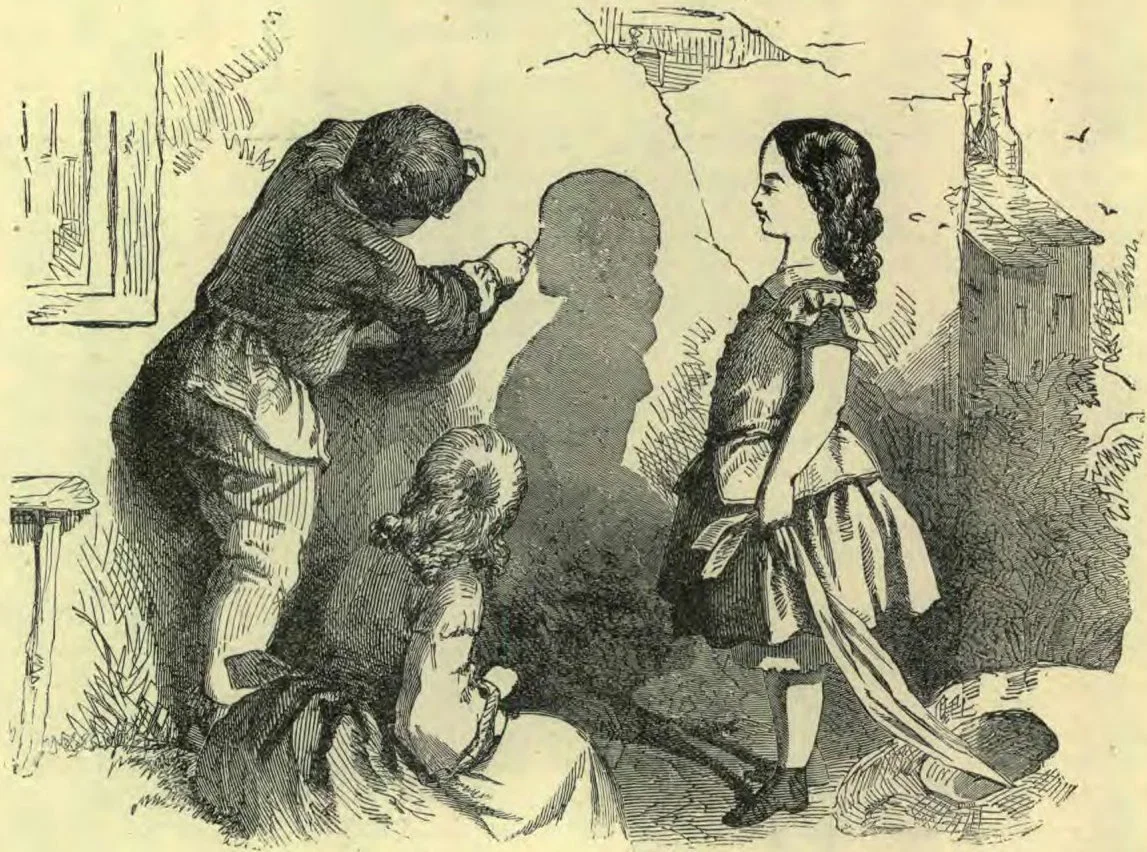
LOUIS DUNCAN and his sisters were on a visit to their grandmother’s, in the country. It was a large old house, and on rainy days the children liked nothing better than to climb to the roomy garret, and “keep house” with the old furniture which was piled away there. And when they were tired of that, there were the swallows’ nests up against the rafters. A pane of glass was broken from the little window in the gable, and the swallows could go in and out as they pleased. Grandma said that since she did not need the room, she did not see why the swallows mightn’t as well have it.
But all the days were not rainy; no, most of them were bright and sunny. Then the children played out of doors; and plenty of nice places they had to go,—to the barn, to the garden, and to the fields and woods. In the back garden was a little old house, which had been built for a man to live in—who once helped to work the farm. But now grandpa’s youngest boy had grown up to be a farmer, and took care of the place, so grandpa used the little house for a shop. He had learned the cooper’s trade when he was young; and now he liked to make pails, buckets, and barrels for himself and neighbors, who all thought grandpa’s things lasted twice as long as those they bought at the store. The children spent many happy hours in the little shop, watching grandpa at his work, and playing with the long curly shavings which he made.
One day they were playing outside the shop, when Effie, who was sitting on the grass, cried out, “See Ada’s shadow on the shop; isn’t it plain?”
“Hold still a minute, Ada,” said Louis, “and I’ll take your picture.” So he got a piece of red chalk from grandpa in the shop, and began to draw. He traced the chalk around the outside of her shadow on the wall, and when it was done, had a very good outline picture of her.
Just then Mrs. Duncan came out to see what the children were about, and to bring them some lunch.
“O mamma,” cried they, “do see Ada’s picture!”
“Yes,” said she, “it is very good; how did you get such a natural outline?”
As the children were eating their lunch on the grass, their mother said, “Your shadow-picture reminds me of the way they used to take pictures many years ago. They did not then know how to make nice photographs such as are now so common. First they used to make what were called profile pictures. They took on white paper a small shadow of the person whose picture they wished to make, and by marking around it, as you did, had a profile, or shadow-picture. The center of this was carefully cut out of the paper, and a piece of black cloth put under in its place. So they had a rude picture, which was, they thought, better than none.”
“Afterward they learned to print these profiles on white paper with black ink, which was a little better than the other way. Your grandma has some of these odd black pictures of herself and grandpa; and when we go in, you may ask her to show them to you. It is only about forty years since people could have any pictures that really looked like them, except large oil paintings, which cost a great deal of money,—so much that few people could afford to have them.”
“Why,” said Louis, “how many, many people must have lived and died without ever having their pictures taken!”
“Yes, indeed,” said Mrs. Duncan; “when I was a little girl, children did not have their pictures taken as they do now. I never had mine taken till after I was married to your father.”
On their way to the house to see grandma’s pictures, Ada said, “I’m so glad you drew my shadow, Louis; for now we have learned ever so much about picture-making.” E. B. G.

MUSIC BOOKS.

Pearly Portals for the Sabbath-school. By D. S. Hakes. The music in this work is new. The words from the best authors. 160 pp. Boards, 35 cents per copy. Cloth, .50
Song Anchor for the Sabbath-school, praise-service and fireside. 164 pp. Boards, 35 cents. Cloth, .50
Temperance and Gospel Songs. For the use of Temperance Clubs and Gospel Temperance Meetings. Price, .30
Better than Pearls. A new collection of the best Gospel Songs, Hymns, and Tunes for use in Tent and Camp-Meetings, as well as in Revivals, Social and Praise Service. Cloth, 40 cents. Board, .30
Songs for Class and School. For Singing-School, Day-School, Convention and Fireside. 160 pp. $.35
Hymn Book. “Hymns and Tunes for those who keep the Commandments of God and the Faith of Jesus.” It has 537 hymns, and 147 tunes, 416 pages. Muslin Bound, $1.00. Morocco, gilt edges, $1.50
All of the above works will be sent by mail, post-paid, on receipt of prices named. Address,
REVIEW & HERALD, Battle Creek, Mich.

GOOD BOOKS.

Sabbath-Readings. In four volumes, containing moral and religious reading for the Home Circle. Vols. 1, 2 and 3, each 60c.; Vol. 4, 75c.
Life of Elder Joseph Bates, relating his experience of twenty-five years on ship-board, with incidents of his rise from cabin-boy up to master and owner. The closing chapters relate to his labors in the ministry and in the cause of temperance and other moral reforms. 352 pp. $1.00
Week-day Religion, by the Rev. J. R. Miller, is a handsomely bound book, printed on fine calendered paper, in large clear type. It is eminently practical in matter, and no one can fail to be benefited by reading so pure and earnest a book. 315 pp. $1.00
Home-making is a book of the same size and style, and by the same author as the one above. It aims to mark out the duties and responsibilities of each member of the household, and to suggest how each may do a part in making the home-life what God meant it to be. 310 pp. $1.00
David Livingstone: The Story of One Who Followed Christ. By Louise Seymour Houghton. This book tells in an interesting style the life of the great missionary traveler and explorer of the dark continent. 330 pp. $1.25
Five Women of England. By Meade Middleton. This book contains a true history of the life and work of five good women of England, among whom are Hannah More and Elizabeth Fry. 400 pp. $1.25
Tales of Three Centuries. Translated from the French. These are thrilling stories of the trials and persecutions of Christians in three different centuries; and one's faith can scarcely fail to be strengthened as he reads of those who counted not their lives dear, for His sake. 264 pp. $1.00

Letter Budget.

ELMER E. CHURCHILL writes from Lowe, Kansas: “I have written once before for the Budget, but did not see my letter in print. I am eleven years old. I have two brothers and two sisters. We have a good Sabbath-school here, and I learn lessons from the Instructor. I get my paper through the club.”
MATTIE HARRIMAN writes from Somerset, Wis.: “I will be thirteen years old the tenth of June. I have taken the Instructor for over a year, and I shall send for it again as soon as my time is out. We have no church here, but we keep the Sabbath. As soon as I have read my paper, I give it to my friends here.”
ELMIRA H. BUNNELL writes from Fairgrove, Iowa: “I like the Instructor very much. I like to hear about the cities of Bible lands, and I like to read the children's corner. I am twelve years old. I went to Sabbath-school all last summer; there were ten in our class. I go to district school, and am trying hard to learn.”
MINNIE COPE writes from Monroe, Green Co., Wis., that she is trying to get up a club for the Instructor, and has sent us one name. Cannot more of our little friends do the same?

PROMISES

We are going to leave,” said the snowflake crew, The pale frost-ferns and flowers; “But we’ll reappear in the summer dew, In the sheen of the summer showers.”
“We are going to build,” said robin red,— “We’re going to build to-morrow; Lend us some straws and a bit of thread; We’re not too proud to borrow.”
“We are going to bloom,” said the crocus bold,— “We’re going to blossom to-day; If you catch a glimpse of purple and gold, You will know we are on the way.”
—Mary N. Prescott.

You have reached the end of this edition.

The Youth’s Instructor · Apr 4, 1883