The Youth’s Instructor, Vol. 27, No. 34.

THE WATER-LILY

The Youth’s Instructor

Aug 27, 1879

S. D. A. Publishing Association · Battle Creek, Mich. · Aug 27, 1879

THE WATER-LILY.

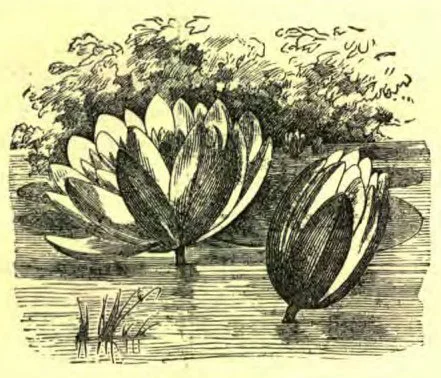
DOWN in the depths of the river, near the shore where the mud and slime were not swept away by the current, grew a humble plant. The flags pressed about it, and thrust their leaves like green swords through the water up into the brightness and pure air, and the eel-grass made a tangled net-work above it. No one expected the little plant to amount to much.
But lying there in the ooze, it thought, “The water is luminous over my head. There is more brightness above than I have had. The flags and the rushes swaying and fluttering up there whisper together of the warm south wind, the gray clouds, and the glory of the sun. If I only could rise! If I only could!”
By-and-by the plant sent forth a leaf, an odd round thing like a fan, and slowly lifted the leaf on the summit of its flexible stem toward the surface of the water.
“Pray don’t be too pushing,” said the duckweed. “You are as well off as the rest of us. A plant of your condition ought to be modest. Don’t be too pushing; no good will come of it.”
The humble plant gave no heed to its neighbor’s comments, but patiently lifted the round leaf a little higher each day. One morning it felt a strange electric thrill. The leaf had reached the surface of the river, and the sun shone upon it, and the tall flags parted a little to make room, while they whispered kindly, “Good morning, neighbor.”
Soon the plant found a round, green ball in its bosom.
“Ah, this is a bud,” it said to itself. “It shall go up to my happy leaf, and there expand the loveliness I know is hidden within it.”
Patiently as it had lifted the leaf, the plant lifted the bud toward the sunshine.
The dreamy summer days went by, and at last the round bud opened its sepals, and like a radiant, golden-hearted star of snow, a blossom lay upon the river, and looked into the sky. The red-winged blackbirds flitting to and fro among the flags, sang of it; the south wind breathed its spicy fragrance; the tall flags whispered, “How beautiful!” and the hope of the plant was fulfilled.
Bertram Krause was the son of a poor laborer. His father wanted him to become a smith.
“Ah! now, if Bertram could shoe an ox, or mend a cart wheel, that’s all I’d ask,” he would say.
But Bertram had different aspirations for himself. He wished to become an artist and paint great pictures like those in the cathedral, into which he often stole to dream and hope.
With a bit of charcoal he could sketch anything, and the lads thought it fine sport to be his models; but his father declared such idling wicked, and said, “Who are you, Bertram Krause, to despise honest work such as your father has done all his life? You will never be worth your salt.”
One day, Bertram went to the river bank to cut flags. He worked industriously all the morning, and at noon, when he sat down upon the shore to eat his bread and cheese, he was very warm, and after he had eaten, he stretched himself upon the grass and fell asleep. When he awoke, the first thing he saw was a water-lily shining white among the flags.
“Hurrah!” he cried. “Hurrah! a water-lily!” and quickly springing up, he waded into the water and picked it. With the blossom came the long, trailing stem, the mud and slime still clinging to it. “This beauty is lowly born,” he thought, as he smelled its spicy fragrance, and with that thought a plan and a hope came into his mind.
His mother was a quiet woman, who had learned to watch and wait, and she sympathized with him, and encouraged his dream. To her he went with the plan, and she procured for him a sheet of coarse paper and some crayons.
With all the skill he possessed, he drew a sketch of the river, the flags, and the water-lily amidst them, and when it was done he carried it tremblingly to a great artist in the city.
Years rolled away, and at the yearly art exhibition at Munich a picture appeared, representing a summer sky, a tangle of reeds and flags, a stretch of sullen river, and upon the grassy shore a ragged, barefoot boy, who was holding a water-lily, at which he gazed with a look of love and joy.
“That,” said an artist, “is by the celebrated Bertram Krause, and is called ‘The Dawn of Hope!’”—Sel.

Varieties of the Water-Lily and Victoria Regia

AMONG the beautiful varieties of the Nymphæa, to which the white water-lily belongs, are, the water-lotus of Egypt, said to resemble the white water-lily in foliage and flower; the showy red or rose-colored lily of the East Indies; a water-plant from the Cape of Good Hope, with exquisitely beautiful blue, highly scented blossoms; the Euryale Ferox, a noble aquatic lily of the East Indies, bearing bluish purple or violet flowers; and, far surpassing all these, the magnificent Victoria Regia, of South America, whose flower resembles the white water-lily in form and color, but measures more than a foot across; the petals, fifty or sixty in number, are of the most delicate tissue and lace-like appearance; the leaves of the plant are of a pleasant green on the upper surface, while the lower is of a rich, dark crimson; they are from five to seven feet in diameter, and are capable of sustaining a weight of one hundred pounds.

WATER-LILIES

Fair water-lily, with heart of gold, With dainty apparel, laid fold on fold, Kissed by the ripples that come and go, Tell me, whence cometh thy raiment of snow?
Dark is the soil where thy rootlets twine, Whence come thy beauty and fragrance divine? Waving aloft at the sweep of the tide, Pure as a virgin and fair as a bride.
Often thy house is the stagnant mere, That gathers its blackness year by year; Shining above it in stainless white, Swingest thou ever a thing of light.
Down in this great wide world below, Where teeming millions go to and fro, Angels look ever and wait to bear Their tidings above of the robes we wear.
And nightly the shining ones sing on high, And the music rings clear through the starlit sky, “Down in the world, ’mid the ‘mire and clay,’ Souls have been walking in white to-day.”
—Lavilla E. Allen, in Christian Woman.

From Sea to Sea: Council Bluffs and the Western Prairies

FROM SEA TO SEA.—NO. 13.

THE city of Council Bluffs derives its name from the high banks, or bluffs, at whose base it is situated; and also from the fact that at this place the Indian tribes formerly met for council, and, in later times, the “pale-faced man” and the “red man” met together for council and treaty.
Only fifty years ago this city was the extreme western border of civilization in the United States. The vast extent of territory over which we have passed was then the refuge of wild beasts and the home and hunting-ground of savages.
Leaving Council Bluffs, we hasten toward Chicago, some five hundred miles distant, over beautiful prairie land—not prairies covered with herds of cattle as in Wyoming and Nebraska, but overspread with well cultivated farms, and dotted with flourishing villages and cities. A few hours’ ride brings us to a place where, only fifteen years ago, I had occasion to take a trip of twenty miles in a stage-coach. We were from noon till one o’clock at night performing this short journey. The prairie mud was so deep that four horses were needed to draw the coach, a little baggage, and one lady passenger, the men being obliged to walk five miles. We now glide over the same ground, the same distance, in thirty or forty minutes.
With the exception of a few clusters of small trees, called groves, which serve as way-marks to the traveler, these prairies in their natural state are nearly as destitute of timber of any kind as the barren desert. Such was their condition twenty-six years ago, when I first saw them. Now I observe large orchards and groves of locust, cottonwood, etc., which the farmers have planted and raised for fuel, and also as a protection from the fierce winds that sometimes blow furiously over this vast tract of level land.
I well remember how long it took me to cross one of these prairies in Illinois, a number of years since, when, in company with a friend, I made the journey in a private carriage. We arose early in the morning, took the point of compass we wished to follow, saw in the distance a cluster of trees called “Shabona Grove,” and traveled for hours in almost a direct line, there being no fences to hinder our air-line passage. Now the same section is covered with highly cultivated and well-fenced farms, and intersected by railroads.
We have now reached the Mississippi, or “Father of Waters,” so denominated by the Indians because of the many large rivers, such as the Missouri and Ohio, emptying into it, making it a mighty, rushing stream as it pours forth its flood of waters into the great Gulf of Mexico. This river is nearly three thousand miles in length, and taken in connection with its main branch, the Missouri, it is the longest river in the world, measuring 4506 miles from the source of the Missouri to the mouth of the Mississippi at the Gulf of Mexico. The Mississippi was for many years the great thoroughfare of travel from New Orleans to the falls of St. Anthony in Minnesota. Now the traffic is divided between the river and the line of railroad running north and south.
After crossing the Mississippi, which at this place is about one mile in width, on a strong bridge similar to that over the Missouri, we hasten through Illinois and approach Chicago, the great inter-ocean city of the West. Night again overtakes us, and we know little by actual sight of the world around us. At the opening of day we enter this large city of 450,000 inhabitants, and on learning that the Eastern train will not leave till late in the afternoon, we improve the time in looking about the place and learning something of the people and their customs.
J. N. L.

BE TRUE, AND YOU WILL BE TRUSTED.

WHEN Lord Wellington was commander of an army in India, a certain rich man offered him five hundred thousand dollars for some secret information upon a very important question. Wellington looked thoughtful a few moments, as if he was weighing the temptation; but he was only considering the best way to answer his tempter. At length he said,
“‘It appears that you can keep a secret, sir?’
“‘Certainly,’ replied the man, feeling sure that he had gained his purpose.
“‘So can I,’ rejoined Wellington. ‘Good morning, sir,’ and the man went away with a chopfallen air.”
Here was a man who would not be bribed for half a million dollars. That is a large sum of money, is it not, children? Would you have refused it under like circumstances?
We have read of a little girl only eleven years old who once overcame nearly as great a temptation as did Lord Wellington in refusing the half million dollars. The particulars, as nearly as we can remember, are as follows:—
Barbara, which was her name, was a child actress in a theater. Her father, once a prosperous physician, had been ruined by strong drink, and he was content to use the scanty pittance earned by his daughter, for the support of his family. It was unfortunate that Barbara had no better place than a theater, but she tried always to do her work well, which gave satisfaction to her employer.
The paymaster for the theater was old, absent-minded, and forgetful, and upon one occasion gave Barbara double her usual allowance. As soon as she discovered the error, she thought to take it back; but the tempter whispered, “What a nice dinner this extra sum will give you to-morrow; then, too, it will help you to purchase clothing for the family. The paymaster is forgetful, and even if he should miss the money, he would not remember it; keep it for yourselves.”
Now this family, which consisted of several members, was very destitute, and the thought that the overpay would supply some of the comforts of life would make the temptation, in the “Philosopher’s Scales,” very weighty. Did she yield? No, indeed! Although she was not instructed religiously, she had a conscience, to whose voice she listened, and returned the money to the paymaster. Did she not prove herself true and trusty?
Boys and girls, be true, and you will be trusted every time. You will never want for friends, or for a situation, if you prove yourselves true,—not for once, we do not mean; but by having an established principle never to be bought to do an unjust act. Resolve that for millions of money you will never betray the confidence reposed in you; and then, with God’s grace to assist, you may come off victorious over every temptation, and occupy positions of trust and usefulness. M. J. C.

PLAN TO COME.

“How is it that you always manage to get to Sabbath-school early?” asked one lad of another. “I am almost always late; nine o’clock comes so quick on Sabbath morning.”
“I always plan to come,” said the other. “I put the shine on my boots on the day before; I have my books all laid together where I can put my hand on them; after breakfast I change my clothes, and start for Sabbath-school, always planning to get there at least fifteen minutes before the time appointed.”
Nearly every boy and girl could be in season if they would only do as Willie did—earnestly “plan to come.”
Think over on the preparation day just what you need to do in order to get ready; lay out your clothing, and see that all is in order. It is very sinful to take God’s holy day to make small repairs that have been forgotten through the week. Remember the verse that says, “Thy commandment is exceeding broad.” God requires us to not even think our own thoughts upon his day.
So let the six days’ work be all done when its hours are over; and when once you get into this habit of “planning” beforehand, you will find it very easy and pleasant. If you begin the week right, you will be likely to end it right.—Child’s World.

LESSONS FOR CHILDREN.

LESSON XXXIV.—DAVID AND GOLIATH.

And there was war with the Philistines. And the army of the Philistines was on the side of a mountain, and the army of Israel on the side of another mountain just opposite. And a valley lay between them. Now among the Philistines there was a giant, whose name was Goliath, and every day for forty days, he came down into the valley, and defied the armies of Israel. This man was nearly twelve feet high, more than twice as tall as an ordinary man. He wore a coat of mail that weighed one hundred and ninety pounds. His spear was like a weaver's beam, and the head of it weighed more than twenty pounds. No man could be found in the army of Israel who dared to go out and fight with this giant. At this time, David was at home, keeping his father's sheep; but his three oldest brothers were in the army, and their father sent David to take them some things, and to see how it fared with them. While he was in the camp, he saw Goliath in the valley, crying aloud for some one to come and fight with him. David thought it a shame that this man should be allowed to defy the armies of the living God in this way, and offered to go out and meet him.
When Saul heard of this, he had David brought before him, and talked with him. He thought it would be in vain for David, who was but a youth, to go out and fight with this giant, who had been a man of war all his days; but when David told him how he had with his own hands slain a lion and a bear that had attacked his father's flock, Saul consented to let him go, and placed his own armor upon him. David had never worn any such armor, and did not wish to fight in it now; so he laid it off, and taking a sling, and a staff, and five smooth stones from the brook, he drew nigh to the giant.
The Philistine was so angry at having a stripling come out to fight him, that he cursed, and said, “Am I a dog, that thou comest to me with staves? . . . Come to me, and I will give thy flesh unto the fowls of the air, and to the beasts of the field. Then said David to the Philistine, Thou comest to me with a sword, and with a spear, and with a shield; but I come to thee in the name of the Lord of hosts, the God of the armies of Israel, whom thou hast defied.”
. . . . And it came to pass, when the Philistine arose, and came and drew nigh to meet David, that David hasted, and ran toward the army to meet the Philistine. And David put his hand in his bag, and took thence a stone, and slang it, and smote the Philistine in his forehead, that the stone sunk into his forehead; and he fell upon his face to the earth. . . .
And David ran and stood upon the Philistine, and took his sword, and drew it out of the sheath thereof, and slew him, and cut off his head therewith. And when the Philistines saw their champion was dead, they fled.”

QUESTIONS.

  1. When there came war with the Philistines, what man of them defied Israel? 1 Sam. 17: 4.
  2. How tall was Goliath?
  3. Describe his coat and spear.
  4. How were the armies situated at this time? Verse 3.
  5. For how many days did Goliath come out and defy the Israelites?
  6. Who of Jesse's family were in the army at this time? Verse 13.
  7. Where was David?
  8. On what errand did his father send him?
  9. What did he see while there?
  10. What did he think of it?
  11. What did he propose to do?
  12. What did Saul think of David's going out to fight Goliath?
  13. How did David gain Saul's consent?
  14. How did Saul prepare him for the battle?
  15. Why was David unwilling to fight in Saul's armor?
  16. With what weapons did he finally go forth?
  17. How did Goliath manifest his anger at having a stripling come forth to fight him?
  18. What threat did he make?
  19. What did David say?
  20. How did David kill Goliath?
  21. What did the Philistines do when they saw that their champion was dead?

BIBLE LESSONS FOR YOUTH.

LESSON LX.—THE JUDGES FROM OTHNIEL TO GIDEON.

  1. How long did the people continue to serve the Lord after the death of Joshua? Josh. 24: 31; Judg. 2: 7.
  2. What did they then do? Verses 11–13.
  3. What was the consequence of their disobedience?
  4. What did the Lord do for them whenever they turned to him?
  5. What were these men called?
  6. Who was the first of the judges? Judges 3: 9.
  7. Who was the second? Verse 15.
  8. What people oppressed Israel at this time? Verse 14.
  9. How did Ehud deliver them?
  10. What noted worthy came next? Verse 31.
  11. What did he do?
  12. After this, how long did the land have rest? Verse 30.
  13. At the end of this time, what did the people do? Judges 4: 1.
  14. What were the consequences?
  15. What did Jabin’s cruelty cause the people to do?
  16. Who was then raised up to deliver them?
  17. Describe the battle at Mount Tabor. Verses 10–24.
  18. How long did the land have rest at this time? Judges 5: 31.
  19. Into whose hands did they fall when they again rebelled? Judges 6: 1.
  20. Describe the oppression which they suffered from the Midianites. Verses 2–6.
  21. Where did they have to dwell?
  22. How did the Lord instruct them in regard to the cause of their troubles?
  23. Who was chosen to deliver them?
  24. How did Gideon feel about being chosen for such a work?
  25. How was he induced to undertake it?
  26. How was an army gathered? Judges 6: 34, 35.
  27. What sign did he ask of the Lord before going out to battle?
  28. How was his army reduced? Judges 7: 2–7.
  29. How large was the army of the Midianites? Verse 12.
  30. Describe Gideon’s attack upon them. Verses 16–22.

SYNOPSIS.

“And Israel served the Lord all the days of Joshua, and all the days of the elders that overlived Joshua, and which had known all the works of the Lord, that he had done for Israel.” Then the people began to serve the gods of the nations around them; and the Lord allowed them to be conquered and cruelly persecuted by their enemies. Whenever they repented, and turned to the Lord, he raised up some wise man to deliver them. These men were called judges, because they gave counsel to the people. The first of the judges was Othniel, son-in-law to Caleb. The next was Ehud, who slew the king of Moab in his own chamber, and, escaping to the land of Canaan, raised an army, and delivered his people from the Moabites, who had oppressed them eighteen years. Then came Shamgar, who slew six hundred Philistines with an ox-goad.
Then the land of Israel had rest eighty years. After this, they again did evil in the sight of the Lord, and were oppressed twenty years by the king of Hazor. When his cruelty caused them to cry to God for help, Deborah, the prophetess, was raised up to deliver them. By her direction, Barak gathered ten thousand men to Mount Tabor, and there defeated Jabin’s army,—a mighty host, with nine hundred chariots of iron, and Sisera as captain.
After this, the land had rest forty years, when the people again did evil, and were delivered into the hands of the Midianites seven years. During this time, their distresses were great; for every year about harvest time the Midianites came up in countless numbers, bringing their tents and their cattle with them, and remaining until they had eaten up everything that grew in the land, leaving no food for man nor beast. The Israelites were obliged to dwell in dens and caves among the mountains. Finally, they cried so earnestly to God that he sent them a prophet, who told them that all this trouble had come upon them because they had not obeyed the voice of God. He also sent an angel to tell Gideon that the Lord had chosen him to deliver his people. Gideon was greatly astonished, but the Lord encouraged him, and he obeyed. He blew a trumpet, and messengers were sent throughout the land to gather an army. Before going to battle, he asked the Lord to give him a sign that his enemies should be delivered into his hand. Gideon put a fleece of wool upon the ground at night, and asked that in the morning the fleece might be wet with dew, while all around should be dry. This request was granted; for in the morning he wrung a bowlful of water out of the fleece, while no dew was found upon the earth. He then asked that the next night the fleece might be dry, and the ground wet, and he found it so.
Then the Lord told Gideon that his army was too large; for if so many should go out to battle, they would think they had gained the victory by their own strength. Then Gideon said, “Whosoever is afraid, let him return;” and twenty-two thousand went back, leaving but ten thousand with him. And after this, the Lord made another division, so that but three hundred remained to go to battle.
Gideon came upon his enemies in the night. They lay along in the valley like grasshoppers for multitude. Following the instructions which the Lord had given him, he divided his men into three companies, giving to every man a trumpet, and an empty pitcher, with a lamp in it. When they came to the outside of the camp, Gideon blew his trumpet and broke his pitcher; and all his men did the same, crying, “The sword of the Lord and of Gideon!” And the Lord set every man’s sword against his fellow, even throughout all the host; and all the host ran, and cried, and fled.
G. H. BELL.

DAKOTA S. S. ASSOCIATION.

A MEETING was held on the camp-ground at Sioux Falls, on the evening of July 14, 1879, for the purpose of organizing a Sabbath-school Association for Dakota Territory. On motion, Eld. S. B. Whitney was called to the chair, and A. L. Dawson elected secretary pro tem. The constitution recommended by the General S. S. Association being presented, it was voted to adopt it. The following-named persons were then elected as officers of the association:—
President, S. B. Whitney, Howard, Turner Co., D. T.
Secretary, M. M. Olsen, Sunnyside, Union Co., D. T.
Executive Board, Geo. E. Henton, Valley Springs, Minnehaha Co., D. T., and E. O. Burgess, Finlay, Turner Co., D. T.
S. B. WHITNEY, Pres
A. L. DAWSON, Sec. pro. tem.

LETTER BUDGET.

PERRYVILLE, R. I.
DEAR EDITORS: I am a little boy eleven years old. I have four sisters and one brother, and all are trying to keep the Sabbath. I take the INSTRUCTOR, and like to read it very much, particularly the letters. I go to meeting and Sabbath-school, and learn my lesson every week. I am trying to be a good boy, and to keep all of God’s commandments, so that when Jesus comes I may meet the INSTRUCTOR family in the kingdom. Yours in love, FRANKIE G. MERRY.
SHERIDAN, MICH.
DEAR EDITORS: We take the weekly INSTRUCTOR, also the Review and Good Health. We think they are all very nice. It has not been quite a year yet since I was baptized by Bro. Miller at camp-meeting. I have one brother who is preaching the third angel’s message. My mother and I are the only ones who keep the Sabbath at home. My father don’t keep the Sabbath, but we hope he will soon. Pray for me, that I may be prepared to meet Jesus when he comes. CLARA C. CUDNEY.
KASSON, MINN.
DEAR EDITORS: I am a little girl eight years old, and I go to Sunday-school. My Uncle Henry Decker was here on a visit and wanted me to take the YOUTH’S INSTRUCTOR, which I have now received, and like very much. I had a little sister Mabel, but she died, and I am going to be a good little girl, so I can meet her in Heaven some day. Good-bye for this time. MAUDIE M. DECKER.

FREEDOM FOR PETS.

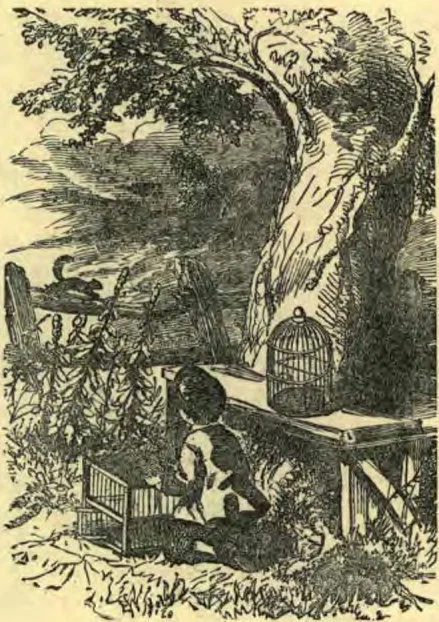
Bennie! wouldn’t it be a nice thing to have a cage made for little sister, just big enough for her to turn round in? She could stay in it all day, and sleep in it at night. Then we would have little openings for her to look out; and we could look in through them, and hear her try to talk.” So said Gertrude to her little brother Bennie, watching closely the expression of his face as he thought over what she was saying.
Bennie was not long in making up his answer. He could not see the matter just as Gertrude had suggested.
“Why, Bennie,” continued Gertrude, “you think it is nice for your squirrel and robin to live in a cage in that way. Why wouldn’t it be just as nice for little sister?”
Bennie hung his head for a few minutes, as if in a deep study. After a little while he said, “Gerty, I don’t think it is nice for my squirrel and robin to be shut up; and I have a great mind to go and let them out to play with their mates in the woods.”
“That is just what I wanted you to think about, Bennie,” continued his sister. “I think they will be so much happier with their playmates—the squirrels and birds.”
The case was all clear to Bennie’s mind. It needed no further argument or persuasion. So, taking his favorite pets to the great old tree on the lawn, he opened the doors, and soon the little prisoners were free. The robin was soon up among the branches, and struck up such strains of song as Bennie thought he had never heard before; and the squirrel scampered along on the fence in so lively a manner as to show how grateful it was for its new-found freedom.

ANTIQUITY OF UMBRELLAS.

Dr. Morrison, the missionary to China, states that there is mention made of umbrellas and parasols, in books printed in China more than fifteen hundred years ago; and that Layard relates that he discovered on the ruins of Nineveh, in bas-relief, a representation of a king in his chariot, with an attendant holding an umbrella over his head.
In India, we also find that the umbrella had been used in remote ages, and principally as an emblem of royalty, in shape differing very little from those in modern use. In Burmah, the princes use a very large umbrella; it requires a separate attendant to carry it, and his position is a recognized one in the royal household. One of the titles of the king is, “King of the White Elephant, and Lord of the Twenty-four Umbrellas.” The Emperor of China, who never does anything on a small scale, if he can help it, has no fewer than twenty-four umbrellas carried before him, when he goes out hunting. The umbrella is used in that country as a defense against sun as well as rain, and is principally made of a sort of glazed silk or paper, beautifully painted.

THE WORTH OF A BOY.

ONCE a little lad happened to put himself very much in the way of a busy and fretful gentleman. “Get out of my way,” he said, with a vexed and angry look at the little fellow; “I do not see what boys are good for.” The lad looked up at him and replied quickly, “They are good to make men of.” Boys ought never to forget that. They will be men by-and-by, if they live, and they ought to be careful that what the boy is, and what the boy does, may not spoil the man that he is to become in a very few years.—Young Reaper.

Sir John Lubbock's Ant Menagerie and Slave-Making Ants

A MENAGERIE of ants is kept by Sir John Lubbock, of England. About forty kinds are in separate nests under glass, surrounded by water to prevent their running over the house. Among these ants a kind of blind beetle lives, which is taken as much care of as if it were their own young. All ants are not great workers. The large red ones which are found in Central Europe are lazy fighters, and go out against other kinds of ants, and bring them home as slaves. They never build houses, or take care of the baby-ants, nor prepare their own food. They have become so helpless by being aristocrats for so long, that if deprived of their slaves they soon die.

Nature Tends to Music

ALL nature tends to music. A bullet whistling through the air sings as sweetly as a bird. The murmur of the leaves in the breeze, the rumble of the great city, the rushing of waters, the singing of birds, the sighing of the wind, and all the confused noises of nature, when softened by distance, are said to be upon one pitch—the key of F.

Jesus Loves Me, This I Know

JESUS loves me, this I know, For the Bible tells me so; Little ones to him belong; They are weak, but he is strong.

TRUTH AND LOVE.

’Tis a little thing to do To speak the word that's true— Yet truth is always best, And he who speaks it, blest.
A smile's a little thing, Yet never birds that sing So sweetly grief beguile As one who gives a smile.
To bear another's load A moment on the road, Or ease another's need, Is but a little deed.
To soothe another's pain, Hoping for naught again, Is what a child can do, And find it easy, too.
Yet never once was lost A word or smile that cost But just a kindly thought That gave and counted not.
And fairer than a star Such deeds of kindness are— Brighter than stars above, The words of truth and love.

You have reached the end of this edition.

The Youth’s Instructor · Aug 27, 1879