The Youth’s Instructor, Vol. 32, No. 21.

SMYRNA

The Youth’s Instructor

May 21, 1884

S. D. A. Publishing Association · Battle Creek, Mich. · May 21, 1884

SMYRNA
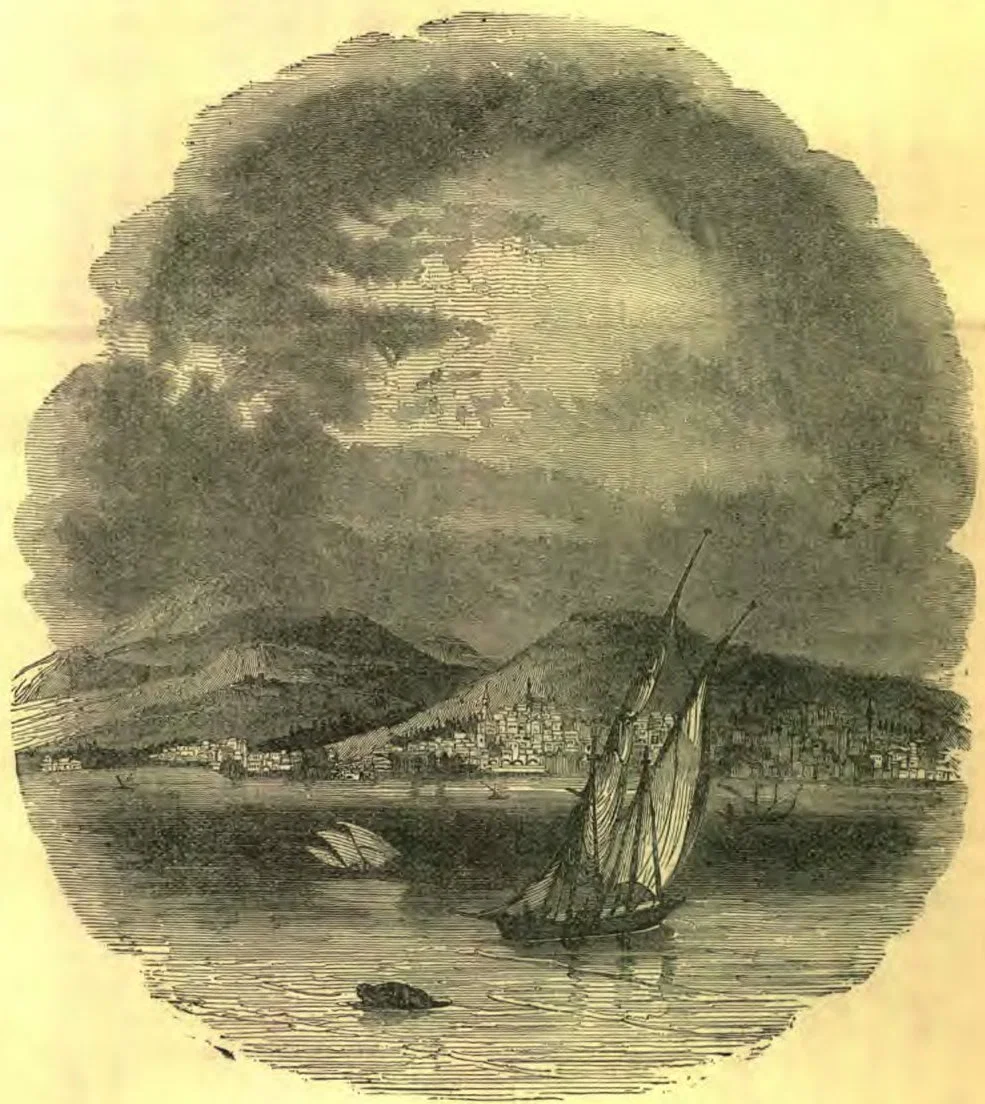
TRAVELING directly northward from Ephesus, we come, after a distance of fifty miles, to Smyrna, the commercial center of Asiatic Turkey. This city is very pleasantly situated among the surrounding mountains, and opens out upon one of the finest harbors in the world. It stands at the foot of a high hill, up whose sides it has part-way climbed. Its rounded domes and tall minarets, framed against dark green cypress trees, present a picturesque appearance from ship-board; but, like most Turkish towns, it will not do to give it too close an inspection. The streets are narrow and dark, and the unpretentious houses are for the most part made of wood, with roofs more after the European style than any usually found in the Orient. Each race living here has its own district. Near the shore are the quarters of the Franks and Greeks; up on the slope of the hill are the Armenians and Turks; and between them the Jews have a small quarter. The population is variously estimated at from one hundred and fifty thousand to one hundred and eighty thousand, of whom the greater part are Turks and Greeks.
The summit of the hill is crowned with the ruins of a fine old castle, that can be dimly seen in the picture.
All through the year the magnificent harbor at Smyrna is crowded with shipping from America and Europe. But not to shipping solely does the life and bustle of the town belong. Large caravans and long lines of camels pour in from all parts of central Asia, Arabia, and Syria, bringing the merchandise of the Orient to the sea, and carrying back the products of the great West. So many nationalities meet here, that, on hearing the confused speech of the people, a stranger might almost persuade himself that he was in the very Babel of olden times.
Smyrna is a city of such ancient date that its early history is lost in fable. It has suffered many changes of fortune from earthquake and hostile nations, sometimes lying in ruins, then again rebuilt, populous and prospering. In the fourteenth century it was taken by the Turks, in whose hands it still remains.
In the early days of Christianity, this city contained an important church, said to have been founded by the apostle John. Over this church, Polycarp was placed as bishop, and he continued in this office more than eighty years, till, in a persecution raised against the Christians, he was, in A. D. 166, led to the stake. You have doubtless read of his trial, and how, when tied to the stake, the flames curved outward, leaving his body unharmed, so that he was at last put to death by the axe of the executioner. His grave stands on the side of Castle Hill, under a tall cypress tree, and on the tombstone are engraved these heroic words, uttered by him when urged by the proconsul to blaspheme the name of the Holy One: “Eighty-six years have I served him; during all this time he never did me an injury; how then can I blaspheme my King and Saviour?”
There are now, in this ancient city that once enjoyed the perfect freedom of the gospel, a body of Christians who are striving to introduce a pure religion into this dark land.
W. E. L.

A RAINY DAY AND ITS LESSON.

NEVER were there more anxious watchers of the weather than were in the Burnham household that midsummer morning. It was the day set for the Sunday-school picnic, and the children had looked forward to it, and talked of nothing else, for several days. And now it looked like rain! They were all, Edna, Chrissy, and Katrine, with Carl and Fritz, out in the yard looking at the sky, and holding up their hands to see if they could feel a sprinkle.
“It does rain!” said Edna, with a wail in her voice; and when two or three great drops fell on Chrissy’s face, and she echoed the words of her eldest sister, they all turned and went into the house. Very sober faces they wore.
“If it were anything but a picnic, we could put on our waterproofs and go,” said Edna; “but rain spoils a picnic, anyway.”
Presently the rain fell heavily, and the children knew that they were shut in for the day. Katrine hugged her large rubber doll, while Fritz bounded his ball lightly. Edna took a piece of paper, and began to draw a picture. Now and then she erased a false line with the head of her pencil. Chrissy, while brushing her hair, began coaxing her mother for a circle comb.
“What good would it do you? You would break it in almost no time,” replied Mrs. Burnham.
“Oh, no! they don’t break easily! You know they are made of rubber, and are ever so limber!”
“Dear me!” said Carl; “I’d like to know what isn’t made of rubber! There are our overshoes, our coats, our hats, and grandpa says his eyeglass bows are made of rubber; and mother’s clothes-wringer is made of rubber, at least the rollers are, and my suspenders are made of rubber, and ever so many other things, like hairpins and jewelry!”
“My dolly is made of rubber, too,” said Katrine, “but it isn’t black like a comb.”
“But they are made of the same thing, anyway!” affirmed Carl; “I know, for I read about it in a book.”
Here Grandpa Burnham, seeing trouble ahead, came to the front. While he had appeared to be otherwise absorbed, he had not lost a word of the children’s talk.
“Carl is right, little one,” he said, patting Katrine’s head lovingly. “They all come from the same thing, all these different articles you have named, and many more; and a very useful substance it is, too. What would Edna’s picture look like if she had to leave all her mistakes in it? Or how would Carl, here, get over to the post-office to-night after my paper without his boots and coat? And yet when I was a boy, we had none of these things.”
The children opened their eyes in astonishment.
“And you can remember when India rubber was first invented, or discovered?” said Edna.
“Yes; I remember very well the first pair of rubber overshoes I had; I think you would laugh at them. They were of solid rubber, the sole and heel as thick as my finger, and the upper part as thick as a piece of very heavy leather. Pencil erasers were not common then, and when a pair of overshoes was worn out, we used to cut what was left into small pieces, and use them as erasers. That was about the year 1828, though I believe India rubber was in use for erasing pencil marks one hundred years ago; and I read somewhere that a piece an inch square cost thirty or forty cents.”
“But, grandpa, please tell us what it is made of,” said Chrissy.
“And who discovered it,” said Edna.
“And I want to know why some of it is black like my shoes, and some white like my dolly,” added Katrine.
“I know what it is made of,” said Carl; “it comes from a tree. The tree grows in the tropics—or the trees, for there are several kinds that produce the gum. They tap the trees, not just as we do for making maple sugar, but they cut out a chip with an axe as high up the trunk as a man can reach, and the sap or juice that runs out is what the rubber is made of.”
“Edna wants to know who discovered it,” said grandpa. “The use of the pure gum, which was just the juice of the tree dried either in the sun or over a fire, was known to the natives of the tropical regions where the tree grows, long ago; and it began to be used in France and England about the beginning of the present century. But it was not until 1844 that a man named Goodyear made some important scientific discoveries in regard to it, and patented his invention for using it in a variety of forms. The difference in color is owing to the difference in the manner of preparing it for use.”
“I suppose that man Goodyear made a great deal of money out of his inventions?” said Carl.
“I presume he did at last; but he was very poor while he was studying the subject, and making his experiments. It is said that he was so poor that his bed was sold to pay his debts; and that his credit was so low he could not buy a farthing’s worth of anything. Often there was neither food nor fuel in the house, and still he worked on, not for a little while, but for ten long years! It took so long to find out how to make something very useful out of what was once an almost useless gum! There is a lesson of patience and perseverance for you, Carl.”
“I was just thinking,” said Edna, “how many things God has given us that we have to study about, and find out, by thinking how to use them.”
“Yes,” said grandpa. Then a far-away look came into his eyes, and presently he said:—
“But Himself we cannot find out even by searching. ‘Oh, the depth of the riches both of the wisdom and knowledge of God! How unsearchable are his judgments, and his ways past finding out!’”—Faye Huntington.

THE KING'S SHIPS.

God hath so many ships upon the sea! His are the merchantmen that carry treasure, The men-of-war, all bannered gallantly, The little fisher boats and barks of pleasure. On all this sea of time there is not one That sailed without the glorious Name thereon.
The winds go up and down upon the sea, And some they lightly clasp, entreating kindly, And waft them to the port where they would be; And other ships they buffet, long and blindly. The cloud comes down on the great sea sinking deep, And on the shore the watchers stand and weep.
And God hath many wrecks within the sea; Oh, it is deep! I look in fear and wonder; The wisdom throned above is dark to me, Yet it is sweet to think His care is under; That yet the sunken treasure may be drawn Into His store-house when the sea is gone.
So I, that sail in peril on the sea, With my beloved, whom yet the waves may cover, Say, God hath more than angels' care of me, And larger share than I in friend and lover. Why weep ye so, ye watchers on the land! This deep is but the hollow of His hand.
—Boston Transcript.

BEAUTIFUL PARIS

FOREIGN TRAVELS.—NO. 6.

BEAUTIFUL PARIS.

We came from London to Paris in the night, crossing the English Channel in a small steamboat. The distance across from Dover to Calais was about twenty-four miles. We reached Paris in the early morning, and remained there only one day. We could see but a small portion of this immense city of two millions of people, in that length of time. However, we visited a few of the most prominent objects of interest.
Paris was in existence before the time of Julius Cæsar, though called Lutetia until A. D. 360, when Julian, who resided there, named it Parisii, from which the present name is derived. Since that time, there has been, under the kings of France, a gradual growth, so that from the time of the great Revolution it has rapidly increased in population, size, and beauty, till it has become probably the most beautiful city on the globe.
In this respect it forms a striking contrast to London. There we see every evidence of wealth and power, business and commerce; but the fog and drizzle of that climate give everything exposed to them a dingy, poor appearance. Not so in Paris. The skies are clear, the buildings look clean and bright, the streets are usually broad, and adorned with trees, and the city has many fine squares, in which are placed statuary and public monuments. Vast sums of public money have been expended in its adornment, in laying out public grounds, in erecting works of art, and in making it attractive to the visitors who throng the city every year to enjoy its pleasures. People go from all parts of the world to London on business, crowding its streets at times till they almost overflow; but to Paris they come for pleasure seeking, to enjoy themselves and spend their money for every kind of gratification of the senses. While Paris is one of the most beautiful cities of the world, it is no doubt one of the most wicked. It seems to be referred to in the book of Revelation as the city “which is spiritually called Sodom and Egypt,” doubtless because the sins which were committed in those countries are so prevalent in Paris. Pride, fullness of bread, and abundance of idleness was in Sodom. Such a condition of things prevails in Paris. Lovers of luxury and vice come from all parts of the world to tarry in it. We could not feel much at home in such a place.
Some of the most terrible scenes of wickedness which have ever occurred in our world have transpired in Paris. Prominent among these are the massacre of St. Bartholomew, Aug. 24, 1572, and the scenes of the French Revolution. At the massacre of St. Bartholomew, leading Protestants, who were then called Huguenots, were invited to come to Paris to attend a royal wedding, when thousands of them were treacherously slaughtered, the king himself, it is said, firing upon his own subjects. It was a scene of awful horror. The river Seine was discolored by the blood of the victims.
The scenes of the French Revolution were, in some respects, the most horrible ever recorded in history. Infidelity and atheism had full sway, till no respect was shown for God or man. But these scenes are forgotten now amid the pleasures of sense.
There are many beautiful gardens and public squares in Paris, which it would be impossible for me to describe in this article. Neither can I describe all the public buildings, that are of such immense size and fine appearance. Among the most remarkable of the latter is the palace of the Louvre, now used as a treasury of art, painting, etc., containing perhaps the most remarkable collection in the world. The palace of the Tuilleries is now occupied as government buildings and offices. These two palaces cover about forty-eight acres of ground. The Hotel Des Invalides and its grounds occupy about thirty acres. It was founded by Louis XIV., for the aged and disabled soldiers, nearly five hundred making it their home. Those who have been disabled by wounds, or have served thirty years, are entitled to be received in it. Besides comfortable board and lodging, each soldier receives a small pension. Under the dome of this building is the tomb of Napoleon Bonaparte, whose bones were brought back from St. Helena.
The cathedral of Notre Dame, founded in 1165, is the largest in the city, and one of the most famous in France. In it may be seen the gifts of the kings and emperors of France, censers of pure gold, and other sacred utensils used in the Catholic worship, and vestments of the richest and most costly kind. One could but think of the description of great Babylon given in the book of the Revelation while seeing these things,—how her great men were the kings of the earth, and how she was clothed with scarlet, gold, and precious stones. Here, it is claimed, are to be found fragments of the “true cross” and the “crown of thorns.”
In this cathedral, at nearly all times in the day and every day in the week, the faithful Romanists may be seen at their devotions, crossing themselves with holy water, or bowing in reverence before an image or some pictured saint, while saying their prayers or counting their beads.
The public grounds in connection with the Tuilleries and the Louvre, and reaching to the “Arch of Triumph,” are probably the finest in the world. This promenade is one and a third miles in length, planted with elm and lime trees, and very wide. The paved street leading through it is broad, affording room for many carriages to pass at once. The open space each side of the road is adorned with beautiful statuary, while long lines of lamps, lighted up at night, make the place look very brilliant. Various places for amusements are scattered through the grounds, and fountains of beautiful design are here and there interspersed. Everything that lavish expense could do to make it attractive seems to have been done. Here, in the summer season, from the middle of the afternoon till far into the night, may be seen the finest equipages, and multitudes of cabs, omnibuses, and other vehicles, and vast numbers of people, all intent on pleasure seeking. Music is not lacking, and we may be sure the god of this world feels that he has made a success in capturing the masses of the people by his well-laid schemes.
At the farther end of this wonderful avenue is the “Arch of Triumph,” the largest triumphal arch in the world. It stands upon a hill. The whole structure is one hundred and sixty feet in height, one hundred and forty-six in width, and seventy-two in depth. The central archway is sixty-seven feet in height and forty-six in width. The structure is of solid stone. It can, on account of its elevation, be seen from a large part of the city. It was commenced by Napoleon in 1806, to commemorate the victories of France, and was completed by Louis Phillippi, in 1836. There are various figures and representations sculptured upon it, and the names of the great victories of France are inscribed upon the stones.
From this triumphal arch, radiate, like the spokes of a wheel, twelve fine avenues, leading through different parts of the city. It is a beautiful sight to stand on this high point after the street lamps are lighted at night, and see the little points of light in almost endless succession, many thousands in number, leading far into the depths of the city.
But this beautiful, wicked city has no place in our hearts. We look for one far more beautiful, where the streets are of gold, and the gates of solid pearl. Every citizen will have a fine mansion. Its walls are of jasper, and it is garnished with all manner of precious stones. But best of all, Christ our Lord will be there, and the inhabitants will all be righteous. In these respects it will be a wonderful improvement upon Paris or any other city in the world. UNCLE IDE.

ROSY SNOW.

Rosy snow on the roofs in the morning; Drifts in the hollows, by wild winds curled; Bells on the beaten road chime away cheeringly— Oh, the great white world! Brown little sparrows on twigs bare and red, You shall have crumbs both of cake and of bread— I will remember you, flitting unfearingly Out in the great, white world!
Rosy snow on the orchard this morning! Faint-flushed blossoms with crisp edges curled; Soft-floating petals by blithe breezes flung to me— Oh, the sweet, white world! Young, whistling robin, with round, ruddy breast, I'll never touch your blue eggs in the nest; I will remember the welcome you've sung to me Out in the sweet, white world!
—St. Nicholas.

NEW-TESTAMENT HISTORY.

LESSON 188.—PAUL SETS SAIL FOR ROME.

1. How was Paul interrupted as he was making his defense before Agrippa? Acts 26:24.
2. What did Festus say?
3. How did Paul reply? Verse 25.
4. Who knew that Paul’s story was true? Verse 26.
5. Why did Paul feel so sure that Agrippa knew about all these things?
6. What direct appeal did Paul make to the king? Verse 27.
7. What did Agrippa say? Verse 28.
8. What earnest wish did Paul then express? Verse 29.
9. How was the interview broken up? Verse 30.
10. What opinion did they express among themselves as soon as they had withdrawn from Paul?
11. What did Agrippa say unto Festus? Verse 32.
12. To whom were Paul and certain other prisoners delivered, when it was determined that they should sail for Italy? Acts 27:1.
13. Into what ship did they enter? Verse 2.
14. Where was Adramyttium?
15. What man is mentioned as being one of the passengers?
16. Is this man spoken of anywhere else in the Scriptures?
17. At what port did the ship stop the next day after she set sail? Verse 3.
18. What courtesy did Julius extend to Paul?
19. On leaving Sidon, what did adverse winds compel them to do? Verse 4.
20. Over what sea did they afterward sail?
21. To what city did they finally come?
22. Where was Lycia?
23. What change was made at Myra? Verse 6.
24. How did they afterward proceed on their voyage? Verse 7.
25. Where is the island of Crete situated, and how large is it?
26. Into what harbor of Crete did Paul’s vessel sail? Verse 8.
27. Near what city was this harbor?
28. Why had sailing now become dangerous? Verse 9.
29. What admonition did Paul give those who had command of the ship? Verse 10.
30. Who seems to have had chief control? Verse 11.
31. Whose counsel did he conclude to follow?
32. Why were they anxious to continue the voyage? Verse 12.
33. What port did they hope to reach?
34. Which way must they sail in order to reach it?

NOTES.

Acts 27:1. We should sail.—By this it is evident that St. Luke was with Paul; and it is on this account that he was enabled to give such a circumstantial account of the voyage.—Clarke.
Ver. 2. A ship of Adramyttium, which was a seaport of Mysia, on the eastern Ægean Sea, opposite to Lesbos. It was on a bay of the same name, and was then a flourishing city. . . . It would appear that they embarked in this Adramyttian ship because they had no opportunity at this time to sail directly from Cæsarea to Italy.—Hackett. Aristarchus.—The same person was with Paul at Ephesus, . . . where he had been seized by the mob, and was in great personal danger. . . . Luke and Aristarchus were certainly not prisoners at this time, and seem to have gone with Paul merely as his companions, through affection for him, and love for the cause of Christianity.—Clarke.
Ver. 3. Landed at Sidon.—This city had anciently one of the finest harbors in the East, and was celebrated at this time for its wealth and commerce. . . . The distance from Cæsarea to Sidon was sixty-seven geographical miles. As they performed the voyage in a single day, they must have had a favorable wind. The prevailing winds now in that part of the Mediterranean, at the period of the year then arrived, are the westerly; and such a wind would have served their purpose. The coast-line between the two places bears north-northeast. The season of the year must have been near the close of summer or early in September.—Hackett.
Ver. 4. Under Cyprus.—Cyprus is the largest island in the Mediterranean,—an island extremely fertile, abounding in wine, honey, oil, wool, etc. It is near to Cilicia, and not far from the Jewish coast.—Barnes. It is evident that they left this island on the left hand, and passed to the north of it, instead of going to the south, which would have been their direct course in proceeding from Sidon to Proconsular Asia. . . . They kept on their northern course after leaving Sidon, instead of turning to the west or northwest, as they would have done under favorable circumstances.—Hackett.
Ver. 5. The Sea of Cilicia and Pamphylia—i. e., the coast of those countries. The Cilician Sea extended so far south as to include even Cyprus. . . . The Pamphylian Sea lay directly west of the Cilician. . . . Instead of the westerly winds which had opposed them since their departure from Sidon, they would be favored now by a land breeze which prevails there during the summer months, as well as by a current which constantly runs to the westward along the coast of Asia Minor.—Ibid. Lycia was a province in the southwestern part of Asia Minor, having Phrygia and Pisidia on the north, the Mediterranean on the south, Pamphylia on the east, and Caria on the west.—Barnes.
Ver. 7. Cnidus . . . Crete.—Passing by the promontory of Cnidus in the southwestern angle of Asia Minor between Rhodes and Cos, they proceeded in a southwesterly direction till they sailed under Crete, that is, in the lee of Crete over against Salmone, a promontory on its eastern extremity. “And hardly passing it” (more literally, sailing along it with difficulty), “we came,” says Luke, “to a place which is called the Fair Havens, nigh whereunto is the city of Lasea.” Fair Havens was a roadstead on the southern coast of Crete. Crete is a large island of the Mediterranean lying south of the Ægean Sea. Its length is one hundred and sixty miles, with a breadth varying from six to thirty-six miles.—Barrows’ Bib. Geog.
Ver. 9. The fast, which occurred among the Jews on the great day of atonement. This was the tenth of the month Tisri, which answers to a part of the month of September and part of October. It was therefore the time of the autumnal equinox, and when the navigation of the Mediterranean was esteemed to be particularly dangerous, from the storms which usually occurred about that time.—Barnes.
Ver. 12. Phenice.—This was a port or harbor on the south side of Crete, and west of Fair Havens. It was a more convenient harbor, and regarded as more safe.—Ibid.

HOW GOD TEACHES THE BIRDS.

On the Island of Java grows a tree, the leaves of which are said to be a deadly poison to all venomous reptiles. The odor of the leaf is so offensive to the whole snake family that if they come near the plant in their travels, they immediately turn about, and take an opposite direction.
A traveler on the island noticed one day a peculiar fluttering and cry of distress from a bird high above his head. Looking up, he saw a mother-bird hovering round a nest of little ones in such a frightened and perplexed manner as to cause him to stop and examine into the trouble. Going around to the other side of the tree, he found a large snake climbing slowly up the tree, in the direction of the little nest.
It was beyond his reach; and since he could not help the little feathered songster by dealing a death-blow, he sat down to see the result of the attack. Soon the piteous cry of the bird ceased, and he thought, “Can it be possible she has left her young to their fate, and has flown away to seek her own safety?” No; for again he heard a fluttering of wings, and looking up, saw her fly into the tree with a large leaf from this tree of poison, and carefully spread it over her little ones. Then, alighting on a branch high above her nest, she quietly watched the approach of her enemy. His ugly, writhing body crept slowly along, nearer and still nearer, until within a foot of the nest; then, just as he opened his mouth to take in his dainty little breakfast, down he went to the ground, as suddenly as though a bullet had gone through his head, and hurried off into the jungle beyond.
The little birdies were unharmed; and as the mother-bird flew down and spread her wings over them, the poison leaf (poison only to the snake) fell at the feet of the traveler; and he felt, as never before, the force and sweetness of the beautiful words, “Are not two sparrows sold for a farthing? yet not one of them shall fall to the ground without your Father”--for who but he, who made the dear little birds, could have told this one the power there was in this little leaf?—S. S. Advocate.

Sabbath School Department Notes in the Review

☞ For additional notes, see the S. S. department in the Review for May 20.

A CHAT WITH THE LITTLE FOLKS.

GOOD MORNING to all our dear little friends. We are glad the bright spring-time has come again, so that you can spend your play hours out of doors instead of being shut in on account of the cold. To know that you are happy, we have but to watch you tripping through the fields and woods to pick the early wild flowers, at times following the crooked brook as it goes babbling over its gravelly bed to where its waters form a basin in which the shining minnows are having their frolic and fun. Here you stop to rest awhile, and to watch these tiny creatures in their innocent play. Here, too, you give ear to the chorus of sweet bird voices with which the air is filled; and before going farther, you look away in every direction to get views of God's great panorama which nature is spreading out before you.
Are you happy? Yes! we know you are; for who does not love the green fields and woods with their rich treasures, and nature's beautiful pictures which everywhere greet the eye?
We want to tell our little friends one secret of happiness. We almost know a good many of you have already found it out. If you have, we are glad. But we are so sure some of you have not, that we must tell you about it. It is to have a little flower bed, all your own; and to have the care of it yourselves, as much as you can. We well remember our first flower bed, the first seeds planted, and how closely we watched the ground until the little plants peeped out; and then the growth of the plants, until the buds burst into bloom. We ever look back upon those days as the happiest of life. Plant-life seemed so wonderful; and the more we learned of the flowers, the more we loved the Creator of them, and the more exalted seemed his character.
We wish we could influence every boy and girl who has not already planted a garden, to begin one now. A small beginning is better than none at all. There are many wild flowers and ferns which love to be noticed. A few pansies, with their bright, intelligent-looking faces, would pay you well, besides many others which are easily cultivated. And as your flowers grow, watch their growth. You will find out some curious things about them; and you will notice some things not easily explained. For instance, what gives the flowers their beautiful tints? Take any bright flower of many colors, break the stem which supports it, and you will see that the juice which feeds it is all one color;—then what paints it so many colors?
You will find the study of plant-life very pleasing, as well as very useful in teaching you that “the works of the Lord are great, sought out of all them that have pleasure therein.” M. J. C.

THE EIDER DUCK.

In a very cold country far away in the Northern Ocean,—Iceland it is called,—there are thousands of these beautiful birds. Wherever you step, you find one.
You think they would not like to stay where the rivers are always frozen, and snow is on the ground all the long year, with only a few days of sunshine. But they do, because they can be very quiet there, and do pretty much as they like.
Their nests are a sort of little mattress made of drift-grass and sea-weed, over which they spread a bed of finest down. The careful mother plucks this down from her own breast, heaping it up in a sort of thick, fluffy roll around the edge of the nest.
You know that while she is sitting on her eggs, she must sometimes leave the nest for food. The weather is so cold that before she goes, she carefully turns this roll of down over the eggs, to keep them warm until her return. A great deal of money is made by the Icelanders in selling the down. When it is taken from the nest, the little mother goes to work just as carefully as before, and makes it all over. But if they take it the second time, and her home is left with bare walls, her breast bare too, what is she to do?
In a moment the male bird comes to her help, and plucks the down off his own breast. His feathers are whiter, though not so soft.
This down is so light that it takes a great many feathers to weigh anything at all. If you should fill your father's hat with them, they would not weigh an ounce. After all, they would make you the warmest covering in the world.—Mrs. G. Hall.

Skill Comes Through Practice, Not Knowledge Alone

When we use our knowledge in trying to do things, we find that skill in doing comes little by little, and that the best knowledge cannot bring us the skill which will come only through our trying to do.

WHY WE CALL THE CAT PUSS.

Did you ever think why we call the cat puss? A great many years ago, the people of Egypt, who have many idols, worshiped the cat. They thought the cat was like the moon, because she was more active at night, and because her eyes change, just as the moon changes, which is sometimes full, and sometimes only a bright little crescent, or half moon, as we say. Did you ever notice your pussy’s eyes, to see how they change? So these people made an idol with a cat’s head, and named it Pasht, the same name they give to the moon; for the word means the face of the moon. That word has been changed to pas or puss, the name which almost every one gives to the cat. Puss and pussy cat are pet names for kitty everywhere. Who ever thought of it as given to her thousands of years ago, and then people bowed down and prayed to her?—Harper’s Young People.

Letter Budget.

WALTER J. BLAKE writes from Canada. He says: “I am ten years old. I am trying to work for Jesus. I have one brother younger than myself. I go to Sabbath-school, and study Book No. 2. When I have read my papers, I send them to others and ask them to subscribe. I sent four this month. I have two dollars to use in paying postage on papers and letters to let people know of the truth. Papa pays for my paper. I am trying to live so I can meet the INSTRUCTOR family in the new earth.”
ELLA M. BROWN, of McPherson Co., Kan., says: “I was fourteen years old last September. I was baptized one year ago last July, and united with the church at the same time pa and ma did. I have two sisters and two brothers living, and two sisters and one brother dead. We have no Sabbath-school, as we are the only family of Sabbath-keepers here. I want to be good, so that I can have a home with the INSTRUCTOR family when Jesus comes.”
MAY SMITH writes from Harrison Co., Iowa. She says: “I am twelve years old. There are but a few in this town who keep the Sabbath, so we cannot have a Sabbath-school. It is about seven miles to the nearest Sabbath-school. Because it is so far, and the weather has been so cold the past winter, my cousin and I have attended Sunday-school. I stay with my grandparents. I have three sisters and one brother, and we all go to day-school, but my brother, who is too small to go. I am trying to live so I can be saved with God’s people.”
GEORGIE P. LOBDELL, writing from Fresno Co., Cal., says: “I am ten years old. I have two sisters, one eight years old, and one baby sister six months old, named Lillie May. I do not go to school; mamma teaches me at home. I have not learned to write very well yet, so I sit by mamma while she writes for me. We all keep the Sabbath, and all go to Sabbath-school. I learn lessons in Book No. 2. I can repeat all the ten commandments. I want to keep them all. My little sister and I read a psalm every morning. We are nearly through the book of Psalms. We take the INSTRUCTOR, and my little sister reads it for me. I love to hear the Budget read.”

THE NEST.

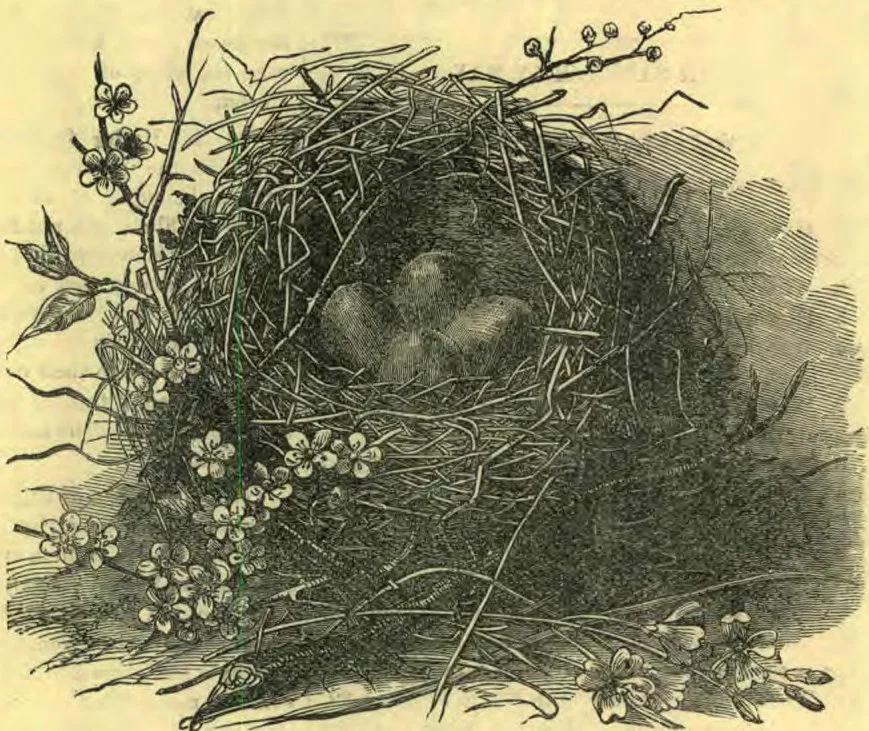
HERE they are! Four precious eggs, Safe hidden in the nest away. Four round eggs now, but we shall find, Instead, four tiny birds some day. My boy must wait, and patient be, Before the birdlings he may see.
This little nest, leaf-hidden here, Is like another nest, I know, Where thoughts are lying, fair and pure, Which day by day mature and grow. God only knows what hopes of mine Around that nest of thoughts entwine.

You have reached the end of this edition.

The Youth’s Instructor · May 21, 1884