The Youth’s Instructor, Vol. LII, No. 15

The Library of Congress

The Youth’s Instructor

April 12, 1904

Review and Herald Publishing Assn. · Washington, D. C. · April 12, 1904

The Library of Congress
ONE familiar with the best of Washington always gives to another anticipating a first visit to the capital city, the following advice: “Don’t fail to go to the Congressional Library.” The wise heed the instruction, and are well repaid. Lowell said, “There is no work of genius which has not been the delight of mankind.” So the Library, which is a gigantic triumph of genius, is of special delight. Its corridors constantly echo and re-echo the footfalls of visitors from all parts of this country, and across the waters.
The Library was founded in 1800; but the present building was not begun until 1888. It was finished in 1897, having cost $6,617,124, only about one half, however, of the cost of the Capitol.
The plan of the building for its service as a library is unique and admirable; but the general interest is concerned chiefly in the magnificent series of mural and sculptural decorations that greet the eye of the observer everywhere,—above, below, and all around. We who are artists in appreciation, if at all, rather than in touch, can be entranced by a few strokes of the brush in the hand of a genius; so it is not strange that the combined harmonious grouping together about the walls and ceiling of one building, the results of the best work that threescore celebrated men in their profession could accomplish in a year and a half, should prove highly interesting and instructive to you and me. Both inside and out, the predominating style of architecture of the building is the Italian Renaissance—that used in Italy at the time of the Revival of Learning, or about the fifteenth century—a style constructed chiefly from the long-neglected models of Greece and Rome.
The true university these days is a collection of books. —Carlyle
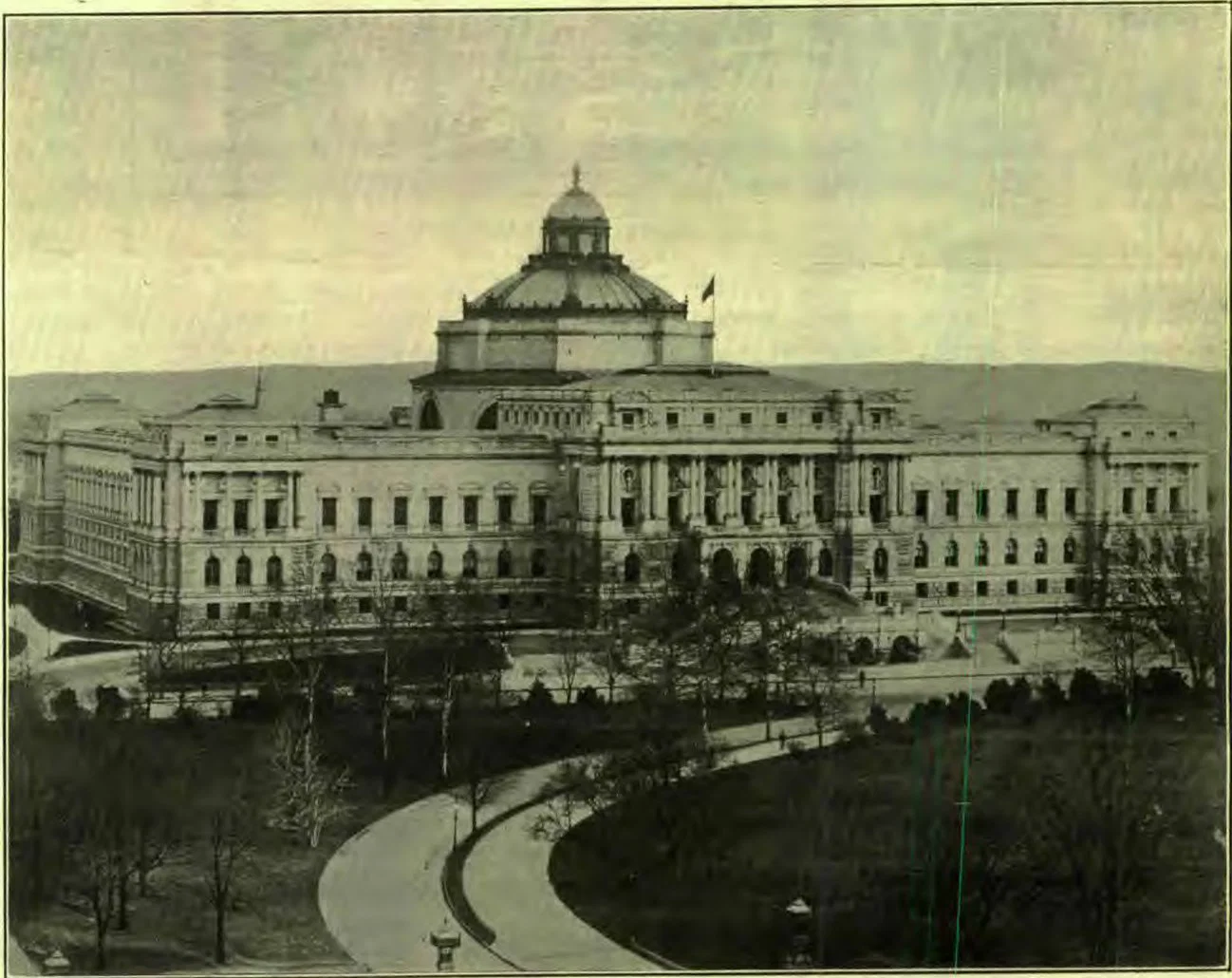
The walls of the Library are made of New Hampshire granite; “the stone is a close-grained variety, so even and light in tone that when the sun is shining upon it, the effect is almost as brilliant as if white marble had been used.” The building is four hundred seventy feet long and three hundred forty feet deep, and faces the east front of the Capitol. Though it is nearly a quarter of a mile away, its grounds seem to form a part of those of the Capitol, and the two buildings are connected by a tunnel. Through this an endless cable carries two trays back and forth at a speed between the terminals of six hundred feet a minute. Thus a book may be ordered by telephone, and received by an enthusiastic debating Senator within three minutes after it has left the Library—less time, it is said, than was required to receive one when the library occupied the Capitol itself.
Its floor space, exclusive of the cellar, equals an area of eight acres. The exterior walls form a great rectangle, which encloses a cross dividing the open space into four courts, each one hundred fifty feet by seventy-five or one hundred feet. At the intersection of the cross is an octagon, serving as the main reading-room. This octagonal Rotunda is conspicuous because of its gilded dome and lantern, which is surmounted by a great blazing torch with a golden flame—the Torch of Learning.
It is claimed that the Library is the most perfectly adapted for convenient use and storage of books of any large library in the world, and that it is the largest, costliest, and safest. Since it is the Nation’s Library, loyal Boston can take no offense at the claim, though her library as a marvel of art is an honor to the country. The shelving space in the Congressional Library amounts to nearly one hundred miles, making it possible to shelve about 4,500,000 books, reckoning nine to the foot. For the securing of sufficient daytime light 2,164 windows are pressed into service. Each window lighting the book-stacks consists of a single piece of polished plate glass three feet wide, and permanently sealed so that no dust or moisture can penetrate it.

Approaches and Main Pavilion

Even a detailed description of the large, costly, and unique fountain at the base of the broad entrance flight of steps, of the entrance porch itself, of the arches, carvings, and statuary, would only serve to show that the approaches to the building are extensive and imposing; therefore, with the bare statement that such is the case, I pass on to the doors that admit one to this hall of learning.
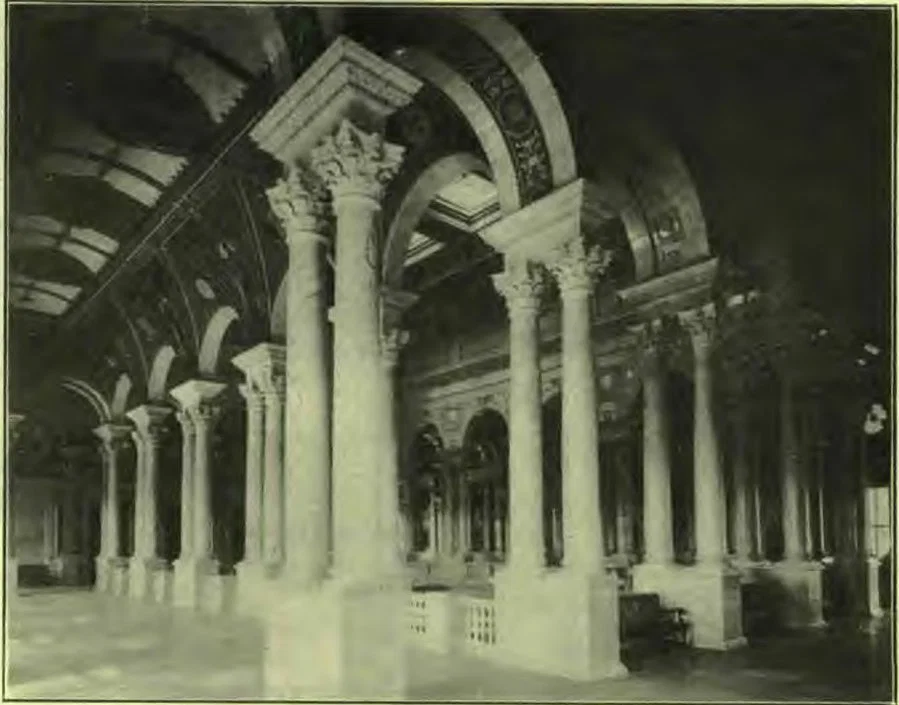
The three deep arches of the entrance porch, which can be observed in the main illustration, mark the site of the bronze doors which are “covered with a design of rich sculptural ornament in relief.” The subject of the decoration of the middle door is “The Art of Printing,” that of the one to the left is “Tradition,” to the right “Writing.” The three in their proper relation indicate the successive and gradually perfect ways in which the nations have preserved the history of their religion, literature, science, and history, namely,—tradition, writing, and printing. The happy, artistic combination of symbols chosen by the artist to express his thought, reveals the secret of the charm of the entrance doors. Entering by any one of these, the visitor passes immediately through a deep arch into the main entrance hall. The snowy whiteness of the glistening Italian marble columns, the gold and white of the paneled ceilings, the harmonious blending of colors in the mosaic floors, the commingled glory of color from the artists’ brushes concentrating upon one in the well or center of the Main Pavilion, produce an effect hardly to be equaled elsewhere in the world—“a vision in polished stone” and exquisite color! One must study the meaning of each stroke of the artist, if he would fully appreciate what he sees; for almost every kind of ornamentation used is symbolic, and a volume is expressed in a single production. It is not color effect alone that was desired, but the expression by it of many principles and events relating to the world’s history.
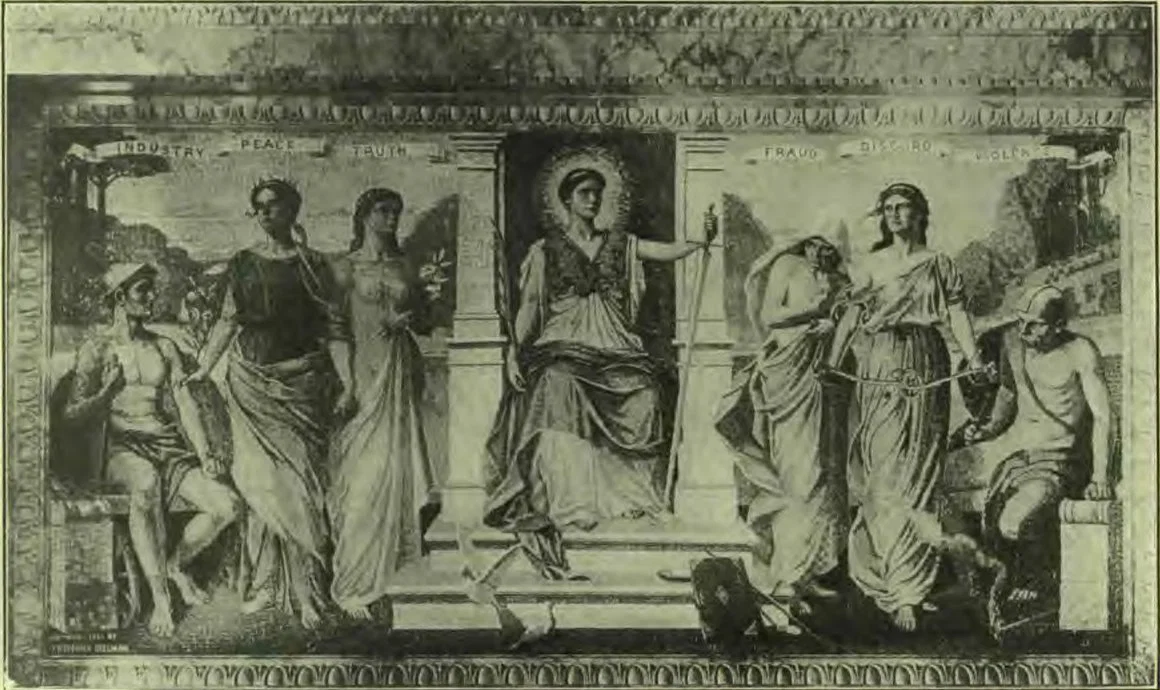
A MOSAIC IN THE REPRESENTATIVES' READING ROOM.
At the ends of the corridors in panels on a deep-red background are white, floating figures of women, symbolizing justice, fortitude, courage, patriotism, temperance, prudence, industry, and patience. The style of the paintings is Pompeian. The inscriptions in gold occurring frequently on the walls are of interest, President Eliot, of Harvard, having been given the honor of selecting a large number of them. A few of these are given on the last page of this number.
Facing the entrance to the Staircase Hall is the arch, commemorating the erection of the Library. In the spandrels of the arch are two life-size marble figures entitled “The Students,” one a boy, the other an old man, indicating that books are alike for the instruction and pleasure of youth and age.

Frescoes

Passing under the arch, one comes into the east corridor. Here the six paintings illustrating the evolution of the book are found.
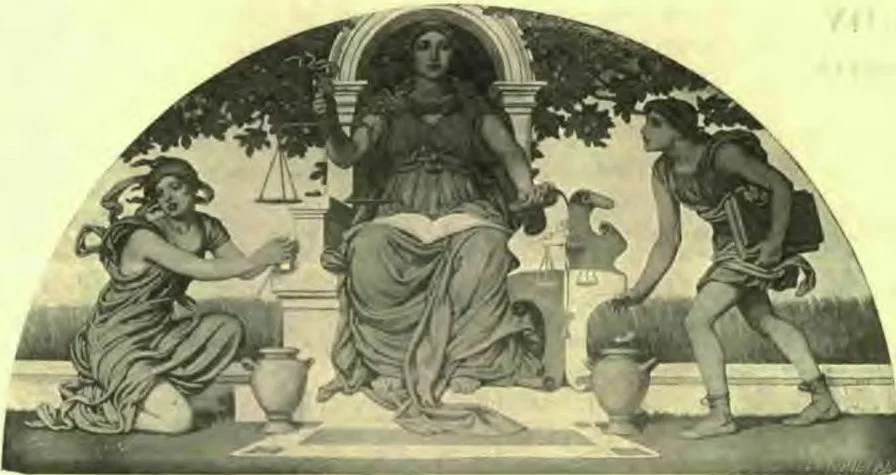
The soft colors and clearness of outline make these among the most attractive frescoes in the Library. Beyond this corridor is the small lobby leading to the central reading-room. Its walls are ornamented by a series of decorations, illustrating government. The painting in the central tympanum, representing the abstract conception of a republic as the ideal state, is entitled simply “Government.” The other paintings suggest the nature of good and bad administrations, and the results to which each leads, good government resulting in peace and prosperity, and corrupt legislation in anarchy. In the painting Good Administration (see illustration), the central figure is that of a grave and mature woman sitting on a marble throne, and holding in her right hand a pair of scales evenly poised, and with her left laid upon a shield quartered to represent the even balance of parties and classes. The frame of her chair is an arch, a form of construction in which every stone performs an equal service. On the right a youth casting his ballot into the voting-urn carries a book under his arm, suggesting that education should be the basis of suffrage. To the left is another urn into which a girl is winnowing wheat, symbolizing the care with which a people should choose its public servants.
The field of wheat and the fruitful tree in the background are symbolic of the prosperous and careful labor fostered by a good government. A striking contrast to this is the panel entitled “Corrupt Legislation,” which is “represented by a woman with a beautiful but depraved face sitting in an abandoned attitude on a throne, the arms of which are cornucopias overflowing with the coin which is the revenue of the state. But this revenue is represented not as flowing outward, for the use and good of the people, but all directed toward the woman herself. The path in front of the throne is disused and overgrown with weeds, showing that under such a corrupt government the people have abandoned a direct approach to Justice. With her right hand, the woman waves away, with a contemptuous gesture, a poorly clad girl—representing Labor—who comes, showing her empty distaff and spindle, in search of the work which should be hers by right, but which she can not obtain under a government inattentive to the wrongs of the people. In her left hand the woman holds a sliding scale—used as being more easily susceptible of fraud than a pair of balances, and the proper emblem therefore of the sort of justice in which she deals. A rich man is placing in it a bag of gold; he sits confidently beside her, secure of her favors in return for his bribe. At his feet are other bags of gold and a strong box, together with an overturned voting-urn filled with ballots, signifying his corrupt control of the very sources of power. In his lap he holds the book of Law, which he is skilled to pervert to his own ends, purchasing desired legislation. In the background are his factories, the smoke of their chimneys testifying to his prosperity. On the other side the factories are smokeless and idle, showing a strike or shut-down; and the earthen jar in which the savings of Labor have been hoarded lies broken at his feet.”

Reading Rooms

This lobby leads the reader directly into the Rotunda, the Main Reading-room; but the visitor must pass to the gallery above before he is allowed a view of the room where art and wealth together have conspired to make a scene that defies the pen’s description. At the landing of the stairway leading to the elegant marble gallery, is an arched panel, fifteen and one-half feet high, and nine feet wide, containing a marble mosaic of Minerva, the goddess of wisdom. How such beautiful, graceful figures, with such exquisite blending of delicate colors, can be made by building them out of tiny stones is a problem that only the skilled Italian of Venice, with his enamels of twenty-five thousand different tints, can satisfactorily solve.
The Representatives’ Reading-room is ornamented with two beautiful mosaic panels, “History” and “Law,” each more than seven feet long, and made in Venice. Law is typified by a beautiful young woman seated on a massive throne, holding in one hand a sword to be used against skulking Fraud, Discord with her malign serpents, and Violence with torch and sword. The palm in the other hand suggests the reward she offers to Truth, Peace, and Industry. She wears the ægis on her breast to signify righteousness and wisdom. On the steps of her throne are the scales of justice and the book of the law, and a pair of white doves emblematic of mercy.
Just opposite the Senators’ Reading-room is the general news reading-room, where the most omnivorous reader surely may satiate his appetite, for here between seven and eight thousand papers and magazines are at his service.
There are corridors and pavilions filled with works of art of various nations, and a room in which books printed when the art was in its infancy are displayed. Here one can see original copies of Poor Richard’s Almanac, bearing the date of 1741. A unique contrast do the newspapers of 1600 make when placed beside the voluminous Sunday editions of many of the leading newspapers of to-day; so do the volumes of poetry and prose of the sixteenth and seventeenth centuries when associated with the beautifully illustrated, clearly printed, and velvet or morocco covered books of the twentieth.
One pavilion and a large share of another room are filled with the etchings and hand engravings of one man, Albrecht Durer, a Dutch engraver, who lived from 1741-1528. That one man could accomplish so much in a short lifetime is a marvel to all who observe case after case filled with the fruits of his patient toil and skill.
AN INTERIOR VIEW OF THE CONGRESSIONAL LIBRARY
Congress has made the Copyright Department a division of the Library of Congress; two copies therefore of all copyrighted productions, are required to be deposited in the Library. There were in the year 1900, nearly one hundred thousand entries of titles made in the Copyright Office.
It is to be regretted that the public are excluded from some of the most handsomely ornamented rooms, it having become necessary on account of lack of room to use them for offices.
Over one of the entrance arches is a fresco consisting of two floating figures bearing a scroll which contains the inscription, “Give instruction unto those who can not procure it for themselves.” The Library of Congress is a magnificent monument of learning, reared in accordance with this advice of Comenius, and that fact expressed by Bacon, “The inquiry, knowledge, and belief of truth is the sovereign good of human nature.”

The Girl in the Car

ONE hot day in July I was traveling through a mountainous district of Pennsylvania. The car was crowded, and the passengers were beginning to feel tired and cross, and were looking forward impatiently to their journey’s end.
Two stout, red-faced gentlemen gave uneasy and irritated glances over their magazine leaves toward a poor little woman who held a restless, fretful baby in her arms, vainly trying to keep it quiet. Some young women in the rear said something about the folly of bringing crying babies on trains to annoy others. The rest were stolidly indifferent or contemptuously silent.
Just then our train swept into the station at E., and as it pulled up, out of the midst of a merry group of friends who had evidently come to wish her a prosperous journey, a bright-faced girl got on the train. There were two seats vacant, but without a moment’s hesitation the young girl came and sat by the poor woman with the troublesome baby.
It was wonderful how the advent of this girl changed in a moment the whole atmosphere of the car. Her happy face was like a ray of sunshine, as she gave a bright glance around, and then turned and held out her hands to the baby. For a moment its round, wondering eyes looked questioningly into the new face, then, with a radiant smile, it reached out its little arms to her in perfect confidence. She took it from its bewildered mother, and gathered it with a happy little laugh into her arms.
All through the next two hours’ ride, while the dust flew and the heat was stifling, Little Miss Cheerful, as I mentally named her, and the baby had a good time. It was astonishing how interesting that “cross” baby had become, and what attractions it developed under its nurse’s skilful handling. Even the grim conductor, who had eyed the forlorn mother and restless child sourly, now looked benevolently on the merry group.
The poor wearied little mother laid her worn face back on the cushion and was soon asleep, confident that her little one was in good hands. When at her journey’s end she woke with a rested, happy look, she said to her kind young friend, “You don’t know how much good your kindness has done me. I have been traveling three days, and have had no sleep for two nights. God bless you, dear!” And she passed out into the crowd with a smiling face, while her baby waved its tiny hand to the dear young girl.
We all felt ashamed of ourselves, and had a lesson in unselfishness which will not soon be forgotten by at least one of those who were traveling that sultry day.
I learned afterward that our bright fellow traveler was the daughter of one of Pennsylvania’s richest coal kings, whose home of wealth had not made her selfish, nor made her look down upon those whose lot was hard and uninteresting. Besides, I learned, too, that she is a follower of Him who said, “Inasmuch as ye have done it unto one of the least of these my brethren, ye have done it unto me.”— The Classmate.

Spring

WINTER is past; the heart of Nature warms Beneath the wrecks of unresisted storms; Doubtful at first, suspected more than seen, The southern slopes are fringed with tender green; On sheltered banks, beneath the dripping eaves, Spring’s earliest nurslings spread their glowing leaves, Bright with the hues from wider pictures won, White, azure, golden,—drift, or sky, or sun,— The snowdrop, bearing on her patient breast The frozen trophy torn from Winter’s crest; The violet, gazing on the arch of blue Till her own iris wears its deepened hue; The spendthrift crocus, bursting through the mold, Naked and shivering with his cup of gold. Swelled with new life, the darkening elm on high Prints her thick buds against the spotted sky; On all her boughs the stately chestnut cleaves The gummy shroud that wraps her embryo leaves; The house-fly, stealing from his narrow grave, Drugged with the opiate that November gave, Beats with faint wing against the sunny pane, Or crawls, tenacious, o’er its lucid plain; From shaded chinks of lichen-crusted walls, In languid curves, the glittering serpent crawls; The bog’s green harper, thawing from his sleep, Twangs a hoarse note and tries a shortened leap; On floating rails that face the softening noons The still shy turtles range their dark platoons, Or, toiling aimless o’er the mellowing fields, Trail through the grass their tessellated shields. — Oliver Wendell Holmes.

Was God's Throne Moved?

In order that man might comprehend the work of our High Priest in the heavenly sanctuary, the earthly sanctuary was built; and priests divinely appointed by God served in the earthly sanctuary, of whom it was said, “Who serve unto the example and shadow of heavenly things.” Heb. 8: 5. In the earthly temple the work of the priest was confined to the first apartment until the day of atonement, when the service was carried into the most holy place. If this was a shadow of heavenly things, then in the heavenly sanctuary the work was confined to the first apartment until the antitypical day of atonement.
For over eighteen centuries Christ plead his blood before the Father in the first apartment of the heavenly sanctuary. In October, 1844, he passed into the most holy place.
In the type the glory, or visible presence, of the Lord was sometimes manifested in the first apartment, even at the door of the holy place he sometimes met with them. Ex. 29: 42-44. When Isaiah saw the throne of God, “his train filled the temple.” Isa. 6: 1. The throne of God is a living throne composed of angels. It is movable. Eze. 1: 1-28. When the scene of the opening of the judgment in 1844 was shown to Daniel, he saw the throne placed in the most holy place. Dan. 7: 9, R. V. His attention was especially attracted by the “wheels of burning fire,” as he beheld the wondrous sight, the moving of the throne of the infinite God within the holy of holies and the opening of the judgment.
In the article entitled “End of the 2300 Days,” in “Early Writings,” the prophet was first shown the Father seated on his throne in the holy place. Then we read, “I saw the Father rise from the throne, and in a flaming chariot go into the holy of holies within the veil, and sit down. Then Jesus rose up from the throne. . . . Then a cloudy chariot with wheels like flaming fire, surrounded by holy angels, came where Jesus was. He stepped into the chariot, and was borne to the holiest, where the Father sat.”
Read chapters 23, 24, and 28 in “Great Controversy.”
MRS. S. N. HASKELL.

A Message to Our Girls

GOOD ADMINISTRATION
GOOD ADMINISTRATION
A CLUSTER of young girls stood about the door of a schoolroom one afternoon, engaged in close conversation, when a little girl joined them, and asked what they were doing. “I am telling the girls a secret, Kate, and we will let you know, if you will promise not to tell any one as long as you live,” was the reply.
“I won’t tell any one but my mother,” replied Kate. “I tell her everything, for she is my best friend.”
“No, not even your mother, no one in the world.”
“Well, then, I can’t hear it; for what I can’t tell my mother, is not fit for me to know.” After speaking these words, Kate walked away slowly, and perhaps sadly, yet with a quiet conscience, while her companions went on with their secret conversation.— Selected.

Cooler Than Cool

SYDNEY SMITH'S name for Monckton Milnes (afterward Lord Houghton) was “Cool of the Evening,” and the reason for this choice is partly revealed in the anecdote below.
At a London dinner given by a distinguished man, Sydney Smith had the place of honor, and Milnes was among the other guests.
Milnes’ manner to the great wit and divine was lacking in the respect due to age and position. He calmly addressed him as “Smith,” which every time made those who felt what was proper wince as at a personal affront.
Finally Milnes said, with something of an air: “I’m going on to the archbishop’s reception at Lambeth Palace.”
“Oh, are you? So am I,” said Sydney Smith. “May I ask if you have a carriage here?”
“No,” said the “Cool of the Evening.”
“Well, I have, and I shall be happy to give you a seat in it, but you must do me one favor. Don’t call the archbishop Howley!”
The voice and manner of piteous entreaty convulsed the company and crushed Milnes, who retired as soon as possible from the table.— Youth’s Companion.

THE WEEKLY STUDY

Behold, the Bridegroom Cometh

SCRIPTURE STUDIES:—
CHAPTER STUDY:—
“Great Controversy,” Chapter Twenty-Two.
LESSON TOPICS:—
Prophecies for the believer following the first disappointment.
Parable of the ten virgins shown to be applicable at this time.
Explain the parable referred to.
Describe Satan’s activity at this time.
The position of William Miller after the second disappointment, as characteristic of all the truly consecrated believers.
Why a definite time was preached.
PERSONAL LESSONS.
Note that at the “midnight” of the dark night of disappointment, extending from the spring to the autumn of 1844, the message was proclaimed in the very words of Scripture, “Behold, the Bridegroom cometh.”
Without the preaching of definite time for the coming of Christ, the work designed of God would not have been accomplished. Satan was leading very many to look far in the future for the great events connected with the judgment and the end of probation. It was necessary that the people be brought to seek earnestly for a present preparation.—“Early Writings,” page 109.
Are the leaders doing all they can to secure a careful home study of these lessons by all the members? If only Sabbath-school teachers studied the lessons, the Sabbath-school would be not nearly so potent a factor in character-building.
It would be well to choose two persons to present the lesson, each one taking about half of the chapter. The Scripture Studies at this time should be used in connection with the Lesson Topics.
Let whoever has any part to act in the teaching of this lesson, read very carefully two or three times the entire chapter. One can’t afford to miss having the blessing gained from the reading to give to others.
F. M. D.

Union College Young People’s Society

OUR Young People’s Society did not get a very early start this year. However, we are now quite well organized, and have the duties distributed as much as possible so as not to overburden any one.
Two meetings are held each week, one on Sabbath afternoon consisting of a program of historical, field, and biographical studies; and a missionary meeting on Wednesday forenoon. A consecration service is held every few Sabbaths. At the opening of each Sabbath meeting a scripture drill is conducted on texts assigned the previous Sabbath. All appreciate the value of these drills. We believe that the man of God should be thoroughly furnished unto all good works, and able always to give an answer to every man that asketh a reason for the hope that is within him.
At our Wednesday meetings, missionary projects are discussed, work assigned, and reports given. Good music has an important place in all of our meetings. This adds much to the interest of our programs, as well as being a means of praising our Creator.
Since we are located in an educational center with several large institutions of learning at our doors, besides a number of church societies, we are endeavoring to reach some of these young people with the saving truth for our time. For this purpose a committee has been appointed to visit these institutions, attend their Young People’s meetings, and help them in a kindly, Christian way. We have been gratified with the reports from this committee thus far. Our members have been invited to take part in their meetings, and in some instances have led their meetings. Those who compose this committee have testified to the good done their own souls by coming in contact with these young people, many of whom are longing for more light.

Periodical Work

A large number of the special Signs was taken by our Society, and either sold or mailed. Each week we mail a club of the regular Signs to persons with whom different members of the Society will correspond and furnish other reading-matter if a sufficient interest is shown. In our periodical work we have found it a good plan to secure from the conference presidents the names of individuals in some locality where the conference intends to send laborers, thus we may prepare the minds of the people to receive them. A young man of our number is now using a club of fifty Life Boats, ten Signs, and other of our periodicals, furnished him by the College View Church Society, in the penitentiary and the jails of Lincoln. Our foreign departments are also doing a good work. A club of fifty Sendebuds is mailed regularly by our Scandinavian young people, and a club of seventy-five Hausfreunds by the German young people.

Our Foreign Mission Bands

Thirty of our young people who are interested in foreign fields with a view to becoming foreign missionaries, have been organized into two bands, which meet each week to study the fields in which they are interested. They will also take up correspondence with foreign missionaries who are already in the field. A movement is now on foot to improve the condition of a former fellow student who is a missionary in an unfavorable and uncongenial locality.
Our week-of-prayer offerings amounted to $140. A weekly free-will offering is taken to defray the expenses of our Society, and the surplus is donated to some needy enterprise. Twenty-five dollars of this surplus has been donated toward the purchase of a printing-press for our mission in Porto Rico. Our Foreign Mission Bands have raised $30 for the school in South America. We have also sent a collection of reference books to Colegis de Cameras, Argentina.
As young people we are thankful for the opportunity of preparing ourselves for a place in the Master’s vineyard, and at the same time doing some work for him. Practise is and should be a part of the thorough workman’s course, and it is only thus that we become efficient laborers.
J. I. BEARDSLEY, President.

How Satisfying Is a Perfect Word

How satisfying is a perfect word! How great to know the truth, and utter it So that it shall eternally be heard, And worlds together in its chords be knit! — Lucy Larcom.

Young People's Society Leaflet Prepared by General Conference

A LEAFLET, or manual, is being prepared by the Sabbath-school Department Committee of the General Conference, in charge of the Young People's Work. This leaflet sets forth the reasons for the organization of Young People's Societies, and gives helpful suggestions relative to the organization and carrying forward of the work. It also calls attention to various lines of missionary work, tells how and where to report, and gives much more of value to those in charge of such Societies. The manuals are for all, and can be had for the asking. As soon as they are ready, the General Sabbath-school Secretary will supply those in charge of the Young People's Work in each conference with the manual.

Report from Hillsdale, Michigan

THERE being no Young People’s Society in the Hillsdale church, the regular Sabbath service, January 23, was devoted to that work. Testimonies and other matter was read relative to the subject. The brethren and sisters expressed themselves as being heartily in favor of the movement, and willing to lend their influence to make the work a success. Accordingly an organization of about eighteen members was effected, with Brother John O. Stow as leader.
Notwithstanding the severity of the weather and the fact that many of the young people live at a distance, the meetings have continued with unabated interest. The Society is studying “The Great Controversy,” believing the lessons to be of sufficient importance to necessitate their beginning at the first of the book, although the INSTRUCTOR lessons are much in advance of them.
The Young People’s Convention held at Hillsdale, March 10-13, has just closed, and was a decided success. The neighboring churches were well represented. The meeting was held especially for the churches in the southern part of the East Michigan Conference, the convention at Owosso being for the northern part. By these it was possible to reach a large number of our young people. Very efficient help was rendered by Elders C. N. Sanders and E. K. Slade, Sister Tillie E. Barr, also by Brother A. J. Harris of the Jackson Sanitarium.
The principal feature of the convention was the consideration of educational work, and the one theme running through all the meetings seemed to be “A Training for Service.” Under this heading we note the following topics upon the program, “Need of Training,” “Educational Advantages,” “Call to the Youth,” “Training for Eternity,” “Threefold Education,” “Home Influence,” “Poverty not a Hindrance,” “The True Basis.” Time was also devoted to the medical missionary work, the canvassing work, and our relations to the church and to the message. The devotional meetings were intensely interesting, and nearly every one testified to the blessing received.
We could but note the warm hospitality accorded the visitors, especially as the majority of the brethren and sisters live from one to eight miles in the country, and drove the distance daily, bringing their families and those they were entertaining. The meeting seemed very much like the accounts we have read of those meetings held years ago when the brethren remained together all day, studying the Word and seeking God.
A State organization is contemplated in order more closely to come in touch with isolated persons. The Young People’s Work is onward in this conference. We believe there are here many noble young men and women and youth who will yet become efficient workers for God.
CAROLYN A. HATHAWAY.

April: A Poem by Anna J. Grammiss

April

APRIL laughed, and threw a kiss; Then afraid it seemed amiss, Quick she dropped a shining tear, And it straightway blossomed here; Seeing this, she then threw more, Crying harder than before— A tear for every kiss she threw; From every tear a blossom grew, Till she, laughing, ran away, And left her flowers all to May.
— Anna J. Grammiss.
Continue reading: The Threatened Downfall of a Suit of Clothes