"It is strange," said a gentleman who sat next to me in the car, and with whom I had struck up quite an acquaintance, "what an influence a look, a word, or the little act of a perfect stranger will sometimes have upon a person."
"Yes," said I, "more than any of us realize."
"It was the simple act of a stranger that changed the whole course of my life."
"Indeed! How so?"
"When I was a boy, my father moved to the then far West—Ohio. It was before the days of steam, and no great mills thundered on her river banks, but occasionally there was a little grist-mill by the side of some small stream, and thither, whenever the water was up, the whole neighborhood flocked with their sacks of corn. 'First come, first served.' Sometimes we had to wait two or three days for our turn. I generally was the one sent from our house, for while I was too small to be of much account on the farm, I was as good as a man to carry a grist to mill. So I was not at all surprised one morning when my father said: 'Henry, you can get up old roan and go to mill to-day.'"
"Saunders' mill was ten miles away; but I had made the trip so often that it did not seem far. I believe one becomes more attached to an old mill than to any other building. I can see just how it looked as it stood there under the sycamores, with its huge wheel and rough clapboard sides."
"When I arrived, I found the North Branch and the Rocky Fork folks there, ahead of me, and I knew there was no hope of getting home that day; but I was not at all sorry, for my basket was well filled with provisions, and Mr. Saunders always opened his big barn for us to sleep in; so it was no unpleasant time we had while waiting for our grist. This time there was an addition to the number that had been in the habit of gathering from time to time in the old Saunders' barn—a young fellow about my age, probably a little older. His name was Charley Allen, and his father had bought a farm over on the Brush Creek road. He was sociable and friendly, but I instinctively felt that he had 'more manners' than the rest of us. The evening was spent, as usual, in relating coarse jokes and playing cards. Although I was not accustomed to such things at home, I had become so used to it that it had long since ceased to shock me, and indeed, I was fast becoming a very interested spectator."
'Well, boys, it is time for us fellers to go to roost,' said Jim Finley, one of the greatest roughs on the Rocky Fork, as he threw down his pack of cards and began to undress. We all followed his example, although it was not much undressing we did to sleep on the hay; but we were so busy with our own affairs that we did not notice Charley Allen until Jim exclaimed: 'Heydey! we've got a parson here, we hev!' Charley was kneeling by the oats bin, praying. Jim Finley's jest met with no response. The silence was only broken by the drowsy cattle below, and the twittering swallows overhead.
More than one rough man wiped a tear from his eyes as he silently went to his bed on the hay. I had always been in the habit of praying at home, but I never thought of such a thing at Saunders' mill. As I lay awake that night in the old barn, thinking of Charley Allen's courage, and what an effect it had upon the men, I firmly resolved that in the future I would do right. I little thought how soon my courage would be tested. Just after dinner I got my grist, and started for home. When I arrived at Albright's gate, where I turned off to go home, I found the old squire waiting for me. I saw in a moment that something had gone wrong. I had always stood in the greatest awe of the old gentleman, because he was the rich man of the neighborhood, and now I felt my heart beginning to beat very fast. As soon as I came near he said, 'Did you go through this gate yesterday?' I could easily have denied it, as it was before daylight when I went through, and I quite as often went the other way. Charley Allen kneeling in the barn came to my mind like a flash, and before I had time to listen to the tempter I said, 'Yes, sir, I did!'
'Are you sure you shut and pinned the gate?' he asked.
'This question staggered me. I remembered distinctly that I did not. I could pull the pin out without getting off my horse, but I could not put it in again; so I carelessly rode away, and left it open.'
'I—I—I—'
'Out with it; tell just what you did!'
'I left it open,' I said, abruptly.
'Well, you let the cattle in, and they have destroyed all my early potatoes—a terrible piece of business.'
'I'm very sorry, I'd—'
'Talking won't help matters now; but remember, boy, remember that sorrow don't make potatoes.'
'I felt very badly about the matter, for I was really sorry that the old gentleman had lost his potatoes, and then I expected to be severely reprimanded at home; but I soon found that they knew nothing of the matter, and after several days had passed, I began to rest quite easy. Alas for human hopes, one rainy afternoon I saw the squire riding down the lane. I ran off to the barn, ashamed to face him, and afraid to meet my father. They sat on the porch and talked for a long time. At last my curiosity overcame my fear, and I stole back to the house, and went into my mother's room to see if I could hear what they were talking about. 'Why, the boy could be spared well enough, but he don't know anything about the business,' said my father. 'There is one thing he does know,' said the squire, 'he knows how to tell the truth.' He then related the circumstance which I so much dreaded to have my father hear. After he had gone, my father called me to him and told me that the squire was going to start a store in the village, and wanted a boy to help, and that I could if I wanted to. I went, and remained in the village store until it blossomed out into a city store; and people say that I got my start in life when I entered Albright's store; but I will always maintain that I got it while I was waiting for the grist.' —Sunday School Times.
THE LITTLE GIRL THAT NOBODY LIKED.
"Wasn't it lovely in Miss Hodge to give us such a short Latin lesson?" said Sue.
"I don't know as 'twas very lovely. She generally gives us long enough ones to make up," said Katie.
"Say, don't you think that new girl is pretty?" whispered Carrie.
"Not so very. Too many freckles," said Katie.
Katie walked home alone. Frankie was in the front yard, putting the last touches to a snowman.
"Look Kit, isn't he a big feller," shouted the little boy.
"I don't call him so very tremendous," said Katie. "You needn't throw that snow-ball at me, sir."
Katie went into the house, and found mamma and Aunt Eleanor talking with Mrs. Eldridge in the parlor.
"What red cheeks our little girl has!" said Mrs. Eldridge, pleasantly; "she must have been out in the cold."
"I don't think it's very cold to-day," said Katie, seating herself by the register.
"My Minnie has been out skating for the first time this winter," Mrs. Eldridge went on.
"Does she like to skate? I hate to."
Mrs. Eldridge said no more, but turned to Katie's mamma.
"Katie, I must show you the hood Mrs. Eldridge brought me," said mamma, after she was gone. "Don't you think it's pretty?"
"I don't think red's a pretty color a bit. What a queer shape it is! I've got to go and study."
"Eleanor, what shall I do with that child?" said Mrs. Wicks helplessly. "Do tell me what is the matter with her."
"Her food don't agree with her, I'm sure of that," said grandma. "The child's stomach is out of order."
"I've talked and I've talked, and it does no good," continued Mrs. Wicks. "She contradicts from morning till night. I'll turn her over to you, Eleanor. I wish you would have a serious talk with her. But if you ever have children of your own, you'll find it not such an easy matter," sighed Mrs. Wicks, "to make little angels of them." Aunt Eleanor had heard this many times before. She laughed, and went on crocheting, but she did not forget her little niece with her sad infirmity.
That night they all sat in the parlor. Grandma was nodding over her knitting; papa complained there was nothing in the paper; Frankie was pulling the cat's tail; and Katie was groaning, "Oh, dear, I wish somebody'd play go-bang with me."
"Let's all play something," said Aunt Eleanor, throwing down her work. "I heard of a new game the other day. Let me tell you. First some one goes out of the room."
"Oh, let me go! let me go!" cried Katie.
"In just a minute, dear. The people left in the room decide on some adjective, like amiable, or conceited, or flattering; and when you come in, and say something to each one, he must be amiable, or conceited, as the case may be, in his answer. And you must guess by his manner what this adjective is. You all understand? There Katie dear, run out in the hall. We won't keep you long."
So papa and mamma and grandma begged Aunt Eleanor to tell them some adjective. They could really think of not another one in the language besides amiable and conceited and flattering, and those Katie had already heard.
"I have one," said Aunt Eleanor, and whispered something in the ear of each. "Come Katie."
Katie had been thinking up questions as she sat on the hall stairs, and started out bravely.
"Auntie, don't you think mamma's new bonnet is pretty?"
"Pretty!" said Aunt Eleanor, "I wouldn't be hired to wear such a looking thing."
Katie looked puzzled, and a little uncomfortable.
"Mamma, are we going to have that lovely pudding for dinner to-morrow?"
"I'm sure I don't know," said Mrs. Wicks, with a weariness which was quite sincere. "Who cares for pudding? I'd like never to see one again."
"Well, papa, you like it any way don't you? You said you did."
"A man's a right to change his mind, hasn't he?" said Mr. Wicks, gruffly. "I suppose I can eat it if I can't get anything else, though." Katie reddened. Had she not said that very thing at breakfast?
"Frankie," she went on, "you ought to go to bed. It's half past seven."
"I'm not going to bed till I get ready," said Frankie, as if the game cost him no great effort.
"You naughty boy! Now, grandma, how did you like the work-bag I gave you Christmas?"
Grandma looked troubled, but Aunt Eleanor gave her a warning.
"I think, dear," said the old lady, tremulously, "that it was a very queer shape."
Katie could bear it no longer. "I don't know anything about your old game; but I know you are all perfectly horrid! You contradict everything I say. You don't agree"—
"Hurrah! you've guessed it. And a person who never agrees is what?"
Poor Katie! she stood still, looking from one to the other, then sobbed out, "I—I—suppose you—you mean disagreeable," and rushed out of the room.299When Aunt Eleanor went upstairs, a tearful voice called, "Auntie, will you come here a minute?"
"Yes, dearie."
"Oh, Auntie, I know what you all meant. You played that game on purpose, so I could see how it sounded. I'm never going to be disagreeable again!"
It was a great promise to make, and it must be confessed that Katie sometimes forgot to keep it. At the end of a year, she was by no means a little angel, but she was quite as far from being "the little girl that nobody liked."—Christian Register.
The Home Circle.
By Henry Burton
ALTERNATIONS.
If all our world were one broad, level plain,
Each vale exalted and each hill made low,
The rivers then would stagnate, and the rain
Would turn the fields into a reedy slough.
If skies were cloudless, ever clear and bright,
And all our days were one incessant glare,
The flowers would droop just through excess of light
And dearth and death would meet us everywhere.
Or if the sky were always dark with cloud,
Making the sunlight only dull and dim,
The wail of famine would wax long and loud,
Earth's cup of sorrow filled up to the brim.
If all the seasons were one summer day,
With harvest ripening in the sunshine warm,
How we should miss the winter cold and gray,
And long to hear the voices of the storm!
If all our life were one exultant psalm,
With no soft interlude of minor tone,
Methinks its music soon would cease to charm,
And we would weary of its monotone.
If all our days were one unbroken joy,
The very joy would ripen it to pain;
For as the gold must have its base alloy,
So sorrow blesses, and our loss is gain.
Creation's law is still the law of life—
The evening and the morning round our days;
While through the changing chords of rest and strife,
Prayer sings responsive to her sister Praise.
—Henry Burton.
ITEMS OF NEWS.
There are 887 Episcopal churches in London.
There was 80 per cent. more tobacco produced in 1880 than in 1870.
A Washington telegraph company is laying its wires in the sewers.
The Italian Government is making preparations for specie payment.
The French have fixed the number of troops to occupy Tunis at 10,000.
Chili and the Argentine Confederation have agreed upon the draft of a treaty.
All the gambling houses in St. Louis have been closed under the new law.
Minnesota mills will grind 35,000,000 bushels of wheat during the fiscal year.
Twenty-three hundred and fifty-one immigrants arrived in New York June 22.
The Mayor of Cincinnati has prohibited picnics on Sunday within the city limits.
Belgium has adopted the postal savings bank system, with stamps for small deposits.
Mrs. Lincoln, widow of President Lincoln, is dangerously ill, and is not expected to live.
The Irish census shows a population of 5,159,849, being a decrease of 252,538 since 1871.
Hartmann, the Nihilist is intending to come to the United States. He is not needed here.
It is estimated that Connecticut raised tobacco enough last year to make 900,000,000 cigars.
Last year California sent $1,000,000 worth of fresh fruit to the States east of the Rocky Mountains.
The foreign commerce of Boston during the month of May amounted to nearly fourteen millions of dollars.
It is reported that at Cornell university nearly all the students have signed a pledge of abstinence from tobacco.
The editors of the New York Police Gazette have been indicted by the Grand Jury for publishing lottery advertisements.
On Friday night June 24, the residence of Mr. W. Collins on Webster street, Oakland, was burned to the ground. Loss $12,000.
Of 49,550 families in Georgia, who were visited by the colporteurs of the American Bible Society, 18,000 were without the Scriptures.
The earnings of the Union Pacific Railway Company for the first eight days in June, 1881, increased $175,034 over the same time last year.
A dispatch from Dartmund, Prussia, says that an explosion occurred June 24, at the Liefban colliery. Seventeen persons were killed and five injured.
Tucson, A. T., was seriously damaged on the 27th by the explosion of a quantity of Tonite powder. Nearly every building in town was shattered.
The Methodist Episcopal church has in this country forty-five colleges and theological seminaries, besides ninety other high grade institutions of learning.
Several thousand workmen are on a strike in Stockholm, and riots are feared. Numbers of fires in Sweden recently are believed to be of an incendiary origin.
The revised New Testament has been adopted for all services in the theological seminary at Andover. President Porter has also introduced it in the Yale chapel.
In the afternoon of June 22, a fire destroyed a large portion of the city of Tombstone, A. T. The total loss is estimated at a quarter of a million. The fire originated in a saloon.
A whole train on the Morlos railroad in Mexico fell into the San Antonio river, June 25, on account of the falling of a stone bridge. Two hundred are reported dead, and many injured.
The proposed amendment to the Constitution of Pennsylvania, prohibiting the manufacture and sale of intoxicating liquor, has been defeated in the Senate by a vote of sixteen to twenty-four.
It is stated that of the sixty-eight cities that made weekly death reports to the national Board of Health, in 1880, Vallejo, Cal., is the healthiest city reported, and Norfolk, Va., the most unhealthy.
The Wisconsin Legislature has appropriated to the State University and experimental farm of that State, four thousand dollars for the purpose of conducting experiments in the production of sugar from amber cane.
Thomas Garfield, an uncle of the President, was killed by a locomotive as he was crossing the railroad track near Cleveland, June 21. Mrs. Arnold, the President's sister, was injured, it is feared fatally.
The ship Franconia, from New York, went ashore on the Farallones Friday morning, June 24, in a dense fog. All the crew were saved, but the ship with the cargo, valued at about $300,000, was a total loss.
Calcutta advices say: "A report has reached here from Central Asia that large bodies of Russian troops are assembling on the borders of Kashgar, and a conflict with Chinese troops cannot long be avoided."
Philadelphia has been making a great effort to have the remains of William Penn removed from England to that city; but the trustees of the cemetery where he was buried, refused to grant the request.
The largest elevator in the country has just been completed in Brooklyn, N. Y. It has cost nearly $2,000,000, and has a storage capacity of 2,500,000 bushels. Half a dozen vessels can load from it at the same time.
A dispatch from Ottawa states that Sitting Bull has commenced selling horses to keep his band from starving, and cannot hold out much longer. The Canadian Indians refuse to have anything to do with him.
Mayor King of Philadelphia has prohibited the sale as well as the use of fire-crackers for the fourth of July. It would be well if all cities could invent some other than a Chinese method of celebrating our national holiday.
Kansas was visited, on the 25th, by one of the severest storms of wind, rain, and hail ever known there. Five inches of water fell during the night. Orchards were stripped of their fruit, and thousands of acres of grain were cut down.
The 9th of June was the centennial anniversary of the birth of George Stephenson, the originator of the railway locomotive. It was celebrated with great enthusiasm in England. Fifty years ago the English Parliment called him a lunatic.
On the morning of the 20th the store of Dr. Timothy Conkling, at Centerville, Shasta county, was blown up with giant powder. The building was entirely demolished, and the Dr. was very seriously injured. The perpetrator of the deed is unknown.
The relations of the Porte with the French Embassy at Constantinople are represented as very strained in consequence of the Tunis affair. The French Ambassador was unable to obtain an audience with the Sultan to present the usual complimentary message.
The Utes are again on the war path. Several murders of settlers have been committed by them. A company of settlers that organized to resist them was overpowered and several killed. Troops have been dispatched to the seat of war, in San Juan county, Utah, and fighting is reported.
The comet, which was discovered on Wednesday morning, June 22, has created a decided sensation, the more so as it was entirely unexpected, and was not first seen by the astronomers. From the change in its position during the night, many supposed there were two, but this has been disproved.
June 22 a fire broke out in wheat-fields near the railroad, about eight miles from Merced, and in spite of the efforts of three or four hundred men, burned for several hours. The area burned over is estimated at two and a half miles in width, and four and a half in length. Standing grain, grain in sacks, machinery, and houses were destroyed.
Serious complications are liable to grow out of the affair between France and Tunis. At Marseilles there have been furious encounters between the French and Italians. Quite a number of persons have been killed, and many wounded. Two factories which employed Italians have been burned, and many manufacturers have dismissed their Italian workmen. Large bodies of troops are required to keep the peace. A dispatch says: "There are signs of disorder at Lyons, where many Italians are likely to repeat the scenes of Marseilles. The fact that Italy is utterly unable to cope with France is the only thing which prevents her from listening to the voice of the people and declaring war." Bismarck, it is said, views with complacency the fact of a possible war between France and Italy. Meanwhile, France is planning an advance upon Tripoli.
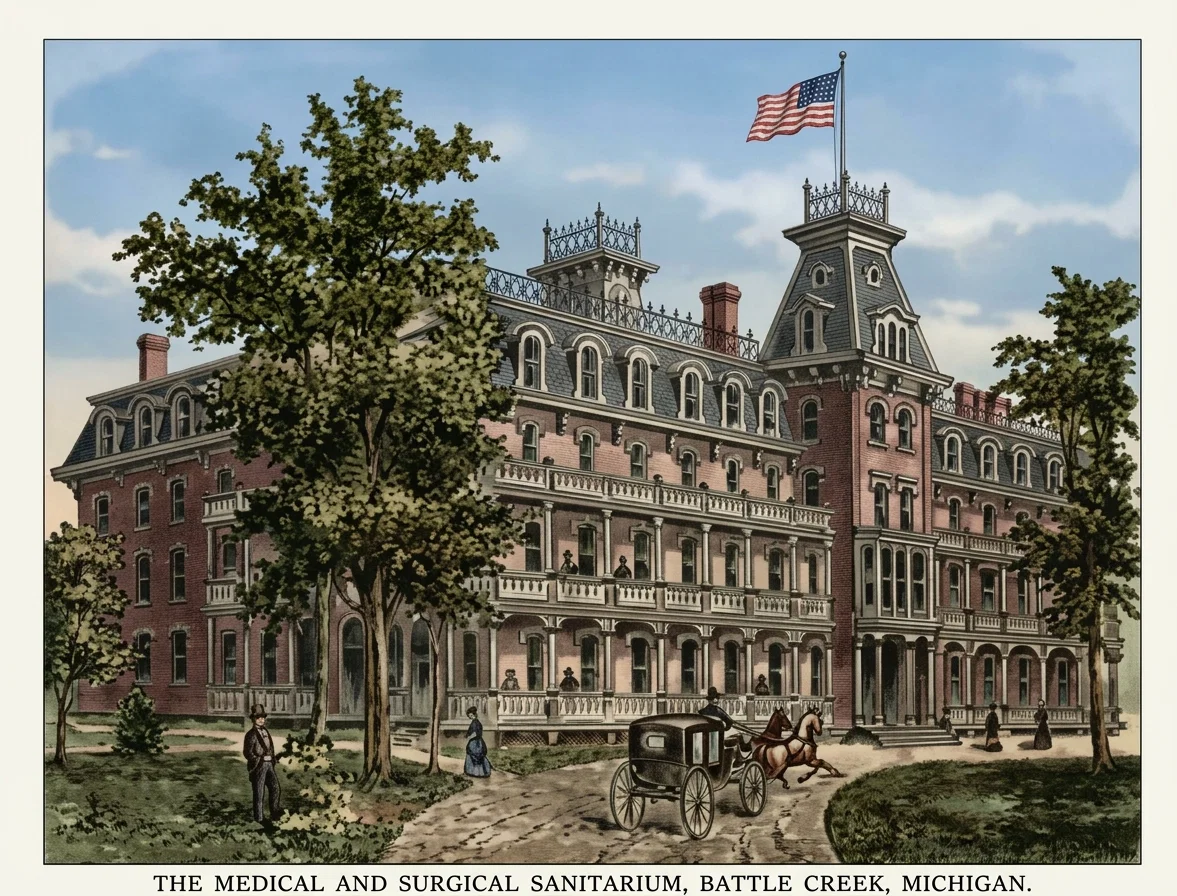
MEDICAL AND SURGICAL SANITARIUM,
By John Harvey Kellogg
Battle Creek, Michigan.
This institution, beautifully located in one of the most healthful cities of Michigan, is everywhere recognized as the
GREAT SANITARIUM OF THE WEST.
More than 4,000 patients successfully treated. The erection of new buildings and the addition of all the most approved remedial appliances known to the profession, have made it The Most Complete Institution of the Kind in America. All modern hotel conveniences furnished. Terms very reasonable.
J. H. Kellogg, M. D., Medical Superintendent.
Address, SANITARIUM, Battle Creek, Mich.
Obituary
By Mrs. C. J. Hutchings
WILLARD.—Died in Mountain View, Cal., June 20, Ethel May, daughter of Julian D. and Lovina Willard, aged four months and seven days. After much suffering the fair little one fell asleep in Jesus to rest until the Life Giver comes. The bereaved mourn not as those that have no hope.
Sweetly sleeps our little one,
Guarded by the angels bright,
Till God's work on earth is done,
And we see the morning light.
Then shall angels bear thee home
To the mansions bright and fair,
Ne'er from loving arms to roam,
Then we hope to meet thee there.
Remarks at the grave by Bro. J. M. Loveland.
MRS. C. J. HUTCHINGS.
JUVENILE BOOKS.
The Sunshine Series. Stories for little ones, in ten small books, adapted to children from the ages of four to ten years. In glazed paper covers, 320 pp. 50 cts.
Golden Grain Series. A choice collection of instructive stories suited to the wants of children from eight to sixteen years and older, illustrated and beautifully bound in three volumes.
THE HARD WAY, 160 pp. 40 cts.
THE SCHOOL-BOY'S DINNER, 160 pp. 40 cts.
GRUMBLING TOMMY, 160 pp. 40 cts.
Golden Grains in Ten Pamphlets. The same reading as in the first two volumes, without pictures, in ten pamphlets of 32 pages each, 320 pp. 50 cts.
Sabbath Readings for the Home Circle. In three volumes, containing moral and religious reading for the household; carefully selected, and compiled for the use of Sabbath-school and family libraries. Each 60 cts.
The Child's Poems. Containing Little Will and other stories, teaching beautiful lessons of temperance and virtue. Bound in cloth and richly embossed in gold and black. 128 pp. 30 cts.
The Game of Life. Three lithographic illustrations with explanations. These scenes represent Satan playing a game with man for his soul. Neatly bound in board. 50 cts.
The Advent Keepsake. A collection of Bible texts for each day in the year, on the subjects of the Second Advent, the Resurrection, etc. Muslin, 136 pp. 25 cts.