The Youth’s Instructor, Vol. 30, No. 2.

BEGINNING THE NEW YEAR WELL

The Youth’s Instructor

Jan 11, 1882

S. D. A. Publishing Association · Battle Creek, Mich. · Jan 11, 1882

BEGINNING THE NEW YEAR WELL.

“Oh dear!” said Hortense Collins, “Thanksgiving and Christmas are over, and here it is New Year’s; so good-bye to all fun and nice times for a long while to come. I wish it could be Christmas the year round; don’t you, Nellie?”
“No, cousin. I don’t believe I can say yes to that. The fact is, there is so much excitement about it that one hardly has time for proper thought or reading. Indeed, I nearly always feel, after it is over, that I have lost something, somehow, I cannot tell how.”
“Lost? I am sure we always gain. Only think how many presents we got this year, and in some cases we have even several of the same kind.”
“Yes; but I don’t mean in that way, cousin. To speak plainly, I always seem to lose in my Christian life. I know the fault is mine, and it should not be so; but that does not change the fact.”
“How soberly you talk, Nellie, just as if one couldn’t be a Christian as well at Christmas as at any time—a queer theory, I think.”
“That is so, cousin, while we are professing to celebrate our Saviour’s birth, to think of him and love him less. I have been trying this year to study into it, so as to see if I cannot have it different another time. I have been weighing it ever since Christmas—for a whole week—now shall I give you the conclusions I have arrived at?”
“Certainly,” said Hortense, “for to speak truthfully, as you have to me, I must admit that my interest in the prayer-meetings and even my Sabbath-school lessons is less, and I find myself hurrying through my prayers as I have never before done since I felt that Jesus accepted me as his child; and I believe that to be one reason why I feel so discontented that the festivities of the last few weeks are over, and have such a thirsting for more of the excitement that came with them.”
“Well, I will tell you, Hortie, what I believe is the secret of the thing. I think we are too selfish in our holiday amusements; we think too much of what we shall receive and too little of what we may do to make others happy. Then we read too little, pray too little, and spend too much time on our poor, little selfish selves; what say you to that?”
“I say that I believe you are more than half right, Nellie.”
“It does look reasonable,” replied Hortense, “that the proper and true way to celebrate the birthday of our Lord is to do good to others, forgetting self; then I believe we shall more truly appreciate the good things that He, through our kind friends, gives to us.”
“But after all,” said Nellie, “what good will it do us to learn our mistakes and see where we have failed, if we do not try to rectify them? Christmas will not come again for nearly a year, and I fear our good purposes will be forgotten by that time.”
“The poor ye have always with you,” said Hortense, “and when we will, we may do them good! This is the first day of the new year. Let us begin it aright. In the first place I rushed through my morning devotions, and I am going back to my room; go with me, cousin; let us begin together again, as we did when we first took Jesus for our friend.”
An hour later they returned with smiling faces, prepared to carry some of their outgrown garments to a poor girl who was sadly in need of them.
Then they gathered from their Christmas gifts several articles of which they had duplicates, and sent them to some schoolmates who had received nothing of any account for Christmas, because of the poverty of their homes.
After this, they carried a basket of provisions to the lonely cottage of a poor woman who lived by herself, but who suffered so from rheumatism that she was often unable to rise from her bed. There Hortense and Nellie passed the afternoon, sweeping, dusting, mending, and reading to her.
Some of you may think that this was very dull and uninteresting work, but, as they returned home, they were both heard to say, in almost the same breath, “What a nice day this has been;” and Hortense added, “This would indeed verify the wishes of our friends by being ‘a happy new year,’ if every day of it should be as happy as this.”
“That is so,” said Nellie, “and why shouldn’t they be, if we begin them by asking our Heavenly Father to help us make them so by doing good to others?”
“I think they may; after all, I believe those are the happiest who make others happy, instead of those who try the hardest to be happy themselves.”
Would that everybody might learn this golden rule of happiness!—Little Star.

THE FRIENDLY TERNS.

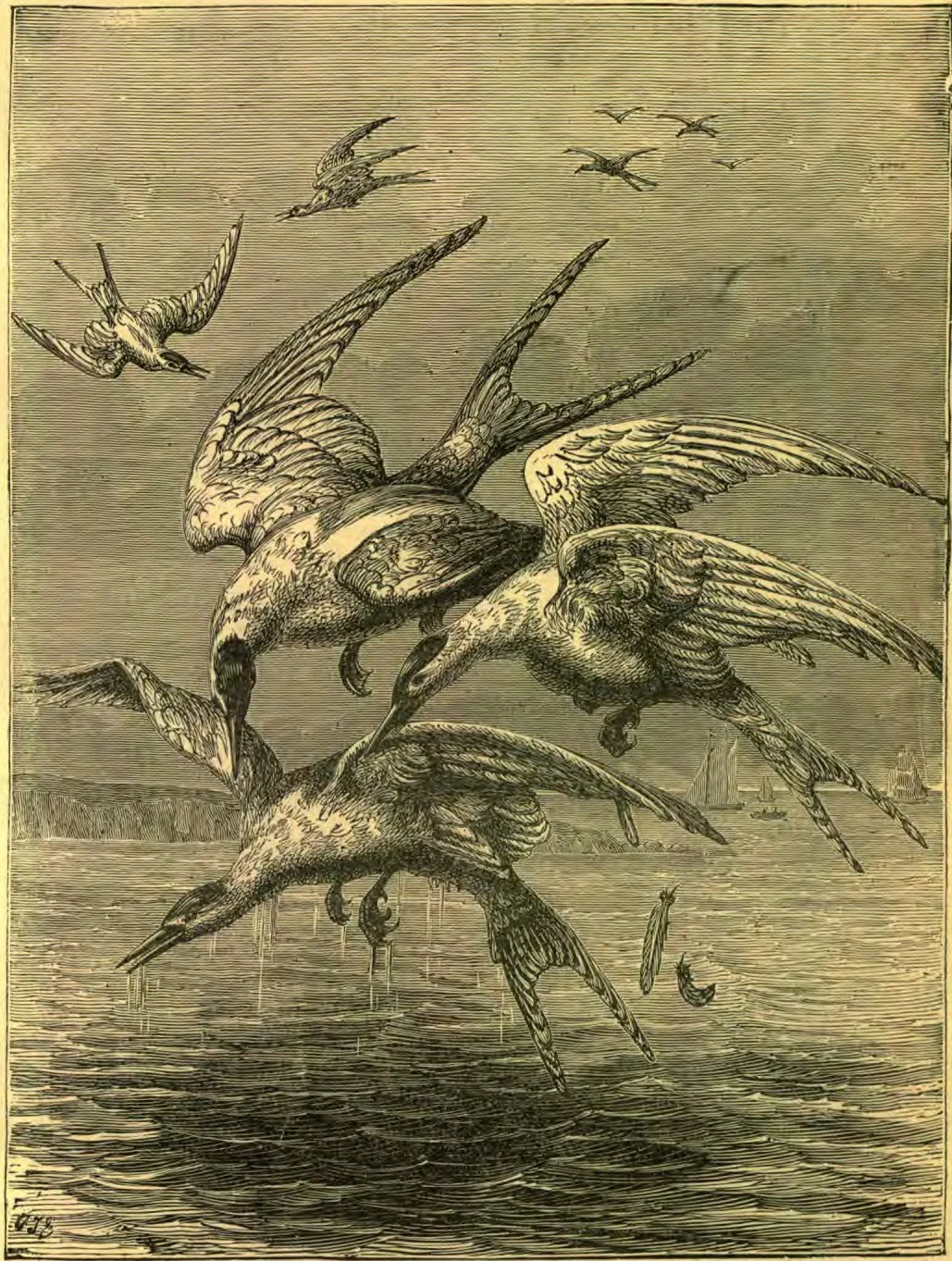
ONE day Mr. Edwards, the Scotch naturalist, shot at a Tern, hoping to secure the beautiful creature as a specimen. The ball broke the bird’s wing, and he fell screaming down to the water. His cries brought other Terns to the rescue, and with pitiful screams they flew to the spot where the naturalist stood, while the tide drifted their wounded brother toward the shore. But before Mr. Edwards could secure his prize, he observed, to his astonishment, that two of the Terns had flown to the water, and were gently lifting up their suffering companion, one taking hold of either wing. But their burden was rather heavy; so, after carrying it seaward about six or seven yards, they let it down, and two more came, picked it up, and carried it a little further. By relieving each other in this way, they managed to reach a rock, where they thought they would be safe.
But Mr. Edwards did not approve of losing his specimen in this way, and made for the rock. He was soon discovered by the watchful Terns, who now surrounded the rock in great numbers, and, with screams and cries, once more bore away their disabled friend right out to sea. Mr. Edwards might have prevented them if he had tried; but he had too warm an admiration for the brotherly kindness of the birds, who, as he says, exhibited “an instance of mercy and affection which man himself need not be ashamed to imitate.” Indeed, he was rather glad of the disappointment which had given him the opportunity of witnessing this remarkable scene of sympathy and brotherly love.

SLIPPING AWAY.

THEY are slipping away—these sweet, swift years, Like a leaf on the current cast; With never a break in the rapid flow, We watch them, as one by one they go Into the beautiful past.
As silent and swift as a weaver’s thread, Or an arrow’s flying gleam; As soft as the languorous breezes hid, That light the willow’s long golden lid, And ripple the glassy stream.
As light as the breath of the thistle-down, As fond as a maiden’s dream; As pure as the flush in the sea-shell’s throat, As sweet as the wood-bird’s wooing note, So tender and dear they seem.
One after another we see them pass, Down the dim-lighted stair; We hear the sound of their heavy tread, In the steps of the centuries long since dead, As beautiful and fair.
There are only a few years left to love; Shall we waste them in idle strife? Shall we trample under our ruthless feet, Those beautiful blossoms, rare and sweet, By the dusky way of life?
There are only a few swift years—ah! let No envious taunts be heard; Make life’s fair pattern of rare design, And fill up the measure with love’s sweet wine, But never an angry word. —Selected.

ENGLAND UNDER WILLIAM THE CONQUERER.

William was a man of gigantic form, terrible strength, savage countenance, and desperate bravery. His revenge on his foes was cruel. His enemies confessed that no knight was his equal. When he at one time conquered the town of Alençon, he tore out the eyes of his prisoners and cut off their hands and feet and threw them into the town. He was a great lover of the deer, and delighted in hunting. Before his coming, the people of England could hunt game and kill it for their own. When the Normans came, they would not allow any one but themselves or Saxon noblemen to hunt and kill wild animals. If a poor person killed one, they put out his eyes, or cut off his hand, or compelled him to pay a great sum of money. This they called “The forest law.”
William turned the people out of a great many villages in Hampshire, pulled down their houses, and spoilt their gardens, to make a great forest for himself and the Norman barons to hunt in. That large portion of this county still remains a forest. It is about eight or ten miles from Southampton, and is still called “The New Forest.” He also took away from the Saxon earls and thanes (lords) houses and lands, and gave them to Norman noblemen, who were called barons.
Instead of having a paid army, as England now has, William required these barons, in return for his gifts, to come with their servants to join him whenever he engaged in war.
The lands thus given to these barons were called feuds, and the king was called their feudal lord. If any one of these barons had a larger amount of land than he could care for himself, he parcelled it out to gentlemen. These were also called feuds, and the baron was feudal lord of these smaller barons. When the great barons received the land from the king, or the lesser ones from the great barons, each fell before his lord, kissed his hand, and promised to serve him.
With all the enactments of William there was one thing that he would not allow: no papal letters could be received within his realm save by his special permission. While Gregory VII., the Hildebrand of history, was striking terror everywhere with his decrees, William was the one ruler who dared to repudiate his claim.
There was one great difficulty which was experienced in England after the Norman conquest. It was this: All the Normans spoke French, and the English spoke the old Saxon language. It was difficult for them to understand one another. By degrees the English learned some of the French, and the French learned some of the Saxon; and so they mixed the two languages more or less together, and produced what is now called the English language.
When the Normans came over, they laughed at the long, low, wooden houses of the Saxons. These houses had a place for fire in the middle of the room, with a hole for smoke to escape in the top of the house. The Normans built castles and houses of stone like those in their own country, with a fire-place in one side, and a chimney. This was certainly a great addition to their comfort.
J. N. LOUGHBOROUGH.

Self-Importance and the Danger of Being Forgotten

He who thinks too much of himself will be in danger of being forgotten by the world.

THE SNOW-FLAKE.

PRETTY little snow-flake, floating swiftly by, Bringest thou a message from the fleecy sky!
Yes, oh yes! a lesson beautiful as true; Silent be, but busy, when you've work to do.
Avalanche and snow-drifts grow from single flakes, Every crystal helping, yet no noise it makes.
Glittering little snow-flakes, white as white can be, How can I be spotless, pure, and white like thee?
All that comes from Heaven, perfect is, like God; But, alas! the sinner, earthly ways has trod;
Yet to God returning, thence anew to grow, Sins, though they be scarlet, shall be white as snow.
Loving little snow-flake, tender is thy tread, Weaving o'er the flowers, dainty coverlet.
Loving work is ever best when gently done; All that's hard and selfish, rough or cruel, shun;
Do each little duty with a smiling face, Gather all around you in love's warm embrace.

WORDS THAT STAIN.

A small brush of camel's hair had been dipped into a fluid in which was some nitrate of silver, or “caustic” as it is sometimes called. The brush was wiped upon a white sheet. Pretty soon there appeared a black stain upon the white surface. It did not look very dark at first; but the action of the light seemed to deepen the color until it was an ugly spot that could not be washed out nor bleached out in a whole summer.
A bright lad heard a vile word and an impure story. He thought them over. They became fixed in his memory; and they left a stain which could not be washed out by all the waters of this great round earth.
Do not allow yourself to listen to vile, “smutty” stories, or unclean words. There are persons who seem to take an evil delight in repeating such things. And those who willingly listen to them receive a stain upon their memory. To give ear to filthy talkers is to share their sin. Do not lend your ears to be filled or defiled with shameful words and vile stories.
In these days of evil speech and of bad books it is our duty to care what we listen to and what we read. A vile story smirches and defiles the heart, pollutes the memory, and inflames the fancy.

NEW YEAR RESOLUTIONS.

On the last day of the old year we are quite apt to make good resolutions for the new year which is to come. We promise ourselves that we will improve our time better, that we will be prompt and faithful in every little duty, whether at home or at school; we promise to be more patient with others, to speak no unkind words, even though we are sorely vexed, to take more pains to comfort the tired, the lonely, and the sad ones around us—in short, to be less selfish, and to strive hard each day to become more like our great Pattern.
For a few days or weeks we remember these resolutions, but, too often, before the year is past, we have almost forgotten them; and when the last day of the year comes, and we look back over our life, we feel very much dissatisfied with ourselves, and ashamed of our neglect. Sometimes, then, we think, “I will never make another resolution; I shall break it if I do.” But this is not the best way to look at it. The very fact that we break these resolutions ought to show us that we need to make them, and, too, that we need special help in keeping them.
Now there is One who can and will, if we ask him earnestly, help us to keep all our pledges and good resolutions. Let us look to him for assistance, and then we may safely resolve to do better than ever before, during the new year upon whose threshold we now stand.
E. B.

Words of Comfort from Scripture

Everybody needs words of comfort at one time or another. The youngest child is old enough to cry. The oldest person finds it hard to keep the tears back always. There are no words like Bible words. If you want to help any one in sorrow, you can best do so by finding words in the Bible that suit his case.

SCENES IN THE LIFE OF CHRIST.

LESSON 51.—JESUS HEALS THE SYRO-PHOENICIAN WOMAN.

When the people who were with Jesus on the other side of the sea found that he had crossed over, they took boats and followed him. On finding him at Capernaum they said, “When camest thou hither?” Jesus, turning toward them, said, “Verily, verily, I say unto you, Ye seek me, not because ye saw the miracles, but because ye did eat of the loaves, and were filled. Labor not for the meat which perisheth, but for that meat which endureth unto everlasting life, which the Son of man shall give unto you.”
Then Jesus went on teaching many things that were so hard to believe that many of his disciples forsook him, and followed him no longer. “Then said Jesus unto the twelve, Will ye also go away? Then Simon Peter answered him, Lord, to whom shall we go? thou hast the words of eternal life. And we believe and are sure that thou art that Christ, the Son of the living God.”
“Then came to Jesus scribes and Pharisees, which were of Jerusalem, saying, Why do thy disciples transgress the tradition of the elders? for they wash not their hands when they eat bread. But he answered and said unto them, Why do ye also transgress the commandment of God by your tradition? For God commanded, saying, Honor thy father and mother; and, He that curseth father or mother, let him die the death. But ye say, Whosoever shall say to his father or his mother, It is a gift, by whatsoever thou mightest be profited by me; and honor not his father or his mother, he shall be free. Thus have ye made the commandment of God of none effect by your tradition. Ye hypocrites, well did Esaias prophesy of you, saying, This people draweth nigh unto me with their mouth, and honoreth me with their lips; but their heart is far from me. But in vain they do worship me, teaching for doctrines the commandments of men.”
Then our Lord went on to show that it is not what we eat that makes us bad, but that it is by our evil thoughts, words, and deeds that we make ourselves corrupt. “Then Jesus went thence, and departed into the coasts of Tyre and Sidon. And, behold, a woman of Canaan came out of the same coasts, and cried unto him, saying, Have mercy on me, O Lord, thou son of David; my daughter is grievously vexed with a devil. But he answered her not a word. And his disciples came and besought him, saying, Send her away; for she crieth after us. But he answered and said, I am not sent but unto the lost sheep of the house of Israel. Then came she and worshiped him, saying, Lord, help me. But he answered and said, It is not meet to take the children’s bread, and to cast it to dogs. And she said, Truth, Lord; yet the dogs eat of the crumbs which fall from their masters’ table. Then Jesus answered and said unto her, O woman, great is thy faith: be it unto thee even as thou wilt. And her daughter was made whole from that very hour.”

QUESTIONS.

1. When the people who were with Jesus on the other side of the sea found that he had crossed over, what did they do? John 6: 22-24.
2. Where did they find him? Verse 24.
3. What question did they ask him?
4. What motive did he say they had in following him?
5. What advice did he give them? Verse 27.
6. What does this seem to mean?—That we should not be so anxious to get food for this life as we are to get such a knowledge of God’s will as will enable us to gain eternal life in the world to come.
7. Who was ready to give them such instruction as would make them wise unto eternal life?
8. For what were many of these people most anxious,—to receive instruction, or to be fed?
9. How are we to gain a knowledge of God’s will?
10. How may we deserve the same reproof that Jesus gave to those who followed him across the sea?
11. What caused many of the disciples of Jesus to forsake him?
12. What did Jesus then say to the twelve? Verse 67.
13. Who answered the question?
14. What did he say?
15. Of what did these disciples feel certain?
16. Who at this time came to Jesus from Jerusalem? Matt. 15: 1.
17. What question did they ask?
18. What question did Jesus ask in return? Verse 3.
19. What commandment had they transgressed? Verse 4.
20. How had they broken this fifth commandment? Verses 5, 6.
21. What saying of Isaiah the prophet did Jesus apply to them? Verses 8, 9.
22. What did our Lord then go on to show?
23. To what place did Jesus next go? Verse 21.
24. Who came crying after him?
25. How did Jesus treat her?
26. What did the disciples do?
27. What did Jesus say to them?
28. What did the woman do just at this time?
29. What did Jesus say in answer to her humble prayer?
30. What reply did the woman make?
31. How did Jesus then address her?
32. What was the effect of his words?

NOTES.

It is a gift, etc.—The word gift, as here used, is from a Hebrew word meaning devoted or dedicated to God. The Jews had a way of thus dedicating their property to God for sacred uses. And they thought it right for a person who had set apart his means in this way to refuse to help his parents who might be in want, on the plea that his property was dedicated to God. Jesus tells them that in so doing they transgressed the commandment of God; for he had said, “Honor thy father and thy mother,” etc.
Tyre and Sidon.—These were cities of Phoenicia, situated on the Mediterranean sea-coast, north of Carmel. They were both very ancient cities, and were formerly very rich and prosperous. The coasts of Tyre and Sidon would be the country around these cities.
A woman of Canaan.—This woman is called, also, a Greek, a Syro-Phoenician by birth. Mark 7: 26. Anciently the whole land, including Tyre and Sidon, was in the possession of the Canaanites, and called Canaan. The Phoenicians were descended from the Canaanites. The country, including Tyre and Sidon, was called Phoenicia, or Syro-Phoenicia. That country was taken by the Greeks under Alexander the Great, and those cities, in the time of Christ, were Greek cities. This woman was therefore a Gentile, living under the Greek government, and probably speaking the Greek language. She was by birth a Syro-Phoenician—born in that country—and descended, therefore, from the ancient Canaanites.—Barnes.
It is not meet, etc.—That is, it is not fit or proper.

NEW-TESTAMENT HISTORY.

LESSON 64.—WARNINGS AND INSTRUCTIONS.

In our last lesson Jesus was reproving the Pharisees and lawyers. While exposing their hypocrisy, he said, “Woe unto you, scribes and Pharisees, hypocrites! for ye compass sea and land to make one proselyte, and when he is made, ye make him twofold more the child of hell than yourselves. Woe unto you, ye blind guides, which say, Whosoever shall swear by the temple, it is nothing; but whosoever shall swear by the gold of the temple, he is a debtor! Ye fools and blind; for whether is greater, the gold, or the temple that sanctifieth the gold? and, Whosoever shall swear by the altar, it is nothing; but whosoever sweareth by the gift that is upon it, he is guilty. Ye fools and blind; for whether is greater, the gift, or the altar that sanctifieth the gift? Whoso, therefore, shall swear by the altar, sweareth by it, and by all things thereon. And whoso shall swear by the temple, sweareth by it, and by him that dwelleth therein. And he that shall swear by heaven, sweareth by the throne of God, and by him that sitteth thereon.” “And as he said these things unto them, the scribes and the Pharisees began to urge him vehemently, and to provoke him to speak of many things: laying wait for him, and seeking to catch something out of his mouth, that they might accuse him.”
“In the meantime, when there were gathered together an innumerable multitude of people, insomuch that they trode one upon another, he began to say unto his disciples first of all, Beware ye of the leaven of the Pharisees, which is hypocrisy. For there is nothing covered, that shall not be revealed; neither hid, that shall not be known.” “What I tell you in darkness, that speak ye in light; and what ye hear in the ear, that preach ye upon the housetops. And fear not them which kill the body, but are not able to kill the soul; but rather fear him which is able to destroy both soul and body in hell. Are not two sparrows sold for a farthing? and one of them shall not fall on the ground without your Father. But the very hairs of your head are all numbered. Fear ye not therefore, ye are of more value than many sparrows. Whosoever, therefore, shall confess me before men, him will I confess also before my Father which is in heaven. But whosoever shall deny me before men, him will I also deny before my Father which is in heaven.”
“He that receiveth you receiveth me, and he that receiveth me receiveth him that sent me. He that receiveth a prophet in the name of a prophet shall receive a prophet’s reward; and he that receiveth a righteous man in the name of a righteous man shall receive a righteous man’s reward.” “But beware of men; for they will deliver you up to the councils, and they will scourge you in their synagogues; and ye shall be brought before governors and kings for my sake, for a testimony against them and the Gentiles. But when they deliver you up, take no thought how or what ye shall speak; for it shall be given you in that same hour what ye shall speak. For it is not ye that speak, but the Spirit of your Father which speaketh in you.”

QUESTIONS.

  1. What was the principal theme of the last lesson?
  2. While thus reproving the scribes and Pharisees, how did he address them? Matt. 23: 15.
  3. What did he say of their efforts to make proselytes?
  4. When they were successful, what was the effect upon the character of those whom they proselyted?
  5. How did he again address them? Verse 16.
  6. How did they manifest their blindness? Verses 16, 18.
  7. By what questions did he expose the weakness of their theory? Verses 17, 19.
  8. What statements did he then make? Verses 20-22.
  9. When Jesus said these things, what did the scribes and Pharisees do? Luke 11: 53.
  10. What was their motive in doing this? Verse 54.
  11. How well was the preaching of Jesus attended at this time? Luke 12: 1.
  12. Against what evil practice did Jesus warn his disciples?
  13. How did he show the folly of hypocrisy?
  14. What admonition did he give his disciples? Matt. 10: 26.
  15. How did he inspire them with boldness? Verse 28.
  16. How did he assure them of the protecting care of their Heavenly Father? Verses 29-31.
  17. What precious promise did he make to those who faithfully confess him before men?
  18. Is this confession to be made by words, or by deeds?—By both.
  19. What warning did he give to those who deny him? Verse 33.
  20. How can you prove from the Scripture that we may deny Christ by our actions, as well as by our deeds?
  21. In what way may Christians receive both Jesus and his Father? Verse 40.
  22. What rewards did Jesus promise? Verse 41.
  23. Why are the disciples to beware of men? Verse 17.
  24. Into what trying situations are the disciples to be brought? Verse 18.
  25. Why are they to be brought into such places?
  26. How are they instructed to behave in such times of peril?
  27. What assurance is given to encourage them? Verse 20.

NOTES.

Compass land and sea.—A proverbial expression, similar to ours, You leave no stone unturned; intimating that they did all in their power to gain converts, not to God but to their sect.—Clarke.
Proselyte.—One that comes over from a foreign nation, religion, or sect, to us—a convert.
Twofold more the child of hell.—That is, twice as bad. To be a child of hell was a Hebrew phrase, signifying to be deserving of hell, to be awfully wicked.—Barnes.
The lawyers.—This does not mean those who practiced law, as among us, but men skilled or learned in the law of Moses. It is not known in what way the lawyers differed from the scribes, or whether they were Pharisees or Sadducees.

THE BOOK OF THE NEW YEAR.

THE book of the New Year is opened, Its pages are spotless and new; And so, as each leaflet is turning, Dear children, beware what you do!
Let never a bad thought be cherished, Keep the tongue from a whisper of guile, And see that your faces are windows, Through which a sweet spirit shall smile.
And weave for your souls the fair garments Of honor, and beauty, and truth, Which will still with a glory unfold you, When faded the spell of your youth.
And now with the new book endeavor To write its white pages with care; Each day is a leaflet, remember, That is written, then turned—beware!
And if on a page you discover At evening a blot or a scrawl, Kneel quickly and ask the dear Saviour In mercy to cover it all.
So when the strange book shall be finished, And clasped by the angel so tight, You may feel, though the work be imperfect, You have earnestly tried for the right.
And think, how the years are the stairway On which you must climb to the skies; And strive that your standing be higher, As each one away from you flies.
—Emily J. Bugbee.

THE COTTON PLANT.

Lena sat in her little chair holding her doll, and telling it a fairy tale which her aunt had told her the day before.
“Why don’t you say it’s a pretty story, Mamie?” said Lena to her dollie. Then throwing it down, she said, “You are nothing but paper; you don’t know anything,” and ran away into her aunt’s room.
“Dear me! I wish I had a real live doll—one that can hear when I talk to her,” said Lena.
Her aunt saw that her little niece needed something to think about, and she asked her of what her doll was made. Lena said that one was made of paper and the other of rags. Her aunt then asked what rags are made of, and Lena, thinking she knew very well, said, “Of old clothes and things.”
Lena had on a pink and white muslin dress, and her aunt asked if she could tell of what her dress was made.
“Cotton,” says Lena.
“Tell me all you know about cotton, how it grows, and how it is used,” said Aunt Belle.
“I don’t know much about it. Uncle John said that when he was South, he saw some field hands picking it and sending it to market. Afterward it is made into cloth,” said Lena.
“Sit down, and I will tell you more about cotton. Girls and boys should know of what their clothes are made.”
Lena drew her chair close to her aunt, and listened attentively, for Aunt Belle is a good talker, and always interests the children.
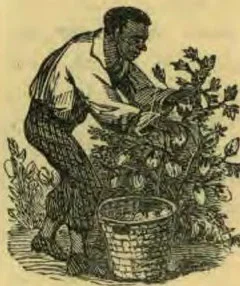
“Cotton,” she began, “grows from a seed. You have seen seed put into the ground, and after a few days of sunshine and moisture a little stalk shoots up. This grows very fast, putting out little twigs and downy-covered leaves. Finally, little flower-buds begin to swell, and in a few days a yellow or dull purple blossom unfolds. The shrub is quite pretty as well as useful. It is not placed in the flower garden for ornament, but out in a field with thousands of others, where it ripens into fruit—not fit to eat, not delicious, juicy fruit, but white dry cotton shreds, very fine, so fine that to see how they look one must put them into water, and look through a microscope; then they see very fine, ribbon-like hairs, in clusters, and these fill the little pods—or capsules, as botanists call them—so full that they burst open, showing their snowy white fruit-cotton. This is picked off and gathered into large bundles and sent away to be made into cloth. If you were to visit Lowell, Holyoke, or any large town, you would find mills with machinery for working up these little hairy ribbons into thread, paper, and cloth. Large quantities of cotton grow in the Southern States, and it is sent North, and into England and other countries. It grows in Egypt, India, and Africa, where the climate is hot. Cotton grew many hundreds of years before men became skillful enough to make it useful.”
“I should like to see cotton growing,” said Lena. “I wonder how men ever learned to make it into paper and cloth.”
“You know, Lena, that God puts all knowledge into the minds of men, and all the good into their hearts. You may some time go South and see the cotton fields; and when you learn how it grows, and think how wonderfully God has supplied our wants by showing men how to make this little plant useful, you will love God and worship him more fully than ever,” said Aunt Belle.—Zion’s Herald.

THE READY HAND.

A SABBATH-SCHOOL teacher was out looking up an absent scholar. With neatly clad feet she was picking her way over the muddy crossing. Just before her was a young girl, carrying a pail of water. A blast of wind swept around the corner, and snatching her shawl from her shoulders, held it fluttering behind her. She set down her pail at the curbstone, to wrap it again about her. The lady behind her reached out her hand and laid it over her shoulder, saying kindly, “Wait a moment, and I will find you a pin.”
As the search went on, in a free, pleasant way she said, “As I came on behind you just now, something made me think of a woman who went to draw water from a well, nearly two thousand years ago, and found something very precious there.”
The pin was found, and the kid-covered hands were put out to gather together the edges of the faded shawl. The pale face of the girl was lifted in amazement to the pleasant countenance so near her own, but the kind voice went on; “I have a beautiful card at home with the picture and story upon it. Will you tell me where you live, and let me bring it to you when I come this way next week?”
“Yes, miss,” said the girl, in a timid voice giving her name and number.
“Very well; I shall not forget you, but will certainly bring it to you the next time I come.”
The girl carried the water into the house, with a flush upon her cheek and a flutter of joy in her heart. There was but little in her hard life to make it bright or pleasant, but this thoughtful act and kind word and promise of the lady seemed to create a little rill of joy, which flowed through her heart, and made the week until the promise was fulfilled quite unlike the ordinary weeks of her life. Nor did the week end it, for her wonder at what the story might be, proved a good preparation of the heart to receive it. Like the woman of Samaria, she, too, longed to draw water from this wonderful well, and the lady, in lessons of kind and patient instruction, at length led her to the “fountain opened for sin and uncleanness.”
How rich was the harvest of her “little deed of kindness, her little words of love!” Did she think when she scattered those tiny seeds that she should reap pearls so soon? We do not think she even thought of the harvest; her heart was so full of loving-kindness that it could not but express itself thus. If the heart be full of love, the lips will be ready with loving words, and the hand with kind deeds and generous gifts,—Christian at Work.

YE HAVE DONE IT UNTO ME.

Two young girls were walking leisurely home from school one pleasant day in early autumn, when one thus addressed the other:—
“Edith Willis, what will the girls say when they hear that you have invited Maggie Kelley to your party?”
Edith was silent for a moment, and then, raising her soft blue eyes to those of her companion, she replied:—
“Ella, when mamma told me to invite Maggie, I asked her the same question. She told me that it made no difference what the girls said who thought Maggie quite beneath them because she was poor, and her school bills were paid by my father; and she asked me if I would like to hear what Jesus would say. So she took her Bible and read to me these words: ‘And the King shall answer and say unto them, Inasmuch as ye have done it unto one of the least of these my brethren, ye have done it unto me.’”
Continue reading: LETTER BUDGET