Your ShelfYour Projects

Signs of the Times, Vol. 23, No. 3.

Gentleness Divine.—

Signs of the Times

Jan 21, 1897

Pacific Press Publishing Company · Oakland, California · Jan 21, 1897

Gentleness Divine.—

Editorial

Gentleness Divine.—
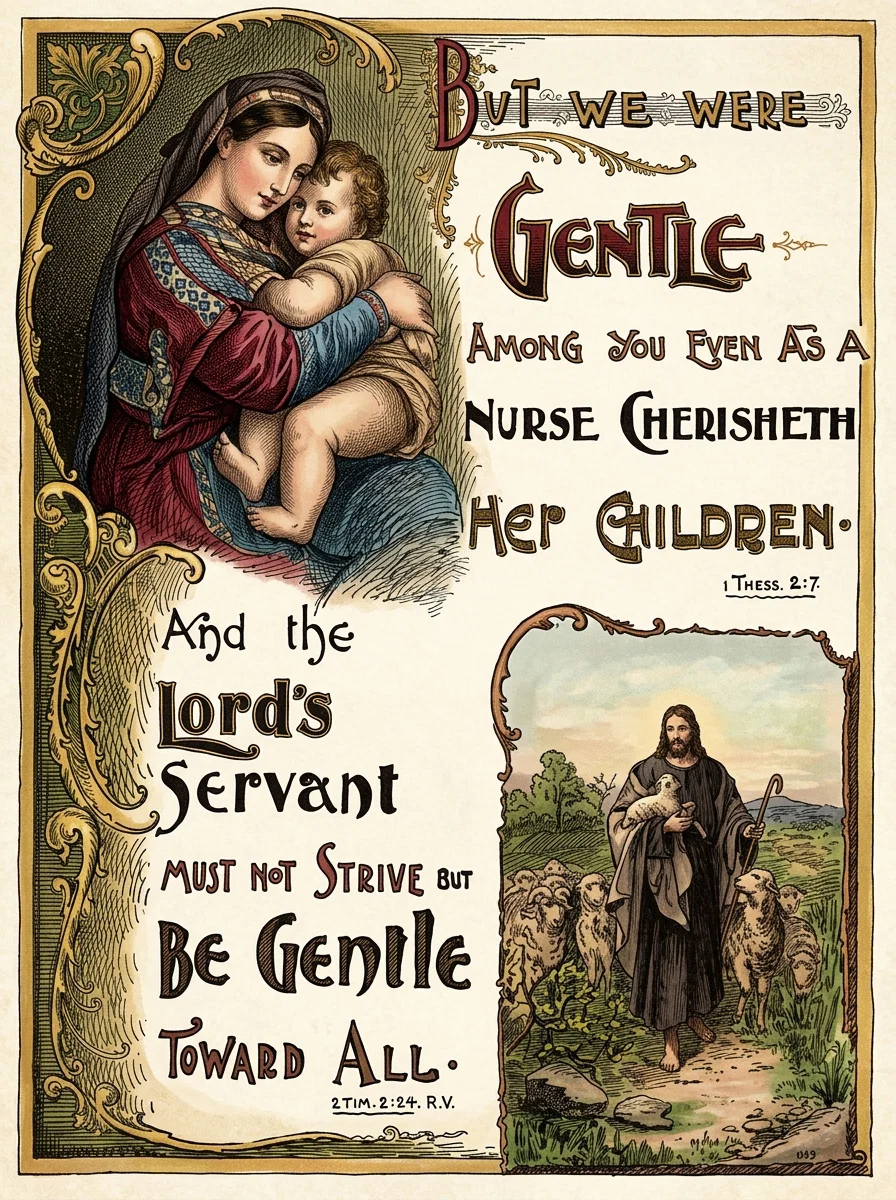
The fifth fruit of the Spirit named in Gal. 5:22, 23, is “gentleness”—in the Revised Version, “kindness.” “The fruit of the Spirit is love, joy, peace, long-suffering, gentleness.” Gentleness is “softness or sweetness of disposition,” not only under favorable conditions, but unfavorable. It must be considered in connection with long-suffering; for the test of true gentleness is the condition indicated by long-suffering.

Goodness, Kindness.—

The original word is defined to mean “usefulness, moral excellence, gentleness, goodness, kindness.” It means more than mere mildness. Mildness may indicate an almost entire want of spirit, or indifference. Mildness may refer to the mere outward manifestation. Some persons may be mild or kind through fear. The tiger is tamed in the same way. Others may be kind and courteous because “it pays” in a business way. But true gentleness, or loving-kindness, springs from within. It is the fruit of love, the acting out of the desire to minister to others. As it is born of the Spirit of God, it is divine. As Dr. James Hamilton has truly said:—
It is love holding intercourse with those around it. It is that quiet influence which, like the scented flame of an alabaster lamp, fills many a home with light, and warmth, and fragrance altogether. It is the carpet, soft and deep, which, while it suffuses a look of ample comfort, deadens many a creaking sound. It is the curtain, which from many a beloved form wards off at once the summer’s glow and the winter’s wind. It is the pillow, upon which sickness lays its head and forgets half its misery. . . . It is considerateness. It is tenderness of feeling. It is warmth of affection. It is promptitude of sympathy. It is love in all its depths and all its delicacy. It is everything included in that matchless grace, the gentleness of Christ.

Not Weakness.—

Gentleness is not indicative of weakness, although many act as if they so regarded it. There are many boys, youth, and men who would quickly and strongly resent it if they were told they were not gentlemen; and yet they would scorn to be called gentle men. But gentlemen means gentle men, men who are gentle. It does not imply weakness; it is, when exercised under strong provocation, the evidence of strongest self-control—self-control for love’s sake. The heart in which it dwells comprehends more than the momentary insult, the quick word, the unlovely display of human nature on the part of him or them who offered the provocation; it sees human souls at stake, eternity of loss or gain, and it is gentle for sake of the soul that does the wrong. Gentleness is founded on the strong principle, born of the Spirit of God, of love to men. There were or are none stronger than Christ, and none so infinitely gentle.

Gentleness Is Considerate.—

It considers the case of the one with whom we have to do. It puts ourselves in his place. This is what Christ did. He put himself in the sinner’s place, met all his temptations, bore all his infirmities, with the infinite strength and patience of divine love; and hence he sympathizes with all suffering humanity, and is gentle toward all. It was when we were in sin that the gentleness of God won us. “For we ourselves also were sometimes foolish, disobedient, deceived, serving divers lusts and pleasures, living in malice and envy, hateful, and hating one another. But after that the kindness [gentleness] and love of God our Saviour toward man appeared.” Titus 3:3, 4. So of old God cared for his people even as an eagle cares for her young; and even when they in their sinning refused his care, “his soul was grieved for the misery of Israel.” “In all their afflictions, he was afflicted.” And so it is that an apostle beseeches us by one of the strongest appeals to our gratitude,—“by the meekness and gentleness of Christ,”—the gentleness of the mightiest, for all power is in him.

Be Gentle.—

And so also it is that the minister of God is exhorted not to strive, “but be gentle unto all, apt to teach, patient;” “to be no brawlers, but gentle, shewing all meekness unto all men.” Another apostle tells us that “the wisdom that is from above is first pure, then peaceable, gentle, and easy to be entreated, full of mercy and good fruits, without partiality, and without hypocrisy.” O, for more of the meekness and gentleness of Christ in these days of selfish hurry, bustle, care, worry, and misery! It would win to Christ more lost souls than all the argument, theology, traditions, rituals, pomp, or numbers. Kindness, gentleness, will open a heart closed to all things else. It will awaken love when all else finds love dead. It is love’s most mighty weapon in the Christian’s mission to fallen man. But man is not to depend on expecting it from others, but from God; and he is to give freely to others, hoping for nothing. Thus shall he be able to say with one of old, “Thy gentleness hath made me great.” Thank God, there is gentleness for all in Christ Jesus. Letting Christ abide in the heart, the ungentle will become gentle, the harsh mild, the rude courteous, the unloving, hating, and harsh disposition loving, and kind, and tender. Ask for his Spirit; he is willing to give it. Receive it, submit to its blessed will, and it will bear its own fruit.

POWER AND FREEDOM.

Power belongs to the Lord alone. It is not safe to trust men with power. When men have power and use it they always become tyrants. The Lord has all power, and in the thought of that is the most wonderful revelation of love, and kindness, and long-suffering, and freedom.
With absolutely all power, with the hearts of men in his hands, the Creator of men, living in the flesh and giving his life to us, so that we live upon his life, has never exercised his power over against our wills. Such is the Lord. Then no one who knows the Lord, and who yields to him and his power, will have anything of arbitrariness; there will be nothing savoring of force or compulsion in him. No man who knows the power of God, which is love, will try to compel others to agree with him; and of course no body of men who know the Lord will do so.
It is the Lord’s power that is to work in men. That power we see in all the visible creation. There is a mighty power there, as in vegetation; but no arbitrariness. That power will work its way out wherever there is an opening; but it works in quietness. That power has dwelt in us, yet never has it been exercised against our will. Can we conceive of any freedom greater than that? It is the freedom the Lord has guaranteed to men, and he himself will maintain it.
The very fact that the Lord has never compelled us to do anything, should show us that his will is not something against man. The Lord has revealed his will to us that we may choose it. His will is life and righteousness. When we choose that his will shall be done in us, then he will do it; for he has all power to work it. He “worketh all things after the counsel of his own will.” And when we give him the privilege, yielding our way to his way, our judgment to his judgment, altho he works in us, yet we are still free.
This is religious liberty, the liberty that is to be proclaimed to men. There are many who profess to know the Lord, who are zealous and sincere, who yet do not know the Lord, because they think he is pleased to have them dictate as to how people shall serve him. The only way this can be counteracted, as far as it ever will be, is to proclaim the Lord, and the freedom of the Lord, to everybody.
Those only can proclaim the freedom of the Lord, who know it. When we recognize the fact that the Lord has been with us all the years, and yet waiting, having all power, and yet refusing to use one particle of it against our will, we shall know what it is that the Lord wants to be proclaimed to men. And this message will be proclaimed in love, for that is the power of the Lord.
It is his power alone that is to be manifested. We stand where Christ stood: “I can of mine own self do nothing.” We can say: “His power is dwelling in me, because I am willing it shall. I am zealous of good works. I know his power is sufficient to work them. I have tried to manufacture them, and could not; now I yield to him, that he may work in me that which is good through Christ Jesus.”
Then it is his power working in us mightily, and that power will work only that which is persuasive and gentle. There will be no compulsion of others, and the man who knows the Lord will always be a free man. “With freedom hath the Lord made us free.” The Gospel proclaims liberty to the captive; let us exercise it, and enjoy it. E. J. W.

INCREASING UNION OF CHURCH AND STATE.

The New York Journal of December 27 gives an account of another instance of “judge-made law,” or judicial perversion of law, on account of religious prejudice. There is an organization of Orthodox Jews in New York called “Agudath Hakehiloth,” which recently decided to incorporate. This society was to hold its regular annual meeting on the second Sunday in January. Justice Roger A. Pryor refused to incorporate it, on the ground that such gatherings were a violation of a sacred custom of Christian law and tradition. The following is his decision as given in the New York Journal of December 27:—
I observe that the annual meeting of the proposed corporation is appointed to be held on the second Sunday of each January. It is not a religious corporation, and its annual meetings are for the performance of just such secular business as is transacted by other civil corporations. The question is not whether such meetings on Sundays are legal, but whether they should be approved by a justice of the Supreme Court. A thing may be lawful, and yet not laudable.
In the state of New York the Sabbath exists as a day of rest by the common law, and without the necessity of legislation to establish it, and may be protected from desecration by such laws as the Legislature, in its wisdom, may deem necessary to secure to the community the privilege of undisturbed worship, and to the day itself that outward respect and observance which may be deemed essential to the peace and good order of society, and to preserve religion and its ordinances from open reviling and contempt.
The Christian Sabbath is one of the civil institutions of the state; and the Legislature, for the purpose of promoting the moral and physical well-being of the people, and the peace, quiet, and good order of society, has authority to regulate its observance and prevent its desecration. The sanctity of the Christian sabbath is sanctioned and secured by repeated acts of legislation, extending from the colonial period to the present year, and as well by the impressive deliverances of the Court of Appeals.
As justice of the Supreme Court, I may not approve that which the immemorial and uniform policy of the state condemns. Although not explicitly stated, it is nevertheless an inference from the face of the certificate before me, that the members of the proposed congregation are of a race and religion by which not the first but the seventh day of the week is set apart for religious observance. The fact might be of decisive importance were a desecration of the holy day contemplated, but the act intended is an aggression upon the Christian sabbath. The law which scrupulously protects them in the observance of their ceremonial gives them no license, and I am sure they have no desire to affront the religious susceptibilities of others. True, to a prosecution for work or labor on the first day of the week, the defendant may plead that he uniformly keeps another day as holy, and does not labor on that day, and that such labor complained of did not disturb others in observing the first day of the week as holy, but otherwise the legislation of the state against profanation of the Christian sabbath, is operative and imperative upon all classes of the community.
Because the holding of corporate meetings on Sunday is contrary to the public policy of the state, if not to the letter of the law, I decline to approve this certificate.
This is a remarkable decision, even under the Dark Ages Sunday law of New York State. Here is a society of people who uniformly keep another day as holy time; they propose to hold their annual meeting on a Sunday, presumably because it will interfere less than any other day with their business intercourse with the world. Certainly it could not be said that their meeting could interfere with public or private worship any more than any church meeting. Judge Pryor’s refusal was not based upon the illegality of such a meeting.
His decision rests wholly on the unscriptural supposition that Sunday is sacred, and the utterly un-American assumptions that it is the duty and the right of the state to protect it. He ought to know, as every true Christian does know, that only God can make a day truly sacred or holy, and no legislature or court can protect “from desecration” that which is not sacred, or, for the matter of that, that which is sacred. If the day is truly holy, if it has been made holy by the Lord, no act of man can change its intrinsic character. Jesus was the “Holy One of God.” He was blasphemed by Jews, crucified by Romans, but his essential holiness was in no way affected. If Sunday is the Christian Sabbath by the authority of God, no act of man can change it; neither can any act of man prevent the desecration of that which is in itself moral, and which pertains to purpose and motive, rather than to outward act. Man may compel outward observance, which leads to hatred or hypocrisy, but never can he compel righteousness. The religion “preserved” by acts of legislature is formal, outward, dead. The religion of the Bible needs no such help. Macaulay has truly said:—
The ark of God was never taken till it was surrounded by the arms of its earthly defenders. In captivity, its sanctity was sufficient to vindicate it from insult, and to lay the hostile fiend prostrate on the threshold of its own temple. To such a system [Christianity] it can bring no addition of dignity or of strength that it is part and parcel of the common law. The whole history of Christianity shows that she is in far greater danger of being corrupted by the alliance of power than of being crushed by its opposition.—Essay on Southey’s Colloquies.
The whole of Judge Pryor’s decision is based upon the old traditional policy of the Dark Ages, of a union of Church and State, and which was interwoven into much of colonial legislation, and of which Sunday laws are a notable example.
The question, as we understand it, was not as to what day was selected by the society for its annual meeting, but as to whether it was entitled to incorporation. Judge Pryor arbitrarily decides that it could not be incorporated because it met on a day which he, and presumably a majority, considered religiously “holy.” The decision is certainly new and strange. Nothing could show more conclusively the effect which the religious clamor for Sunday laws is having, even upon the highest courts in the land. It will be but a little while at this rate before every vestige of right, even in the way of so-called toleration, is taken from every one but those who will support the Sunday. In an editorial the next day, the same paper remarks:—
This is a novel doctrine in a nation whose birth was due to a desire for religious liberty, and whose Constitution guarantees its citizens against interference with their personal liberty within the law.
This is another example of judge-made law, and its encroachment on the rights of the people, concerning which Samuel R. Taylor, Esq., in the New York Independent of Oct. 22, 1896, eloquently protested. It was at one time thought that there never would come a time when the Constitution of the United States, or the Congress of the United States, or the Legislatures of the various states, would enact laws which would virtually constitute a union of Church and State, with all its attendant evils, in this country, but we have not to wait for that. Our courts are anticipating our Legislatures. The Sunday-law people will have much better and more rapid results by clamoring in the ears of the courts than in the lobbies of the Legislatures.

THE GREATNESS OF HIS GENTLENESS.

In the words of Hosea the Lord says, “I will be as the dew unto Israel.” The figure conveys the idea of gentleness, refreshing, and strength. Fresh every evening, the dew wets the fields, and gives the reviving and strength which vegetation needs for the growth it must make with each day’s sun.
Thus it is with grace, and the mercies of the Lord. “They are new every morning.” There must be daily growth, and every day we must have the refreshing and reviving from the Lord. He reveals himself to the believing heart as gently and noiselessly as the dew distils upon the blade of grass; but there is strength in his mercies, that fortifies the soul in the stress of sin, and in the heat, “when the blast of the terrible ones is as a storm against the wall.”
There is so much lost to many because they are not content to rest daily in the Lord, and drink in of his quiet presence. When Job, in his time of affliction, spoke of the days of his strength, when he was eyes to the blind, and feet to the lame, and the blessing of him that was ready to perish came upon him, he said: “My root was spread out by the waters, and the dew lay all night upon my branch. My glory was fresh in me.” Chapter 29:19, 20. The message to every believer is, “Arise, shine; for thy light is come, and the glory of the Lord is risen upon thee.” This glory seen upon the Christian, as fresh and glistening as a dew-bespangled meadow in the morning sun, is the testimony of the Christian life.
The Lord often uses the figure of the dew and the rain to describe the nature of his word,—the word by which we are born again, and grow, and are sanctified. He says by Moses, “My doctrine shall drop as the rain, my speech shall distil as the dew, as the small rain upon the tender herb, and as the showers upon the grass.” Deut. 32:2. “For as the rain cometh down, . . . so shall my word be.” Isa. 55:10, 11.
It is a divinely appropriate simile. Faraday showed that there is stored in a dewdrop sufficient electric force to rend a rock. Each drop of dew or rain is bringing life and power into vegetation; and thus the force that would shatter the rock, if pent up, is working itself out in nourishing delicate tissues, and carrying the water of life to all animate creation.
So is God’s word. “No word from God shall be void of power,” said the angel to Mary; and the Lord says, “Is not my word . . . like a hammer that breaketh the rock in pieces?” The power of the word is the almighty power of God. And there is in it the same combination of power and gentleness, carried to an infinite degree. All the power is for the faint and the weary, and the word comes as a still small voice to the soul. In the heart of the believer it becomes a well of water springing up unto everlasting life. It is everlasting strength and everlasting consolation.
This mingling of gentleness and strength that is in the word, reproduces itself in those who take the word in its fulness. “I will be as the dew unto Israel; he shall grow as the lily, and cast forth his roots as Lebanon.” Hosea 14:5. The glory of the Lord is risen upon the believer, and he will reflect the beauty and the grace of Jesus’ character. In his meekness and humility, and divine beauty of soul, he was “the Lily of the valley;” and to those who take him he brings the same life that he lived. They are made partakers of the divine nature.
Then there is the infinite strength of his character, which he also shares with those who are his. The life, for beauty, is as the lily, but for strength, it casts forth its roots as the cedars of Lebanon. It is rooted and grounded in love, rooted and built up in him. The firmness and constancy of the character that is rooted in the word can not be shaken tho all the world is removed. It is a rare combination, this blending of consummate gentleness and grace with unflinching firmness and unyielding strength. It can only come as the gift of God.
The Lord works this in the believer; for it is his own way of dealing with his children. His providences may appear otherwise to the natural heart and eyes, but in the end every soul that is subdued wholly to God will recognize his infinite tenderness in all his ways. David’s was a rough and stirring school of instruction, but in the end he was able to say, “Thy gentleness hath made me great.” E. J. W.

A WRONG CONSCIENCE.

Apply It to the Sunday-Law Question.

THE Pacific Coast Endeavourer of January 7 gives utterance to the following excellent Gospel thoughts, thoughts which seem to us should meet the approval of every Christian:—
A gentleman made a remark the other day which forcefully put a truth we too often overlook. He said “many of the most cruel things that ever have been perpetrated have been done at the stern dictates of conscience.” How true, and yet how sad! Why is it men must be so stern and cruel? Nay! not must be, but are. There is no must be to wrong, and that harshness and cruelty are always wrong, there can be no question. God makes his rain to fall on the just and the unjust. Christ said to the harsh condemners of the wicked woman, “Let him that is without sin cast the first stone.” And I do not believe in limiting the meaning of these words to the general idea, viz., that let him who is without the same sin of which this woman is guilty, cast the first stone. Sin is sin, and one sin receives condemnation at God's hands as much as another. There may be no desire to be a drunkard in your life, but should you, therefore, cast a stone at the drunkard? What about your own sins? Unbrotherly, unforgiving, full of “thinking evil” of your brother, uncharitable, not a peacemaker, a gossiper, a slanderer, perhaps, who are you that you should cast a stone at a poor drunken wretch, who, maybe, is striving with untold agonies to free himself from his thraldom? No! let us remember we are all imperfect, all incomplete, all human. Let us remember that Christ’s plan is the plan of love and forgiveness. Did ever the harsh, stern doings of these men who say, and doubtless say truly, that they are driven by conscience, lead the sinner they persecuted into the fold of Christ?
The statement quoted above is absolutely true. All the religious persecutions of the world have been instigated and carried on through the dictates of a corrupted or uninstructed conscience, a conscience which assumed to be conscience for others. And, furthermore, the methods always adopted by such consciences have ever led to the use of physical force, a thing which in both its genius and operation is foreign to the Gospel of Christ. Christ came and died to win sinners. He lives to win sinners through those who represent him here. But whenever the church of Christ departs from that spirit, that object, that method, her conscience becomes perverted.
Now a principle is worthless unless it can be put in practice where it applies. Why not let these principles of the Endeavourer apply to the Sunday reform? Why not win the sinners? They can not be coerced into keeping even one duty enjoined of God; for all of God’s laws are spiritual. Force can only compel an unwilling outward conformity. Sunday laws, instigated oftentimes doubtless by “the stern dictates of conscience,” have never led “the sinner they persecuted into the fold of Christ.” Why not, brethren in the Endeavour cause, use Gospel methods in the Sunday reform? But if there is no Gospel for Sunday to which you can consistently appeal, why not leave the day to care for itself? Jesus said, “Every plant which my heavenly Father hath not planted, shall be rooted up.” If Sunday is of God, there is Gospel and grace to support it in the Gospel way; if it is not of God, let it go. Let Christians use Christ’s methods.

Question Corner

“Enquire, and make search, and ask diligently.”

No. 462. Marital Obligations—Payment of Debt.

If a woman's husband refuses to acknowledge her as wife, is she still obliged to fulfil her vows to him of love and obedience? Is the husband to the wife in the same conditions? Is a man obliged to pay a loan on a farm after the mortgage has taken the farm for the loan, and sold it for less than its value?
READER OF “SIGNS.”
It is almost impossible to reply to such questions as these; there are generally too many conditions involved. In general: (1) If all that can be done has been done to effect a reconciliation between husband and wife, and he still refuses to live with her, or acknowledge her as his wife, she certainly is released, in the nature of the case, from obedience to him, altho she is not free to marry or love another unless her husband violates his marriage vow by consorting with others. Fornication or adultery on the part of either husband or wife leaves the innocent party free to marry again, according to the Scriptures, and of course a legal separation is also necessary. See Matt. 5:32; 19:9; I Cor. 7:2, 10–16. (2) We do not know what the law is in your state. Presumably the farm was worth the amount of the mortgage, the security for the loan; but if it was not, the mortgage should be justly dealt with. It is right to do right always. Let the Christian put himself in the other man's place, and in the sight of God and his own conscience do to and by that man just as he would that that man should do by him if circumstances were reversed. Follow the Golden Rule. Do as Christ would have done.

No. 463. A Special Resurrection.

In Dan. 12:2 we read, “And many of them that sleep in the dust of the earth shall awake, some to everlasting life,” etc. Are not all the righteous, or those worthy of eternal life, raised at that time? And I supposed those mentioned in last clause were not raised until the thousand years were expired. Please explain.
S. G. H.
The text does not say all will rise, but “many,” “some” to life, “some” to shame. It evidently refers to a special resurrection, which will take place just before our Lord comes. Some of the preeminently righteous and some of the preeminently wicked will be raised to pass through the last plagues, and witness Christ in his coming. So it is said that when he comes all living upon the earth shall see him, and they also which pierced him. Rev. 1:7. For fuller explanation see comments on the text in “Thoughts on Daniel and the Revelation.”
No. 464. M. F. B., GLENBURN, CAL.: We can give you no further information concerning Marchand's Peroxide of Oxygen than is given in his advertisements. Inclose stamps and write to W. H. Maxson, M. D., St. Helena, Cal., or J. H. Kellogg, M.D., Battle Creek, Mich.

“YOUR REASONABLE SERVICE.”

“I BESEECH you therefore, brethren, by the mercies of God, that ye present your bodies a living sacrifice, holy, acceptable unto God, which is your reasonable service. And be not conformed to this world; but be ye transformed by the renewing of your mind, that ye may prove what is that good, and acceptable, and perfect, will of God.” We are not our own. By creation and by redemption we belong to God. The clay out of which we are formed is his production; and “hath not the potter power over the clay?” Not only this, but we have been bought with a price, even “with the precious blood of Christ.” The great Master Artist alone is the rightful owner of the work of his hands; and he has a claim on our willing service; “for in him we live, and move, and have our being.”
“The earth is the Lord’s, and the fulness thereof; the world, and they that dwell therein.” The cattle upon a thousand hills are his; all the gold and silver belong to him. He has made men the stewards of his goods. To some he has intrusted special talent; to others worldly possessions. All have some capacity of usefulness. These talents are given that they may be used to honor and glorify God. He claims our time; for it is his. Our strength should be used in his service; our intellect and our means should be given willingly to him.
God has not given men talents capriciously. He who knows all things, who is acquainted with each one, has given to every man his work. Those to whom he has intrusted much are not to boast, for what they possess is not their own; it is lent them on trial; and the greater the endowment, the greater the returns required. Day by day God is testing men, to see whether they will acknowledge him as the giver of all that they have. He watches to see whether they will prove themselves worthy of eternal riches. The use they make of their precious endowments, decides their destiny for eternity.
Of all the gifts that God has bestowed upon men, none is capable of being a greater blessing than the gift of speech. With the tongue we convince and persuade; with it we offer prayer and praise to God; and with it we tell others of the Redeemer’s love. God would have us consecrate this gift to his service, speaking only such words as will help those around us. And if Christ rules in our hearts, our words will reveal the purity, beauty, and fragrance of a character molded and fashioned by him. But if we are under the guidance of the enemy of all good, our words will echo his sentiments. Watch well your words. Consecrate your gift of speech to the Lord’s service; for he will one day require it at your hands.
Every one of us exerts an influence on those with whom we come in contact. This influence we have from God, and we are responsible for the way it is used. God designs that it shall tell on the side of right; but it rests with each one of us to decide whether our influence shall be pure and elevating, or whether it shall act as a poisonous malaria. Those who are partakers of the divine nature exert an influence that is Christlike. Holy angels attend them on their way, and all with whom they come in contact are helped and blessed. But those who do not receive Christ as their personal Saviour can not influence others for good. Whatever their station in life, they carry with them an influence that Satan uses in his service. Such lose all hope of eternal life themselves, and by their example lead others astray. Guard well your influence; it is “your reasonable service” to place it on the Lord’s side.
God also intrusts men with means, not to be used selfishly. He desires that his gifts be used to help those who need assistance. He gives men power to get wealth. He waters the earth with the dew of heaven and with the showers of refreshing rain. He gives the sunlight, which warms the earth, awakening to life the things of nature, and causing them to flourish and bear fruit. Is it too much for him to ask for a return of his own?
God permits misfortune to come to men, adversity to try them, in order that he may test those whom he has placed in more favorable circumstances. If his stewards are faithful, he declares them worthy to walk with him in white. But if they use his gifts solely for their own benefit, it will be said to them, “If therefore ye have not been faithful in the unrighteous mammon, who will commit to your care the true riches?”
Many, instead of consecrating their means to God’s service, look upon their money as their own, and say that they have a right to use it as they please. Like the inhabitants of the Noatic world, they use God’s gifts in their own service. Even some who profess to know and love the Lord do this. God has revealed his will to them. He has called upon them to surrender all that they have to him; but the love of the world has perverted their will, and hardened their hearts. They refuse to obey him to whom they owe all that they have. Regardless of his call, they clasp their treasures in their arms, forgetting that the Giver has any claim upon them. Thus the blessings given by God are turned into a curse, because a wrong use is made of them.
Christ understood the danger of the love of money; for he said, “How hard is it for them that trust in riches to enter into the kingdom of God!” He looked with sorrow upon the enthusiasm shown for the things that perish, and, lifting the curtain that veiled eternity from view, he declared, “Seek ye first the kingdom of God, and his righteousness.” “Lay not up for yourselves treasures upon earth, where moth and rust doth corrupt, and where thieves break through and steal; but lay up for yourselves treasures in heaven, where neither moth nor rust doth corrupt, and where thieves do not break through nor steal.”
To-day he calls upon us to give close attention to our eternal interests. He would have us subordinate every earthly interest to his service. “For what shall it profit a man,” he asks, “if he shall gain the whole world, and lose his own soul?”
God’s right to our service is measured by the infinite sacrifice he has made for our salvation. “Behold, what manner of love the Father hath bestowed upon us, that we should be called the sons of God.” For our sake Christ lived a life of sorrow and privation. He was pure and holy, yet on him was laid the iniquity of us all. He gave relief to the afflicted; yet he himself was “a man of sorrows, and acquainted with grief.” With a touch of his hand he healed the sick; yet he suffered grievous bodily pain. He cast out demons with a word, and delivered those bound by Satan’s temptations; yet temptations such as have never beset any man assailed him. He raised the dead by his power; yet he suffered the agony of a most terrible death.
All this Christ suffered for us. What are we giving him in return? He, the Majesty of heaven, submitted patiently to scorn and insult. Can we complain if the service of God requires patience and self-denial? He who laid the foundations of the world consented to become a servant for our sake; and with his own footsteps smoothed the rough path for our feet. Should we look upon any sacrifice as too great? Should we hesitate to render to God our reasonable service?
There is no religion in the enthronement of self. God asks us to be true to him, to trade upon the talents he has given us, that we may gain others. His will must be made our will in all things. Any departure from this standard degrades our moral nature. It may result in lifting us up, in enriching us, and in seating us beside princes; but in the eyes of God we are unclean and unholy. We have sold our birthright for selfish interest and gain, and in the books of heaven it is written of us, Weighed in the balances of the sanctuary, and found wanting.
But if we regard our talents as the Lord’s gifts, and use them in his service by showing compassion and love toward our fellow-men, we are channels through which God’s blessings flow to the world; and at the last great day we shall be greeted with the words, “Well done, good and faithful servant; thou hast been faithful over a few things, I will make thee ruler over many things; enter thou into the joy of thy Lord.”
Time, laden with precious, golden opportunities for serving the Lord, is fast passing into eternity. Dear reader, are you improving these opportunities as they pass? You can not afford to slight them; for you must stand before the judgment seat of God, to answer for the deeds done in the body. Do your words cheer and encourage those who come to you for help and comfort? Does your influence strengthen those with whom you associate? Are your possessions faithfully given to the Lord?
Consecrate yourself to-day to the Lord’s service. Remember how brief is the period of life allotted to you. Say not presumptuously, “To-day or to-morrow we will go into such a city, and continue there a year, and buy and sell, and get gain.” God may have different plans for you. You have no lease of life in which to carry out your own purposes. Life is but a vapor that “appeareth for a little time, and then vanisheth away.” You know not how soon your hand may lose its cunning, your step its firmness. Cast your care upon the Lord, and on no account allow the things of the world to separate you from him. Consecrate all you have and are to him. This is but “your reasonable service.” Do not delay; for there is peril in a moment’s delay. A few more years at the longest will be yours to work for the Master, and then the voice which you can not refuse to answer will be heard, saying, “Give an account of thy stewardship.”
MRS. E. G. WHITE.

RESIGNATION

God knoweth best. It is not meet That we should murmur at his will; 'Tis ours to "suffer and be still," Low lying at his feet.
He knoweth best. Our blinded eyes, So dim with unshed tears, can see No light athwart the gloom, till he Shall bid the clouds arise.
He knoweth best. We can not tell Why he doth sever tender ties, We only know that he is wise; He doeth all things well.
He knoweth best. And he will keep, The near or far, his watch between; His tender care, tho all unseen, "Shall slumber not, nor sleep."
He knoweth best. His love hath planned Each step that marks our onward way; 'Tis ours to trust him—come what may, "Our times are in his hand."
He knoweth best; he loveth best; He leadeth us from day to day; 'Tis ours to follow all the way, And leave to him the rest.
—Selected.
Continue reading: CHRIST AND THE SABBATH