The Youth’s Instructor, Vol. 32, No. 19.

THE SWAN

The Youth’s Instructor

May 7, 1884

S. D. A. Publishing Association · Battle Creek, Mich. · May 7, 1884

THE SWAN.

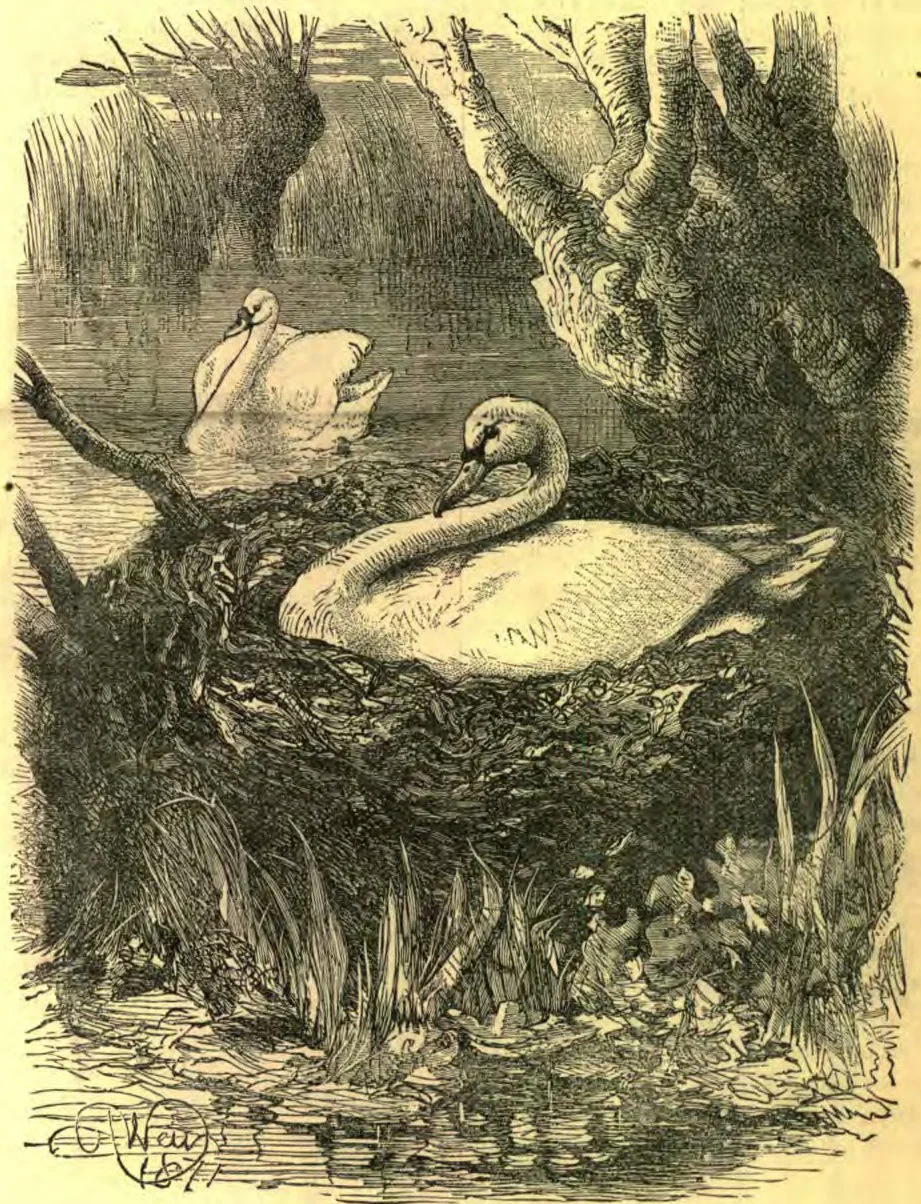
ONE of the most beautiful and graceful, as well as one of the largest of our water-birds is the swan. It is found nearly the round world over. In America it frequents the shores of Hudson’s Bay in the summer and early autumn; but at the approach of winter it migrates southward to the coasts of Delaware, Maryland, and Virginia. It is also found on our western rivers.
The body of the bird is generally five feet long, and it measures seven feet from tip to tip of its outstretched wings. It is very careful of its snowy white plumage, taking great pains to keep it free from dirt. Its nest is made of reeds and rushes, and is set in some secluded spot close by the bank of a river or pond. In building, it sometimes raises the nest one or two feet to keep it from inundation. It lays six or seven eggs of a dull green color, dashed with brown. When very young, the little swans mount their mother’s back, and are thus carried from place to place. They are a bluish gray, and do not don their beautiful white dress until nearly full-grown.
Swans live on vegetables, but they have sometimes been seen eating small fish. In feeding, they do not dive, as ducks frequently do, but simply put the head under water, often keeping it there from three to five minutes. They are very destructive to fish, following them to their spawning grounds, and greedily devouring their eggs. In this way they have sometimes almost wholly destroyed the fish in the stream or pond where they live.
In the old country the swan is considered the special property of the Crown, and no subject is permitted to own one of these birds unless he has a special grant. With each grant is attached a “swan mark,” cut in the bill of the bird, so as to show the right of the owner.
Swans always fly in a wedge-shaped flock, headed by a solitary leader. When they alight after a long flight, they do so at quite a distance from the shore, making a careful examination of their surroundings before venturing near the water.
Their favorite place of hunting for food is among little ponds not far inland. At nightfall they swim from one of these ponds to another, flying when necessary. The swan is quite a high flier; but as it is a heavy bird, it is with some difficulty that it gets under way. Hunters are aware of this fact, and so lay in wait near the inlet or outlet of the pond, or in some other place where it is difficult for the swan to swim, when, as it rises to fly, it becomes an easy prey.
A favorite method of hunting these birds is by using a boat. In the bow of the boat is placed a cage of burning pine knots. Behind this is stretched a screen to keep the light from the eyes of the hunters, who occupy the other part of the boat. At the stern sits the paddler, who quietly pushes the boat forward toward the game. Fascinated or bewildered by the bright light, the swans swim curiously toward it. But they discover their error, when, too late to remedy it, they fall victims to the rifle-shots of the boatmen. From this, “that other race, the human folk,” might learn a useful lesson.
It seems a pity that such innocent and beautiful creatures should be sacrificed to the marksman’s gun. Perhaps when people have learned that “what they shall eat” and “what they shall put on” is not all of life, we may hope that our feathered friends will be left unmolested. W. E. L.

GOD CARES FOR ME.

I sat in the door at eventide, My heart was full of fears; And I saw the landscape before me lie Through mists of burning tears. I thought to myself, The world is dark, No light nor joy I see; Nothing but toil and want is mine, And no one cares for me.
A sparrow was twittering at my feet, With its beautiful auburn head, And looked at me with dark, mild eyes, As it picked up crumbs of bread; And said to me, in words as plain As the words of a bird could be, “I'm only a sparrow, a worthless bird, But the dear Lord cares for me.”
A lily was growing beside the hedge, Beautiful, tall, and white And it shone through the glossy leaves of green, Like an angel clothed in light; And it said to me, as it waved its head In the breezes soft and free, “I'm only a lily, a useless flower, But the Master cares for me.”
Then it seemed that the hand of the loving Lord Over my head was laid, And he said to me, “O faithless child, Wherefore art thou dismayed? I clothe the lilies, I feed the birds, I see the sparrows fall; Nothing escapes my watchful eye, My kindness is over all.”
— Selected.

GREAT LONDON

FOREIGN TRAVELS.—NO. 5.

GREAT LONDON.

Two days were spent in London. That is but a little time in so large a place, and a portion of this was devoted to business. So we had little time to see the many wonderful things in it. London is almost a world of itself. It is of enormous size, containing four million people. It is about as large as any other two cities in the world. Take all the people in the great States of Michigan and Iowa, and put them into London, and also those of Vermont and New Hampshire, and all put together they only equal about the same number as the one city of London. Take the cities of New York, Chicago, St. Louis, Cincinnati, Boston, Washington, San Francisco, Buffalo, Baltimore, Louisville, and New Orleans, and all put together hardly equal London. It is the center of commerce, of finance, and of political influence for all the world. “There are in it more Scotchmen than in Edinburgh, more Irishmen than in Dublin, more Jews than in Palestine, and more Catholics than in Rome.” “In it are annually consumed 16,000,000 bushels of wheat, 400,000 oxen, 1,500,000 sheep, 130,000 calves, 250,000 swine, 8,000,000 head of poultry and game, 400,000,000 pounds of fish, 5,000,000 oysters, 1,200,000 lobsters, and 3,000,000 salmon.” About 6,500,000 tons of coal are consumed yearly.
The bank of England is a vast edifice, covering a whole block, or about four acres of ground. It is surrounded by a high, solid stone wall, with no windows, and is lighted artificially. It is the money center of the world. The amount of money negotiated in the bank on an average daily amounts to over ten million dollars. It employs nine hundred persons, at an aggregate salary of over one million per year.
The Smithfield market, which is the principal one for the supply of beef, is an astonishing sight. When one had seen it, he would not wonder why the British people are called “beef-eaters.” All the other city markets I ever saw would make but a small corner of this. Near this is the spot where John Rogers was burned at the stake.
The tower of London is an interesting place to visit. It covers about thirteen acres, and was commenced by William the Conqueror, A. D. 1078. It was for many years used as a prison for State prisoners, and has witnessed many a bloody scene. Here the crown jewels or regalia were kept, among which are the crown of Queen Victoria and those of other royal personages. Here, in a small space, may be seen royal treasures valued at fifteen million dollars. In the tower are kept some forty thousand rifles and other implements of warfare, and figures on horseback, clad in ancient armor.
We were permitted to visit the hall where the house of lords meet. The lord chief-justice of England, clothed in his official wig and gown, was hearing a case. The attorneys were also dressed in official costumes, such as would probably provoke smiles from American boys and girls.
Of course we went to Westminster Abbey, where the great and renowned of England are buried. A white marble bust of Longfellow, our American poet, has been placed there recently by his English admirers. Here was an ancient chair, in which Victoria sat when she was crowned, as did all the sovereigns of England. Underneath it was the famous stone of Scone, upon which the kings of Scotland used to be crowned. It was captured from the Scotts by Edward I., in 1297. There were many statues of great men here, and many wonderful things, which we will not attempt to describe.
We spent an hour or two in the Zoological Gardens, which are said to contain the finest collection of wild beasts in the world. Barnum’s white elephant (which, by the way, is not very white) was here. Lions, tigers, white, black, and grizzly bears, giraffes, hippopotamuses, and rhinoceroses, were to be seen, some of them of prodigious size. London is not a beautiful city. It is black with coal smoke, and very dingy. The fine monuments are in a little while as black as the elements can make them. But the rush of people and carriages, and the evidences of wealth, are astonishing, and long to be remembered. How solemn to think all these multitudes in a little while must stand at the Judgment bar, and pass into eternity!
UNCLE IDE.

A MORAL HERO.

THIS morning, while I was in the garden tying up the flowers that last night’s wind had blown down, two boys met on the street near me, and stopped to talk about some plan that was to give them “lots of fun.”
“I tell you it’ll be just the jolliest thing we’ve ever done,” said one of them. “Almost every boy I’ve seen has promised to help.”
“Have you seen Jo Fielding?” asked the other.
“Not yet,” was the reply. “You think he’ll go with us, don’t you?”
“I’m afraid not,” was the answer. “He’s such a queer fellow, you know.”
“Yes, I know Jo’s queer,” said the other lad; “but he’s as fond of sport as any of us.”
Just then I heard a cheery whistle down the street.
“There’s Jo, now,” exclaimed the boys. “We’ll ask him about it.”
Jo came along, whistling like a bird. It did me good to listen to his tunes; they seemed to be his good spirits bubbling over.
“Hello, Jo! You’re just the chap we want to see,” said one of the boys. “Do you want some fun?”
“Of course,” answered Jo. “I’m always ready for that, you know.”
“Then you’ll go with us to-night? Just the jolliest time you ever heard of!”
“Well, that depends,” said Jo. “I can’t promise until I know what it is.”
Then the boys explained their plan. I did not hear what it was; but I heard Jo’s answer. It came, prompt and decided; “Can’t do it.”
“Why not?” asked the boys.
“Because it wouldn’t be right,” answered Jo, “that’s why.”
“I don’t see how you can make that out,” said one of the boys. “It’s just for fun, you know.”
“But you know as well as I that what you’re going to do isn’t right,” said Jo. “You can’t make right out of wrong by calling it fun. I like real fun as well as the next one; but I can’t take part in such fun as this.”
“Oh, come, Jo, don’t preach!” said the other boy. “You aren’t afraid, are you?”
“Yes,” answered Jo, with the light of the best and noblest kind of courage shining in his eyes, “I’m afraid to do what isn’t right.”
How I wanted to tell him that he was on the right road to a useful and honorable manhood! It is the fear to do wrong, and the courage to do right, that has brought about all that is noblest and best in the way of reform. Have courage to say “no,” boys, when tempted to do that which your conscience tells you is not right.—The Well-Spring.

EDITOR'S CORNER.

At times we like to have a kind of general talk with our readers, imagining them seated around us, asking and answering questions, something like a class in Sabbath-school. We will adopt this course in the present paper. There is, however, one unpleasant feature in imaginary dialogues,—we have all the talking to do; whereas, if they were real, we might expect to have our questions answered. In our talks with you from week to week, we have only one desire,—to help you. And when we offer you instruction which might do you good were you to give it proper attention, we love to think you are making good use of it.
To make more forcible two or three subjects which we have presented in previous numbers of the INSTRUCTOR, we wish to bring them to your notice by catechizing you a little.
First, with regard to attending regularly at the house of God for worship: how many can say they are doing this, and with the single purpose of honoring God, and receiving religious instruction? We gave you reasons why we should unite our sympathies and exchange words of encouragement more and more frequently; do you keep them in mind, to prompt you to faithfulness? There are many lonely ones among our readers, who seldom, if ever, have the privilege of hearing God's word in the sanctuary; the Lord has a special blessing for them when in sincerity of heart they offer him their best service. Were we to give them some of our privileges, how thankfully they would receive them, and how faithfully they would improve them!
Secondly, trusting that you attend the house of God, and that your object in doing so is to grow in the knowledge of the truth, we hope you may learn the lesson of giving your thoughtful attention to the things spoken. We repeat the statements made a few weeks ago, that good listeners get the best that is said; and that good listeners, by their close attention, help the speaker to say his best things. Thus you gain a double advantage by the habit of keeping the eye right on the speaker or teacher while he is talking. Make the best use of both the ear and the eye, we once said to you. Have you made any improvement here? If not, we urge you to do so soon, for we wish to say other things about your duty in God's house.
Our apology for referring to these things so soon, is owing to the following circumstance which came to our notice since our talk on good listeners in January:—
A little visitor at Battle Creek, a member of the INSTRUCTOR family, attended meeting one Sabbath during his stay, and as he sat in front of us, and in range with the minister, it was impossible not to observe his movements. We are sorry to say that his eyes took in almost everything except the speaker. We made some allowance for him, however, as it was his first attendance at the Tabernacle, and he had a boy's curiosity to see it, which was all well enough when gratified at a proper time.
Desiring that you shall feel the importance of improving every opportunity to hear what is said for your instruction, and knowing the young need frequent reviews, "line upon line, precept upon precept," before they learn to confine the mind any length of time to one subject, we thought this talk would be more profitable than something new. May the Lord bless the dear readers of the INSTRUCTOR. M. J. C.

NEW-TESTAMENT HISTORY.

LESSON 186.—PAUL IN THE HANDS OF FESTUS.

  1. Where did Festus go soon after coming into the province he was to govern? Acts 25:1.
  2. Who immediately sought an interview with him? Verse 2.
  3. For what purpose did they seek this interview?
  4. What did they want to have done? Verse 3.
  5. What did they purpose to do in case this favor was granted them?
  6. What decision did Festus make?
  7. What did he invite the Jews to do? Verse 5.
  8. How soon did he return to Cæsarea? Verse 6.
  9. What command did he issue the next day?
  10. What course was taken by Paul’s accusers? Verse 7.
  11. How did Paul reply to them? Verse 8.
  12. What did Festus propose to Paul? Verse 9.
  13. Why did he do this?
  14. What defense did Paul make? Verses 10, 11.
  15. How did Paul incidentally state that Festus knew him to be innocent?
  16. To whom did Paul appeal for a decision on his case?
  17. What did Festus then say?
  18. What noted persons came to Cæsarea to salute Festus? Verse 13.
  19. How long was it before Festus told them about Paul?
  20. In stating Paul’s case, how did Festus indirectly expose the cruelty and injustice of the Jews? Verses 15, 16.
  21. In speaking of Paul’s trial, what did Festus say of the charges brought against him? Verses 18, 19.
  22. What excuse did Festus make for asking Paul to go to Jerusalem to be judged? Verse 20.
  23. Why had Festus kept Paul a prisoner? Verse 21.
  24. What request was made by Agrippa? Verse 22.
  25. Describe Paul’s reception by the king and Bernice. Verse 23.
  26. How did Festus introduce Paul? Verse 24.
  27. What opinion did he express in regard to Paul’s guilt? Verse 25.
  28. Why did he wish to have him examined by Agrippa? Verse 26.
  29. What seemed unreasonable to Festus? Verse 27.

NOTES.

Acts 25:1. To Jerusalem.—The governors of Judea at this time usually resided at Cæsarea; but as Jerusalem had been the former capital, as it was still the seat of the religious solemnities, as the Sanhedrin held its meetings there, and as the great and rich and learned men and the priests resided there, it is evident that a full knowledge of the state of the province could be obtained only there. Festus, therefore, having entered on the duties of his office, early went to Jerusalem to make himself acquainted with the affairs of the nation.—Barnes.
Ver. 5. Which among you are able.—Your chief men, not those who are able, who may find it easy to perform the journey. Their attendance at the trial was imperative, and the magistrate would not speak as if they were to consult their convenience merely in such a matter.—Hackett.
Ver. 11. Unto Cæsar.—This power of appealing to Rome was a privilege of all Roman citizens, and a great safeguard against tyranny and oppression on the part of provincial magistrates.—Rev. Com.
Ver. 12. When he had conferred.—It was customary for the proconsul, or his substitute, to choose a number of men whose office it was to aid him in the administration of justice. The proconsul himself presided, but was bound to consult his assessors, and to decide in accordance with the views of the majority. . . . An appeal to the emperor was not granted in every case. It was necessary to consider the nature of the accusation, and also the amount of evidence which supported it. Some offenses were held to be so enormous as to exclude the exercise of this right; and when the crime was not of this character, the evidence of guilt might be so palpable as to demand an immediate and final decision.—Hackett.
Ver. 13. King Agrippa.—King Herod Agrippa II., son of Agrippa I., who died so miserably at Cæsarea (chap. 12:21–23), and great-grandson of Herod the Great, was the last of the famous Herodian princes, who played so distinguished a part in the story of Israel during the last fifty years of the existence of the Jews as a separate nation. He was only seventeen years old when his father died. The young prince was then at Rome, and was the intimate friend of the imperial family. Claudius, the emperor, had he not been dissuaded from his purpose by his freedmen and counsellors, would have at once appointed him to the royal succession in Judea; but it was urged that he was too young to guide the destinies of that stormy province. But in about four years he bestowed on him Chalcis, and in 53 the tetrarchy of Philip and Lysanias, with the title of king. . . . Nero, on his accession, had also shown much favor to the young Jewish sovereign. . . . He died at an advanced age, having survived the fall of Jerusalem many years, about the year A. D. 99.—Rev. Com. Bernice was the eldest daughter of Agrippa I., and a sister of Drusilla. She was noted for her beauty and profligacy.—Hackett.
Ver. 19. Of their own superstition (Rev. Ver., religion).—He knew that Agrippa was a Jew. Festus would not speak of the religion of his royal guest as superstition, but would speak of it with respect. He meant to say simply that they had certain inquiries about their own religion.—Barnes.

IMPORTANCE OF BIBLE STUDY.

The admonition to “search the Scriptures” was never more appropriate than at the present time. This is an age of unrest, and the youth drink deeply of its spirit. Would that they could be made to realize the importance and the peril of the position they occupy! Would that parents and Sabbath-school teachers could be led to see their duty to guide them wisely! Never before have there been so many important interests at stake. Never were such momentous issues before any generation as await the one now coming upon the stage of action. Never were the youth of any age or country so earnestly observed by the angels of God as are the youth of to-day. All Heaven is watching with intense interest for every indication of the characters they are forming,—whether, when brought to the test, they will stand firmly for God and the right, or be swayed by worldly influences.
There are many who profess Christ, but are unacquainted with him. They do not serve Jesus, do not love his requirements. Satan is well pleased with such, for he can use them to decoy others from the right path. But those who are truly converted, whose hearts are fully set to do right and to press against the strong current of self-indulgence and pleasure-seeking, are objects of his bitter hatred, and he will bring to bear against them all the opposing influences within his reach.
God has a great work to be done in a short time. He has committed to the young talents of intellect, time, and means, and he holds them responsible for the use they make of these good gifts. He calls upon them to come to the front, to resist the corrupting, bewitching influences of this fast age, and to become qualified to labor in his cause. They cannot become fitted for usefulness without putting heart and energy into the work of preparation. Christian principle must be developed by being cherished and brought into active exercise. Self-control must be gained by earnest effort aided by the grace of God. The influence of the home and the Sabbath-school should combine to aid in this work.
When the young choose the service of Christ, and prove that through divine aid they have the moral principle to govern self, they are a power for good, and an influence goes out from them that leads others to glorify God. Satan knows this, and he seeks to gain control of the talents of the young, that he may use them in his service. His bewitching snares are ever around them. He excites the natural tendency to selfishness, self-indulgence, and impatience of restraint. He allures them to ruin by absorbing their time and taking their attention, so that there is neither time nor inclination for prayer and the study of the Scriptures. He tries to make them believe that the requirements of Christ restrict their liberty and hinder their enjoyment. Is it not well to become wise as to his devices?
The service of Christ is not so hard as Satan would make it appear. It is true that liberty to sin is restricted, and we must learn to suffer reproach for Christ’s sake. But the requirements of God are made in wisdom and goodness. In obeying them, the mind enlarges, the character improves, and the soul finds a peace and rest that the world can neither give nor take away. When the heart is fully surrendered to Jesus, his ways will be found to be ways of pleasantness and peace.
It is a divine law that blessings come at some cost to the receiver. Those who would become wise in the sciences must study; and those who would become wise in regard to Bible truth, that they may impart that knowledge to others, must be diligent students of God’s holy word. There is no other way; they must search the Scriptures diligently, interestedly, prayerfully. Precious words of promise and encouragement, of warning, reproof, and instruction, are there found. They will learn of Christ’s love, the value of his blood, and the wonderful privileges afforded by his grace.
Oh that parents and Sabbath-school workers would realize their responsibility to train the dear youth to love and understand the Bible! The knowledge of God’s revealed will, in which men need make no mistake, and the faithful performance of the duties therein enjoined, would tax their mental powers to the fullest extent, and develop the moral power necessary to meet the demands of the time with energy and fidelity; and after all their research, there is beyond an infinity of wisdom, love, and power.
The Bible should ever be the Christian’s text-book; of all books it should be made the most attractive to the young. If they drink deep of its spirit, they will be prepared to withstand the wiles of Satan, and to resist the temptations of this infidel age. By its simple beauty of language, its elevated sentiment, its unerring truthfulness, its tenderness and pathos, the word of God is well calculated to impress the mind and impart rich lessons; and if teachers are wise in giving instruction, they can make its sacred truths of continual interest. Mrs. E. G. WHITE.

NEPTUNE’S DRINKING CUP.

NEPTUNE is the name given by the ancient Greeks to the one whom they imagined to be the god of the sea. As it may be supposed, the master of so unquiet a palace as the waves of the ocean did not use a vase made with great care, of porcelain, nor even of silver. But it would not be easy for any one to imagine of what the old sea-god’s drinking-cup is made, nor by what workman. So we must explain that Neptune’s drinking-cup is a gigantic sponge, fashioned by very tiny insects into a shape almost precisely like that of the goblets we use daily on our dinner-tables.
Perhaps nothing in the world more wonderfully displays the guiding hand of God than the building of this sponge-cup, often six feet in height and three feet across at the top, by a few little insects closely imprisoned in little cells of the sponge, which they make themselves. For unless God teaches them, how do they know in what direction to use their long but very, very slender arms?—such slender arms that we cannot see them without a microscope, but skillful enough to shape first the short stem and then the swelling sides of this curious vase of the sea.
Neptune’s drinking-cup is found only in seas near the equator, growing on the rocks under shallow waters. When torn from its home, and dried, it loses much of its cup-like shape; but it is not often disturbed, as the savages who dive after and pick the sponges for market imagine that they would never be lucky again should they destroy one of these wonders of the sea.—Christian Weekly.

THE BUG WITH A MASK.

HERE is a funny little creature that wears a covering all over his face, just like a mask. And what do you think it is for? Let us see. Perhaps you have seen the beautiful dragon-flies that look so much like humming-birds and butterflies too. They have broad wings, as thin as a fly’s, that glitter like glass in the sunshine. Their backs are just like blue steel.
You will always find them in the hot summer months flying through the fields, or over ponds and rivers. In the country they are called “devil’s darning-needles,” because they are so slender, perhaps. The French people call them “demoiselles,” which means ladies.
Now this handsome, swift creature grows from an ugly bug, that crawls over the mud at the bottom of the pond. And this is the way it comes about. Little, white eggs are laid on the water, the ripples carry them far away, and then they sink into the mud. The warm sun hatches them, and from each egg creeps a tiny grub of a greenish color. They are hungry creatures, with very bad hearts. They eat up every little insect that comes in their way. They are very sly, too. They creep toward their prey as a cat does when she is in search of a rat.
They lift their small, hairy legs, as if they were to do the work. It is not the legs, but the head that does it. Suddenly it seems to open, and down drops a kind of visor with joints and hinges.
This strange thing is stretched out until it swings from the chin. Quick as a flash some insect is caught in the trap and eaten. This queer trap, or mask, is the under lip of the grub. Instead of being flesh like ours, it is hard and horny, and large enough to cover the whole face. It has teeth and muscles, and the grub uses it as a weapon too.
It is nearly a year before this ugly-looking grub gets its wings. A little while after it is hatched, four tiny buds sprout from its shoulders, just as you see them on the branch of a tree. These are really only watery sacs at first. Inside of them the wings grow slowly, until you can see the bright colors shining through.
Some morning this hairy-legged little bug creeps up a branch. Then he shakes out his wings, and flies away into the air, a slender, beautiful dragon-fly.
I have told you of the only creature in the world that wears this curious mask.—Mrs. G. Hall.

“TRUSTY FOR ONCE.”

“Say, Phil, will you take charge of my fruit-stand for an hour or two?”
Phil Brown could not quite think that this request was made to him until it was repeated. It was Mr. Deering, the groceryman, that asked the question; and as he never said things that he did not mean, Phil knew that he was in earnest.
“You see that my clerk who usually attends to that stand has left me for a better position, and we are all pretty busy inside of the store this morning,” Mr. Deering explained.
“I’ll do the best I can,” Phil stammered, walking slowly toward the place where his services were required.
“Here is the box of change; keep a lookout, or some of those idle fellows will steal anything that they can get their hands upon;” and as Mr. Deering said this, he walked into the store. Phil wondered how the merchant dared to trust him in such a position, for he was often hanging around the saloon that was only a step or two away, and if he had never stolen any of the fruit belonging to Mr. Deering, he had often helped to eat it after others had taken it.
“He don’t know how bad I am, or he would not have dared to leave me for a minute here alone,” he said to himself as he glanced at the fine oranges, figs, apples, and candies that were arranged so temptingly. This fruit-stand stood upon the steps of the large grocery store, and Phil well knew that they were too busy upon the inside to watch him, so he concluded that Mr. Deering did not know that he, too, was an idle saloon loafer.
“But I’ll be trusty once,” he said, and a determined look came over his face.
Phil had lots of custom that morning, and everybody who knew him stared as they saw him there.
“What can it mean?” Phil heard more than one of the boys say as they passed by.
“What if Mr. Deering should keep me here,” he said, and he felt a little proud that he dared to think of such a thing.
“Could I be trusty always?” he asked himself again and again.
He was very careful about making the right change and in watching the boys, for he well knew that they would “play sharp” with him if they had a chance.
Once Bill Benson went up close to Phil, and whispered in a friendly, coaxing way:—
“Give me just one orange, Phil.”
But Phil shook his head very decidedly.
“He will never know it, and they are all busy upon the inside,” Bill ventured again.
Phil shook his head, and said, in a low, firm voice, “I’ll be trusty for once.”
Bill went away muttering to himself something that Phil could not hear. All day Phil managed the fruit-stand, only leaving long enough to eat his dinner. At night Mr. Deering went after the box of change, and as he looked around, he said,—
“You have had a busy day, Phil.”
“Yes,” was the only answer.
“You may come to-morrow, Phil,” Mr. Deering said. “A boy that can be trusty for once can be trusty always,” he continued.
Phil’s face flushed with pleasure and surprise.
“I happened to overhear what you said to Bill Benson, and I made up my mind to keep you if you would stay here. Will you be trusty always, Phil?”
“I’ll try,” was all the boy said, while tears gathered in his eyes.
“It is too bad for you to be idle, Phil, and thus go to ruin. Turn over a new leaf, as the old saying is, and shun bad company, and you may be trusty as truth itself.”
“I’ll try,” Phil kept repeating to himself as he walked homeward, and he did try, and succeeded.
—Selected.

WHY SOME BIRDS HOP, AND OTHER BIRDS WALK.

A little bird sat on a twig of a tree, A-swinging and singing as glad as could be, And shaking his tail, and smoothing his dress, And having such fun as you never could guess.
And when he had finished his gay little song, He flew down in the street, and went hopping along This way and that way, with both little feet, While his sharp little eyes looked for something to eat.
A little boy said to him: “Little bird, stop! And tell me the reason you go with a hop. Why don’t you walk, as boys do, and men, One foot at a time, like a dove or a hen!”
“How queer it would look, if, when you go out, You should see little boys go jumping about Like you, little bird! And you don’t know what fun It is to be able to walk and to run.”
Then the little bird went with a hop, hop, hop; And he laughed, and he laughed as if he never would stop; And he said: “Little boy, there are some birds that talk, And some birds that hop, and some birds that walk.
“Use your eyes, little boy; watch closely, and see What little birds hop, with both feet, just like me, And what little birds walk, like the duck and the hen; And when you know that, you’ll know more than some men.
“Every bird that can scratch in the dirt can walk; Every bird that can wade in the water can walk; Every bird that has claws to catch prey with can walk; One foot at a time—that is why they can walk.
“But most little birds who can sing you a song, Are so small that their legs are not very strong To scratch with, or wade with, or catch things—that’s why They hop with both feet. Little boy, good-by.”
—L. J. Bates, in Wide-Awake.

Letter Budget.

LAURA JOHNSON, writing from Douglas Co., Neb., says: “I am fifteen years old. My father and I were baptized in Iowa not long ago. There are none keeping the Sabbath here except our family. I want to gather the smaller children together, and make up a Sabbath-school, if I can. I want to please Jesus in all I do. Pray for me, that I may be faithful.”
EMMA JOHNSON, Laura’s sister, writes from the same place. She subscribes for the INSTRUCTOR, and says: “I like the INSTRUCTOR, there are so many pretty pieces in it. I visited my aunt in Iowa, with my father and sister, and saw them baptized. I am eight years old. I want to be a good girl, so I can meet Jesus when he comes.”
WE have a very neatly printed letter from ELSIE G. WALSTON, Chittenden Co., Vt. She writes: “I keep the Sabbath with my papa and mamma. I go to Sabbath-school, and study Book No. 2. I am learning the names of the books in the Bible. I have learned as far as the Song of Solomon. I am trying to be a good girl, so I can meet Jesus when he comes. I send my love to the INSTRUCTOR family.”
MERTIE MERRILL writes from Clare Co., Mich. She says: “I am twelve years old. The INSTRUCTOR is a welcome visitor every week. Some of the time I have been careless about learning the Sabbath-school lessons, but I do not intend to be in the future. After I have read my papers, I lend them to other children to read. My mamma has been sick, but is better now. We still keep the Sabbath, and are glad when it comes. I am reading the Bible through. Have read as far as the Book of Ezra, in the Old Testament. I want the prayers of all the INSTRUCTOR family, that I may meet them when the earth is made new.”

You have reached the end of this edition.

The Youth’s Instructor · May 7, 1884