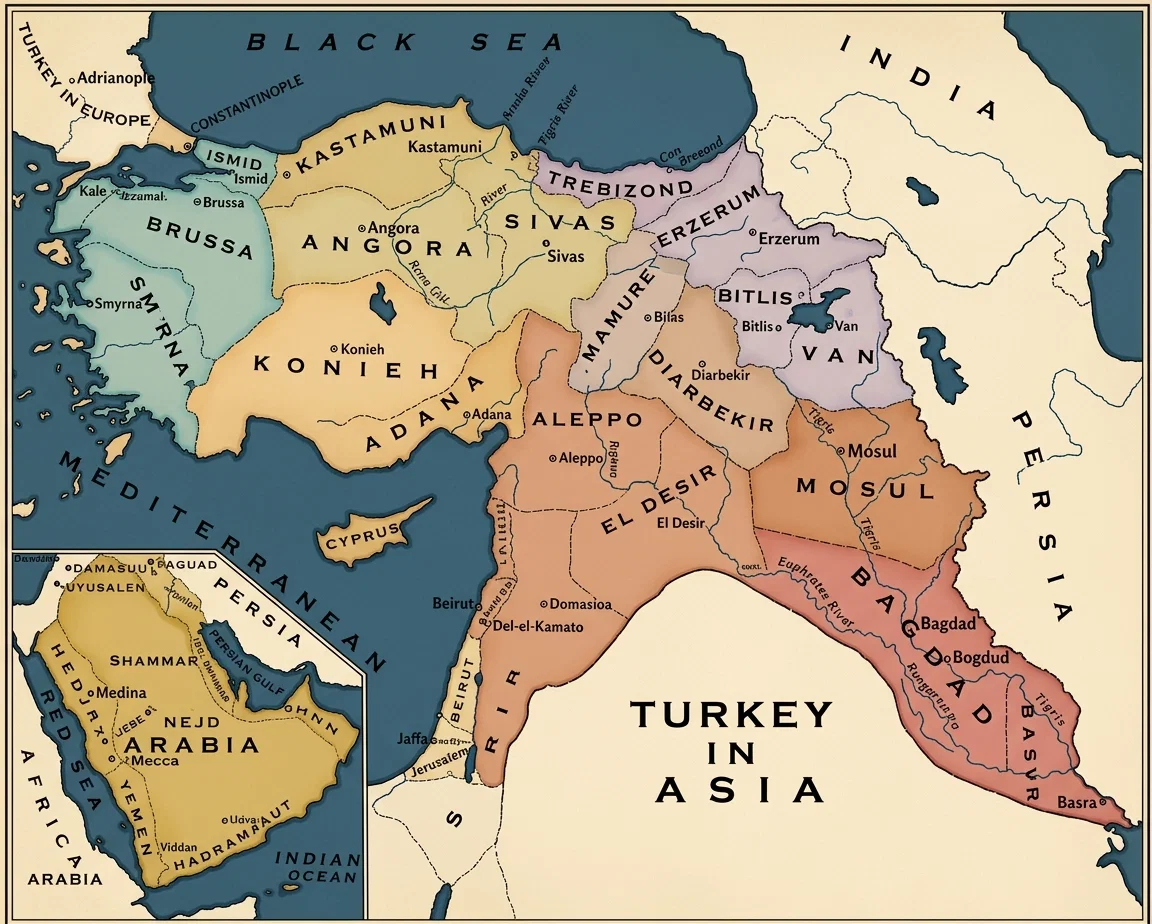
The scale of the large map is 240 miles to the inch; the map of Arabia, in the lower left-hand corner, is 1,000 miles to the inch. We have given only the most important towns, and capitals of the vilayets, or provinces. There are many other towns not given. Arabia, if the map were extended, would occupy the place of the title, and extend southward a thousand miles or more.
LAST week we gave a chronicle of the history of the Ottoman Empire from the time of Osman, its founder, to the present time.
This week we wish to say something of its territory in both Europe and Asia, stating just the facts as we are able to gather them, previous to the present war.
European Turkey, at the beginning of the present war in the Balkans, covered a territory of about 65,350 square miles, with a population of 6,130,200. What it will be when the war is over and the final settlement takes place, it is pretty difficult to imagine. There may be left only Constantinople and a few miles of territory at the back. That city even may be lost. The population is not wholly Mohammedan, by any means. Many belong to the “Orthodox” or Greek Catholic Church. The people are largely, however, of Slav, or Turkish, descent. Besides this, there are many Greeks and Albanians. The two chief religions are Mohammedan and Greek Catholic. The adepts, or the advanced ones in the study of the Koran, are called the Ulemas, who decide all doubtful cases relating to religious and social life, and who can fill judicial as well as ecclesiastical posts. The patriarch of Constantinople, of the Greek Church, presides over the permanent synod, and nominates all the lesser dignitaries, subject to the confirmation of the Porte. The Armenian church has its patriarch at Constantinople, while the Roman Catholics have nine archbishoprics in the Turkish Empire.
The Government
The Turkish Empire is a theocratic monarchy under the sultan, who is also called the calif, or successor of the prophet. His chief representative in functions is called the grand vizier, while the chief vicar in religious affairs is the Sheik-ul-Islam. The constitution provides for a parliament composed of a senate, the members of which are appointed by the sultan, and a lower house elected by the people, or indirectly by manhood suffrage. Effort has been made during the last few years to bring it into harmony with Western practice and progress. General conscription, that is, the bringing of all classes into the army, has been in progress since 1800. For a long time Christians were not permitted to serve in the army, but paid an army tax instead. Certain of the Arabian and Kurdish tribes were also exempt; but in 1909 a decree was issued extending the liability to military service to non-Mohammedans, and this liability to service extends from twenty to forty years of age. In 1911 the strength of the army was fourteen army corps, with a numerical strength of 420,000 men. In 1911 there were eight battle-ships in commission, two others nearing completion, three armored cruisers, twenty-four destroyers and torpedo boats, and a number of small gunboats.
The empire is divided into what is called eyalets, or vilayets. According to the last census, not taking into account the present war, these were about as follows:
Vilayets
In Europe:
Vilayet
Area, square miles
Population
Constantinople
2,702
1,136,000
Adrianople
15,015
1,106,500
Saloniki
13,684
1,165,400
Monastir
10,690
847,400
Kossovo
12,100
961,000
Scutari (Albania)
4,516
322,000
Janina
7,045
648,000
Total in Europe
65,752
6,186,300
In Asia: Asia Minor
Vilayet
Area, square miles
Population
Ismid
4,323
222,800
Brusa
28,486
1,626,900
Bigha
2,625
129,400
Archipelago
2,744
325,900
Smyrna (Aidin)
20,844
1,396,500
Kastamuni
19,184
1,018,900
Angora
26,055
892,900
Konieh
39,779
1,088,000
Adana
14,359
403,400
Sivas
24,240
1,086,500
Trebizond
11,850
1,163,800
Subtotal
194,489
9,355,000
Armenia and Kurdistan
Vilayet
Area, square miles
Population
Erzerum
19,686
597,000
Mamuret-ul-Aziz
13,240
575,300
Diarbekir
13,703
471,500
Bitlis
10,345
398,600
Van
15,517
430,000
Subtotal
72,491
2,472,400
Mesopotamia
Vilayet
Area, square miles
Population
Mosul
29,220
300,300
Bagdad
54,503
850,000
Basra
16,482
200,000
Subtotal
100,205
1,350,300
Syria
Vilayet
Area, square miles
Population
Aleppo
30,340
995,800
Zor
32,849
100,000
Syria
23,816
955,700
Beirut
11,773
533,600
Jerusalem
8,222
333,000
Lebanon
2,509
399,500
Subtotal
109,509
3,317,600
Arabia
Vilayet
Area, square miles
Population
Hedjaz (approximate)
96,500
300,000
Asir, Hodeida, Sana, and Tais (all until recently included in the vilayet of Yemen)
77,200
750,000
Subtotal
173,700
1,050,000
Total in Asia
650,394
17,545,300
Besides these vilayets, there is also Egypt, with its 400,000 square miles, and 9,821,000 population, of which the sultan is the nominal ruler. Tripoli has recently been lost by the Turkish government, to Italy.
It is of interest to note some of the large towns in Turkey in Asia, besides the cities of Constantinople in Europe, with a population of 1,125,000, and Alexandria, Cairo, and Allahabad in Egypt, with populations respectively of 332,246, 654,476, and 172,000. Westerners sometimes seem to get an idea that all of Turkey is in Europe, but Turkey’s largest dominion is in Asia, as shown in the tables before given from “The International Encyclopædia.”
Damascus. Damascus is the capital of the Turkish vilayet of Syria; contains the world renowned Ommiade Mosque; built as a heathen temple; made into a Christian church; converted at last into a mosque. In it also is the street called Straight (Acts 9:11). Population is estimated at 225,000.
Smyrna. Population 201,000. The seat of an early Christian church; noted for its carpets and rugs. Like many other cities of Asia Minor it has suffered greatly from earthquakes.
Bagdad. Capital of the vilayet of the same name. A town in ancient Mesopotamia, situated on both banks of the Tigris River, on the projected Bagdad railway, which Germany is building from Constantinople to the Persian Gulf. Population estimated last year at 150,000.
Beirut. A city in the vilayet of the same name. Situated on a bay at the foot of the Lebanon Mountains. Said to be the healthiest place on the coast. Possessing a university, astronomical observatory, and a society of Oriental languages. Population in 1900, 140,000.
Aleppo. The capital of the vilayet of the same name. Extending from the Mediterranean to the Euphrates. The town has been captured and sacked, and devastated by earthquakes, and ravaged by plague and cholera during its history. It is a great commercial center, in spite of its inland position. There is here a mosque which contains the alleged remains of Zacharias, the father of John the Baptist. At one time contained about 300,000 inhabitants.11Its population at the present time is estimated to be 129,000.
Brusa. The earliest capital of the empire, and the former capital of Bithynia. Population in 1900, 76,303.
Mecca. The holiest place on earth to Mohammedans; noted as the birthplace of Mohammed; in the vilayet of Yemen in the western part of Arabia on the Red Sea. There is here a peculiar cubic structure called the Kaaba, said to have been built by Abraham. Its four sides are covered with black silk, annually renewed, and the covering is known as the holy carpet, sent every year from Cairo, and carried in procession from Jeddah to the city. Openings in the silk are left to show two sacred stones. The black stone at one of the angles is a special object of veneration. It stands in a mosque enclosure capable of holding 35,000 people. The permanent residents of the city are 60,000. Pilgrims sometimes number 100,000. Non-Mohammedan visitors enter at the risk of their lives. It is supposed to have been the home of Ishmael. The sheriffs since 1513 have ruled in the name of the Turkish sultan, who also sends a governor to the place.
Jerusalem. The holy city of Jews and Christians. Population about 60,000.
Medina. A walled city of 50,000 inhabitants, in the western part of Arabia, 245 miles north of Mecca; second only to Mecca in sanctity. Here is Mohammed’s tomb behind the mosque where he died. Abu-Bekr and Omar are buried in the same spot. Non-Mohammedans are rigidly excluded.
Konieh. The ancient Iconium where Paul preached (Acts 13:51). Has a population of 44,000.
Mosul. The capital of a vilayet of the same name, in ancient Mesopotamia, opposite the mounds of the ancient Nineveh. Population 40,000.
Trebizond. A town on the Black Sea; an important shipping point, the trade of which reaches about ten millions annually. It is fortified and walled, and was the capital of the empire of Trebizond under Alexis Comnenus in 1204. Captured by the Turks in 1461. Has a population of 40,000. In 1895 was the scene of fearful Armenian massacres.
Erzerum. An important military center. Famous for its copper and ironware, shawls, and carpets.
Bitlis. A thriving city in central Asiatic Turkey; engaged principally in the manufacture of firearms and cotton cloths of a bright red dye. Population of the town, 38,800.
Adana. A town in the southern part of Asia Minor, a railway terminus. Population of 32,000.
Antioch. Noted especially from the fact that it was a city well known in New Testament times. Built by Seleucus the first king of Syria, and named by him after his father. Noted at one time for its wealth and luxury. There the name “Christian” was first used (Acts 11:26). Almost destroyed by an earthquake in 1872, but has since recovered, and has now a population of 28,000.
There are many other towns ranging from 44,000 to 10,000 in population.
The chief interests in Asiatic Turkey are, first of all, the silks, drugs, cloths, etc., that come from there, and also the fact that it connects us so strongly with Bible lands and the ancient wars between the early powers of earth, such as Babylon and Persia. It has this lesson for the student of government, as well as religion, that no people are governed well, and no government is strong, unless it has the consent of its people and union and harmony among them. That has not been the case with the Turkish government. A state religion always proves a curse. Turkey has had serious troubles without, but its troubles within have been even more serious, and no government can by cruelty and force perpetuate itself.
What We May Expect of Church Consolidation
By Editor
A CORRESPONDENT writing from Los Angeles, under date of January 7, 1913, and who says that he is an “ex-priest of the Church of Rome,” takes issue with a recent article on the Federal Council of Churches by Mr. K. C. Russell. He says:
“I believe that the earlier we have unity upon religious doctrines and unity of churches, that is to say, consolidation of the entire religious world separated from politics, the sooner will the millennium come.
“I believe that so long as there are those who class themselves as ‘Protestants,’ there will always be friction and persecution as well as religious hatred, sanctioned alike by both Protestants and Catholics against one another.
“As an ex-priest of the Church of Rome, and as one accepting no one’s dogma but my own, I believe that the very antagonism among the Protestants is constantly adding to the strength of Rome. I also believe that the Seventh-day Adventists are viewed by most Protestants in the same light as Romanists.
“Seventh-day Adventists make very poor neighbors among Protestants by their tinkering and hammering on what the Protestant regards the Sabbath day. And all churches, Protestant and Catholic, regard them as filching the Jewish Sabbath, not so much because they believe in the righteousness of it, but to be different.
“It is only a matter of another century, when Rome will predominate; and long before that time every denomination and sect will have adopted a Jesus different from one another, and all of them will have different gods, all of which will be fighting one against the other.
“There are too many sects; too many creeds; too many fanatics, and the most dangerous of them all, in religion and in the field of labor, are the Seventh-day Adventists. Protestants and Romanists alike hate them, and some day a well-directed inquisition will terminate them. Fanaticism is the greatest danger to our country.
“I believe that even God hates a Seventh-day Adventist for no other reason than they are counterfeit Christians (so-called) of a hybrid type.”
We have not space for all of Mr. James Mullowney’s creed, but we give the gist of it, especially that its spirit may be seen. We make the following brief observations:
1. “Unity upon religious doctrine”—“consolidation.” “Unity upon doctrine is a matter of individual conscience. Mr. Mullowney must have believed in this or he would not have left the Church of Rome and set up his own ‘dogma.’ Granting, then, the right of individual belief, what force, or power, would he use to consolidate?
2. “Separated from politics.” But that is just what a consolidated church never has done, separated from politics. That was the warning which was given this country years ago by Hon. R. M. Johnson, adopted by the Congress of the United States, that a consolidation of religious forces to effect a political purpose is always dangerous; and one of the objects of the Federation of the Protestant Churches in America, is to purify politics, and through politics enforce certain Christian dogmas. The Roman Catholic Church has never been separate from politics, only as she has been compelled to be. How can such consolidation bring the millennium?
3. “Friction and persecution.” There has always been friction between those who are loyal and faithful to conscience and the Word, and those who are not. It was the Master Himself who said, “I came not to send peace” on earth, “but a sword.” The whole difficulty lies in this, that there are conscientious souls who will be faithful and bold toward God, whatever may come, and there are those, on the other hand, who will count them fanatics and stubborn, and will exercise the power of the civil arm to bring them to their ideas of what ought to be,—hence always friction and persecution as long as the carnal heart is against God’s law. Mr. M. will never find it otherwise in this world.
4. Why did Mr. M. add to the “antagonism” in the differences, by himself separating from the Church of Rome? True Protestantism protests only against those things in the professed church of Christ which are contrary to the Word. Our critic ought to read the famous “Protest of Spires.” That protest was both Christian and Biblical in all its essentials.
5. Regarding the Sabbath, Seventh-day Adventists and Seventh-day Baptists, and the seventh-day keepers there are scattered among other denominations, have regarded the commandment of the eternal God and the example of the Lord Jesus Christ with apostles and prophets, a sufficient basis for the observance of the seventh day. To them it is vital.
6. Our critic is putting off the predominance of Rome a good deal farther than present indications will warrant. The “more sure word of prophecy” has spoken upon this question, and everything indicates its fulfilment.
7. If too many sects and too many creeds, why does Mr. M. set up another sect of his own, and another creed? Why not stay with that church which he believes will predominate, and which his letter seems to indicate will blot out Seventh-day Adventists? and if, as he believes, God hates them, why can he not leave them with God?
Of course one can see that as long as he holds his present attitude, which is intrinsically and emphatically Roman, it is only an easy step to constitute himself, if he has the power, God’s agent, and be the means of bringing an end to the hated sect.
Ah, brother, it is a bad state to be in,—contrary to every principle of the Master. It was Jesus Himself who said, “If any man hear My words, and believe not, I judge him not: for I came not to judge the world, but to save the world.” It was He who said, concerning His pitiless murderers, “Father, forgive them; for they know not what they do.” It was His apostle who said, in speaking to those who crucified the Christ, “And now, brethren, I know that in ignorance ye did it, as did also your rulers;” and it was another apostle who said, in referring to the wicked rulers of this world, “But we speak God’s wisdom . . . which none of the rulers of this world hath known: for had they known it, they would not have crucified the Lord of Glory.”
The above quotations from our critic clearly reveal to us just what the Federal Council of Churches will accomplish if they are enabled to carry out their religio-political schemes. We believe that many of them—the majority of them—do not believe in persecution, or hold any such spirit as is indicated in the above; but when they have enacted the laws, set in operation the legal agencies for persecution, we may be very sure that there will be plenty of minds who have such decided and malignant hatred toward some whom they are pleased to denominate12fanatics, that persecution will inevitably follow. Of this God has forewarned us in His Word, and of just such things as this, this journal has given warnings from its very existence.
Hypochlorite Treatment of City Water
The hypochlorite treatment of city water supplies, we learn from the Journal of the American Medical Association, has resulted in a marked diminution of bacteria, and a decided reduction, in some cities, of typhoid fever. The use of the chemical is to disinfect polluted water. Reports seem clearly to show that its use in an emergency, till a better permanent system can be devised, is beneficial.
Its Sieges and Calamities
Constantinople
Its Sieges and Calamities
As THAT wonderful city of Constantinople (in the old classic ages Byzantium) is even yet in peril, it may be of interest to our readers to note some of the many sieges and calamities she has passed through. This compilation may have missed some of them, but it gives most of the important items of this character.
Before Christ
667, the city first colonized by the Megarians.
479, Greeks conquer Byzantium.
409, Byzantium captured by Alcibiades.
357, Byzantium with Chios, Cos, and Rhodes successfully revolts against Athens.
340, unsuccessfully besieged by Philip of Macedon.
After Christ
73, Vespasian, the Roman, subdues Byzantium, Lycia, Rhodes, Thrace, Cilicia, and Samos.
194, besieged by Severus.
330, Constantine dedicates Constantinople as the new capital of the Roman Empire, styling it Second or New Rome.
365, Procopius seizes the city.
419, the great walls of Constantinople are built as a protection against the barbarians by Athemius, the general of Theodosius II.
433, fire destroys a great part of the city.
460, an earthquake of forty days’ duration destroys the greater part of the city.
527-565, Justinian I reigns.
532, Belisarius rescues Justinian from the insurrection of the Green circus faction; 30,000 Greeks are slain, the city burned, splendidly rebuilt by Justinian.
557, earthquake destroys many buildings and lives.
559, Belisarius repels the Bulgarian invaders.
610, Heraclius takes the city, and makes himself emperor.
668-675, first siege by the Saracens.
677, again besieged. Callinicus destroys their fleet with Greek fire.
717-718, second siege by the Saracens.
725, the Saracens invade the city.
746-749, desolated by the plague; 200,000 victims.
821-823, besieged by Thomas, the general of the murdered Leo.
864, unsuccessfully besieged by twenty-two Russian ships.
907-1043, repeated attacks by the Russians.
1081, sacked by the rebel army of Alexius Comnenus.
1203, May 9, taken by the Crusaders, ostensibly to restore Isaac II to his throne.
1235, Baldwin II, king of Jerusalem, unsuccessfully besieges the city.
1261, July 25, captured by the revolting Greeks, and the Latin empire ends.
1347, captured by John Cantacuzenus.
1410, attacked by Musa Chelebi.
1422, unsuccessfully besieged by 200,000 Turks under Amurath II.
1425, peace is made between the Greeks and the Turks.
1453, Mohammed II captures the city.
1459-66, Servia and Albania are annexed.
1466, Epirus also; 1475, Crimea.
1453-1481, the city repopulated and rebuilt. Creation of the Turkish Stamboul.
1516, Phenicia, Syria, and Palestine are annexed; later, Egypt also.
1611, the plague destroys 200,000 lives.
1826, the Janizaries revolt, and many thousands are massacred; the organization is abolished.
1828, Austria joins with England in interference to prevent the fall of Constantinople, and in bringing about peace.
1865, August, cholera rages, and fire consumes 2,500 houses.
1868, an insurrection by the Young Turkey Party fails.
1877, the National Council rejects propositions made by a conference of the powers respecting Servia and Montenegro; the first Turkish parliament opens, with thirty senators and ninety deputies.
1881, March-April, conference of ambassadors; Turkey yields, and decides to transfer to Greece most of the territory indicated by the Berlin Conference.
1890, fire consumes property worth $5,000,000.
1912, besieged by Bulgarians.
Riches and Dangers
PRESIDENT-ELECT Woodrow Wilson said to the Chicago Commercial Club, January 11: “I am not indicting the banking methods of America. Our banking system does not need to be indicted; it has been convicted.” And the New York “World” points out that one member of the powerful triumvirate that controls the monopoly of credit in the United States has been the one who has convicted it. The Pujo Committee of Congress has been bringing out some very interesting facts in its investigations of the money power. One of the men who was upon the witness-stand for two days was George F. Baker, chairman of the First National Bank of New York; and he admitted, in response to questions, that in fifty years his bank, which had started with a capital of $500,000, had made $86,000,000. He admitted, we are told, that he was one of two chief financial lieutenants of J. P. Morgan, the “great general;” that he personally bought control of the Chase National Bank, and turned it over to the first security company, the holding company of the First National. He admitted the familiar system of “interlocking directorates,” and the frequent bank consolidations; nor could he name any American company flotation of $10,000,000 or more issued in recent years through any other house than J. P. Morgan & Co. or one of its eight associates and allies. This group was doing the big business of the country. From testimony given in the New York “World” of January 13 we quote:
“Question: Is there any doubt of the fact that there has been of late years a vast and growing concentration of credit in the hands of a few men?”
Mr. Baker’s answer was: “Well, there is a GREAT AMOUNT OF MONEY that has come together here more or less concentrated.”
“Question: I suppose you would see no harm in having the control of credit as represented by the control of banks and trust companies, still further concentrated? Do you think that would be dangerous?”
“Answer: I think it has gone about far enough.
“Question: You think it would be dangerous to go farther?”
“Answer: It might not be dangerous, but still it has gone about far enough. In good hands I do not say that it would do any harm. If it got into bad hands it would be very bad.”
“Question: If it got into bad hands it would wreck the country?”
“Answer: Yes; but I do not believe it could get into bad hands. . .
“Question: You see the peril in that, do you not?”
“Answer:Yes.
“Question: So that the safety of the country lies in the personnel of the men?”
“Answer:Very much.
“Question: Do you think that is a comfortable situation for a great country to be in?”
“Answer:Not entirely.”
And this is the testimony of one of the important men in the great money control of the country. Mr. Baker does not consider that it is in “bad hands,” and yet Mr. Morgan, the “great general” of the group, could use millions of the United States money just as if it were his own! And the journal quoted from pertinently remarks: “A power that in ‘bad hands’ would be ‘very bad,’ and would ‘wreck the country,’ is a power too great to rest in the hands of Messrs. Morgan, Baker, and Stillman, excellent as they feel their motives are. A situation not ‘comfortable for a great country to be in’ is a situation a great country must change. It can not leave its safety in the personnel of the men at the head of the clique of bankers.” And it is true, too, that “no feature of monopoly is more repellent than the monopoly of credit.”
Credit seems to be good at first. It invariably works out evil at last. And so God’s Word foretelling this very condition 2,500 years ago, and nearly 2,000 years ago repeating it, in the prophecy of Habakkuk and in that of James,—the very conditions which exist now,—of how men would heap to themselves the riches and the credits of the country, until they were left alone in the earth, and of the awful recoil, reaction, revolution, which would be sure to follow, that would topple the thrones of many kings into the dust. God has forewarned us concerning all this, but we doubt very much whether President Woodrow Wilson will be able to make any decided change.
Inciting Murder
THE NEW YORK World (Three-a-Week) of January 13 reports Joseph J. Eltor, an agitator and member of the Industrial Workers of the World, as saying, January 10, in Bryant Hall, to the striking waiters in New York:
“Remember, if you are compelled to go back (to work) under unsatisfactory conditions, go back with a determination to stick together until you get what you want. Go back with your minds made up that it is the unsafest thing in the world for the capitalist to eat food prepared by members of your union.”
What can this mean but inciting to poisoning or murder? He was asked later what he meant by this, and he replied that he meant just what he said. Effort has been put forth to minimize the meaning or correctness of the statement, but the editor contends that it is a correct report. The World remarks editorially: “This is open instigation of murder. It means that, and it means nothing less. Should any weak-minded waiter act on such advice, Joseph J. Eltor will at once become a promising candidate for Sing Sing, if not for the electric chair.” And what can we say of an association or organization, which will support men who advocate such things?
Restricting Immigration.
There are bills before the two houses of Congress to restrict immigration. One has a writing test, and the other a reading test. It has been declared that these are un-American; and they are. Really, a writing test is no particular test at all as to the character of an individual. Sometimes men of education are the very worst citizens. They are agitators and anarchists. On the other hand some foreigners who are unable to read or write would make commendable, earnest citizens in a community. They would not add much to its strength in an intellectual way personally, but they would build up good homes, and their children would be sent to school. Not education, but character, ought to determine citizenship. It is character which will determine the citizenship in heaven. God will not ask of the individual whether he can read or write, but, Is he one who has so submitted to the government of heaven that God's law can be read in his life and on his heart?
Opposition to the Whipping Post
One of the blue law bills before the California Legislature is that wife beaters shall be whipped with a six-tailed whip, not to exceed thirty lashes; but the suffragette lobbyists at Sacramento are strongly opposed to it. One of them, Mrs. Helen Moore, said: “Men seem to think that legal suasion is more powerful than moral suasion. We take an entirely different view. The establishment of the whipping-post would serve to brutalize the victim even more if possible.” And she is right about it. It is a step backward toward the Dark Ages.
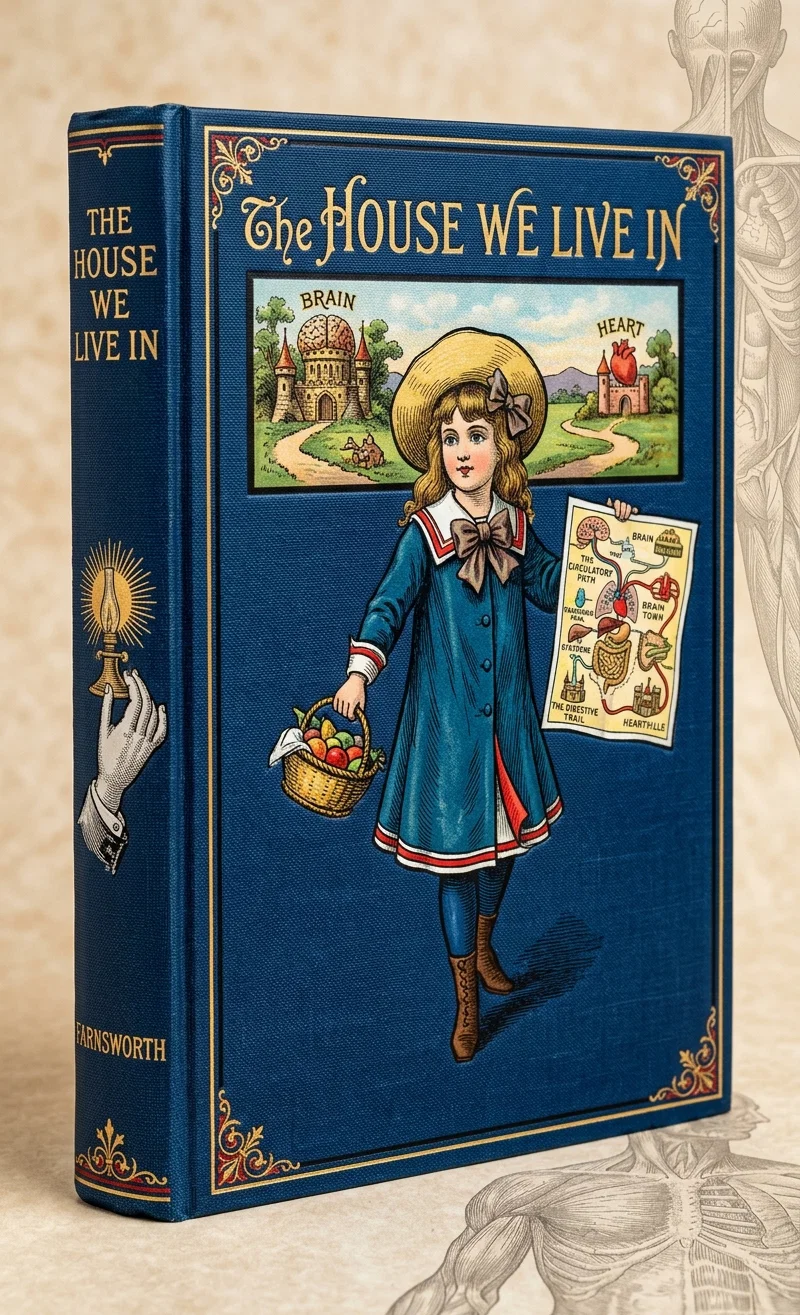
THE HOUSE WE LIVE IN OR THE MAKING OF THE HUMAN BODY
By Vesta J. Farnsworth
By Vesta J. Farnsworth
THIS is a book for home reading and it is a great help to mothers in teaching their children how to care for themselves physically. The structure of the human body is set forth in a most interesting and instructive manner, and all its wonders, uses, functions, etc., are told in a most attractive way.
The style of the book is conversational—a mother talking with her children. It makes a splendid birthday gift.
Two hundred and eighteen pages, nearly 150 illustrations, attractive cloth cover.
Price, post-paid, $1.00.
Pacific Press Publishing Assn.
Mountain View, California
Portland, Ore. Calgary, Alberta Kansas City, Mo.
Sanctuary
“Christ Our Advocate,” a pamphlet which can be secured at this office for ten cents, is an invaluable aid in studying the sanctuary question. It explains the building and purpose of the earthly sanctuary, patterned after the heavenly, and pictures the present work of Christ, “Our Advocate,” in the heavenly sanctuary. The great prophetic 2,300 day period is thoroly explained, as are also prophecies relating to the conditions in the world during the time that the heavenly sanctuary cleansing work is going on.
The Law
That question of “Under the law? or under grace?” is a constantly recurring one. Bible Students' Library tract No. 163 gives a careful answer from the Bible. Single copy, 2 cents; a hundred, $1.00. This office.
OUR LITTLE FRIEND
The Children's Eight-page Weekly
Stands for great and sound principles of goodness and truth, and instills them, by simple lessons and stories, into the minds of its little readers.
Its General Contents
The Great Out-of-Doors and Some of Its Delights and Wonders, Children of the Bible, Our Feathered Friends, Dumb Creatures of the World, Confidential Talks with Boys and Girls about Themselves, What a Boy Can Do, What a Girl Can Do, How to Spend Rainy Days, The Bulletin Board.
A Strong Staff of Interesting Writers
Just the kind of honest little stories of more than moral worth that you would wish a child of yours to read.
60 cents a year 30 cents six months
A postal card will bring you a sample copy. Look it over and request it sent to some little one. An appreciative gift for any youngster.