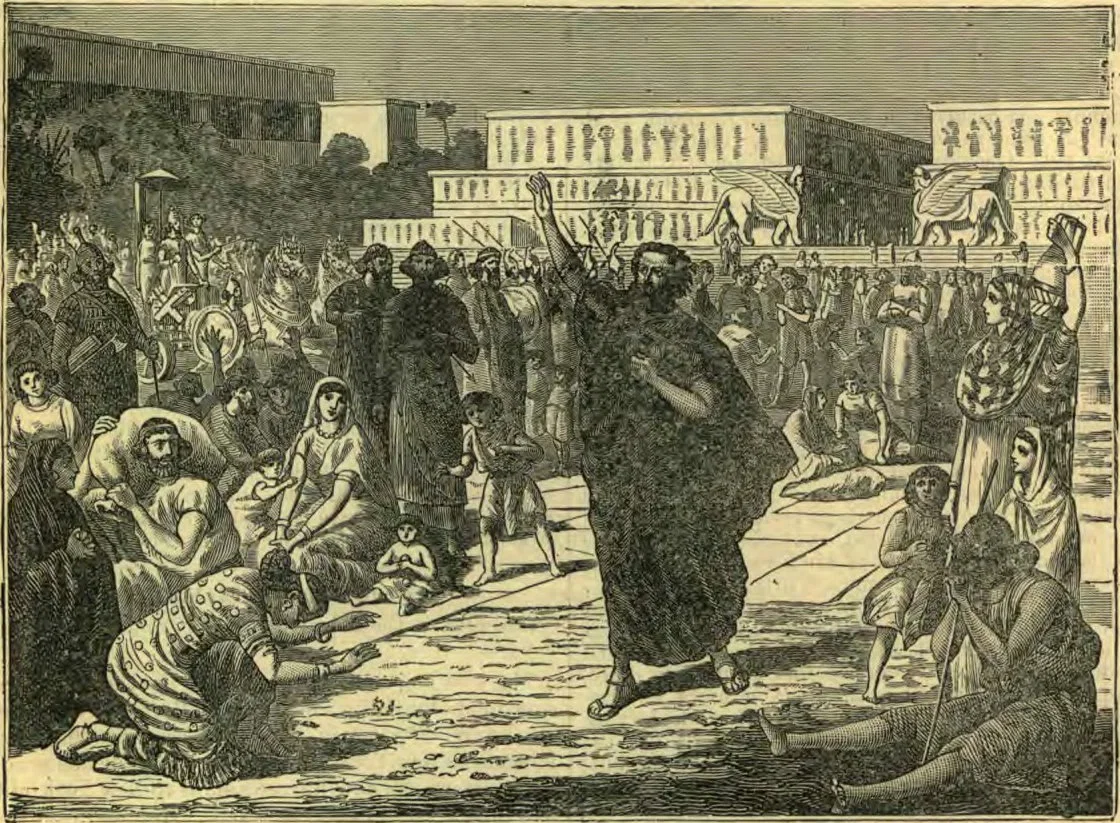
Once, a long time ago, there lived a man who did not like to do what he knew he ought to do. He was a prophet. The Lord sometimes talked to him, and told him things to do. Once he told him to go away off from home to a great city. The city was so large that it took three days to go the length of it.
Now this man did not want to go to the city; for if he did, he would have to tell the people some very disagreeable things, that would be likely to make them angry with him. So he journeyed off in another direction.
But the Lord was watching this prophet all the while. He saw him go on board a ship to try to run away. When night came, God sent a great storm on the sea, and the little vessel rocked up and down so hard that the sailors thought they would surely drown. They were heathen men, and they thought their gods must be angry with them to send such a storm as that. So they cast lots to find out which one of them had done anything to make the gods angry; and the lot fell on the run-away prophet.
Then the sailors prayed to the prophet's God, and cast the prophet overboard into the sea. Now you will remember his name; for you have often heard about Jonah, and how a great fish swallowed him up.
But the Lord did not want Jonah to die; and when, after three days, he let him go on land again, he was very willing to visit the great city.
How astonished and frightened the people must have felt when they saw this stranger running through their streets, and heard him cry, “Yet forty days, and Nineveh shall be overthrown!” I suspect the shoemakers must have left their benches, the carpenters their shops, the merchants their stores, and everybody must have run somewhere to talk over the strange news. “Could it be possible,” they would say, “that our city will be overthrown!” But the words of the prophet kept ringing in their ears, “In forty days your city shall be destroyed!”
So the king called the noblemen together, and they sent out messengers all around to tell the people to keep a fast. Even the cattle were to be given no food and no water; but all, both men and beasts, were to cover themselves with sackcloth, and the people were to cry mightily to Jonah's God to forgive their sins. Even the king took off his fine, soft, royal robes and put on the coarse sackcloth, and sat in ashes; for this was the way people did in those days, when they wanted to show that they were very sorry for anything.
When God saw that they truly repented, and did not do wrong any more, he forgave them.
Now, would you not think Jonah would have been glad to have God forgive these wicked people, and save their great city? But he wasn't. He built him a little booth outside the town, and waited to see the Lord destroy it. And when he found out that God had forgiven the people and meant to save them, he was so sorry because what he preached did not come true, that he just scolded and complained about it.
Did you ever see any people who acted about as sensible as Jonah did? Did you ever know a boy who was sorry when any good thing happened to a playmate he did not like? Don't you think he might read the book of Jonah, and learn a lesson from it?
W. E. L.
A LITTLE WOMAN.
Little Pen Ashford will never forget the day when people began to call her “little woman.” She was papa’s and mamma’s only child, and she had never had anything hard to do, any more than her bird or her kitty or her dolly had; and her mamma called her a flower, a bird, a sunbeam.
But all at once, one day, this little girl showed that she was good for something else than to be petted and played with. It was a cold, snowy day. The servant had gone out for the afternoon, and Pen and her mother were alone in the house. Mamma had not been well, and about three o’clock she grew very ill indeed—so sick and weak she could not sit up, nor tell Pen what to do for her. Pen was scared at first, and stood by the bed and looked at mamma pitifully, while the storm roared without.
Presently Pen’s little mind seemed full of soft, clear voices. “Pen,” said one voice, “you must go for papa and for Aunt Alice and for the doctor!” “Pen,” said another of the clear voices, “you must put some wood in the stove before you go.” “And Pen,” said another of the voices, “you must put a glass of water and the camphor by the bed before you go.” “And Pen,” said still another, “explain to mamma that you are going.”
All these voices did little Pen obey. She was but five years old, and I think she was brave to get herself ready all alone, and to trudge off over the snowy road to the village through the storm to bring that help to her mamma. But she did it, and this was the way she earned her name of “Little Woman.”—Little Men and Women.
GOLDEN-ROD
Tell me, sunny Golden-rod,
Growing everywhere,
Did fairies come from fairyland
And make the dress you wear?
Say, did you get from mines of gold
Your bright and shining hue?
Or did the baby stars some night
Fall down and cover you?
Or did the angels flap their wings,
And drop their glitter down
Upon you, laughing Golden-rod,
Your nodding head to crown?
Or are you clothed in sunshine, caught
From summer’s brightest day?
To give again in happy smiles
To all who pass your way?
I love you, laughing Golden-rod,
And I will try, like you,
To fill each day with deeds of cheer,—
Be loving, kind, and true.
—Our Little Ones.
Erratum: Date of Kaiser William's Birth
Erratum.—In giving the date of Kaiser William’s birth, on page 196 of the INSTRUCTOR, the type made it read 1779 instead of 1797, as it should be. Several hundred copies were printed before the error was discovered.
Letter Budget.
WILLIE NORWOOD writes from McPherson Co., Kan. He says: “It has been a long time since I wrote to the Budget. When I wrote last, there was only our own family keeping the Sabbath here, but last fall tent meetings were held here which resulted in some others keeping the Sabbath. We now have an interesting Sabbath-school of sixteen members, and take five copies of the INSTRUCTOR. I am twelve years old. I am at work away from home. I expect to have more money to use in God’s cause now, money that I earn myself. The man for whom I work is not a Sabbath-keeper, but he lets me go home Friday evening to spend the Sabbath. It is raining to-day, for which we are all very thankful; for we have no water in this town except when it rains. We have to hire our water hauled, which costs us twenty-five cents a barrel, or one dollar for a tank which holds six barrels. I have one brother and one sister, and a cousin staying with us who is not a Sabbath-keeper. I hope he may become one. I am trying to do God’s will.”
ELMER H. PIERCE writes from South Lancaster, Mass. He says: “When I read the letters in the Budget, especially those from persons I know, it makes me feel that I would like to write one. I was twelve years old last August. I am now going to school at So. Lancaster, Mass. I enjoy it much. I never could study much, for my eyes would pain me if I did. But the Lord has blessed me and helped my eyes so I can study all I want to. But he did not do this until I had confessed all my sins that I knew of. My mother and sister are here with me, and my papa is preaching in Northern Vermont. My home is in Bordoville, Vt., but I have not been there very much the last year or two because my parents were away, working in the cause. I expect to canvass some next summer. We have a large Sabbath-school because there are so many students. I study in Book No. 6. I should like very much to live at home and have pets as I used to, but I am willing to stay anywhere if the Lord is with me, for his coming is very near, and I want to be ‘waiting, and watching,’ so that he will save me.”
The next is a letter from Clay Co., Dakota, written by LOUISE POULSON, who says: “I am an orphan girl, ten years old. I live with my uncle and aunt, and attend Sabbath-school with them. The church is built on my uncle’s farm. I learn my lessons in Book No. 2. My aunt is going to give me a missionary garden this summer, and I will try to raise some onions. I hope I will have better luck than my aunt had last summer. The hail mashed hers all to pieces. I have three brothers, and my grandma keeps house for them. I am trying to read the Bible through, as Eld. A. D. Olsen told us to do. I have three aunts here, and they all keep the Sabbath. I earn money by knitting stockings for Aunt. I give it in to the Sabbath-school. My aunt has three little boys. We each have a pair of doves and a hen that will eat from our hands; and we each have a little calf. I will try to live for God that I may be saved.”
FLORA M. McCALL, a little girl twelve years old, writes a letter from Hamilton Co., Ind. She says: “I have been keeping the Sabbath four years. I go to Sabbath-school, and to day school too. My papa died when I was five years old. Mamma is at the Indianapolis mission, and I am staying with uncle and auntie. I am going to pay my tithing. Uncle gave me a hen, and I am going to raise chickens and sell them and put the money into the cause. I love to read the Budget. I am glad my little friends are encouraged, and I hope we shall all be ready when the Saviour comes to gather his jewels.”