“I,” SAID the duck, “I call it fun,
For I have my little red rubbers on;
They make a funny three-toed track
In the soft, cool mud. Quack! quack!”
“I,” cried the dandelion, “I;
My roots are thirsty, my buds are dry,”
And she lifted her little yellow head
Out of her green and grassy bed.
“I hope ’t will pour! I hope ’t will pour!”
Croaked the treetoad at his gray bark door;
“For with a broad leaf for a roof,
I am perfectly weatherproof.”
Sang the brook: “I laugh at every drop,
And wish they never need to stop
Till a big river I grow to be,
And find my way down to the sea.”
—Selected.
SOME OF OUR TOOLS.
By Nellie V. Dice
In our last lesson we named the articles that we are to use in sewing; we will now tell something about how each is made. First let us examine the needle. The sewing-needle is made from steel wire, which is cut from coils into pieces about twice the length of a needle. After being straightened, the pieces are ground to a point at each end, and flattened in the middle; on this flattened portion two small dents are made to mark the places for the eyes, which are drilled by machinery. They are then cut in two, hardened by being heated and dipped in oil, and tempered by again heating and cooling. After being scoured, rounded, and polished, they are sorted, folded in papers, and labeled ready for sale. Simple as the needle is, it passes through the hands of a hundred workmen before it is finished.
Thread is “a slender cord composed of two or more yarns or filaments, as of flax, silk, cotton, or wool, twisted together.” That made from the flax-plant is called linen thread, and is very strong. This plant grows to a height of two or three feet, and has a delicate blue flower. The stalk of the plant is hollow, and consists of a woody portion, called the boon, and a fibrous portion, from which the thread is made. If a fine fiber is desired, the stalks are pulled up by the roots as soon the leaves begin to fall off, and the bottom of the stalk becomes yellow. By waiting until the seeds are ripe, seeds for oil and a coarse fiber are obtained. After being dried in the sun, the seeds are removed, and the stalks soaked in water to loosen the fiber from the boon. The fibers are dried and run through rollers, to break the boon. Then they are combed out, and the wood is removed by machinery. The flax is then ready for the mill, where it goes through many processes before the finished product is spooled.
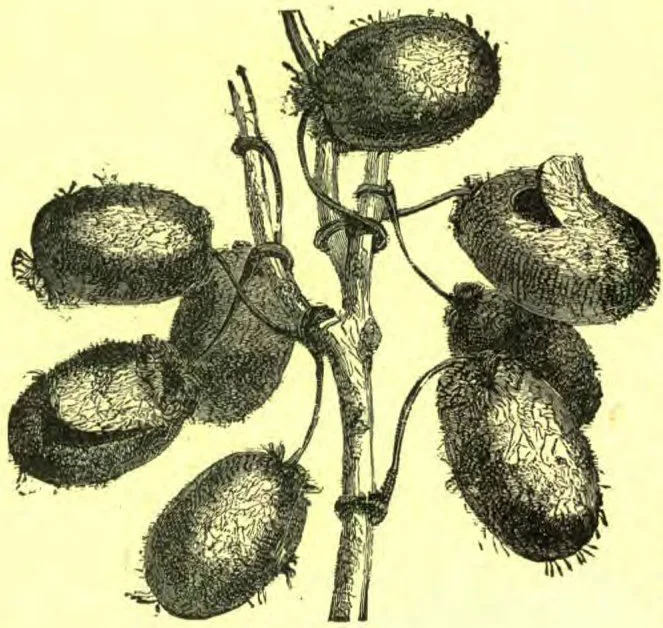
Silk thread is made from the cocoons of the silkworm. Each cocoon contains one fourth of a mile of thread, which is so fine and delicate that it is necessary to reel the threads from four or more cocoons together. In order to keep the threads of the moth’s silken house unbroken, the cocoons are subjected to heat sufficient to kill the little builders inside. It is said that to furnish material for forty yards of silk, over one hundred thousand of these tiny creatures perish. Silk is the strongest of all fibers used for weaving.
COCOONS.
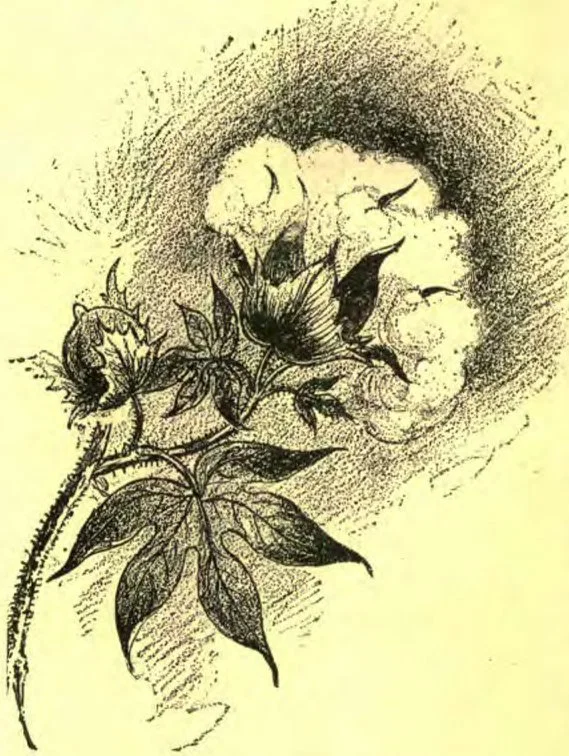
Cotton thread is made from the cotton-plant, which grows on plantations in warm countries. The seed is sown in March and April, and early in June the plant begins to bloom. The blossom resembles that of the hollyhock, and changes its color, being a pale straw-color in the morning, pure white at noon, pale pink at night, and a bright pink the next morning. At the close of the second day it is a light purplish red. After the flowers fall, the pods, or bolls, grow rapidly. When they are ripe, they burst open, showing the fleecy cotton ready for picking. When thread is to be made, the yarn is doubled and twisted more than for weaving into cloth, as greater strength is required. It is then reeled off into loose skeins for washing, bleaching, and dyeing, after which comes the reeling onto the bobbins and the spooling. After an attendant has set the spool on the spindle, and attached the end of the thread from the bobbin, the machine runs the thread on evenly, without overlapping or leaving a hair’s-breadth between, and even adjusts its work with the same precision to the widening of the spool with every layer of thread. It runs on exactly two hundred yards, and at the right time and place cuts a slit in the edge of the spool, draws the end of the thread tightly into the slit, and cuts it off, dropping the finished spools into a tray, where they are labeled, and packed into boxes containing a dozen each.
COTTON BLOOM.
Pins such as those now in use were not known in ancient times; but thorns, and bone, wooden, gold, or silver skewers were used to fasten the clothing. In the sixteenth century, when pins were first manufactured, they were so expensive that only the rich could afford to buy them. When first made in the United States, a paper of pins cost one dollar; but pins in many sizes are now made by machinery, and can be bought for less than five cents a paper.
Scissors are made in many sizes and styles. Every pair over six inches long should be called shears. Those made of steel are made almost entirely in Germany. In this country iron, with steel for the inside edges, is used. Nearly all the work in making scissors is done by hand, the process depending somewhat upon the size. Each pair passes through the hands of fifty or sixty workmen before it is finished.
In last week’s paper you read something about thimbles. They are made of celluloid, aluminum, silver, and gold, with open or closed tops. The little dents on the surface are made to hold the head of the needle firmly.
Do not be satisfied with this brief description of the articles we shall use oftenest in our work. If you can, read further on each subject, especially about thread-making and the working of the little silkworm. NELLIE V. DICE.
Daily Cross: Trusting God for Tomorrow's Load
“CHARGE not thyself with the weight of a year,
Child of the Master, faithful and dear,
Choose not the cross for the coming week;
For that is more than he bids thee seek.
“Bend not thine arms for to-morrow's load;
Thou mayest leave that to thy gracious God:
‘Daily,’ only, he saith to thee,
‘Take up thy cross, and follow me.’”
CONCERNING A PEST.
By Viola E. Smith
“O MAMA!” cried Flora, as she ran into the house, “isn’t it too bad? Nannie and I had made the nicest playhouse in the barn, and were having such a good time,—and now we can’t play there any more at all!”
“Why not?” asked mama.
“’Cause the rats keep running across the floor and scaring us. I hate rats, and I just wish I lived where there wasn’t a single one!”
“If you had lived here two or three hundred years ago, you would have had your wish; for there were none here then.”
“Yes, but there were no people here then, except Indians,” spoke up fourteen-year-old Ned; “and Flo and Nan would have been more afraid of them than of any number of rats. Really, mother,” he added, more thoughtfully, “were there no rats here then? How is it that there are so many now?”
“They came over here in ships from European countries. Every ship brought a colony of rats, which, without so much as saying ‘by your leave,’ stole a passage across the Atlantic. They increase rapidly, and are sometimes extremely troublesome on shipboard. We are told that on the return of the man-of-war ‘Valiant’ from Havana, in the year 1766, the rats on board had increased to such a number that they devoured one hundredweight of biscuit daily. The ship was at length smoked between decks, in order to suffocate them.”
“All the rats I ever saw were brown. Are they all that color?” asked Nannie.
“No,” answered her mother; “there used to be more black rats in this country than there are at present; but the brown rat has nearly driven them away. Originally, the brown rat came from Norway, whence it has been carried to all parts of the world.”
“Wherever rats may have come from, they are nothing but nuisances,” said Ned, decidedly; “see how they are eating father’s corn.”
“You remember the little bird which sang so sweetly in the old elm-tree a few days ago, don’t you, Ned? We said that the life of God was in it, and we all agreed that this was a beautiful thought. Whose life is it, I wonder, that is in the rat?”
“Why, it must be God’s life, mama,” said Flora.
“Certainly; for God is the author of all life. If we love God, we shall not hate anything he has made. When we are obliged, in self-defense, to destroy any creature, we should do it as mercifully as possible. Rats prefer clean food; but when they can not get it, they will eat almost anything. They are often of great use in places where there is much refuse. It is a good plan to remember that—”
“He prayeth best who loveth best
All things both great and small;
For the dear God, who loveth us,
He made and loveth all.”
VIOLA E. SMITH.
NOTES AND COMMENTS
In Dewey's Honor.— The cruiser “Olympia,” with Admiral Dewey on board, left Manila, May 20, for her homeward voyage through the Indian Ocean, Red Sea, Mediterranean, and Atlantic. The plan is to reach New York about July 4. An outlay of $150,000 has been planned in that city, which will be the place of the first and noisiest demonstration. It is also proposed to build him a palatial house in Washington, and supply him with money to keep it up. Subscriptions are already pouring in for this object.
St. Gotthard Tunnel Ventilated.— The question of satisfactory ventilation for the great St. Gotthard Tunnel, the longest tunnel in the world, has been settled by utilizing compressed air to clear the passage of smoke and gas. The system works perfectly; and with increased traffic no smoke remains in the tunnel, the pipes soon drawing it out. Before this system of ventilation was adopted, the smoke often became so dense that trainmen were afraid to venture in; but now it is not necessary to close the car windows while passing through the tunnel.
Gay Automobile Parade.— A gay scene was presented in front of Madison Square Garden, New York, May 24, when fifty electric vehicles were arranged in line, ready for the automobile parade. All kinds and styles were represented. Several hundred persons gathered to view the unusual sight, and spectators all along the line of the parade halted to watch the line of motor-carriages as they rolled along at a high rate of speed. Like the telephone and other inventions of recent years, these vehicles have come to stay, and without doubt one result will be a great improvement in the public roads of the country. The increasing use of bicycles also has a tendency in this direction.
A Long Reign.— May 24, the birthday of Victoria, queen of England, was generally observed all over the world. Telegrams of congratulation from the rulers of all civilized nations and from many prominent societies were received. The queen was born in 1819, and is therefore eighty years old. Only one of England's rulers reached a greater age than she has already attained. George III, her grandfather, died in his eighty-second year; but the closing years of his life were darkened by insanity. She has already reigned longer than he did, as he became king at the age of twenty-two, while she was crowned at nineteen. The world has never seen in any country so great advancement during the life of one sovereign as has been seen under the rule of the present queen; and the government of England to-day is as good as that of any earthly power.
Expedition to Guam Island.— Not long after Admiral Dewey's famous battle in Manila harbor, the Island of Guam, thirty-two miles long and five broad, one of the Ladrones, was seized for a United States naval station. Captain Richard P. Leary has been appointed governor of Guam; and on May 10 he and his garrison of one hundred and twenty-five marines, with the ship's officers and crew, sailed from New York on the “Yosemite,” which will remain at the island three years. It is proposed to survey the coasts and harbors of the island, place beacons and buoys, prepare maps, develop roads, organize a police force, and establish a stable government. The natives are said to look kindly upon American rule, and the development of the little island will be watched with interest. On account of the comparatively isolated position of Guam, which is out of the regular steamship routes, the “Yosemite” carried a miscellaneous assortment of articles in her hold, among which were the following: “A military band for the plaza, a windmill for the gardens, new furniture for the palace, an evaporating plant for supplying pure drinking water, portable lighters for carrying the cargo from ship to shore, acres of roofing for coal-sheds, hundreds of thousands of feet of lumber for dwellings, an ice-plant, an elaborate astronomical and surveying outfit, an equally complete photographic outfit, special postage-stamps for the island, agricultural implements for those of the natives who are inclined to work, saddles and horses for Governor Leary, carpenters, builders, machinists, clothing, provisions, and a complete outfit for the subsistence of all hands for one year.”
After the stilling of the tempest, where did Christ and his disciples land? Mark 5:1; Who met them as they left the ship? Vs. 2-5; Describe this man's condition. With what words did he address the Saviour? V. 7. When asked his name, what reply did the man make? V. 9. What request was made in behalf of the demons? Where did they desire to go? Vs. 11, 12. What was the result of their being permitted to enter the swine? V. 13. When the swine disappeared in the sea, what did the keepers do? V. 14. Who came to see what had been done? Did they show any gratitude for the healing of the poor demoniac? What did they beg Jesus to do? V. 17; As Jesus was about to leave, what earnest plea was made by the healed man? V. 18. What did Jesus counsel him to do?—V. 19. How well did he carry out this instruction? V. 20; How was the Saviour received on his return to Galilee? Luke 8:40. Who came to Jesus, and what request did he make? V. 41. While the Saviour was hastening to the dying bed, what incident happened that delayed him? Vs. 43-48. What was the difference between the touch of this woman and that of the many persons who were roughly jostling against the Saviour? Have we access now to the hem of Christ's garment? As the Saviour spoke words of hope and good cheer to the woman, what message was brought from the house of the ruler? V. 49. How did Christ comfort the sorrowing father? V. 50. On arriving at the house, whom did Jesus find in the room of the departed? V. 52; also Matt. 9:23; What did he do? Tell how the girl was raised to life. Vs. 54, 55. How were the parents affected? What charge did they receive?
NOTES.
Gadara was the fortified capital of Perea, the “country of the Gadarenes,” or Gergesenes. It was about eight miles southeast from Tiberias. The present ruins of the city are about two miles in circumference. The tombs were in the sides of the cliffs, round about the city, some of which were still preserved, and used by Arabs for dwellings.
Mark and Luke speak of but one demoniac coming to Christ, while Matthew introduces two. The lesson here given follows the two former accounts, simply because they are more complete in detail. While two demoniacs were present, probably one of them made the prominent demonstrations, which would explain why only one is mentioned by two of the evangelists.
Covetousness is well-nigh universal, and robs its unhappy victims of the richest blessings. These Gergesenes felt so bad over the loss of their swine that they had no words of welcome for the Saviour, nor appreciation for the wonderful miracle he had wrought. Many professing Christians of to-day show more real concern for their property than for the saving of precious souls.
The record says that he “began to publish in Decapolis [meaning ten cities] how great things Jesus had done for him.” This name Decapolis was applied to an extensive territory lying east of the Jordan.
The wondering crowd that pressed close about Christ realized no accession of vital power. But when the suffering woman put forth her hand to touch him, believing that she would be made whole, she felt the healing virtue. So in spiritual things. To talk of religion in a casual way, to pray without soul-hunger and living faith, avails nothing. A nominal faith in Christ, which accepts him merely as the Saviour of the world, can never bring healing to the soul. The faith that is unto salvation is not a mere intellectual assent to the truth. He who waits for entire knowledge before he will exercise faith, can not receive blessing from God. It is not enough to believe about Christ; we must believe in him. The only faith that will benefit us is that which embraces him as a personal Saviour; which appropriates his merits to ourselves. Many hold faith as an opinion. Saving faith is a transaction, by which those who receive Christ join themselves in covenant relation with God. Genuine faith is life. A living faith means an increase of vigor, a confiding trust, by which the soul becomes a conquering power. After healing the woman, Jesus desired her to acknowledge the blessing she had received. The gifts which the gospel offers, are not to be secured by stealth or enjoyed in secret. So the Lord calls upon us for confession of his goodness. “Ye are my witnesses, saith the Lord, that I am God.”—The Desire of Ages, page 347.
These “minstrels” were hired mourners, who kept up continual discord on wind instruments, accompanied with wild howls of lamentation. The number of these mourners was in proportion to the wealth of the afflicted family.
Who wrote this book? When and where? What circumstances called for it? What danger threatened the Colossians? Upon what great fact is the argument of this passage based? Where are we to seek for Christ to-day? V. 1. In what sense can we ascend to heaven? V. 1. What is Christ's position now? V. 1. To what, then, should we give attention? Vs. 1, 2. Must Christians take no interest in things of this world? V. 2. In what sense are Christians dead? V. 3. What life have they now? V. 3. What further is said of this life? V. 4. How and when will Christ and Christians be manifested? V. 4. How is this fulfilled now? What should be put to death? V. 5. How can it be done? What will be the end of evil and those who love it? V. 6. Were we ever sinners? V. 7. In what relation to sin does the Christian now stand? V. 8. How must his sincerity be manifested? V. 9. What has been put on? V. 10. What does this mean? How does the Christian grow? V. 10. What distinctions are obliterated? V. 11. Explain this. What fills all hearts and thoughts? V. 11. What, therefore, should the Christian put on? V. 12. To what extent should we be ready to forgive others? V. 13. In what one virtue are all included? V. 14. What should be a ruling power in our lives? V. 15. What cause for thankfulness have we? V. 15.
NOTES.
1. The epistle to the Colossians was written by Paul during his first imprisonment at Rome, about 62 A. D. It was addressed to the church at Colosse, a city in Phrygia. Epaphras, its pastor, visited Paul, and reported that the church was being misled by false teachers, who set forth a mixture of Judaism, Christianity, and speculative philosophy. The object of the epistle is to prove that Christ is all and in all,—the head of the church and of the individual.
2. The argument is based upon the resurrection of Christ. He had risen from the dead, and ascended on high, into a new world, a new life. Those who have followed their Lord, in a spiritual sense, are also risen from death, and have ascended into a new world of desire and deed. “If ye then be risen with Christ, seek those things which are above.” This is not so much a command as a consequence. He who is risen will seek the things above.
3. “For ye are dead;” your life is hidden with Christ; your communion is with heaven; you live as seeing him who is invisible. Your glory is not manifested to the world; but it will be when he appears in glory. You are a prince in training, getting ready for court, and will be brought out in due time, and in heavenly splendor.
4. “Put off the old man:” the mind and deeds of the low family and environment from which you have been rescued must be put away. “For which things’ sake the wrath of God cometh.” The life of the past and the flesh can not be tolerated by him who can not look upon iniquity. Verses 5-9 give a detailed list of the things God hates, and will not excuse in those who would enter into the heavenly family, into the court of the King.
5. “Put on the new man.” The same lesson is taught again and again, under various figures and symbols in the Word. “Take away the filthy garments from him,” is the putting away of the “old man.” “I will clothe thee with change of raiment,” represents the new man. “Though your sins be as scarlet, they shall be as white as snow.” “Though ye have lien among the pots, yet shalt thou be as the wings of a dove covered with silver, and her feathers with yellow gold.” The change wrought in the heart by the reception of the grace of Christ is brought out in most beautiful symbols. The difference between the old and the new life is of the vastest and most striking contrast.
6. To the character described as “the new man” belongs peace. It is no chance, no new circumstance; it is a result. Live out the recipe, and prove the sequel. Christ said, “My peace I give unto you.” His was the peace of the character of the “new man.” Mercy, humility, kindness, meekness, compassion, willingness to forgive, love,—what could result from such a combination but the peace of God, which passeth all understanding? “Let the peace of God rule in your hearts, . . . and be ye thankful.”
Swallowing a Farm.
Some one has wittily set forth one effect of the drink evil in the following words, which are worthy the careful thought of every young man:—
“My homeless friend with the chromatic nose, while you are stirring up the sugar in a ten-cent glass of gin, let me give you a fact to wash down with it. You may say you have longed for years for the free, independent life of a farmer; but you have never been able to get enough money to buy a farm. But there is where you are mistaken. For some years you have been drinking a good improved farm at the rate of one hundred square feet at a gulp. If you doubt this statement, figure it out for yourself. An acre of land contains 43,560 square feet. Estimating, for convenience, the land at $43.56 an acre, you will see that it brings the land at just one mill a square foot. Now pour down the fiery dose, and imagine you are swallowing a strawberry-patch. Call in five of your friends, and have them help you gulp down that five-hundred-foot garden. Get on a prolonged spree some day, and see how long it will take to swallow a pasture-land to feed a cow. Put down that glass of gin, there is dirt in it—three hundred feet of good, rich dirt, worth $43.56 an acre.”
MISSIONARY MONEY FROM BOUQUETS.
By W. S. Chapman
(Concluded.)
Next take your green stuff, and sort it over, putting each kind of leaf, twig, or spray, by itself. If anything shows the least sign of wilting, don’t use it. Begin with the largest leaves; if you have but a few, place them equidistant from one another. If you have a good supply, make a border all around, lapping each leaf a quarter of an inch or more over the preceding one. Use a wooden toothpick, a darning-needle, or something similar, to make a hole for the leaf-stem. These holes should be small, so that the leaf will be held firmly in place; the leaves should hang gracefully over the edge of the plate.
When the first row is in place, add another of smaller leaves of a different kind. Let this row project half an inch less than the first. Add still another row, if you have smaller and still different leaves, or smaller leaves of the same kind as the first row. Finally insert your twigs and other green stuff over your foundation of leaves, using taste and judgment so as to produce the effect of a soft, full cushion of green, as well as a border. This cushion, to look well, should swell in an arch from the earth to the tip of the first leaves. Therefore in adding the twigs and odd green things, draw them in, or extend, as needed, to give this rounded appearance.
Sort over your flowers and buds as you did your green stuff, not only putting the different kinds together, but sorting the buds and blossoms according to size. Having them all before you, select the smallest bud, cut the stem about half an inch long, and, beginning in the center of the mud, put in a single bud, and then a few of a similar size around it. Then put in a circle of larger buds around the smaller ones, then a still larger row, and so on until you have filled a small space, which will vary according to the size of your plate, from one to two or more inches. Try to have your bouquet framed in your mind before you begin, and then work toward your ideal. Don’t have the center of buds too small or too large; use your judgment. Take the smallest blossoms, and cut off each little bloom that goes to make the flower; that is, cut off every little bloom that has a stem. Often these stems will not be more than a quarter of an inch long, but cut them half an inch long when you can. In cutting up your flowers in this way, you will obtain blossoms varying in size. After cutting off as many as you think you will need, sort them out according to size. Select the smallest, and put in a row around the buds, and another row of larger, and a third of still larger, and so on until you reach the border of green, where you will use, of course, the largest size.
Often a pretty effect is produced by making a ribbon of blooms of another color half-way between the center and the edge; stripes up and down are effective; and a variegated bouquet is very striking. You can also pile the mud on the plate in the shape of a pineapple, and putting the green end of a pineapple in the top, and securing it with a slender stick, build rows of sweet-scented shrub bloom down the mud to represent the pineapple growth.
If these bouquets are sprinkled daily, and are not exposed to too much heat, they will often last several weeks.
W. S. Chapman.
MAN'S PLACE IN NATURE.
By M. E. Cady
Man's Relation to Air.
While air is necessary to lift the vapors above the earth, and carry the clouds about, thus watering the dry land, it is also necessary for the growth and development of plants, the lower animals, and man. As soon as God had formed man, he breathed into his nostrils the breath of life, and he became a living soul. Many persons breathe as if they thought God breathed into man's mouth instead of his nostrils. The nostrils are provided with air-chambers, in which the air is warmed before it enters the lungs. The nose contains the olfactory nerves, which respond to the fragrant odors that are carried about in the air. After the air has passed through the nostrils, it enters the music-box (larynx), which is situated at the top of the windpipe (trachea). The larynx contains the vocal cords, which vibrate under the influence of the air as it passes between them. In this way we are able to express ourselves in conversation and song.
The air passes on down through the trachea, which divides into two branches, called bronchial tubes. Both these tubes divide and subdivide again and again into smaller and smaller divisions, until we come to the microscopic air-cells of the lungs. The trachea, with the two bronchial tubes and their smaller branches, reminds one of an inverted tree. The two lungs are enveloped in a sac called the pleura.
As the air is received into the lungs, they are inflated. The lung cell-walls are permeated with minute blood-vessels,—the capillaries. These subtract the oxygen from the air, and give off, in return, carbon dioxide, which is exhaled from the lungs. The oxygen passes into the body by means of the blood, and takes up waste particles of carbon, and carries them out at each expiration of the air from the lungs.
Not only does the air force these wastes out of the body, which, if retained, would cause death in a short time, but it also enables us, through the sense of smell, to detect the presence of impurities in the outer air, and thus avoid breathing them into the lungs to poison the blood. The sense of smell is not only a protection against these dangers, but through it we also are able to enjoy the delicate perfumes of the flowers, the fragrance of the fields and meadows, and the savory odors of our foods. And smell is an important element in taste. One who has lost the sense of smell is unable to distinguish and enjoy the flavors of many articles of food. This may be tested by holding the nostrils closed, and endeavoring to taste various kinds of food. Without this sense of smell, which is dependent upon the air we breathe, we should be deprived of many of the pleasures of life.
This would be true, also, if we could not hear; and hearing is almost entirely dependent upon vibrations in the air. To understand this, we must know something about the mechanism of the ear. The outer ear is simply a funnel, leading into a canal which terminates in the ear-drum, or middle ear. Within this drum is a chain of small bones, which is attached at each end to the flexible walls of the drum. Beyond this is the inner ear, consisting of the cochlea, or “snail-shell,” a spiral passage filled with fluid. Projecting into this fluid are several rows of very small hairs, and in the fluid are small “ear-stones,” which move about as the liquid is agitated.
But how does the liquid become agitated?—The air strikes the ear-drum, and the movement is communicated by the ear-bones to the inner ear. The walls of the inner ear are permeated with the small fibers of the auditory nerve, which carry the sensations to the brain. So we really hear in the brain. The ear is the instrument which collects the sound-vibrations, and the auditory nerve carries them to the brain.
By this short study we see that air sustains wonderful relations to man. Without it he could not smell, hear, or even live. We should take great care of the nostrils, lungs, and ears,—the organs by means of which life is, made so much brighter and happier. Our next study will be on “Man's Relation to Water.”
M. E. CADY.
CIGARETTES
Do you know how they are made? I think I can enlighten you. An Italian boy only eight years old was brought before a justice in New York City as a vagrant, or, in other words, a young tramp. But with what did the officer charge him?—Only with picking up cigar stumps from the streets and gutters. To prove this, he showed the boy’s basket half full of stumps, water-soaked and covered with mud.
“What do you do with these?” asked the justice.
“I sell them to a man for ten cents a pound, to be used in making cigarettes.”
Not a particularly agreeable piece of information, is it, boys?
In our large cities there are a great many “cigar-butt grubbers,” as they are called. It certainly is not a pretty name, though very appropriate; for it is applied to boys and girls who scour the streets in search of half-burned cigars and stumps, which are dried, and then sold to be used in making cigarettes.
But this isn’t all, nor even the worst of it. These cigarettes have been analyzed; and physicians and chemists were surprised to find how much opium is put into them. A tobacconist himself says that “the extent to which drugs are used in cigarettes is appalling.” “Havana flavoring” for this same purpose is sold by the thousand barrels. This flavoring is made from a bean that contains a deadly poison. The wrappers, warranted to be rice-paper, are sometimes made of common paper, and sometimes of filthy scrapings of ragpickers, bleached white with arsenic.
A bright boy of thirteen came under the spell of cigarettes. He grew stupid and subject to nervous twitchings, until finally he was obliged to give up his studies. When asked why he did not throw away his miserable cigarettes, the poor boy replied with tears that he had often tried to do so, but could not. Another boy of eleven was made crazy by cigarette-smoking, and was taken to an insane asylum in Orange County, New York. He was regarded as a violent and dangerous maniac, exhibiting some of the symptoms peculiar to hydrophobia.—Selected.
Rising Deaths Attributed to Intoxicating Drink
Dr. Carter, of Liverpool, has lately pointed out that the number of deaths directly resulting from the use of intoxicants is increasing.
THE YOUTH'S INSTRUCTOR GOOD-READING DIME MISSION FUND.
By Editor
An offer was made in the YOUTH'S INSTRUCTOR of Oct. 6, 1898, to furnish the paper to reform schools, orphanages, Y. M. C. A. mission reading-rooms, and public libraries for sixty cents a year. At the same time an invitation was extended to all who wished to have a part in this worthy enterprise to contribute to its support.
There have been responses, and a number of these institutions are being supplied with the INSTRUCTOR. As an incentive to a more extended work in this direction, we have decided to offer the paper at the rate of fifty cents a year; when sent to such institutions. We hope there will be a generous response by the youth who read this paper, and that our tract societies and Sabbath-schools will raise a fund for this purpose. Even if the amounts are small, send them in.
There are many boys and girls who are inmates of orphans' homes, State reform schools, and other institutions, who would be glad to read the INSTRUCTOR. Will you not aid in sending it to them? It will be genuine missionary work, and may be the means of saving some precious souls.
COURTESY takes less time than apology.
Subscription Dates Extended After Youth's Instructor Price Change
By Editor
WHEN the recent change was made in the YOUTH'S INSTRUCTOR, the time of each subscription was extended, the figures being set ahead to make up for the reduction in price. This explanation is made because some have evidently not noticed the change in the figures on their address label.