Review and Herald Publishing Company · Battle Creek, Mich. · Jun 8, 1899
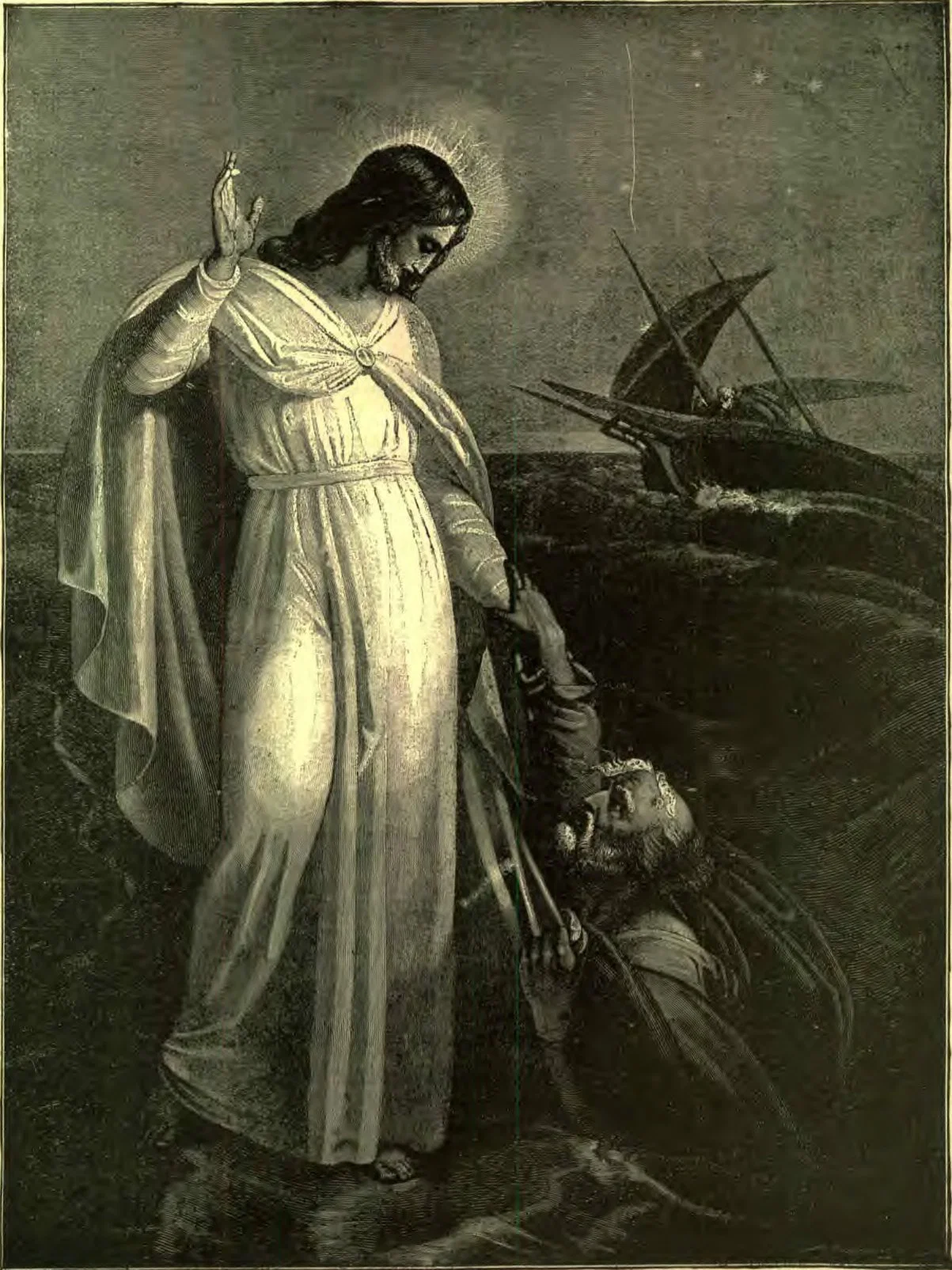
LORD, SAVE ME.
VICTORIOUS ONE, we take our eyes from thee, And only know the raging of the sea,— The wild waves dashing,—and in doubt and fear, Sink mid the billows; yet thou, Lord, art near, And to the cry of dread, “I perish! save!” Thy hand is reached to lift us from the wave.
That word of thine, which faith found firm as rock, Doubt lost, and left us to the tempest’s shock. With woe o’erwhelmed, we saw no heavenly light; The word that called us forth seemed made for blight. Yet in the soul’s dread sorrow, thou wert there, To lift us from the billows of despair.
Self-pride that we could walk triumphantly Lost us the solid pathway through the sea; That look behind, to note the eyes of men, Left us to waves no human power could stem: The billows hid thee, though thy hand was near; Thy tender voice reproved our doubt and fear.
O pride and doubt! foes of the soul, still ye Cause us to sink in life’s tempestuous sea. But Christ can never fail. When we despair, He fainteth not: his great success is there; And to the cry, “I perish, Master! save!” His hand uplifts to walk with him the wave.
Soul, learn thy lesson. It is not in thee To walk in safety o’er life’s troubled sea.
“LORD, SAVE ME!”
The storm will overwhelm without thy Lord, There is no solid pathway save his word. Why look behind? Why gaze upon the wave? Look to thy Saviour: he alone can save.
DOERS OF THE WORD.
By Ellen G. White
I.
Christ attaches great importance to the doing of the word, as well as to the hearing of it. Among those who listened to his teachings were some who found it easy to hear, but who did not bring into their practical life the truths they heard. Christ sought to teach them that the divine word is not to be treated indifferently, but that all who hear it are to be doers of it.
By a parable Christ warned his hearers: “Not every one that saith unto me, Lord, Lord, shall enter into the kingdom of heaven; but he that doeth the will of my Father which is in heaven. Many will say to me in that day, Lord, Lord, have we not prophesied in thy name? and in thy name have cast out devils? and in thy name done many wonderful works? And then will I profess unto them, I never knew you: depart from me, ye that work iniquity. “Therefore whosoever heareth these sayings of mine, and doeth them, I will liken him unto a wise man, which built his house upon a rock: and the rain descended, and the floods came, and the winds blew, and beat upon that house; and it fell not: for it was founded upon a rock. And every one that heareth these sayings of mine, and doeth them not, shall be likened unto a foolish man, which built his house upon the sand: and the rain descended, and the floods came, and the winds blew, and beat upon that house; and it fell: and great was the fall of it.”
As Christ spoke these words, he was walking near the sea-coast. About him were houses, some completed, others in the process of erection, apparently in most desirable positions. The disciples expressed their admiration of the wisdom of the men who had chosen such beautiful and desirable locations; but these houses were built upon the sand. Still another house was built high upon an eminence, which would require hard climbing to reach. This house was built upon the rock.
Passing on some distance, Christ and his followers saw the place where a house had formerly stood; but the ruins alone remained to tell the story. This house had been washed away by storm and tempest, while fierce winds366had not prevailed against the building whose foundation was riveted to the solid rock.
Christ used this instance to impress his lesson. He pointed to the house built high upon the rock, and then to the broken framework and débris about them, and showed the sure result of building upon a sandy foundation. He sought to convince his disciples of the lack of wisdom revealed by the man who built his house so insecurely. “Every one that heareth these sayings of mine,” he said, “and doeth them, I will liken him unto a wise man, which built his house upon a rock: and the rain descended, and the floods came, and the winds blew, and beat upon that house; and it fell not: for it was founded upon a rock. And every one that heareth these sayings of mine, and doeth them not, shall be likened unto a foolish man, which built his house upon the sand: and the rain descended, and the floods came, and the winds blew, and beat upon that house; and it fell: and great was the fall of it.”
Christ likened him who obeys the word of God to the man whom the world had many times denounced as foolish for placing himself in a place apparently so inaccessible. The greatest Teacher the world ever knew looked beneath the foundation, and showed the necessity of building securely, on the rock. Then when rain and tempest sweep down upon the building, it is found secure.
In the illustration we as well as the disciples have a profitable lesson to learn. The house which was apparently so difficult of access, but which had stood unmoved amid storm and tempest, illustrates the spiritual life of those who build upon the sure foundation.
MRS. E. G. WHITE.
Ways Are Not Scarce for God's Work
“Ways are not scarce, nor chances few, For those who long God's work to do.”
THE LAND OF "PRETTY SOON."
By Ella Wheeler Wilcox
I know a land where the streets are paved
With the things we meant to achieve;
It is walled with the money we meant to have saved,
And the pleasures for which we grieve;
And kind words unspoken, the promises broken,
And many a coveted boon,
Are stowed away there in that land somewhere,—
The land of "Pretty Soon."
The road that leads to that mystic land
Is strewn with pitiful wrecks,
And the ships that have sailed for its shining strand
Bear skeletons on their decks.
It is farther at noon than it was at dawn,
And farther at night than at noon:
Oh, let us beware of that land down there,—
The land of "Pretty Soon."
— Ella Wheeler Wilcox.
AROUND NAPLES.
By H. A. Henderson
THERE are some interesting places around Naples, often overlooked in the natural desire to visit Vesuvius and the historic ruins of Pompeii; and it is of my visit to some of these that I will tell you.
On the north side of the city is a large mountain, pierced by two tunnels. One of these is mostly natural, and is used by goatherds and the poorer classes; the other is for general traffic and passengers. Through this we passed one pleasant afternoon; and after an hour's drive through a beautiful country, descended into a valley, shaped like an immense bowl, three miles in diameter. Here we engaged a guide, and were conducted into a hot, ill-smelling cave, the site of the Emperor Nero's famous sulphur baths. There are several rooms, with parts of the ancient stone couches still remaining. In some places, steam hot enough to burn our fingers was issuing from crevices in the walls. This cave is in the crater of an extinct volcano.
A few yards from the baths we entered a small enclosure, and found ourselves before a tunnel extending into the side of the crater, and sloping downward. On our asking our guide if we were to enter this tunnel,—the Dog Grotto,—he said, to our horror, “Two minutes in there would kill you.” At his bidding we followed him in until our shoulders were even with the first step, leaned over, and took one breath, which nearly strangled us. The effect was similar to what would be experienced by holding the face over the top of a base-burner, and inhaling the gas. As long as a lighted torch was held above the level of the first step, it burned; but as soon as it was placed below that level, the blaze was extinguished. Our guide then called a little dog, and in spite of our remonstrance, held it in the gas about fifteen seconds. At first it struggled, then its muscles relaxed; when brought out, it acted as if recovering from drunkenness.
Two miles away we found another crater, a little larger than the one first visited, and not quite inactive. Although it is more than twenty miles from Vesuvius, it is claimed that when Vesuvius is comparatively quiet, this crater is active, and vice versa. In the crater is a lake of white sand, in the center of which is a hole about five feet in diameter, filled with boiling mud. As we approach, we feel a jar, and hear a hissing sound only a few feet under us. At one side of the crater is an opening from which issues hot steam. A man crawls in on his hands and knees, and brings us some sulphur so hot we can hardly hold it.
Leaving this place, we passed through a town and by the remains of an old estate, once the home of Cicero, soon reaching a third crater. In the center is a beautiful lake, on the edge of which are the ruins of an old temple, built in honor of Pluto. Walking along the side of the crater, we found ourselves in a lonely wood, and before what appeared to be a cave. Our guide lighted a torch, and started in, beckoning us to follow. We reluctantly did so, and soon were walking downward in a tunnel large enough for three to walk abreast. On we went; and when we began to look anxiously over our shoulders at the entrance, which had become but a speck in the distance, our guide said, “No fear, no fear.” As we went on, the passage began to narrow; and finally we paused before a side-entrance, through which one could pass only with difficulty. Two men appeared in the passage, looking very large in the flickering light of the torches, and our guide told us to follow them. It was too late to turn back, so downward we went, until it seemed as if we must be in the very bowels of the earth. Suddenly the men ahead of us dropped into the water up to their waists, telling us to get on their shoulders. As there appeared to be no alternative, we complied; and they carried us a little distance to a room twenty feet square, standing us on a ledge of rock while they stood in the water. The ceiling and sides of the room were covered with hieroglyphics and some Greek characters. Mounted again on the shoulders of the men, we were carried into another room similar to the first; then by some winding, narrow passages we reached the main passage, breathing a sigh of relief when we stood once more in the open air.
On our way home we visited the tomb of Vergil, also the prison where the unnatural Nero confined his mother before she was murdered.
H. A. HENDERSON.
JUNE
June, with sunshine in her eyes,
Passed her hand across the skies;
Then, with archly smiling lips,
Blew upon her finger-tips.
Soon the air grew wondrous sweet,
Overhead and under feet;
Under feet and overhead
Trooped the roses, white and red,—
Trooped the roses, crimson, white,
Pink and yellow, pale and bright,—
Till they perfumed earth and air,—
Roses, roses, everywhere!
Wearied then, she shook her head,
And the petals, white and red,—
All the petals, crimson, white,
Pink and yellow, pale and bright,—
Fluttered slowly, softly down
To the border of her gown.
Half dismayed to see them fall,
Quick she turned to leave them all;
Looking back to say good-by,
She met the warm glance of July.
— Selected.
BEARS IN DEATH GULCH.
In the Yellowstone National Park is a ravine called Death Gulch, because it is evident that animals occasionally perish in it on account of the excessive quantity of carbonic acid in the air. In this respect it resembles the celebrated Dog Grotto near Naples. Both are in a volcanic region where active eruptions do not now occur, but where mephitic gases issue from the rocks, and settle in low places. A recent visitor to the Yellowstone Park reports having seen the carcasses of eight bears in Death Gulch.—Youth’s Companion.
THE WORKERS THAT ARE NEEDED.
THE foolish pride and ambition that cause so many young men to push into the ranks of clerks, bookkeepers, stenographers, etc., instead of learning a trade, have brought about the result that these so-regarded “genteel” occupations are both overcrowded and underpaid. While this is true, the supply of skilled craftsmen seldom exceeds the demand; and a first-class mechanic is rarely without employment. The other day a young man, a mason, in this city refused an all-summer's job at twenty-four dollars a week, preferring to work for himself. Many a clerk and bookkeeper working for a third of this sum, or even less, would be benefited not only financially but physically by the change from a close office to some outdoor work.
Not long ago, says a writer in the Wellspring, a shrewd and wealthy business man, talking with a company of friends, declared that if he should insert in all the city papers an advertisement: for a bookkeeper, a clerk, a machinist, and a dyer, at least fifty times as many bookkeepers as dyers would apply. His friends laughed at this statement, and the matter was put to the test, with the result, surprising to the business man himself, that six hundred bookkeepers, twenty carpenters, fourteen machinists, and four dyers answered the advertisement.
This true incident contains a moral so plain that it is not necessary to point it out, and one that the young man who is deciding what part he shall take in the world's work would do well to think about.
THIS IS HOW THEY RISE.
A young woman recently found employment in a queensware store. She immediately began a course of study, in her leisure moments, on glassware and china. She then read some recent works on the appointments of the table; and in a short time, by applying herself to her business, became the most valued employee in a large store.
In a millinery establishment the young woman who found time for reading a book or two on colors and their harmonious combination found her own taste greatly improved and her ability to please increased. She was soon a favorite with both employers and customers.
A young woman who, to earn an honorable living, went into a kitchen, and, instead of gossiping every evening, found time to read a few good books and household papers, was soon too valuable a housekeeper to be kept in a subordinate position in the kitchen. She knew how a table should look for a formal dinner, what dishes were in season, how to serve a meal, and something about food values.
Good sense and application will accomplish wonders.—Womankind.
A FLOWER STORY.
By A. B. C.
It was a pleasant May-day, not very long ago,—
An overarching sky of blue, and tender green below,—
When two small maids with spelling-books went tripping home from school,—
A school where easy tasks were set, and pleasant was the rule.
Two little maids with spelling-books; and as they homeward walked,
They stopped to pick the dandelions, and happily they talked,—
Till all at once both little maids the selfsame moment spied
A very Prince of dandelions in all the countryside.
He was a kingly dandelion, and stood up straight and tall,
Of full a thousand dandelions, the fairest of them all.
“’Tis mine! ’Tis MINE!” cried bonnie Belle, as on both quickly ran.
“I saw it first, you selfish thing! Now—get it if you can!”
As Mabel snatched the flower away, Belle’s tears began to flow—
’Tis queer what very little things will make a quarrel grow!
Why, all about those tearful maids, a-shining in the grass,
A thousand cheerful dandelions laughed but to see them pass.
But when, victorious, in her hand, fair Mabel held the prize,
Its wealth of shining color grew all tarnished in her eyes;
And ’neath her clear-eyed mother’s glance, possession brought a sting
That made the princely dandelion a very hateful thing.
What was the matter, Laughing Eyes, with the dandelion king,
And why did he to Mabel’s heart no lasting pleasure bring?
A. B. C.
MAKING HOME PEACEFUL.
By Mrs. L. D. Avery-Stuttle
XXVII.
On the morning of the second day of her illness, grandmother was so much worse that Mr. Beardsley insisted upon calling a doctor, who pronounced the case very serious. Mrs. Beardsley and Janet were kept busy all that day and the next, giving her medicine, and trying to do something to ease her sufferings; but she rapidly grew worse until it was plain that her mind was wandering. Grandpa Beardsley appeared to be continually in her thoughts.
“James,” she would call, hoarsely, “James, see! your father wants a piece of toast. I’ll make him some. Poor old man! see how white he looks. Don’t—don’t—Ellen—Regie!—don’t speak so cross to him!” and then she would murmur, gently, “Saint of the Lord—poor old man!” Evidently grandmother was living over that never-to-be-forgotten day when the old deacon fell asleep.
At last, on the evening of the fifth day, she appeared to be sleeping quietly, and Mrs. Beardsley was trying to get a little rest, which she sadly needed. Suddenly, about midnight, grandmother’s shrill voice was heard calling in tones of anguish. Mrs. Beardsley hurried into the room, supposing her to be still delirious. In her agony, which appeared to be as much mental as physical, she raised herself up in her bed. Her small black eyes gleamed like balls of fire, and she flung her arms wildly above her head: “Ellen! Ellen!” she cried, “I’m going to die, and I ain’t ready! Where’s James?”
“Would you like to have me send for Elder Maynard, mother? Shall I send Janet?”
“No! no! I want James to pray for me, Ellen. He’s a Christian! Many’s the time he’s been kind to me when I’ve been wicked an’ spiteful. Call James, Ellen. Oh, I wish I’d been better to his father,” she added, with a sigh, as Mrs. Beardsley hurried to call her husband.
With hands raised to heaven, James Beardsley bowed beside the couch of the trembling woman; and with earnest voice and a heart filled with faith, he commended her to the keeping of the Good Shepherd, from whom none of his lambs ever wander so far that he can not hear their cry.
“Do you think he’ll hear, James? will he hear?” she wailed. “Oh, I’ve been a ‘wanton professor’ so long! Bunyan calls ’em ‘damnable.’ If I’d been a better mother, Ellen, you wouldn’t have found it such hard work to do right; but if you an’ James’ll forgive me, mebby the Lord will.”
Ellen Beardsley was sobbing aloud. “Yes, mother,” she said, gently, “we forgive you as we hope to be forgiven.”
Quickly the restless head fell back upon the pillows, the terrified expression in the deep eyes gave place to one of peace; and in a moment the sick woman dropped into a quiet slumber. It was as if the touch of healing had accompanied the assurance of pardon, even as when, nearly nineteen hundred years ago, the divine Master said to the dying sufferer, “Thy sins be forgiven thee; arise, and walk.” When grandmother again awoke, the pain was gone, and an expression of such peace and happiness and love glorified her face that it was almost transfigured. “O Ellen! Ellen!” she cried, “the angels of God have met me!”
After that Grandma Sharpe gradually but surely regained her health and strength. But if those knowing her so well wondered within themselves if the keeping power of God would be strong enough for such as she, they gradually ceased to doubt as the weeks passed away. The jealous, unlovely disposition had been exchanged for one of kindness and loving charity toward all. In this wondrous change no one rejoiced more than did James Beardsley, and he often said to himself, “What hath God wrought!” Even the children noticed the difference in grandma.
“Dranma don’t stold Bessie one bit all day,” the child remarked in an astonished manner one afternoon when she had been unusually trying to grandma’s patience; “Bessie lites dranma now.”
“Why, yes, Bessie,” replied Flossie, in a whisper, “why, yes; grandma says the angels met her one time, and one of ’em stays with her all day now; and I presume,” she added, wisely, “it’s the same one that stayed with grandpa ’fore he died; she acts most ’zactly like him.”
Mrs. Beardsley’s surprise at this change was very great; and though she said little, the Spirit of God was pleading with her every moment. Night and day the burning words that her mother uttered in her mortal terror on that memorable night rang in her ears with ever-increasing frequency, and would not be dismissed: “I’m going to die, and I’m not ready!” What if the angel of death should again hover over their roof? what if she should be chosen? Would she be ready? Ellen Beardsley’s conscience was at work; and memory brought back many a scene, especially in the management of her children, which caused her much regret and pain. She remembered how unwisely she had dealt with Reginald; how she had failed to instruct him and warn him with loving tenderness; what if he were never converted, as the result of her example and unwise course!
In the midst of reflections like these one beautiful morning late that spring the postman called with letters. There was one in the bold, familiar hand of her brother Earl. She opened it with a dull foreboding of evil. It was a very brief letter; and as Ellen Beardsley read it with trembling haste, every word seemed to burn itself into her heart. She noticed that the wrapper was a square pink-tinted one, instead of the plain-white which her brother always made use of, and she dully wondered why he had used it. She even noted the scent of violets on the paper. Just then the canary began a merry tune from his cage in the sunny window, and she dimly realized that Janet was asking her some question about making a pudding for dinner. Strange that in moments of anguish, when the heart is suddenly filled with an overmastering sorrow, the most trivial affairs—the most commonplace sights and sounds—will stamp themselves upon the brain. Once more, with dry eyes and a feeling of suffocation at her heart, Ellen Beardsley read the letter she had received. Let us stand by her side, and read with her the few brief words:—
DEAR SISTER: Reginald left here this morning. I do not know just where he intended to go, but I think to some point in the South. We quarreled yesterday, Ellen, and this is the result. Of course you will blame me; but when I tell you that I have just discovered that the young man has been appropriating money from my office for some time, I trust you will not think me hasty in allowing him freedom to go, as he naturally wished to do. I am much disappointed in him; for he seemed to be doing well at school. You will forgive me for saying that although I am not a Christian, I must say I did not expect such duplicity from a boy who, I suppose, has had Christian precept and training from babyhood.
In much sympathy,
EARL.
With a second reading of the letter, Ellen Beardsley understood more fully its real import. She had only one thought,—to hurry to her own room, where no one could witness her agony. She rose mechanically from her chair, and tottered forward; but her trembling feet refused to support her, and with a moaning cry, “My punishment is greater than I can bear!” she fell heavily to the floor.
For days the stricken woman lay upon her couch of pain, battling for life through the delirium of fever. Weary weeks of tedious convalescence followed,—weeks of heart-searching and deep humiliation of soul,—weeks when memory was busy bringing to her mind scenes which she would fain forget. She remembered with sorrow the unquestioned freedom she had given her son in the use of the too liberal allowance of money she had furnished him from childhood, until all sense of its true worth had been taken away; how she had screened him from blame in the matter of Janet’s stolen money, and stubbornly refused to use reason or judgment.
She sees it all plainly now,—the whole miserable affair. Tom Willis told his story truly, after all,—poor Tom! how she had wronged him! Knowing her son’s dishonesty at last, she could understand many things that had puzzled her in the past. How blind she had been! how unjust to Tom! She decides to write and ask his forgiveness. She remembers her cruelty to little Tim Mallory; her unsympathetic, unloving conduct toward her noble husband; and last but by no means least, her harshness and severity toward his godly father. All these things come up before her, and settle themselves with such crushing weight upon her soul that it seems to her she can never be forgiven.
In deep contrition of heart, Ellen Beardsley reviews her past life with all its deformity; but not until she has fully decided that the blood of Christ alone is sufficient to cleanse her sins; not until she flings herself, in her helplessness and sin, at the feet of the Saviour of sinners, and cries from her burdened heart, “Just as I am, . . . O Lamb of God! I come, I come,” does she feel the sweet peace of forgiveness: but when at last she arises from her bed of suffering, she is indeed a changed woman.
MRS. L. D. AVERY-STUTTLE.
(Conclusion in next number.)
LISTENING
By A. R. Wilcox
It is annoying for one to say anything, and find afterward that nobody was listening. Public speakers often find it difficult to talk to an inattentive audience. Not all have the gift of being interesting in ordinary conversation, but all who have ears may become good listeners. An old philosopher once said that he learned manners from the unmannerly,—by doing exactly opposite to what he saw others do that was disagreeable to him. A. R. WILCOX.
PATTERNS AND MOLDING.
By W. K. Loughborough
As mentioned in the last article, our present study is to be on molding and pattern-making. In making patterns for molding it is necessary to bevel, or, as we call it, give draft to, them, that they may be drawn from the sand without injury to the mold; and, as far as possible, it is best to avoid square corners inside, as such tend to hold the sand. To make a nice corner, warm some beeswax sufficiently to soften it, and smooth it over with the point of a knife blade that has been heated a little.
All nail-holes, brad-holes, or any other indenture should be filled with wax. Never use putty for this purpose, as sand always adheres to an oily substance. All patterns should be sandpapered smooth, and afterward varnished with shellac. When the first coat is dry, sandpaper smooth and varnish again. In this manner apply about three coats of varnish into which has been stirred thoroughly just enough lampblack to color it.
In making a pattern with a hole that has to be drawn, make the draft on the under side. I can not in this article give you all the instruction upon this subject that I would like to.
Now about molding, and the tools used for the work: The first thing required is a kind of sandy loam,—not the gray sand, which slips easily, but a yellowish sand, which, when pressed in the hand, will pack and keep in place.
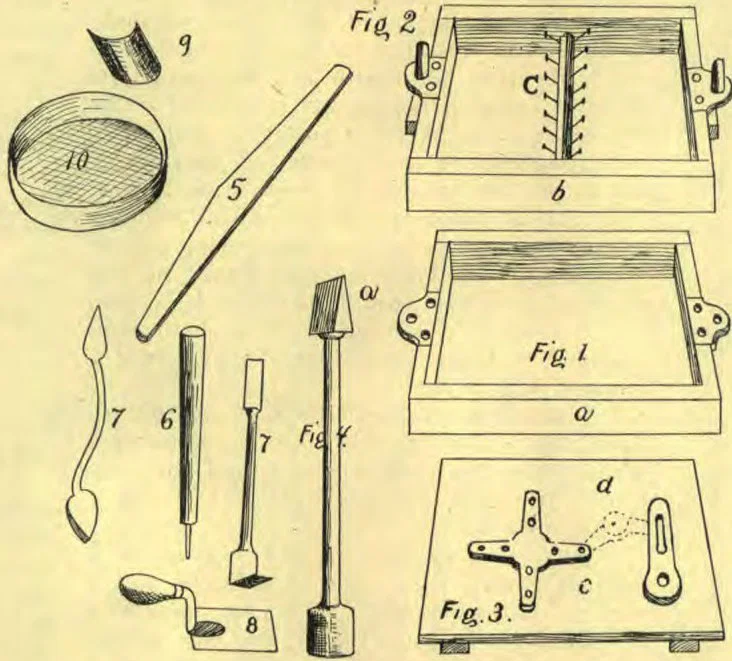
Next come the flasks. Let us suppose we have the patterns for the spider and crank to the lathe. We will make the flask about sixteen inches wide on the inside, two feet long, and ten inches deep. It is made in two parts, as shown in the illustrations. The lumber for such flasks is generally of pine, about one inch and a quarter thick. Then you want a follow-board, also a molding-board. These should be the size of the flask on the outside. In Fig. 1, a is the lower part of the flask, called the “nowel,” and b, Fig. 2, is the top, or “cope.” Upon each end of the flask you will notice some irons with holes and pins to hold the flask in place. Across the top part, or cope, there should be a crosspiece, c, running to within two inches of where the pattern comes. These are beveled from each side, with eight-penny nails driven in to keep the sand from dropping out. Pack the sand under the crosspiece with your hands. Lay down your molding-board, and place your patterns upon it. See Fig. 3. Take a, Fig. 1, and turn it bottom side up, having the irons come down on molding-board. The large side of the patterns should be placed down. Then take a coarse wire sieve (brass wire is best, as it will not rust), called a “riddle,” and sift on a little sand. See that the holes are packed with sand. Do this with your hands, not packing them too hard. Fill your flask with sand; then take your rammer (see Fig. 4), and with the peen end, a, ram around the edges of the flask. With the other end of the implement ram it all down so hard that it will stay in place. Take a stick or straight-edge (Fig. 5), and strike off the sand. Sprinkle on a little sand with the hand, put on your follow-board, grasping both sides firmly; then turn it over, take off your molding-board, and you will see your patterns. Now with a bristle brush, like a counter brush, brush off all the loose sand. See that it is full up to the top of the pattern. Then sprinkle on some parting sand (burnt sand brushed from castings when removed from the mold), and with a hand-bellows blow sand off from patterns.
To form a hole into which to pour the metal, a tool is used called a “sprue.” It is a stick about ten inches long (see Fig. 6), one inch and a quarter in diameter at the top, and three fourths of an inch at the bottom. In this end there is inserted a piece of one-fourth-inch wire, which should project two inches. Place your sprue in the sand (see d, Fig. 3), put on the cope, and with your riddle sift on sand enough to cover your patterns, afterward filling up with sand. Now, with your rammer, as you did at first, take your strike (Fig. 5), and scrape off the top. Pull out the sprue, and with your finger in the hole, rim it out on the top to make a sort of cup to turn the metal into. Take hold of the handles on the ends of the cope (the handles to the cope are blocks nailed to the end of the flask. The handle to the rammer, shown in Fig. 4, is about four feet long), and lift off the cope, letting it stand upon the side. This will separate where the parting sand was sprinkled.
From a sponge containing water squeeze a little around the edge of the pattern. Rap the pattern lightly with a small hammer; then with a gimlet having a coarse screw upon the end, carefully draw out your patterns. Afterward look them all over; and if you discover any broken places, you can mend them with a tool called a “slick.” Wet this instrument so that sand will adhere to it, and patch the broken places, slicking down smooth.
Then with a little piece of tin or brass bent up (see Fig. 9), cut your gate where it enters the mold one eighth of an inch deep, and an inch and a fourth wide from the mold to the sprue (see dotted lines at c, Fig. 3), beginning at the point from which the pattern was drawn; close together, and it is ready for the metal.
Some of the tools used are shown in the illustrations. Fig. 8 is a brass trowel for smoothing the sand. The slick (Fig. 7) is of one-fourth-inch brass wire, from six to eight inches long. Brass wire is generally tempered. To anneal it, or make it soft, heat it red-hot, afterward dipping it in cold water. After it is annealed, hammer the ends thin to the shape wanted. Pounding sometimes hardens it so that you will need to reheat it. Fig. 9 is a piece of tin or brass about three inches square, bent to a curve, to cut the gate. Fig. 10 is a “riddle.” W. K. LOUGHBOROUGH.
HOW DISHES ARE MADE.
By Laura E. Hutchinson
The Chinese were the first to discover the art of making china; and their principal branch of this industry was making teacups, this being the article most used by the tea-drinking Chinaman.
There is a town in China where a great many potters lived, and made their beautiful dishes. There was a river close by this town; and when the cups and pots were finished, they were packed and sent away in the boats. The potters’ furnaces were always burning to bake the dishes, so that at night the town looked as if it were on fire.
The potters would not allow a stranger to stay all night in the place, for fear he would find out the secret of china-making. Visitors were obliged either to sleep in one of the boats or to go away until the next morning. At last two strangers thought they had found out the secret. They saw potters buying large bricks at the markets, and they were sure this was the material they used; and they were right, so far, but they soon found that something else was needed. We can imagine how the Chinaman laughed when he heard that people were trying to make china without “kaolin,” as the necessary substance was called. But now people do not even have to use the Chinaman’s bricks, as there is a kind of clay that does quite as well: it is called “porcelain clay.”
This clay is carried to a porcelain manufactory, where all kinds of cups, saucers, jugs, and basins are constantly being made. It is put into a machine where it runs upon a number of sharp knives that work round and round, and chop it to pieces. When it has been chopped long enough, it is turned into a kind of churn, and churned as if it were going to be made into butter. When the churning is over, it is called “clay cream.” Other substances, such as flint and bone, are then mixed with it; but they have to be ground into powder before they can be used, and then made into a “clay cream.”
Then the two creams are mixed together, stirred until they are quite smooth, and boiled over a fire until the moisture is dried out, and the mass looks much like dough. A man then begins to slap and beat it, and cut it in pieces, and to fling the pieces one on the other with all his might. When he has slapped it long enough, he says it is “ready for the potter.”
The “potters’ wheel,” used in making dishes, is of great antiquity. When china was first made, one man did the entire work of making a dish; but now potters are classed according to their work, as throwers, turners, handlers, etc.
“Throwing” requires a great deal of practise, as a good thrower is expected to throw several hundred pieces a day. In consequence of the new plan of pressing all large pieces in plaster molds, the thrower has but small or moderate-sized pieces to work, and these he finishes only on the inside, leaving the outside to be finished by the turner.
The thrower prepares the pieces of a thicker bulk than is required, and it is the turner’s business to bring them to a proper thickness by removing the excess of material, and giving to the outside a smooth and highly finished surface.
Flat pieces, such as plates, dishes, saucers, and the like, are made in plaster molds, on which a bat of soft clay is tightly compressed by a hand-tool, called a polisher.
In manufactories which have adopted the latest improvements, the ovens in which the pieces are dried are heated by steam-pipes. After the ware is dried, it is placed in “saggars” and fired. The firing must be conducted very slowly at first, to prevent too sudden an evaporation of the damp, which would cause the dishes to crack.
Our best china is painted by hand. In China one man paints nothing but red, another blue, and so on; but here one person paints flowers, another leaves, another fruit, and another figures. After being painted, the dishes are fired for the last time.
It was a long time before people found out how to paint pictures on china, or to give it its beautiful gloss. The surface was not hard enough to hold the colors, and wanted a coating upon it called “enamel.” A potter named Bernard Palissy tried again and again to make the enamel, and spent all his time in trying one thing and then another. We are glad to know that he succeeded at last, and made a great deal of money; but since his time many improvements have been made.
Until recently the English stoneware and earthenware had possession of the American market. We made but little of these wares ourselves; but now manufactories are springing up in different parts of the country, and potters’ clay has been found in many places. The purest porcelain, however, still comes from China and Japan.—Laura E. Hutchinson.