The Youth’s Instructor, Vol. 27, No. 37.

THE TRADES OF ANIMALS

The Youth’s Instructor

Sep 17, 1879

S. D. A. Publishing Association · Battle Creek, Mich. · Sep 17, 1879

THE TRADES OF ANIMALS.

Young readers, do you know that many animals—birds, beasts, and even insects—are good mechanics, skilled in business and building operations? This is true; and what they do is done systematically, with neatness and dispatch. Nor do they idle, lounge about, or stop to play, till the work is done, and well done.
Of all the lower animals, the dog is most remarkable for sagacity and faithfulness. In some countries he acts as a shepherd, often filling the place of several men. Some dogs serve as watchmen, some are hunters, and others are messengers, delivering with fidelity whatever is intrusted to them. The Newfoundland dog, and the dogs of St. Bernard, belong to the Life-Saving Society, as could be testified by hundreds of human beings whom they have saved from a watery grave or a no less terrible death among the mountain snows.
The otter and the heron are fishermen, though they use neither line nor net. The otter we seldom see, for he works his traps mostly under water; but the heron may be often seen standing with his long, thin legs in the shallow part of the stream, suddenly plunging his long bill below the surface, and bringing up a fish.
Ants are day-laborers, and very industrious in their calling; they always seem in earnest at their work. Catch them asleep in the day-time if you can! They set us an example of industry.
The swallow is a fly-catcher; and the number that he daily catches would astonish you. You often see him in his vocation, skimming along the surface of the brook or pond.
The beaver is a wood-cutter, a builder, and a mason; a very good workman at all these trades. He fells the small trees with his teeth; and after he has built his house he plasters it skillfully with his tail-trowel.
The wasp is a paper-maker. His paper is water-proof, and made of materials that no other paper-maker would use. Look at the curious paper dwellings of wasps and hornets—not patented, are they?
Singing birds are amateur musicians, and excel all others in harmony. Hardly can we decide which of them most excels—the lark, the robin, the thrush, or the nightingale.
The fire-fly and the glow-worm are lamplighters.
The bee is a professor of geometry; for he constructs his cell so scientifically that the least possible amount of material is formed into the largest spaces with the least waste of room. Not all the mathematicians of Cambridge could improve the construction of his cells. Nor can the best hermetical sealers among us preserve provisions so well.
The caterpillar is a silk-spinner, far excelling any other in his line of business; indeed, we do not know an art that would supply any silk worth the name without him.
The mole tunnels like a skillful engineer.
The nautilus is a navigator, hoisting or taking in sail as he goes, or casting anchor at pleasure.
Young friends, is not this wonderful, marvelously wonderful? Who endowed these animals with wisdom? God? Yes; God. Who of us could make cells and honey and wax, like the bee, silk like the silk-worm, or music like singing-birds? The goodness and glory of God are seen in all his works. “Oh that men would praise the Lord for his goodness, and for his wonderful works to the children of men!”

THE VISITOR

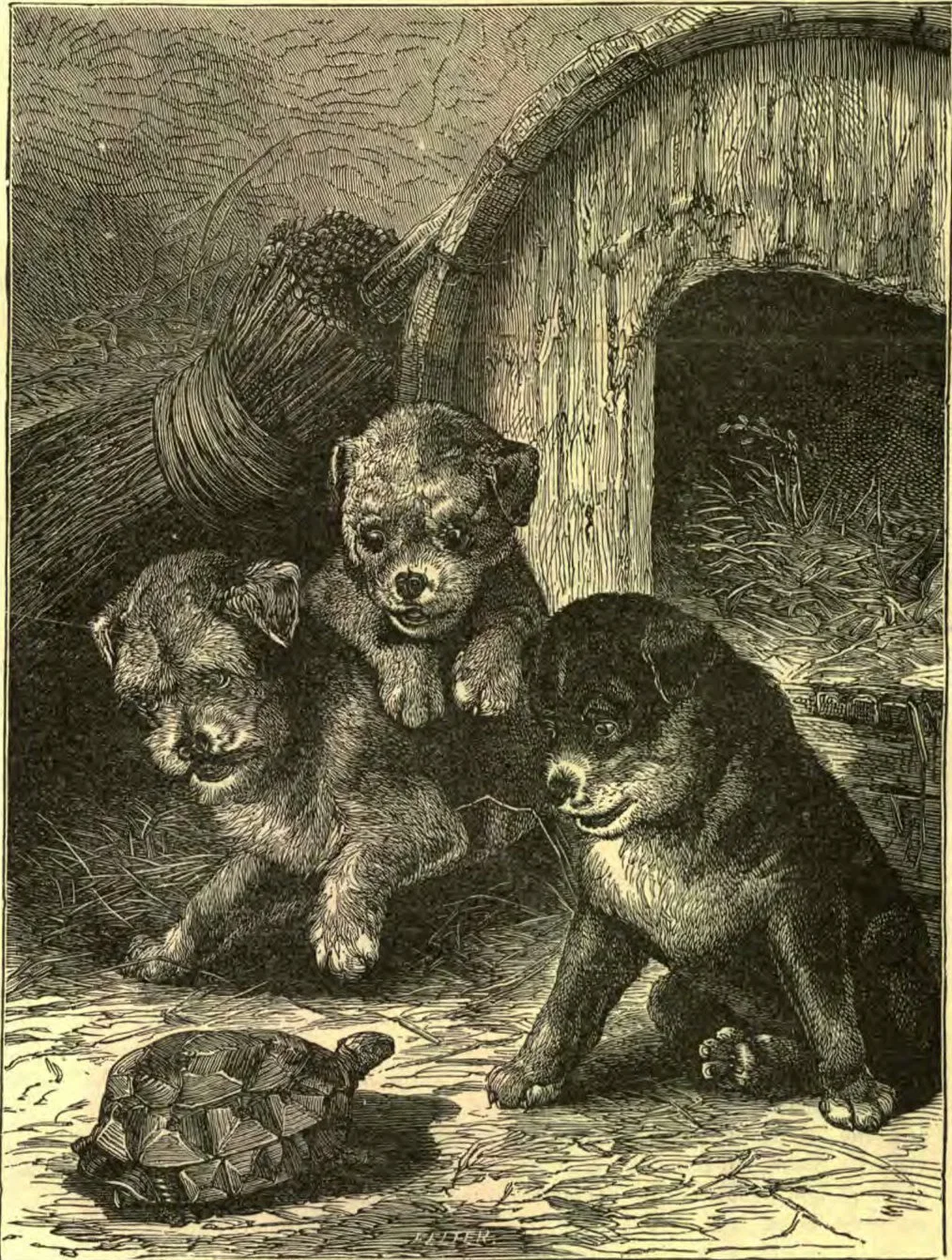
“He's curious, I do declare,” Says puppy No. 1; “I wonder if he comes to fight, Or if he comes for fun.”
“I don't see either fight or fun In him,” says No. 2; “But if he once were sorely tried, No knowing what he'd do.”
“Oh! oh!” says timid No. 3, “I'd like to see my mother; This visitor takes too much room, I'll get behind my brother.” —Myrtle.

BERNARD PALISSY, THE HUGUENOT POTTER.

In a quiet little town in the south of France, more than three hundred and fifty years ago, was passed the early life of Bernard Palissy. His parents were poor, and he had no school advantages; but he was a bright, active boy, and by some means he learned to read and write, and also to paint portraits on glass, and to measure land.
When a youth he left his home, and after traveling through different parts of France he settled in the town of Saintes. Here he advertised himself as a painter and land surveyor, but obtained little employment, and remained very poor.
One day he chanced to see some specimens of ancient pottery, among which was an enameled cup of great beauty. He looked at it with admiration. No man in France could make the enamel to which that cup owed its beauty. Palissy knew nothing of pottery, but he determined to discover the secret of the wonderful enamel.
He immediately began to make experiments, and for seven long years continued his efforts, in the midst of privation, hardships, and repeated failures. At length he succeeded in producing the enamel, and, after eight years more, he established a pottery which became famous throughout France.
From childhood, Palissy had studied the beautiful things of the woods and fields, and now he delighted in reproducing leaves and flowers, birds, butterflies, and even reptiles, in all their brightness of color and elegance of form. His work was highly prized, and he was often employed by the nobility in making various ornaments for the decoration of their palaces.
Palissy was a Protestant, in France called a Huguenot. He loved the word of God, and endeavored to obey its teachings. An inn-keeper named Victor was also a Protestant, and the two friends met every week to study the Scriptures together. After a while they invited their neighbors to join them, and many gladly listened to the message of divine truth.
But they were not long to enjoy these privileges. A new king, Francis II., had ascended the throne, and one of his first edicts commanded that all should be burned at the stake who would not give up their precious Bibles and return to the Catholic church. Palissy continued to preach, and openly to declare himself a Protestant, but for a time his genius secured him from persecution. Finally he was arrested and committed to prison. His captors determined to remove him secretly to Bordeaux, where he would be beyond the protection of his powerful friends.
Victor the inn-keeper, suspecting this design, was waiting near the prison door at evening when he heard the sound of hoofs, and saw a small troop of horsemen approach the gate. It was opened, and a muffled form led out. Victor sang with a careless air a tune which they had often sung together. He was answered by a shrill whistle. Then he knew that they were taking his friend to Bordeaux, and that no earthly power could save him but the king of France.
Victor hastened to the nobleman who had befriended Palissy. The nobleman hastened to the queen. She was about to build a new palace, and being informed of the good potter’s skill she obtained his release.
He soon after went to Paris, where for some years his life was one of great prosperity. Here he made important discoveries, and published several scientific books. At the time of the massacre of St. Bartholomew, Palissy, then upwards of eighty years of age, was sent to the Bastile, from which he hourly expected to be led to the scaffold or the stake. The king was unwilling to see him put to death, and tried to induce him to renounce his faith, but in vain. His answer was, “I am ready to yield up my life for the glory of God. Those who compel you, a king, have no power over me; for I know how to die.” But he was not put to death. Four years he remained in the gloomy prison, and then God himself released him. He had been faithful to his Master here, and a glorious reward awaits him hereafter.
Though not faultless, the character of Bernard Palissy was a noble one. We think the secret of his greatness may be found in these cardinal principles of his life: To persevere in his undertakings, and overcome difficulties, instead of yielding to them; to make use of every opportunity for improvement; to do his best in everything, no matter how insignificant the work might be; and, most important of all, to be true to his convictions of right at all times, and under all circumstances.
M. A. D.

ELIZA H. MORTON

CHILDREN'S VOICES.—NO. 4.

DEAR CHILDREN: I have written to you about your words, and now I wish to call attention to your thoughts. The Bible says, “Out of the abundance of the heart the mouth speaketh.” This means that what you have in your minds constantly, you will speak with your lips. You cannot speak kind, pleasant, loving words when you think unkind or impure thoughts. When evil thoughts enter the mind, drive them away, and try to think of something good. Keep away from bad company, and above all, ask Jesus to give you songs of praise in your heart continually. If the heart is pure, the words will be pure.
Far, far away, beyond the bright stars that twinkle in the blue sky above, there are beautiful mansions in a golden city. God and Christ dwell there; and there dwell also shining angels, whose work it is to keep in God’s books a faithful record of human lives. Every cross, impatient, idle word is written down. Do you desire to know your life-record? The day is coming when those books will be opened, and the deeds of every person stand revealed. Some will then receive a “crown of life,” and some will be banished from the presence of God.
Dear children, with which class will you be found? If you use your voices in praising God while here, you will hereafter unite with angels in singing a higher, sweeter song. May God bless you and help you to prepare for the coming of Him whose “voice is as the sound of many waters.”

ELIZA H. MORTON

DRIFTING

A CERTAIN ship’s crew in mid-ocean beheld a vessel drifting in the distance without masts and without a helm. Steering toward it, they shouted,
“Whither bound?”
Faintly the answer came, “No-whither.”
“Where are your masts and sails?”
“We need none.”
“Where are your charts, your compass, your chronometer?”
“We have none, we need none.”
“Why do you not need them?”
“Oh, we don’t know which way to steer, and so one port is as good as another to us, or no port at all, for that matter.”
“Surely they are mad!” cries the captain as he sails away.
Out on the sea of mortality, is that your bark without sails, or rudder, or compass, or destined end in view?
Do something. Do the best you can. Anything but aimless drifting. Steer toward goodness, spread your sails to catch the winds of opportunity, and press for the port of Heaven.—S. S. Classmate.

LESSONS FOR CHILDREN.

LESSON XXXVII.—SAUL SUCCEEDED BY DAVID.

Saul continued to pursue David for years, trying to take his life, although David had never done him any harm. He took three thousand soldiers with him, and hunted David in mountains, in caves, and in every place where he fled. Finally, David was obliged to go and dwell with the Philistines.
At different times, David had Saul in his power, and could easily have killed him; but he would not lift up his hand against the Lord’s anointed. At one time, Saul came into a cave where David and his men were hidden; at another time, David found him asleep in a valley; for the Lord had caused a deep sleep to come upon him and his soldiers; in the cave, David cut off the skirt of Saul’s garment; and in the valley, he took a cruse of water from under his head, and a spear that stood by; yet he would not harm the king.
At one time, David and his men were without food, and the priests at Nob gave them showbread from the tabernacle. When Saul heard of this, he had eighty-five of the priests slain, because they had helped David by giving him something to eat.
Finally, Saul was greatly troubled, for the Philistines came up with an army to make war, and when he sought counsel of the Lord, he could get no answer; so he sought counsel of a woman that was called a witch, but he found no comfort, for he was told that he and his sons should die. This proved true; for the next day they went out to battle, and were slain.
When David heard of the death of Saul and Jonathan, he mourned greatly. It was natural that he should mourn for Jonathan, his dearest friend; but Saul had been his bitterest enemy, and no one expected David to mourn for him. Although David was much in war, he was always kind to a conquered enemy, and now he seemed to forget Saul’s cruelty, and to remember only his courage and goodness.
Soon after this, the Lord told David to go up to Hebron, and there the tribe of Judah assembled, and made him their king; but Abner, a mighty man of war, who had been captain of Saul’s host, made Ish-bosheth king over the other tribes. Ish-bosheth was the son of Saul, and he and Abner made war with David for a long time. At last, Abner became angry with Ish-bosheth, and tried to have all the tribes take David for their king. About this time, Ish-bosheth was killed by two of his own servants, and David, at the request of the people, became king over the whole land. At the command of David, the men who had killed Ish-bosheth were put to death.

QUESTIONS.

  1. How long did Saul continue to persecute David?
  2. Tell how Saul hunted David to kill him.
  3. Where was David finally obliged to go?
  4. Had David ever tried to harm Saul?
  5. Then why did Saul treat him so cruelly?
  6. Did David ever have Saul in his power?
  7. What instances can you mention? 1 Sam. 24:3, 4; 26:7–12.
  8. Why would not David harm the king? 1 Sam. 26:9–11.
  9. Who fed David and his men at Nob?
  10. How were they punished? 1 Sam. 22:17, 18.
  11. What great trouble finally came upon Saul? 1 Sam. 28:1, 4, 5.
  12. Tell how Saul tried to get counsel.
  13. What was his fate? 1 Sam. 31:3, 4.
  14. When David heard of the death of Saul and Jonathan, what did he do? 2 Sam. 1:17–27.
  1. Was it natural that he should mourn for Jonathan?
  2. Why would he not be expected to mourn for Saul?
  3. What did he seem to have forgotten?
  4. What only did he seem to remember?
  5. What did the Lord tell David to do soon after this? 2 Sam. 2:1.
  6. What honor was conferred upon him at Hebron?
  7. Who was made king over all the other tribes?
  8. Whose son was Ish-bosheth?
  9. Who made war with David at this time?
  10. What did Abner finally do? 2 Sam. 3:8–12, 17–21.
  11. What happened to Ish-bosheth about this time? 2 Sam. 4:5, 6.
  12. At the request of the people, what did David become? 2 Sam. 5:1–3.
  13. What was done with the men who had slain Ish-bosheth?

BIBLE LESSONS FOR YOUTH.

LESSON LXIII.—THE FIRST KING OF ISRAEL.

  1. By whom was Samuel assisted in his old age? 1 Sam. 8:1.
  2. Describe their course of conduct.
  3. What did this lead the people to do?
  4. What comfort and instruction did the Lord give Samuel?
  5. Tell how Saul was anointed
  6. What took place at Mizpah? 1 Sam. 10:17–27.
  7. Were the people agreed in having Saul reign over them?
  8. What united them? Chap. 11.
  9. How was the kingdom renewed, and Saul fully established as king?
  10. How did Samuel show that the people had had no good cause for wanting a king? Chap. 12.
  11. How did he show that from the first the Lord had been their king, and that in desiring another they had rejected the Lord?
  12. By what miracle did the Lord confirm the words of Samuel?
  13. What did the people say?
  14. What instruction did Samuel give them?
  15. What provoked the Philistines to make war with Israel? Chap. 13: 3–5.
  16. How did the men of Israel behave?
  17. How long did Saul wait at Gilgal for Samuel?
  18. What rash act did Saul then perform?
  19. How did he try to excuse his conduct when Samuel came?
  20. What did Samuel say to him?

SYNOPSIS.

When Samuel had grown old, the people became dissatisfied, and wanted a king. They found no fault with Samuel; but his sons, who assisted him in judging the people, took bribes, and perverted judgment.
Samuel was grieved to have the people ask for a king; but the Lord comforted him, and told him to do as the people said. The Lord did not leave the choice of a king to the people; but chose Saul, and brought him before Samuel, who anointed him, and afterward caused him to be proclaimed king at Mizpah. Some of the people were unwilling that Saul should reign over them; but they gladly accepted him after he had delivered them from the Ammonites, who came up against Jabesh-gilead, and greatly terrified the people.
Then the kingdom was confirmed at Gilgal, and the people joyfully received Saul as their king. At this time Samuel called upon the people to witness that he had never taken bribes, nor wronged them in any way, thus showing that they had no good cause for wanting a king. He told them that the Lord had been their king from the first; that it was he who had, from Moses down, raised up men to deliver them; and thus he made it apparent that in desiring a king they had rejected the Lord. He told them that in this they had done wickedly, and called upon the Lord to confirm his words by causing it to thunder and rain. Now this was a time of year when rain never falls in that country, but the Lord sent a thunder-storm in answer to Samuel’s prayer. This greatly terrified the people, and they called upon Samuel to pray for them, which he did.
Two years after this, Jonathan provoked the Philistines to war by making an attack upon one of their garrisons. The men of Israel were very cowardly, hiding themselves in caves, in mountains, in thickets, and in dens. Only a few came to the help of Saul against the Philistines. Saul waited at Gilgal seven days for Samuel to come and offer sacrifice to the Lord; but Samuel did not come at the time appointed, and the people were leaving Saul, so he became impatient, and offered sacrifice himself. Samuel’s delay seems to have been intended as a trial of Saul’s faith and obedience; for as soon as Saul had offered the sacrifice, Samuel came. “And Samuel said to Saul, Thou hast done foolishly; thou hast not kept the commandment of the Lord thy God, which he commanded thee; for now would the Lord have established thy kingdom upon Israel forever. But now, thy kingdom shall not continue: the Lord hath sought him a man after his own heart, and the Lord hath commanded him to be captain over his people, because thou hast not kept that which the Lord commanded thee.”
G. H. BELL.

HOW TIME IS WASTED.

THE Sunday-School World cautions teachers against a practice far too common in Bible classes. It says: “A very large amount of precious time is wasted by Sabbath-school classes in discussing what one and another ‘thinks’ about some subject. For instance, the lesson is the parable of the rich man and Lazarus. Within five minutes after the lesson opens, one is giving his opinion about ‘the probable degrees of punishment in another life;’ another says, ‘I think this—;’ and another, ‘I don’t agree with you, I think,’ etc. Then a fourth says, ‘My opinion is,’ etc. So the discussion drifts until the hour closes, and the members congratulate themselves on having had such a good discussion in Sabbath-school. No teacher should be content to let the hour thus pass. Remember that the main object should be, not to learn what this one and that one thinks, but what God says.”

Spirituality: The Highest Preparation for Sabbath-School Teachers

SPIRITUALITY.—After all, spirituality is the highest preparation. Do you know what the word means? Probe deeper into its signification, until you have an experience of its full possession. To have prayed well is to have studied well, and he who lives nearest to Christ will best understand his word, and best teach it to others. As healing virtue went out from Jesus to her who touched only the hem of his garment, so should healing virtue go forth from every Sabbath-school teacher. And that it may go out, it must first go in by contact with the great Teacher. Then, as the soft iron touching the galvanic battery becomes a magnet and draws to it other metal, will the spiritual instructor, holding fast to Jesus, draw to him a multitude of souls. Here, then, is the secret of wonderful power, of astonishing success, for the busy Sabbath-school teacher.

The Teacher's Preparation Makes Lasting Impressions

THE work of the teacher is not unlike that of the photographer, who employs ten-fold more time to prepare the surface which receives the impression than he takes to secure the impression itself. The impression is the work of a moment. And so with the teacher. A half-hour is allotted in which the impression must be made. Of how much importance, then, is the preparation, when this impression must be made to endure!

“ENOUGH FOR ME.”

Two children talking by the way, One questioned of the other, “Whom do you tell your troubles to, Now that you have no mother?”
“My mother’s friend is mine, you know; She said before she died, I must to her Lord Jesus go,” The orphan child replied.
“Oh, Jesus lives up in the sky! He has so much to do, He couldn’t stop his work in Heaven To look and care for you.”
“About his work I do not know; But he has said he’d see, And listen when I speak to him; And that’s enough for me.”
Oh, blessed childhood, keeping true A mother’s precepts sweet, Our wearied, orphaned hearts would fain The precious faith repeat,—
Would say in all the troubled days, And through life’s mystery, “He says he’ll listen when I speak, And that’s enough for me.” —Sel.

MEASURELESS LOVE.

ONE beautiful, bright morning in early spring, two little children stood at the gate, watching their father mount his horse in order to take a long journey. When ready to start, he bade them good-bye. As he did so, the little boy said, “Father, you will have to ride twenty miles before you can reach the end of my love for you.”
The father smiled, and said to his bright-eyed little daughter, “How far must I ride to reach the end of your love?” After a moment’s thought, she exclaimed, “O papa, you can never ride to the end of my love for you!”
Those little children loved their father because he was very kind to them. All children should love their parents. Some who read this article may not have a father on earth; but we all have a Heavenly Father, who is very kind to us. We should never forget the love which he has shown in giving his dear Son Jesus to die for us, that at last we may live in Heaven with him.
When we have done wrong, if we repent, and ask him in prayer to forgive us, he will do so. Soon he will send Jesus to this earth to save all who have served him. Then we can love him forever, and that love will be as boundless as was that little girl’s for her father. In order to love him forever, we must first learn to love him here. Do you love him now?
S. H. LANE.

THE TITLES OF THE RULERS OF THE WORLD.

The following is a list of the titles given to the rulers of the various empires, kingdoms, republics, and peoples of the world:
President, king, queen, emperor, czar, sultan, prince, lieutenant-governor, mikado, duke, burgomaster, grand-duke, captain-general, governor, administrator, inspector, commissioner, shah, bey, representative, governor-general, and viceroy.
The chief ruler of our own country, and 25 others, is called a President.
Italy, and 15 more, are ruled by a King.
Austria, and 4 other countries, are ruled by an Emperor.
Great Britain, the Society Isles, and Madagascar are ruled by a Queen.
The Russians are ruled by the Czar.
Turkey and Morocco are ruled by the Sultan.
Montenegro, and 11 other small States, are ruled by a Prince.
British Columbia, and 23 other countries, are ruled by a Governor.
Quebec, and 11 other provinces, have a Lieutenant-Governor.
Japan is ruled by the Mikado; Persia, by the Shah; and Tripoli and Tunis, by the Bey.
Anhalt, and 4 other small governments, have a Duke; while Baden, and six more, have a Grand-Duke.
Bremen, Hamburg, and Lubeck are governed by a Burgomaster.
Queensland, and three more, have a Captain-General; and Gambia, and three besides, are ruled by an Administrator.
Egypt is ruled by a Viceroy; Greenland, by an Inspector; Burmah, by a Commissioner; and Andora, by a Representative.
G. W. A.

A PLANT WITHOUT STALK OR LEAF.

THERE is a very big flower with a queer name, Rafflesia arnoldi; but the oddest thing about it is that it has neither stalk nor leaf.
I don’t mean a dead flower with the stalk and leaves plucked away, but a living and growing flower. The one I heard of measured three feet across, weighed ten pounds, and could hold about two gallons of water. It was found in the East Indian island of Sumatra, but I am told that others of the same family have been seen in South America.
These curious flowers grow upon the roots of other plants, seeming to sit on the roots, and spreading up like heads of cabbages.—Jack in the Pulpit.

A BUTTERFLY'S PUMP.

A BUTTERFLY is the very last creature one would suspect of carrying a useful tool, and, above all, of using it. But it is true that this beautiful insect carries, coiled up under his head, a long pump, shaped like two half tubes (as though you split a tube lengthwise). This tube he can open, and after hooking the two sides together, stick it deep into a flower, and pump out every drop of honey there.

Humbly Take What God Bestows

Oh, humbly take what God bestows, And like his own fair flowers, Look up in sunshine with a smile, And gently bend in showers.

LETTER BUDGET.

Oskaloosa, Iowa.
Dear Editors: I am a little girl ten years old. I am not a Sabbath-keeper, but I like to read your paper very much. My aunt sends it to my brother Eddie and me. My pa and ma like to read the paper, and they think a great deal of Sabbath-keepers. My aunt is a Sabbath-keeper, and she is going to take us to Sabbath-school. My brother is six years old. We want to be good children, that we may be saved in Heaven.
Rena Mason.

SPRINGFIELD, OHIO

Dear Editors: I have been trying to keep the Sabbath with my parents all my life. I am now ten years old. I want to be a Christian. I have been taking the INSTRUCTOR some time. I attend Sabbath-school. I have four brothers and three sisters, but I am the only child that lives at home with my parents. Two of my brothers and two of my sisters keep the Sabbath. Pray for me.
Harvey V. Cottrell.

MILTON, OREGON

DEAR EDITORS: I am a little girl thirteen years old. My father is dead. My mother, brother, and I, keep the Sabbath. I do not live with my mother, but with a family of Sabbath-keepers. I am a fatherless child, but God has promised to be a father to the fatherless.
Yours in the hope of a home in the kingdom of God, DELPHIA L. PARSONS.

NASHVILLE, MO

DEAR EDITORS: I take the INSTRUCTOR and like it very much. I have been keeping the Sabbath with my parents, brothers, and sisters about nine years. We have no Sabbath-school here, but I learn the lessons and pa hears me recite them. I want to improve my time, that I may be useful in some way in the cause of God. If pa could send me, I would like to go to the College at Battle Creek. Then I could attend Sabbath-school also.
Yours truly, EDWIN POTTS.

You have reached the end of this edition.

The Youth’s Instructor · Sep 17, 1879