The Youth’s Instructor, Vol. 32, No. 32.

THE EDDYSTONE

The Youth’s Instructor

Aug 6, 1884

S. D. A. Publishing Association · Battle Creek, Mich. · Aug 6, 1884

THE EDDYSTONE.
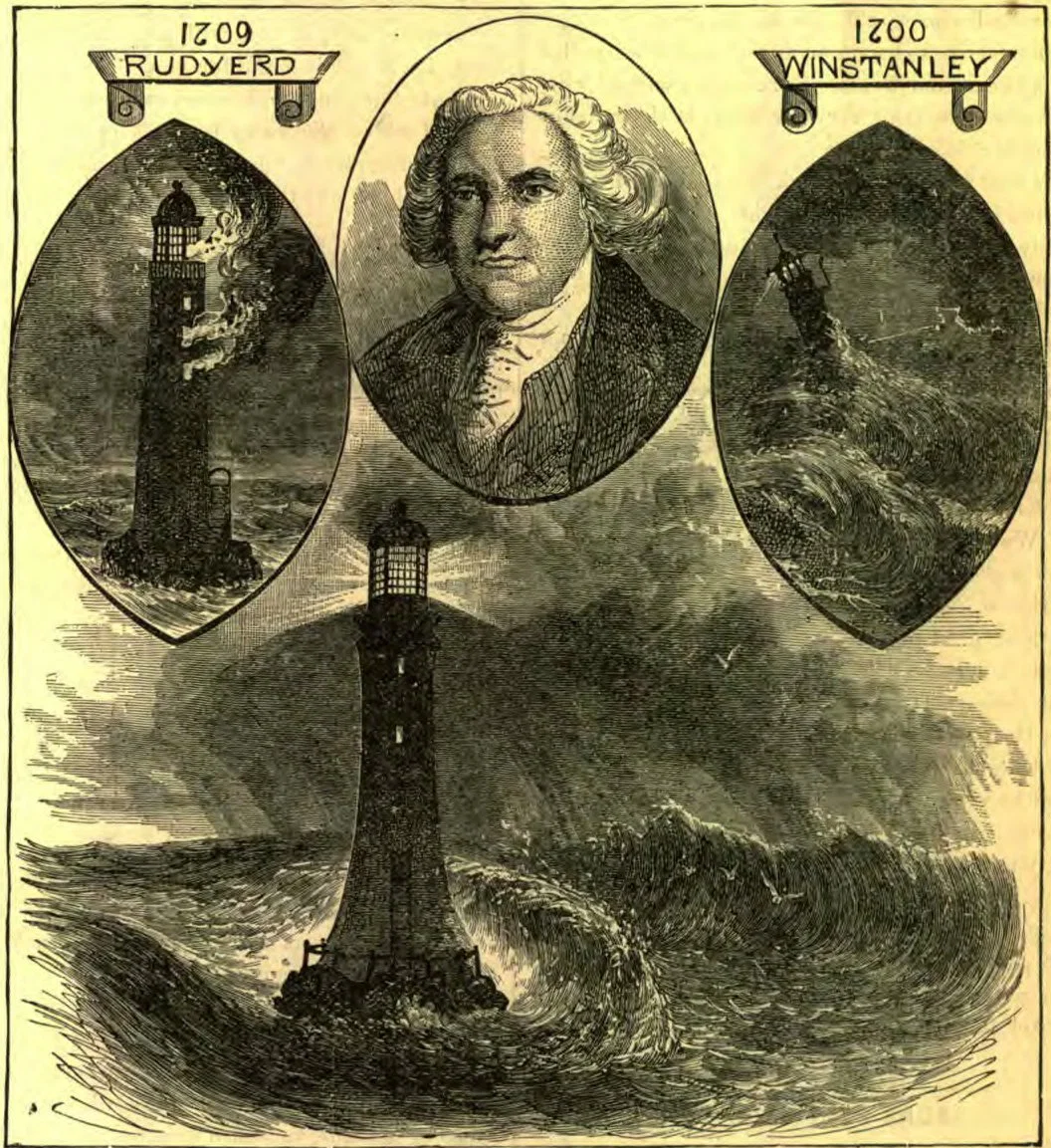
OFF the Cornish coast, in the English Channel, lies a group of gneiss rocks, six or seven hundred miles long, called the Eddystone. The great waves sweep over them night and day, making them at all times very dangerous. Formerly they were the cause of many disastrous shipwrecks.
Winstanley, a mercer of London, whose picture is given in the accompanying engraving, was the first to entertain the thought that it was possible to build a lighthouse on this dangerous spot. He was the owner of five goodly merchant ships, two of which were wrecked off the Eddystone when coming into port, freighted with costly cargoes.
The first, the good ship Snowdrop, “tarried long,” till the owner grew anxious for the safety of the crew; and then, as Jean Ingelow has so well told it, one day—
“Two mariners stepped down the street, With looks of grief and fear: ‘Now, if Winstanley be your name, We bring you evil cheer!’
“‘For the good ship Snowdrop struck—she struck On the rock,—the Eddystone, And down she went with threescore men, We two being left alone.’”
But the noble man mourned not so much for his lost merchandise, as for the brave lives that had been sacrificed in his service.
“The Snowdrop sank at Lammas-tide, All under the yeastly spray; On Christmas Eve the brig Content Was also cast away.
“She was a fair ship, but all’s one! For naught could bide the shock.— ‘I will take a horse,’ Winstanley said, ‘And see this deadly rock.
“‘For never again shall bark o’ mine Sail o’er the windy sea, Unless, by the blessing of God, for this Be found a remedy.’”
Then he went to the mayor, and told of his loss, making this request:—
“‘Lend me a lighter, good Master Mayor, And a score of shipwrights free; For I think to raise a lantern tower On this rock o’ destiny.’
“The old Mayor laughed, but sighed also: ‘Ah, youth,’ quoth he, ‘is rash; Sooner, young man, thou’dst root it out From the sea that doth it lash.
“‘Hast gold in hand? then light the land, It ’longs to thee and me; But let alone the deadly rock In God Almighty’s sea.’”
But he would not be dissuaded from his purpose, and so the Mayor granted his request; and—
“He wrought at ebb with bar and beam, He sailed to shore at flow; And at his side, by that same tide, Came bar and beam also.”
Nothing daunted, he toiled on for four long years, battling with the wind and waves of the ocean, and with that bitterer storm of scorn and opposition on land, until, at last—
“Up the stair Winstanley went, To fire the wick afar; And Plymouth in the silent night Looked out and saw her star.”
Three years it withstood the shock of the waves; but on one wild night, while Winstanley himself was at the tower,—
“The winds broke, and the storm broke, And wrecks came plunging in.
“The great mad waves were rolling graves, And each flung up its dead; The seething flow was white below, And black the sky o’er head.”
When morning broke, the lighthouse tower was down—“down in the deep where he doth sleep, who made it shine afar”—worker and work buried in one common grave.
In 1709, Rudyard erected a lighthouse on the same spot. This was burned by fire; and in 1759, one of solid masonry took its place. This tower was in use until 1882, when, being considered unsafe on account of the wearing away of the rock on which it stood, it was superseded by a larger and better one.
Can we call the first work a defeat? It was a grand victory. “Men called Winstanley crazy; but he had an angel’s thoughts.” Though his work was all imperfect, he led the way, and to him is honor due;—
“For the spirit of the father Has fallen on the son. And Englishmen, with one accord, Unite to make it known, That a light shall shine forevermore From the wild rock Eddystone.”

Choosing Books Wisely

Books, like friends, should be few and well chosen.

AUNT PATTY AND TIM.

Some years ago, there lived in an old cottage on the bank of a small stream in New Jersey a good old colored woman who was known to all the neighbors as “Aunt Patty.” Aunt Patty had lived to see husband and children all laid in the village graveyard; and now, in her old age, with failing eye-sight and hands stiff with rheumatism, she was waiting patiently till the Lord should give her rest.
The overseer of the poor had visited her many times, with the request that she should return to the county of which she was a native, in order to enter the poorhouse there, and be cared for properly. But Aunt Patty always pleaded so earnestly to be left in peace in her own home, that finally he consented to let her stay, and gave her an allowance of one dollar a week. This went far toward the bare necessities of life, but would permit of no luxuries; and some kind ladies looked in from time to time to see if Aunt Patty had coal for her fire, and warm flannels for the bitter winter weather. One of these ladies once asked Aunt Patty how it happened that everything in the cottage was so neat and clean, when Aunt Patty’s rheumatism made it almost impossible for her to stir.
“O Miss Mary,” replied the old woman, “bless your heart! Don’t you know it’s Tim Kearney that clears up for me and puts everything to rights?”
“And who is Tim Kearney?”
“Oh, his father lives down the road a piece, and there’s no end of young ones, and a cross stepmother. And Tim, he comes up to see his old auntie, and get a little bit of quiet; and I teach him to read, and he chops my wood, and I give him a baked potato before he goes home.”
Miss Mary knew Tim by sight, a big, rough, red-headed Irish lad, about fifteen years of age; but how kind the heart was beneath this unpromising exterior she had never suspected.
When Christmas came, Miss Mary took a big basketful of things to Aunt Patty, and at the bottom lay a new calico dress to gladden the old woman’s eyes. When she called again three weeks later, her first words were,—
“Aunt Patty, if you will give me your calico dress, I will get it made for you.”
Aunt Patty’s face beamed with smiles as she hobbled across the room to the clothes-press, and with a triumphant, “Lor’ bless you, honey, it’s all done!” shook out the dress, finished—skirt, waist, and all.
As soon as Miss Mary could speak for astonishment, she asked how all this had been done, for surely the poor, stiff hands of Aunt Patty had never made these neat seams, and stitched on these bands of trimming so evenly: Aunt Patty, who was in such ecstasies of delight that she could hardly speak, at last managed to exclaim,—
“It’s Tim, ma’am, it’s all Tim! He has taken every stitch in it.”
And so it was. Tim, for love of Aunt Patty, had learned to sew, and under her direction, had cut out and made up her new dress as well as any dressmaker could have done. Love truly wrought a miracle when those rough hands learned to guide a needle, and that wild boy sat quietly by Aunt Patty’s side, night after night, after a hard day’s work in a brickyard, and stitched away at the calico dress while she told him Bible stories or sang some stirring Methodist hymn.
In the Caucasus they have a proverb that “heroism is but patience for one moment more;” and to my mind Tim was a hero, when he stuck like a man to his uncongenial task.
Aunt Patty is at rest now in the little green graveyard, and the joy has gone out of Tim’s heart because he can no longer work for her. But do you not think that he will make a better man because of his true, unselfish love for good old Aunt Patty?—Christian Weekly.

LITTLE THINGS.

Each one of a thousand acts of love costs very little by itself; and yet, when viewed all together, who can estimate their value? Not the doing of half-a-dozen great favors in as many years, but the little every-day kindnesses, none of which seems of much consequence considered in itself, but the continued repetition of which sheds a sunlight over the whole neighborhood. It is so, too, in a family. The child whose good offices are always ready when they are wanted—to run up stairs or down, to rock the cradle, or to run on an errand, and all with a cheerful look and a pleasant temper—has a reward along with such good deeds. If a little girl cannot take her grandfather on her lap as he takes her on his, she can get his slippers, or put away his book, or gently comb his thin locks; and, whether she thinks of it or not, little kindnesses that come from a loving heart are the sunbeams that lighten up a dark and woeful world.—Selected.

WHAT THE MEN SAY OF YOU.

"Charlie Leslie," called out a farmer to a boy who was passing, "we are short of hands to-day. Couldn't you give us a turn at these pears? They must be off to market by to-morrow morning. If you will help me, I'll pay you well."
"Not I," said Charlie, "I'm off on a fishing excursion. Can't leave my business to attend to other people's," and with a laugh, he walked on.
"That's just what the boys are good for, now-a-days," growled the farmer. "These pears might rot on the trees for all the help I could get from them. Time was when neighbors, men and boys both, were obliged to each other, and turned in and helped in a pinch, and took no pay but 'Thank ye.' Lads now-a-days are above work, if they haven't a whole jacket to their backs."
"Could I help you, Mr. Watson?" said a pleasant voice just then, as Fred Tracy appeared around the clump of lilac bushes that had hid him from view. He had heard the farmer's conversation with Charlie, and as he was an obliging boy, he was sorry to see the farmer's fruit spoil for want of hands to gather it. "I have nothing in particular to do this afternoon, and would as lief help you awhile as not."
"Might know it was you, Fred," said the farmer, well pleased. "I don't believe there is another boy around who would offer his services."
The matter was soon arranged, and Fred pulled off his jacket and went to work with a will, picking and sorting the fruit very carefully, to the satisfaction of Mr. Watson.
"If that boy had to work for a living, I would hire him in a minute," he thought. "But he'll make his way in any business. One so obliging will make a host of friends, who will always be willing to lend him a helping hand."
Fred would take no pay from the farmer, who, he knew, was working hard to pay off a mortgage. But he did accept a basket of pears for his mother; for they were excellent ones, and the farmer insisted on his taking them.
Ever after that, Fred was sure of a friend in farmer Watson, and one who was always ready to speak a good word for him whenever his name was mentioned. If boys only knew what a golden capital this 'good name' is, they would work harder to get it. It has helped many a man to acquire great riches. It is of great importance to a boy what the men of his place say of him. Never fancy that they do not know you, that they have no interest in what you do. Every business man sees and estimates the boy that passes before him at pretty nearly his real worth. Every man with sons of his own takes an interest in other men's sons. There is nothing like obliging ways to make friends with people, and to lead them to speak well of you. That will be a stepping-stone to all your success in after life.—Selected.

EDITOR'S CORNER.

“THERE'S always a river to cross; Always an effort to make If there's anything good to win, Any rich prize to take.”
In harmony with the sentiment expressed above, it is the experience of all who seek for anything worthy of thought or attention that it is only gotten by earnest effort. Why this rule was made for us by the great Architect of our lives, we do not know, unless it be that anything obtained by hardship or at great cost is most fully appreciated, and hence, as a general rule, put to its best use.
The child creeps; and then it walks; and each day of its future life it may gather strength. But it requires patient toil to reach the pinnacle in any pursuit. Simply desiring a thing does not procure it. The “sluggard desireth, and hath nothing; but the soul of the diligent shall be made fat;” “the hand of the diligent maketh rich.” Whether one becomes rich in worldly goods, in knowledge, in faith, or in any other treasure, there is “striving;” “there are thorns for the feet, and trials to meet, and a difficult river to cross.”
“There's always an effort to make, if there's anything good to win.” It is because of the great prize offered to him who shall strive for it that we wish you all to give this subject the most careful attention. As a people, we believe there is “something good to win;” a literal place for the righteous to inhabit; and although it is described in language the most thrilling, yet it is said, “Eye hath not seen, nor ear heard, neither have entered into the heart of man, the things which God hath prepared for them that love him.” It is well to keep in mind that Paradise is not yet reached.
“Yonder's the fruit we crave, Yonder the charming scene; But, deep and wide, with a troubled tide, Is the river that lies between.”
Shall we, like the sluggard, desire, and have nothing? Shall we shun the difficult river, and so sacrifice the precious treasures on the other side? Ah, no! dear readers, the river must be crossed; and an easy time we need not expect. Indeed, we should not desire it; but, on the contrary, we should prepare our minds for the worst; and then, with one hand in that of the great Leader, one step at a time, we shall be led safely into the haven of eternal rest.
“The rougher the way that we take, The stouter the heart and the nerve; The stones in our path we break, Nor e’er from our impulse swerve; For the glory we hope to win, Our labors we count no loss; ’Tis folly to pause and murmur because Of the river we have to cross.”
“So, ready to do and to dare, Should we in our places stand, Fulfilling our Master's will, Fulfilling the soul's demand; For though, as the mountains high, The billows may roar and toss, They'll not overwhelm if the Lord's at the helm, When the difficult river we cross.” M. J. C.

Bible Study.

Bible study is always a good thing; but Bible study is not always as good a thing as it might be. Wherever the study of the Bible is entered upon in a proud, rebellious, or uncharitable spirit, the mind of the reader is encased as if in triple steel against the entrance of the truth. Most men's difficulties with the Bible are difficulties within themselves; and what is wanted for their removal is not an expurgated Bible, but an expurgated reader. One of the great religious spirits of the present century touches this truth in a sermon on The Inward Witness to the Truth of the Gospel. "When I see," he said, "a person hasty and violent, harsh and high-minded, careless of what others feel, and disdainful of what they think; when I see such a one proceeding to inquire into religious subjects, I am sure beforehand he cannot go right—he will not be led into all the truth—it is contrary to the nature of things, and the experience of the world, that he should find what he is seeking. I should say the same were he seeking to find out what to believe or do in any other matter, not religious; but especially in such a solemn and important inquiry; for the fear of the Lord (humbleness, teachableness, reverence toward him) is the very beginning of wisdom; it leads us to think over things moderately and honestly, to examine patiently, to bear doubt and uncertainty, to wait perseveringly for an increase of light, to be slow to speak, and to be deliberate in deciding." This is certainly the true spirit in which to approach the study of the Bible; and where that spirit is, there need be no fear of Scripture difficulties. Humility, reverence, patience, are the three keys to which the Scripture opens; where these are lacking, the deepest knowledge of the Bible must also be lacking. The true spirit in which to come to the study of the Bible is that of the little child, waiting to be taught, knowing that there is much to learn, and, by God's grace, determined to learn it, if God will. No native brightness of intellect, no acquired power of critical insight, no wealth of knowledge, can take the place of that humility and teachableness which alone will reveal, through the blessing of God's Spirit, the hidden treasures of the word of God. Only in that spirit of docility and in that spirit of reverent humility will the study of the Scriptures become the best which it may become.—S. S. Times.

A PERFECT AND AN IMPERFECT PATTERN

Written for the Instructor.

A PERFECT AND AN IMPERFECT PATTERN.

EDEN, the home of Adam and Eve in their purity and innocence, came from the hand of the Creator a garden of perfect beauty; but this favored pair transgressed God’s command, and were driven from the lovely home that had been prepared for them. Their sin and its sad consequences were put on record for our profit, to serve as a warning to those who should live after them. In the providence of God, samples of character are given us in his word, illustrating vice and virtue, sin and righteousness. Inspired men wrote these histories, that we, viewing the characters of these good men as a whole, might copy their virtues and avoid their failures.
We may look back, and detect the flaws that marred otherwise beautiful and well-balanced characters; but we should never excuse sins or mistakes in ourselves because of the failures recorded on the sacred page. Adam and Eve, and others that lived so long ago, had not the light that we have; but we have the benefit of their experience. We are also favored above them in that the standard of all excellence is before us in the life and character of Christ. On us the Sun of Righteousness has arisen; and in his bright beams, sin appears in its true character. From the teachings of God’s word, and the examples on record there, we know how offensive sin is, and what will be its sure consequences; and this throws upon us a responsibility that our first parents did not have.
Jesus left his royal robe and throne, and came to the world, that he might redeem Adam’s disgraceful failure. He passed over the ground where Adam fell; he endured temptations of tenfold greater power; and yet in every particular he obeyed the will of his Father. Of the scoffing Jews he could ask, “Which of you convinceth me of sin?” Adam and Eve were convinced of sin. They yielded to temptation, and in consequence of their transgression, the world has for long ages been flooded with misery. In contrast there is presented before us the life of Jesus, who, when tempted of Satan, came from the field of conflict a conqueror, pure and sinless. This victory he gained, not for himself, but for the ruined sons and daughters of Adam.
Dear young friends, you should early learn to copy the virtues of the pure and righteous characters that are delineated in the Holy Scriptures. While from the example of those who have erred you may learn what traits of character and what course of conduct God looks upon with displeasure; you may treasure up in your heart the memory of the piety and good deeds of the righteous of all ages; and you may take the same course that made their lives a blessing to their fellow-men.
But above all, aim to copy the perfect Pattern. Jesus led a life of self-denial. In his example there is nothing for you to shun. It was his daily employment to comfort the sorrowing, to relieve the suffering, and to help and bless all who came to him. He is the same pitying Saviour now that he was eighteen hundred years ago, and he will not turn away a single repenting sinner. You may have access to his strength and wisdom. Through the merits of his blood, you may overcome every spiritual foe, and remedy every defect of character. Jesus “was made flesh, and dwelt among us, and we behold his glory, the glory as of the only begotten of the Father, full of grace and truth.” And by beholding, you may become changed into the same image.
And now, which example will you copy,—that of our first parents in disobeying God, or that set by the precious Saviour? The result of sin is before you, and the result of obedience. Adam lost Eden, not only for himself, but for the race,—for you and for me. But through Jesus it will be restored in more than its original loveliness. The prize before you is eternal life in the kingdom of God; is it not worth striving for? “Eye hath not seen, nor ear heard, neither have entered into the heart of man, the things that God hath prepared for them that love him.” Says the psalmist, “In Thy presence is fullness of joy; at Thy right hand there are pleasures forevermore.”
MRS. E. G. WHITE.

GOOD LIFE, LONG LIFE.

He liveth long who liveth well; All else is life but flung away; He liveth longest who can tell Of true things truly done each day.
Then fill each hour with what will last; Buy up the moments as they go. The life above, when this is past, Is the ripe fruit of life below.
Sow love, and taste its fruitage pure; Sow peace, and reap its harvest bright; Sow sunbeams on the rock and moor, And find a harvest-home of light.

MEMORIZING SCRIPTURE.

It is to be apprehended that the inability to give Scripture texts in proof of even the most important doctrines of the faith is a growing defect among the young people in our Sabbath-schools. They are taught everything about the word of God, without learning much of the word of God itself. The defect is a serious one, and is poorly compensated for by any amount of brilliant declamation or discussion on the part of the teacher, which leaves the pupil ignorant, after all, of the Bible’s own inspired words and doctrines. What is most needed is that the young mind, while the memory is still quick, strong, retentive, and unoccupied as to other things, shall be filled with an accurate and extended knowledge of the very words of Scripture. To what better use can the mind of a child be put than to the task, which most children find easy and pleasant, of committing to memory selected portions of the Bible? In all literature there are no words so beautiful and so precious as the words of Jesus and his divinely inspired apostles. In all history and philosophy there are no truths so important for a young mind to learn, and so salutary in training it, as these sublime and beautiful lessons of the word of God. No theory of Christian education can ever be complete without them; nor can any young mind be properly developed in the absence of these divine lessons of love, of truth, of moral virtue, contained in the word of God.
No young person is likely to know much about the doctrines and precepts of the Bible who does not commit its words to memory. There may, indeed, be some desultory acquaintance with its facts, but as to anything more, the knowledge will be, at best, superficial, uncertain, and defective. David could say, “I have hidden thy word in my heart that I might not sin against thee.” What all students of the Bible, whether old or young, need to do, is to store the mind, the memory, the heart, with the very words which the Holy Ghost did inspire, and which God has accordingly spoken in the Scriptures. The loss to the child for life by reason of this omission is incalculable. Our deliberate opinion, confirmed by experience and long observation, is that no one thing could be learned in the Sabbath-school, so important in all its influences and results, as this one thing which is now universally omitted.—The Interior.

Large Giving and the Lord's Abundant Provision

THERE is no danger of growing poor by large giving. The Lord is able to pour in, as we pour out.

IMPORTANT BIBLE SUBJECTS.

LESSON 6.—REVIEW.

[NOTE TO THE STUDENT.—Do not consider the lesson learned until you can give at least the substance of every text, with the correct reference for each. The references in black letters indicate those texts that should be committed to memory. A little diligent application each day will enable you to do this.]
1. WHERE do we find the promise of Christ’s coming? Repeat it.
2. How many times will he come?
3. Prove that the promised coming is not at the death of the saints.
4. Can you show that it does not occur at the conversion of sinners?
5. In what manner will he come?
6. How many will see him when he comes?
7. Who will come with him?
8. Will any one be looking and waiting for him? Give proof.
9. Who will be ignorant concerning his coming?
10. What will produce blindness on this subject?
11. Is it possible for us to know anything concerning the time of his coming? Give proof.
12. When the disciples wanted to know the sign of his coming, how did Christ caution them?
13. Of what terrible calamity to the Jewish people did he speak?
14. Prove that the promise of Christ’s coming was not fulfilled at the destruction of Jerusalem.
15. What did he say would take place after that event?
16. What signs of his coming did he give?
17. When were these signs fulfilled?
18. Then what may we know concerning the coming of the Lord?
19. With what confidence may we teach that his coming is near at hand?
20. How extensively will the truth concerning Christ’s coming be preached?
21. Will everybody believe it?
22. What will be the condition of the world when he comes?
23. What are those who believe that Christ is near exhorted to do?

Sabbath School Department Notes Reference

☞ For additional notes, see the S. S. Department in the Review for Aug. 5.

THE FALSE BALANCE.

Two little girls, in the early morning of an October day, were dressing in a sleepy fashion, or rather one of them was dressing, and the other sat on the side of the bed, looking at her.
“There,” said Bess impatiently, “now that shoe-string must go and break, and I know the bell’s just going to ring. Turn over the leaf, Gussie, so we can be learning the text while we do our hair.”
Gussie got up on to the bed, and turned over the leaf on a roll of texts which hung on the wall, and then stood a minute, reading it to herself.
“Why don’t you hurry?” said Bess, looking up at her; “you’ll be late. My! What a text to pick out for folks: ‘A false balance is an abomination unto the Lord.’ Seems to me if I were to print those verses, I’d find some that had some sense to ’em.”
“Why, Bessie Maynard, that’s in the Bible! How dare you to talk so?” said Gussie, with wide open eyes.
“Well, I don’t mean just that way, of course. I mean sense for everybody. You know yourself there’s a difference. There’s verses about wives, and husbands, and ministers, and—and grandmothers; and they don’t fit everybody. I should think that verse was meant for grocery men that don’t weigh things right; and I just wish they had to learn it.”
“It’s easy to learn, anyhow,” said Gussie, “only I like to think about my verse. Some of them seem made on purpose for me, like ‘Diligent in business,’ and ‘Whatsoever thy hand.’”
“Yes,” said Bess, in a satisfied manner, “you are so slow, Gussie, and such a put-offer; but there isn’t a thing in this verse to think about.”
There was a little silence, for Bessie was brushing her thick, curly locks, and it took all her patience to struggle through the tangles.
“That’s because you didn’t brush it out last night,” said Gussie.
“I s’pose so! but it is such a bother. Dear me! I’m just going to braid it this way; I can’t stop.”
“Oh, Bessie! you know mamma won’t like it; and it spoils your hair,” said Gussie.
“It’ll do for once,” said Bess; “it looks all right, anyhow.”
“I wonder”—began Gussie, and then suddenly stopped.
“What?” inquired Bess.
“I didn’t know—I thought, maybe, that might be what the text meant,” said Gussie, slowly; “sort of half doing things; not giving quite so much as you pretend to”—
Gussie stopped, afraid of offending her sister, of whom she stood greatly in awe; but Bess only laughed, as she answered, “You do think of the queerest things, Gussie.”
That was what they all said of Gussie, but she kept on thinking.
It was her day to dust the parlors.
“I’ll help you,” said Bess, “and then you’ll get through so we can go for chestnuts.”
“But you don’t do the corners, Bessie, and you haven’t moved any of the books,” said Gussie, as she watched her sister’s rapid whisks of the duster.
“What’s the difference?” said Bess; “it looks all right; you s’pose anybody’s going to peek around after a speck of dust? There, now, that’s done.”
But Gussie, with the thought of that false balance in her head, kept on until the work was thoroughly done, saying to herself, “If I pretend to give mamma a pound of work, and only give her half a pound, I’m sure that’s a deceitful balance.”
The next thing in order was to pick over the grapes for jelly, and even patient Gussie sighed over the big basket; but, as usual, Bessie’s part was done long before hers.
“I wish you could learn to be a little more nimble with your fingers, Gussie,” said her mother; and Bessie added, in an undertone, “It’s ’cause you fuss so; s’posin’ a bad grape does go in now and then, who’s going to know it when they’re all smashed up?”
“I don’t care,” said Gussie, feeling a little touched by her mother’s remarks. “I shan’t have any false balances about my work, ’cause the Lord can tell a bad grape if it is smashed up, and it isn’t the grape that matters, it’s putting it in.”
Only one thing more stood between the little girls and the holiday excursion for chestnuts. The history lesson must be learned for Monday, and then they would be as free as the birds. “How I hate it,” said Gussie, “stupid, dry stuff. I don’t see any use in knowing it, anyhow.”
“I’ll tell you what,” said Bess, “let’s begin about the middle, because the first of it never does come to us.”
“And then,” said Gussie, “Miss Marcy will s’pose we know the beginning.”
“Yes,” nodded Bess. “I’m going to finish in half an hour—‘On account of these things it was plainly impossible—’”
“But we don’t know what things,” said Gussie.
“No, and I don’t care.”
“And if Miss Marcy s’poses we know, and gives us credit, it’ll be a deceitful balance, ’cause we make her think we know a pound when we only know half a pound.”
Bessie’s face flushed a little. “I just wish, Gussie Maynard, you wouldn’t talk any more about that grocery man’s text. It’s just nonsense—trying to make it fit us.”
But after all, Bessie did not feel quite comfortable, and she went back and learned the beginning of her lesson.
“There,” she said, “that’s good, full weight, and I don’t intend to be a ’bomination any more.”—Selected.

Letter Budget.

GRACIE PATTEN writes from Shiawassee Co., Mich. She says: “I have taken the INSTRUCTOR two years. I like to read the stories real well. I do not go to Sabbath-school, it is so far away, but I am trying to be a good girl. I am eleven years old.”
EDITH STONE, writing from Sandusky Co., Ohio, says she was baptized at camp-meeting last fall, and is trying to be faithful, so that when the Lord makes up his jewels, she may be one of them. She has one sister and two brothers, and they are younger than herself. She likes to read good books, and papers like the INSTRUCTOR.
NELLIE M. BURKEY writes from Mercer Co., Mo. She says: “I have two brothers and four sisters. We take the INSTRUCTOR, Review, Signs, Good Health, and the Sentinel, and I like to read them all. I am keeping the Sabbath with my pa and ma. I go to Sabbath-school and prayer-meeting when I can. I have never been baptized, but would like to be. I want to obey my parents, and overcome all my sins.”
MILES A. CONNOR, of Langlade Co., Wis., says: “I am twelve years old. I anxiously wait each week the arrival of the INSTRUCTOR. Ours is the only family in this neighborhood that keeps the Sabbath. My only sister died on the morning of the last day of April. She was in her fourteenth year. I cannot tell you how lonely I feel, as I have no brothers. I want your prayers, that I may meet her with the INSTRUCTOR family at Christ’s coming.”
E. A. JOHNSON, of Mason Co., Mo., says: “My papa gave me a few potatoes to plant last year, and I raised a dollar’s worth of potatoes, so that I have paid for my own INSTRUCTOR this year. I have read the New Testament through once. I have never been to school. I learn my Sabbath-school lessons, and we have Sabbath-school at home. I am nine years old, and keep the Sabbath with papa and mamma. We live in the country.”
CHARLIE ALGRIN writes from Blue Earth Co., Minn. He says: “I have no brothers or sisters. I am ten years old. We take the INSTRUCTOR, Review, and the Harolden, and I like them all very much. I can read a little Swedish, that my father taught me. I go to Sabbath-school as often as I can, and study in Book No. 4. I think it is nice to have a Sabbath-school. I have read the Bible through once. I am thankful God gave us such a good book and so many promises, if we are faithful. I want to be a good boy, and not be a stumbling-block for others around me.”
Continue reading: CHILDHOOD PLEASURES