Review and Herald Publishing Company · Battle Creek, Mich. · Nov 8, 1900
“KIM SAN,” OR GOLDEN HILL
By R. W. Munson
In 1893 a little family consisting of father, mother, and three children, all of whom had been born in a foreign land, were passengers aboard a large white ocean steamship that had cleared from Vancouver for Hongkong, China. At first the weather was raw and chilly, and some of the time almost freezing cold, although it was in the month of March. Gradually they slipped out of the chilly latitudes into more southern waters, and finally dropped anchor in the harbor of Yokohama, in the Land of the Rising Sun. From there they sailed on through the lovely inland sea of Japan to the rock-bound harbor of Nagasaki, and at last came to anchor in the quiet waters of Hongkong.
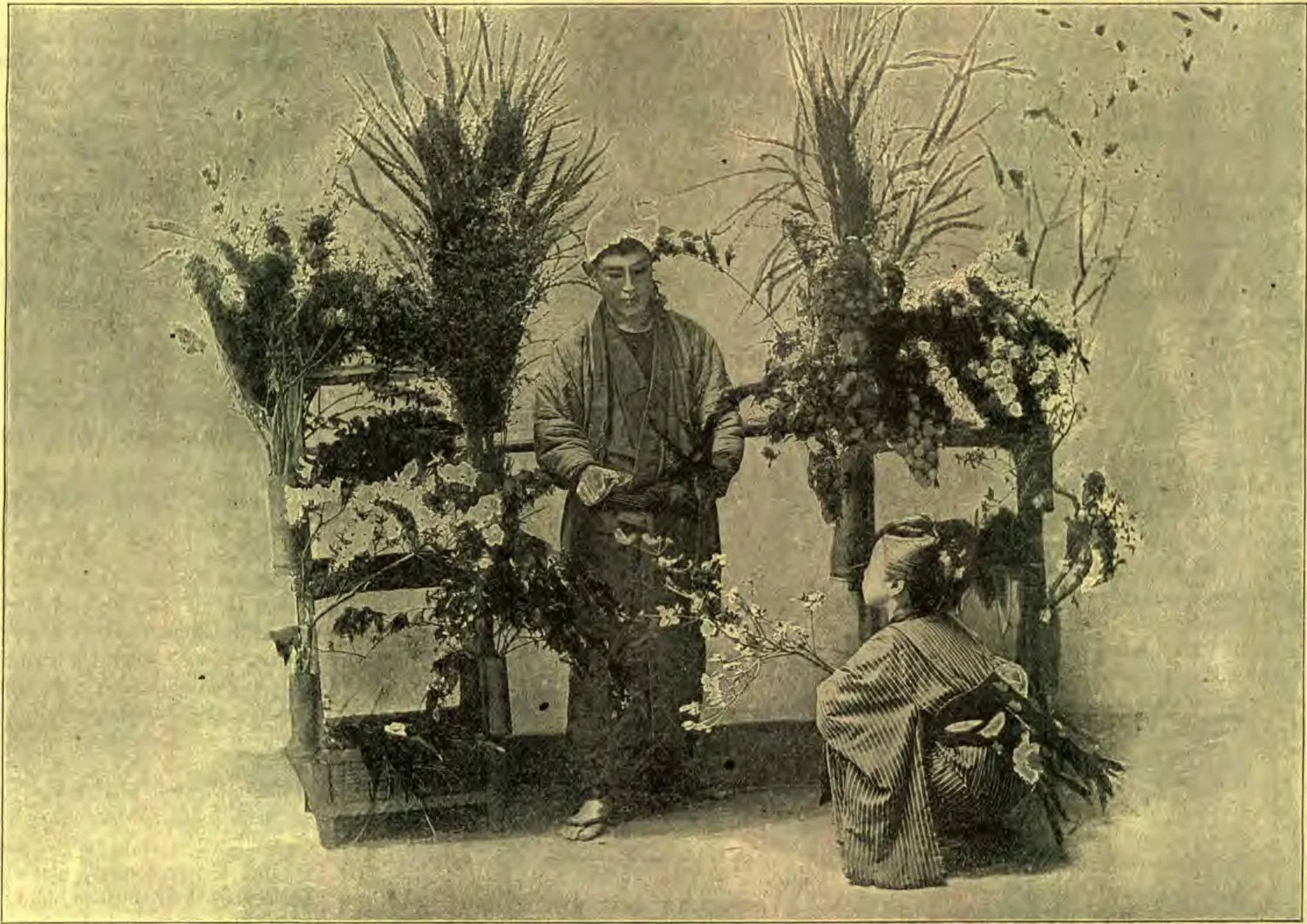
JAPANESE FLOWER-SELLERS
It is hard to realize that it can be so hot and so cold at the same time in two different places in this world, but such is indeed the case. As our three little child-voyagers' approached the equator, they shed their winter clothing; as they sighted the southernmost of the Aleutian Islands, they were passing through a blinding snowstorm; and when they reached Hongkong, they were welcomed by warm showers. From black to white, from thick to thin, from heavy to light — this was the transformation that took place in their garments as they coasted down the shores of the Flowery Kingdom, whence Kim San’s ancestors came. It was not the season of the year when the much-dreaded typhoons (huge rotary wind whirlpools) devastate the China seas, and so they had a quiet passage.
All the journey through, papa and mama and the three child-voyagers prayed for God’s blessing upon the work they were going to undertake. At Hongkong? — Oh, no; their journey was not yet done. Leaving the great ocean steamer, they embarked in one of the neat little sailing-boats beside it, and went over to another and smaller steamer bound for Singapore, six days’ journey to the south and west. At Singapore they were warmly welcomed by their friends, the missionaries; and here, in due time, they were appointed to open an orphanage for poor and orphaned Chinese lads.
To this home there came, early in 1893, three boys, one of whom, Song Liang, was of peculiar interest because of his misfortunes, for he was both orphaned and afflicted. His mother was dead, his father in prison on the west coast of Sumatra; altogether, he seemed so left alone in the world that the hearts of both parents were strangely drawn out to him. This poor lad was not a “good” little boy. Oh, no! He was nakal, or naughty, indeed; yet he had some lovable ways. For one thing, he did not steal, like most of the other lads, and he really tried at times to be good. He knew nothing about the cradle at Bethlehem, or the shepherds on the plain. He had never heard of the “land that is fairer than day,” and did not understand how it was that “God so loved the world, that he gave his only begotten Son, that whosoever346believeth in him should not perish, but have everlasting life.” But he learned all those things, little by little, from day to day; and gradually the light of the gospel broke in upon his darkened mind, until one day, when he had been overcome by the tempter, and had done something very wrong indeed, our papa missionary, whom we will call Mr. Smith, took him alone, and after pointing out to him, in gentle, loving words, the result of such wrong-doing, knelt down and prayed with and for him. The poor boy was convulsed with grief, and then, for the first time, did the Spirit of God open his eyes to see the real blackness and wickedness of sin, and he wept tears of genuine repentance. The result was a marked change in his character. He began to pray, and to struggle against the evil nature within. He found peace and pardon where so many other children have found it — at the foot of the cross. In short, he became, instead of a worshiper of the ugly gods of the Chinese, a true disciple of Jesus Christ. He was then, although very small for his age, sixteen years old. For three years he attended the mission school, and learned English — his mother tongue was Malay — until he reached the fifth reader. He was not a brilliant boy,—such boys often prove the greatest failures through pride,—neither was he dull. He was keen-witted and studious; but neither Song Liang nor Mr. Smith dreamed for what experiences God was preparing the boy.
Early in 1896 it was decided by the missionaries at Singapore to open a mission in the native states of the Malay Peninsula, and Mr. Smith was appointed to take charge of it. He went up the coast, a trip of two days by steamer, to visit the place, secure a house, and arrange for the transfer of the family. Ten days later, on his return to Singapore, he found Mama Smith lying dangerously ill, and a speedy return to America was advised by the physicians. So in three years from the time of their arrival, the family found themselves sailing back again over the broad Pacific. It was a sad journey; for they had left all their orphanage boys to scatter — no one knew where.
And surely enough they did scatter. Only two or three were left, and among those that were scattered was Song Liang. He was not loved quite as much by others as he had been by Papa and Mama Smith, and he ran away from the new home in which he had been placed, and began to drift. He entered into an agreement with an Arab printer to go to Palembang, on the southeastern coast of Sumatra; but he was unjustly treated, and made up his mind to return to his native town, where his sisters and grandmother were. He wrote for the money to pay his passage; and when he had received it, slipped quietly away by a steamer bound for Batavia, whence he sailed up the west coast of Sumatra to Benkuhen, his birthplace. He did not tarry there long, but was sent on to Padang by his relatives, who were well-to-do, and did not care to keep him with them; and again he was sent from there into the interior, up the railway line to Padang Pandjang, at the summit of the mountain highlands. Here he toiled “like a slave” for an aunt, who coined money out of the very sweat of his brow, but paid him no wages. His food and clothing were wretched, and the old woman sought to find some fault in his work, that she might have a chance to justify her cruelty, but she found none.
Two long, painful, weary years the poor boy toiled early and late, without a cent of compensation and no kind words. Then, to cap the climax, in true Chinese fashion she compelled him to marry a girl whom he did not know and had never seen. The young girl-wife made life very miserable for him. She would often drive him out of the room at night, and make him sleep outside, without anything under him but the dirty board floor. She continually reproached him for not providing better things for her; and when he gave her money, spent it as quickly as foolishly, just as any other child would do; for she was not yet sixteen. Erelong a son was born to him; but the child’s advent seemed only to multiply the father’s sorrows. The baby reached the age of ten days (or it may be more), when he must receive a name. According to the custom, many friends came, each bringing a present of a coin, according to their ability, for the little one.
Now occurred an opportunity for the adversary to attack Song Liang again, and compel him to abandon not only his faith in God but his life as well. Among the guests who came to his house was one wealthy Chinese woman, who wore some valuable brooches, or clasps, on the front of her kabiah, or coat-like gown. One of these was stolen by another of the guests, who gave out that she bought it from the wife of Song Liang. To aggravate the case, the real thief was a near relative, and the wife of a well-to-do business man. As the young couple were poor almost to destitution, it certainly appeared a strong case against them. And though the Lord interposed by restraining the prosecution of the case by the interested persons, the shame and disgrace of the accusation clung to the young couple, and there seemed no help nor hope for them. Song Liang lost his situation, and starvation stared himself and family in the face. The last handful of rice was cooked and eaten, and there was not a penny with which to buy more. He had a small Oxford Bible, which he constantly carried about and read. Although he so often did wrong, in his extremity he always turned to the Lord. So at this time, in his perplexity he went alone to pray, and poured out his burdened heart to God for help.
When he returned to the house, a friend came in, and went straight to the rice-box. Seeing it empty, he said, “What is this? — an empty rice-box! Here, go and fill it,” at the same time slipping a coin into Song Liang’s hand. His rent was due, and he had nothing with which to pay it; but his landlady told him she wanted no rent from him. He desired work, and after praying, he started out to seek employment. He was soon hailed by a man in the Dutch government service, and offered a situation in the military hospital. The future seemed to brighten; but home was the last place to which he desired to go, for there he was met with abuse and neglect. If he wanted rice, he had to cook it himself; if his clothes needed washing or mending, he must see to them; if the baby, Kim San, needed food, he must wash his bottle, and prepare the milk. Most painful of all, the dear little fellow was growing thinner and weaker each day, until he was a veritable picture of a famine baby. And a famine baby he was; for he was being slowly starved to death on poor cow’s milk and rice mash. R. W. MUNSON.
Padang, Sumatra.
(Concluded next week)
Ye Are Not Your Own
By Ellen G. White
We sometimes hear the questions: Am I never to do as I please? Am I never to have my own way? Am I always to be restrained? Can I never act in accordance with my inclinations?
The less you follow natural inclinations, the better it will be for yourself and for others. The natural inclinations have been perverted, the natural powers misapplied. Satan has brought man into collision with God. He works continually to destroy the divine image in man. Therefore we must place a restraint on our words and actions.
When the grace of God takes possession of the heart, it is seen that the inherited and cultivated tendencies to wrong must be crucified. A new life, under new control, must begin in the soul. All that is done must be done to the glory of God. This work includes the outward as well as the inward man. The entire being, body, soul, and spirit, must be brought into subjection to God, to be used by him as an instrument of righteousness.
The natural man is not subject to the law of God; neither, indeed, of himself, can he be. But by faith he who has been renewed lives day by day the life of Christ. Day by day he shows that he realizes that he is God’s property.
Body and soul belong to God. He gave his Son for the redemption of the world, and because of this, we have been granted a new lease of life, a probation in which to develop characters of perfect loyalty. God has redeemed us from the slavery of sin, and has made it possible for us to live regenerated, transformed lives of service. God’s stamp is upon us. He has bought us,347and he desires us to remember that our physical, mental, and moral powers belong to him. Time and influence, reason, affection, and conscience,—all are God’s, and are to be used only in harmony with his will. They are not to be used in accordance with the direction of the world; for the world is under a leader who is at enmity with God.
The flesh, in which the soul tabernacles, belongs to God. Every sinew, every muscle, is his. In no case are we by neglect or abuse to weaken a single organ. We are to co-operate with God by keeping the body in the very best possible condition of health, that it may be a temple where the Holy Ghost may abide, molding, according to the will of God, every physical and spiritual power.
The mind must be stored with pure principles. Truth must be graven on the tablets of the soul. The memory must be filled with the precious truths of the word. Then, like beautiful gems, these truths will flash out in the life.
The value that God places on the work of his hands, the love he has for his children, is revealed by the gift he made to redeem men. Adam fell under the dominion of Satan. He brought sin into the world, and death by sin. God gave his only begotten Son to save man. This he did that he might be just, and yet the justifier of all who accept Christ. Man sold himself to Satan, but Jesus bought back the race.
At an infinite cost to heaven we have been given a second probation. Then should not God be in all our thoughts? Should not his will control our actions?
You are not your own. Jesus has purchased you with his blood. Do not bury your talents in the earth. Use them for him. In whatever business you may be engaged, bring Jesus into it. If you find that you are losing your love for your Saviour, give up your business, and say, “Here I am, Saviour; what wilt thou have me to do?” He will receive you graciously, and love you freely. He will abundantly pardon; for he is merciful and long-suffering, not willing that any should perish. He is a loving Redeemer, whose pity survives the neglect and abuse of his mercy, the resistance of his claims.
We, and all that we have, belong to God. We should not regard it as a sacrifice to give him the affection of our hearts. The heart itself should be given to him as a willing offering.
Impressed with man’s great obligation to God, Paul wrote: “I beseech you therefore, brethren, by the mercies of God, that ye present your bodies a living sacrifice, holy, acceptable unto God, which is your reasonable service.” He urges a recognition of God’s claims. “Know ye not,” he asks, “that your body is the temple of the Holy Ghost which is in you, which ye have of God, and ye are not your own? For ye are bought with a price: therefore glorify God in your body, and in your spirit, which are God’s.” MRS. E. G. WHITE.
LIVING AT OUR BEST
It is a supreme hour when the soul realizes the power that God has given it—that it can be what it will; and if it will to live greatly, all the forces of circumstances can not deny it. No poverty can make the generous soul small; for though money be lacking, he can always give of himself; neither can any consideration compel the truth-lover to doubtful words.
Those whose ambition it is to live “in favor with their own difficult spirits” have no time to listen to small voices that approve or condemn; their faces are turned always toward the vision shown them of God. They may seem to themselves—so far above them does the vision shine—to be failures; but all the time their earnestness, their courage, their unswerving devotion, are becoming a part of the world’s life, and lifting all mankind.—Well-Spring.
A SOLITARY WAY
There is a mystery in human hearts,
And though we be encircled by a host
Of those who love us well, and are beloved,
To every one of us, from time to time,
There comes a sense of utter loneliness.
Our dearest friend is a stranger to our joy,
And can not realize our bitterness.
“There is not one who really understands,
Not one to enter into all I feel!”
Such is the cry of each of us in turn.
We wander in a “solitary way,”
No matter what or where our lot may be;
Each heart, mysterious even to itself,
Must live its inner life in solitude.
And would you know the reason why this is?
It is because the Lord desires our love.
In every heart he wishes to be first.
He therefore keeps the secret key himself
To open all its chambers, and to bless
With perfect sympathy and holy peace,
Each solitary soul that comes to him.
So when we feel this loneliness, it is
The voice of Jesus saying, “Come to me;”
And every time we are “not understood,”
It is a call to us to come again;
For Christ alone can satisfy the soul,
And those who walk with him from day to day
Can never have a “solitary way.”
And when beneath some heavy cross you faint,
And say, “I can not bear this load alone,”
You say the truth. Christ made it purposely
So heavy that you must return to him.
The bitter grief which “no one understands,”
Conveys a secret message from the King,
Entreating you to come to him again.
The Man of Sorrows understands it well;
In all points tempted, he can feel with you.
You can not come too often or too near.
The Son of God is infinite in grace,
His presence satisfies the longing soul;
And those who walk with him from day to day
Can never have a “solitary way.”
— Selected.
TECHNIQUE
By Pedro Lemos
PEN-DRAWINGS, as stated in the last lesson, should be made larger than the size to which they are to be reduced. The finer the work, the less reduction it will stand; if reduced small, and the lines have been drawn too close together, the spaces between the lines will be apt to fill up with ink, even with very careful printing, and the artist must not count on that.
A good course to follow is this: If you are merely practicing to learn the handling of your pen, make your drawing large; but if you are making the drawing for publication, do not let it be more than twice the size you expect it to appear on the printed page. By this means the lines come out clean, distinct, and sharp-cut, which they are not likely to do when reproduced the same size as drawn.
In charcoal or pencil it is possible, in drawing an outline, to build up a line by drawing lightly, and then partially erasing, again drawing and again erasing, till the line is complete. In penwork it is possible first to draw an outline in pencil, and then go over it in ink, but the final outline, once in ink, must remain. Of course the line may be erased with a penknife or obliterated with a little Chinese white, and a new line drawn; but this method is resorted to only in case of an error, and is never as satisfactory as to draw the line correctly the first time. But there can be no continual erasing, as the student who has been trained in an art school does when drawing in charcoal or pencil.
There are many different ways to make your lines, or technique; but there are three methods which are more generally used, and under which all other techniques may be classed.
First, is the crosshatching. This is employed a great deal for shades and shadows, and in backgrounds, but is seldom used nowadays throughout a drawing, as it has a tendency to make a picture look mechanical and unnatural. Crosshatching is made by drawing parallel lines, and crossing these with a second set of parallel lines; the deeper the shade, or shadow, the more lines will be required, all crossing each other.
This method is illustrated in the lines of the accompanying drawing (1). The drawing above each set of lines illustrates their use in a picture.
The student should be careful not to run the lines, in crosshatching, too close together, as the least reduction will make the shade print solid black. For curved surfaces, curved lines, crosshatched, are used.
The second method of expressing shadow, or depth of tone, is by increasing the number of lines. The deeper the shadow, or tone, the closer the lines should be drawn to each other, as in the lines shown in 2. Do not attempt to make very long strokes, and do not overlap the ends of the lines, as this will leave an uneven shade.
The third method is by pressure of the pen, as shown in lines 3. This can be done by beginning at the light end of a line, and gradually thickening the line as you approach the shades, by pressing the pen; or the process can be reversed, and the dark end of the line drawn first, whichever is easier for you to do. Do not allow your pen to run dry before recharging it, as you will then have gray lines, which will reproduce brokenly.
The first thing to acquire is firmness of touch. You must get your hand under control, just as a pianist does in running scales and practicing exercises on the piano. Practice of the foregoing methods for some time will do much toward steadying the hand. Draw the lines boldly, and do not hesitate, as a quick, free stroke is necessary to give the evenness of tone that you wish to acquire.
When you have gained a certain proficiency in the handling of your pen, you will, of course, not be bound down by these precise methods of expressing light and shade; but at the beginning, at least until you have trained your hand correctly, it will be better to use them. Artists are continually striking out in paths of their own, and discovering new ways, peculiarly their own, of obtaining effects. One thing the student will find of great help is the study of good examples. He can supply himself with materials, and learn how to use them, he can learn from nature to interpret what particularly interests him; but the quickest and best way to gain the proficiency desirable is to study the work of the best pen artists, in which he can learn both the handling of the pen and how to interpret nature. PEDRO LEMOS.
Forgetting Faults and Choosing Happiness
If you would increase your happiness and prolong your life, forget your neighbors’ faults. Forget the slander you have ever heard. Forget the temptations. Forget the fault-finding, and give a little thought to the cause which provoked it. Forget the peculiarities of your friends, and remember only the good points, that make you fond of them. Forget all personal quarrels or histories you may have heard by accident, and which, if repeated, would seem a thousand times worse than they are. Blot out as far as possible all the disagreeables of life; they will come, but they will grow larger when you remember them; and the constant thought of the acts of meanness, or, worse still, malice, will only tend to make you more familiar with them. Obliterate everything disagreeable from yesterday; start out with a clean sheet for to-day, and write upon it, for sweet memory’s sake, only those things which are lovely and lovable.—Selected.
Pity and Need Make All Flesh Kin
“Pity and need make all flesh kin.”
MARY’S LESSON
By Grace L. Collins
It was not strange that in the fall of her freshman year Mary Snow should have been dazzled by the sudden change of fortune that had befallen her in the new world of college. The deference paid to her as class president was, indeed, in striking contrast to the patronage she had received when she had waited on customers behind the counter of her father’s little book-shop, and studied between times. What wonder that Mary felt that if the petty economies and hardships of her home life were known, she could never again be the boon companion of these merry-hearted girls?
But when, one morning, Mary received a letter from her father saying that he would pass through the college town on a business trip, and that he would spend the afternoon with her, she suddenly realized that the old, hard-working life was as much a reality as this new, care-free one. As she greeted her father, she could not but notice the faded coat, the threadbare hat. To the fine, scholarly face she gave no thought: it was father, that was all.
There were two ways of reaching the campus from the station, known as the front way and the back way. The first led past the shops, where college girls were always swarming. The second was generally deserted, save by washerwomen with bundles and boys with groceries.
“Father,” said Mary, after a minute’s hesitation, as she chose the back way, “this is ever so much shorter—”
“That’s good, Mary; I am rather tired. Now tell me all about college,” he responded.
Mary began to tell of her new experiences; but as they went up the deserted street, all the sunshine of her life seemed to have been clouded over. She was trying vainly to persuade herself that it was a kindness to protect her father from possible criticism, when she saw coming down the road the one girl whose opinion she valued most—a senior, Helen Clarke, who stood to Mary for all that a girl should be.
As they met, Helen stopped to ask Mary about a class meeting; and then, in a commanding little way of her own, paused for an introduction. “O Mr. Snow!” said she, “I hoped this was Mary’s father when I saw you with Mary. I have longed to meet you ever since I read your contributions on Russian literature in the corner of that little Lawtonville newspaper. I have saved all the articles in a little book; they should be collected into a volume. Don’t you think so, Mary?”
Mary, who had been so absorbed in her own study that she had scarcely been aware of her father’s work, and was quite ignorant of its value, shamefacedly nodded assent.
“Have you any special plan for this afternoon, Mary?” went on Helen; “because there is to be a meeting of a literary club of seniors at our house; and it would be the greatest favor if Mr. Snow would be willing to come, and let us all meet him, and possibly tell us more about his favorite Russian poet, whom he knows so well, and we so slightly. Can’t you come with me now?”
Mr. Snow accepted with pleasure, and the three turned up a side street into the front way. Then, as Helen led Mary and Mr. Snow across the campus, she took pains to introduce all passing professors. As Mary saw her father and instructors face to face, she realized suddenly the dignity of her father’s presence, the patience of his daily drudgery, and the pathos of his unappreciated genius.
The parlor was full, and Mr. Snow was greeted warmly. He was given the seat of honor; while the girls sat on the floor, the window-sills, and the arms of one another’s chairs. Mr. Snow glowed with enthusiasm for his favorite Russian, and the girls glowed with enthusiasm for Mr. Snow.
It was in a party of five or six seniors, after that most successful meeting had adjourned, that Mr. Snow was shown every detail of the campus, Mary, very silent, bringing up the rear. Then Helen escorted Mary and her father to the station; for Mr. Snow wished to leave suggestions concerning the studies of the club. Finally, when the train had pulled out, and Mr. Snow, his dark eyes flashing with pleasure, had waved the last good-bys, the two girls stood silent on the platform.
Then Mary sobbed, “O Helen! Helen! I am so ashamed!”
“Don’t say a word, my dear,” replied Helen, quickly. “When I was a freshman, I chose the back way once, but I didn’t meet any senior. I’ve always felt that I must do something to try to blot out that blunder. You have given me the opportunity.”—Grace L. Collins.
ARE YOU WILLING TO DIE ON THE ALTAR?
By David Paulson
ARE you sure that you are camping on the altar of service? It is certainly much better to live there than to die there, but it is better to die there than try to live anywhere else. All the dross in us must be consumed; but that which God consumes he will replace by something else a hundredfold more precious and enduring. Providence has ordained that “there is no man that hath left house, or brethren, or sisters, or father, or mother, or wife, or children, or lands,” for Christ’s sake, “and the gospel’s, but he shall receive an hundredfold now in this time, houses, and brethren, and sisters, and mothers, and children, and lands, with persecutions.”
Every one who attempts to engage in any branch of the Lord’s work must of necessity leave behind him some of the associates of his childhood. Various motives may prompt him to do this. The soldier boy does this very thing for the sake of country, glory, or adventure; and instead of receiving a hundred times more than he left, he will be fortunate if he secures a hundred times less; for Jesus guarantees this result only to those who leave these things for his sake and the gospel’s.
When the young Christian goes out into the missionary field, or enters one of our institutions for training, and discovers that he has fared no better than the soldier boy, it is the only evidence he should need to show him that his motives were of no higher order. The true worker will find, in the new fathers and mothers that God raises up for him in the way of matrons and managers, the new brothers that he secures in the way of roommates or associates in work, the room or rooms which are assigned to him in the place of the house or houses he left, something that will be a hundredfold better than that which was left behind. And if he can not recognize the same by sight, nor reckon it to be so by faith, he needs no greater evidence that he did not leave what remained behind for Christ’s sake and the gospel’s; for God’s word never fails. The new roommates may seem disagreeable; but there will be some development of character acquired by associating with them that will be a hundred times more valuable than could have been secured from those left behind. The room itself may be small and poorly furnished; but if the beautiful apartments at home were left for Christ’s sake and the gospel’s, the apparently insignificant quarters will become the habitation of angels of light to such an extent that the self-sacrificing worker will be led to exclaim, “A day in thy courts is better than a thousand.” The matron may appear severe and exacting; but the lesson of painstaking faithfulness required in the work will be worth a hundred times more than the easy-going way in which the fond mother, in her mistaken kindness, allowed similar tasks to be done at home.
In addition to receiving this hundredfold more of blessings than we could have secured if we had hushed the call of duty, we are also to receive persecutions. And there are many who are anxious to take only the first half of this divine prescription, leaving out that part which pertains to persecutions. But the young men and women who are to have the privilege of having one end of the balance-beam loaded down with a hundred times greater blessings than they ever experienced before, must be willing, for their own good, to allow God to weigh down the other end of the beam with a hundred times more persecutions than they have ever endured before.
This answers the query that so often arises in the minds of young missionaries, “Why do I seem to have more trouble now than I did before I entered the work?” for in order to have a share in the glory of Christ, we must also have a share in his sufferings.
DAVID PAULSON, M. D.
THE FRUIT OF DIVINE SEED IS DIVINE CHARACTER
By W. S. Sadler
The mind of man is the soil; his time, opportunity, and talents are the seed; while the fruit that results is the character. The soil may be human; but if the seed is divine, if we become partakers of the divine nature, if the growth and development of the seed are presided over by the mind which was in Christ Jesus, then the fruit—the character—will be divine. Talents, abilities, faculties, are not character; they are but the seeds that have in them the possibilities of developing character, and the character into which they are made will largely depend upon the influences and atmosphere with which they are surrounded.
God has given to every man a garden spot, if we may call it so, and at least one talent—the talent of time. Upon the conscientious and faithful use of this soil and seed is dependent the fruit he will gather,—the character he will develop. Watered by the dews of heaven, and shone upon by the precious rays from the Sun of righteousness, the fruit of character may ripen day by day, provided there is an unbroken connection between the Vine and the branches,—between us and Christ. W. S. SADLER.
“GARLAND” STOVES AND RANGES
were awarded highest prize at Paris Exposition, 1900.
Moonlight Peace
By Minnie Rosilla Stevens
The pale November moon ascends
The eastern firmament to-night,
And over sleeping wood and hill
And meadow sheds her silvery light.
A branching oak against the sky
Stands out in mystic tracery;
With mournful voice the night winds sigh
In broken chords of harmony.
The earth seems steeped in dreamless sleep;
And peace—His peace—is over all.
Who, in beholding rest so deep,
Would weary task or toil recall?
Oh, that the peace of sleeping wood,
The glory of the autumn moon,
Might every tired spirit soothe,
And every darkened soul illume!
Yea, more! To such might every glance
At peaceful wood and moon so bright
Foreshadow heaven’s eternal peace,
And speak of Him who is its light!
Minnie Rosilla Stevens.
A Curious Dairy Herd
By Edison J. Driver
In the old ivy vine that shades our porch a strange industry is being carried on by ants. All day long I can see them hurrying up and down, to and from their work. They appear to be as much absorbed in it as are men in business. And as I watch closely, I observe that in some ways they are quite as knowing and shrewd as men. Indeed, they must be wise; for their business is nothing less than the herding and milking of cows, and that, too, in a land full of enemies.
Ant-cows are properly called “aphides,” but most often we call them simply “plant lice,” “green flies,” or “blight.” Every summer they live on our rose-bushes and garden plants; and unless we sprinkle them with tobacco water, often do much injury. But as one man’s loss is often another’s gain, ants find aphides valuable for their honey.
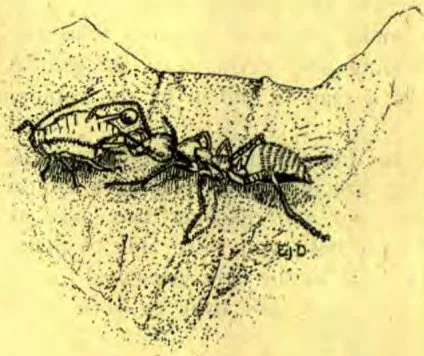
The illustration shows a common garden ant milking one of his cows. This he does by tapping the little creature gently, thus coaxing it to yield its store of honey-dew. If successful, the ant will greedily devour the sweet nectar, and then go to another “cow” for more, and so on till he has milked five or six. Imagine your dairyman drinking the milk from half a dozen of his cows at one meal!
Do you know what this honey-dew that the ant likes so well really is?—It is glucose. In drinking the juices of plants, the aphis gets more sugar, or glucose, than its body can use, but only little muscle-making food along with it. The insect must continue eating, and in some way get rid of the sweet, which otherwise would clog its system. So nature has provided for it the little tube-like strainers shown in the picture. Through these it yields glucose at the call of the ant.
ANT MILKING AN APHIS
But ants do more than milk their cows. They also keep them on good pasture. If you will notice, you will often see the aphides gathered in large numbers on the juiciest shoots and leaves. From this it is plain that ants know the best food for their stock, and also that it is easier to protect their herd when gathered closely together; for, as I said before, they live in a land of enemies.
Only a few days ago I saw a small worm creeping stealthily among them, leaving their skins and dry bones in his path. Then there is the little ladybug, which drinks their blood. Another foe lays eggs within them, and the young from these eggs actually eat the poor creatures out of their skins. But their worst enemy is intense cold. The frost of winter would soon destroy the whole aphis race, could it but reach them. Only two things prevent this,—greenhouses, where the aphides may live during the winter, and ants.
Early in October the aphides lay their eggs and die. Ants find these eggs, carry them into their warm nests, and carefully tend them during the winter months. Then when spring comes,350they are brought out, and placed on buds and leaves. In the warm air and light they quickly hatch; and the little aphides at once begin drinking the sweet juices, and making honey for their protectors. Edison J. Driver.