ONE of the features of the last days, set forth to arouse alarm, and awaken action, is that deception of the most fatal kind will be abroad, and well-nigh all-powerful, in the land. One of the most emphatic injunctions given for the Christian in these times is, “Be not deceived.”
To be deceived is to be misled; to be made to think that something is true which is false, and that something is false which is true: and this is usually practised on the part of the deceiver, to gain some advantage over the victim, for the deceiver’s benefit, or to lead the deceived into trouble, and perhaps destruction, for the sake of hatred or revenge.
But why, speaking from the standpoint of the great moral and religious field to which the Scripture admonitions apply, should any one be deceived? It is not that God has irrevocably doomed any one to deception, or will suffer deceptive power to fall upon any one to such a degree as to put it beyond his power of discernment to detect, or his ability to resist, if he will lay hold on the source of strength provided. The rule by which God acts in this matter is, in a sufficient number of instances, clearly stated. It is spoken of those whose blindness could be said to be a judicial infliction of punishment from heaven, if that could be said of anything of that nature; but, as the record shows, it was nothing of that kind, but a condition for which the persons involved were themselves responsible. It reads as follows: “And for this cause God shall send them strong delusion, that they should believe a lie: that they all might be damned who believed not the truth, but had pleasure in unrighteousness.”
The apostle had just before been speaking of the working of Satan “with all power and signs and lying wonders, and with all deceivableness of unrighteousness in them that perish; because they received not the love of the truth, that they might be saved.” In this scripture much is stated, and much is implied. It is most clearly and explicitly declared why any are left to be deceived, and to perish.
A more strictly literal construction, and translation, makes it seem, to the writer, at least, a little more forcible. We quote from Berry’s “Interlinear Translation of the New Testament:” “The working of Satan in every power, and signs and wonders of falsehood, and in every deceit of unrighteousness in them that perish because they received not the love of the truth, to save them. And on this account God will send to them a working of error that is false, for them to believe; that all who believed not the truth, but delighted in unrighteousness, may be judged,”—krithosin, condemned.
The perfect vindication of God’s justice stands out upon the very face of these statements: “They received not the love of the truth [which was designed], to save them.” But no one can receive the truth, or the love of it, till it has been set before him. This, therefore, shows that these persons had had full access to the truth, and opportunity to receive it; and when one has had the truth fully offered to him, and urged upon him in all its strength and loveliness, but refuses to receive it, and persistently turns his back upon it, upon whom lies the blame of his consequent blindness and error?—The answer refuses to be withheld: Upon himself alone, most assuredly. Mark the force of the expression, “God will send to them a working of error that is false, for them to believe.” He sends it in the sense that he will not, according to his own established law of free moral agency, interfere to control men’s wills, and forcibly restrain them from error and evil, which they deliberately and persistently choose to follow. Does the reader call to mind any great manifestation of the “working of error” abroad in the world to-day?—Most assuredly, if he has ever heard of Spiritualism. How could any movement more emphatically meet the prophecy than does this great colossus of deception?
A further description of those who will be taken in the snare of these last-day delusions is given in 2 Tim. 4:3, 4: “For the time will come when they will not endure sound doctrine; but after their own lusts they shall heap to themselves teachers, having itching ears; and they shall turn away their ears from the truth, and shall be turned unto fables.” This shows still more fully that the course of those who are taken in the insidious deceptions of these times is wholly voluntary and self-willed.
Now, how far will this deception go? how far will it spread? and how much will it include? Our Lord himself gives the answer to these questions, in language the full scope of which is not easily comprehended. Instructing his people in reference to the signs and characteristics of the end of this age, he says: “For there shall arise false Christs, and false prophets, and shall show great signs and wonders; insomuch that, if it were possible, they shall deceive the very elect.” Matt. 24:24. The “elect” here mentioned are not persons unconditionally predestinated to the possession of truth, so that it is impossible for them, for that reason, to be deceived; but this election, like all Bible election, is election of quality and character. Those who accept, and cling to, the truth, from the love of it, and who accept, and link themselves with, Christ, in the union of the everlasting covenant, are elected to be kept from error, and to be saved. Error has no power to blind and betray them. But if it were possible, even this class would be deceived. It follows, therefore, inevitably, that everybody else will be deceived. This reduces the human family at last to just two classes,—those who stand fast in the truth, and those who are swept away by the errors and the evil influences of this fearful time. Take in, if possible, an idea of the condition of the world when this state of things is reached!
That which apparently gives power to the work of these false Christs and false prophets, is the signs and wonders they perform, from which another important lesson is drawn; namely, a sign or wonder, that which would strike the multitude as a miracle, is no proof that the movement in connection with which it is done is of God. These deceivers are called “false prophets.” A prophet is one who foretells future events, and predicts what is coming. So these deceivers predict a time of righteousness and good, instead of a time of calamity and evil on account of the sins of the world, which the Lord declares. But these false prophecies will never come to pass; and those who live and act on the supposition that they are true will perish in the deception.
The Christs that appear are also “false Christs.” A Christ is a savior. And such very persons these deceivers claim to be—nothing less. This is one of their prominent and cardinal doctrines, that man is his own savior; that all the God there is, is what man has in his own bosom. One can not go far, at the present time, without meeting some of these pseudo-teachers with their great swelling words of vanity.
What further words of warning and instruction can be needed to set forth the present situation? We are warned of a phenomenal period of deception to come upon the world; and we behold it now; we are told who will be exposed to this deception—those who choose fables, and delight in unrighteousness, rather than in light and sound doctrine; we are told how extensive this deception will be, taking in every soul who does not take God’s word to be the lamp to his feet, and the light to his path; we are enjoined to study carefully the word of God, to be not deceived, to be sober, and watch unto prayer. Every soul endeavoring so to walk, God will lead to the light, and not suffer him to stumble on the dark mountains of error.
“Walk in the light! and thine shall be
A path, though thorny, bright;
For God, by grace, shall dwell in thee,
And God himself is light.”
U. S
SYMPATHY
By H. E. S.
THIS neglected grace is fellow-feeling, a sorrow for the losses, disappointments, or sufferings of others. This is the general meaning of the word, though it may have a wider application sometimes. A person may profess to have sympathy, and know nothing of its real office; while another may show it in a marked degree, and still never mention it in words.
A rich man once said to a Quaker, “I can’t help feeling for the poor heathen.” The shrewd discerner of affairs replied, “Dost thee feel in the right place? Dost thee feel in thy pocket?” The man in this case may have had some feeling for the heathen; but from the question asked, we see that the Quaker concluded that his sympathy was of the kind that men seek to offer in words, without any practical demonstration of its existence. The real thing is the exemplification of the golden rule. To make them acceptable, all works of charity should be accompanied with sympathy, which is charity’s first cousin.
The first definition of charity is love, or universal benevolence. As such, it is the basis of all the graces, and is “the greatest thing in the world;” but as generally used and understood, the word means a grace men manifest toward those who are in unfortunate circumstances, either financially, or as a result of evil habits, temptations unresisted, or the like. In this sense it comes from those on a higher plane than the recipients as regards the particular thing in which it is shown. For instance: charity may be shown for one destitute and hungry by one who has money and food; it may be (but rarely is) shown by women for their fallen sisters. An honest man may have charity for a thief or a rogue, especially if he thinks the man can be led to reform. Cultivated people may have charity for those who violate the rules of etiquette because their opportunities in life have not allowed them to become familiar with the customs of polite society. These are the common exhibitions of charity.
But sympathy is something to be exercised by all, regardless of the position or circumstances in which they may find themselves. It is the most efficacious balm for the healing of all the wounds one may inadvertently inflict upon humanity. It is often the only thing that will gain entrance to a soul closed by sin and prejudice to all efforts for its salvation. It is the one thing that humanity in its lowest walks can not long resist. Those on an equality in every way may sympathize with one another, and the poor may sympathize with the wealthy, or vice versa.
As we have said, to do to others as we would have them do to us, is the basis of all sympathy. It is possible for persons to be mistaken regarding true sympathy, and think they have it when they do not. The story of the boys with the rabbits is a good illustration of this. Two brothers named Charlie and Willie were given a pair of white rabbits. They were just alike apparently, and there was no question as to which was Charlie’s and which was Willie’s. One morning Willie arose early, and going to the pen, found one of the pets dead. He returned to the house, saying, “I’m so sorry for Charlie; his rabbit is dead.” Soon Charlie went to the pen, not having seen Willie. He returned also, saying, “I’m so sorry for Willie; his rabbit is dead.” Each thought he was sorry for the other; but like many older persons, their feelings were for self first.
In the life of our Saviour we are shown many touching instances of his work for humanity; and it is interesting to notice that, perhaps in every case, what he did took the form of sympathy, as the act of an equal, rather than charity, as from one who possessed all power, and who could have bestowed his blessings upon the world with great ostentation if he had seen fit to do so. When the multitude of five thousand men, besides women and children, weary and dusty by reason of the journey from the surrounding cities, at the setting of the sun arrived at the Master’s quiet retreat on the shore of the Galilean lake, the record says, “Jesus . . . was moved with compassion toward them.” Here indeed was true sympathy. He miraculously fed them all before sending them to their homes; but, contrary to present-day customs, when they attempted558to do him honor, he quietly withdrew. John says: “When Jesus therefore perceived that they would come and take him by force, to make him a king, he departed again into a mountain himself alone.”
When the Saviour beheld the weeping sisters of Bethany, sorrowing because they had lost their brother Lazarus, his sympathetic feelings could not be restrained. This occasion drew from him the wonderful action described by the sacred record in the two short words, “Jesus wept.” With a word he could call the sleeping one to “come forth,” which he afterward did; but to show that he could be “touched with the feeling of our infirmities,” he mingled his tears with those of his friends, and the fact has been recorded in the inspired Word for an everlasting lesson to his children. H. E. S.
The Living Word of God
The word of God is quick and powerful. “Quick” signifies “living.” The word of God is living. Is it that to you? When you and I receive that word so that it is in us, we have life. Only so much of the word of God as you get in you, will do you any good. Christ lived by the word of God. The word of God is living and powerful. So then if you find yourself weak, and ready to fall, what is the matter?—You lack the word of God. “I have esteemed the words of his mouth more than my necessary food.” Job 23 : 12. “Let the word of Christ dwell in you richly.”
DOUBT
By H. E. S.
One of the things soon suggested by the power of evil to a human being whose heart God has touched, is uncertainty concerning the work done for him. A wavering opinion on the extent, nature, or reality of the work he knows is really accomplished in himself is one of the first stumbling-stones of the new convert. This same condition of the mind regarding the work done in the lives of others is the huge boulder on the path to destruction, which causes the final overthrow of the unrepentant backslider.
To “waver in opinion,” and “to be uncertain as to a truth or fact,” are the definitions of doubt. The dangers of this obstacle are constantly seen in the experiences of those who do not cast it aside, and are faithfully pointed out in the sacred Guide-book, so that all travelers on life's journey may avoid them. Peter fearlessly arose from his seat in the tempest-tossed Galilean boat at the Lord's invitation, and walked upon the moving waters without difficulty until he hesitated because of the boisterousness of the wind, and wavered in his opinion concerning his Master's power to support him,—that power which, less than twelve hours before, he had seen manifested in the feeding to satisfaction of thousands of hungry people, with only the supplies necessary to meet the immediate requirements of himself and his companions.
Whatever his years may have been, Peter, at this time, was a young convert. He had left his fish-nets only a few months before; but the work that had been done for him individually, and the power he had seen manifested for others, should have been sufficient to settle his faith. But his distrust overcame him as he began to feel his importance in thus walking on the water in view of his fellows; and in his fear, he took the only course by which he could be saved,—called for the Saviour to help him. The Lord immediately caught him up, saying, “O thou of little faith, wherefore didst thou doubt?” These words were a plain rebuke to Peter for his course; but with them came the assistance that is always freely given to those who ask for it.
Blessings can not be received from God in answer to prayer while the mind is filled with doubt and unbelief. The condition laid down in James 1:6 settles this point. After instructing any man who lacks wisdom to ask for it from the source of all wisdom, the apostle says, “But let him ask in faith, nothing wavering. For he that wavereth is like a wave of the sea, driven with the wind and tossed. For let not that man think that he shall receive anything of the Lord.” To be sure, blessings will be given to doubters; for God in his mercy causes the rain to fall on the just and on the unjust; but one in that condition can not commune with God, and exercise prevailing prayer.
It is not safe to doubt what God says. The fact that he says it, is sufficient to remove all possibility of failure. The reason given to Peter on the occasion of the message from Cornelius, calling for him, could not have been made more sure. It was, “Arise therefore, and get thee down, and go with them, doubting nothing: for I have sent them.”
What place is left then for doubting? It is always safe to doubt bad things that are told of others. No harm can result from such a course, and often it is the best one to take. We hear much gossip that is not true, or at least has been greatly exaggerated, and it is best to know that such things are true before we accept them unconditionally. Make this the safety-valve through which the doubts, which in many seem to be a part of human nature, may pass off; but concerning the work of God, or what he has accomplished for man, especially for ourselves, let us never give room to doubt. H. E. S.
CHINA OUR GREAT MISSION FIELD.
By E. Piquist
When speaking about China, one hardly knows where or how to begin. I find it best just now to use the same language our dear Master used while here on earth. In all things he is our true model. In him was the true missionary spirit. He came to this world a perfect laborer for the good of others. He worked and lived as one who loved the people in the field where he was appointed to labor. With a heart filled with love and sympathy for the human race, he longed to do them good, as the evangelist says: “But when he saw the multitudes, he was moved with compassion on them, because they fainted, and were scattered abroad, as sheep having no shepherd. Then saith he unto his disciples, The harvest truly is plenteous, but the laborers are few; pray ye therefore the Lord of the harvest, that he will send forth laborers into his harvest.” Matt. 9:36–38.
Let us now look at the great mission field of China, and we shall find that the word of our Saviour is quite true. There are about four hundred million human beings in the “flowery land” of “Sinim.” I wish each reader had a good map of China proper and all the lands adjoining that great empire. The population of some of the eighteen provinces of China amounts to twenty millions or more. The large cities have a population of from a hundred thousand to one million, or even more. In the interior are hills and plains covered with cities, towns, villages, and hamlets. In the morning the traveler may breakfast in a city of from twenty to thirty thousand inhabitants, or perhaps more. About noon he may stop in a large town to dine. After allowing his horse to rest, he may move on; and in the evening, enter another city, perhaps larger than the one he left in the morning. In that way he may travel day after day through the whole empire of China.
Missionaries are comparatively few. In many places there is no missionary. Moreover, there is not a single one to carry the third angel’s message to the poor Chinese. How is that? Did not Christ die for the Chinese as well as for us? The second coming of Christ concerns the Chinese just as much as it concerns us. Do not you think that there are many in the Chinese Empire who would be glad to hear the truth we love so much?
While I was in China, wandering from place to place, upon the hills and down in the valleys, I used to pour out my heart in prayer to my Father to send help in the form of earnest, Christlike missionaries. I used to wonder if the brethren at home in America really love present truth and the coming of our beloved Redeemer, and if they love the Chinese as Jesus loves them; for it seemed to me that if they did, surely they would do something for China. But now I am glad to hear, from some friends here in Battle Creek, that preparations are made for sending workers to China. One dear brother said to me, the other day: “Surely, we will have a company sent there next spring.” May God grant that his prophecy may be fulfilled. And it can be, if only the whole body of Christ could realize that all that we have and are belongs to the Lord of the harvest.
Next spring an expedition can be sent out to China. Some of the dear brethren who are now preparing themselves for the service of God may be called upon by the Lord of the harvest, to make China a subject of prayer; and at the same time make all needful preparations that can be made here at home, for entering the Chinese field. I brought with me, from China, a few study-books. So if any one is called by the Spirit of God to go as a missionary to China, I can help him in studying the mandarin dialect, which is spoken over nearly the whole empire. A few lessons can be taken without interfering with other necessary studies. Let him not think that the Chinese language is hard to learn. It is not so. In a few days those hieroglyphics will become his best friends. Their smiling appearance will make him love them; and the thing one loves, he understands very soon, and will never forget. Without a good knowledge of the Chinese language, a missionary is of no account in China; because the Chinese use only their native tongue.
It may be asked, What kind of mission can be carried on in China?—Well, friends, I will tell you what can be done, and what should be done. The whole of China stands open for, and is in great need of, medical and sanitary aid. And as far as I know, it is the only work that can be self-supporting in a short time. And as a medical missionary may receive the Spirit of Christ just as truly as may a minister of the gospel, he can give both physical and spiritual aid to the poor, needy people. We need men to spread the present truth among the people. Some of our most important publications should be translated into Chinese.
Who are willing to go to teach the Chinese the true way of life? We need men who are willing to go out among the common people, their hearts overflowing with love, and their hands filled with practical help—men who are willing to suffer hardship and even die for our fallen brethren. Many, if not all, of the Chinese can read, and are quite willing to buy books, as you can see by the result of my humble work last year. In less than a year I sold over sixty thousand Bibles, New Testaments, and portions of the Bible. Besides this, I sold seventeen thousand Scripture calendars with a text of Scripture for every day in the year.
The third angel’s message should be given to the Chinese in the form of publications; and this should be followed up by good, Christlike teachers, who are, in a humble way, qualified to represent the true character of Christ. If the laborer can not preach a long, well-worded sermon, it does not matter so much to the Chinese. The main thing is to represent Jesus in the life, and thus bring them into contact with heavenly things. China is in great need of light on nearly all subjects; and the more light we can give, the better. We must give the people the pure word of God, and explain it through our publications, words, and lives, so that they may see the theme of redemptive love. What the Chinese most need is a true knowledge of God and his love. Other things are important, but this is China’s supreme need.
We are not all able, nor permitted, to go out as missionaries to a foreign land; but those who can not go, can have a part in that work, and also do at home the work God has entrusted to every true follower of Jesus. It is not good for all to go abroad as missionaries, but it is good, and well-pleasing in the sight of God, that all should have their hearts filled with the same loving compassion that was in Jesus. Let us love all whom Jesus loved; then our love and sympathy will reach away to the needy mission field of China. I am sure of that.
Let the whole church of Christ be in constant prayer for China. By the Spirit of Prophecy we are called to stand where Jesus stood when he wept over Jerusalem. When he who can not but love sinful men, saw the people, who are loved and cared for by the Creator, opposing the law of God and rejecting the true light from heaven, he could not keep back his tears. He did not weep over Jerusalem only, he wept over the whole human race. Let us pray to God that we may have the same mind that was in Jesus Christ.
While Jesus was on this earth, he manifested a true missionary spirit. It is well for us to study the life of Christ. He spent much of his time in prayer. While others were sleeping, we see him, our dear Master, the Son of God, alone, outside the circle of comfort and rest, in earnest prayer for blessing in his most important mission work. In the gloomy and dark night, while the chilling dew was falling, we see him, the lovely missionary, prostrate on the ground, pleading with his Father in our behalf—all because he loved us with an everlasting love. At the same time he prayed for the Chinese also, because he loved them just as much as he loved us. Do we really love the Chinese as Jesus loves them? We should. If we love Jesus we can not but love them, and pray for them, as did Jesus. If we pray until our lives become transformed into his image, then I am sure that both men and money will be plenteous to take the last message of warning to the far East. A praying church is the power of a true missionary movement.
About nine years ago God impressed me to pray for China. I was not disobedient to the heavenly calling. I sought God in earnest prayer for the needy field. God heard my supplication, and told me to offer all my earthly possessions on the mission altar. I continued to pray until God told me to forsake all my friends and comforts for the sufferings of Christ. After this, God told me to give up my position as minister of the gospel at home, and go out to the end of the earth with the glad tidings to those who never have heard about Jesus and his love.
God does not wish us to give more than we can afford to give. Some may not be able to give more than a life of constant prayer. Others, I am sure, can give of their money as well as pray. Still others can give prayer, money, and lives for the cause of God. If we can, why should we not do it? Let us draw nigh unto Jesus; he is always willing to help. He can give strength and willing hearts to offer both lives and money for this most important message of these closing days. E. PIQUIST.
THE MESSAGE AMONG MOHAMMEDANS.
By Harry Krum
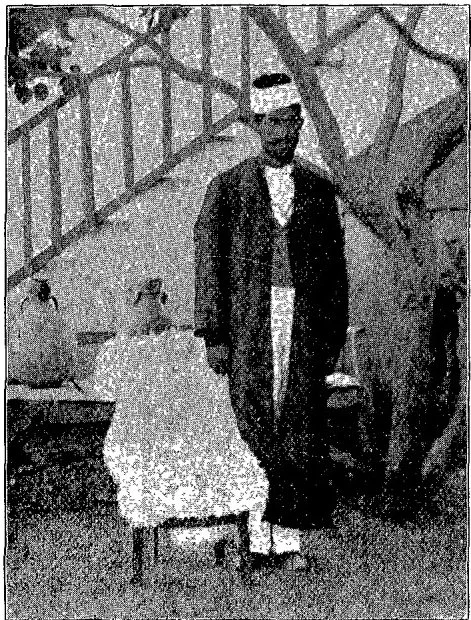
Since Brother Holser's last report concerning the work in Palestine, many interesting and trying experiences have been developed, and successfully passed through. It will be remembered that the converted priest, Sheik Shakker, after relinquishing his position in Lydda, made a tour of the villages surrounding Jaffa, preaching his newly found Saviour. Owing to his priestly attire, all hearts were ready to honor and receive him in the beginning of his visit, and his dignified position for a time held persecution in check. The villagers listened with eagerness and astonishment, and could hardly believe that he had become a Christian. During the first week he visited four villages and two towns, Lydda and Ramleh, returning to Jaffa at the end of the week with two inquiring friends.
During the Sabbath he went into the city, and confessed Christ to all classes, and brought of the higher, as well as of the humbler, people into my house, of whom a large number now believe. The following Sunday he left again, and visited the same villages, but soon returned, being warned by friends that a detachment of soldiers was hunting him. On inquiry, we soon learned that the report was not without foundation, and that all the villages were being carefully searched. He then remained in hiding in this city, and of course their search was fruitless.
At this juncture, all the friends advised him to flee to Egypt; but after seeking the Lord earnestly, I did not feel free to encourage him in this undertaking. We then prayed over the matter; and after prayer, I asked him to choose between remaining in this country, where he would suffer persecution, and would be the means of raising up many believers, and going to Egypt, thus running the risk of losing his ardor and love for the message. He answered quietly and firmly: “No; I intend to confess Christ here among my friends and countrymen.” Some time afterward we found out that it would have been impossible for him to have fled to Egypt, owing to the fact that the authorities had telegraphed to all the cities and ports of the country, instructing them to arrest him.
About this time seventeen cavalrymen were sent to the home of his parents, near Nablus (formerly Sichem), and pitched their tent near the house. Each day they demanded a sheep from Shakker's father, who is a farmer and stock-raiser, also feed for their horses, and tobacco for themselves. Two ways now presented themselves to the parents—either to help search for their son diligently or to support the soldiers indefinitely. They chose the former, searching for their son in all parts, and so fulfilled Matt. 10:21.
After earnestly seeking the Lord, we decided to send Shakker to the hills of Hebron; and then if this place proved unsafe, he could take the overland route to Egypt. Although we had instructed him to go through the villages, it seems as if the Lord overruled our plans, and caused him to go by way of Jerusalem. As soon as he stepped off the train at the latter place, he was arrested and imprisoned. They searched him, but found only his Bible. After they had examined it, expecting to find evidence against him, they burned it before his face. A paper containing texts on Christ and the Sabbath was burned also, but he remarked to them, “I have committed all those texts to memory.” They began to curse him, and said he was worthy of death. To show how much they loathed him, they spit in his face. They did not give him anything to eat. He even offered the soldiers about twenty cents with which to buy for him a small piece of bread worth only two cents, but none could be induced to buy any for him. He fasted almost two days before they had mercy on him. He remained five days in the Jerusalem prison, and was then brought to Jaffa, where he is now, and has been since the 28th of May. Here he has had a remarkable experience. When he was brought here, his thumbs were put in iron clasps, and an officer was so angry with him for denying his former faith that he spit in his face. He endured this treatment with perfect quietness, and the result was that the gruff officer was converted, and afterward begged Shakker's forgiveness. About that time two other soldiers were converted. A barber, who was called in to shave the soldiers, came in contact with Shakker, and was also converted after attending several Bible readings at my house. The latter confessed to his uncle, who in turn reported it to the authorities, and they at once enrolled him as a soldier. Since then there have been eight other conversions in the barracks alone.
SHEIK SHAKKER.
During this time my house has been visited daily by many sheiks, as well as by many from the humbler walks of life. The number of visitors has decreased somewhat, owing to the fact that two soldiers have been watching our house for several weeks. As a result of their vigilance, however, one of the watchers has been converted. For this we feel to praise God greatly. All these men are honoring the Sabbath as much as possible under the existing conditions, and all who have been taught the evil effects of tobacco have given up its use, and all are making rapid advances in other respects. Some time ago one of them was so severely whipped for visiting me that he was obliged to lie in bed for two days, but this has only strengthened him. Yesterday nine of them were here to be photographed, and to-day all, including Shakker, were ordered to be whipped. Four, including Shakker, were whipped severely. The others were spared because the one ordered to whip them is a son of God.
Several weeks ago Shakker wrote a letter to the governor of Jaffa, asking for his release. He stated that he has been a law-abiding citizen, that he has done nothing against the government, and that all he asks for is his God-given right to exercise free thought. In reply he received a personal visit from the governor. But all the governor came for was to scold and curse him, and finally spit in his face.
A short time afterward three of the higher officers visited Shakker, and at first spoke very kindly to him, offering him a cigarette, which he declined. They afterward offered him a position in Acre (Akko) as head teacher of the Koran. He told them that he could not accept such a position, as he did not become a Christian for money. This changed their demeanor at once. He had hardly spoken, before they all began to strike him, and spit in his face. He was very much cast down after this experience, and all through the following night his converts were praying for him, and speaking soothing and cheering words to him. The treatment he had received so weakened his physical condition that he could hardly sleep at night. Another painful incident happened recently. Shakker's parents wrote to the governor, telling him to do with Shakker as he sees fit, as Shakker is not their son any more. In this place he does not receive anything to eat. We have thus far furnished him with food and clothing. Hafiz, my interpreter, has visited the barracks daily, reading and praying with these men.
I especially ask all God's people to remember us in their prayers, as we have new and trying experiences each day. HARRY KRUM.