An interesting city of the United States is Santa Fe, the capital of New Mexico. The city is situated in a valley on both sides of the Santa Fe Creek, at an elevation of six thousand eight hundred sixty-two feet above the sea. The valley, which is irrigated by the creek running through it, is surrounded by high mountains. It is claimed that the climate of this city is unsurpassed for health and comfort. The mean temperature for July, the warmest month of the year, is seventy degrees, and for January, the coldest month, twenty-eight degrees, while the average humidity of the atmosphere is only a little more than half what it is for the Eastern States, and the sun smiles upon the people almost constantly. These natural advantages, therefore, make Santa Fe a great health resort for consumptives, and some remarkable cures have been wrought by its admirable climate.
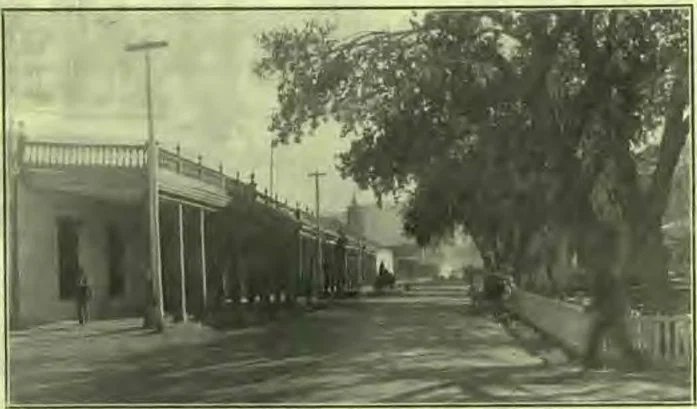
If any one expects to see a modern city on coming to Santa Fe, he will be disappointed. There is nothing up to date in the plain wooden building painted red, with the words Santa Fe on one end in small white letters, nor in the large, barren, sandy tract of land forming the grounds of the three railroad stations, nor in the narrow, unpaved streets, with their sidewalks not more than three feet wide, nor in the one-story adobe houses. These things are more than compensated for, however, with the quiet and restfulness of the city, so different from the bustle and noise of the typical city of the United States. The houses with few exceptions are built of mud bricks eighteen inches long and four inches thick, baked in the sun. The roofs are formed of logs, slanting toward the street. The houses are plastered both on the inside and outside with a thick layer of mud, and furnished with a rain-trough emptying on the street, which gives the passer-by more trouble than the rain. The houses look very pretty, however, with their lace curtains, and Indian pots filled with blooming flowers, and there is no window without these attractions.
They are appreciated all the more because the dry climate and sandy soil do not make friends easily with the fair blossoms; for Santa Fe has not California's productiveness, which is so phenomenal that the pedestrian is advised as he stops to chat a moment with a friend not to place his umbrella handle on the ground, lest it take root and grow. The inside of the houses are whitewashed, and kept scrupulously clean. All of the principal business houses, which are modern two-story brick buildings, front on the three sides of the plaza, or public square. On the fourth side is the old adobe palace which has been the Executive Mansion since 1680, under the Spanish, Mexican, and United States rule. It is now used for government business, the governor having a new mansion on Palace Avenue, built of adobe bricks, but furnished with all modern improvements. The beautiful capitol, land-office, and the fine large penitentiary are modern in style. The plaza, which contains an area of two and one-half acres, is filled with beautiful trees, mostly cottonwoods. Here, during the middle of the day, when it is too warm to work, the men gather in the refreshing shade of the trees to talk and rest.
On Sunday and holiday evenings almost the entire city come here, dressed in their best, to promenade, while the band plays. It is claimed that the San Miguel Catholic church on the outskirts of the city is the oldest church in America. According to some accounts it was erected in 1582, and according to others in 1545. The walls of adobe bricks are from three to five feet thick, which made it a good fortress during the Indian insurrections. The church when first built had no seats, the communicants using the floor. Some of the old Indian squaws during mass now prefer to sit on the floor rather than on the seats. The two pictures, one on either side of the altar, it is claimed, were painted in 1287 A. D. Although they are so old, the features of the faces are more distinct than those of others adorning the walls that were painted several hundred years later. The old bell, the Saint Joseph, which was cast in August, 1356, is now inside of the church, where it was placed when the tower was blown down. The bell gives out a different tone wherever it is struck. The adobe house to the left of the church is said to be the oldest dwelling-house in America. It has been recently added to the church property. There has been built a large, stone Catholic church to take the place of the old; but so far only the younger generation has been persuaded to worship in the new building, the older persisting in going to the old church. There are also several Protestant churches in Santa Fe.
The population of the city consists of about eight thousand Mexicans, a mixed race of Indian and Spanish blood, and two thousand Americans. There are a few of the Castilian families, who are fairer of complexion than the Mexicans. The Mexicans are small, very dark, with straight, black hair, and dark-brown or black eyes. Though lacking in physical energy, they must be rather logical in their thinking, for it is said they make good jurors, and can be depended upon for arriving at a clear and honest decision—more than can be said of many courts presided over by those fairer in face. Though as a race they are exceptionally hale and hearty, there are many cripples among them; from what cause is not known.
They are a quiet people, even the women giving little time to conversation or to gossip. For real kindness and courtesy to strangers, I do not believe the people of Santa Fe can be surpassed.
While they are citizens of the United States, and the courts and all public business is conducted in the English language, yet the language of the people is a mixture of Spanish and Indian that seems to be fairly well understood by all.2Pure Spanish is spoken by some of the old residents.
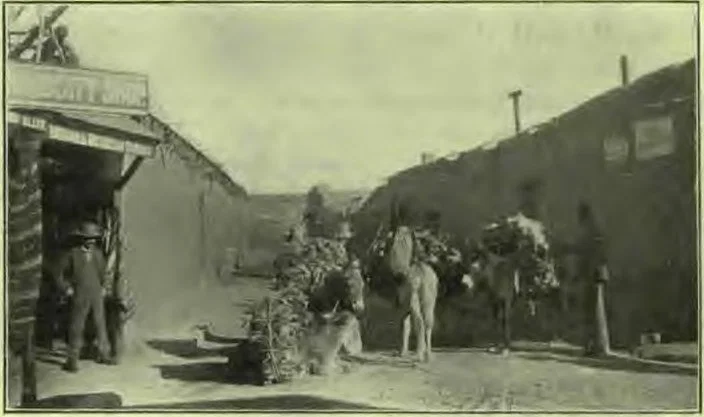
All during the day on Sunday the streets are gay with the bright ribbons of the women and the girls, no number of colors being too many, nor any bright color being slighted. As there are very few horses in New Mexico, owing to the rocky mountain paths, the burro, or donkey, is used to carry all burdens, which are tied to a small saddle. When a man rides on one of these little animals, he has to hold his feet up, else they would touch the ground. Owing to the physical conditions of the country, the burro is a necessity, adding much to the prosperity and comfort of the Mexican life.
BURRO ALLEY
There is an Indian village of Pueblo Indians about twelve miles from Santa Fe. The people of this tribe still retain most of their old customs, the women wearing their blankets and white leather leggings; the men, however, aspire to the white man's apparel, but rarely wear the whole suit at once.
Notwithstanding their adherence to old customs, they have a Yankee's love for the dollar, no Indian chief even being willing to sit for his picture for less. LOUIS R. SWIFT.
A Recipe for a Day
By Amos R. Wells
TAKE a little dash of water cold,
And a little leaven of prayer,
And a little bit of morning gold,
Dissolved in the morning air.
Add to your meal some merriment,
And a thought for kith and kin,
And then, as your prime ingredient,
A plenty of work thrown in.
And spice it all with the essence of love,
And a little whiff of play;
Let a wise old book, and a glance above,
Complete the well-made day.
— Amos R. Wells.
A Brief Sketch of the Life of Geoffrey Chaucer
By Ruth M. Dibbell
Sometime between the dates of 1328 and 1340 there was born in London, England, a boy who was destined to become the father of English poetry, the most polished and versatile writer of the fourteenth century. This was Geoffrey Chaucer, of whom Tennyson says:—
“The first warbler, whose sweet breath
Preluded those melodious bursts that fill
The spacious times of great Elizabeth
With sounds that echo still.”
Of Chaucer’s early life we know but little. His home was by the Thames, and here the poet spent his earliest days. Near here he must have gone to school. Out of school and after play the boy would probably often help his father in his wine-shop and cellar, running errands and filling citizens’ pots with the wine desired.
Young men in Chaucer’s time usually finished their education at some university; and records say that Chaucer attended Cambridge and Oxford, afterward going to Paris to complete his study.
In 1357 he became a page in the household of Prince Lionel, third son of Edward III. His cheerfulness and straight-forward simplicity soon won him promotion, and he was made esquire to Edward III, who spoke of him as his “beloved valet,” and trusted him well enough to send him on many important missions. His especial friend at court, however, was John of Gaunt, the king’s brother. This friendship remained unbroken for forty years.
When John’s wife died, Chaucer wrote a story told in allegory, “The Book of the Duchess.” He had already shown his power of writing excellent verse by the translation he had made from a celebrated French poem, “Le Roman de la Rose.”
Soon after this Chaucer was sent on a mission to Genoa and Florence, a journey which proved to be a great advantage, for he made the acquaintance of Petrarch, the Italian poet, and thus learned to know the works of Dante and Boccaccio. This was of great help to Chaucer, for upon knowing more of the Italian writers, his own composition became richer. However, he lost none of his own sturdy individuality and fresh, pure style.
Upon his return to England he was given a very important position; and both the king and John of Gaunt granted him certain allowances and privileges, so that in worldly affairs he prospered.
But all this good fortune did not cause him to become idle, nor to forget his writings. He still continued to work upon some of his poems.
In honor of John of Gaunt’s second marriage, he wrote “The Parliament of Fowles.” This, with “The Book of the Duchess,” connected as they were with the royal family, confirmed Chaucer’s reputation as a writer of verse.
In 1359 he went with Edward III in an invasion, and was captured by the French, but was ransomed by the king for sixteen pounds.
After his return to England he married the queen’s maid-of-honor, Phillippa Rouet, whose sister became the wife of John of Gaunt.
Chaucer was small and slender in stature, looked upon the ground as he walked, and seemed absent or distracted in manner. He was a diligent student, and although passionately fond of books, he had a still greater love of nature. His poetic soul responded to the beauties of the morning landscape, the matin carols of the birds, and the glories of the rising sun. The Maytime was his favorite season, and long before Burns and Wordsworth, he loved and sang of the daisy. The sight of this little flower as it opened to the sun lightened his sorrow,—
UNITED STATES BUILDINGS, SANTA FE
“And down on knees anon right I me set
And as I could this fresh flower I grette,
Kneeling always till it unclosed was,
Upon the small, and soft, and sweete grass.”
What is more spontaneous and characteristic of the poet than such joyous outbursts as the following?—
“Herkneth thise blisful briddes how they singe
And see the fresshe floures how they springe;
Ful is myn hert of revel and solas.”
Not less evident is Chaucer’s high estimation of women, and his perception of a sacred bond, spiritual and indestructible, in true marriage between man and woman. Of all the flowers in the mead, the daisy, “the emperice and flour of floures alle,” was Chaucer’s favorite, because to him it was the fit representative of the “trouthe of womanhede.” As one man says, “Ditties in praise of the marguerite, or daisy, were popular with the French fashionable poets; but none of them, like Chaucer, among all their allegorical dreamings, ever thought of celebrating in that flower an emblem of womanly truth and purity, wearing its crown, as a gentle, innocent, devoted wife.”
Chaucer says that there is nothing which can take him from his reading,—
“Save, certainly, when that month of May
Is come and I hear the fowles singe,
And see the floures as they begin to spring,
Farwel my book, and my devocioun!”
In his description of nature you can not only see the objects he describes, but you believe at once in the sincerity of his love for them. You know it to be genuine, and besides he makes you see as he sees, feel as he feels.
That Chaucer was a genius, a scholar, and a pure-minded man, no one can deny. He was a keen and sympathetic observer of men. Never has he been excelled in portraiture. No other piece of literature possesses such a portrait gallery as is contained in the Prologue to the Canterbury Tales.
He knew well the life of the common people, and from his writings one can see he was more interested in their customs and manners than he was in ways of people of higher life. He was a favorite everywhere, and knew how with his writings to please all classes of society. His poems were stories which in themselves were of little account, but incidentally gave a living picture of the people of his day, including all classes from the highest to the lowest. The actors pass before one as living realities. He hears them talk, he sees them smile, he knows just how they are dressed, he knows their spirit and bearing as he does that of his friends with whom he is daily associated.
To many other admirable traits we may add that of Chaucer’s courage in misfortune. His cheerful humor never deserted him. In his latter years he was sometimes without money, but instead of repining, he made a song to his empty purse,—
“I am sorry now that ye be so light,
For certes ye now make me heavy cheer.”
But it is to the Canterbury Tales that Chaucer owes his fame and rank as the first poet of modern English literature, and in this work—the result of years of labor and study—the genius and power of the poet are most strongly expressed. The Tales are a collection of stories related by certain pilgrims who rode together in true English fellowship to worship and pay their vows at the shrine of the “holy and blisful martyr,” Thomas a Becket.
Chaucer’s death occurred Oct. 25, 1400. On the bank of the noble river by which he was born and bred, on which for years his daily life was spent, our great early poet passed away. As he was at least sixty when he died, he was justly entitled to the epithets, old and reverent.
Geoffrey Chaucer was the first English poet or writer to be buried in Westminster Abbey, and just as Edward the Confessor’s tomb drew kings and queens to lie around it, so Chaucer’s grave, in a way undreamed of at the time, consecrated one part of Westminster as the Poet’s Corner.
Very fitting is it that he who has been so3justly named the “poet of the dawn, the founder of our fair language, the father of English poetry,” should rest when his life’s work was ended near to others with whose honored names our early history is studded.
RUTH M. DIBBELL.
Nature Study
By B. E. Crawford
It has been said that the days of miracles are past, but in reality there are countless miracles presented to our view every day. We may look to the heavens above or to the earth beneath; we may fix our eyes upon starry firmament, or upon the green fields and forests that spread themselves like a carpet over hill and vale and plain; we may examine the sand and clay and rocks upon which we tread, the myriad creatures that inhabit the streams and rivers and lakes and oceans, or the beasts and birds and creeping things to be found in all parts of the earth; and wherever we turn, all around and above and beneath us, in earth and sea and sky, everything that we behold is a miracle. We may bring to our aid the microscope and the telescope, opening to our view the wonders of the very minute, and bringing within the range of our vision the inconceivably far distant, and still all that we see remains a miracle, an unfathomable mystery.
All created beings tell of the matchless wisdom and love and power of our God. There is a voice in nature that speaks lessons of heavenly wisdom and ever-enduring truth. In that excellent book that we all love so well, “Christ’s Object Lessons,” I read, “Nature is the mirror of divinity.”
When sin entered the world, man was deprived of the privilege of seeing God face to face, but still he may behold the divine power by looking into the mirror of divinity.
The Saviour desires us to read the lessons of his love and wisdom in every lily of the field, in every fragrant rose, in every majestic tree, and even in every spire of grass that grows beneath our feet. There are wonderful truths wrapped up in the things that God has made, truths that are ready to unfold themselves to every diligent student.
As we open nature’s book, and with careful, prayerful study, seek to know the truth, the Spirit of God, that blessed “Spirit of Truth,” often flashes conviction into the mind like the full blaze of the noonday sun shining forth from behind a cloud of midnight darkness. “Unless the mind has become too dark to know God, the eye too dim to see him, the ear too dull to hear his voice, a deeper meaning is grasped” than can be received through any line of logical reasoning, and sublime, spiritual truths are impressed upon the heart.
But fallen man too often does not understand, and in some cases seems determined not to understand. Human vision has become obscured by sin, and many are unable to interpret nature without placing it above God, and so perverting its teaching that the mind is turned away from the Creator. Others think only of her financial treasures. Far too many of us when we look upon the fields of waving grain, see there nothing but sacks of wheat or oats, in the meadows nothing but so many tons of hay, in the woods only planks and boards for houses, or a favorable place for the wretched sport of hunting.
To Adam and Eve in the garden of Eden, nature was a constant teacher. Every natural object was full of the knowledge of God, overflowing with divine instruction. They held communion with the grass and flowers and trees, receiving from each the secret of its life.
Then sin entered the world, and the original brightness departed from the face of nature, but even in the blighted condition in which we find the earth to-day, God’s object-lessons have not been obliterated. Rightly understood, nature still speaks of the Creator. The famous English poet, Alfred Tennyson, once said:—
“Flower in the crannied wall,
I pluck you out of the crannies;
Hold you here, root and all, in my hand,
Little flower, but if I could understand
What you are, root and all, and all in all,
I should know what God and man is.”
When Christ came to this earth and walked among men as one of their number, there were few who could read the character of God in the works of his hands. Man had almost lost sight of the wonderful lessons that God designed he should learn from the book of nature. One object of Christ in coming to this world was to withdraw the veil that sin had cast over nature’s fair face, that we might be able to see the spiritual glory, the divine truth, that God designed all created things should reflect.
As the Saviour led his disciples through the fields and groves, by the lake shore, or on the mountainside, and called their attention to the fowls of the air and the lilies of the field, the waving grain and the spreading vine, his words placed the teachings of nature in a new and glorious light, making them the instructive object-lessons of faith in God.
In every natural object the Creator has written his message of wisdom and love and power. In these messages there are comfort and peace for the worried and perplexed, hope and rejoicing for the despondent and sorrowful, and lessons of simplicity and purity for the youth.
When we as Christians come close to nature’s heart, we come close to nature’s God; and our minds are drawn away from sin and distressing, anxious cares, to the contemplation of the beautiful, the true, and the good, which leads us ever onward and upward, toward purity, peace, and God.
I quote the following words from the poet Wordsworth:—
“Nature never did betray
The heart that loved her; ’tis her privilege,
Through all the years of this our life, to lead
From joy to joy: for she can so inform
The mind that is within us, so impress
With quietness and beauty, and so feed
With lofty thoughts, that neither evil tongues,
Rash judgments, nor the sneers of selfish men,
Nor greetings where no kindness is, nor all
The dreary intercourse of daily life,
Shall e’er prevail against us, or disturb
Our cheerful faith, that all which we behold
Is full of blessings.”
Nature is a great lesson book, but in the hands of those who know not its Author, its teachings are misinterpreted. Happy indeed will be the day when the gospel minister shall be the interpreter of nature, instead of leaving it to the ungodly and the atheistic; when he who deals out the bread of life to hungry multitudes shall be able to show to the people the thoughts of the infinitely wise and good Creator embodied in the universe. This applies as well to Sabbath-school teachers and other missionary workers as to the gospel minister.
B. E. CRAWFORD.
Simple Telephones and How to Make Them
By Edison Driver
Boys, would you like to make a telephone this week? Sound is exceedingly accommodating, and will work with very crude apparatus, so we will make an attempt.
This telephone we are going to construct, if you make it right and do everything just as I tell you, will work well to a distance of half a mile, and if you are very careful indeed, to a distance of two or three miles. However, you would better not lay your plans for anything but a short line, and you will be more than pleased. Say, for instance, you want to connect your house with that of your friend—how interesting it will be some evening when you want to call up Jack. Tap, tap, tap! goes your pencil on the diaphragm of your phone. Tap, tap, tap! comes the answer back. It sounds loud and clear, and would call you from any place. “Hello! Is that you, Jack? All right—how do you work the twenty-first in that arithmetic the teacher gave us to-day? It almost seems that I had worked on it a week here to-night, and I can’t get it yet—” and so on till Jack knows just what you want, and the two of you put your heads together half a mile apart, and work it all out.
The Things You Will Need
Go first to some slaughter-house and get two beef bladders, or, if they are not to be had, take any other kind that are offered, providing they are large enough. Be careful also that they are not broken. Get a box of good strong tacks, four blocks, each ten inches square, of smooth, one-inch pine, or other soft wood, and four pieces of blotting-paper, new or old, of the same length and breadth as the blocks. A ten-cent coil or two of stovepipe wire will do for the line, though wire a little larger would work some better. Two rubber coat or vest buttons complete the list of materials.
For tools you will need the use of a pair of shears, a hammer, a saw, brace and bits, bracket or keyhole saw, a screw-driver, and sandpaper. If you do not have all these tools yourself, a good-natured carpenter will probably do all the work there is to be done with bracket saw or brace and bits for you in ten minutes. Possibly you could borrow some of his tools to use yourself.
Construction
As soon as you get home with the two bladders, wash them very clean in cold water, blow them up tight, tie a string around the neck of each, and let them stay that way for a whole day and night, at least, while you prepare the rest of the phone.
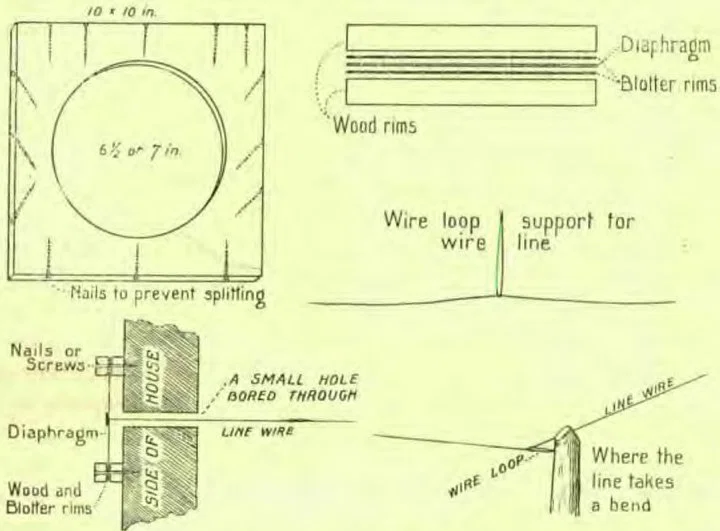
Mark out circles about six and one-half inches in diameter on the four planed boards. After boring a hole in each for the saw to work in, cut out the wheel indicated by the circle. Be careful not to split the rim that is left, for this is the part you will use in making the phone. If you think there is any danger of the rim splitting, you would better drive some long slender nails in as indicated in the diagram. Make the four rims exactly alike. Sandpaper the openings neatly, and cut out four rims from the squares of blotting-paper, to make them exactly correspond to the wooden rims.
The bladders having stood the necessary time, cut off the necks, soak the rest in warm water, and clean and wash till they are soft and pliable, and light in color. Take plenty of time, and let the bladder get quite soft before you take the next step.
Stretching the diaphragm, or drum, is a careful4operation, and if it is not well done, there is no possible satisfaction in the making of the phones.
Lay the bladder on one of the blotting-paper rims, over the board rim, and tack it down with many tacks, taking care that it does not wrinkle. At first, leave the tacks so that they can be removed and the bladder membrane stretched again in case it wrinkles. Have patience, don’t do a poor job here, but be determined that there shall not be a wrinkle in the whole diaphragm. It only requires time and patience.
That having been done alike for both diaphragms, lay the other blotting-paper rims in their places on the wooden rims, and, having punched or bored holes to start the screws, fasten down tightly. If you use screws instead of nails, you can take the phone rims apart to readjust the blotter cushions at any time, which you could not do with nails.
Now take a piece of soft, flexible wire about five feet long, fasten it through the eyes of one of the buttons, and then pass the free end through a tiny hole in the exact center of the bladder diaphragm. Do the same for each diaphragm, and then as shown in the illustration hang weights, like flat-irons, to the end of the wires. This should be done in a warm, dry place, as in the sunshine, and the phones left till perfectly dry. When dry, the diaphragms will be taut as a fine drum-head. But you see if you did not tack them firmly enough they will not be, because the few tacks will give with the pull of the drum, and your phone will not work. This is just another caution to use plenty of tacks, and to do your work well.
I have shown in the illustration the way to set the phones up. Notice the following points: The diaphragms are nailed substantially, or screwed, in their places. The line wire is kept stretched at all points between the two diaphragms. There should be as few bends in the line as possible, and what there are should be through wire loops, which are free to move with every vibration of the line. All supports for the line are made in the same way, and they should be as few as possible. The reason for using care in supporting the line is that everything that touches it, interferes with its motion, and takes that much away from the free vibration and clear sound as heard at the distant phone.
I have given all these details that you need make no mistake. All the operations are perfectly simple, and the cost is practically nothing, and I am free to say that the results, if you do your part well, will fully equal those obtained on the expensive electric phones.
Simpler Forms of Telephones
Somebody asks, Isn’t there an easier way?—Yes, certainly; I told you sound was very accommodating, and you will find it so. Take two tin cans, such as old quart fruit cans. In the exact center of their bottoms punch a small nail hole. Connect them by means of two hundred feet or less of well-waxed string, and you will find you can hear quite comfortably, providing you keep the line wires well stretched.
Another plan is the following: With a pair of pincers, or in any other convenient way, tear the bottom off two baking-powder cans. Wet some of the toughest paper you can get, like thick drawing-paper, or parchment, and tie it smoothly over each of the cans. Allow it to dry. Use waxed string for the line. This makes an excellent little phone. Where a support is necessary for the line, let it be a loop of string, and should a bend be made in it, let it be supported by a string loop also. These two simple phones are generally clear sounding, but not loud, nor will they work at great distances.
Character of the work to be accomplished by the message which caused the awakening. How typified.
The extent of the awakening. See “Thoughts on Daniel and the Revelation,” pages 594–596. How predicted.
Sketch of the life and work of the special herald in Asia and Africa, Joseph Wolff.
Sketch of the work of the heralds in England, Germany, and South America.
The leader should use all his influence to secure thorough personal study of the lesson by each member of the Society. This will only increase the interest in the general study, I am sure.
Those who are preparing to conduct the study should first read the entire chapter in “Great Controversy” in order that they may see the whole world being thrilled with the message direct from the throne of God.
Could any event engage the interest of all heaven more than the beginning of the judgment hour — unless it be the suffering and death of the world’s Saviour — that event which was to begin the successful closing up of the great controversy between sin and righteousness, that event which would forever decide for life or death the case of every human being, that event which would forever cut off the possibility of future sin, the event that would establish the eternal justice and love of God, that event which would at its close bring to earth the Son of God to receive his ransomed ones home? In view of these things is it strange that the Lord, who doeth “nothing, but he revealeth his secret unto his servants,” should have a world-wide proclamation given of the opening of the judgment hour, — an hour of eternal interest to all the universe?
God intended the second angel’s message to be merely an announcement of the beginning of the judgment, the close of which would bring the long-promised Saviour to earth again; but the heralds, like the disciples of old, did not fully comprehend the message which they bore. “Errors that had been long established in the church prevented them from arriving at a correct interpretation of an important point in the prophecy. Therefore, though they proclaimed the message which God had committed to them to be given to the world, yet through a misapprehension of its meaning,” they announced the immediate appearance of the Son of man in the clouds of heaven. F. M. D.
A Cheerful Nature Builds a Palace
“He who a cheerful nature owns A palace rears from hovel stones.”