The Youth’s Instructor, Vol. LII, No. 40

The Sheep and the Shepherd

The Youth’s Instructor

October 4, 1904

Review and Herald Publishing Assn. · Washington, D. C. · October 4, 1904

The Sheep and the Shepherd
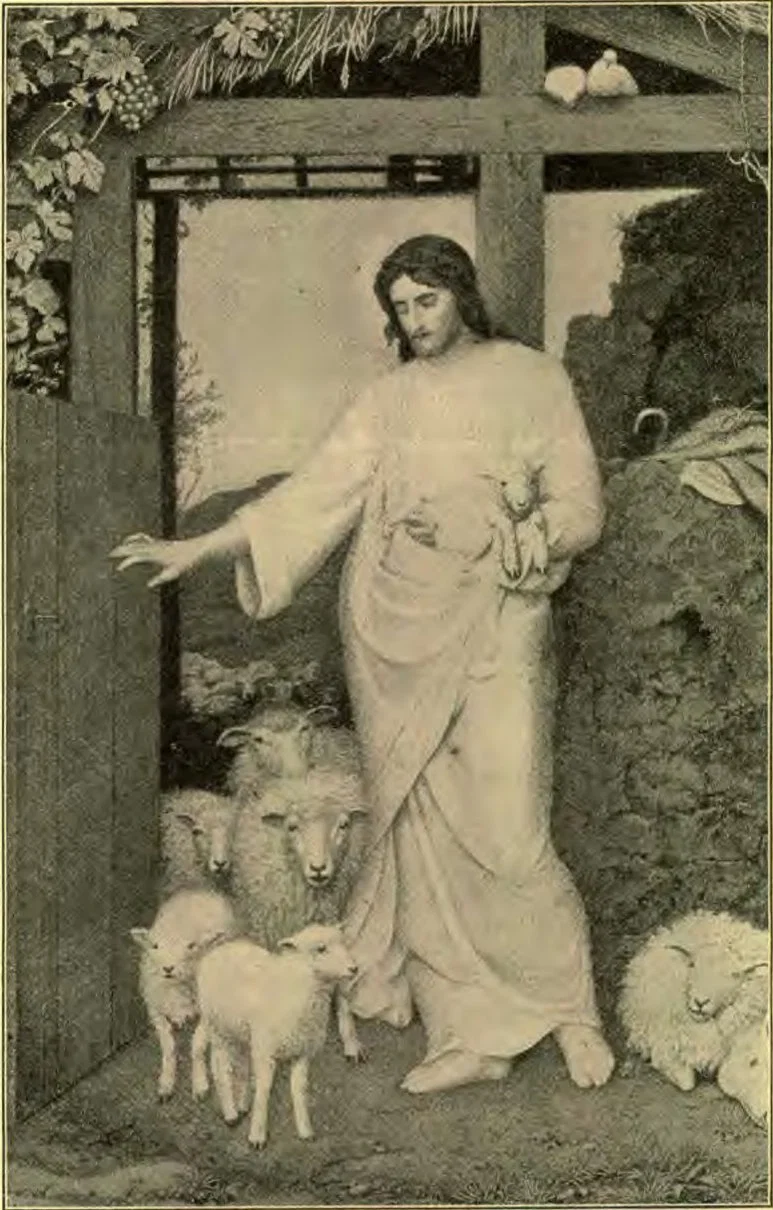
A GENTLEMAN traveling in Syria stopped to watch three shepherds who were watering their flocks at a well. The three flocks were inextricably mingled; to the traveler’s eye the mass seemed one. Presently one of the shepherds stood forth, and began to call, “Men-ah,” the Arabic word for “Follow me.” Thirty sheep immediately separated themselves from the indiscriminate mass, and began to follow the shepherd up the hill. Then a second shepherd began to cry, “Men-ah! Men-ah!” and a second flock separated from the others, and started after the second shepherd.
The traveler was astonished; and as he saw the third shepherd preparing to depart, laying his hand on his crook, and beginning to gather a few dates that had fallen from the palm beneath which he had been resting, the traveler stepped up to him, and asked, “Would your sheep follow me if I called them?” The man shook his head. “Give me your shepherd’s cloak and crook, and allow me to try,” the traveler said. He even wound the shepherd’s turban around his head, and then stood forth and began to cry, “Men-ah! Men-ah!” But no sheep stirred; they only blinked at him lazily as he stood there in the sunshine. “Do they never follow any one but you?” asked the traveler. “Only when a sheep is sick; then the silly creature follows any one,” the shepherd said.
“I am the good Shepherd, and know my sheep”
What a perfect commentary was this little scene upon our Lord’s words, as he tells us of his sheep in the parable of the Good Shepherd! “When he putteth forth his own sheep, he goeth before them, and the sheep follow him; for they know his voice. And a stranger they will not follow, but will flee from him; for they know not the voice of strangers.” John 10:4, 5. And what a sure sign of spiritual sickness it is when one of the great Shepherd’s sheep ceases to hear his voice and follows any other voice, and so goes straying into dangerous and forbidden places!—Selected.

“When Peace, like a River”

“It is well with my soul,” was written by H. G. Spafford, and the popular tune to which it is always sung is one of P. P. Bliss’s best compositions. Mr. Spafford was a member of the Chicago bar and an elder in the Presbyterian Church. He had been successful in his profession, but had made some unfortunate investments, and when the financial panic of 1873 seriously disturbed the business of the country, Mr. Spafford found that his savings of many years had been swept away. The members of his family were prostrated by this disastrous turn in their affairs, and he acceded to the wish of helpful friends that they should visit Europe, and thus be removed for some time from scenes of financial ruin. Mrs. Spafford and her four children took passage on the French liner “du Havre,” and the story of that voyage is one of the most appalling of the many calamities of the sea.
When in midocean and in the blackness of a November night in 1873, the steamship collided with the Glasgow clipper “Loch Earn,” and in twelve minutes the former went down, carrying to death two hundred and thirty souls, and among them were Mr. Spafford’s four daughters.
Mrs. Spafford sank with the vessel, but floated again, and was finally rescued.
The saved were taken to Havre, and from that city she sent a message to her husband, who was in Chicago: “Saved, but alone. What shall I do?”
This message of fearful import—“sufficient to drive reason from the throne”—was the first notice Mr. Spafford had that his dear ones were not as happy as when he parted with them a few days before in New York.
In his unutterable sorrow Mr. Spafford did not chant a dirge to impossible hope. When he reflected that his property was lost in destruction’s waste, that his wife was painfully prostrated, and that his four children were buried in the dark waves of the sea, there came from his heart of hearts a song of trust and resignation that has many times encircled the globe.
“When peace, like a river, attendeth my way, When sorrows, like sea billows, roll; Whatever my lot, thou hast taught me to say, It is well, it is well with my soul.”
When Mr. Spafford returned from Havre with his invalid wife, he said to his friends: “I never felt more like trusting God than I do now.”
Spafford’s hymn of resignation, with its fine musical setting by the lamented Bliss, is one of the most helpful of the many gospel songs written during the past quarter of a century. One Sunday evening a service of song was given in one of our large cities at which the story of “It is well with my soul” was told, and the lines sung with great tenderness of expression by the audience and choir. Attending the service was a gentleman who had suffered financial reverses in the panic of 1889. When he heard the story of Spafford’s heavy affliction, and joined in singing the hymn so pathetically inspired, he said to his wife on their return home from the service: “I will never again complain of my lot. If Spafford could write such a beautiful resignation hymn when he had lost all his children, and everything else save his wife and character, I ought surely to be thankful that my losses have been so light.”—Selected.

—Frances R. Havergal

I Did this for Thee! What Hast Thou Done for Me?

I SPENT long years for thee 1 Tim. 1:15. In weariness and woe, Isa. 53:3. That an eternity John 17:24. Of joy thou mightest know, John 16:22. I spent long years for thee; John 1:10, 11. Hast thou spent one for me? 1 Peter 4:2.
And I have brought to thee, John 4:10, 14. Down from my home above, John 3:13. Salvation full and free, Rev. 21:6. My pardon and my love. Acts 5:31. Great gifts I brought to thee; Ps. 68:18. What hast thou brought to me? Rom. 12:1.
Oh, let thy life be given, Rom. 6:13. Thy years for him be spent, 2 Cor. 5:15. World-fetters all be riven, Phil. 3:8. And joy with suffering blent; 1 Peter 4:13-16. I gave myself for thee: Eph. 5:2. Give thou thyself to me! Prov. 23:28.

—Frances R. Havergal

O Generous Wells: A Selected Verse on Giving

“O GENEROUS wells! be not content, But yield up your crystal treasure; Leave not the withering flowers to die They’ll repay thee with double measure.
“Their leaves will give a brighter green, And sweeter buds will surely blow. Then overflow your moss-grown banks, And make the flowers grow.
“O friends, who have the word of life, Of peace, of comfort, freely give. Be springs that all may share thy store. And have the blessings of all who live.
“Wells are good and grand, I know, But O for a spring that will overflow.”
— Selected.

Harvest Ingathering Program

OPENING SONG, “Wake the Song of Joy and Gladness.”
PRAYER.
SCRIPTURE LESSON, Psalm 111 or 65.
INTRODUCTORY BY THE CHILDREN, Exercise I.
SONG, “Hasten on, Glad Day.”
YOUTH’S EXERCISE, Parable of the Sower.
SOLO, “Harvest Time.”
EXERCISES III AND IV.
QUARTET, “Lead Them to Thee.”
EXERCISE V.
SONG, “When the King Shall Claim His Own.”
EXERCISE VI.
DUET, “Freely Give.”
OFFERING TAKEN.
PRAYER.
SONG, “Joy By and By.”

Notes

All the songs indicated in the program are found in “Christ in Song.” Would it not be well to rehearse the songs in the general exercises of the Sabbath-school, so that all will be able to join with spirit in the singing?
The program with suggestive exercises prepared for “Harvest Ingathering” this year has been arranged with a desire to avoid anything that would lead the youth and children into the worldly ways of doing things. We trust that as it is carried out, or others arranged, all will be done with earnest prayer that nothing of the common may come in, but that God’s richest blessing may rest on all that is said and done. Anciently it was a time of rejoicing for young and old,—true, heartfelt joy and thanksgiving for the blessings of another year. Surely this of all other years is one of wonderful protecting care amid so many calamities by land and sea, through wrecks, storms, and fires.
Again I would appeal to all who engage in arranging Harvest Ingathering exercises not to make it merely children’s day, but a day of rejoicing for all.
A few suggestions in regard to decorations may not be amiss. From the light given regarding the arrangement for the “Feast of Tabernacles,” anciently, we find special preparations were made for it,—that everything was brought from the woods that would please the eye and give expression to the universal joy of the people, and that the temple was the center of attraction. So it is in keeping with God’s plan to decorate, and in a way that he will be honored and the human eye pleased also. The things used should be natural, not artificial, and arranged tastily. Some may regard this as a waste of time, but perhaps even they spend double the time in decorating one article for the home or body, and think nothing of it. So let us not begrudge the time and strength required to prepare God’s house for this service. ANNA HIBBEN.

The Blemished Onyx

ONE of God's methods is to bring good out of evil. But this is not a license to us to do evil that good may come, for it takes the skilful hand of God to work this miracle.
A lapidary brought a large and beautiful onyx to a distinguished artist for whom he had obtained many precious stones for carving.
“See how clear, pure, and transparent this stone is,” said the lapidary; “what a fine one for you to exercise your skill upon were it not for this one fatal blemish!” And he pointed out in one spot an underlying tinge of iron rust, which, as he said, “ruined the stone.”
But the artist, with far-reaching sight, seized upon the onyx, and, having examined it attentively, purchased it. With matchless skill and delicacy, he wrought upon the stone, carving the graceful form of a lovely goddess. And by a wonderful exercise of ingenuity, by sharp cuts of his engraving tool, and by light and patient touches, he fashioned the spot which had been thought an irreparable blemish into a leopard skin, upon which rested the feet of the goddess—the contrasting colors enhancing the beauty of the lovely cameo.
As the artist, by patient skill and labor, changes the unsightly spot on the onyx into a beautiful decoration, so sometimes does God work upon his children. He sees in them some fault, some evil passion which blemishes the whole character, and he begins to use the discipline to give that molding which, by slow processes it may be, will change the blemish into something lovely.
He may use sharp tools, and the work may be tedious and trying; but if we submit ourselves to his hand, and especially if—unlike the passive onyx—we ourselves, being conscious of our faulty character, use our own earnest endeavors, latent graces will gleam out where only blemishes were seen.—Selected.

Introductory Exercise

Exercise I

1. What is this day called?
Harvest Ingathering.
2. How did God’s people anciently celebrate it?
With sacred songs and thanksgiving.
3. How did they prepare for it?
Everything that could please the eye and give expression to the universal joy was brought from the woods.
4. How did the city appear?
The city bore the appearance of a beautiful forest.
5. What was the center of attraction?
The temple was the center of universal joy.
6. What did the people bring?
Old and young, rich and poor, all brought some gift as a tribute of thanksgiving.
7. Why do we observe this day?
Because the Lord has told us it would be well for the people of God at this time to do so.
8. Then why are we here to-day?
To joyfully commemorate the blessings of God to us.
To celebrate the ingathering of the harvest of the earth.
To bring some gift as a tribute of thanksgiving to Him who has crowned the year with his goodness.
To point forward to the great day of final ingathering, when the Lord of the harvest shall have safely gathered the ransomed of the Lord into the heavenly Canaan.

Parable of the Sower

Exercise II

1. Repeat the parable of the sower.
“Behold, a sower went forth to sow; and when he sowed, some seeds fell by the wayside, and the fowls came and devoured them: some fell upon stony places, where they had not much earth: and forthwith they sprung up, because they had no deepness of earth; and when the sun was up, they were scorched; and because they had no root, they withered away. And some fell among thorns; and the thorns sprung up, and choked them: but other fell into good ground, and brought forth fruit, some an hundredfold, some sixtyfold, some thirtyfold.”
2. Who is represented by the sower?
“He that soweth the good seed is the Son of man. He left his home of security and peace, left the glory that he had with the Father before the world was, left his position upon the throne of the universe. He went forth, a suffering, tempted man; went forth in solitude to sow in tears, to water with his blood, the seed of life for a world lost. So those who are called to unite with Christ must leave all in order to follow him. Old associates must be broken up, plans of life relinquished, earthly hopes surrendered. In toil and tears, in solitude and through suffering, must the seed be sown.”
3. What is the seed?
The seed is the Word of God. Every seed has in itself a germinating principle. In it the life of the plant is enfolded. So there is life in God’s Word. In every command and in every promise of the Word of God is the power, the very life, of God by which the command may be fulfilled and the promise realized.
4. Explain the seed that fell by the wayside?
The seed sown by the wayside represents the Word of God as it falls upon the heart of an inattentive hearer. Like the hard beaten path trodden down by men and beasts, is the heart that becomes the highway for the world’s traffic, its pleasures and sins. As the birds are ready to catch up the seeds from the wayside, so Satan is ready to catch away the seeds of divine truth from the soul.
5. Who are represented by the stony ground hearers?
The stony ground hearers are those who depend upon self instead of Christ. They trust in their good works and good impulses, and are strong in their own righteousness. Such a one “hath not root in himself,” for he is not connected with Christ. This class may be easily convinced, and appear to be bright converts, but they have only a superficial religion. Like the rock underlying the layer of earth, the selfishness of the natural heart underlies the soil of their good desires and aspirations, and when the fiery tests of temptation and reproach come, they are offended, faint, and fall.
6. What class is represented by the seed among thorns?
The class represented by the seed among thorns are those who do not yield to the transforming power of Christ after accepting him, but continue the old habits and practices of the former life of sin. If the heart is not kept under the control of God, and the work of purification does not advance continually, the thorns of worldliness and the weeds of riches will spring up and overspread the soul. All habits of indulgence that weaken the physical powers, that becloud the mind or benumb the spiritual perception, are “fleshly lusts, which war against the soul.”
7. Is the sower always to meet with disappointment?
The seed that fell on good ground, the Saviour said, bringeth forth some an hundredfold, some sixty, some thirty. The good ground is not a heart without sin, but one that yields to the conviction of the Holy Spirit, and has a sincere desire to know the truth that he may obey it. He who has such soil trembles at the word; for to him, it is a living reality. He opens his understanding and his heart to receive it, and Satan with all his agencies of evil is not able to catch it away.
8. What is the great truth to be learned from this parable?
From this parable we learn that the harvest depends upon the soil into which the seed is cast. If the word of God fails of accomplishing its work, the reason is to be found in ourselves; and it rests with us to determine what we shall become, for the power of choice is ours. The wayside, the stony-ground, and the thorny-ground hearers need not remain such. The Spirit of God is ever seeking to break up the fallow ground, to remove the stones of selfishness and sin, to uproot the thorns of old habits and practices, and cause the good seed to take root and grow; but he asks us to co-operate with him in the work. The soil must be broken up by deep repentance for sin, and the evil tendencies of the natural heart overcome by earnest effort in the name and strength of Jesus.

Exercise III

An interesting exercise may be prepared based on the thoughts suggested by the song “Beautiful Flowers,” in “Christ in Song,” giving the thoughts of each stanza separately. Following each explanation let the children sing the stanza. There should be flowers, thistles, and thorns to illustrate the song.

Exercise IV

1. What has the Saviour said about children?
“Jesus said, Suffer little children, and forbid them not, to come unto me.” Matt. 19:14.
2. Why does Jesus ask the children to come?
“Come, ye children, harken unto me: I will teach you the fear of the Lord.” Ps. 34:11.
3. How many are invited to come to be taught?
“And all the children shall be taught of the Lord.” Isa. 54:13.
4. What will they be taught, and for what purpose?
“I will make them hear my words, that they may learn to fear me all the days that they shall live upon the earth.” Deut. 4:10.
5. When children are taught of the Lord, what will they do?
“Children, obey your parents in all things: for this is well pleasing unto the Lord.” Col. 3:20.
6. What promise is made to such children?
“They shall be mine, saith the Lord of hosts, in that day when I make up my jewels.” Mal. 3:17.
7. What will the Lord do with his jewels?
“Thy children shall come again to their own border.” Jer. 31:17.
8. What is their border, and how will they shine?
“Then shall the righteous shine forth as the sun in the kingdom of their father.” Matt. 13:43.
9. What is that time called, and when is it?
“The harvest is the end of the world.” Matt. 13:39.
10. How should we feel, and what should we do?
“Be glad then, ye children of Zion, and rejoice in the Lord your God.” Joel 2:23.
11. What do we all want the Lord to do for us?
“Show me thy ways, O Lord; teach me thy paths.” Ps. 25:4. (Answer to be given in concert.)

Exercise V

Led by singing first stanza with chorus of 218, “Christ in Song”—“Count your many blessings, remember every one.” After the singing, let Ps. 66:8, 9; 30:3; and 2 Tim. 1:7 be repeated by three persons, expressing thanks for life and reason; Acts 14:17 for food and gladness; Deut. 10:18 for food and raiment; Mark 10:30 for friends and kindred; and Rom. 1:16 for the gospel light. Then have the second stanza and chorus sung. Now have repeated Ex. 15:2 for salvation; 1 Peter 1:5 for keeping power; Rom. 8:16 for the Spirit; Ps. 119:162 for the word; and Rev. 22:1-3 for promise of paradise restored. The singing of the third stanza with chorus follows.
Let this praise exercise be continued for about fifteen minutes, each recounting the special blessings of the year. Let spirited singing be interspersed, and by all means avoid long, prosy talks during the exercise.

Exercise VI

Let the superintendent or leader give a short talk on giving,—based on Deut. 16:17 and 2 Cor. 9:7, 8, making emphatic the fact that one’s ability to give depends on the use made of God’s blessings, and that one gives according to his appreciation of those blessings.

The Golden Thread and Silver Spangles

THERE is told a beautiful Eastern story of a child walking beside the sea, who saw a bright spangle lying in the sand. She stooped down and picked it up, and found it was attached to a fine thread of gold. As she drew this out of the sand, there were other bright spangles on it. She drew up the gold thread, and wound it about her neck, and around her head, arms, and body, until from head to foot she was covered with the bright threads of gold, and she sparkled with the brilliance of the silver spangles. So it is when we lift out of God’s Word an ornament of beauty to put into our life. We find that other fragments of loveliness, all bound together on the golden chain of love, are attached to the one we have taken up. Then as we draw up the chain and twine it about our neck, and weave it into a web to make a garment for our soul, we find that it is endless. Infinite as God himself, is the abundance of the lovely things that we may draw out of the treasury of his grace to deck our life with beauty.—J. R. Miller, in “The Hidden Life.”

Flume for the Mountain Torrent

A MAN found a wild torrent in the mountain. It could work only waste and ruin as it rushed, uncontrollable, down the gorge. He built a flume for it, and carried its wild floods in quiet streams down into the valley, where they watered fields and gardens, gave drink to the thirsty, and turned many a wheel of industry. That was far better than if he had dried up the torrent. It was far better, too, than if it had been left to flow on forever with destructive force. Now it was flumed and made to do good, and made the world richer and more beautiful. That is what God wants to do with the cravings, the desires, the passions, the longings, and all the mighty energies of our nature. They are not to be destroyed. Yet they are not to be allowed to work waste and ruin in efforts to find gratification in merely earthly channels, in unbridled license. That is sin’s way. Rather, these great forces in our nature are to come under the yoke of Christ, and are to be led by him into all holy service for God and man.—J. R. Miller, in “The Hidden Life.”

A Lesson in Life

I WAS up near the city road one day, Some men were digging a drain; The sky was dark, and the streets were gray With a misty, drizzling rain; I had done my work, and was hurrying by, But one is bound to know What's up when he hears a frightened cry, And a crowd begins to grow.
Ill news flies fast. The word was passed: “The drain!” “the props!” and “Save!” The earth had slipped, and the men were fast— Three souls in a living grave. They had mates at hand, by luck, poor chaps! Who hurried with pick and rope; Thought I, “They’ll dig ’em out perhaps, But little the worse, I hope.”
So I stood and watched them for a while, As I’d nothing else to do. They threw the earth in a goodly pile, And one of the lads got through. “Hurrah!” went up from the waiting throng, And ran through the misty air. A girl I knew came running along, And sighted me standing there.
“O Jem!” she gasped; “can’t you help? Go, go!” And she seized and shook my arm; “Your brother is there, is buried below! And you standing there so calm!” “My brother!” Then in a second’s space I was digging away like mad, Fearing to light on his poor dead face— The only brother I had.
I got him out with a bruise or two, But nothing of harm beside; You’d scarcely think what I say is true, But I then broke down and cried, To think I’d been standing staring there When my kin was like to die, Letting the others do all my share, Out of sheer stupidity.
It seems to me when I come to think, That our life on earth goes so; Some standing safely upon the brink, Some sunk in the depths below; And I’m sure if people only knew That their brothers were like to die, They’d hasten to see what they could do, Instead of just standing by. — Selected.

Thanks

THANK God for wheat, so white and sweet, Of which to make our bread; Thank him for yellow corn, with which His waiting world is fed.
Thank God for fruit and grains and nuts, He gives to us for food; Thank him for every creature which He made and called it good.
Thank him for winter’s store of ice; Thank him for summer’s heat; Thank him for fruit-trees bearing fruit, So luscious, good, and sweet.
Thank God for all his bounty great By which the world is fed; Thank God, ye people, all to whom He gives the daily bread.
—Selected.

THE WEEKLY STUDY

Paul's First Missionary Journey (Continued)

LESSON SCRIPTURE: Acts 14:1-20.
GEOGRAPHICAL STUDY: Name in their order the different places visited by Paul and Barnabas, where located, and distance traveled to reach each place.
REFERENCE STUDY: “Sketches from the Life of Paul,” pages 52-61.
OUTLINE OF TOPICS: — Labor long at Antioch. Persecuted. Flee into Lycaonia. Preach at Lystra. Cripple healed. Apostles given names of heathen gods. Jews arrive from Antioch and Iconium. Paul stoned. Timothy converted.

Notes

No mention is made of a Jewish synagogue at Lystra. Heathen superstition of a rude and uneducated people seemed to predominate. Sorcerers, philosophers, and rulers of synagogues are brought into contact with the gospel.
Lycaonia lay to the center and south of the great plateau of Asia Minor; Galatia lay to the north, and Phrygia and Pamphylia to the west.
Note how quickly public opinion can change. The same people who were bent on worshiping the apostles, follow evil advisors and stone them.
“These (Lystra and Derbe) were inhabited by a heathen, superstitious people; but among them were souls that would hear and accept the doctrine of Christ.”
“Paul and Barnabas appeared in the city together, teaching the doctrine of Christ with great power and eloquence. The credulous people believed them to be gods come down from heaven.”
“As Paul recounted the works of Christ in healing the afflicted, he perceived a cripple whose eyes were fastened upon him, and who believed his words. . . . In the presence of that idolatrous assembly, Paul commanded the cripple to stand upright upon his feet. Hitherto he had only been able to take a sitting posture; but he now grasped with faith the words of Paul, and instantly obeyed his command, and stood on his feet for the first time in his life: and he who had been a cripple walked and leaped as though he had never experienced an infirmity.”—“Sketches from the Life of Paul.”
“The news of the miraculous cure of the cripple was soon noised throughout all that region until a general excitement was aroused, and priests from the temple of the gods prepared to do the apostles honor, as visitants from the courts of heaven.”—Id.
“The Lystrians rushed upon the apostles with great rage and fury. They hurled stones vehemently; and Paul, bruised, battered, and fainting, felt that his end had come. The martyrdom of Stephen was brought vividly to his mind, and the cruel part he had acted on that occasion. He fell to the ground apparently dead, and the infuriated mob dragged his insensible body through the gates of the city, and threw it beneath the walls. . . . The disciples stood around the body of Paul, lamenting over him whom they supposed to be dead, when he suddenly lifted his head, and arose to his feet with the praise of God upon his lips.”—Id.
“Timothy had been converted through the administration of Paul, and was an eye-witness of the sufferings of the apostle upon this occasion. . . . Timothy became the most important help to Paul and to the church.”—Id. G. B. T.
Continue reading: Work That “Has to Be Done”