Review and Herald Publishing Company · Battle Creek, Mich. · Apr 18, 1901
MORE ABOUT KIM SAN, OR “GOLDEN HILL”
By R. W. Munson
Weeks and months passed with their accustomed duties and trials. The gentle, genial influence of the missionary-home atmosphere began to tell upon the young mother’s heart. Gradually Sim Neo, for that was her name, came less to fear the devils and demons which she fancied hovered around to harm her baby boy, as she saw the manifest answer to our prayers in the child’s recovery. Oftentimes as she sat upon the floor and rocked him in her lap, she would gaze lovingly into his face, as if dreaming of the honor he would bring to her in manhood, what sort of wife she would choose for him, or imagining his children leaning upon her knee, as he was now doing. At other times, when the tempter had stirred her up, and her black eyes were flashing with anger, she would fling the little fellow upon the floor, as if he were a rag-baby and she an ill-natured child. We reproved her more or less sternly on such occasions, and tried to show her the sin of treating an innocent, helpless child so cruelly, simply because she was angry with her husband, no matter how unreasonable or unkind he might be to her; for, to tell the truth, Kim San’s poor father, while a good-hearted fellow, had a very quick temper, and was not always as considerate of his girl-wife as he should have been. He fancied, poor chap, that the grievances were all on his side. After all, how similar is human nature the world over!
It happened more than once that I was aroused from sound sleep in the small hours of the night, to find that the boy and girl in the back room were quarreling, or that she was weeping. He would take a blanket, and go out to sleep on a bench on the back veranda. When I would go out to talk with him, I would find the poor boy ready to renounce his wife, declaring vigorously that he would send her back to her relatives the very next day. Here was a chance for me to do true missionary work. After reminding him that such a course was impossible, and counseling patience and prayer, we would go to our knees, and pray for the poor, ignorant, dark-minded girl, and for ourselves.
Every week or two the bag containing “devil medicine” would be brought out, and some of it prepared, only to be thrown away because of our good-natured laughing about it. Poor Kim San was loaded down with amulets and charms to protect him from hantoos, or demons that have an eye particularly for youngsters; and we used to point to our rosy, healthy little girl of two, and ask Sim Neo why our baby was never molested by hantoos. Of course she could not tell; but I dare say she thought, How could they care for such an ugly child? Her nose is not flat, and her eyes are round and blue, and her hair is yellow! What foolish devil would want to disturb her—and a girl at that? If my child were a girl, I wouldn’t care so much what became of her. But this beautiful boy of mine! Oh, that is quite another matter! More than all that, Sim Neo had often heard it said that the white race are the ruling head of the whole tribe of wicked spirits.
Nothing more pitiful, more terrible, can be imagined, than the dreadful devil stories that Chinese mothers tell their children in order to make them afraid of strangers and to exact obedience to themselves. Profanity is unknown among these people; but impure, unclean, and abusive language is heard in every home. And so, having been brought up in that sort of home, our Sim only followed her mother’s and every mother’s example when she called her son a “little devil,” and hoped he would die, the child meanwhile crying piteously.
So the days and weeks and months passed. From a wild, scared, half-terrified creature, she became, little by little, confiding and responsive to the approaches of Mrs. Munson and the children. One by one the charms disappeared from Kim San’s neck and arms, and little by little the light broke in. Difficulties were taken to the Lord by different members of the family, and relief was obtained. The singing of hymns in Malay, the reading of God’s word, and the daily prayer began to make an impression on Sim Neo, and she saw that there was truth in what we so often told her,—that he who has all power in heaven and in earth cares for his children, and hears them when they call upon him. At first she laughed when she saw us kneel in prayer. How absurd it all appeared to her! Why did we kneel in that uncomfortable posture? Could not God hear us sitting? Why did we shut our eyes? One by one real trials and troubles, which she could understand, were suddenly removed, and she could not understand how. Could it be that there really was a real person who heard the missionaries pray, and who was powerful enough to help? Moreover, what made them so light-hearted and happy? They never seemed to fear anything; all, even the children, went to bed in the dark, and were not afraid. They sang so much—and what was it about their singing that so strangely touched her heart? Could it be that the loving Jesus, who the missionaries said had died to save us from all our fears, as well as our sins, was the source of all these blessings?
Slowly, blindly, hardly knowing she did so, Sim Neo came to long for the rest and quiet she saw written on the faces about her. How different from her old home! There, no marks of tenderness or terms of endearment ever reached her ears. She must learn to sew and cook and do other household work. If she tried hard, and did her work well, she simply missed the knocks and abuse she would otherwise get; but no gentle counsel, no motherly anxiety for her personal happiness and comfort, was her portion.
One day I gave her a silver dollar, and her very delight, which was unbounded, gave rise to new fears. Had not her mother and the women in the village told her of drunken Dutchmen, and that they were to be dreaded as a tiger from the jungle? How dreadful it would be for her when Mr. Munson should get drunk, and beat every one, and swear, and do dreadful things. Was he not one of those awful Christians who gouge out the eyes of dead Chinese to use for medicine? Oh, if she could only run home to her mother! Oh, if she could only die! Oh, why had she been born? If it were true that these white men with whiskered faces ruled the hantoos, this man might tell them to kill her baby boy, and then his poor little eyes would have to be gouged out, and his spirit would go groping blindly about in the spirit world. How horrifying!
While all these imaginings were not uttered, we could read them in her countenance, and painful indeed it was to witness such abject terror, and not be able to dispel the poor child’s fears! But prayer and patience were our only resource. The Lord alone could illuminate her mind, and unfailing kindness on our part was all that was needed, together with time, for the work to be done in her heart and mind.
After a time, because we lived too far from the school and the Chinese quarters, we moved to a smaller house in a busier part of town. Here the carriages—those two-wheeled carts entered from the back—went rattling past all day long, and the busy street was alive with foot passengers,—the leisurely, quiet Malay, the patient Hindu, the becued Chinaman, and the white man. For this home, from which Sim Neo wished to flee at first, there finally came to her heart a feeling of attachment. Here she came to understand that I could never get drunk, as I never drank anything more intoxicating than water. Besides, every one was kind to her. Now and then she thought of her home. How marvelous had been122her good fortune to fall into such a pleasant place! No one but a poor Chinese girl could know the miseries of a Chinese home. How glad she was that she was not to go back! “These people,” she thought, “are kind to me, but why? I have done nothing to merit their kindness. They can not be expecting some gain, for there is nothing that I have that can add to their happiness or welfare. Can it be that they are kind from pure kindness of heart, and care for me for my own sake? I never supposed such a thing could be possible. How often my husband has tried to tell me about this wonderful thing, and I would not listen to him. Can it be true that my ancestors have all been mistaken, and that God in heaven lives, and cares for us, and wants us to live forever in heaven with him by and by? They say he does, and I wish I could believe it; but if I do, and neglect to pray to my dead father’s ashes, what terrible calamity may not come upon me? Still, these people do not pray to their dead ancestors, and they seem to be safe and happy. Moreover, they say that the dead are dead, and not alive. If that is so, all this worship of the dead is nonsense.”
By and by poor Sim Neo fell very ill of a fever. Mrs. Munson was by her bedside during the day, and slept by it at night, nursing her through a week of very severe illness, which increased in gravity until one night the doctor gravely shook his head, and showed that he feared the worst. Then it was, when our hearts stood still for fear, that Sim Neo begged us to pray for her. We knelt at her bedside, and prayed, as one can pray only at such times, that God would spare her life, and save her soul. She had told her husband the night before to pray for her, and promised him that if God spared her life, she would serve him truly. The morning after our united prayers, her temperature fell almost to normal, and she slowly recovered.
The change in her has been remarkable. Her fearfulness has disappeared, and instead of shunning our society, she will sit and chat with Mrs. Munson or the children by the hour. No longer does she dread the consequence of neglecting to pray to her dead father’s ashes.
“But what do you mean by her dead father’s ashes?” I hear some reader exclaim: “I supposed the Chinese buried their dead in hermetically sealed coffins, and did not burn them like the Hindus.” So they do, but still they have on their household shrine a vessel containing the “ashes of their ancestors.” Every day, morning and night, they worship at this shrine, and burn fragrant joss-sticks, which are set upright in this vessel.
Sim Neo no longer flies into terrible fits of passion and drives her husband from the room, or flings her precious baby upon the floor—for Kim San has a tiny brother, little Mark. Now, instead of singing her baby to sleep with weird Chinese songs, she sings “Jesus, Lover of My Soul,” “Rock of Ages,” “Calling To-day,” or some other Christian song. She no longer runs away when she sees us about to kneel in prayer, but kneels with us.
So the circumstances surrounding our little hero, Kim San, are undergoing important changes. His mother no longer tries to terrify him with goblin tales, and he is rapidly growing to be a sturdy little Christian boy. Sometimes, with his parents, he visits the home of a great-uncle, an old man of sixty, who had a large family of children. This great-uncle at one time was very rich, and had much influence; but he fell upon hard times, and lost his wealth. When brought low by adversity and disease, he had naught to do but think of his ill-spent years, and in doing so, he came to see the folly of all earthly pomp and power. When little Kim San’s father first visited Padang, and came to live with us, he went one day to see this old uncle, and found him an eager and interested listener to the story of the gospel.
R. W. MUNSON.
BIRD MIGRATIONS
By L. A. Reed
At the present time the birds have well begun their spring migrations. If you love the study of birds, the month of April is the one best month in the year for observations. As the birds which have been south come one by one to the north again, and as the northern birds move on farther north, we may get acquainted with them as they move. The birds, so to speak, are on parade. They are in a long line of march, a veritable procession; all we need to do is to inform our minds and train our eyes to know them as they come one by one into view.
You will already find purple grackles, robins, blue birds, and red-winged blackbirds in large numbers. They come north in March. The meadow-lark, fox sparrow, cowbird, and phoebes should also be in evidence. And I think if your ears are well trained to bird sounds, you will now and then hear the plaintive notes of the mourning dove.
And now, early in April, be on the lookout for the chipping sparrow, a very unpretentious-looking little brown bird with chestnut cap and black forehead. His song is frequently much like the trill of a grasshopper. Then, too, you should see the ruby-crowned kinglets, which we have already described, and the barn swallows.
By the middle of April the migrations are well under way. During the last week or ten days in April, unless the season is cold and backward, you should find whip-poor-wills, chimney swifts, least flycatchers, towhees, purple martins, cliff and bank swallows, several of the warblers, oven birds, house wrens, brown thrashers, catbirds, and wood thrushes. There are a number of good musicians among these, as the catbird, brown thrasher, meadow-lark, and wood thrush; and their clarion notes tell us in unmistakable tones that spring is here.
But the birds are not yet all here; far from it. During the first half of May you will be kept busy getting acquainted with newcomers, and no doubt get so far behind that it will take you all summer to catch up; and when fall comes, some will go away with names unread, titles unknown, and others of them you will not have once seen. Here is nature study for you. During May the following birds are due: Cuckoos, nighthawk, ruby-throated hummingbirds, crested flycatchers, kingbirds, wood pewees, the orioles, bobolinks, indigo buntings, rose-breasted grosbeaks, scarlet tanagers, many of the vireos, long-billed marsh wren, Wilson’s thrushes, redstarts, yellow-breasted chats, Maryland yellow-throats, yellow warblers, and many other warblers.
By the fifth of June the northern birds are gone, and only the birds that remain all summer are left. During June is the time to study the nesting habits of the birds. This is the time when their loves and hates, their faithfulness to their young, and all the more interesting phases of their character are most pronounced and apparent.
Some of the birds begin their nest building in March and April, others in May and June. With birds that rear more than one brood, the nesting season extends into August; but with the birds who rear but one, it is over early in July.
In the matter of bird migrations we see the wonderful guidance of God,—He who watches over the sparrow and whose “tender mercies are over all his works.”
The oriole that nests with us during the summer, will winter far south, in Central America; and the bobolink travels still farther away into winter quarters in southern Brazil. But unless they meet with some accident, these will both return to us the coming spring. “Over valleys, mountains, marshes, plains, and forests, over straits and seas hundreds of miles in width,” they pursue a course with no guide to direct them, and with a regularity and certainty which bring them to the same place, at nearly the same time, year after year.
“While migrating, birds follow mountain chains, coast lines, and particularly river valleys, all of which become highways of migration. Through telescopic observations it has been learned that migrating birds travel . . . at least a mile above the earth.”
When fogs and storms obscure the view of the birds, they sometimes lose their way. Then they fly much lower, perhaps seeking some familiar landmark.
“Although birds are guided mainly by sight, hearing is also of assistance to them in their migrations. . . . It is difficult for us to realize that on favorable nights during the migratory season, myriads of birds are passing through the dark and apparently deserted air above us. Often they are so numerous as to form a continuous stream; and if we listen, we may hear their voices as they call to one another while flying onward.”—Professor Chapman.
The question arises, How are they directed in this night flying? It will not do to say they rely on the sense of hearing, for who would guide the foremost bird? Some of the birds may rely upon others, but there are some led only by that infallible moving of God himself in their little lives, which man blindly calls instinct. Truly, the birds follow out the laws of their existence. God help us to do the same.
L. A. REED.
WRENS VERSUS SPARROWS
SOME time ago in the early spring a pair of English sparrows made up their minds to take possession of a bird house in our garden which a pair of wrens had occupied for two previous years.
Mr. and Mrs. Wren had not yet arrived, so there was none to dispute the sparrows’ right or suspend operations. All went well, and the nest was nearing completion, when one bright, sunny morning, the former occupants arrived on the scene, and trouble at once began.
Mr. Wren took up his position on the front porch of the little house, and by a series of savage attacks and much loud scolding, succeeded in keeping the pair of sparrows off, while Mrs. Wren, working with desperate determination, proceeded to tear the nest apart, and carrying the123materials out the little back door, scattered them in all directions. My! what a shower of hay, straw, feathers, sticks, etc. This was continued until the house was entirely cleared. Then, without delay, began the process of reconstruction. During this time the sparrows did not sit idly by and see their work destroyed. There was a continuous battle between them; and when the action became too pressing, both Wrens would make a grand charge, which invariably resulted in driving the enemy back.
By and by the new nest was finished; and although bad feeling existed for several days afterward, with frequent passages at arms, the sparrows finally gave up the fight as hopeless, and Mr. Wren mounted the chimney, standing guard, and at the same time giving vent to his feelings in loud and spirited song. Of course, our sympathies were with the victors.—Selected.
THE ROBIN'S SONG
By Viola E. Smith
Brown is the earth, and the sky lowers grimly;
Sad is my heart, with their shadows so drear;
When from the maple tree close by the window,
Ripples a river of melody clear;
And by the thrill of delight it awakens,
I know that the robin and springtime are here.
Ah, wonderful bird! with the eye of a prophet,
You see in a vision the things yet to be.
The murmur of waters and sighing of breezes,
The whisper of leaves in your own maple tree;
All sounds of the summer you weave in your carol,
And fling the glad notes to the dull earth and me.
You teach me a lesson of faith, gentle warbler.
Whene'er life seems empty and breezes blow cold,
May I see in a vision a joyful to-morrow,
And trust in the promises left us of old;
And my soul sing forever 'mid earth's desolation,
Of beautiful mansions and streets of pure gold.
VIOLA E. SMITH.
THE HIGHEST TIDES IN THE WORLD
By Geo. E. Langdon
The Bay of Fundy probably derives its name from the Latin word funda, meaning “deep.” It lies between New Brunswick on the north and Nova Scotia on the south. It is known to nearly every one because of its high tides—the highest in the world. The bay is about seventy miles in width at the entrance, and converges to thirty about one hundred and fifty miles above, where it divides into two arms, known as Minas Basin and Chignecto Bay, with their tributaries.
Tides rise and fall twice every twenty-four hours and fifty minutes. The highest tides occur at each new and full moon: these are called spring-tides, and often rise to the almost fabulous height of seventy feet. Spring-tides also ebb very much lower than do other tides. Neap-tides do not ebb so low nor flood so high, not more than half the extremes of spring-tides.
Why the tide should rise to such a great height in this bay seems to be a phenomenon of nature with no satisfactory explanation. A number of theories are advanced, but the one most generally accepted is that the length of the bay has constantly convergent shores. The tide is very swift, flowing seven knots an hour.
The ancients reasoned that the earth respired twice a day. At each inhalation the tide would flood, and at each exhalation it would ebb. Had they visited the Bay of Fundy, they might have concluded that old Mother Earth was practicing the latest respiratory movements to develop her lungs.
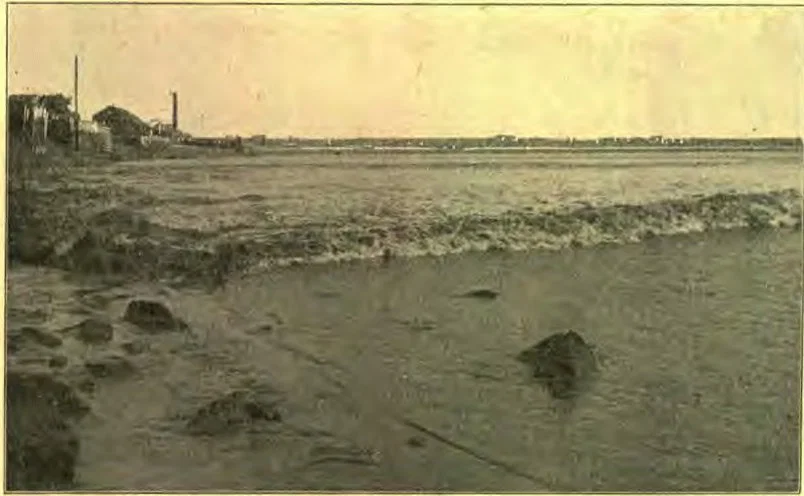
TIDAL BORE OF MONCTON, NEW BRUNSWICK
Most of the Fundy shores are very high and rocky, but around the tributaries at the head of the bay the shores are rarely precipitous, but predominant in broad, flat lands, reaching far back inland along the streams.
The greater portion of these lands was formerly submerged by the sea at high tide, but man has now reclaimed thousands of acres of this beautiful marsh-land from the sea by means of heavy dykes, and converted it into luxuriant meadows, dotted over with barns. Longfellow wrote of it:—
“Bursting with hay were the barns, themselves a village. . .
Dykes, that the hands of the farmers had raised with labor incessant,
Shut out the turbulent tides; but at stated seasons the flood-gates
Opened, and welcomed the sea to wander at will o’er the meadows.”
Occasionally the farmers do let the water in through the dykes, because the rich alluvium (marsh mud) deposited by the waters greatly enriches the land. Sometimes the “turbulent tide” under high wind plows through the dykes, and floods miles of meadow and field. The past season the tide broke through just at haying time, and thousands of tons of hay and other crops were destroyed. In winter, when the farmer has more leisure, he goes out with his team beyond the dykes at ebb-tide, and hauls the rich alluvium from the flats to the upland.
Philosophy teaches that “water seeks its level,” but in the Bay of Fundy and its tributaries, water apparently ignores this rule and flows up-hill. It is not easy to describe the feeling that steals over one who witnesses this phenomenon for the first time. He looks out in the morning, and beholds a wonderful scene. The river which, the night before, was rippling lazily along, with the appearance of any other stream, except for its deep, declining banks and far-receding bed, is now surprisingly changed. It is rushing furiously up-stream, seven knots an hour, growing deeper and wider continually until it has risen forty or fifty feet, and ships under full sail ride gallantly by. For a moment one can scarcely believe his senses; he almost thinks the world has turned upside down. He exclaims, “Great things doeth He, which we can not comprehend!”
On account of these giant tides, many otherwise insignificant streams are made navigable for several miles inland. Ships can ascend these streams only at flood-tide, when the small creeks become large and deep rivers, with the current flowing swiftly toward the source. If vessels fail to reach their destination before the tide ebbs, which often occurs, they must then cast anchor, or they will be carried back to sea by the swift returning tide. Unless a vessel is specially built to lie on the bottom of the river, long lines must be fastened to the mast-head, as the flood ebbs away, and the other end taken ashore and made fast by iron bars driven down, to prevent the ship from capsizing when she settles on her keel in the river’s bed on “dry land.” When a person sees a ship lying, a helpless monster, in the bed of a stream, far from her home on the restless sea, it seems to touch a chord of sympathy in one’s heart. Soon, with unerring accuracy, the flood-tide returns, reversing the river, relieving the patient monster, and again the “ship’s afloat.”
As the water converges toward the head of the bay, it rises higher than it does lower down, and the water is forced up the rivers with great power. A grand and impressive sight may be seen at Moncton, New Brunswick, twenty-five miles up the river, at the first approach of the flood-tide. It is a tidal wave, called the “Bore.” It can be heard roaring and plowing up the river long before it comes in sight. A white, rolling124wall of water, sometimes ten feet high, dashes up the river and stretches far across its bed. What was just before a small stream scarcely ten rods wide, is now more than a mile in width, bearing steamboat, ship, and barge upon its waters.
A man visiting from the West, unacquainted with the tides, on seeing the “bore” fiercely sweeping up the river, cried out to his friends with him, in great excitement, “Oh, what a mighty flood! and without a drop of rain, too! Yes, and it’s coming wrong side up! What an awful cloud-burst there must have been below!”
At the mouth of the River St. John, 450 miles in length, is formed an estuary full of grandeur. One attraction is a curious fall about thirty feet high at low (tide) water; but as the Fundy flood-tide returns rushing up the river, it soon reverses the stream, and the water falls up-stream instead of down.
At high (tide) water no trace of the fall is seen, and then the river presents a scene of busy traffic. Waiting steamboats, ships, woodboats, rafts of logs and lumber, now go sailing by as if no fall were ever there. Soon the tide ebbs away, and the fall again appears, guarding the river, seaward, from friend or foe with all security as before.
Truly, wonderful are the paths of God.
GEO. E. LANGDON.
Halifax, Nova Scotia.
A GREBE ADVENTURE
By Sel.
The grebe is often called “water-witch” because it is so quick in diving under water. There are several kinds, and they can all take good care of themselves, having been known to dive at the flash of a gun, and escape the most practiced sportsman.
The most interesting adventure I ever had with grebes was in North Dakota. I camped for six weeks with a friend on the wild prairie by shallow lakes, where thousands of water-fowl were nesting. Our object was to study birds; and we drove six hundred miles in an open buggy, and slept in a tent or in settlers’ barns.
At last we found ourselves near the Canada line by Rush Lake, a place much frequented by birds. One day in early June we drove over the prairie to a small lake, or slough, about a quarter of a mile across. As we approached it, I saw what appeared to be an island out in the middle, with a large number of birds, which I took to be mud-hens, sitting on its shore. Determining to wade out to them, I pulled up the tops of my long rubber boots, and started in. A few steps, and my boots were almost overflowed. As there was no boat nearer than Rush Lake, the only thing to do was to strip. The water was bitter cold in that northern climate; but the sun shone, and I thought I could get warm in its rays on the island shore before starting back.
Soon I was in breast-deep; and entangled with weeds that gathered, as I advanced, in a great island about my body, I had to clear myself again and again. In a quarter of an hour I was almost frozen—but I was nearly there. Where? Not to the island, for there was none! As I emerged from some high grass, I saw, not dry shore, but a lot of little hummocks of wet weeds floating on the water.
On nearly every one sat a curious bird upright, picking at something. Then, one by one, they plunged into the water, swam off a few feet, and turned to watch the queer object bobbing about like a seal. It was one of the strangest sights of my life—a grebe colony. Each mound was a floating nest, a sort of little house-boat, holding five, or less, dirty white eggs. In a few cases laying had not begun; in other instances the eggs were covered over with rubbish: the birds had tried to hide their treasures when they saw me coming.
I examined everything hastily, for I was shuddering with the cold, and there was no island for me to crawl out upon. Putting a few eggs in the creel I carried, I began the return. My legs were cramping, and I was fairly benumbed. It took all the courage I could muster not to give up. My companion watched me anxiously from the shore. At last I reached it, after forty minutes in that ice-water.
I hurried on my clothes, and for half an hour raced like a madman over the prairie, letting my friend rub me now and then. At last I began to feel warm, and we drove back to camp.—Sel.
GOD SHALL SUPPLY ALL YOUR NEED
By Elizabeth Rosser
Are you hungry? “I am the bread of life: he that cometh unto me shall never hunger.” John 6: 35.
Are you thirsty? “If any man thirst, let him come unto me, and drink.” John 7: 37.
Are you homeless? “In my Father’s house are many mansions. . . . I go to prepare a place for you.” John 14: 2.
Are you orphaned? “A father of the fatherless . . . is God in his holy habitation.” Ps. 68: 5.
Are you lonely? “Behold, I stand at the door and knock: if any man hear my voice, and open the door, I will come in to him, and will sup with him, and he with me.” Rev. 3: 20.
Are you needy? “For the needy shall not always be forgotten: the expectation of the poor shall not perish forever.” Ps. 9: 18.
Are you sick? “The Lord will strengthen him upon the bed of languishing: thou wilt make all his bed in his sickness.” Ps. 41: 3.
Are you deaf, dumb, blind, lame? “The eyes of the blind shall be opened, and the ears of the deaf shall be unstopped. Then shall the lame man leap as an hart, and the tongue of the dumb sing.” Isa. 35: 5, 6.
Are you ignorant? “If any of you lack wisdom, let him ask of God, who giveth to all men liberally, and upbraideth not; and it shall be given him.” James 1: 5.
Are you fearful? “Fear not thou: for I am with thee: be not dismayed; for I am thy God: I will strengthen thee; yea, I will help thee; yea, I will uphold thee with the right hand of my righteousness.” Isa. 41: 10.
Are you weak? “My grace is sufficient for thee: for my strength is made perfect in weakness.” 2 Cor. 12: 9.
Are you sinful? “Come now, and let us reason together, saith the Lord: though your sins be as scarlet, they shall be as white as snow: though they be red like crimson, they shall be as wool.” Isa. 1: 18.
Are you sorrowful? “God shall wipe away all tears from their eyes, and there shall be no more . . . sorrow.” Rev. 21: 4.
Are you burdened? “Cast thy burden upon the Lord, and he shall sustain thee.” Ps. 55: 22.
Are you weary? “There remaineth therefore a rest to the people of God.” Heb. 4: 9.
ELIZABETH ROSSER.
THAKOOR’S THANK-OFFERING
“There now, run away, little one. Papa’s too busy to play this morning. Tell Ayah to put little Bobby to sleep. We don’t want any more sick little boys around here, do we? Run away now, that’s papa’s good boy.”
The merry blue eyes of the good missionary’s child became suddenly sober. It was a whole hour before the time the little fellow usually took his nap; and since he had been so very sick, his papa had spent a part of every morning in quiet frolic with his sweet, delicate child. Bobby gleefully anticipated this frolic with his father, and it is no wonder that this unusual dismissal pierced his tender little heart, and sent him off almost suffocated with his first taste of real sorrow. Papa didn’t want him! In the farthest corner of the nursery two big tears splashed down on the old rag doll that Bobby was hugging and kissing in his first desolation.
Just now everything was in confusion at the mission. The missionary’s family had returned from the mountains only the day before. They could not come sooner because little Bobby had been so ill that they feared he would not live. And now there was so much to be done,—the house to get in order, the free dispensary to be opened right after noon, and a great pile of correspondence to be answered without delay. Dr. Baker, the missionary, was tired and half sick. He scarcely realized what he had said when he had sent the baby away. Sometimes even missionaries come to the end of their proverbial allowance of good-nature. He plunged into his task of letter-writing, and had clicked off half a dozen accounts to different people “at home,” who were supporting some student in the training-school, or otherwise indulging in generosity toward foreign missions. He worked hard and became absorbed. Everything was forgotten but the business in hand, and he hoped to have no interruption until he was through.
However, he soon became conscious of a presence in the doorway, somewhat back of him, but kept at his work, hoping the presence would depart. He heard an apologetic little cough, but paid no attention. The cough came again. Turning around rather impatiently, Dr. Baker saw his faithful old Hindu servant bowing almost to the ground. “What do you want, Thakoor? I’m really too busy to see how busy I am? I haven’t any time to see you this morning.”
THE LITTLE SPRIG OF CONTENT
EDITH is only a schoolgirl, but she has some of the wisdom that is better than any to be gained from books. She does not spend her time fretting over things she does not have. She enjoys what she has.
“Don’t you wish you were going to the sea-shore?” asked Margaret.
“I should like it,” said Edith, “but I’m glad I’m going to grandpa’s. I always have a good time there.”
“Wouldn’t you like to have a new dress like Mary’s?” said Jessie.
“Yes; but I like mine just as well,” was the answer.
Edith has “the little sprig of content,” which gives a rich flavor to everything.—Selected.
TAKE TIME
TAKE time to breathe a morning prayer, asking God to keep you from evil, and use you for his glory during the day.
Take time to read a few verses from God's word each day.
Take time to be pleasant. A bright smile and a pleasant word fall like sunbeams upon the hearts of those around us.
Take time to be polite. A gentle “I thank you,” “If you please,” “Excuse me,” even to an inferior, is no compromise of dignity.
Take time to be patient with children. Patience and kindness will open a way for good influence over almost any child.
Take time to be thoughtful about the aged. Respect gray hairs, even if they crown the head of a beggar.—Selected.
THINK NOT OF SELF
Think not of self, but think of Christ,
And living thoughts will grow;
And words will start and run like fire,
With light and love aglow.
Think not of self or human praise,
But of thy brother’s woe;
And thy true words with love and speed
Right to his heart will go.
Think not of self or this world’s fame,
But of thy Master’s praise;
So shall thy words, made like his own,
The fallen, broken, raise.
Think not of self, or how to speak,
But of the Saviour’s love;
So shall thy words that fragrance bring
Which lures the heart above.
Think not of self or thy own wounds,
But of the Saviour’s blood;
So shall thy speech that unction bring
Which heals and wins to God.
—Selected.
HER SECOND THOUGHT
By Sidney Dayre
“You pretty apple blossoms,
Why do you fly away
Just when the spring is sweetest?
We want you all to stay.
There's not a single flower
More beautiful than you;
Oh, stay, because we love you,
The whole long summer through.”
The apple blossoms whispered,
Still sending down a shower:
“You darling little maiden,
We've bloomed our springtime hour,
If we too long should linger,
Our boughs would never hold
For all the little children
Big apples, red and gold.”
The little maiden pondered
As, pink and pearly white,
Came showering the petals
Upon her ringlets bright.
She laughed, and shook them lightly,
And then looked up to say:
“You sweetest apple blossoms,
Be quick and fly away.”