Your ShelfYour Projects

Review and Herald, Vol. 75, No. 19.

PARENTAL RESPONSIBILITY.—NO 1

Review and Herald

May 10, 1898

Seventh-day Adventist Publishing Association · Battle Creek, Mich. · May 10, 1898

PARENTAL RESPONSIBILITY.—NO 1.

MRS. E. G. WHITE.
In the education of their children, parents should begin early to establish in them correct methods and habits; for the early education of the youth shapes their character in both their secular and religious life. Their minds should be directed in profitable channels of thought. Their occupations should be such as not only to benefit themselves, but to teach others the development of thought and labor that will be for their present and eternal good.
Children may be trained for the service of sin, or for the service of righteousness. Solomon says, “Train up a child in the way he should go; and when he is old, he will not depart from it.” This language is positive. The training that Solomon enjoins is to direct, educate, develop. But in order for parents to do this work, they must themselves understand the “way” the child should go. It is impossible for parents to give their children proper training unless they first give themselves to God, learning of the great Teacher the precious lesson of obedience to his will. The mother should feel her need of the Holy Spirit’s guidance, that she may herself have a genuine experience in submission to the way and will of the Lord. Then, through the grace of Christ, she can be a wise, gentle, loving teacher of her children.
Fathers and mothers are responsible for the health, the constitution, and the development of the characters of their children. No one else should be left to see to this work. As parents, it devolves upon you to co-operate with the Lord in educating your children in sound principles, keeping their minds open and impressible by the inculcation of Bible truth. This will develop strong characters.

DIET.

In too many cases the parents are only grown-up children. They are not intelligent teachers; they do not realize the responsibilities that rest upon them. In their ignorance of the wants of their infants, many parents think that they can be fed upon those things which they themselves eat. They have no knowledge of what constitutes a proper diet. Many mothers have come to me, saying, “My baby does not thrive. It is poor and fretful and sick. What is the matter with it?”
“What do you give your child to eat?” I have questioned.
“The same food that we ourselves eat,—a little bit of everything,— a little tea, coffee, potato, beer, and meat.”
This variety of food is unwholesome for the parents, and is much more so for the child. The child has but a small stomach, and should have regular periods of eating, and then it should not eat too largely. Overeating crowds the stomach, and distress is the result. The “stuffing” process has placed many a little child in its narrow bed, just because of the ignorance of the parents. Let the child dress simply, and eat of the simplest and most wholesome diet. Let him not be indulged, and tempted to eat more than he should. This will ruin the digestive organs before he can become intelligent upon the important subjects of how to eat, how to dress, how to exercise, in order to retain health. The youth who are not perseveringly educated to respect the laws of their own being, will easily turn aside from the laws which God has ordained for their spiritual life.

THE SPOILED CHILD.

In some families the wish of the child is law. Everything he desires is given him. Everything he dislikes, he is encouraged to dislike. Indulgence is supposed to make the child happy, but it only makes him restless and discontented. Indulgence has spoiled his appetite for plain, healthful food, and for the plain use of his time; self-gratification has done the work of unsettling his character for time and for eternity.
A great mistake is made when the lines of control are placed in the child’s hands, and he is allowed to bear sway in the home. But this has been done, and will continue to be done, because fathers and mothers are blind in their discernment and calculation. The child who is not carefully and prayerfully disciplined will be unhappy in this life, and will form such unlovely traits of character that the Lord can not unite him with his family in heaven. There is a very great burden to be carried all through the life of a spoiled child. When his will is crossed, he is aroused to anger. In trial, in disappointment, in temptation, he will follow his undisciplined, misdirected will.
Children who have never learned to obey will have weak and impulsive characters. They may profess to be Christians, but how sad is their experience. They seek to rule, but have not learned to submit. These half-educated children are without moral strength to restrain their wayward tempers, to correct their wrong habits, or to subdue their uncontrolled wills. That mother who, knowing what is best for the spiritual and physical help of her child, yields to his tears and importunity, will, through her own training, be pierced through with many sorrows.
The heavenly intelligences can not co-operate with fathers and mothers who neglect to train their children, and who allow Satan to make the youthful mind an instrument through which he can work to counteract the working of the Holy Spirit. The youth may profess to be converted, but the character will reveal whether or not the neglected work of the parents has been overruled by good. What sin can be greater than that of allowing children to be spoiled by mismanagement? When these children have families of their own, they carry their defects with them, and thus the neglect of parents to deal faithfully carries evil from generation to generation. Thus the world is deprived of the moral power of rectitude and integrity which it should have.
The happiness of every child may be secured by strong, even discipline. A child’s truest graces consist in modesty and obedience,—in attentive ears to hear the words of direction, in willing feet and hands to walk and work in the path of duty. And a child’s true goodness will bring its own reward, even in this life. The early years are the time for the training process, not only that the child may become most serviceable and full of grace and truth in this life, but that he may secure the place prepared in the home above for all who are true and obedient. In our own training of children, and in the training of the children of others, we have proved that they never love parents and guardians less for restraining them from doing evil.
The future of society depends on the education and training of the youth of to-day. Parents, a solemn work is resting upon you. The greatest power, the efficient gospel, has its effect in the well-ordered, well-disciplined family. The children are not to be treated as dolls, made to be dressed and undressed,—idols, to have affection and indulgence lavished upon them, and parental self-sacrifice cater to their impulses. They are to learn to obey in the family government. They are to form a symmetrical character, of which God can approve, maintaining law in the home life. Christian parents are to educate their children to obey the law of God. The reasons for this obedience and respect for the law of God may be impressed upon the children as soon as they can understand its nature, so they will know what they should do, and what they should abstain from doing.
God requires obedience of every human being. Upon this our eternal future depends. In obedience to the law of God we shall form a beautiful character. “The law of the Lord is perfect, converting the soul.” Children should be taught to respect every word that proceeds out of the mouth of God. Parents are ever to magnify the precepts of the law of the Lord before their children, by showing obedience to that law, by themselves living under the control of God. If a sense of the sacredness of the law takes possession of the parents, it will surely transform the character by converting the soul.
Parents, never prevaricate, never tell an untruth by word or deed. If you want your child to be truthful, be truthful yourselves; be straightforward and undeviating. Even a slight prevarication should not be allowed. If the mother is accustomed to be untruthful, the child will follow her example.
The work of “breaking the will” is contrary to the principles of Christ. The will of the child must be directed and guided. Save all the strength of the will, for the human being needs it all; but give it a proper direction. Treat the child’s will wisely and tenderly, as a sacred treasure. Do not hammer it to pieces; but by precept, by true example and love, wisely fashion and mold it until the child comes to years of responsibility. Then still guide with your counsel, bringing your child up in the nurture and admonition of the Lord.

COURAGE

WHO fails to strike when man's assailed, For fear of selfish pain or loss; Who weakly cowers when right is nailed Upon the proud world's heavy cross; Who fails to speak the splendid word Of bold defiance to a lie; Whose voice for truth is faintly heard When party passions mount on high; Who dares no struggling cause espouse, And loves no paths by martyrs trod; Whose timorous soul no call can rouse To dare to stand alone with God,— That man is coward, and no deeds Of valor done on fields of strife Can prove his courage. Battle needs Are naught beside a tested life.
Who dallies with temptation's lure, Nor hurls his tempter to the ground; Who champions not the weak, the poor, Whom power and strength with cords have bound; Who bows obsequious to the strong, And crushes what he knows is weak; Who palters with a deadly wrong, And dares no vengeance on it wreak; Who crouches 'neath opinion's lash, Nor dares his own true thought proclaim; Who never with an impulse rash Ran on before his time—is tame, Is coward, and no work uprears Which lasts. God's edict from on high Says, Courage shall outlast the years, But every coward soul shall die.
— Hattie Tyng Griswold.

THE TRUE LIGHT.

L. A. REED.
(Jacksonville, Ill.)
In a number of places in the Word, Jesus Christ is spoken of as the Light of the world. We can all see the appropriateness of this, and also many reasons why he should be so called. But we consider the expression to be a figure of speech; Jesus Christ is spiritual light because he is like natural light. Truly, there is a likeness here, but have we a right view of the figure?—I fear not.
We read that the light of which John bore witness “was the true Light, which lighteth every man that cometh into the world.” John 1:9. This light is Jesus Christ; but why is he called the true Light? Is he the true Light because the ordinary lights are false? What is the significance of that word “true,” as here used?
In the original of the New Testament, there are two Greek words which, in our version, are translated “true.” These two words are alethes and alethinos. Alethes means truthful; i. e., not false. Alethinos has a meaning that I cannot express by any English equivalent; but we may illustrate the use of the two words.
In John 5:31, 32, the word alethes is used: “If I bear witness of myself, my witness is not true [truthful].” Again, in John 10:41, we have a similar use of the word alethes: “John did no miracle: but all things that John spake of this man were true [truthful].” But the word alethinos is used in such constructions that the word “truthful” does not seem to be at all the proper word to supply. For instance, “the true riches” (Luke 16:11); “true bread” (John 6:32); “true vine” (John 15:1); and “true light” (John 1:9; 1 John 2:8) could not be read “the truthful riches,” “the truthful bread,” etc. And never is the word alethes used in statements like these just given.
To get at the real meaning of the word alethinos, let us take another example: In Heb. 8:2 we have the expression, “the true tabernacle.” And this true tabernacle is contrasted with the one which man pitched. If you have a clear idea of the sanctuary question, you will now see something of the significance of this word “true.” The tabernacle which man pitched was a real tabernacle, for God dwelt in it; but it was not the “true tabernacle.” And neither do we think the meaning here is that the heavenly tabernacle is a truthful tabernacle, in contrast with the earthly as the false tabernacle. What, then, is the meaning of the expression, “the true tabernacle”? In Heb. 9:24 we have the answer; for we read that the holy places made with hands are the figures of the true. In this passage, true is contrasted with figures. The earthly tabernacle served unto the shadow and example of the heavenly: it was a pattern of the true.
Thus the bread of our tables is not the true bread, since it is but a shadow and an example of the heavenly bread; it is a pattern of the true Bread. And if this bread of ours only sustains our perishing bodies, it has not done all that God designed that it should do. True, God meant that it should sustain these mortal bodies of ours; but he also meant that it should teach us of the true Bread, which can sustain us unto eternal life. And so with each of the others; they were meant to teach us of higher and more perfect things, of which they are but the shadow, the pattern, and the example.
Therefore, we conclude that our idea of the figure is all wrong. Jesus Christ is not bread in a figurative sense. O, no! he is bread in the true sense. The bread of our tables is bread only in a figurative and shadowy sense. It is not the bread that sustains our lives, but the virtue of Jesus Christ; for “in him we live, and move, and have our being.” Thus is he the true Bread, and the true Vine, and the true Light. And this light that shines to these physical eyes is not the true light. Of course it is light; no one disputes that: but all its energy and vigor and essence are of Jesus Christ. He is the true Light, the very Light; while physical light is but the shadow, and not the perfect image, of the true.

WILL YOU RECEIVE HIM?

R. A. UNDERWOOD.
(Mesopotamia, Ohio.)
MANY who are looking for, and desiring, the baptism of the Holy Spirit are in the position occupied by the Jews who were looking for the first advent of Christ. “He came unto his own, and his own received him not.”
Why did they not receive him?—Their ideas of the coming of the Messiah were so different from the true manifestation of the Son of God that they “knew him not” (Acts 13:27); therefore they “received him not.” It is true that they were without excuse, because they had the Scriptures that were very plain as to the way Christ would come, and these they read every Sabbath day. But they put their own interpretation upon these Scriptures, so when Christ came in a way different from what they expected him, they would not receive him. Christ says of the Holy Spirit, “If I depart, I will send him unto you.” “Receive ye the Holy Ghost.”
Should the Holy Spirit come to you as he is,—the representative of Christ, the prime minister of God’s kingdom of grace, the “third person of the Godhead,”—would you know him? If you do not know him, how can you receive him? He has come; he is by your side, asking you to receive him; but how can you, while you do not know him?
A short time ago I attended a general meeting, and a dear brother, whom I had not seen for several years, met me at the station. He stood on the platform, not six feet from where I stepped from the train. He was looking for me. I knew him, and stepped close to his side, and looked right in his face, to see if he would recognize me. But no; he was looking for some one who would appear different from what I did. Finally I called him by name, and asked him of his welfare. “This is not Elder Underwood!” he exclaimed. I said, “Yes.”
He continued, “I was looking for a different man.”
When he knew me, he received me most heartily. He saw me, he might have heard of me and seen my work, but he could not receive me until he knew I was the man he was looking for. And until he had evidence that I was the one he desired to meet, he paid no attention to me, no matter how near I was to him, nor how long I waited to be received.

DO YOU KNOW HIM?

We may be affected by the influence of the Spirit, and yet not know him as he is, and hence not receive him. When we enter upon the field of inquiry concerning the Spirit, that we may know him so that we may receive him, we tread upon hallowed ground; yet with humility we may follow on to know what the Spirit has revealed concerning himself and the wonderful plan of salvation.

THE WORK OF THE SPIRIT.

The office and work of the Spirit is a subject of all-absorbing interest. A study now on this topic will aid us in learning, later on, what he is, as well as who he is.
First, he reproves and convinces of sin. “When he is come, he will reprove [margin, ‘convince’] the world of sin.” John 16:8.
Secondly, the Spirit makes the change in conversion. We read concerning Saul: “The Spirit of the Lord will come upon thee, and thou shalt prophesy with them, and shalt be turned into another man.” 1 Sam. 10:6. “Know ye not that the unrighteous shall not inherit the kingdom of God? Be not deceived. . . . And such were some of you: but ye are washed; but ye are sanctified, but ye are justified in the name of the Lord Jesus, and by the Spirit of our God.” 1 Cor. 6:9–11.
Thirdly, the Spirit makes intercession for the saints. “And in like manner the Spirit also helpeth our infirmity: for we know not how to pray as we ought; but the Spirit himself maketh intercession for us with groanings which can not be uttered.” Rom. 8:26, R. V.
Fourthly, the Spirit seals the saints for an endless life of glory. “In whom [Christ] also after that ye believed, ye were sealed with that Holy Spirit of promise.” “Grieve not the Holy Spirit of God, whereby ye are sealed unto the day of redemption.” Eph. 1:13; 4:30.
Fifthly, the Spirit receives the light from Christ, and gives it to the world, through prophets or otherwise. Christ says: “He shall glorify me: for he shall receive of mine, and shall show it unto you. All things that the Father hath are mine: therefore said I, that he shall take of mine, and shall show it unto you.” John 16:14, 15. “He that hath an ear, let him hear what the Spirit saith unto the churches.” Rev. 3:13. “Now the Spirit speaketh expressly, that in the latter times some shall depart from the faith, giving heed to seducing spirits, and doctrines of devils.” 1 Tim. 4:1. “When they shall lead you, and deliver you up, take no thought beforehand what ye shall speak, neither do ye premeditate: but whatsoever shall be given you in that hour, that speak ye: for it is not ye that speak, but the Holy Ghost.” Mark 13:11. While “eye hath not seen, nor ear heard,” of the things that God hath prepared for those that love him, yet “God hath revealed them unto us by his Spirit. . . . Now we have received, . . . the Spirit which is of God; that we might know the things that are freely given to us of God.” 1 Cor. 2:9–12.
Sixthly, the prophet of God is simply the visible mouthpiece (Ex. 4:15, 16), through whom the Holy Ghost speaks. “For the prophecy came not in old time by the will of man: but holy men of God spake as they were moved by the Holy Ghost.” 2 Peter 1:21. The sweet psalmist of Israel said, “The Spirit of the Lord spake by me, and his word was in my tongue.” 2 Sam. 23:2. Again, we read, “This Scripture must needs have been fulfilled, which the Holy Ghost by the mouth of David spake before concerning Judas,” etc. Acts 1:16. “And when they agreed not among themselves, they departed, after that Paul had spoken one word, Well spake the Holy Ghost by Esaias the prophet unto our fathers,” etc. Acts 28:25.
Seventhly, the Spirit does not speak of himself, but he glorifies Christ. “When he, the Spirit of truth, is come, he will guide you into all truth: for he shall not speak of himself; but whatsoever he shall hear, that shall he speak: and he will show you things to come. He shall glorify me.” John 16:13, 14.
Eighthly, the Spirit delivers the saints and directs their work. “Not by might, nor by power, but by my Spirit, saith the Lord of hosts.” Zech. 4:6. The case of Philip and the eunuch illustrates this. “The Spirit said unto Philip, Go near, and join thyself to this chariot.” And when his work was done for the eunuch, “the Spirit of the Lord caught away Philip.” Acts 8:29–39. Again: “As they ministered to the Lord, and fasted, the Holy Ghost said, Separate me Barnabas and Saul for the work whereunto I have called them. And when they had fasted and prayed, and laid their hands on them, they sent them away. So they, being sent forth by the Holy Ghost, departed unto Seleucia,” etc. Acts 13:2–4. Being sent by the Holy Spirit, they would be under his direction; hence we read: “Now when they had gone throughout Phrygia and the region of Galatia, and were forbidden by the Holy Ghost to preach the word in Asia, after they were come to Mysia, they essayed to go into Bithynia: but the Spirit suffered them not.” Acts 16:6, 7.
Ninthly, the Spirit raised Christ from the dead. “For Christ also hath once suffered for sins, the just for the unjust, that he might bring us to God, being put to death in the flesh, but quickened by the Spirit.” 1 Peter 3:18; see also Rom. 8:11.
What shall we say more? I can do no better, in closing, than to quote the following from the pen of Mrs. E. G. White, in the REVIEW AND HERALD of Oct. 26 and Nov. 30, 1897:—
Wherever we are, wherever we may go, he is always there, one given in Christ’s place, to act in his stead. He is always at our right hand, to speak soothing, gentle words; to support, sustain, uphold, and cheer.
The Holy Spirit ever abides with him who is seeking for perfection of Christian character. The Holy Spirit furnishes the pure motive, the living, active principle, that sustains striving, wrestling, believing souls in every emergency and under every temptation. The Holy Spirit sustains the believer amid the world’s hatred, amid the unfriendliness of relatives, amid disappointment, amid the realization of imperfection, and amid the mistakes of life.
Why should we not know the Holy Spirit, and receive him in his fulness? Who can not see that the Holy Ghost is the prime minister of Christ’s kingdom of grace in the work of the salvation of a lost world?

CONFIDENCES

It is better to be too reserved rather than too much given to confidences with ordinary acquaintances. The most momentous affairs of your life are of little consequence or interest to the greater part of the people you meet. What you have suffered or done is of little moment to them. You may be burning with your wrongs, and bursting with anxiety to relate them to somebody; but to ninety-nine out of every hundred people you meet the story would be only faintly amusing. It would hardly be remembered by them two hours after you had told it.
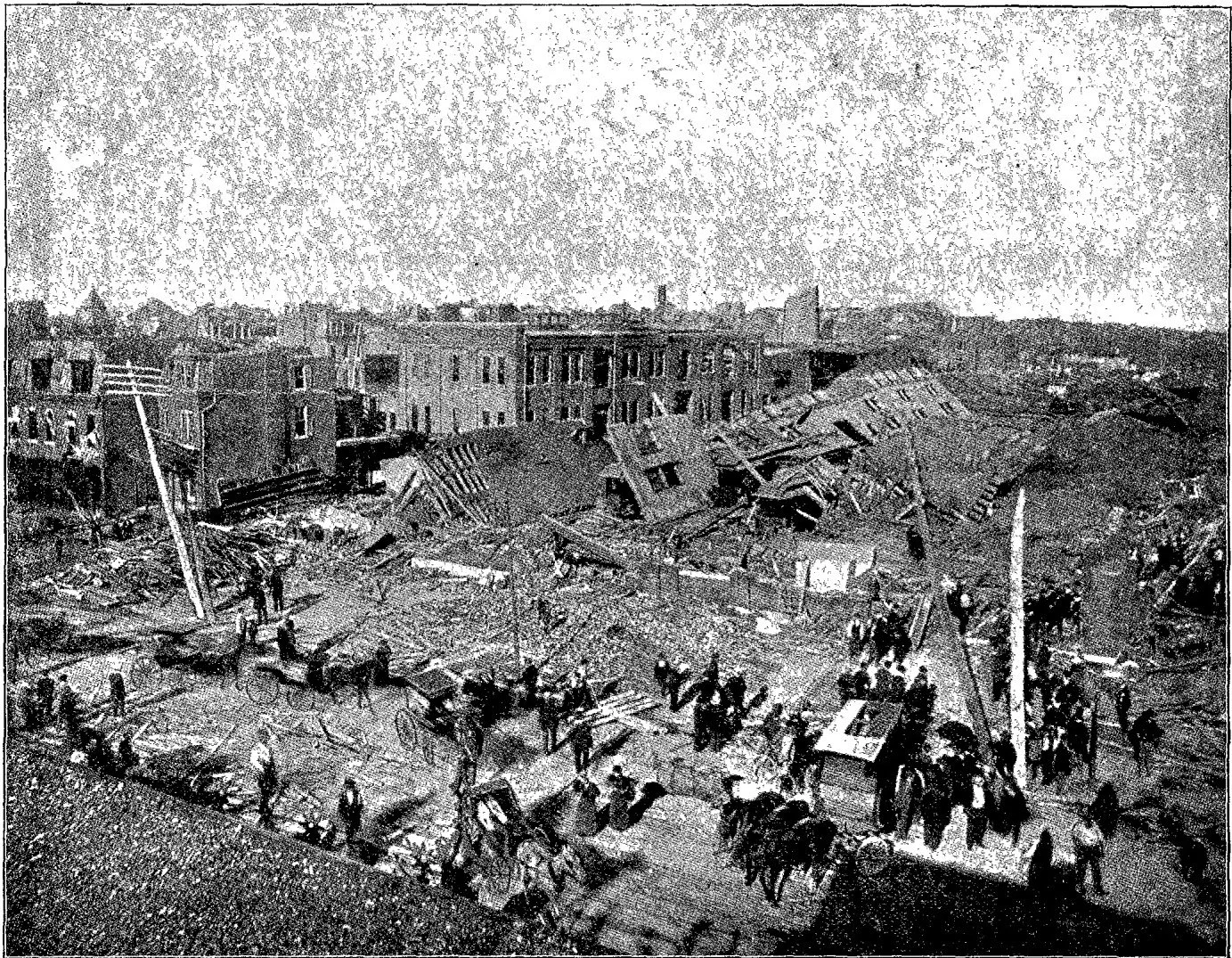
View of the immense power-house of the Union Depot Railway Company, showing the extent of the wreck, and the thoroughness of the awful work of the St. Louis storm, 1896. It is a word-picture in itself.
It is a good plan to think over these truths, to keep them in one's heart, and promptly to quench in one's self the egotistical longing to tell that little “tale of woe” to any one who will sit still and listen to it. We are not likely to be sorry that we refrained from speaking. We may be very sorry that we did speak.
The bitter lesson that we, as individuals, are of small account to the world at large, is one not easy to learn. But it must be learned, if we would carry strong, healthy minds in our bodies. We must find consolation and compensation in ourselves for the ills of life, and then it will be easier to break ourselves of the wretched habit of always looking for a confidant.—Harper's Bazar.

THE SIGNIFICANCE OF STORMS.

A. O. TAIT.
(Oakland, Cal.)
Previous to this century, history records the occurrence of but few great storms; and when the hurricane or earthquake is mentioned, it is described as something not only terrible, but also unusual. But not the least among the marvelous signs of this time, is the frequent occurrence of wind- and hail-storms, cyclones, tidal waves, etc., with their disastrous effects. Statistics are not needed to convince any man of thirty-five or forty years, that these storms have greatly increased during the last quarter of a century.
Twenty-five or thirty years ago, when the whirling cyclone began to make such frequent appearances on the plains of Kansas and other prairie States, it was confidently affirmed that “these storms had always raged there,” that “the level character of the country was peculiarly fitted to produce them,” and so on. We were told that “the reason that we had not known of them before, was that the country was not sufficiently populated for the storms to be reported.”
It is not a little amusing to hear men talk so knowingly of what has “always been,” and in the same breath tell us, “Only no one was there to report it.” If “no one was there” to make the report, then how can any one tell the conditions that existed? A man does not need a university education to enable him to see the point. All that we may say of the times and places when and where “there was no one to report,” is pure speculation. And, indeed, how many there are who can be fed on simple speculation; yet these very persons will talk knowingly of their visionary theories, and would try to have you believe that they are “thoroughly scientific.” There is nothing that we need more to guard against in this age than baseless speculations. The word of God gives us enduring facts. Cling to these. This word says, plainly: “It shall come to pass in the last days, saith God, I will pour out of my Spirit upon all flesh: and your sons and your daughters shall prophesy, and your young men shall see visions, and your old men shall dream dreams: and on my servants and on my handmaidens I will pour out in those days of my Spirit; and they shall prophesy: and I will show wonders in heaven above, and signs in the earth beneath; blood, and fire, and vapor of smoke: the sun shall be turned into darkness, and the moon into blood, before that great and notable day of the Lord come: and it shall come to pass, that whosoever shall call on the name of the Lord shall be saved.” Acts 2:17-21. And another scripture tells us that “great earthquakes shall be in divers places, and famines, and pestilences; and fearful sights and great signs shall there be from heaven.” Luke 21:11. Here we are very plainly told by the Lord that he “will show wonders in heaven above, and signs in the earth beneath; blood, and fire, and vapor of smoke;” also that there will be “fearful sights and great signs” from heaven.
Now when the Lord, “in the last days,” shows his wonders in heaven above, and signs in the earth beneath, and when these “fearful sights and great signs” are appearing, it will not be something that “has always been,” “only there was no one there to report it.” As these signs of the coming of the Lord appear, they will be more and more marked unto the end. They will be sufficiently clear to carry with them the positive conviction that they betoken the judgment-day.
Men may deride it as they will, but it is nevertheless a fact that God has undertaken to give signs to convince the world that the end of all things is at hand. To say that these signs, as they are seen, will not carry with them just such a conviction as God intends, is to limit his power and wisdom.

Standing Where the Lord Has Placed Us

“THOSE who stand upon the ground where the Lord has placed them, will receive the mercies he has promised.”

IN THE LORD’S KEEPING.

C. H. Wetherbe, in Christian Work.
The Lord’s cause is represented in the Bible as a vineyard. Concerning it are these words: “I the Lord do keep it.” It is a thrilling thought that millions of Christians are deeply interested in the safety and perpetuity of the Lord’s cause; but more uplifting still is the thought that above and beyond all the care and concern of all Christians in the world for the cause so dear to their hearts, is Christ’s care for his cause. He throws the whole of his almightiness into the keeping of his vineyard. No human being can possibly have such an interest in his vineyard as our Lord has. It is the treasure of his infinite love.
He gives much more thought to it than he does to all heaven. Day and night his eyes are upon his cause and his people. And he does a great deal more than to look upon these treasures of his heart; he puts his whole soul into caring for them and keeping them. Referring to his vineyard, he says: “I will water it every moment: lest any hurt it, I will keep it night and day.”
Notwithstanding the interest which Christians have in the cause of Christ, it would wither and perish if he himself did not “water it every moment.” Not a moment passes without the Lord’s refreshing his vineyard. Upon it he lets fall each moment the dew of his abundant and invigorating grace.
In the night seasons, while his people are asleep, the Lord keeps watch and ward of his cause. At times his servants may be slack and negligent, but the Lord is incessantly vigilant in keeping his vineyard. The enemy may seek to hurt it, but the Lord stays the hand of every foe; for he keeps his cause “day and night.”
The leading of the Holy Spirit is to an entire dependence on him,—a reliance only, entirely, and constantly on the Holy Ghost. No leaning on self, or friends, or dogma, or doctrine; on experience or circumstances; on interests or affiliations; on feeling or faith, but on him. He may take all these away if they interfere. He wants you, he is striving to get you, he will allow nothing to get between him and you; and the kindest thing he can do is to remove anything or everything on which you may lean or look, and the wisest thing you can do is to let him. Let go of things, and receive him. This is his darling wish concerning you,—that your dependence may be on him.—King’s Messenger.
“The kingdoms of intellect and of grace are not identical, neither are they hostile. True learning and religion march side by side, not force to force. Brains do not exclude from heaven, and piety is no bar to knowledge.”

WITHOUT A RIVAL.

If the Holy Spirit is not allowed to live without a rival in the heart, he will not abide there. He will not compete with things, nor with people, for your attention and your affection. If you are occupied in heart and thought with anything but himself, he will not occupy you; and if you give an ear to other voices, he will cease to speak, and you may seek in vain to know his will. You will soon find yourself in an unequal contest with darkness, and discord will fill your being, and manifest itself in your life.
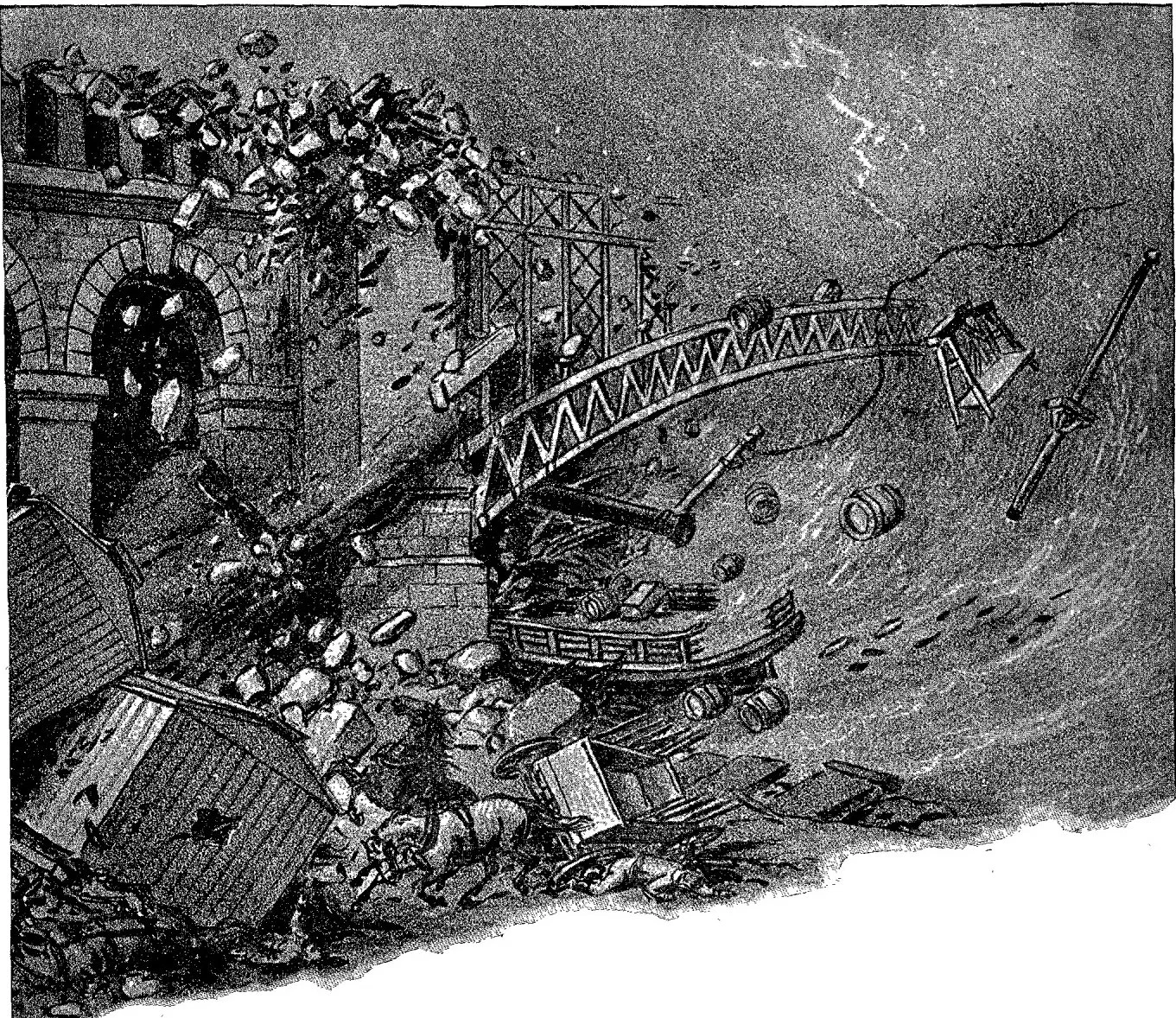
Destruction of the east end of Ead's bridge during the great St. Louis storm.
His sheep must not know the voice of a stranger; they must know only his voice, and it will be easy following him. How shall you know?—Be still to know. Knowing only him will fill your being and your life with harmony, and enable you to quiet the discord in other lives, and give to them harmony instead. So, beloved, refuse to have your mind and heart occupied with anything that is not of him. Hear his voice, see his face always, meditate on his ways and works, commune with him, and his life will fill and flow through every part of yours, until every act of your life will glow with characteristics of himself.—Selected.
Continue reading: CHRISTIAN MANLINESS