JUNE 18, a bright little school boy was murdered in this city by his father who had become insane by brooding over the death of his wife which had taken place some months previously. The insane father after sending three bullets into his child’s brain turned the weapon on himself. The father was much attached to the boy and the neighbors now recall the fact that he was often heard to remark, “When I go, Walter will go with me.” The boy, an exceptionally manly little fellow, was also much attached to his father. The secret of this sad affair is thus told by the World:—
Upon the table at which the distracted father was seated when the tragedy took place was an open hymn book. The covers had been bent back so that it could not close, and inmates of the house now remember that throughout the early afternoon they heard the old man singing the verses of the hymn at which the book was opened. It was entitled “Beautiful Beckoning Hands,” and read as follows:—
Beckoning hands at the gateway to-night,
Faces a-shining with radiant light,
Eyes looking down from your heavenly home,
Beautiful hands they are beckoning, come.
Beckoning hands of a mother, whose love
Sacrificed life’s devotion to prove;
Hands of a mother, to memory dear,
Beckoning higher the waiting ones here.
This hymn has always been a favorite with Forshay, but by a singular coincidence he had on Sunday evening heard it sung for the first time by its author, Rev. C. C. Luther, who is temporarily filling the pulpit of Dr. Knapp at the Macdougal Street Baptist Church. It was after a visit to his wife’s grave at Greenwood Sunday afternoon, that Forshay had taken his youngest boy (he never went anywhere without him) to the church. On their return from church that evening he had taught the bright little boy the hymn, and together they had sung it over many times.
So it seems that this utterly unscriptural hymn was responsible in some degree at least for this terrible tragedy. The Bible declares, “The dead know not anything” (Eccl. 9:5); and that “his sons come to honor, and he knoweth it not” (Job 14:21); that “his breath goeth forth, he returneth to his earth; in that very day his thoughts perish” (Ps. 146:4); but popular theology teaches, as does the hymn referred to, that the dead are conscious in heaven beckoning to their friends on the earth. If this were true, and they were so beckoning, and it were possible for those left behind to rejoin the departed by death, what would be more natural than just such an act as that committed by an “orthodoxy” insane father?
Divorce Between Church and State Must Be Absolute
The divorce between Church and State ought to be absolute. It ought to be so absolute that no church property anywhere, in any State or in any nation, should be exempt from equal taxation.—James A. Garfield.
What Rome Expects.
ACCORDING to the Catholic Reading Circle Review, during his recent visit to this city, Mgr. Satolli gave a private interview to Rev. Jacob McMahon, director of the League of the Sacred Heart in the cathedral, here and chairman of the executive committee of the Catholic summer school of America. During the course of the interview the subject of the summer school came up. Mgr. Satolli said he had heard of that institution of intellectual training and wished to learn fully its objects and methods. He listened very attentively to the explanation offered by Father McMahon, who described in detail the history, the objects and the usefulness of the school. Mgr. Satolli encouraged him and blest the work, saying: “From the experience that I have gathered in America, I do believe that it is the country of all others in which Catholic truth may have the largest field of action. We only need freedom of speech, and this is most ample in America. I would be very much pleased to see the Catholic summer school incorporate with its object, the presentation to the American people of the precise idea of the relations by which is established the harmony between the Church and the State, so much to be desired and so fruitful of good. In this matter I find a great want of knowledge in America. I am speaking about what is commonly called public ecclesiastical law, which precisely deals with the foundation, or better, the essential constitution of the Church and the State, and determines the limits of the action of both authorities in such a way as to prevent the conflicts that unfortunately disturb social peace and retard social progress.”
Leo Invites All to Enter the Fold
POPE LEO, in an encyclical letter dated November 7, 1885, reported by cable to the New York Herald, . . . says:—
“We exhort all Catholics to devote careful attention to public matters, and take part in all municipal affairs and elections, and all public services, meetings and gatherings. All Catholics must make themselves felt as active elements in daily political life in countries where they live. All Catholics should exert their power to cause the constitutions of states to be modeled on the principles of the true church.”
The pope issued at Rome, January 10, 1890, . . . a letter in which he says:—
“Furthermore, in politics, which are inseparably bound up with the laws of morality and religious duties, men ought always, and in the first place, to serve, as far as possible, the interests of Catholicism. As soon as they are seen to be in danger, all differences should cease between Catholics. Since the fate of States depends principally on the disposition of those who are at the head of the government, the church cannot grant its patronage or favor to men whom it knows to be hostile to it, who openly refuse to respect its rights; who seek to break the alliance established by the nature of things between religious interests and the interests of the civil order.”
The pope’s encyclical letters of 1885 and 1890 are direct attacks upon the institutions of this country, and to them is due the great increased membership of the different patriotic associations.—North American (Phila.), March 14, 1894.
To Open Public Buildings on Sunday.
REPRESENTATIVE DURBOROW, who was an enthusiastic supporter of the bill providing for the opening of the World’s Fair on Sunday, proposes to introduce a bill providing for the opening of the public buildings in this city on Sunday, and for keeping them open until six o’clock on the evenings of the week days. The congressman says that he expects much opposition from those who believe in the puritanical idea of the Sabbath as the only proper one, but that they will be overthrown. The opposition that the World’s Fair Sunday opening bill met in Congress, Mr. Durborow thinks, will be arrayed against this bill also. He says he is not to be deterred by the experience of the Fair managers, who found that the people would not visit anything on Sunday but the Midway Plaisance. “I am led to believe,” he says, “by the fact that this city is largely composed of intelligent, progressive, and liberal people, that the masses will gladly avail themselves of any chance to obtain pleasure and knowledge at the same time, even though it is to be done on Sunday. If we give the people here the opportunity they will show us that our efforts have not been wasted.”—Washington Cor. N. Y. Sun.
Breeders of Infidelity.
If there is any bill that richly deserves to be passed by the present Parliament, it is the one for the abolition of religious prosecutions, which proposes the repeal of certain ancient laws, as, for instance, the law (Act 1 Edward VI., c. 1) “against such as shall unreverently speak against the sacrament of the altar;” the section of 1 Elizabeth, c. 2, which is directed against anything in derogation of the Book of Common Prayer; the section of 21 George III., c. 49, directed against Sunday lectures and debates; and so much of the Act of 6 George IV., c. 47, as relates to “blasphemy” in Scotland. One would think that the naming of these laws would be all the argument necessary to secure their prompt repeal: yet the English Churchman says of the proposal: “Thus the extreme radicals—we hope unconsciously—further the interests of Romanism and infidelity.” Such laws as these are the outgrowth of Romanism, and the breeders of infidelity.—Present Truth, London.
Drug Store Closings and the Sunday Blue Laws
THREE Sundays of closed drug stores have not made the people any more satisfied with the mayor’s narrow ideas of his duty in enforcing the laws. There were more cases last Sunday, where physicians and patients had to send to outside cities to get prescriptions filled. It is difficult to make the friends of those suffering from sickness, very enthusiastic over the “high moral ground” which, we are assured by the mayor’s friends, is the sole ground for his enforcement of antiquated Blue Laws.—Everett (Mass.) Republican.
Reversed.
IN the early days of Christianity in the Roman Empire, Christians were persecuted for refusing to serve as soldiers. Now a missionary in Japan complains of the action of the chief of the Japanese army in issuing an edict ordering soldiers professing Christianity to leave the service.—Present Truth, London.
Freedom of Conscience Versus State Authority
WHILE the Holy Scriptures command us to be subject to “rulers” and to “the higher powers,” they in no wise require us to surrender our freedom of conscience or to obey the State in preference to God. Christ clearly distinguished between the things that are God’s and the things that are Caesar’s. And while he always obeyed the civil law, he submitted to civil crucifixion rather than to surrender his claim as Messiah. Just so Peter and the other apostles when required by the Jewish clergy, vested with civil authorities, to abstain from preaching the cutting truths of the gospel, nobly answered: “We ought to obey God rather than men.” Acts 5:29.
No State which strictly adheres to its God-given functions over civil affairs will have any chance to persecute. Persecution is on the part of the Church a sign of apostasy; on the part of the State a prophecy of future political, social and economic ruin.—John Valleumier, in The American.
The Parochial School in England.
AT their recent annual meeting the Catholic bishops of England united with Cardinal Vaughan, the archbishop of Westminster, in a deliverance on public elementary education which coincides in many respects with the views of Archbishop Corrigan in regard to the public schools of this country. The deliverance is in part as follows:—
“That, while political power and the responsibilities of self-government are more and more devolving upon the masses of the people, and while obvious dangers menace the future of society, it is to the country’s highest advantage that religious principles of life and conduct should be deepened and strengthened in the souls of all during the period of elementary education, and that these advantages can be adequately secured, so far as the education of Catholics is concerned, only by Catholic public elementary schools, conducted under Catholic management.
“That Catholic parents cannot in conscience accept or approve for their children a system of education in which secular instruction is divorced from education in their religion.
“That Catholic parents cannot in conscience accept or approve for their children a system of religious education based upon private interpretations of the Bible given by school teachers, whether trained in religious knowledge or untrained.
“That the only system of religious education which Catholic parents can accept for their children is that given under the authority and direction of the Catholic Church, which they believe that Christ himself has appointed to teach all those things which he has revealed.
“That to take the management of schools intended for Catholic children out of the hands of those who represent the religious convictions of their parents, and to place it in the hands of public ratepayers who cannot represent those convictions, is a violation of parental rights, to be resisted as an unwarrantable attack upon religious liberty and upon a fundamental law of nature.
“That Catholic public elementary schools, satisfying the demands of the Education Department, have a right to as full a share of public money, whether from the rates or from the taxes, as any other public elementary schools in the country, and that it is unjust to deprive them of it because of the religious instruction required by the parents, which is given to the children attending such schools.
“That, in the present religious condition of the people of England, the State ought to observe a consistent and strict impartiality in respect to religious education, whether given in voluntary or board schools; and to distribute for ‘maintenance,’ to all public elementary schools fulfilling the requirements of the Education Department, an equal proportionate share of public money collected for public elementary education.
“That compulsory State education is an intolerable tyranny, unless due regard be paid by the State to the education of the children in their own religion; that happily, in the case of pauper and semi-criminal children, such regard is part of the English law, which makes provision for the education of such children in their own faith; and that, therefore, consistency and justice require that the children of the honest working classes, who are compelled under penalties to attend school, should not be less advantageously provided for in respect to education in their own religion.”
A committee was appointed, with Cardinal Vaughan as chairman, to draft a bill for presentation to Parliament providing for the expenditure in the maintenance of Catholic schools of a proportionate part of the public money raised for the purposes of elementary education.—New York Sun.
Theological Discussion.
“WE don't play the piano at our house on Sunday,” said the first little girl, “and you folks do. We ain't heathens.”
“Neither are we,” said the second little girl, “but we don't believe in usin up all our religion on Sunday, so's there won't be none left through the week, like some folks does.”—Indianapolis Journal.
An Iniquitous Proposition.
THE latest proposed Sunday iniquity is “the introduction of literature on Sabbath observance into school books.” It is scarcely necessary to say that it was a committee of the Reformed Presbyterian Synod that proposed this. Commenting on this scheme an exchange well says:—
Talk of Church meddling with or control of secular affairs, but did any one in the United States ever before hear of a proposition so outrageously audacious and insolent as that revealed by the name of this Covenanter committee? What wonder that such Protestants as these are opposed to the division of the public school funds in the interest of the Catholics! They want it all to serve their own purposes; they want to make the common schools, supported by the taxation of all classes of the people, the propagating grounds of their own narrow and intolerant notions. Of a piece with this demand is that of several Protestant lay organizations that only Protestant teachers shall be employed in the State schools. A western newspaper, mouthpiece of one of these sectarian societies, in declaiming against all teachers who are not Protestants, indignantly asks why Catholics should be allowed to teach in Protestant schools. Protestant, mind you, not public or common schools. It has come to this that the schools of the people are held by one division of the church to be its property now, while the other division holds that they should be its private possession as soon as possible; and both agree in demanding that religion of some kind shall be taught therein all the time. All this in plain denial of the letter and spirit of the Constitution and of the law of equal freedom.
Dr. H. H. George was chairman, and of his report the Christian Reformer says:—
Dr. H. H. George . . . reported that he had corresponded with three leading school-book publishers; viz.: Ginn & Co., Boston; Potter & Co., Philadelphia; and the American Book Company, New York. The first mentioned thought it a grand idea, and would like to have the matter continued, and suggested that some sample manuscripts be prepared and submitted to the company. The second, or representative of the Potter & Co. firm, could see no objection to it, and would be quite willing to consider it further. The American Book Company did not know that it would be expedient. They were aiming to meet any public demand in the line of school books, but had not known of any demand in the direction of Sabbath literature for such books. The committee deems it advisable to take further steps to prepare some discussion of the subject of the Sabbath in a graded series to suit the different school readers, and also a more analytic discussion of the subject for the text-book on physiology, and have them submitted to these and other book firms.
This is a monstrous proposition. Mr. George and his confrères would be horrified at the idea of turning the common schools over to the Catholics, even where papists are in the majority; but they deliberately plan to seize the schools in the interests of their Sunday propaganda. School books have quite enough of the errors of so-called orthodoxy in them now without making them vehicles for conveying into every home the claims of the false Sabbath.
French Writer Warns of Modern Rifles' Deadly Toll
A PROMINENT French writer, in an article upon the capacity of the new rifles for destruction, says that a battlefield at the end of a general engagement between two such armies as European governments would be likely to put into the field would be covered with two or three hundred thousand corpses, crushed and mangled. There would be none left to bury the dead and pestilence would break out in the surrounding country. In such a state of affairs he declares War would be regarded as a monster in history, and that he would be sure to bring annihilation upon his own people.—Exchange.
The Dogs and the Fleas: A Review of Capital and Labor
“THE DOGS AND THE FLEAS,” is a bold and somewhat overdrawn sketch of the present condition of society, wherein the workers are the dogs, and the bankers, bondholders, corporations and capitalists, both domestic and foreign, are the fleas, which are sucking the blood of the dogs and keeping the latter in a state of starvation.
This book tells much truth, but it also omits much. Our sympathies are with the downtrodden and oppressed everywhere, but capital is not alone responsible for the ills of labor. Thrift and Waste, Economy and Extravagance, must not be left out of the calculation. Nor is the assumption warranted that men with money and men without money differ essentially in their nature. The inhumanity of capital to labor is not greater than is the inhumanity of labor toward labor. Trade-unionism is quite as intolerant as capital. The inevitable conclusion is that the evils complained of in the book under discussion are due primarily not to any social or economic system, but to fallen human nature—wrong systems being themselves a result, rather than a cause.
Franklin on Religion Supporting Itself
By Benjamin Franklin
WHEN a religion is good I conceive that it will support itself, and when it cannot support itself and God does not take care to support it, so its professors are obliged to call for help from the civil power, it is a sign, I apprehend, of its being a bad one.—Benjamin Franklin.
IS THE PAPACY IN PROPHECY?
BY THE
Rev. Thomas W. Haskins, M. A.,
Rector Christ Church, Los Angeles, Cal.
The above is the title of a treatise written by the author, at the request of the Ministerial Union of Los Angeles, California. It grew out of a discussion upon the present aspect and aims of
The Roman Catholic Church in the United States,
the author taking the ground that the rise, progress, present and future condition of the temporal power known as the Papacy, or Vaticanism,
Is Outlined in the Prophecies of Holy Scriptures,
with sufficient accuracy to determine what the “Papacy” is, and what is to be its future development and ultimate end.
Paper Covers, - - - 25 Cents.
Cloth Covers, - - - 60 Cents.
Mailed, post-paid, on receipt of price.
PUBLICATIONS ON THE SABBATH QUESTION.
READ the following and see if there is not some publication among them which you desire to read, or which will benefit some friend:—
The Abiding Sabbath. By A. T. Jones. No. 9 of the Bible Students' Library. This is a review of two Sabbath “prize essays,” one of $500, and one of $1,000. It contains mighty arguments on the Sabbath question; 174 pages; price, 15 cents.
Is Sunday the Sabbath? No. 24 of the Library. A brief consideration of New Testament texts on the first day of the week; 8 pages; price, 1 cent.
Nature and Obligation of the Sabbath of the Fourth Commandment. By J. H. Waggoner. No. 54 of the Library. Clear and strong in argument; price, 10 cents.
Sunday; Origin of its Observance in the Christian Church. By E. J. Waggoner. No. 80 of the Library. The testimony given with reference to Sunday is wholly Protestant. All Protestants should read it; price, 15 cents.
Who Changed the Sabbath? No. 107 of the Library. What God's Word predicted; what Christ says; what the papacy says; what Protestants say. A most convincing document; 24 pages; price, 3 cents.
“The Christian Sabbath.” No. 113 of the Library. A reprint of four articles in the Catholic Mirror, the organ of Cardinal Gibbons. What Catholics have to say to Protestants on the subject; 32 pages; price, 4 cents.
Christ and the Sabbath. By Prof. W. W. Prescott. The spiritual nature of the Sabbath, what true Sabbath keeping is, and the relation of Christ to the Sabbath in both creation and redemption. A most important tract. No. 14 of the Religious Liberty Library; 38 pages; price, 5 cents.
The History of the Sabbath. By John N. Andrews. A complete history of the Sabbath and first day of the week in religious life and thought, from the earliest ages to the present time, and especially during the Christian dispensation; 550 large octavo pages; price, cloth, $2.00; library binding, $2.50.
MEMOIRS OF EDWIN BAINBRIDGE.—
The subject of this memoir is the young English tourist who met his death at the dreadful volcanic eruption of Tarawera, New Zealand, on the 10th of June, 1886. 12mo, 160 pages, fully illustrated, cloth extra, 75c.
MISSIONARY LADIES IN FOREIGN LANDS
—By Mrs. E. R. Pitman, author of “Heroines of the Mission fields,” etc. 12mo, 160 pages, fully illustrated, cloth extra, 75c.
Pacific Press Publishing Co.,
Oakland, Cal.
43 Bond St., New York City.
The Law of God as Changed by the Papacy
Is the title of a large Chart just issued, which shows in a striking manner the blasphemous pretentions of the Papal power. The testimony of the _Best Catholic Authorities_ is given, and shows, by quoting their own words, that Sunday is a child of the Catholic Church. These quotations, together with admissions from standard Catholic works, are arranged in parallel columns on either side of this Chart, while the center column contains the Ten Commandments as taught by the Catholic Church. The whole forms a collection of extracts of incalculable value for every Bible student.
The Charts are three by four feet in size, and are printed on heavy map cloth in bold type, easily read across the largest room.
Price, Post-paid, $1.00.
A fac-simile edition on thin paper, size 5½ x 7½ inches, suitable for missionary distribution, has been prepared, and will be sent post-paid at 50 cents per hundred, or $4.00 per thousand.
Address Pacific Press, 43 Bond Street, New York City. or Oakland, Cal.
This really two dollar paper will be furnished at the following
PRICES OF SUBSCRIPTION:
Single Copy, One Year, Post-paid, - $1.50
Single Copy, Six Months, Post-paid, - .75
In Clubs of Ten or More to One Address, Post-paid, - 1.25
To Foreign Countries in Postal Union, Post-paid, - ($2) 8s.
Address, Signs of the Times,
12TH AND CASTRO STREETS, OAKLAND, CAL., U. S. A.
Religious Liberty Library.
A monthly publication (with occasional extras) published by the International Religious Liberty Association. The following have been issued:—
No. 1. Due Process of Law and the Divine Right of Dissent. An interesting and instructive work upon the “Process of Law,” “Christianity and the Common Law,” “Individual Right of Religious Belief,” “The Divine Right of Dissent,” etc., in review of Judge Hammond’s decision in the King case. By A. T. Jones. 120 pages. Price 15 cts.
No. 2. Religious Intolerance in the Republic. A lucid and vivid portrayal of recent persecutions in Tennessee, written by the editor of the Arena. 16 pages. Price 2 cts.
No. 3. Church and State. A timely document upon the origin of Church and State union with the arguments and excuses for Sunday laws, laws exempting Church property from taxation, laws against blasphemy, religious tests, etc., all well considered. By James T. Ringgold, of the Baltimore Bar. 60 pages. Price 10 cts.
No. 4. The National Sunday Law. Arguments in behalf of the rights of American citizens, presented by A. T. Jones in opposition to the Blair Sunday-rest Bill. A thorough catechism upon the subject of Church and State. 192 pages. Price 25 cts.
No. 5. Sunday Laws in the United States. Their groundlessness and unconstitutionality exposed. By James T. Ringgold. 24 pages. Price 3 cts.
No. 6. The Captivity of the Republic. A Report of the Hearing on the Sunday Closing of the World’s Fair, before the House Committee on Columbian Exposition, Jan. 10–13, 1893. 128 pages. Price 15 cts.
No. 7. Appeal and Remonstrance. Resolutions adopted by the General Conference of the Seventh-Day Adventists, Feb. 24, 1893, with documentary evidence attached. 24 pages. Price 3 cts.
No. 8. Appeal from the U. S. Supreme Court Decision Making This a “Christian Nation.” A Protest. A review of the decision of the Supreme Court of the United States, declaring that “this is a Christian nation;” a powerful protest against the union of Church and State involved in this decision; also the subsequent act of Congress closing the World’s Fair on Sunday, and how it was secured. The work contains the text, in full, of this remarkable decision of the U. S. Supreme Court. By A. T. Jones, Editor American Sentinel, New York City. 86 pages. Price 15 cts.
No. 9. Shall Religion Be Taught in the Public Schools? A lucid exposition of both the unconstitutionality and impracticability of connecting religion with our public school educational system. 12 pages. Price 1½ cts.
No. 10. Religious Liberty and the Mormon Question. Is the Prohibition of Polygamy Religious Legislation? 20 pp. Price 2½ cts.
No. 11. The “Civil Sabbath;” or Disguised Religious Legislation. Sabbath laws shown to be religious and only religious. 12 pages. Price 1½ cts.
No. 12. The Columbian Year, and the Meaning of the Four Centuries. An address delivered by Alonzo T. Jones, on Columbus Day, 1892. Revised to date. 44 pages. Price 5½ cts.
No. 13. The Limits of Civil Authority, from the standpoint of natural rights and divine obligation. 12 pages. Price 1½ cts.
No. 14. Christ and the Sabbath. A study of the spiritual nature of the Sabbath and what Sabbath-keeping really is, showing the impossibility of its enforcement by civil law. 44 pages. Price 6 cts.
No. 15. Rome’s Challenge: Why Do Protestants Keep Sunday? A reprint of a series of articles which appeared recently in the Catholic Mirror, the official organ of the papacy in the United States, in which Protestants are sharply arraigned on account of the absurdity of their position with reference to the Sunday institution; with copious notes, by A. T. Jones, Editor of the American Sentinel. 40 pages. Price 5 cts.
No. 16. Our Answer: Why Do Seventh-Day Adventists Suffer Imprisonment Rather Than Keep Sunday? A brief, historical, scriptural presentation of the Sabbath—the sign of loyalty to God—and Sunday—the sign of loyalty to the Roman Catholic Church. “It should be translated into every language, and placed in the hands of every person on the earth.”—A. T. Jones, Editor American Sentinel.
No. 17. Scriptural Relation of Religion and the State. A scriptural presentation of the principles upon which the proper relation of religion and the State is based, substantiated by facts of history. 80 pp. Price 10 cts.
No. 18. Christ and the Pharisees; or, Christ’s Faithfulness in Sabbath-keeping. A striking parallel between the time of Christ and our day, showing that as Christ was persecuted and even put to death for his faithfulness in keeping the Sabbath according to God’s idea, so in our day those who keep God’s Sabbath—the seventh day—are being and will continue to be persecuted for the same thing and for the same reasons. 40 pp. Price 5 cts.
No. 19. Protestantism, True and False. This work, by A. F. Ballenger, after stating clearly the fundamental principles of true Protestantism, shows by incontrovertible evidence that modern Protestantism has fallen away from these principles. 32 pages. Price 4 cents.
Annual subscriptions to the Library, $1.00. Liberal discounts on any of the numbers in quantities and to the trade.
Order of PACIFIC PRESS,
43 Bond Street, New York City,
Or Oakland, Cal.
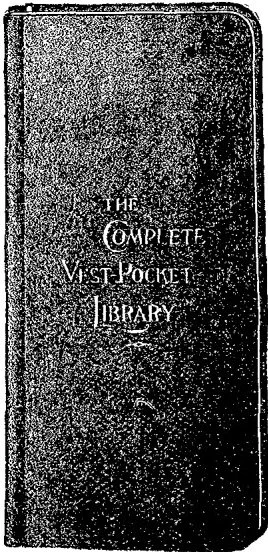
THE COMPLETE VEST-POCKET LIBRARY
STANDS PRE-EMINENT,
In that while it is no larger than the average of such books, and of convenient size to carry in the vest-pocket, it gives, besides other useful information, THE CORRECT SPELLING AND PRONUNCIATION OF 45,863 WORDS, OR ABOUT TWICE AS MANY AS ANY SIMILAR WORK.
As its name indicates, it is much more than a dictionary. It contains:—
THE COLUMBIAN WORD BUILDER, a very simple and yet exceedingly useful device which more than doubles the capacity of the dictionary.
GUIDE TO PRONUNCIATION.
A VERY FULL LIST OF ABBREVIATIONS.
THE COLUMBIAN PRONOUNCING DICTIONARY AND SPELLER (135 pages).
THE COLUMBIAN PRONOUNCING AND STATISTICAL GAZETTEER OF THE WORLD.
THE COLUMBIAN DIGEST OF PARLIAMENTARY PRACTICE.
THE COLUMBIAN RAPID CALCULATOR, AND COMPEND OF BUSINESS AND SOCIAL FORMS.
THE COLUMBIAN PERPETUAL MEMORANDUM, STAMP BOOK AND THREE YEARS' Calendar.
TABLES OF WEIGHTS AND MEASURES.
The whole forms a book only 5⅝ by 2¾ inches and only three-eighths of an inch thick.